
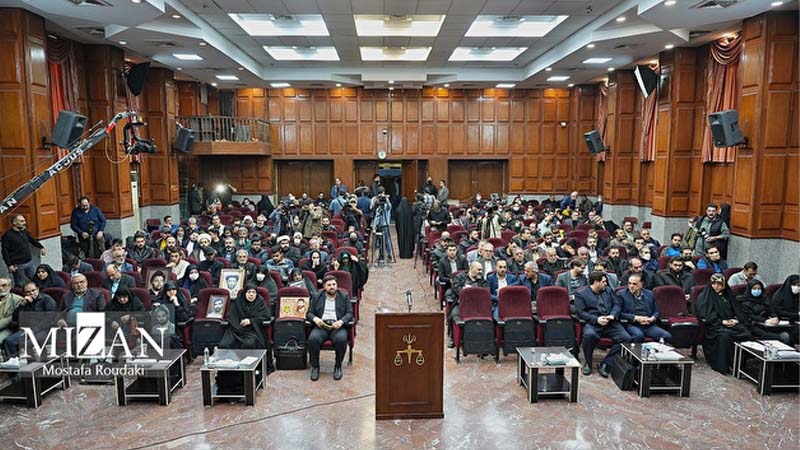
The 40th court session examining the charges against 104 members of the Mujahedin-e Khalq (MEK) as well as the organization’s nature as a legal entity, was held on October 7th, in branch 11 of the Criminal Court of Tehran Province, presided over by Judge Amir Reza Dehghani.
In this court, the plaintiffs’ lawyer said: The scale of the crimes committed by members of the organization cannot be described in a few documents, whether it is the young people who fell into the trap of the MEK or the parents who lost their children as a result of the MEK’s terror acts.
Maddah continued, “One of the crimes they committed was Operation Chelcheragh, a military operation carried out by members of the MEK on June 18, 1988.”
He said, “The goal of this operation was to capture the border city of Mehran, 100 kilometers from Ilam. After capturing the city of Mehran, members of the group looted the city, killed more than 8,000 Iranians, and took 1,500 people as hostage.
The lawyer said that the MEK calls its force as National Liberation Army. “Which liberation army in the world would storm a hospital and assassinate people from two-year-old children to young people, men and women?” he added. “A liberation army is supported by the people based on international law, while the MEK assassinated ordinary people.”
According to Maddah, intimidating, killing civilians, having illegitimate goals, lack of public support, and violence and resorting to force are among the most important definitions of terrorism in international law.
He said, “Liberation organizations in international law have special characteristics that distinguish them from terrorist groups. These organizations usually move towards their goals by observing the rules of war and international law and use legitimate means to achieve their goals, not by war crimes such as shooting and executing innocent people.”
The plaintiffs’ lawyer added, “The liberation armies are internationally recognized and supported by international institutions. In contrast, the MEK was recognized as a terrorist group in many countries, including the United States and Europe.”
Maddah notified that the MEK’s army stole a large amount of military equipment and tools that were to be used against the Iraqi Baath regime, in Operation Chelcheragh. The group even mentioned this issue in its newspaper, Mujahed.
“Since this action was a widespread act against national security and territorial integrity, the crime can be an example of corruption on earth,” he suggested. “Also, since they used weapons against people and created fear and insecurity, this crime can also be an example of war.”
The lawyer, on behalf of his clients asked the judge to take action to attribute the crimes of corruption on earth and war to all the leaders of the MEK who are among the defendants in the case and to issue sentences for them commensurate with these crimes.
A number of former members of the MEK including Ali Ekrami and Iraj Salehi also attended the 40th court in order to testify about what they witnessed in Chelcheragh.
Families of victims of Operation Chelcheragh took the stand and asked the court to bring MEK leaders to justice. The son of Asad Soltani, the sister of Salem Alipour and the brother of Mohammadi demanded revenge for the blood of their beloved ones who were killed on June 18, 1988 in the Mehran-Dehloran region.
At the end of the hearing, the judge announced that the next hearing would be held on October 21.
