
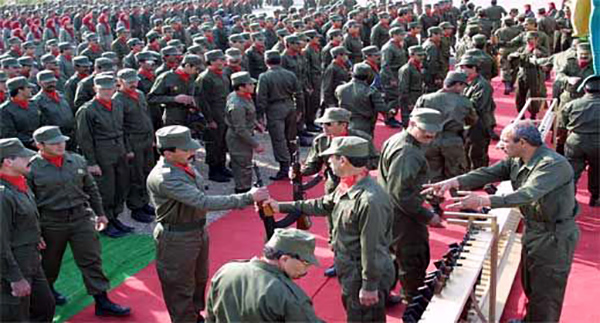
While the Mujahedin-e Khalg (MEK) has been widely attempting to rebrand itself, particularly through extensive lobbying efforts and propaganda campaigns, the historical record of its actions, including its past designation as a terrorist organization by several states and its controversial internal structure, continues to be a significant impediment to a full image rehabilitation.
The group’s violent attacks against Iranian civilians and authorities, its past alliance with Saddam Hussein during the Iran-Iraq war and reports on human rights abuses within its own ranks, are frequently cited by critics and remain a major obstacle to gaining widespread legitimacy inside and outside Iran.
In December 2025, the primary activities of the MEK, in the West have focused on propaganda, cyber operations, political lobbying, and human rights campaigns. The group is active online from its base in Albania and via its political wing, the National Council of Resistance of Iran (NCRI), with specific recent reports of continued activity in Western countries.
Key activities of the MEK in the last weeks of 2025 include:
Online and Propaganda Activities: A significant portion of MEK activity involves round-the-clock online operations from locations like Camp Ashraf 3 in Albania. These activities, often utilizing fake accounts on platforms like X (Twitter) and Facebook, are designed to cleanse the group’s image, spread anti-Iranian government disinformation, and artificially amplify their popularity using hashtags such as #FreeIran and #IranProtests.
Political Lobbying and Media Influence: The NCRI continues to engage in lobbying efforts in Western political circles, particularly in the US and Europe. This involves leveraging connections with Western politicians paying them hefty sums to speak at events and advocate for their cause. Maryam Rajavi, the group’s propaganda figure has frequently showed up in the rented halls of Western governments. The goal is to position the MEK/NCRI as a viable, democratic alternative to the current Iranian government.
Human Rights Campaigns together with violent pratiques: The organization and its supporters have claimed to be involved in campaigns focusing on human rights in Iran. The pratiques of the MEK’s so-called “resistance units” were focused on human rights slogans. However, violent actions like burning governmental buildings are very typical pratiques of the so-called units.
The MEK’s strategy of downplaying or cleansing its violent past and the activities of its Western lobbies widely circulated on its current media output is a clear attempt to present a more palatable image to international audience. However, this selective presentation does not erase extensive documentation and testimonies regarding its history. For example, reports from international bodies like Human Rights Watch and various academic studies have detailed the MEK’s cult-like characteristics, including enforced celibacy isolation from the outside world and a severe psychological manipulation of its members.
Furthermore, despite being removed from the US State Department list of foreign terrorist Organizations in September 2012, and similar delistings in European Union, the reasons for these removals were often cited as political expediency rather than a fundamental change in the group’s nature or a full exoneration of its past actions.
Critics argue that the MEK’s substantial financial resources, often attributed to donations and lobbying and speaking fees, enable its sophisticated propaganda machine, but this does not fundamentally alter the perception of its historical trajectory.
The group’s continued existence as a highly centralized and secretive organization, with an enormous background of violence, and an unchanged leadership for decades, further fuels skepticism about its genuine transformation into a democratic political entity.
Mazda Parsi
