Nejat Society
  • Home
  • Articles
  • Media
    • Cartoons
    • NewsPics
    • Photo Gallery
    • Videos
  • Publications
    • Books
    • Nejat NewsLetter
    • Pars Brief
  • About Us
  • Contact us
  • Editions
    • عربي
    • فارسی
    • Shqip
Nejat Society
Nejat Society
  • Home
  • Articles
  • Media
    • Cartoons
    • NewsPics
    • Photo Gallery
    • Videos
  • Publications
    • Books
    • Nejat NewsLetter
    • Pars Brief
  • About Us
  • Contact us
  • Editions
    • عربي
    • فارسی
    • Shqip
© 2003 - 2024 NEJAT Society. nejatngo.org
Borrell and Assadi
European Union

Iranian diplomat was set up using a demented woman and her small cult

The European Union is a peculiar construct. The idea behind its establishment was to — by jam-packing different political and economic units into one giant entity — create a powerhouse that is politically and economically uniform and competitive. But the result has been an unwieldy structure that struggles to impose unity on its components on matters of internal and external policy and that is submissive to traditional power players, including those inside the Union itself.
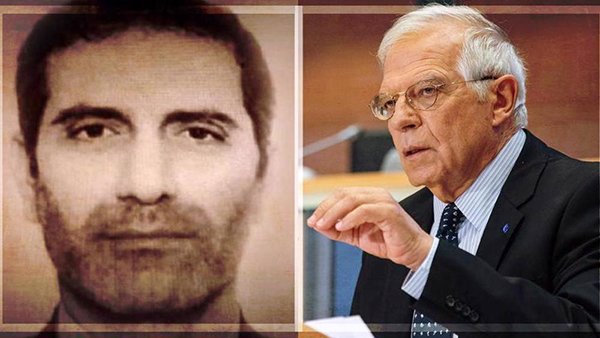
Borrell and Assadi

Germany and France, among the world’s top 10 economies, seem to lay an outsized claim to authority as political and economic decision-makers in the EU, even though the bloc has appointed senior representatives for policymaking. All the while, poorer, outlying members differ on policy and budget assignment.

That disequilibrium has been on display in the EU’s approach toward Iran, too. While the Union’s high representative for foreign policy seems to be in favor of sound diplomacy with Iran, individual member states, mostly the more powerful ones, have been singing their own tune.

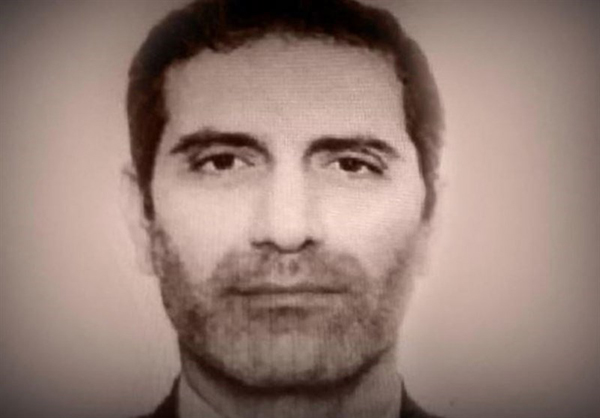
The latest instance is the case of an Iranian diplomat who has been accused of involvement in an alleged bomb plot in Europe. Diplomat Assadollah Assadi, posted originally to EU member Austria, was arrested in EU member Germany in 2018 and was moved to EU member Belgium, where authorities claimed they had intercepted him communicating with alleged suspects planning to bomb a gathering of anti-Iran cultists in France, also an EU member.

Those countries are using their membership in the Union to easily have Mr. Assadi arrested in one member state and move and try him in another, but are conveniently refusing to acknowledge his diplomatic immunity on the grounds that it applies only to one member state, namely Austria. Essentially, they are being EU members when prosecuting Mr. Assadi but unconnected individual units when it comes to acknowledging his immunity.

That duplicitous behavior is confounded when juxtaposed with the position of the Union’s top representative for foreign and security policy, Josep Borrell, who has said he seeks “maximum diplomacy” with Iran.

I asked Belgian Ambassador to Tehran Véronique Petit to comment on the apparent confliction of positions for this article. She declined via the Belgian Embassy on the grounds that it is a “judicial case,” even though the matter is political and she represents all branches of the Kingdom of Belgium in Iran.

Iran’s Foreign Ministry says the unlawful jail term issued in Belgium against an Iranian diplomat is a clear violation of the 1961 Vienna Convention on Diplomatic Relations.

It is worth noting that the accusation against Mr. Assadi is that he was involved in a bomb plot against an anti-Iran group known as the MKO, or more commonly the MEK, a small cult of deranged individuals who have spent most of their lives confined to camps wishing to topple the Iranian government. Their leader, a demented woman who teaches celibacy and armed opposition to Iran, views herself as Iran’s president-in-waiting. The Israeli regime is known to have tapped healthier MKO members to conduct terror attacks inside Iran.

Of course Iran has rejected the accusation against Mr. Assadi and demanded his swift release. (The international convention protecting his diplomatic immunity is, ironically, named after the capital of the European country where he was posted to.) His prosecution comes at a time when there are hopes the parties to the Iran deal could move to revive the agreement in light of the change of administration in the United States. When Mr. Borrell advocated “maxim diplomacy” with Iran, he said it should replace the former Trump administration’s “maximum pressure” campaign against the country.

That is a long way from happening. But Mr. Borrell has seemed eager to work to that end. He has already traveled to Russia and China, the two parties to the deal that are not Western-aligned. Crucially though, the simple question is: who is he speaking for when he speaks of “maximum diplomacy” with Iran while Union members are holding an Iranian diplomat?

The Union may justify by saying it cannot impose policy on individual members, which would take us back to the inherent absurdity at the heart of the EU. If Union members can do something that is contrary to stated Union policy, how can they exist as a union?! The EU can either want to pursue “maximum diplomacy” with Iran or hold an Iranian diplomat hostage. It cannot do both at the same time.

By Hossein Jelveh

(Hossein Jelveh is an independent Iranian journalist based in Tehran. He has graduated with a master’s degree from the Faculty of World Studies at the University of Tehran. You can follow him on Twitter @hossein_jelveh.)

(The views expressed in this article do not necessarily reflect those of Press TV.)

February 20, 2021 0 comments
FacebookTwitterPinterestWhatsappTelegramSkypeEmail
MEK Cult
The cult of Rajavi

How can the MEK grow so many agents for the Islamic Republic?

In the language of espionage, agent is a person who is unofficially employed by an intelligence service, often as a source of information. However, in the language of the Mujahedin Khalq Organization (the MKO/ MEK/ PMOI/ Cult of Rajavi), agent is a person who defects the group, criticizes the group and gives testimony against it.

Since the MEK’s relocation in Albania the number of defectors from the group has been on the rise and eventually the number of people who have been accused by the MEK of being the agents of the Iranian government have been on the rise too.

MEK in Albania

View of some members of the Iranian opposition resistance Mujahedeen-e- Khalq group, who have resettled in Albania from Iraq, in a street, in Tirana, Albania, Friday, May 17, 2013.

A look at the group’s media in different languages, particularly their Persian and English websites provides us with a long list of individuals who are called by the MEK, or its political vitrine the NCRI (National Council of Resistance of Iran), as”Tehran operatives”or”agents of Iranian regime”. How come that there are allegedly so many Iranian agents in Albanian territory?

The so-called list contains a range of people who have one thing in common: they all have been interviewed or quoted in the mainstream media, from Massoud Khodabandeh and his wife Ann Singleton who left the group in the 1990s when it was located in Iraq to Hassan Heyrani and Gholam Mirzaiee who left the group after its relocation to Albania, , a few years ago. Normally, those who defected the MEK in Albania are more likely to be contacted by the Western main stream media compared with those who left the group in Iraq or those who returned to Iran after defection.

What do these people tell the media that once they leave the group? they turn from”The unique holy fighter”–what the MEK calls its members—to”Agents of the Mullahs”–what it calls its defectors?

Hasan Heyrani

Hasan Heyrani, MKO former member in Tirana

Hassan Heyrani was quoted by the Guardian in November 2018:
“According to one recent MEK defector, Hassan Heyrani, the group’s main work in Albania involves fighting online in an escalating information war between Iran and its rivals. Heyrani, who left the MEK last summer, says that he worked in a”troll farm”of 1,000 people inside the Albanian camp, posting pro-Rajavi and anti-Iran propaganda in English, Farsi and Arabic on Facebook, Twitter, Telegram and newspaper comment sections.”

He was also quoted in the famous revealing article of the Intercept by Murteza Hussain on the MEK’s fake persona”Heshmat Alavi”:
“There’s a problem, though: Heshmat Alavi appears not to exist. Alavi’s persona is a propaganda operation run by the Iranian opposition group Mojahedin-e-Khalq, which is known by the initials MEK, two sources told The Intercept…”Heshmat Alavi is a persona run by a team of people from the political wing of the MEK,”Hassan Heyrani told the Intercept.”They write whatever they are directed by their commanders and use this name to place articles in the press. This is not and has never been a real person.”
The Intercept article adds:

“Heyrani said the fake persona has been managed by a team of MEK operatives in Albania, where the group has one of its bases, and is used to spread its message online. Heyrani’s account is echoed by Sara Zahiri, a Farsi-language researcher who focuses on the MEK. Zahiri, who has sources among Iranian government cybersecurity officials, said that Alavi is known inside Iran to be a”group account”run by a team of MEK members and that Alavi himself does not exist.”

https://dlb.nejatngo.org/Media/Report/Aljazeera_Alavi_MEK.mp4

to download the video file click here

Hassan Heyrani was interviewed by a lot of other journalists including Linda Pressly and Albana Kasapi of the BBC. In their radio report, titled”Albanian’s Iranian guests”, Kasapi and Pressly interview the citizens of Albania neighboring the MEK camp, the Albanian politicians and the defectors of the group. They were not allowed to interview the members inside the camp.

The MEK media called the report”BBC’s propaganda against the resistance”and called Hassan Heyrani and Gholam Mirzaiee, the two defectors interviewed in the report as”agents of the Mullahs’ embassy”.

Gholamreza Shekari is another former member of the MEK who, according to the group, turned into a”spy”as soon as he left the group. The MEK website claims that they are not real defectors but they just play the role of former members!”The MOIS is organizing its mercenaries through two defectors, Hassan Heyrani and Gholamreza Shekari, who are posing as ‘former members’ or ‘separated members’ of the MEK”, the so-called National Council of Resistance asserts.

Gholamreza Shekari

Gholamreza Shekari; Tirana; Der Spiegel

Shekari was interviewed by Luisa Hommerich of Der Spiegel in February 2019.”Gholamreza Shekari, a slender 50-year-old man with bony cheeks, says he spent 27 years as a member of the People’s Mujahedin,”Hommerich writes.
How did Shekari spend 27 years of his youth days in the MEK just to defect the group in order to pose as former member and separated member?

“The organization’s public face is liberal”, Shekari told Hommerich.”Internally, though, it works by way of lies, manipulation and fear.”This statement seems to be the main reason that he is labeled as a Tehran operative.
What goes inside the MEK camp is the main idea of all testimonies made by former members. Indeed, the controversies between what former members say and what the MEK leaders show off are stimulating for all journalists to follow their curiosity in order to discover true facts.

The number of reports and articles based on testimonies of former members are increasingly going up and therefore the number of the alleged Iranian agents who work against the MEK are getting higher. Each former member of the group who officially declares its defection from the group is added to list of the agents.

The MEK leaders have to explain their leadership methods that are so ineffective that not only would make members leave the group but also make them agents of the enemy’s agenda!

By Mazda Parsi

February 18, 2021 0 comments
FacebookTwitterPinterestWhatsappTelegramSkypeEmail
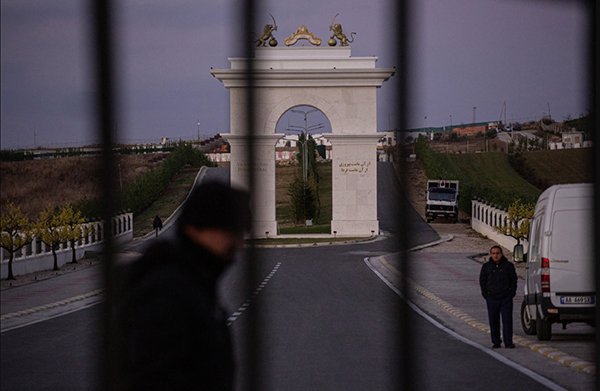
NYT photo of the Ashraf3 CAmp of MEK in Tirana
Mujahedin Khalq Organization members' families

Everywhere prisoners are allowed family visit, why not in the MEK?

Ms. Zahra Shahbaz Mansouri, daughter of Reza Shahbaz Mansouri, based in the Mojahedin-e Khalq (MEK) Camp in Albania, wrote a letter to the World Health Organization (WHO) in Albania expressing concern about her father’s health and calling for an investigation.

NYT photo of the Ashraf3 CAmp of MEK in Tirana

The text of the letter is as follows:

Representative of the WHO in Albania

Greetings and best regards,

I am Zahra Shahbaz Mansouri, daughter of Reza Shahbaz Mansouri.
My father is currently in the MEK camp in Albania. He left Iran years ago to find a job and more income. We later found out that he was deceived by the elements of the MEK and transferred to Iraq.

In all these years, we have not met him or even heard his voice, and it is the ultimate wish of every child to be able to communicate with his father and be informed of his condition.

You know that even in the most dreadful prisons in the world, and in the case of the most dangerous prisoners, families are allowed to contact the prisoner. But we are also deprived of this minimum possibility of meeting.
Who can help us deprived families? To which international body should we take our grievances to support us? Does anyone in the world pay attention to our rights?

Most importantly, my father has the infection of Covid-19 virus at the MEK camp in Albania and he is in critical condition. The sanitary facilities inside the camp are not so good due to the closed group life and many deaths have been reported so far.

I desperately ask you not to neglect any action that can be taken to alleviate my family’s worries.please help us get news of my father conditions and be allowed to contact him.

Surely you know a child’s worries about his father when he is sick. Please understand how we must be feeling and do not hesitate to pursue this issue.

Thanks and best regards,
Zahra Shahbaz Mansouri
Mashhad, Iran

Copy to:
Office of the Prime Minister of Albania
Office of the United Nations High Commissioner for Human Rights

February 17, 2021 0 comments
FacebookTwitterPinterestWhatsappTelegramSkypeEmail
Mostafa Nurishad
Mujahedin Khalq Organization members' families

On my brother’s abduction or disappearance

Working Group on Enforced or Involuntary Disappearances (WGEID)
Office of the United Nations High Commissioner for Human Rights

Greetings and best regards,
Regarding my brother Mustafa Nourishad, son of Morteza, I Mojtaba Nourishad lodged a complaint against the Albanian government with the UN Committee on Enforced Disappearances under the UN International Convention for the Protection of All Persons from Enforced Disappearance, of which the Albanian government is a signatory.

After a long time, I was given forms that I filled out and sent along with the required additional documents.
I then received a reply that the subject of my complaint had been referred to the UN Working Group on Enforced or Involuntary Disappearances (WGEID) for further investigation, and they concluded that there was insufficient reason for the Albanian government to be responsible for my brother’s abduction or disappearance.
According to the following information:

The identity of the person forcibly disappeared: Mustafa Nourishad, son of Morteza

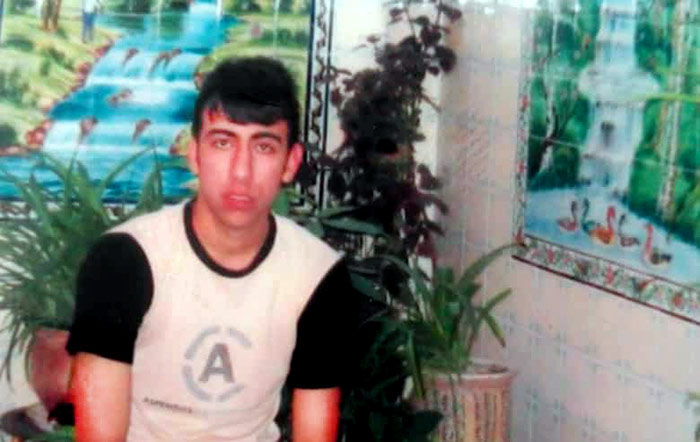
Mostafa Nurishad

Mostafa Nurishad

When he disappeared: About 15 years ago, when he was 19 and a university student, he left home and there was no news of him. An advertisement was published in the newspaper at the time for his disappearance. After years of ignorance, it became known through some former members that he was in Camp Ashraf in Iraq in the Mojahedin-e Khalq Organization (MEK, MKO), with whom it was not possible to have any contact.

After the fall of Saddam Hussein, we were able to travel to Iraq and approach Camp Ashraf, but the officials of the organization did not cooperate. In Iraq, we also went to the UN office, which did not help and they did not help either. We were then informed that the organization, along with all its members, had been transferred to Albania and had been stationed in a remote and isolated camp with no contact with its members.

Where he disappeared: He first disappeared in Iran, but we later learned that he had been tricked into Iraq and joined the MEK, and then transferred to Albania with this organization.

Country responsible for his disappearance: Certainly, based on the evidence obtained, the MEK is responsible for his disappearance, which is now fully supported by the Albanian government. It should be noted that according to the UN Convention, governments supporting organizations responsible for a person’s disappearance should be questioned.

Complainant’s identity and relationship: Mojtaba Nourishad, brother of the missing person

It is necessary to emphasize a few points:
Since we received information that Mustafa Nourishad is in the MEK camp in Albania, we and hundreds of other families have sent numerous letters to various officials in the country, including Prime Minister Edi Rama, who is also the acting Minister of Foreign Affairs, but did not receive any response.

The families of the MEK members prepared a 550-page petition addressed to the Albanian authorities with more than 11,000 signatures and submitted it to the Albanian embassy in Paris, requesting an opportunity to find out about their missing loved ones, to which no response has been received so far from the Albanian government.

We and other families tried to obtain Albanian visas to travel to Albania and seek information from our missing loved ones through local authorities, but unfortunately we learned that the Albanian government has gone so far to support the MEK that at the request of this organization, it refuses to issue visas to Iranian citizens.

Therefore, as a last resort and reference, we complained to the UN Committee on Enforced Disappearances. It should be noted that our complaint is not against the MEK, but against the Albanian government, which supports this organization and leaves them openhanded to forcibly keep our loved ones in captivity.

Hundreds of families in Iran and in other countries are in a similar situation to us, and the United Nations should step in and ask the Albanian government, which is currently in charge of the MEK, to allow us to communicate with our missing loved ones in Albania. Therefore, I request that our complaint be re-examined and the information provided be taken into account.

Thanks in advance and I look forward to your response.
Mojtaba Nourishad
Karaj – Alborz Province – Iran

February 15, 2021 0 comments
FacebookTwitterPinterestWhatsappTelegramSkypeEmail
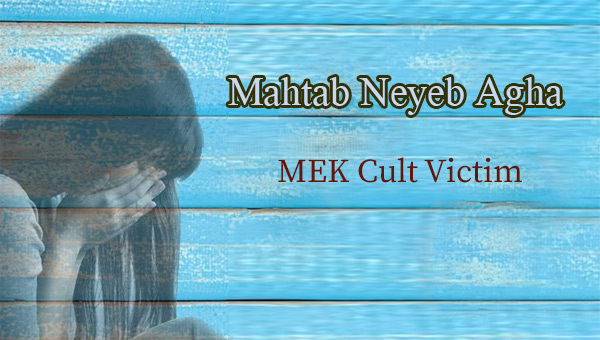
Mahtab Nayebagha
The cult of Rajavi

MEK and Children – Mahtab Nayeb Agha

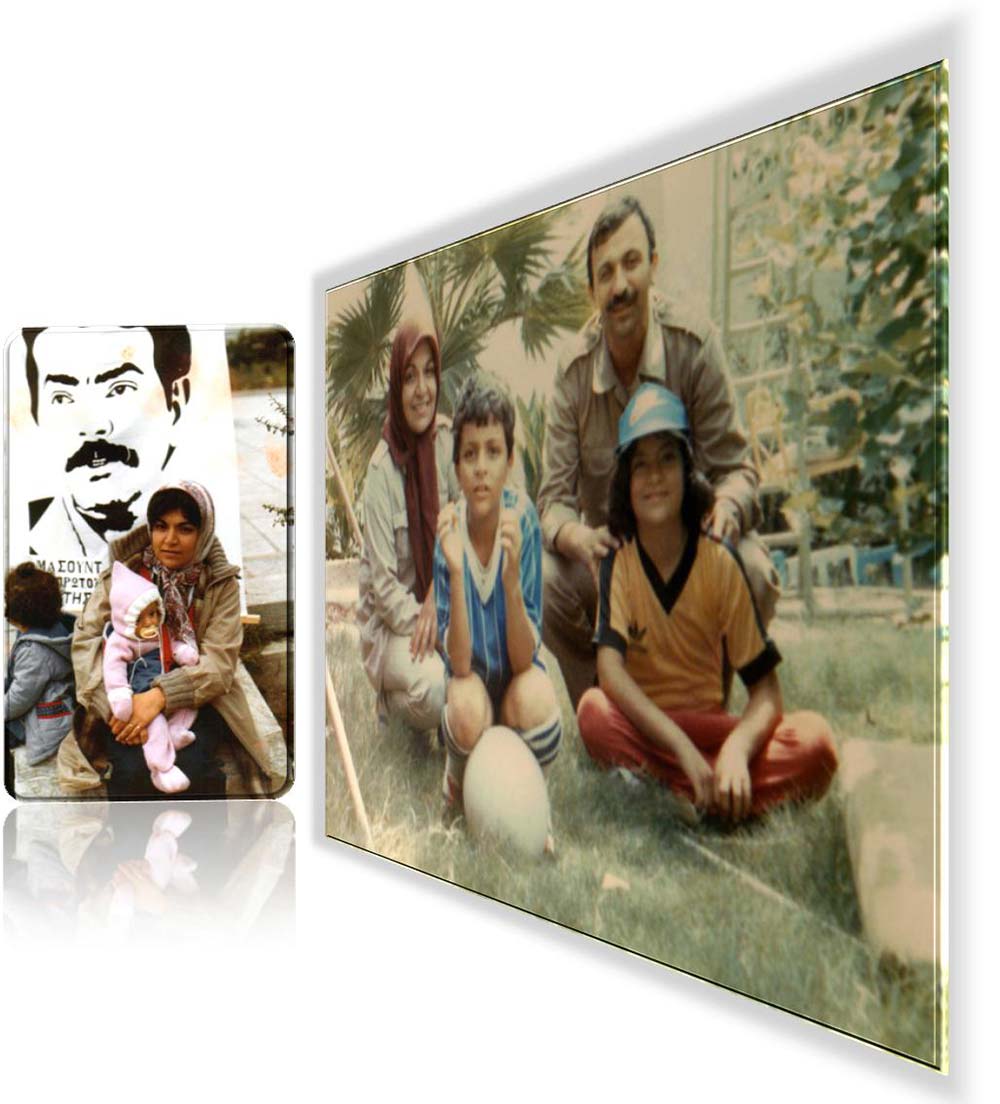
She was born in Saint Diego, the US, in 1980. Her father Hassan Nayeb Agha and her mother Mitra Yusefi were sympathizers of the Mujahedin Khalq Organization (the MKO, MEK, PMOI, Cult of Rajavi). Then, the parents took Mahtab and her brother Shahab to Camp Ashraf, Iraq to join the MEK.

It was difficult or almost impossible to live a family life in Camp Ashraf. Members of the families lived in separated bases and they were just allowed to meet each other in the weekends. In one of these family visits, the eight-year-old Mahtab was asked by her mother if she is happy with that life style. “Soon her shiny eyes became teary and she wanted to hide it,” her mother Mitra writes in her book.

Mahtab Nayebagha

Mitra recalls the day that Mahtab was hospitalized in the camp’s clinic because of an illness. “The girl asks mommy will you stay with me or you go?” Mitra writes. “I replied: Oh, honey! of course I stay. Trying to make her understand our relationship, I said: I am you mother.”

However, the life in the organization distresses Mahtab with sadness and grieves of other children; she has friends who have lost their parents in the group’s operations. Now, they have “fake mothers” whom they do not love, as Mahtab tells her mother who replaces the term with “ideological mother” in the book.

In 1990, Mahtab and her brother were separated from their parents and were sent to Europe together with hundreds of other MEK children. Mahtab and Shahab were adopted by a couple, Soheila and farhad, who were friends of their parents, in Sweden.

Mitra Yusefi

After the MEK leaders forced members to divorce Mitra started conflicting the leaders and asked to leave the group. It took her a year to leave Iraq and join her children in Sweden, in 1991. She began to write the book of her life experience of which a large part is about the complications and the troubles the MEK imposed on her and her family.

In page 314 of the dairy book, Mitra Yusefi writes about the nightmares that Mahtab suffered from as the consequence of the years of separation from parents and loneliness. “Mahtab sometimes get angry and cries about the stress she suffered during those years,” she writes.

In Mahtab’s nightmares, everyone has left Iraq except her who has been left there alone. Besides, somewhere in the book Mitra cites Mahtab as saying “I dreamed that you had to leave us to get back to Iraq”.

The mother, Mitra, tried her best to convince her husband, Mahtab’s father, Hassan, to leave the MEK and join his family in Sweden but she failed. The only result of her efforts was that the MEK media call her the agent of the Islamic Republic. Hassan is still a commander of the MEK and is not allowed to contact his family.

“I wish she was wise enough to choose another life, an accessible life,” Mitra writes about Hassan and grieves of Mahtab and Shahab in the absence of their father. “I wish he preferred a normal life that would not impose that much suffering and pain on his children.”

February 14, 2021 0 comments
FacebookTwitterPinterestWhatsappTelegramSkypeEmail
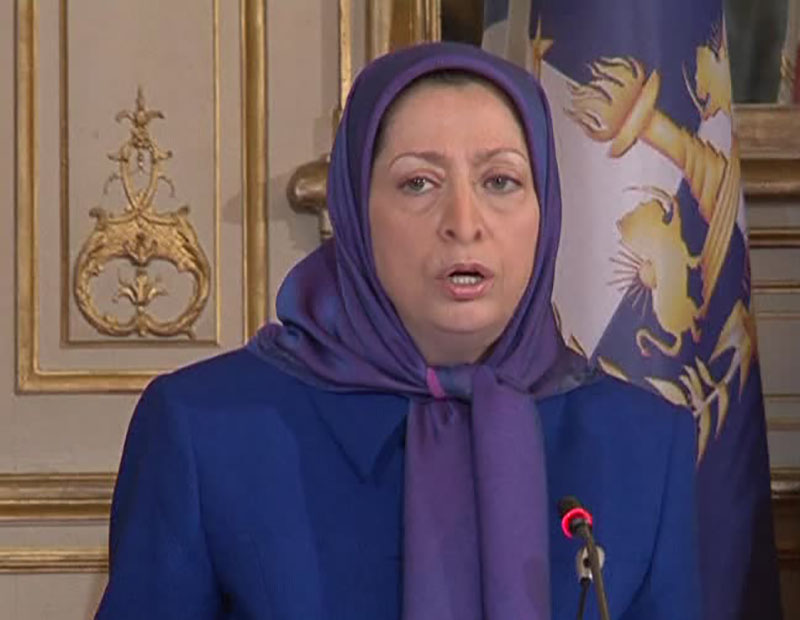
Maryam Rajavi
Mujahedin Khalq; A proxy force

MEK terrorists against diplomacy

Tehran has summoned the Belgian ambassador to protest the 20-year jail term handed down by an Antwerp court against an Iranian diplomat on baseless charge, stressing that the Islamic Republic does not recognize the ruling, which violates international law.

The Belgian envoy was called in to the Iranian Foreign Ministry on Tuesday to file Tehran’s “strong representations” with Brussels over the unlawful verdict issued in the case of Assadollah Assadi.

At the meeting, the Foreign Ministry’s director-general for Western Europe slammed the ruling as a violation of international law, which disregards Belgium’s commitments to the Islamic Republic.

Earlier this month, a court in the Belgian city of Antwerp handed down the 20-year jail sentence to Assadi, claiming that he had plotted a supposed attack against a gathering of the Mujahedin-e-Khalq (MKO) anti-Iran terrorist cult in Paris in 2018.

Tehran has rejected the verdict and said it was a result of Belgium’s falling under the influence of the anti-Iran MKO terror group, which is freely active on Europe’s soil.

Assadi’s arrest, trial and sentencing is a breach of the 1961 Vienna Convention on Diplomatic Relations and thus lacks legitimacy, the official added.

The detention and the ensuing judicial process was in line with the plots hatched the Mujahedin-e-Khalq Organization (MKO) terrorist group with the goal of harming Iran-Europe relations.

He said even statements by certain Belgian authorities and the judicial process were clearly reflective of the terror outfit’s rhetoric.

https://dlb.nejatngo.org/Media/Documentary/Rajavi-Iraq-Fr-Alba.mp4

To download the video file click here

The Iranian official further asked the Brussels government to respect humanitarian rules in dealing with Assadi and swiftly free the diplomat.

In turn, the Belgian ambassador said he would submit Tehran’s note of protest to the government in Brussels.

Iran’s Foreign Ministry has slammed the “unlawful” jail term issued in Belgium against an Iranian diplomat as a “clear violation” of the 1961 Vienna Convention on Diplomatic Relations, saying Tehran is making all-out efforts to clear him of the charges and secure his release as soon as possible.

“Iran regards the arrest, the legal procedures and the verdict issued against Assadollah Assadi as unlawful and a blatant violation of international law, specifically the 1961 Vienna Convention on Diplomatic Relations,” the ministry’s Public Relations Department said in a statement on Tuesday.

The ministry said it had pursued all political, intelligence and legal channels to secure the freedom of the Iranian diplomat and has protested to the governments of Germany, Austria and Belgium over the illegal detention and holds them accountable for the repercussions of the arrest.

Assadollah Asadi

“The Foreign Ministry reserves its right to follow up on the issue through legal and diplomatic channels and, on this basis, [necessary] measures are being taken,” the statement said.

In June 2018, Belgian authorities said that the Belgian police had intercepted a car carrying homemade explosives and a detonation device, claiming that Assadi had handed the materials to two people in Belgium earlier.

Assadi, himself, was apprehended in Germany the next day and told he could not apply his diplomatic immunity.

Dimitri de Beco, the Iranian diplomat’s defense lawyer, said back then that the plaintiffs were turning the case into a political trial on behalf of the MKO, the most hated terror group in Iran.

The MKO has conducted many assassinations and bombings against Iranian officials and civilians since the 1979 Islamic Revolution. It notoriously sided with former Iraqi dictator Saddam Hussein during the 1980-88 war that he had imposed on Iran.

February 13, 2021 0 comments
FacebookTwitterPinterestWhatsappTelegramSkypeEmail
No trust on the MEK
Mujahedin Khalq Organization

Regime changers love to think Iran is always on the ‘brink of collapse’

February 11 marks the 42nd anniversary of the Iranian revolution of 1979, which ousted a despotic monarch and ushered in what many Iranians hoped would be the independence and freedom they had fought to attain for so long. These hopes were not fulfilled, however, and under the Islamic Republic, Iranians have had to continue their fight for freedom.

Their efforts have at times been undermined by outside pressure, driven by the false narrative propagated by opponents of diplomacy in the United States that the Islamic Republic is on the brink of collapse.

Despite the decades-long political struggle of Iranians — from the 1906 Constitutional Revolution, to the nationalist movement of Mossadegh in the 1950s and the various opposition groups that the Shah repressed in the 1960s and 70s — the world was still shocked by the overthrow of the monarchy. Less than 14 months before the revolution, President Carter infamously called Iran “an island of stability.” In retrospect, it seems, this was more the wishful thinking of people with a geopolitical stake in Iran’s future, than careful analysis of the reality in the country.

In the 42 years that have followed, commentators and analysts — often those with their own political motives — continue to fall for the same trap, conflating their own desire for the collapse of the Islamic Republic with the facts on the ground. If the lessons of 1979 teach us anything, it is that such lack of understanding should not inform American foreign policy decisions.

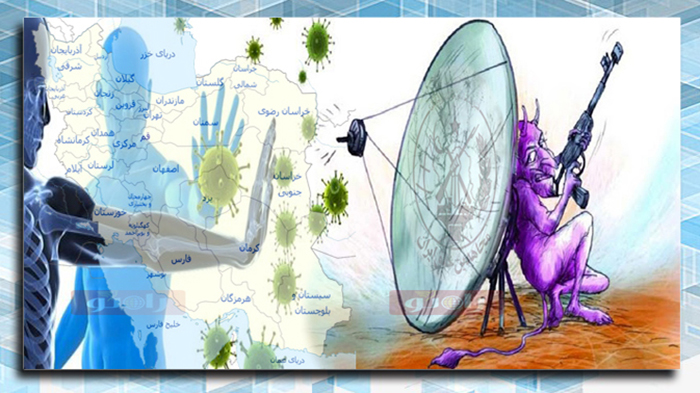
Corona virus

One of the most notable figures to lead this charge has been the eldest son of the fallen Shah, Reza Pahlavi, who declared himself the rightful king of Iran in October of 1980, three months after his father’s death. Mr. Pahlavi has made a name for himself among anti-Iran hawks and neocons in Washington for his persistent claim that the Islamic Republic is on the verge of collapse, an idea echoed by monarchist supporters in the Iranian diaspora.

Speaking to an audience at Georgetown University in 1989, Pahlavi stated, “I have no doubt that the Iranian people are taking the first steps to dispose of the Islamic Republic. Many Iranians now believe that the Khomeini regime has reached the end of its life.” 32 years after his confident assertion, the Islamic Republic still stands.
But the idea that the Islamic Republic is on its last legs is not an idea that can be attributed to Pahlavi alone.

Another dissident group — and formerly U.S. designated terrorist group — with a wildly different vision for Iran, the Mujahedeen-e-Khalq (MEK), has also promoted this narrative while appealing to U.S. officials to put pressure on the Islamic Republic. What both the MEK and diaspora monarchists have in common is their disconnect with Iranian people and society, which has evolved significantly over four decades. These groups often ignore the political movements and actors inside Iran, or the fact that millions of Iranians — encompassing the majority of the voting population — participate in Iran’s elections because the outcome impacts their daily lives.

In the case of dissident groups it is plain to see why they would promote the idea that the Islamic Republic is weak and close to falling. These groups have, in fact, for years helped prevent American diplomacy in favor of sanctions and military threats based on the premise that the regime is perpetually on the “verge of collapse” and diplomatic engagement would throw it a lifeline.

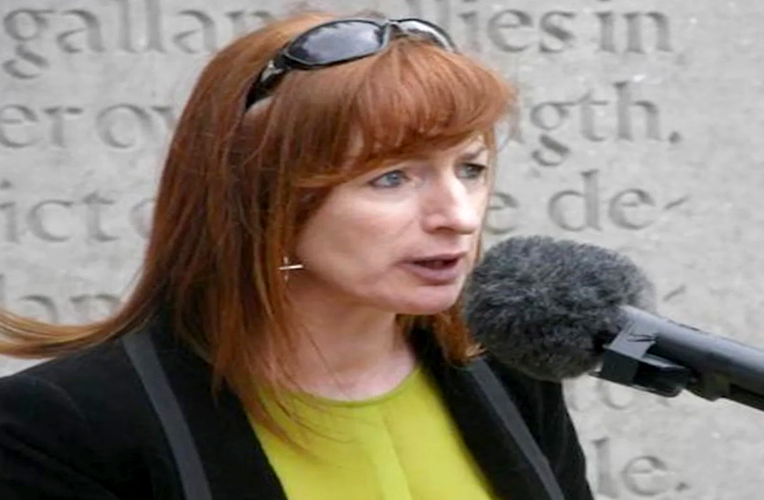
Clare Daly

In June 2019, when asked if the U.S. and Israel would have to intervene militarily in Iran, Reza Pahlavi went as far as saying, “if the proper pressure does not exist at this time to force this regime to collapse, then of course it would become unavoidable to consider other options.” All of this is to say that the narrative they espouse fits their own political objectives.

American foreign policy decisions, however, should not be based on the political agenda of any group, especially one that does not have the best interests of the U.S. and the American people in mind. In order to make informed policy decisions, we must separate ideological aspirations from facts on the ground. Despite four years of “maximum pressure” on Iran under the Trump administration, which included unprecedented sanctions, extrajudicial assassinations, sabotage, threats, and belligerent rhetoric, the Islamic Republic continues to stand — as it has done in the face of enormous pressure over several decades — and the domestic movement for human rights in Iran has been weakened. And while sanctions have brought unjust hardship to millions of ordinary Iranians, Iranian officials remain unscathed.

The narrative of imminent collapse has been part of the discourse on Iran since the revolution of 1979. But like the story of total stability before the revolution, this analysis appears to be driven more by the political interests of a few than an objective examination of the Islamic Republic’s internal security.

If we wish to grapple with the many issues the Iranian government poses, most notably the repression of its own people, we must do so with a strategy grounded in reality. Though anti-Iran hawks in Washington and some dissidents in the Iranian diaspora may be willing to go as far as war to collapse the Islamic Republic, that is certainly not the will or desire of the American people. After decades of failed pressure-only policies, the Obama administration achieved a historic détente with Iran. Now, with the total failure of Trump’s maximum pressure, it is time to try something new: maximum diplomacy.

Written by Assal Rad – Responsiblestatecraft.org

February 13, 2021 0 comments
FacebookTwitterPinterestWhatsappTelegramSkypeEmail
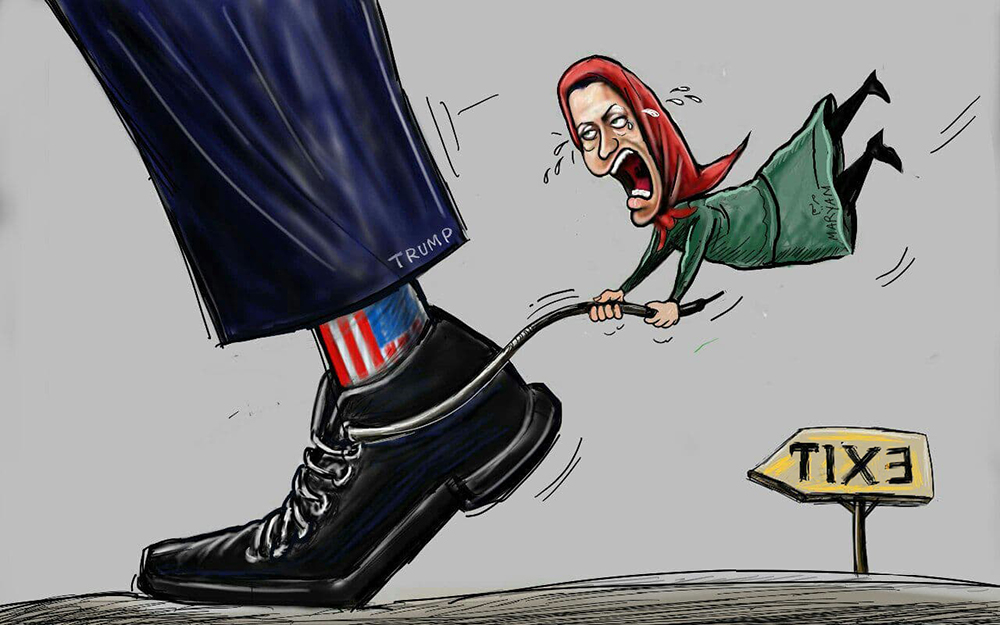
Rajavi and Trump
Mujahedin Khalq; A proxy force

The Mojahedin-e Khalq in Post-Trump period

led by Maryam Rajavi, the Organization (MKO) is going through a very difficult situation that can be called the post-Trump period. On the other hand, the Corona virus is killing the members of this group one after another, while the wishes of Maryam Rajavi, John Bolton and their former leader Donald Trump, to celebrate the overthrow of the Iranian government in Tehran’s Azadi Square have faded.

With rising of criticism and dissatisfaction among the MKO members concerning its leadership, a number of them have recently split from the group; an issue that has been admitted by the MKO ringleaders.

Rajavi and Trump

The group’s commander knows that the situation differs from what they experienced in in Iraq, where they were supported for many years by Saddam Hussein’s regime. They know very well that space is much freer in Albania, and they cannot control their members as easily as they did in Iraq. The issue of controlling the members who lived in this dark tunnel for 40 years and are now seeking freedom and exit has become a problem for Maryam Rajavi and her companions.

Therefore, the continuous contradictions and the gradual death that has overshadowed Rajavi’s group, has entered its final stage with the collapse of Trump. Maryam Rajavi is well aware that the policy of deception, lying and brainwashing, which were carried out by her missing husband and then by herself is no longer useful to persuade the members of the group to stay.

Rajavi sought to prevent separation of the group’s members by this deception that the government in Iran would be overthrown by entering of Trump to the White House. She had promised her members that this goal would be achieved if they used all their best. In the same way, Rajavi’s husband used to force the members to work eighteen hours a day in order to deprive them of the opportunity to think about their future.

At the end, nothing new was happened. The analysis and prediction of Maryam Rajavi and some of her American supporters was nothing but an illusion. For this reason, the leadership of this Iranian group has difficulty in convincing its members to stay. In the time of Saddam Hussein and with his support for Massoud Rajavi, members could be somehow controlled, but now it is very difficult for Rajavi to act in the heart of Europe, and to be able to deceive the members of the group as before.

By Ahmad Jafar Alsaedi – Translated by Habilian

February 13, 2021 0 comments
FacebookTwitterPinterestWhatsappTelegramSkypeEmail
Albania
Mujahedin Khalq Organization members' families

Why the Albania gov. do not give the MEK members’ families visa?

Mohammad Ebrahim Haddadi Moqaddam expressed concern about the health of his brother Mahmoud Haddadi Moqaddam

Mr. Mohammad Ebrahim Haddadi Moqaddam, brother of Mahmoud Haddadi Moqaddam, trapped in the MEK camp in Albania, wrote a letter to the World Health Organization in Albania expressing concern over his brother’s health.

World Health Organization

The text of the letter is as follows:

Representative of the World Health Organization in Albania
Greetings and best regards
I am Ebrahim Haddadi Moqaddam, brother of Mahmoud Haddadi Moqaddam. My brother is now in a closed, remote camp of Mojahedin-e Khalq (MEK) in Albania with no connections to the outside world.
It is needless to say that my family and I have not seen or heard from my brother for many years, and we have not even received a message from him, and this always bothers us.

Now the news worries us a lot, and that is that on the one hand my brother is probably infected with the Covid-19 virus and he is in a very severe condition, and on the other hand the health conditions inside the camp are extremely unfavorable.

We, the family of Mahmoud Haddadi Moqaddam, have no desire other than hearing his voice and learning about his health. Of course, Albania does not give us visas in support of the MEK and does not allow us to travel. The MEK does not even allow a single phone call to its members.

I urge you not to neglect any action that is conceivable and fruitful in order to alleviate the concerns of me and my family, so that news of my brother reaches us and communication is possible.

You must know very well how a brother feels in such a situation. Is it acceptable to prevent MEK members from communicating with their families in these circumstances? Isn’t this a clear violation of basic human rights?

Mohammad Ebrahim Haddadi Moqaddam
Torbat Heydariyeh – Khorasan Razavi – Iran

Copy to:
Office of the Prime Minister of Albania
Office of the United Nations High Commissioner for Human Rights

February 11, 2021 0 comments
FacebookTwitterPinterestWhatsappTelegramSkypeEmail
mek in labania and the coronavirus
Mujahedin Khalq Organization members' families

I am concerned over my son’s health conditions at MEK Camps

In a letter to the head of the WHO and the Albanian government, Mr. Motaleb Babaei Chamazkati expressed concern about his son Houshang Babaei Chamazkati, who was detained in the MEK camp in Albania, and asked him to contact his family.

mek in labania and the coronavirus

Honorable President of the World Health Organization
Greetings
I am Motaleb Babaei Chamazekti, the father of Houshang Babaei Chamazekti. My son has been a prisoner of the Mojahedin-e Khalq Organization (MEK, MKO) for more than thirty years and now lives in the organization’s camp in Albania.

I do not have any information about my son’s condition because the MEK does not allow my son to call his family and we are now unaware of his health.

This is a matter of great concern to me and my family, given the widespread wave of the Coronavirus in the MEK camp in Albania and the deaths of several people in recent weeks.

As the WHO Official I ask you as well as the Albanian government to intervene in the situation of the MEK camp in Albania, because this organization does not allow anyone to enter the camp, and this is very worrying. You are aware that the coronavirus can cause many casualties in closed environments and in public life, such as the MEK camp in Albania.

I would also ask you to enquire the officials of the MEK to allow my son to call his family so that after a few decades we can hear his voice and be informed of his health.

Thanks
Motaleb Babaei Chamazketi
Ghaemshahr – Mazandaran – Iran

February 9, 2021 0 comments
FacebookTwitterPinterestWhatsappTelegramSkypeEmail
Newer Posts
Older Posts

Recent Posts

  • Expectations of human rights bodies regarding censorship within the MEK

    October 13, 2026
  • The Jamalis’ Plea for Help: Save Our Brother from the MEK!

    October 11, 2026
  • Testimonies of Participants in the MEK’s Staged Propaganda Stunt in Karaj

    October 7, 2026
  • Giuliani’s MEK ties have dogged him for years

    October 6, 2026
  • The Tragic Impact of MEK Isolation on Yazdan Teimorian and His Family

    October 5, 2026
  • Facebook
  • Twitter
  • Instagram
  • Youtube

© 2003 - 2025 NEJAT Society . All Rights Reserved. NejatNGO.org


Back To Top
Nejat Society
  • Home
  • Articles
  • Media
    • Cartoons
    • NewsPics
    • Photo Gallery
    • Videos
  • Publications
    • Books
    • Nejat NewsLetter
    • Pars Brief
  • About Us
  • Contact us
  • Editions
    • عربي
    • فارسی
    • Shqip