Nejat Society
  • Home
  • Articles
  • Media
    • Cartoons
    • NewsPics
    • Photo Gallery
    • Videos
  • Publications
    • Books
    • Nejat NewsLetter
    • Pars Brief
  • About Us
  • Contact us
  • Editions
    • عربي
    • فارسی
    • Shqip
Nejat Society
Nejat Society
  • Home
  • Articles
  • Media
    • Cartoons
    • NewsPics
    • Photo Gallery
    • Videos
  • Publications
    • Books
    • Nejat NewsLetter
    • Pars Brief
  • About Us
  • Contact us
  • Editions
    • عربي
    • فارسی
    • Shqip
© 2003 - 2024 NEJAT Society. nejatngo.org
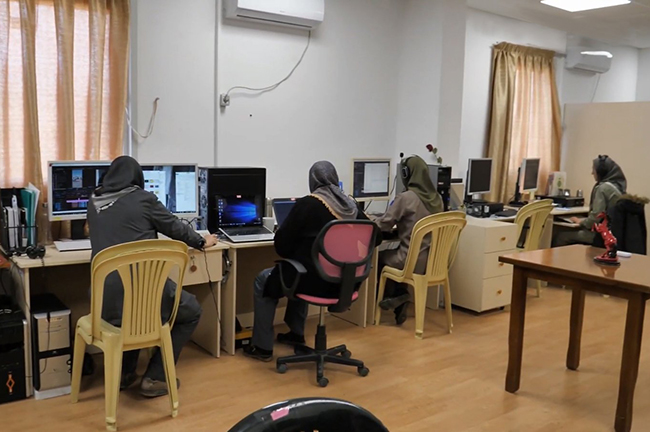
MEK troll farm in Albania
Mujahedin Khalq; A proxy force

Disinfo troll farms reason to Doubt US VER of Gulf-of-Oman Incident

7 Reasons to Doubt US Version of Gulf-of-Oman Incident

Given Pompeo’s regime-change agenda for Iran, Caitlin Johnstone pours cold water over his version of events.
In a move that surprised exactly zero people, Secretary of State Mike Pompeo has wasted no time scrambling to blame Iran for damage done to two sea vessels in the Gulf of Oman on Thursday, citing exactly zero evidence.

“This assessment is based on intelligence, the weapons used, the level of expertise needed to execute the operation, recent similar Iranian attacks on shipping, and the fact that no proxy group operating in the area has the resources and proficiency to act with such a high-degree of sophistication,” Pompeo told the press in a statement.

“The United States will defend its forces, interests, and stand with our partners and allies to safeguard global commerce and regional stability. And we call upon all nations threatened by Iran’s provocative acts to join us in that endeavor,” Pompeo concluded before hastily shambling off, taking exactly zero questions.
Here are seven reasons to be extremely skeptical of everything Pompeo said:
No. 1: Pompeo is a known liar, especially when it comes to Iran.
Pompeo has a well-established history of circulating blatant lies about Iran. He recently told an audience at Texas A&M University that when he was leading the CIA, “We lied, we cheated, we stole. We had entire training courses.”
No. 2: The US empire is known to use lies and false flags to start wars.
The U.S.-centralized power alliance has an extensive and well-documented history of advancing preexisting military agendas using lies, false flags and psyops to make targeted governments appear to be the aggressors. This is such a well-established pattern that “Gulf of Tonkin” briefly trended on Twitter after the Gulf of Oman incident. Any number of government agencies could have been involved from any number of the nations in this alliance, including the U.S., the U.K., Saudi Arabia, the UAE or Israel.
No. 3: John Bolton has openly endorsed lying to advance military agendas.
I wrote an article about this last month because the Trump administration had already begun rapidly escalating against Iran in ways that happen to align perfectly with the longtime agendas of Trump’s psychopathic Iran hawk National security adviser. At that time people were so aware of the possibility that Bolton might involve himself in staging yet another Middle Eastern war based on lies that The Onion was already spoofing it.
On a December 2010 episode of Fox News’ “Freedom Watch,” Bolton and the show’s host Andrew Napolitano were debating about recent WikiLeaks publications, and naturally the subject of government secrecy came up.
“Now I want to make the case for secrecy in government when it comes to the conduct of national security affairs, and possibly for deception where that’s appropriate,” Bolton said. “You know Winston Churchill said during World War Two that in wartime truth is so important it should be surrounded by a bodyguard of lies.”
“Do you really believe that?” asked an incredulous Napolitano.
“Absolutely,” Bolton replied.
“You would lie in order to preserve the truth?”
“If I had to say something I knew was false to protect American national security, I would do it,” Bolton answered.
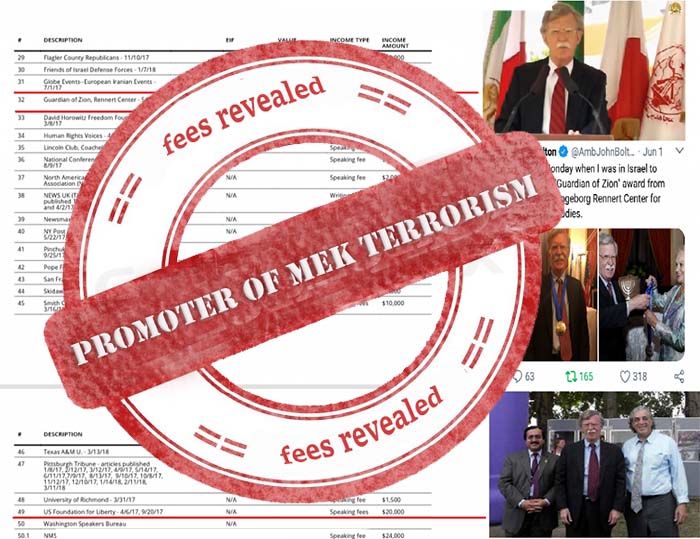
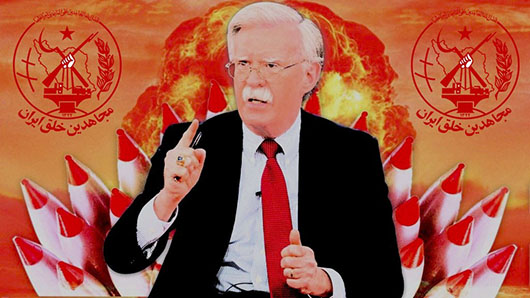
John Bolton – defender of Zion, promoter of MEK terrorism – fees revealed

This would be the same John Bolton who has been paid exorbitant speaking fees by the pro-regime change MEK terror cult, promising the cult in a 2017 speech that they’d be celebrating regime change in Tehran together before 2019. This would also be the same John Bolton who once threatened to murder an OPCW official’s children if he didn’t stop getting in the way of his Iraq war agenda.

No. 4: Using false flags to start a war with Iran is already an established idea in the DC swamp.

Back in 2012 at a forum for the Washington Institute of Near East Policy think tank, the group’s Director of Research Patrick Clawson openly talked about the possibility of using a false flag to provoke a war with Iran, citing the various ways the U.S. has done exactly that with its previous wars.
“I frankly think that crisis initiation is really tough, and it’s very hard for me to see how the United States president can get us to war with Iran,” Clawson began.
“Which leads me to conclude that if in fact compromise is not coming, that the traditional way that America gets to war is what would be best for U.S. interests,” Clawson added. “Some people might think that Mr. Roosevelt wanted to get us into the war… you may recall we had to wait for Pearl Harbor. Some people might think that Mr. Wilson wanted to get us into World War One; you may recall we had to wait for the Lusitania episode. Some people might think that Mr. Johnson wanted to get us into Vietnam; you may recall we had to wait for the Gulf of Tonkin episode. We didn’t go to war with Spain until the USS Maine exploded. And may I point out that Mr. Lincoln did not feel that he could call out the Army until Fort Sumter was attacked, which is why he ordered the commander at Fort Sumter to do exactly that thing which the South Carolinians said would cause an attack.”
“So if, in fact, the Iranians aren’t going to compromise, it would be best if somebody else started the war,” Clawson continued. “One can combine other means of pressure with sanctions. I mentioned that explosion on August 17th. We could step up the pressure. I mean look people, Iranian submarines periodically go down. Some day, one of them might not come up. Who would know why? [Smattering of sociopathic laughter from the crowd.] We can do a variety of things, if we wish to increase the pressure (I’m not advocating that) but I’m just suggesting that this is not an either/or proposition — just sanctions have to succeed or other things. We are in the game of using covert means against the Iranians. We could get nastier at that.”
No. 5: The US State Department has already been running psyops to manipulate the public Iran narrative.
State Department officials admitted to congressional staff at a closed-door meeting on Monday that a $1.5 million troll farm had gone “beyond the scope of its mandate” by aggressively smearing American critics of the Trump administration’s Iran policy as propagandists for the Iranian government, according to a new report from The Independent. That “mandate” had reportedly consisted of “countering propaganda from Iran,” also known as conducting anti-Iran propaganda.
“Critics in Washington have gone further, saying that the programme resembled the type of troll farms used by autocratic regimes abroad,” says The Independent.

“One woman behind the harassment campaign, a longtime Iranian-American activist, has received hundreds of thousands of dollars from the State Department over the years to promote ‘freedom of expression and free access to information,’” the report reads.

No. 6: The Gulf of Oman narrative makes no sense.
One of the ships damaged in the attacks was Japanese-owned, and the other was bound for Japan. This happened just as Japanese Prime Minister Shinzo Abe was in Tehran attempting to negotiate a de-escalation between the U.S. and Iran with Trump’s blessing, and just after Iran had released a prisoner accused of conducting espionage for the U.S. in what many took to be a gesture of good faith.
Iran has been conducting itself with remarkable restraint in the face of relentless sanctions and provocations from the U.S. and its allies. It wouldn’t make much sense for it to suddenly abandon that restraint with attacks on sea vessels, then rescue their crew, then deny perpetrating the attacks, during a time of diplomatic exchanges and while trying to preserve the nuclear deal with Europe. If Tehran did perpetrate the attacks in order to send a strong message to the Americans, it would have been a very mixed message sent in a very weird way with very odd timing.
No. 7: Even if Iran did perpetrate the attack, Pompeo would still be lying.
Pompeo’s statement uses the words “unprovoked” twice and “Iran’s provocative acts” once, explicitly claiming that the U.S. empire was just minding its own business leaving Iran alone when it was attacked out of the blue by a violent aggressor. Sometimes the things put out by the U.S. State Department feel like they’re conducting experiments on us, just to test the limits of our stupidity.
As noted in this article by Moon of Alabama and this discussion on the Ron Paul Liberty Report, the U.S. has been provoking Iran with extremely aggressive and steadily tightening sanctions, which means that even if Tehran is behind the attacks, it would not be the aggressor and the attacks would most certainly not have been “unprovoked.” Economic sanctions are an act of war; if China were to do to America’s economy what America is doing to Iran’s, the U.S. would be in a hot war with China immediately. It could technically be possible that Iran is pushing back on U.S. aggressions and provocations, albeit in a strange and neoconservatively convenient fashion.
Either way, we have seen exactly zero evidence supporting Pompeo’s claims, so anyone you see hastening to blame Iran for the Gulf of Oman incident is either a war whore or a slobbering moron, or both. Knowing what we know about the U.S.-centralized empire and its pre-existing regime change agenda against Iran, there is no reason to believe Pompeo and many reasons not to.
By Caitlin Johnstone, CaitlinJohnstone.com
June 15, 2019 0 comments
FacebookTwitterPinterestWhatsappTelegramSkypeEmail
US Warmonger Hawks
Mujahedin Khalq; A proxy force

From Trump-MEK Iran disinfo to Gulf of Tonkin incident

Backing Pompeo’s ‘Gulf of Tonkin’ incident is a massive anti-Iran online propaganda campaign

Twitter has announced that it is removing 4,779 accounts associated or backed by Tehran, the latest strike in the ongoing anti-Iran campaign perfectly timed to coincide with the attack on two oil tankers in the Gulf of Oman.
Secretary of State Mike Pompeo was already blaming Iran hours after the incident, offering not a shred of proof aside from a few other dubious incidents in the Middle East that the US has previously pinned on Iran, without evidence. Even the mainstream media has initially been reluctant to take his word for it, mostly because the narrative is so improbable. Japan’s PM Shinzo Abe was in Tehran, promising to use his”utmost effort”to de-escalate tensions, when as if on cue, a Japanese ship was hit along with a Norwegian vessel.
When even CNN is acknowledging that the attack”doesn’t appear to benefit any of the protagonists in the region,”and Bloomberg admits”Iran has little to gain”from blowing up the ship of its esteemed guest, Pompeo must realize another route of influence is required. Who better to call in for reinforcements than Twitter, which has demonstrated time and again its willingness to serve the US’ preferred narrative with mass deplatformings?

Some 4,779 accounts were removed for nothing more than tweeting”global news content, often with an angle that benefited the diplomatic and geostrategic views of the Iranian state.”This was deemed”platform manipulation,”and therefore unacceptable, the company declared in a blog post.

Just the tip of anti-Iran campaign iceberg?
Tweeting with an angle that benefits the diplomatic and geostrategic views of the American state, however, is just fine – at least, it wasn’t Twitter that brought the “Iran Disinformation Project”crashing to a halt earlier this week. The State Department shut down the social media campaign it created to”counter Iranian propaganda” after it supposedly went rogue, smearing any and all critics of Trump’s hawkish Iran policy as paid operatives of the Iranian government.
Human rights activists, students, journalists, academics, even insufficiently-militant American propagandists at RFE/RL, Voice of America and other US-funded outlets were attacked by @IranDisinfo – all on the US taxpayer’s dime.
Congress only learned of the project in a closed-door hearing on Monday, when the State Department confessed the troll campaign had taken $1.5 million in taxpayer money to attack those same taxpayers – all in the name of promoting”freedom of expression and free access to information.”
The group contracted to operate Iran Disinfo is run by an Iranian immigrant and claims to focus on strengthening”civil society”and”democracy”back home, though its work is almost exclusively US-focused and its connections with pro-war think tanks like the Foundation for Defense of Democracies have alarmed congressional staffers.
While the State Department was long barred from directing government-funded propaganda at its own citizens, that rule was quietly repealed in 2013 with the passage of the Smith-Mundt Modernization Act, which gave US government narrative-spinners free reign to run influence operations at home.
The Pentagon is also technically forbidden from running psychological operations (“psy-ops”) against American citizens, but that rule goes out the window in case of”domestic emergencies”– and the domestic emergency declared by then-President George W. Bush days after the September 11 terror attacks remains in effect, 18 years later.

Trump’s favorite Iran troll exposed?
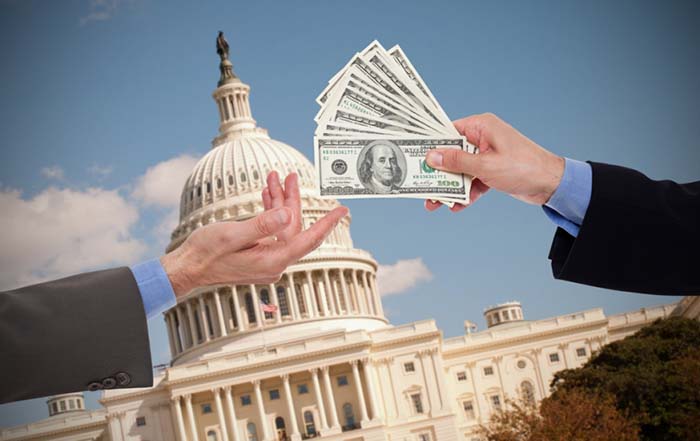
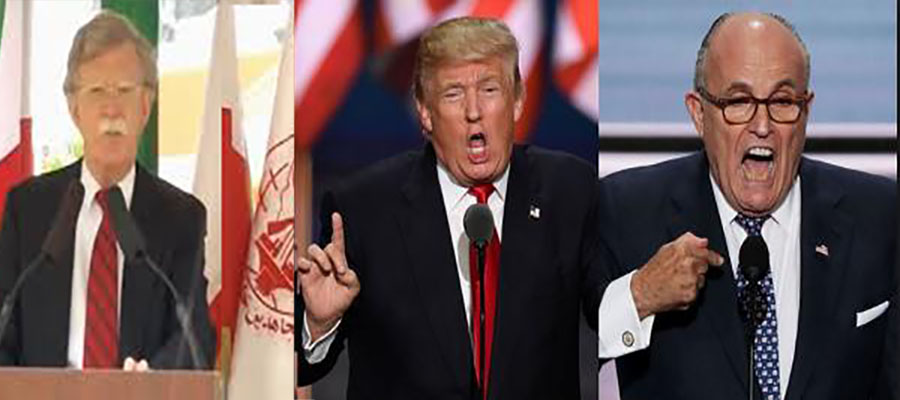
Nor was the State Department’s trolling operation the only anti-Iran psy-op to be unmasked this week. Heshmat Alavi, a virulently anti-Iranian columnist promoted by the Trump administration and published in Forbes, the Hill, and several other outlets, was unmasked as a propaganda construct operated by the Mojahedin-e Khalq (MEK), a controversial Iranian exile group often called a cult that has only recently lobbied its way off the US’ terror list. The MEK is notorious for buying the endorsement of American political figures, and national security adviser John Bolton, Senator Bob Menendez (D-New Jersey), and former New York mayor Rudy Giuliani are among those who have spoken at its events.
The fictional Alavi’s stories were used to sell Trump’s withdrawal from the Iran deal to the Washington Post and other more reputable outlets, as well as to promote the MEK as a”main Iranian opposition group” and viable option for leadership post-regime-change.

In reality, it is very much a fringe group, hated by the majority of Iranians for fighting on the side of Iraq during the Iran-Iraq war of the 1980s.

Indeed, Alavi’s relentless advocacy for the group may have scared off a few of the sites that initially published his work – the Diplomat and the Daily Caller both quit publishing him in 2017, citing quality concerns.

“We were always active in making false news stories to spread to the foreign press and in Iran,”a Canadian MEK defector told the Intercept, describing a comprehensive online propaganda mill run out of the group’s former base in Iraq that sought to control the narrative about Iran on Facebook and Twitter.

Alavi may have been unmasked, but there could be thousands more where he came from. Twitter’s attempts to aid the US war effort by deplatforming thousands of pro-Iran accounts is an implicit endorsement of their activities. The Intercept’s comprehensive investigation of the Alavi persona essentially dropped the key to the MEK’s propaganda network in Twitter’s lap; their refusal to act on this information, merely removing the Alavi account without investigating the swamp of”coordinated inauthentic behavior”surrounding it, indicates they are content with being weaponized in the US propaganda war against Iran. Trolling is fine, as long as it’s”our guys”doing it.
Helen Buyniski

June 15, 2019 0 comments
FacebookTwitterPinterestWhatsappTelegramSkypeEmail
Russia Today on Alavi
Mujahedin Khalq; A proxy force

RT: Fake News, Fake writer, real policy

Fake Iranian activist ‘Heshmat Alavi’ exposed
The White House has used a completely made-up Iranian journalist to justify sanctions.

https://dlb.nejatngo.org/Media/Report/RT_Alavi_MEK.mp4

June 13, 2019 0 comments
FacebookTwitterPinterestWhatsappTelegramSkypeEmail
TYT on Heshamt alavi
Mujahedin Khalq; A proxy force

Fake Forbes Newsman is an MEK Front

Fake Newsman: Anti-Iran Forbes “Writer” is a People’s Jihadi Front

“Heshmat Alavi” who has published anti-Iran screeds in Forbes, the Daily Caller and other substandard rightwing venues, does not, according to The Intercept, actually exist.

The name is a front propaganda efforts of the People’s Jihadis (Mojahedin-e Khalq or MEK). The MEK has committed numerous acts of terrorism in Iran and then collaborated with Iraqi dictator Saddam Hussein. It was listed as a terrorist organization the the US until a few years ago and it is mysterious why it was ever taken off the list. My own suspicion is that bribes were taken or influence peddling was practiced.

NBC news once reported that the People’s Jihadis has links to the Israeli intelligence organization, Mossad. Others have alleged Saudi money and support.

Rudi Giuliani, John Bolton and Mike Pompeo, who now make US foreign policy, have taken large bribes from this terrorist organization.

The idea of blacklisting the Iranian Revolutionary Guards Corps as a terrorist organization (nonsensical because it is a national guard, not a non-state actor) was first recently floated by the non-person “Heshmat Alavi” in the non-news-source “Daily Caller.” Then Trump followed through. Putin’s hold on the Trump administration is feeble as a kitten’s compared to that of People’s Jihadi cult leader Maryam Rajavi in Albania.
The Young Turks interview the Intercept Washington Bureau Chief on the story:

https://dlb.nejatngo.org/Media/Interview/TYT_Alavi_MEK.mp4

June 12, 2019 0 comments
FacebookTwitterPinterestWhatsappTelegramSkypeEmail
paid advocacy
Mujahedin Khalq; A proxy force

outrage over US-funded scheme to shape Iran debate

Outrage on Capitol Hill over ‘completely unacceptable’ US-funded scheme to shape Iran debate

‘This is something that happens in authoritarian regimes, not democracies’

United States officials say they are outraged by a government-funded troll campaign that has targeted American citizens critical of the administration’s hardline Iran policy and accused critics of being loyal to the Tehran regime.
State Department officials admitted to Congressional staff in a closed-door meeting on Monday that a project they had funded to counter Iranian propaganda had gone off the rails. Critics in Washington have gone further, saying that the programme resembled the type of troll farms used by autocratic regimes abroad.

“It’s completely unacceptable that American taxpayer dollars supported a project that attacked Americans and others who are critical of the Trump administration’s policy of escalation and conflict with Iran,” a senior Congressional aide told The Independent, on condition of anonymity.
“This is something that happens in authoritarian regimes, not democracies.”

One woman behind the harassment campaign, a longtime Iranian-American activist, has received hundreds of thousands of dollars from the State Department over the years to promote “freedom of expression and free access to information.”
The campaign relentlessly attacked critics of the Iran policy on social media, including Twitter and Telegram messaging app, accusing them without evidence of being paid operatives of the regime in Tehran.
A spokeswoman for the State Department told reporters on Monday that funding for the “Iran Disinformation Project” had been suspended and is under review after it was reported that it went beyond the scope of its mandate by veering from countering propaganda from Iran to smearing domestic critics of White House policy.

State Department officials disclosed to lawmakers they had granted $1.5 for Iran Disinfo, which repeatedly targeted, harassed and smeared critics of Trump’s tough stance against Iran on social media.

Among those targeted were American activists, scholars, and journalists who challenged the Trump administration’s “maximum pressure campaign” against Iran.
The revelation that US taxpayer money was being used to attack administration critics has now sparked a flurry of queries.
“There are still so many unanswered questions here,” Congresswoman Ilhan Omar wrote on Twitter. “What rules are in place to prevent state-funded organisation from smearing American citizens? If there wasn’t public outcry, would the Administration have suspended funding for Iran Disinfo?”

Cold War-era US rules barring the use of government-funded propaganda against American citizens have been flouted for decades.
Congresswoman Barbara Lee accused the State Department of giving taxpayer money to operatives “accused of intimidating and harassing U.S. human rights activists, journalists, and academics who’ve criticized their hawkish policies on Iran.”
She added: “This is unacceptable and we will not stand for it.”
State Department officials speaking at the closed-door meeting admitted the project was out of bounds, according to Congressional staffers speaking to The Independent on condition of anonymity.
Both Democratic and Republican Congressional staffers were highly critical of the project and questioned whether US officials should continue to work with the contractor, E-Collaborative for Civic Education. The State Department spokeswoman declined to outline steps to prevent such an operation in the future.
Some have said the harassment campaign resembles those launched by the Iranian regime against its critics, as well as clandestine troll farms run by Russia, Saudi Arabia, and other autocracies in attempts to shape online debate and intimidate critics.
In a twist, Iran Disinfo has even attacked journalists deemed insufficiently supportive of the Trump administration’s policies at US-funded news outlets including Voice of America, Radio Farda, and RFE/RL.
The harassment campaign is one aspect of an Iran policy that critics have warned was overly politicised, incoherent and risky.
Defying American allies, the United Nations Security Council, and the advice of his own intelligence mandarins, Mr Trump voided the 2015 Iran nuclear deal last year and launched an unprecedented campaign of sanctions and threats against Tehran, vowing to pressure the country into cutting a “better deal” than the one it forged with his predecessor, Barack Obama.
Seeking evidence that its policies were working and popular, the administration has relied an unconventional information sources, often citing obscure right-wing news outlets and think tanks.
E-Collaborative for Civic Education, co-founded by Iranian American activist Mariam Memarsadeghi, is a long-time State Department contractor.
It purports to promote democratic political life and empower civil society inside Iran, but it appears to have no presence inside the country and instead confines itself to engaging with Iranians in the Diaspora.
Congressional officials also confirmed to The Independent that one individual working for the Foundation for Defence of Democracies, an influential Washington organisation with hawkish views on Iran, is part of the E-Collaborative for Civic Education’s Iran Disinformation Project.
One Congressional staffer said he expected the State Department would examine “the extent of coordination” between Iran Disinfo project and “pro-war think tanks like the Foundation for Defence of Democracies.”

Over the weekend, The Intercept revealed that a purported Iranian activist, who had published dozens of articles on Iran in prominent outlets such as Forbes and The Hill, does not exist and is a fake persona run by a team of operatives connected to a bizarre Iranian political cult.
The “Heshmat Alavi” persona had a strong presence on Twitter and harassed Iranian journalists, academics, and activists who are critical of the Mujahedin-e-Khalq organisation, a one-time armed guerilla group now holed up in Albania. There is no known link between the Iran Disinfo programme and the fake persona.

At least one was cited by the Trump administration as proof against the effectiveness of the Obama-era nuclear deal. Some of the MEK articles were also picked up by US government funded Voice of America’s Persian-language service.

Both the Alavi account and the US-funded account frequently accused Iranian Americans sceptical about the Trump administration of being dupes of the Tehran regime.
“It’s an outrage that the Trump Administration was funnelling taxpayer dollars to a smear campaign accusing US citizens of dual loyalty to a foreign regime,” Dylan Williams, vice president of the left-leaning Jewish-American organisation J Street, told The Independent.
“Decent people wouldn’t tolerate such state-sponsored defamation if the target was Jewish Americans and we shouldn’t when the target is Iranian-Americans.”

Negar Mortazavi and Borzou Daragahi ,

June 12, 2019 0 comments
FacebookTwitterPinterestWhatsappTelegramSkypeEmail
MEK after Trump
Mujahedin Khalq Organization's Propaganda System

Trolls to make US Iran Case

Why does the U.S. need trolls to make its Iran case?

This weekend, a new wrinkle was added to the ongoing saga about the information war over Iran policy: the stunning revelation that an online persona that was cited by the Trump administration to justify leaving the Iran nuclear deal is likely not a real person, after all.
On Sunday, the Intercept published an investigation into “Heshmat Alavi,” a rabid supporter of the Mujahideen-e Khalq (MEK), a controversial Iranian opposition group. Since 2014, he had amassed a large Twitter following, which he apparently leveraged to attract interest in freelance submissions.
But according to the Intercept report, it turns out Alavi, the self-proclaimed “Iranian activist with a passion for equal rights” who claims to be “in contact with sources that provide credible information about the mullahs’ regime in Tehran,” was a team of MEK members producing the content in Albania.
That didn’t stop Forbes, the Hill, Daily Caller and even the Voice of America from amplifying Alavi’s platform as a voice on Iran policy. All of these outlets, and several more, have published articles by Alavi that claimed the MEK is the main opposition to the current Iranian regime.

More disturbing than the articles, however, were the Twitter tirades that Alavi directed at established journalists who write on Iran — including me — referring to us “lobbyists,” “agents” and “collaborators” of the Islamic republic. These efforts actively sought to undermine our credibility about the best approach to deal with Iran and resorted to personal attacks in order to do so.

Apparently, libel isn’t a concern if you’re not actually a person.
After the report, Twitter appears to have suspended the account.

But the MEK, the organization that “Team Heshmat Alavi” represents, has a nasty history. It was on the State Department’s list of foreign terrorist organizations for years before being removed in 2012. These days, it has no discernible popular support in Iran and egregiously mistreats its members.
Despite its history and negligible influence among Iranians, the MEK happens to have the support of many U.S. officials, including Trump advisers John Bolton and Rudy Giuliani, both of whom have appeared as paid speakers at the group’s events.

The new revelations come less than two weeks after reports that the State Department had been funding an initiative called the Iran Disinformation Project, which was outed last month by Iran watchers for targeting and spreading lies about knowledgeable and experienced Iran commentators. The State Department suspended the funding to that initiative temporarily, but a full accounting of how taxpayer money may have been used against U.S. citizens — a crime under U.S. law — has not happened yet.
The Heshmat Alavi saga does not appear to be directly linked with the Iran Disinformation Project. But both operations raise similar concerns.

In both instances, the U.S. government — knowingly or not — aided in the flow of falsehoods perpetuated by opaque sources targeting U.S. citizens and attempting to discredit journalists and other commentators. And in both cases, the administration seemed to care more about advancing their views on Iran than about verifying the truth.

In the current atmosphere, any discussion of Iran that doesn’t explicitly advocate for the most severe measures against Iran — and, by extension, all people inside Iran — is branded apologia by supporters of President Trump’s “maximum pressure” campaign. The MEK and Iranian Disinformation Project talking points have a captive audience here in the capital. So, too, do the rants of others echoing the most hawkish elements of the Trump administration’s Iran rhetoric.
But this is the United States of America. In this country, at least, we can and must have these conversations in the light of day, and maintain an atmosphere where we can openly debate and defend dissenting views without spreading falsehoods or slander. This is critical, not just for our democracy, but also for long-term peace and stability.
Political commentators have pointed to this rhetorical buildup against Iran as similar to the George W. Bush administration’s case for war with Iraq. But the comparison isn’t entirely apt: We are not at the same informational disadvantage we were as a nation in the lead-up to the Iraq War.
The current Iranian American population is much bigger than the Iraqi American population of the early 2000s. It’s better positioned economically in the society and has more political representation. And crucially, there is a flow of Iranian Americans who still routinely travel to the country. Social media is rich with images from inside Iran telling myriad stories.
So, instead of resorting to false narratives and personal attacks, we should cultivate our Iran policy — because there still isn’t a coherent one — the old-fashioned way: by making real arguments, backing them up with actual evidence and prioritizing real people over the tactics of manipulation and fraud preferred by authoritarians.

Jason Rezaian,

June 12, 2019 0 comments
FacebookTwitterPinterestWhatsappTelegramSkypeEmail
Heshamt Alavi
Mujahedin Khalq Organization's Propaganda System

Twitter has suspended MEK Mouthpiece account

Prominent Anti-Iran ‘Writer’ Not Real Person, Mouthpiece of Shady Iranian Group

Iran’s opposition pro-U.S. MEK created a fake persona named Heshmat Alavi who writes for right-wing media against the Iranian government.

The pro-West Iranian opposition group Mojahedin-e-Khalq (MEK) is using a fake profile to push for their anti-Iran agenda according to a report.

The organization is managing the social media profile of Heshmat Alavi, a person who had supposedly written for various right-wing media outlets.
“Heshmat Alavi is a persona run by a team of people from the political wing of the MEK,” Hassan Heyrani, former member of MEK’s political department who defected in 2018, affirmed, apparently having direct knowledge of the operation.

As of Monday, Twitter has suspended Alavi’s account. Forbes has also deleted all articles pertaining to Alavi.

“They write whatever they are directed by their commanders and use this name to place articles in the press. This is not and has never been a real person.”
Twitter has suspended Alavi’s user, while Forbes has deleted his article entries on the website.
MEK was originally an anti-west, especially anti-U.S. organization and pushed for the killing of six U.S citizens in Iran in the 1970s. While in 1979, they enthusiastically cheered the seizure of the U.S. embassy in Tehran. After the Iranian Revolution, its young leaders pushed for endorsement from the Ayatollah Ruhollah Khomeini but were denied.
So Massoud Rajavi, its young leader, allied with the winner of the country’s first presidential election, Abolhassan Banisadr, who was not an ally of Khomeini, either. Soon Banisadr and MEK became some of Khomeini’s main opposition figures and had fled to Iraq and later to France.
In the neighboring country, MEK allied with Sadam Hussein to rage war against Iran.
The organization was deemed a terrorist group by the U.S. and European Union for the better part of the 1990s, but things changed after the U.S. invasion to Iraq in 2003. This is when the U.S. neoconservative strategists leading the Department of State and the intelligence agencies saw MEK as an asset rather than a liability. Put simply in words they applied the dictum of “the enemy of my enemy is my friend.”
Soon after it gained support from U.S. politicians like Rudy Giuliani and current National Security Advisor John Bolton, who now call MEK a legitimate opposition to the current Iranian government, as MEK shed its “Marxism.” After the U.S.’ official withdrawal from Iraq, they built MEK a safe haven in Albania, near Tirana.
From this safe haven in Albania, MEK started spreading fake news and online campaigns against the Iranian goverment. They also created a fake persona to spread their propaganda.
“We were always active in making false news stories to spread to the foreign press and in Iran,” Reza Sadeghi, a former MEK member, explained.
Alavi’s persona is managed by three MEK members according to the former MEK operative, Heyrani.
“They were my friends. We were close friends,” Heyrani said. “We were working together.”
Alavi’s articles have been published by media houses like Forbes, The Hill, The Daily Caller, The Federalist, Saudi-owned al-Arabiya English, among others.
All his articles denounce the Iranian government and often suggests that it should be replaced by MEK and its leader Maryan Rajavi, wife of Massoud Rajavi.
His social media followers comprise of right-wing journalists, think tank employees and Alavi is often cited by neoconservative publications.
In fact, when U.S. President Donald Trump withdrew from the nuclear deal with Iran in 2018, the White House claimed that an article by Alavi was cited as the reason for this decision. Alavi wrote in Forbes that the nuclear deal has allowed Iran to increase its military budget, hence Trump’s decision to withdraw and sanction the country.
“The Mojahedin” — the Iranian name for the MEK — “wants to show to the world that their narrative has support, even from people who are not directly members of the group,” Heyrani said, adding that “they want to show that other independent people — writers and activists — support their approach and believe that freedom and democracy will come to Iran through the work of this group.
https://www.telesurenglish.net/news/Prominent-Anti-Iran-Writer-Not-Real-Person-Mouthpiece-of-Shady-Iranian-Group-20190610-0011.html

June 11, 2019 0 comments
FacebookTwitterPinterestWhatsappTelegramSkypeEmail
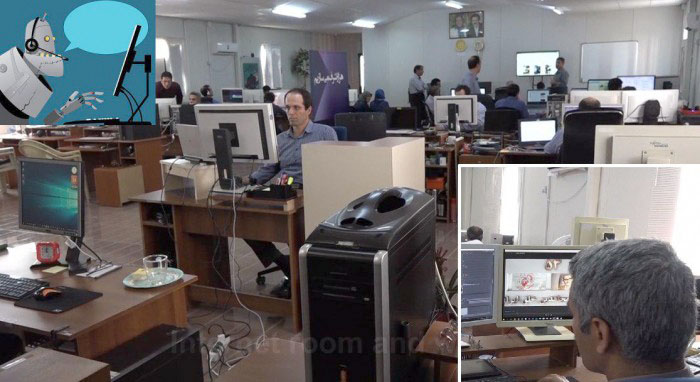
MKO making terror trolls in Albania
Mujahedin Khalq Organization's Propaganda System

Bolton and a little-understood Twitter network have both boosted MEK

The Suspicious Twitter Network Trolling for Regime Change in Iran

An American non-profit says it’s been the victim of a harassment campaign.

As the Trump administration has ramped up economic sanctions against Iran and aimed increasingly threatening rhetoric at the country, an influence network has popped up on Twitter pushing similar messages.
Networks comprising over four hundred Twitter accounts composed of likely bots along with real accounts and “cyborg” accounts—accounts run by real people, but augmented with software to push posts faster and more frequently—have consistently released messaging opposing the Iranian government.
Coordinated attempts to manipulate discourse on Twitter are explicitly against the platform’s rules.
The accounts often tweet messages backing regime change in Iran and calling for an end to the rule of Ayatollah Ali Khamenei. Many of the accounts also frequently voice their support for the People’s Mujahedin of Iran (MEK), a militant opposition group that some have called a terrorist organization, and its leader Maryam Rajavi. The accounts also frequently criticize the National Iranian American Council (NIAC)—a non-profit representing Iranians in the U.S.—claiming it advocates in support of Iran’s current religious authorities. There is no evidence to suggest this is true, and NIAC firmly denies the assertion. In 2008 the group filed a defamation suit against a writer who alleged they had lobbied on behalf of the Islamic Republic of Iran; a federal judge found that the defendant’s actions didn’t amount to defamation, but made no ruling on the truth of his allegations.*
The full impact of the networks is hard to gauge, but one set of over 350 accounts has collectively tweeted over 5 million times to nearly 500,000 followers, according to numbers collected by independent researcher Geoff Golberg, who first flagged the accounts to Mother Jones. Golberg, who founded the social media manipulation research project SocialCartograph, says that he has no specific interest in Iranian geopolitics and stumbled onto the accounts amid broader research into social media influence campaigns.
Another set of 75 accounts found by researcher Ben Decker, who runs the media and tech investigations consultancy Memetica, also post pro-regime change and anti-NIAC content. Decker, who is a former researcher at Harvard’s Shorenstein Center, says the accounts exhibit signs that suggest they are possibly either not real or are being augmented. Beyond accounts posting at a superhuman pace on a 24 hour a day, seven day a week schedule, Decker noted that “the network of accounts had a massive spike in followers, totaling around 125.2k users, during the last week of February”—a “red flag as far as inorganic network activity is concerned.”
While coordinated attempts to manipulate discourse on Twitter are explicitly against the platform’s rules, NIAC says it has been a victim of such attacks and complains the company hasn’t taken enough action to protect them. The organization claims that it was targeted by a coordinated social media attack over Memorial Day weekend, when accounts critical of NIAC tweeted out the hashtag #NIACLobbies4Mullahs in droves, to push the notion of NIAC’s supposed ties to Iran’s religious authorities. Jamal Abdi, the NIAC’s president, believes the efforts are an attempt to undermine his organization’s credibility and effectiveness.
“The goal of these attacks is simple: to divide and weaken our community. To ensure that Iranian Americans do not have a voice, do not hold influential positions in Washington D.C., do not run for office and build political power, and shy away from civic engagement,” he wrote in a piece for The Iranian. Golberg’s work has caught the attention of NIAC and he has publicly communicated with it his findings, but he says he is not being paid by the organization.
The networks are made up of a mix of legitimate and false accounts, and it can be difficult to definitively say which are bots, cyborgs, or normal posters augmented via other means. But some of the profiles’ behavior echoes patterns that experts use to judge if accounts are not being run organically. The five most prominent accounts in the network have tweeted hundreds of thousands of times in the several years since they were created, averaging over 100 tweets a day. That speed alone doesn’t confirm that the accounts are inauthentic or engaging in artificial coordination, but to Golberg it’s a clue, along with the interconnectedness of the network’s accounts and their similarities in the users they retweet, follow and interact with, as well as the sometimes nearly identical content of their tweets.
Twitter has deleted thousands of Iranian accounts in the past several months, including some of the over 350 accounts that appear to be a part of the influence campaign identified by Golberg. Over 200 of the accounts he flagged remain, pumping out content in support of regime change in Iran.

It’s unclear who is behind the accounts, but their positions mirror the positions of the MEK and what is seen as its international political arm, the National Council of Resistance of Iran (NCRI). Both have consistently pushed for regime change in Iran, earning allies in and close to the Trump administration, despite the organization formerly being labeled by the State Department as a terrorist group, a designation some experts believe it should still have.

Trump’s National Security Advisor, John Bolton, called the MEK “a viable opposition to the rule of the ayatollahs” at an MEK event in 2017. Trump’s lawyer, Rudy Giuliani, who has taken payments from the group, called for Iran’s current ruling regime to be replaced by the armed group at a 2018 rally hosted by the organization in Paris.

The MEK has a history of running online disinformation campaigns. Al-Jazeera has documented a Russian Internet Research Agency-style troll operation run out of Albania, interviewing former MEK members who detailed how the organization controlled thousands of accounts to spread propaganda about regime change and other political aims. And according to the Daily Beast, a former lobbyist for the NCRI, Soheila Aligholi Mayelzadeh, ran an influence campaign on Facebook in support of more aggressive confrontation with Iran.

It’s unclear what action Twitter is taking on the accounts. Golberg has for many months repeatedly flagged the network to Twitter employees, and had direct message conversations with the company about his disinformation research more broadly.

Former MEK members detailed how the organization controlled thousands of accounts to spread propaganda.

“Platform manipulation is a violation of the Twitter Rules,” a company spokesperson wrote after being asked about the accounts. “For accounts that we can reliably link to a nation state, we disclose every information operation down to the Tweet to a dedicated public archive—the largest of its kind in the industry. We have disclosed activities linked to Iran in the past and will remain vigilant.”
While news of Russian attempts to use social media platforms to influence politics both in the U.S. and elsewhere have dominated headlines, more and more examples of influence efforts related to Iran have surfaced. In addition to the online campaigns being carried out by people sympathetic to the MEK’s perspective, Iran’s ruling regime also appears to have engaged in its own political manipulation attempts.
Late last month, both Facebook and Twitter announced that they had deleted thousands of Iranian accounts that were engaged in what Facebook’s chief of security Nathaniel Gleicher called “coordinated inauthentic behavior.” The accounts appeared to have been created to mislead by posing as news organizations, journalists, and under other false identities, and to spread information about “political and social issues in Iran and globally,” according to Yoel Roth, Twitter’s head of site integrity. Both companies had previously deleted batches of accounts originating in Iran that they identified as being a part of a network trying to influence political discourse.

While the Trump administration has been wary of potential Iranian social media manipulation efforts, it seems their focus has been on content pushed by the current regime—and not by allies of a political group that, like the United States, is working against it.

“I can say definitively that it’s a sufficient national security concern about Chinese meddling, Iranian meddling, and North Korean meddling that we’re taking steps to try and prevent it,” Bolton told ABC News in August.

This article has been revised with additional information about the 2008 case.

Ali Breland, Motherjones.com

June 11, 2019 0 comments
FacebookTwitterPinterestWhatsappTelegramSkypeEmail
Mujahedin Khalq Organization's Propaganda System

The MEK’s Fake Mouthpiece and Western Credulity

Murtaza Hussain has reported an important story on the ongoing propaganda campaign sponsored by the Mujahideen-e Khalq (MEK) cult. This is the group of discredited Iranian exiles that has been building up its support in the West over the last decade by cultivating ties with and paying many Iran hawks, including the current National Security Advisor John Bolton.

Hussain has found that a prominent online figure, Heshmat Alavi, is a fake persona created by the MEK’s troll farm in Albania to harass and attack journalists and analysts that criticize the cult and oppose war and regime change in Iran:
There’s a problem, though: Heshmat Alavi appears not to exist. Alavi’s persona is a propaganda operation run by the Iranian opposition group Mojahedin-e-Khalq, which is known by the initials MEK, two sources told The Intercept.

“Heshmat Alavi is a persona run by a team of people from the political wing of the MEK,” said Hassan Heyrani, a high-ranking defector from the MEK who said he had direct knowledge of the operation. “They write whatever they are directed by their commanders and use this name to place articles in the press. This is not and has never been a real person.”

Heyrani said the fake persona has been managed by a team of MEK operatives in Albania, where the group has one of its bases, and is used to spread its message online.
The MEK has long been harassing and attacking journalists and analysts that oppose their fanatical regime change agenda and their creepy, abusive organization.

On occasion, I have also been subjected to some of this same treatment on Twitter when I have pointed out the group’s past and its current abuses against its own members, but others have had to endure much worse harassment and threats for a long time. The Alavi case goes beyond unleashing the usual army of bots against the group’s critics.

In this case, the fake persona was able to publish dozens of articles in Western news and opinion outlets promoting the MEK as the main Iranian opposition group and advocating for regime change in Iran:
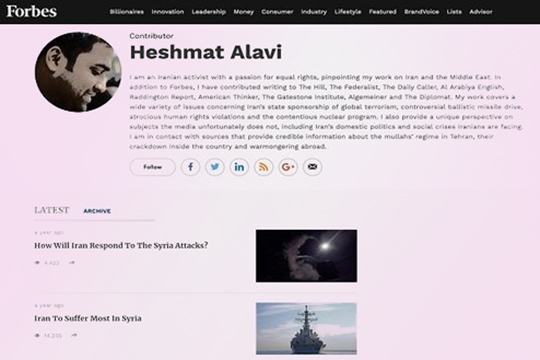
Alavi, whose contributor biography on the Forbes website identifies him as “an Iranian activist with a passion for equal rights,” has published scores of articles on Iran over the past few years at Forbes, The Hill, the Daily Caller, The Federalist, Saudi-owned al-Arabiya English, and other outlets.

The problem here is not just that the MEK has managed to spread its poison in Western media using this fake persona, but that so many of these outlets readily accepted submissions from a pro-MEK trolling operation. It isn’t surprising that a creepy cult intent on rehabilitating its image in the West would resort to trickery and lies, but it is disturbing how willing so many of these outlets were to lend legitimacy to that effort and broadcast outright propaganda. It is equally troubling how long the MEK was able to get away with this before the deception was uncovered.

The Alavi case is an important piece of a larger story about how advocates of regime change in Iran have been resorting to harassment, intimidation, and smears of Iranian and Iranian-American journalists, analysts, and genuine activists for years. It is similar to the recent scandal involving U.S. government funding of the so-called Iran Disinformation Project that engaged in similar smear tactics and harassment against many of the same people, and it is part of the same phenomenon of shouting down credible opponents of regime change and war in an attempt to control the debate. Fortunately, thanks to Hussain’s story, Twitter has suspended the Alavi account and the fake persona has been outed to the entire world. No doubt the MEK will keep trying to promote their message in Western media outlets, and some will be happy to oblige them, but an important part of their campaign of deception and intimidation has been exposed and stopped.

June 10, 2019 0 comments
FacebookTwitterPinterestWhatsappTelegramSkypeEmail
heshmat alavi
Mujahedin Khalq Organization's Propaganda System

The warmonger activist revealed to be fake persona run by MEK

An Iranian Activist Wrote Dozens of Articles for Right-Wing Outlets. But Is He a Real Person?

In 2018, President Donald Trump was seeking to jettison the landmark nuclear deal that his predecessor had signed with Iran in 2015, and he was looking for ways to win over a skeptical press. The White House claimed that the nuclear deal had allowed Iran to increase its military budget, and Washington Post reporters Salvador Rizzo and Meg Kelly asked for a source. In response, the White House passed along an article published in Forbes by a writer named Heshmat Alavi.
“Iran’s current budget is funded largely through ‘oil, taxes, increasing bonds, [and] eliminating cash handouts or subsidies’ for Iranians, according to an article by a Forbes contributor, Heshmat Alavi, sent to us by a White House official,” Rizzo and Kelly reported. The White House had used Alavi’s article — itself partly drawn from Iranian sources — to justify its decision to terminate the agreement.

“Heshmat Alavi is a persona run by a team of people from the political wing of the MEK. This is not and has never been a real person.”
There’s a problem, though: Heshmat Alavi appears not to exist. Alavi’s persona is a propaganda operation run by the Iranian opposition group Mojahedin-e-Khalq, which is known by the initials MEK, two sources told The Intercept.

“Heshmat Alavi is a persona run by a team of people from the political wing of the MEK,” said Hassan Heyrani, a high-ranking defector from the MEK who said he had direct knowledge of the operation. “They write whatever they are directed by their commanders and use this name to place articles in the press. This is not and has never been a real person.”
Heyrani said the fake persona has been managed by a team of MEK operatives in Albania, where the group has one of its bases, and is used to spread its message online. Heyrani’s account is echoed by Sara Zahiri, a Farsi-language researcher who focuses on the MEK. Zahiri, who has sources among Iranian government cybersecurity officials, said that Alavi is known inside Iran to be a “group account” run by a team of MEK members and that Alavi himself does not exist.
Alavi, whose contributor biography on the Forbes website identifies him as “an Iranian activist with a passion for equal rights,” has published scores of articles on Iran over the past few years at Forbes, The Hill, the Daily Caller, The Federalist, Saudi-owned al-Arabiya English, and other outlets. (Alavi did not respond to The Intercept’s requests for comment by Twitter direct messages or at the Gmail address he used to correspond with news outlets.)
The articles published under Alavi’s name, as well as his social media presence, appear to have been a boon for the MEK. An opposition group deeply unpopular in Iran and known for its sophisticated propaganda, the MEK has over the past decade turned its attention to English-language audiences — especially in countries like the U.S., Canada, and the United Kingdom, whose foreign policies are crucial nodes in the MEK’s central goal of overthrowing the Iranian regime.

Alavi’s persona is said to be managed by a trio of MEK members. Heyrani, who at one time helped coordinate online operations for the group, named the individuals and a commander from MEK’s political wing who have been responsible for writing English-language articles and tweets under Heshmat Alavi’s name, and shared their photographs and names with The Intercept. “They were my friends. We were close friends,” Heyrani said. “We were working together.”

Heyrani explained that the MEK leadership would not look kindly on the fluent English speakers who operate the persona writing under their own names. Rank-and-file members, he said, are discouraged from having prominent public profiles — a reflection of what many critics have said is the MEK’s cult-like operating principles. “The leader of the organization doesn’t allow any person to use their real name,” said Heyrani, “because the leader is the first man in the organization, and everything should be under their shadow.”
The MEK conducts relentless online information campaigns, using an army of bots to flood online debates about Iran with the group’s perspective. One of the goals of the MEK team that manages the Hesmat Alavi account, Heyrani said, is to get articles under Alavi’s name published in the American press. The Intercept’s requests for comment to the MEK’s political wing, along with interview requests to the alleged operators of Alavi’s persona, went unanswered.
Another former MEK member now living in Canada, Reza Sadeghi, confirmed that the trio identified by Heyrani was involved with the group’s online information operations. Sadeghi was a member of the MEK until 2008, involved in lobbying activities in the United States, as well as operations at the MEK’s former base at Camp Ashraf in Iraq. He described a growing online propaganda center run by the group, intended to sway online discourse about Iran.

“We were always active in making false news stories to spread to the foreign press and in Iran,” Sadeghi said. “At Camp Ashraf, there were computers set up to do online information operations. Over the years, this activity got more intense with the introduction of social media platforms like Facebook and Twitter.”

The MEK is among the most controversial groups seeking to depose the Iranian government. Although today it is mainly involved in political activism and lobbying, the group also has a history of violence. From 1997 until 2012, the MEK was listed as a Foreign Terrorist Organization by the U.S. State Department, a status that was finally revoked as part of a diplomatic deal struck by the Obama administration. The group’s last claimed violent attack was in 2001.
The MEK initially sided with the Islamic Revolution but fell out of favor shortly after the establishment of the clerical-led Islamic Republic. The subsequent crackdown forced the group into exile, operating between France and Iraq — where, thanks to Saddam Hussein’s largesse, the group occupied Camp Ashraf, used as a staging ground for its participation on Iraq’s side of the brutal Iran-Iraq War.
The years following the U.S.’s invasion of Iraq were harrowing for the MEK, complicated by the terrorist listing. As the Americans withdrew their military forces, they handed over security at the MEK’s Iraqi base to the Iraqi government; another round of violent crackdowns ensued. The 2012 deal to remove the MEK from the U.S. terror list facilitated the movement of thousands of MEK members from Iraq to Albania, where the group would be housed in a new secretive compound. It is from this base in Albania where, according to the MEK defector Heyrani, some of the MEK members managing the Alavi persona were said to be working.

Alavi’s articles tend to mix scathing denunciations of the Iranian government with not-so-subtle suggestions that it might be replaced by the MEK and its leader, Maryam Rajavi. The group seems to have had great success with Alavi, particularly at Forbes.
The Intercept reached out to editors at the outlets that Alavi has published articles with over the past several years. None of these outlets were able to confirm that they ever spoke with or met Alavi. He was not paid for his writing at Forbes, the Daily Caller, or the Diplomat, according to spokespeople for those publications.
Although Alavi has published articles about Iran in a number of predominantly right-leaning publications, by far the most frequent publisher of his articles is Forbes. In a span of a year, between April 2017 and April 2018, Alavi published a staggering 61 articles for the Forbes website.

A Twitter account created under Alavi’s name in 2014 boasts over 30,000 followers, including a number of journalists and D.C.-based conservative think tank employees. The account frequently shares articles and hashtags praising Rajavi and shares footage of protests and events held by the MEK.

Alavi seems to have gained some purchase in right-wing circles in Washington. In addition to his many articles published by Forbes and other sites, Alavi also appears to run a blog called “Iran Commentary,” which describes its mission as focusing on “issues related to Iran and the Middle East.” One of its reports was recently cited as a source in an article from the Washington Free Beacon, a neoconservative site that takes an ultra-hawkish view on Iran.
The body of work published under Alavi’s name takes a consistently hawkish line toward the Iranian government and President Hassan Rouhani. Alavi’s articles also mixed criticisms of Iran and U.S. policy with overt advocacy for the MEK. His pieces in the Daily Caller, The Hill, and other outlets — though less numerous than his contributions to Forbes — employed a similar mix of advocacy against the Iranian regime and praise for the MEK. Though the MEK is known to be widely loathed among Iranians, Alavi described the group as the “main Iranian opposition group” in a 2017 Daily Caller article.
The Diplomat, a foreign policy website that published a handful of Alavi’s pieces in 2017, said that Alavi sent drafts from a Gmail account. Alavi pitched the outlet dozens of articles, though only a small number were accepted. The Diplomat stopped accepting pitches from Alavi after determining that his articles were not meeting publication standards, said a source who asked for anonymity to discuss internal matters.
The Daily Caller also told The Intercept that the outlet stopped publishing Alavi’s articles over concerns about the quality of his submissions. The Hill, al-Arabiya English, and The Federalist did not respond to requests for comment.
“We terminated our relationship with Heshmat Alvi in early 2018,” a Forbes spokesperson said in a statement to The Intercept. “For your background, all contributors to Forbes.com sign a contract requiring them to disclose any potential conflicts of interest. If we discover a contributor has violated these terms, we investigate the case fully and end our relationship if appropriate.”
The MEK uses a number of means to gain influence in Washington. The group has paid prominent political figures to give speeches and press conferences, donated money to politicians, and disseminated its messages through these interlocutors’ appearances in media, as well as its own robust social media presence. In 2018, its social media operations were the subject of an Al Jazeera “Listening Post” documentary.
The group has used these public relations efforts to pursue its policy goals. Up until 2012, the MEK was mostly focused on getting itself off the U.S. terror list. In the years that followed, the group focused on attacking nuclear diplomacy between Iran and the U.S., and, after 2015, attacking the deal itself. Throughout, the MEK’s messaging has emphasized regime change — and attempted to present the MEK as a viable alternative to the Islamic Republic’s leadership, offering Rajavi, who has been the group’s public face for a decade and a half, as a potential figure to lead the country.
Alavi’s articles often track closely with these objectives. In his stories, Alavi has included positive references to Rajavi, as well as the MEK’s political wing, the National Council of Resistance of Iran. In an article in Forbes effectively calling for international support for regime change in Iran, Alavi wrote:
The time has come to set aside the “reformist” mirage in Iran. For decades, Maryam Rajavi, as President of the National Council of Resistance of Iran, is providing the sole, realistic alternative for Iran with a ten-point plan that enjoys the support of thousands of elected officials across the globe.
Like his focus on the MEK’s goal of elevating Rajavi, Alavi’s messaging has also lined up with the group’s efforts to attack the Iran nuclear deal. During the period between 2017 and 2018, when Alavi’s articles appeared in Forbes, the Trump administration was taking steps to extricate the U.S. from the deal, despite objections from European allies and former Obama administration officials. Alavi’s articles egged the administration on, with items such as “Iran Feeling The Heat From Trump On Nuclear Deal” and “How Trump Can Correctly Approach Iran’s Nuclear Deal.” In May 2018, Trump announced that the U.S. would be withdrawing from the agreement — one month after Alavi’s last article was published in Forbes.
The MEK’s messaging emphasizes regime change — and Alavi’s articles often track closely with this objective.
The Alavi article that the White House offered to the Washington Post in 2018 to justify withdrawing from the nuclear deal cited semiofficial Iranian government sources to demonstrate increased military spending by Rouhani government. It concluded with a rhetorical flourish typical of Alavi’s articles, praising the Trump administration for ending “appeasement” policies toward Iran and chastising Europe for “standing alongside the murderous mullahs’ regime against the will of the Iranian people.”
Alavi’s tack — exerting pressure on political discourse in the United States, rather than in Iran itself — appears to be part of the MEK’s strategy.
“The group barely produces content in Farsi. They seem to have given up on having a domestic audience in Iran. Their point now is to influence people in the English-speaking world,” said Massoud Khodabandeh, a former member of the MEK’s intelligence department who left the group in 1996. “Their online strategy works in Washington; it doesn’t work in Tehran.”
Alongside its social media strategy and periodic articles, the MEK involves itself in higher-stakes information campaigns. In 2002, the MEK helped reveal the existence of a covert Iranian nuclear facility near the city of Natanz. But according to arms control experts, the MEK got crucial details wrong. A 2006 article in the New Yorker also suggested that the intelligence may have been handed to the group by Israeli intelligence, calling into question the MEK’s claims that it operates a potent espionage network inside Iran.
In other instances, the MEK’s information has been less than reliable, causing skepticism among many Western national security analysts. During a 2015 press conference, MEK officials claimed to have evidence of a secret nuclear facility under construction in Iran, complete with clandestine photographs of the site. This claim was partly debunked by a blogger from the liberal website Daily Kos. A reverse image search of a picture of the purported door to the nuclear site revealed that it had actually been taken from a commercial website in Iran that advertised safe boxes.

The MEK has had the most success influencing the debate over Iran policy online through its aggressive social media presence. Any remarks about the group or even Iranian politics in general can be expected to be met by scores of MEK-supporters commenting through replies on Twitter and other social media. Many of the pro-MEK accounts will repeat the same messages, often word for word, swarming the mentions of any commentator.
Geoff Golberg, an expert on social media manipulation and founder of SocialCartograph, a social media mapping firm, took particular note of Alavi’s Twitter account, which appears to act as a node in an online campaign to boost the MEK’s profile. The account is heavily promoted by other pro-MEK accounts, as well as supporters of the group’s policy of confrontation toward Iran. To casual observers, these swarms of online activity can make it seem as though a large number of Iranians are enthusiastic about whatever it is that the MEK is promoting.
“The Heshmat Alavi account is part of a group of accounts, which, for years, have engaged in coordinated inauthentic behavior,” said Golberg. “The account is connected to thousands of inauthentic MEK-focused accounts, many of which regularly engage with the account’s tweets. The goal of these efforts is to create the illusion of a larger support base than exists in reality.”

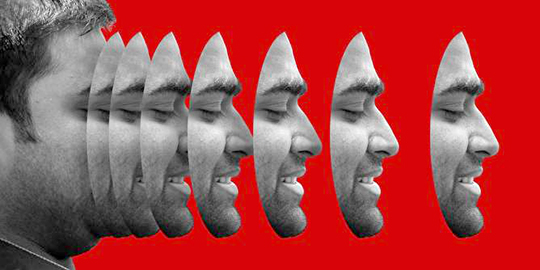
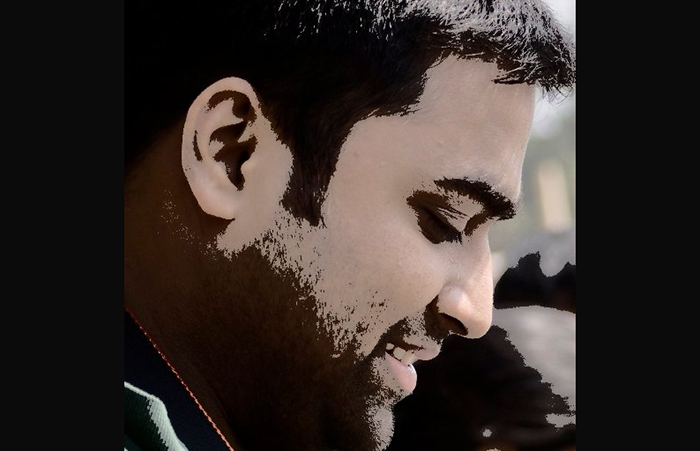
Alavi has left few traces online — aside from his social media, his articles, and his emails to editors. One single photo, a heavily filtered side profile, is used for all of Alavi’s author profiles, his LinkedIn page, and Twitter account. The photo’s origins are unclear.
At a minimum, there are strong indications that the Alavi persona is not what it claims to be. The use of fake identities to conduct political propaganda has become common in recent years. The 2016 U.S. presidential election saw the use of innumerable bots and fake accounts to spread misinformation and paranoia among the public.
A 2018 BBC News investigation looked into another prominent online persona alleged to be false: a Twitter account operating under the name “Sarah Abdallah” that was mixed up heavily in the online debate over the war in Syria. The Sarah Abdallah account was in some ways on the opposite side of the political spectrum as Alavi: Abdallah was a vocal supporter of the Syrian government of Bashar al-Assad, a close Iranian ally. An online research firm determined Abdallah’s account to be “one of the most influential social media accounts in the online conversation about Syria.”
Although the BBC investigation raised serious concerns about the influence of a shadowy online account that was being followed by hundreds of real journalists, it stopped short of concluding that Abdallah was fake or being operated by a front organization.
For all her influence, however, Sarah Abdallah was never able to achieve the success of Heshmat Alavi, whose articles were published in U.S. media outlets and read in the White House.
“The Mojahedin wants to show to the world that their narrative has support, even from people who are not directly members of the group.”
To those unfamiliar with the internal politics of Iran, Alavi could come across in his writings as what he simply claimed to be: “an Iranian activist with a passion for equal rights.” The former MEK member Heyrani says that this framing is exactly what the group was hoping to create with the persona. To the extent that publications like Forbes were indifferent or amenable to Alavi’s message, it seems to have worked.
“The Mojahedin” — the Iranian name for the MEK — “wants to show to the world that their narrative has support, even from people who are not directly members of the group,” Heyrani said. “They want to show that other independent people — writers and activists — support their approach and believe that freedom and democracy will come to Iran through the work of this group.”

By Murtaza Hussain, the intercept

June 10, 2019 0 comments
FacebookTwitterPinterestWhatsappTelegramSkypeEmail
Newer Posts
Older Posts

Recent Posts

  • MEK agents near schools in Tirana, Albania

    October 17, 2026
  • Expectations of human rights bodies regarding censorship within the MEK

    October 13, 2026
  • The Jamalis’ Plea for Help: Save Our Brother from the MEK!

    October 11, 2026
  • Testimonies of Participants in the MEK’s Staged Propaganda Stunt in Karaj

    October 7, 2026
  • Giuliani’s MEK ties have dogged him for years

    October 6, 2026
  • Facebook
  • Twitter
  • Instagram
  • Youtube

© 2003 - 2025 NEJAT Society . All Rights Reserved. NejatNGO.org


Back To Top
Nejat Society
  • Home
  • Articles
  • Media
    • Cartoons
    • NewsPics
    • Photo Gallery
    • Videos
  • Publications
    • Books
    • Nejat NewsLetter
    • Pars Brief
  • About Us
  • Contact us
  • Editions
    • عربي
    • فارسی
    • Shqip