
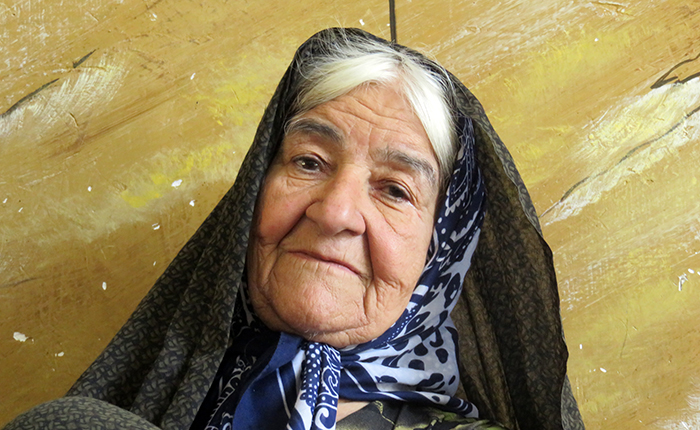
My dear Mohammad
I have missed you a lot.I can’t wait for the day that I can finally have you back.
My dear Mohammad
I have missed you a lot.I can’t wait for the day that I can finally have you back.

Albanian Police arrested several people on money laundry charges, Sahar Family Foundation cited from Albanian media.
The arrested men including two Jewish Albanians, laundered thousands of euros by the aid of an NGO named FARA. The money was funneled to Albania from Israel.
The construction permit was issued by the Albanian National Territorial Council for the Mujahedin Khalq Organization (the MKO/MEK/ PMOI/ Cult of Rajavi) to construct their new Camp Ashraf 3 in Manze in Durres region in North of Albania. However, the permit was officially granted to FARA, (an extremely problematic issue for Albania and Albanians).
The relation between the arrestees and the confiscated money with the MKO and its third camp is under investigation.

Massoud Rajavi surfaced in Iraq, the country that was in war with Iran at that time. After he was expelled from France territory in June 1988, he was welcome by the then Iraqi dictator Saddam Hussein as the fifth column agent who would aid Iraqi Baath regime in spying and military operations. However, Maryam Rajavi is still in France running the Mujahedin Khalq Organization (the MKO/ MEK/ PMOI/ the Cult of Rajavi) with its full potentials as a destructive terrorist cult.
At that time, Massoud Rajavi was in the first stages of establishing his cult of personality. His expulsion from France was a year after his marriage with Maryam Qajar Azdanlou, the wife of Abrishamchi another high ranking member of the group. The marriage was marked as the start of the “Ideological Revolution” that required members to divorce their spouses and to dedicate their entire existence to the group’s cause and its leader Massoud Rajavi.
Up to the Ideological Revolution, the MKO was a political group with a violent back ground of fighting against the Iranian government but after the Ideological Revolution was declared and started its rule, the MKO became a destructive cult with a terrorist extremist substance. It almost took two decades to fall Saddam Hussein and the MKO go disarmed by the US military. The fall of the landlord and the disarmament of the group led a large number of MKO members –who couldn`t justify their stay in the group anymore—to leave the group.
Once the rank and file defected the group, secrets of the Cult of Rajavi were revealed in the testimonies that former members made in different courts and media in order to bring Massoud Rajavi to trial. But Massoud got disappeared. He had not been seen since Maryam was arrested by the French Police in June 2003.
Maryam has been the only leader of the MKO since the disappearance of Massoud. She has made efforts to maintain the cult-like structure of the group whether in Iraq or Albania. The same as any other destructive cult, leaving the MKO is forbidden. Members are fed up and disappointed due to the suppressing atmosphere of the cult that controls all aspects of their life, bars them from contacting their family and friends. They were tortured mentally and physically by the order of its cruel leader. They can hardly ever leave the group normally; they have to escape.
Therefore, the rank and file of the MKO are definitely suffering a more threatening oppressive situation these days than in 1988 that Massoud joined them in Iraq. Today, the MKO members are taken as hostages in a remote camp outside the Albanian capital. The new camp is called Ashraf 3 by the group leaders who wish to maintain Rajavi’s cult-like structure the same as it was once formed in Camp Ashraf, Iraq.
The Expulsion of Maryam Rajavi from France and her relocation in Albania seems to be a very vital solution for the threat of her destructive cult that endangers European citizens too. Eventually, the MKO’s camp in Albania should be supervised by the United Nations authorities in order to offer members of the group possibilities to choose for their future with their own free will.
Mazda Parsi
Open Letter from the “Free Iran” Association to the UN High Commissioner for Refugees in Albania
We would like to inform you that the authors of this paper are human rights activists who have had a history of organizational co-operation with the Mojahedin-e Khalq Organization under the leadership of Masood Rajavi and Maryam Rajavi in Iraq and Albania, but due to political differences and access terrorist and sectarian organizations of this organization have been separated from this organization.
We, besides appreciating the efforts of the UN High Commissioner for Refugees in Albania, we consider it necessary to further help and informing for the work of refugees and members of Mojahedin-e Khalq who wish to separate from this organization or those who have already been separated from this organization.
According to the close knowledge and experience of our long-standing cooperation (10-30 years) with the Mojahedin-Khalq organization and also the reports published by the police and the Albanian Interior Ministry and the new members who abandoned the Mojahedine organization, we believe that the process of brainwashing and the isolation of persons and arrestees within the organization goes further to the base of Mojahedin-e Khalq in Albania.
But in spite of inhuman and illegal conditions, members of Mojahedin-e Khalq have created the conditions for being separated from the mental and physical occupation of this cult. Unfortunately, UNHCR unlawfully and in violation of the fundamental human rights provisions has deviated from some of its responsibilities by entrusting the cult of Mojahedin-e Khalq and has allowed this organization to made inhumane pressures to its members who, according to international law, are recognized as refugees and have not paid attention to the problems that these people have reported to UNHCR’s offices in Albania, while not being able to exercise their fundamental rights.
Under the provisions of international law and the fundamental obligations of the UNHCR High Commissioner for the Protection of Refugee Rights, we have been waiting for you to help these refugees who have been separated from the cult of Mojahedin-e Khalq. But our reports show that this is not true and that the process of staying and legal issues in Albania are facing with serious obstacles.
The UNHCR High Commissioner should provide direct financial assistance to all refugees, regardless of this if, he has been disconnected from the Mojahedin-e Khalq organization in Albania or is still present there. According to you, can the UNHCR High Commissioner entrust his responsibilities to a terrorist cult who has committed thousands of terrorist operations and human rights violations in his story?
International human rights organizations have made various reports on the negative performance of the organization, as can be seen from the Human Rights Watch report on widespread human rights violations in the camps of this organization.
Currently, over 240 members of Mojahedin-e Khalq, who have been part of this organization, reside in Tirana, where police and the Interior Ministry of Albania are in contact with them, they have also confirmed the brainwashing of prisoners at the headquarters of Mojahedin-e Khalq in Albania, which are in line with the reports of international human rights organizations.
Now arises the question that, how UNHCR’s High Commissioner some parts of his formal and organizational responsibilities trusts to a sectarian and violent organization?
Are not UNHCR officials in Albania aware that the Mojahedin organization treats its members as slaves and does not allow them to meet and talk with their families?
We hope that UNHCR in Albania closely monitor the works and responsibilities of its staff, in order to provide better conditions for refugees separated from the Mojahedin-e Khalk Organization.
With respect,
Association “Free Iran-Mojahedin-e Khalq survivors in Albania”
Dedicated copies for:
– Interior Ministry of Albania
– Albanian representatives in the European Parliament in Albanian
Free Iran (Survivors of Rajavi cult in Albania)
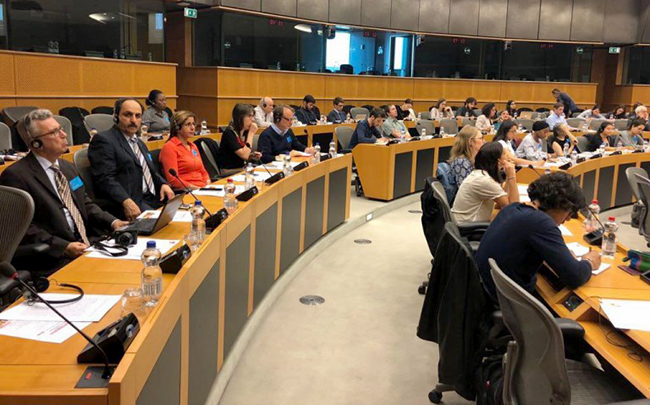
A delegation of Women Association and Ava association attended a conference by socialist democrats of the European Parliament on Thursday May 24, 2018.
The conference was held to discuss the legal and humanitarian situation of the refugees in Europe. It was headed by MEP Antonio Panzeri member of the Progressive Alliance of Socialists and Democrats.
Former members of the Mujahedin Khalq Organization (the MKO/ MEK/ PMOI/ the Cult of Rajavi), from Ava and Women Associations who attended the meeting included Batoul Soltani, Amir Movasaqhi, Reza Jebelli and Ali Akbar Rastgou.
Challenging the leadership of the MKO, Reza Jebeli addressed the audience:
“We were all members of the organization [that was] based in Iraq. We were there for many years. We were disconnected from the outside world. We had no relation with our families. Many of our loved ones died during the years. We had no way to contact them. We were with this organization called Mujahedin, Iranian Mujahedin.”
Mr jebeli went on to demand the president of the event to watch out Maryam Rajavi’s visits to the Parliament. “The next time Maryam Rajavi -which comes here to the parliament hall all the time and talk about human rights—ask them about this two thousand people that right now is in Abania [in a] refugee camp and they are segregated and they have no right to visit their family,” he stated. “So this is a question I will ask you please if you could investigated the situation in Albania.”
He also warned the European parliament and the UN on the relocation two thousand members of the MKO as an organization that was previously listed as a terrorist group in a European country.
Mr. Jebeli expressed his concerns about those who are still in the MKO military-like camp in Tirana because they have no way out. He described their situation as “dangerous”. “The enemy of your enemy is our nightmare”, he asserted.
Nejat Society

WE THE PEOPLE ASK THE FEDERAL GOVERNMENT TO TAKE OR EXPLAIN A POSITION ON AN ISSUE OR POLICY:
STOP TERRORIST RAJAVI ENTERING USA!
Link to the Petition page (Sign the Petition)
https://petitions.whitehouse.gov/petition/stop-terrorist-rajavi-entering-usa
The Honorable Donald Trump,
We, the undersigned, respectfully petition you not to allow the terrorist Maryam Rajavi of the Mujaheddin Khlaq (aka MEK) to enter the USA.
We remind you that MEK was responsible for the killing of American servicemen in Iran before the revolution. One of their victims was US Air Force Lieutenant Colonel Turner who was an American Patriot that was murdered in front of his children in Tehran on May 21, 1975.
It is an insult to the late Colonel Turner and his family and the family of other brave US serviceman murdered by Terrorist Rajavi, if she is allowed to enter the USA.
Please do not desecrate the names of these brave souls by allowing the terrorist Rajavi into the United States.
Thank you and God Bless America
Coalition of Iranian Opposition Groups
(END)
Descendants of ‘gun-toting cowhands’ insulting Iranian nation: Judiciary chief
TEHRAN – Denouncing U.S. President Donald Trump’s aggressive tone and actions against the Iranian nation, Judiciary chief said on Monday that those who are descended from “gun-toting cowhands” are insulting the great Iranian nation whose civilization dates back to thousands of years ago.
Hinting at insults by successive U.S. administrations to the Iranian nation, Ayatollah Sadeq Amoli Larijani said, “We have not forgotten how the new, amateur president of America insulted the Islamic Republic and the dear people of Iran by calling them a ‘terrorist nation’.”
“The biggest civilizations emerged in this territory,” he asserted.
He further said the U.S. is still trying in vain to break the “will” and “power” of the Iranian nation without regard to its past 40 years of failures. “Such wickedness is still ongoing in America’s governing body,” he continued.
Elsewhere in his remarks, Amoli Larijani pointed to the U.S. withdrawal from the 2015 nuclear agreement, saying exiting an international treaty is “indigestible” for every country, “but the U.S. does such thing through bullying.”
He also pointed to the impact of Mojahedin-e Khalq Organization (MKO/MEK), an anti-Iran terrorist group, on U.S. politicians, saying that with the help of the MKO the U.S. has been trying to disrupt the Iranian economy.
Trump’s new national security advisor John Bolton is in close contact with the MKO which has done numerous terrorist activities in Iran and joined Saddam Hussein’s army in the fight against Iran in the 1980s.
Amoli Larijani said the U.S. “has unfortunately fallen in this wrong direction by the illusions and fantasies of [such] terrorist groups.”
“Today, the advisors of the American government are linked with the most notorious and most evil terrorists in the world,” he said, adding that the MKO terrorists are moving the U.S. government in the wrong direction by raising their hopes of the collapse of the Islamic Republic.
The Judiciary chief also highlighted the importance of gaining “insight, unity and empathy” to foil the plots hatched by the country’s enemies.
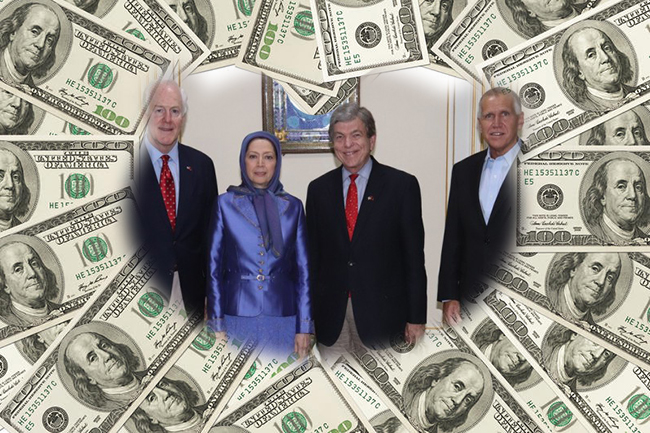
Iran’s radical pseudo-Marxist cult Mohajedeen e Khalq, better known by its acronym MEK, is somewhat reminiscent of the Israel Lobby’s American Israel Public Affairs Committee (AIPAC) in that it operates somewhat in the shadows and is nevertheless able to punch well beyond its weight by manipulating politicians and understanding how American government functions on its dark side. MEK promotes itself by openly supporting a very popular hardline policy of “democratic opposition” advocating “regime change” for Iran while also successfully selling its reform credentials, i.e. that it is no longer a terrorist group. This latter effort apparently convinced then Secretary of State Hillary Clinton on 2013 as she and President Barack responded to the group’s affability campaign by delisting MEK from the government list of terrorist organizations.
This shift in attitude towards MEK was a result of several factors. First, everyone in Washington and the Establishment hates Iran. And second, the Executive Order 13224, which designates Iran’s Revolutionary Guards as a terrorist organization, ipso facto defines any group fighting against it as one of the good guys, justifying the change.
MEK is best described as a cult rather than as a political movement because of its internal discipline. Its members are, according to the testimony of those who have somehow escaped, subjected to considerable indoctrination best described as brainwashing. Though not exactly imprisoned, adherents are kept isolated and separated insofar as possible and cannot contact their families. Their possessions are collectivized so they have no money or other resources. If they are in contravention of the numerous rules that guide the organization they are punished, including physically, and there are reports of members being executed for trying to escape.
The current head of the group is Maryam Rajavi, the wife of the deceased co-founder of MEK, Massoud. She is reported to be politically savvy and speaks excellent English learned in part to enable her to communicate with adoring American politicians. The group itself was founded in 1965. Its name means “People’s Holy Warriors,” derived from its Marxist/populist roots and its religiosity. It was not unlike the Taliban which developed in adjacent Afghanistan. During the 1970’s it rebelled against the Shah and was involved in bombing and shooting American targets. It executed U.S. Army Lt. Col. Lewis Hawkins in 1973 as he was walking home from the U.S. Embassy and in 1975 it killed two American Air Force officers in their chauffer driven car, an incident that was studied and used in CIA training subsequently as an example of how not to get caught and killed by terrorists. Between 1976 and 1978 the group bombed American commercial targets and killed three Rockwell defense contractors and one Texaco executive.
MEK welcomed the Iranian revolution and also the occupation of the U.S. Embassy but soon fell afoul of the Ayatollah Khomeini regime. It eventually moved to join Iran’s enemy Saddam Hussein in Iraq and participated on the Iraqi side in the bloodletting that followed when the two countries went to war in 1980-8. For that reason alone, MEK is particularly hated by most Iranians and the repeated assertion that it is some kind of “Iranian democracy” alternative is ridiculous as the people in Iran would never accept it. In terms of the duplicity surrounding its marketing, it is reminiscent of Iraqi con artist Ahmed Chalabi, who also had little following inside Iraq but was able to convince Pentagon geniuses like Paul Wolfowitz that he represented some kind of democratic movement. At the time Chalabi was also secretly working for Iran.
MEK was protected by Saddam and later by the U.S. invaders who found a weapon to use against Iran useful. They were housed in Camp Ashraf near Baghdad, and later, after Ashraf was closed, at so-called Camp Liberty. In 2013, when the Iraqis insisted that they go elsewhere the President Barack Obama facilitated their removal to Albania under the auspices of the United Nations refugee program, with the $20 million dollar bill being footed by Washington. The organization’s political arm, the National Council of Resistance or Iran (NCRI), meanwhile established itself in Paris under the control of Maryam Rajavi, in part to place it closer to the American and European sources of its political legitimacy and financing. In 2001, to make itself more palatable, the group had renounced violence.
The MEK folks in Albania have become a bit of a problem. Through various additional migrations they have multiplied and now number around 3,000 and have largely adhered to their cultish ways even though one of the original objectives of the move into Europe was to somehow deprogram and “deradicalize” them in an environment far removed from Iran-Iraq. Part of the problem is that the Albanian government likes the U.N. subsidies used to support the MEK associates, but it will not let them work as they have no legal status and they cannot resettle or lead normal lives. So they resort to criminal activity that includes promotion of fraudulent charities, drug trafficking and even a form of slavery in which their own people are sold and traded as laborers.
The temporary solution has been to move the MEK out of a rundown university property in the capital Tirana to a more remote site in northern Albania dubbed Ashraf-3, but local people believe that that is just kicking the can down the road and that MEK should be forced to go somewhere else, preferably in the United States, which seems to like them so much.
Also, Albania is majority Muslim and has been subjected to the same Saudi Arabian ultra-conservative wahhabi promotion backed by lots of money that has plagued many states in the Middle East. Albanians accustomed to the mild form of Turkish Islam suddenly found themselves confronting the Sunni-Shia divide and also the MEK as agents of both Saudi Arabia and Israel. Many outraged Albanians see the unreformed MEK in their midst as a terror time bomb waiting to go off, but the government, under pressure from the U.S. Embassy has not sought their removal.
Meanwhile back in the United States everything involving the non-deradicalized MEK is just hunky dory. MEK and the NCRI are enemies of Iran and also seem to have plenty of money to spend, so they buy high ranking American speakers to appear at their events. Rudy Giuliani and John Bolton have appeared regularly, as have Senators John McCain, Lindsey Graham and Jeanne Shaheen. At a 2015 appearance in Paris, Giuliani brought the crowd to its feet by calling for “Regime change!” after shouting out that the “Ayatollah must go!” In August 2017, Senators Roy Blunt, John Cornyn, Thom Tillis and Carl Levin met with Rajavi in Paris. Newt Gingrich also considers himself a friend of the Iranian resistance while Elaine Chao, Secretary of Labor and wife of Senate Majority leader Mitch McConnell spoke in Paris for five minutes in 2015 and was paid $50,000. The payments made to the other politicians have not been revealed.
And then there is the Saudi and Israeli angle. Saudi Arabia is now the major funder of MEK/NCRI. It’s intelligence chief Turki al-Faisal spoke before the group in 2017. Israel funded the group in its early days and its external spy service Mossad continues to use MEK stay-behinds in Iran to assassinate scientists and tamper with computer systems. The CIA, which recently expanded its anti-Iran task force, it also working closely with MEK. And Giuliani, Bolton, Chao are all in the White House inner circle, which, not coincidentally, is baying for Iranian blood.
Lost in all of the above is any conceivable American interest. It is difficult to even make the claim that Iran threatens the United States or any vital interest and the drive to decapitate the Mullahs, both literally and figuratively, really comes from Riyadh and Tel Aviv. And there is potential collateral damage where it really might matter as MEK cultists continues to sit and fester in a holding pattern maintained by Washington in the heart of Europe. What comes next? War of some kind with Iran is appearing to be increasingly likely given recent remarks by Secretary of State Mike Pompeo, threating to crush the Iranians. Is Washington intending to send the MEK warriors on sabotage missions inside Iran, something like the resistance to the Germans in World War 2? Maybe Giuliani and Bolton know the answer to that question.
Philip Giraldi, Global Research
While the dogs of war bark, the Ancient – and New – Silk Road goes on forever and a civilization with a long and proud history gets on with life
The minute you set foot in the streets of Mashhad, the air smelling of saffron, a fine breeze oozing from the mountains, it hits you; you’re in the heart of the Ancient Silk Road and the New Belt and Road Initiative (BRI).
To the east, the Afghan border is only three hours away on an excellent highway. To the north, the Turkmenistan border is less than four hours away. To the northwest is the Caspian Sea. To the south is the Indian Ocean and the port of Chabahar, the entry point for the Indian version of the Silk Roads. The Tehran-Mashhad railway is being built by the Chinese.
A group of us – including American friends, whose visas were approved at the highest levels of the Iranian government – have gathered in Mashhad for the New Horizon Conference of independent thinkers. Right after a storm, I’m in a van on the way to the spectacular Imam Reza shrine with Alexander Dugin, which the usual suspects love to describe as “the world’s most dangerous philosopher,” or Putin’s Rasputin.
We’re deep in debate not over geopolitics but … bossa nova. Exit Sun Tzu and Machiavelli, enter Tom Jobim and Joao Gilberto.
Persia traditionally has been a land of serious intellectual discussion. At the conference, after a lunch break, a few of us decide to start our own geopolitical debate, no cameras rolling, no microphones on. Dugin expands on what multipolarity could be; no universality; pluriversal; a realm of pluralistic anthropology; all poles sovereign. We discuss the pitfalls of Eurasian identity, Islamic identity, sub-poles, India, Europe and Africa.
A few minutes later Iranian scholar Blake Archer Williams – his nom de plume – is delving into “The sacred community of Shi’ite Islam and its covenantal dispensation.”
Karaj is a bustling three million-strong city one hour away from Tehran by freeway. Early one morning I enter a room in a hawza – an Islamic seminary. In my previous travels I have visited hawzas in Qom, but never a female-only school. This one harbors 2,275 active students from all over Alborz province up to PhD level. They study philosophy, psychology, economics and politics. After graduation, some will go abroad, to teach in Islamic and non-Islamic nations.
Our Q&A is exhilarating. Many of my interlocutors are already teachers, and most will become scholars. Their questions are sharp; some are extremely well informed. There’s so much eagerness to know detail after detail about life in the West.
The next day I visit the Islamic Azad University; more than four million alumni, 1.4 million current students, 29,000 faculty members, 472 campuses and research centers and 617 affiliated high schools. The Karaj campus is the second in importance in Iran.
This is an extraordinary experience. The hillside campus may not be a UCLA, but puts to shame many prestigious universities across Europe. Not to mention the annual tuition fees; only US$1,000 on average. Sanctions? What sanctions? Most of the equipment may yield from the 1980s, but they have everything they need. As attested by jovial master architect Ali Kazemi, who spent 16 years in Paris after graduating from Nanterre, the academic standards are very high.
Rector Mohammad Hasan Borhanifar – formerly at the University of Kyrgyzstan in Bishkek – opens all the doors at the campus. I’m shepherded by Mohammad Hashamdar, from the Faculty of Languages. I talk to the deans of all faculties and have a Q&A with students, mostly in international relations.
Even before the proclamation of the “strongest sanctions in history,” everyone wants details on the US Treasury’s new form of financial war, even more deadly than a hot war. In slightly more than two months, the purchase of US dollars, steel, coal and precious metals will be banned; there will be no more Iranian imports to the US and aviation and the car industry will be under sanctions.
Airbus may have to cancel multi-billion dollar orders from Iran. An IT professor tells me Iran can buy excellent Sukhoi passenger jets instead. No Peugeots? “We buy Hyundai.”
My interlocutors update me on investments by Total, Airbus, BASF, Siemens, Eni – its branch Saipem signed a $5 billion deal with the National Iranian Oil Company, NIOC, to develop oil and gas fields and ultimately supply energy to Europe. They confirm that if Total pulls out of the development of the 11th phase of the South Pars gas field, the Chinese CNPC will take over.
Almost 70% of Iran’s oil exports go to China and Asia, 20% go to Europe. Almost 90% of what the EU buys from Iran is oil, going mostly to Spain, France, Italy, Greece, Germany and the Netherlands. Iran remains THE Big Prize, as Dick Cheney well knew; an astonishing $45 trillion in oil and gas reserves.
I’m slightly alarmed when, talking to the Friday prayer imam – who is the actual representative of Ayatollah Khamenei in Karaj – he’s clueless about the New Silk Roads. Just as the Ancient Silk Road allowed Buddhism to fertilize Chinese culture, Iran, India and China are bound to cross-fertilize again; imagine a trans-Eurasia lab equipped with a wide gene pool and well-educated young armada searching for creative solutions.
The LA freeway hell pales in comparison with being stuck in a monster three-hour traffic jam from Tehran to Karaj, only 25 kilometers. I duly incorporate a Persian imprecation to my vocabulary; kharab beshe, which in polite translation means “going to nowhere.” I miss my requisite geopolitical dinner with Professor Marandi of the University of Tehran; we do it later on Whatsapp – like MBS and Jared Kushner.
What daily life in 17 million-strong, congested to death Tehran reveals is the standard of living essentially of a mid-level emerging nation. Everyone has a car, and smartphones and wi-fi are ubiquitous. In parallel, everywhere we feel intimations of a Persian civilization boasting at least a millennium of fabulous history even before Islam was born. And when we talk to the secularized intellectual elite, it’s clear that for them, in comparison, Arabs are nothing but trouble.
Everywhere I go I’m back in the ’70s; the whole infrastructure seems decades old, but everything works. Except for timing; Iran might as well be the land of magical realism 2.0, where the unexpected happens when all hope has been forsaken.
In Mashhad, I’m the guest in a political talk show on Khorasan TV – in a studio immaculately preserved from the ’70s. Yes, this is the heart of the fabled Khorasan – “where the sun arrives from” – that transfixed Alexander The Great. I spend half an hour dissecting the JCPOA; my translator is an over-qualified import-export expert. Khorasan TV’s blockbuster is an American-style cop show essentially covering road accidents in real time; after all, the crime rate is negligible.
Real inflation is at 16% a year – so far. Foreign exchange inflation is much higher. Real youth unemployment is at a steep 30%, in a country of 80 million where the median age is 29 and 40% of the population is under 24. One of my translators in Karaj, Ali, is 24; he’s unemployed, learned English by watching DVDs and cannot afford to rent his own place.
Under the new rial devaluation, the median regional salary plunged to about US$250 per month. One cannot rent a 40 square meter apartment near Azad University for less than $200 per month.
I stop for a late night pizza in Mashhad. The bill reads a whopping 200,000 rials; that’s a little more than $3. The euro in the black market spikes to nearly 80,000 rials.
Telegram has been blocked – but still, everyone uses both Telegram and WhatsApp. Some VPNs work, some don’t. The block was not necessarily linked to the spread of anti-government rumors during the January street protests – which actually started in Mashhad.
Elaheh, who did her language master in France; Bojan, who has a PhD in economics from San Diego State; or Ayoub Farkhondeh, who works on terrorism studies at the Habilian research institute, are all amused by the “bizarre” coverage by Western media of all things Iran.
The analysis of well-educated people in both Mashhad and Tehran tends to qualify the protests as essentially IMF riots – which happen when the Washington Consensus forces governments to reduce subsidies. Real revolutions, in Iran, involve clerics, middle-class intellectuals and the bazaaris.
This time the focus was the grassroots; the working class in small provincial cities. Millions in Iran, after all, depend on government salaries and subsidies. In contrast, Team Rouhani is essentially neoliberal.
Of course, there’s government criticism – more towards the clerics than neoliberal Team Rouhani. Businessmen told me of untold ministerial-level corruption – but it’s virtually impossible to verify the numbers. The Pasdaran, as the IRGC is referred to, continue to control a great deal of the economy and to manage a welfare system and client system that distributes favors to millions of people, but also imposes rigid social control.
At the same time, not looking at Iran via a windowless cubicle in Washington but actually on the ground, it’s clear that NSC Adviser John Bolton’s plan to revive the Mujahedin-e Khalq, known as MEK, to attempt a color revolution will fail miserably. MEK is universally despised. The whole of Iranian society won’t blame either Khamenei or Rouhani for the incoming economic war.
Persian politeness, hospitality and graciousness always strike a visitor as deeply touching. All that combined with an obsession with the image that the West has of Iran. Iran does not seek “isolation”; it’s Washington politics that wants it isolated.
So no wonder Europe is on the spot. The EU will activate a 1996 law which forbids European companies to comply with US sanctions, protecting them “against the effects of the extra-territorial application of legislation adopted by a third country.” Still, the question is ubiquitous; “The Europeans will side with us or the Americans?”
In parallel, Iranians don’t want to be like the West. And the best way to understand it is by visiting the Imam Reza shrine over and over again – I went early in the morning, after an afternoon storm, and at night.
The Imam Reza shrine, known as Astan Qods-e Razavi, is a marvel enveloped in golden and turquoise domes, lavish minarets and 12 courtyards spread over one million square meters. It hosts the largest Iranian NGO; a centuries-old administrative structure encompassing eight general directorates, more than 50 industrial, agricultural and service companies, over 15 cultural and research institutions and more than 12,000 students.
The 12th-century library at the shrine is one of the world’s oldest, along with Alexandria, the Vatican and Topkaki. Ayatollah Khomeini ordered its preservation. The public library holds four million books in more than 90 languages. There’s even a lab to “cure book diseases.” Mashhad runs a library in India plus a documentation center with more than 18 million items, including a 1,300-year-old document linked to Imam Ali.
Before leaving on a night flight to Doha, I visit the shrine one last time with two fine, steeped in history, Italian observers, ace journalist Giulietto Chiesa and writer Roberto Quaglia. It’s the first day of Ramadan. We’re speechless facing the crossover of aesthetic beauty, spiritual illumination and plain old fun.
Whole families gather, improvise a picnic, chat, take selfies, kids roam around playing. Instead of being glued to some dodgy version of Big Brother, like most across the West, they prefer to live life in a shrine. It is indeed an organic “third day,” like a government insider told me in Tehran.
Meanwhile, a Chinese train is snaking along from Mongolia to Tehran carrying sunflower seeds. While the dogs of war bark, the Ancient – and New – Silk Road goes on forever.
By Pepe Escobar, Atimes.com
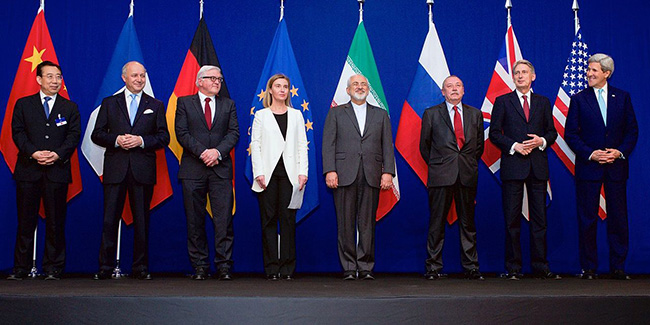
The Trump White House plans to break the Iran deal by sanctioning companies from Europe and Asia doing business in and with Iran. Ironically, President Obama paved the way to unilateral sanctions.
For three years, the comprehensive nuclear accord (JCPOA) has offered Iran relief from US, UN, and multilateral sanctions on energy, financial, shipping, automotive and other sectors. But recently that era came to a halt. “The United States will withdraw from the Iran nuclear deal,” President Trump said on May 8.
Two weeks later, Secretary of State Mike Pompeo, the ultra-conservative former head of the CIA, said Washington will impose “the strongest sanctions in history [on Iran] once they come into full force.”
In contrast, Chinese Foreign Minister Wang Yi has reiterated Beijing’s support for the deal. “China will continue to work to maintain the deal,” Wang said, stressing that the agreement was “hard-earned.” By the same token, the other key signatories of the nuclear deal—UK, France, and Germany, and Russia—say the deal will be sustained.
American internationalism began a century ago, when President Woodrow Wilson purported to “make the world safe for democracy.” That’s no longer the goal (if it ever was). Rather, the objective is now to ensure US unipolarity in a multipolar era, by any means necessary.
Regionally, Trump’s quest for primacy leans on Saudi Arabia for economic and geopolitical support, as evidenced by the $110 billion arms deal with Riyadh a year ago, and reinforced security ties with Israel, as reflected by US recognition of Jerusalem as capital of Israel—another fatal policy mistake that reversed decades of US foreign policy.
Now America also plans to “apply unprecedented financial pressure on the Iranian regime,” as Pompeo said. The administration’s objective is to restore primary sanctions that were lifted after the International Atomic Energy Agency’s (IAEA) certification in January 2016 that Iran had complied with the agreement. As secondary sanctions on firms have remained in place, along with sanctions applying to US companies, including banks, the White House will fortify them.
In a typical unipolar move, the Trump administration is extending sanctions over to EU firms that have done business in and with Iran since the 2015 nuclear deal, thus raising risks for their U.S. access. As Treasury Secretary Steven Mnuchin says, EU-Iran business agreements will be voided as “the existing licenses will be revoked.”
Along with Renault, PSA Peugeot Citroen and Sanofi, French companies have huge stakes in the deal, thanks to the $21 billion Airbus contract and the oil giant Total’s $2 billion deal to develop the South Pars oil field. Some 120 German companies, including Volkswagen and Siemens, operate in Iran and another 10,000 do business with Iran. Royal Dutch Shell would be adversely affected.
Economic pressure could harm significantly Iran’s oil industry which is the fourth largest reserve holder of crude oil in the world and whose largest buyers include China, South Korea, Turkey, Japan, Italy and India.
During the sanctions era, Iran shifted toward Asia and it has a vital role in the China-led One Road One Belt initiative. Indeed, through the worst days of the 2010-16 sanctions, Asian countries remained engaged in Iran’s economy. In the coming years, these countries hope to support Iran to become a major regional trading hub and to diversify its economy away from oil and gas. But if the White House sanctions EU companies for Iran business, it will sanction firms from Asia as well.
In the 2003 Iraq War, President Trump’s new National Security Advisor, John Bolton, relied on false data from U.S.-based Iraqi exiles. Since last fall, Bolton has been urging the US to implement a similar regime change with Mojahedin-e Khalq (MEK), which was de-listed as a terrorist group by Secretary of State Hillary Clinton in the early 2010s. MEK is an Iranian opposition group which has lucratively financed and then been lobbied by former heads of the CIA, FBI and the Homeland.
Bolton wants a new regime in Tehran before February 2019—the 50th anniversary of the revolution.
With his pledges to withdraw from the climate and nuclear accords and America’s key trade agreements (e.g., North American NAFTA, Asia-Pacific TPP, and US-EU TTIP), Trump has electrified the historical debate on the legality of US withdrawal from treaties and other international agreements.
While the US constitution sets forth a process whereby the executive has the power to make treaties with the advice and consent of the Senate, it does not specify how such treaties can be terminated. The nature of the agreement matters as well. When the president enters into executive agreements, these do not receive the Senate’s advice and consent. But such “political commitments” are not seen as binding. As a result, the US will withdraw if the Iran deal is not renegotiated.
Ironically, it was the President Obama who created the opportunity for such strategic maneuvering. When his administration concluded the JCPOA, it considered the plan of action a non-binding political commitment, which allows the Trump administration to argue it has ability to withdraw from the JCPOA. True, on 2015, the Security Council unanimously adopted resolution 2231 endorsing the Iran deal. So Trump’s critics could argue that the resolution converted at least some provisions in the JCPOA into obligations that are binding under international law which would mean a complex and long debate.
Yet, today such critics seem to be largely absent. When Obama concluded the Iran talks, most Democrats hailed the accord. Yet, most Democrats turned their coats in late 2016, the Senate and the House of Representatives unanimously extended the Iran Sanctions Act for a decade.
As a legal scholar, Obama knew well the loopholes his administration left to its successor. His (few remaining) supporters say he concluded the deal out of political expediency (not enough Republican support in the Congress). Others see it as a “Wilsonian” failure (adequate authority to sign the deal but not to implement it). But radicals believe that Obama, who was trained in the CIA front Business International Corp. in the ‘80s, was used to pave the way to withdrawal.
In a recent meeting with President Xi Jinping, German Chancellor Angela Merkel sought a common strategy to ward off a trade war, keep markets open and a unity in the nuclear deal. It is a stance that is aligned with the interests and values in Beijing.
Whatever the legal pretexts for Trump’s withdrawals, they herald the end of Wilsonian internationalism in America. In the past, Washington, Brussels and Tokyo shared similar interests and values, it was said. As the White House is substituting unilateral bullying for multilateral diplomacy, those days are busy fading into history.
By Dan Steinbock, atimes.com
This article was originally published by South China Morning Post (Hong Kong) on May 25, 2018.