Nejat Society
  • Home
  • Articles
  • Media
    • Cartoons
    • NewsPics
    • Photo Gallery
    • Videos
  • Publications
    • Books
    • Nejat NewsLetter
    • Pars Brief
  • About Us
  • Contact us
  • Editions
    • عربي
    • فارسی
    • Shqip
Nejat Society
Nejat Society
  • Home
  • Articles
  • Media
    • Cartoons
    • NewsPics
    • Photo Gallery
    • Videos
  • Publications
    • Books
    • Nejat NewsLetter
    • Pars Brief
  • About Us
  • Contact us
  • Editions
    • عربي
    • فارسی
    • Shqip
© 2003 - 2024 NEJAT Society. nejatngo.org
Albania - Elona Gjebrea
The cult of Rajavi

Mojahedin Khalq terrorist training camp in Albania impacts whole Balkan region

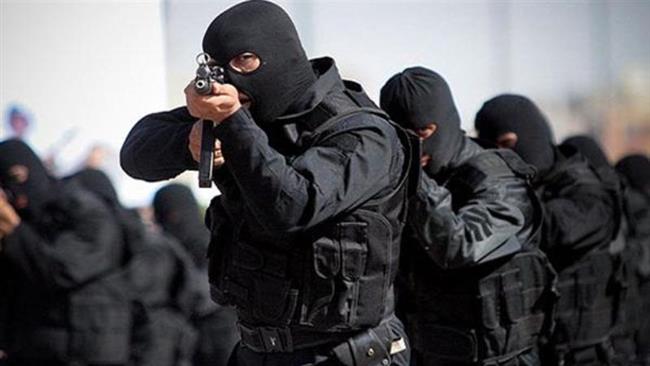
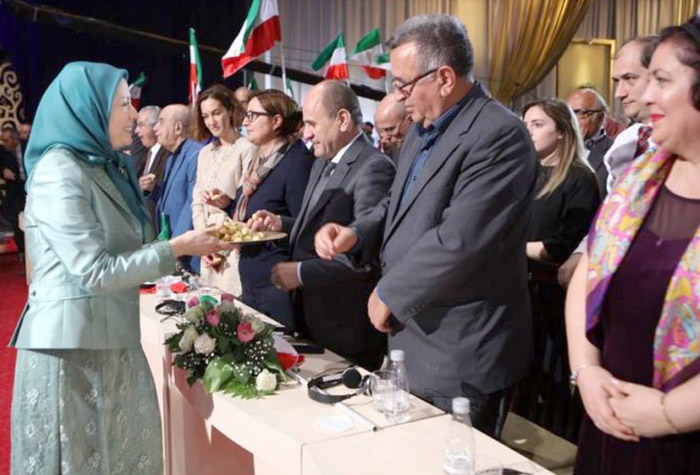
Residents of Tirana no doubt welcomed news that members of the terrorist Mojahedin Khalq organisation (MEK) have moved out of the capital to a closed camp in Manëz, Durres a few kilometers from Tirana. Citizens had been disturbed by the bizarre, anti-social behaviour of the group’s members and puzzled by their lifestyle.

However, they might not be so pleased if predictions come into play. That is, the arrival of widows and orphans of killed Daesh fighters to occupy the apartment blocks and university campus recently deserted by the MEK.
Albania - Elona Gjebrea

There is every possibility this will not happen though. The agreement brokered between Prime Minister Sali Berisha’s government and the Obama Administration in 2013 to bring the MEK there included the establishment of an Institute for De-Radicalisation which would have made sure the 3000 radicalized MEK fighters were rehabilitated safely back into normal society.

This did not happen. There is, therefore, no American funded Institute to de-radicalise incoming Daesh members. Instead, the MEK locked down on its control over its own members and has further managed to groom Albanian politicians, officials and mafia heads into cooperating with and supporting them. This latest move to a new base is part of the MEK’s overall survival strategy – hold on to members and promote the MEK’s brand as instigators of regime change against Iran.The building of a new base was first exposed when investigative journalist Gjergji Thanasi uncovered shipments of cement which were not linked to tax or import documents. Further investigation revealed plans to build a terrorist training camp in the Manëz area. The camp has a small-arms firing range, reinforced concrete armoury, 3.5-meter-high walls with lookout turrets to guard the entrance. The entrance is guarded by MEK personnel. Albanian authorities have no jurisdiction inside the camp. It is a de facto extra-judicial enclave.
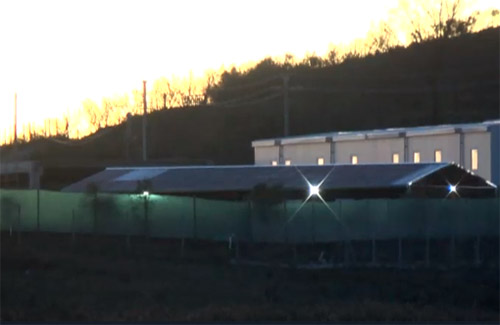
The MEK, led by Maryam Rajavi from France, keeps its members behind closed doors in a state of modern slavery which neither the UNHCR nor the UN-IOM appear able or willing to deal with. Significantly the camp is named ‘Ashraf Three’ after the MEK’s original military base in Iraq, gifted to them by Saddam Hussein to help his war effort against Iran (1980-88). The newest camp has also been gifted to the MEK by its backers.

With this backing, the MEK feel secure enough in Albania to have conducted several open acts of violence. Two in Tirana and one in the European Parliament. But it is events in Iran which are a greater cause for concern.

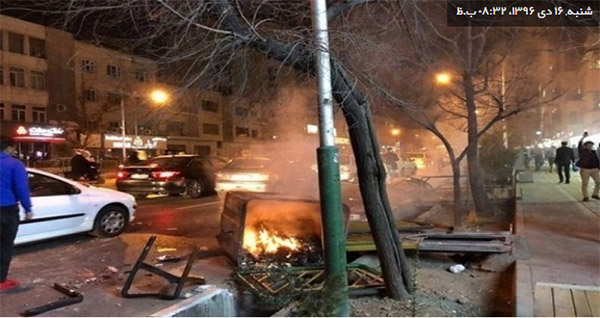
Now that the protests and unrest in Iran have been quelled, some facts are emerging which could have serious repercussions throughout the Balkans region. What began as working-class protests against economic hardship and government corruption were quickly politicised by agitators who introduced violence. Security authorities arrested hundreds of protesters who were alleged to have taken part in this violence. Most have since been released pending further investigation. These investigations will look closely into interference by external forces behind the violence. A state of affairs acknowledgedin a Security Council meeting on Friday 5th January when the isolated Trump Administration was warned by other members against interfering in Iran’s internal affairs.

Major General Mohammad Ali Jafari, commander of the Islamic Revolution Guards Corps (IRGC) announced that a number of people involved in the violence had been trained by the terrorist MEK. Iran’s Intelligence service in the western Iranian province of Lorestan also said it had disbanded and arrested four members of a terrorist cell linked to the MEK in Boroujerd city. According to Iran, Intelligence services have uncovered a network of agitators organised from Afghanistan and Arbil in Iraqi Kurdistan. This network had been making preparations for several months and had planned to launch violent actions later in 2018. It appears that the spontaneous working-class protests against high prices and corruption triggered the network to jump on this bandwagon ahead of schedule.

If the plan was to provoke Iran’s security services into a harsh crackdown on the protesters which would be spun in western media as human rights violations, this did not work. Instead the establishment brought out its supporters in massive counter demonstrations. But above all, when the protests turned violent, ordinary people went home. They wanted no part in manufactured regime change.
The discovery of MEK involvement is not surprising. The group has been a favourite tool for anti-Iran regime change pundits for decades when it was based in Saddam Hussein’s Iraq. In an interview with Serbian Sputnik, political analyst Aleksandar Paviç warned that “Trump, along with Israel, has a clear plan and this is being activated today by Albania. The CIA and Israeli services are preparing soldiers to send them to war in Iran to overthrow the regime”.

Although the MEK has lobbying offices in nearly every major western capital, there is only one MEK terrorist training camp. It is in Albania – Ashraf Three. The camp may look innocuous and may be far away from civilian eyes. But Albania and thereby the greater Balkan region – a kind of frontline between Russia and America – will pay a high price for hosting this group.

The MEK is not only calling for violent regime change from inside Albania, it is actively training terrorist agents to deploy for this mission. This means that Iran, a Russian ally, now has a direct interest in this region. Albania can now be considered a frontline country in Iran’s fight against terrorism.

At the same time, no wonder that the European Union regards Albania not as a friendly neighbour but as a security risk right on its doorstep. There is no chance whatsoever of Albania joining the European Union while it hosts the MEK terrorist group.

The Gordian Knot of Balkan states which neither the Americans, Russians nor the EU have been able to unpick would be best served if these countries found common cause in ridding this sensitive area of the one group which serves none of their interests. Nobody wants it cut by an Iranian sword.

Anne Khodabandeh (Singleton), Balkans Post,
January 10, 2018 0 comments
FacebookTwitterPinterestWhatsappTelegramSkypeEmail
Mujahedin Khalq; A proxy force

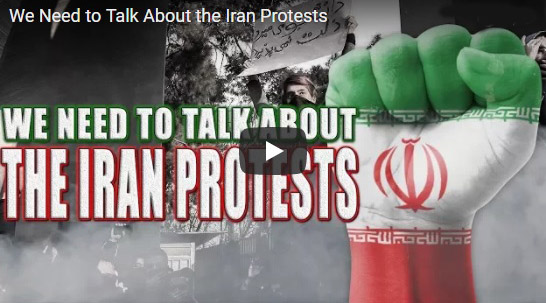
Episode 326 – We Need to Talk About the Iran Protests

Are these protests in Iran spontaneous, or are they the result of another regime change operation? This week on The Corbett Report, James explores the past, present and future of US and Israeli involvement in Iran, and the attempts to foment unrest in the country.

https://dlb.nejatngo.org/Media/Report/Corbet-Report-Iran.mp4

To download the video file click here

TRANSCRIPT

Late last month reports emerged of a secret deal reached between the US and Israel setting out a wide-ranging plan to confront Iran in a number of different areas.

Reports have just come out claiming that the United States and Israel have signed a secret deal to tackle the nuclear threat from Iran, so it looks like the deal isn’t so secret anymore. The far-reaching Memorandum of Understanding was signed on December 12th at the White House following intense talks between both nations and plans to set up four teams to handle various aspects of the Iranian threat. One team will focus on Iranian activityin Syria and Lebanon, another will deal with both diplomatic and intelligence activities to grapple with Iran’s nuclear weapons ambitions, a third will tackle Iran’s ballistic missile program and the fourth will oversee preparations for any escalation by Iran or Hezbollah.

SOURCE: Your Morning News From Israel – Dec. 31, 2017

And then, just two days after that report broke, just three weeks after the plan itself was agreed, a wave of protests broke out across Iran. These protests, originating in discontent over the performance of the economy under the Rouhani government, soon morphed into rallies, riots and violence aimed against the Iranian republic itself.

Could these protests be the result of the US and Israeli plan to undermine Iran? If these were just two isolated data points then connecting these dots would be a stretch. But when we put recent events into their proper perspective, there is no doubt that the US, Israel and their allies are actively supporting and fomenting regime change in Iran. And that’s why “We Need to Talk About the Iran Protests.”

This is The Corbett Report.

From the scattered and contextless news reporting of the mainstream media, it might appear that the protests happening right now are, in fact, a grassroots uprising against an unpopular and repressive regime. After all, this is what we are told by US Ambassador to the UN, Nikki Haley.

NIKKI HALEY: Now the Iranian dictatorship is trying to do what it always does, which is to say that the protests were designed by Iran’s enemies. We all know that’s complete nonsense. The demonstrations are completely spontaneous. They are virtually in every city in Iran. This is the precise picture of a long-oppressed people rising up against their dictators.

SOURCE: Ambassador Nikki Haley speaks on Pakistan, Iran

And surely no one can make the case that the Iranian people do not have valid reason to be upset at their government.

After years of rising unemployment and inflation and dwindling hopes for a foreign investment boom, even Supreme Leader Ayatollah Ali Khamenei is upset with the country’s economic outlook under President Hassan Rouhani. The government’s latest budget proposal, sent to parliament just weeks ago, has only made things worse, cutting an extremely popular cash transfer program instituted under previous President Mahmoud Ahmadinejad that gave each Iranian a stipend of about $90 per month.

The videos of the earliest demonstrations in this wave of protest, scattered footage of a few dozen protesters in the northeastern city of Mashhad calling for economic relief, are in line with the “spontaneous” uprising being touted by the political puppets and their mainstream media mouthpieces. But those early protests soon descended into chaos, mayhem, violence and death.

Now, with dozens dead and hundreds arrested, the question has to be asked: have the initial, grassroots protests been hijacked by regime change agents?

The question is by no means outlandish. In June of 2017, Secretary of State Rex Tillerson admitted to Congress that the government is actively working with parties inside Iran to help foment regime change inside the country.

Rep. Ted Poe: I would like to know what the policy is in the US toward Iran. Do we support the current regime? Do we support a philosophy of peaceful regime change?

[…]

Rex Tillerson: Our policy towards Iran is to push back on this hegemony, contain their ability to develop nuclear weapons and to work toward support of those elements inside of Iran that would lead to a peaceful transition of that government. Those elements are there, certainly, as we know.

SOURCE: Fiscal Year 2018 State Department Budget Hearing

That same month, it was revealed that the CIA has created a new mission center to focus exclusively on gathering and analyzing intelligence about Iran.

Ramping the tension up even further, it was reported just this past week that the US has given the green light to Israel to assassinate Qassem Soleimani, the commander of the Quds Force, the overseas arm of the Iranian Revolutionary Guard.

All of this comes on the heels of repeated warnings by President Trump over the past year that the US was preparing operations against the Iranian government.

Michael Flynn: President Trump has severely criticized the various agreements reached between Iran and the Obama administration, as well as the United Nations as being weak and ineffective. Instead of being thankful to the United States for these agreements, Iran is now feeling emboldened. As of today, we are officially putting Iran on notice. Thank you.

SOURCE: Michael Flynn: We’re Officially Putting Iran on Notice

Trump: It is far past time for the nations of the world to confront another reckless regime—one that speaks openly of mass murder, vowing death to America, destruction to Israel, and ruin for many leaders and nations in this room. The Iranian government masks a corrupt dictatorship behind the false guise of a democracy. It has turned a wealthy country with a rich history and culture into an economically depleted rogue state whose chief exports are violence, bloodshed, and chaos. The longest-suffering victims of Iran’s leaders are, in fact, its own people.

SOURCE: Trump Slams Iran at UN Speech

Colin Bray: Donald Trump made an ominous sounding statement to journalists following a meeting with top US military officials at the White House. He suggested the talks on Thursday, during which North Korea and Iran were discussed, were a prelude to a major event, but then declined to comment further.

President Trump: …Could be the calm. The calm before the storm.

Reporter: What storm, Mr. President?

Trump: You’ll see.

SOURCE: Trump warns he’ll ‘put an end to Iran’s aggression & nuclear ambitions’

But perhaps this is just hot air, political bluster designed to throw the Iranians off balance. Maybe these comments and the sudden wave of violence in Iran are coincidental. Is there any reason to think that the US, Israel and their allies are actually operating in Iran?

To answer this question, we have to see the current unrest not as a spontaneous protest arising in an historical vacuum, but as the end result of a century of interference in Iranian politics.

The modern era of Iranian politics traces back not to last month, but to 1951, when then-President of Iran, Mohammad Mosaddegh, nationalized the Iranian oil industry, revoking concessions that had been made to the Anglo-Persian Oil Company (later rebranded as British Petroleum) half a century earlier. This enraged the British and put the Americans—embroiled in the Cold War and worried about Soviet influence in the region—on edge. Together they hatched a plan—dubbed “TPAJAX” and led by Kermit Roosevelt, Jr.—to topple the government and strengthen the rule of the US-friendly Shah, Mohammad Reza Pahlavi.

The plan was comprised of four main components: the first was to begin a propaganda campaign portraying Mosaddegh as a communist; the second, to encourage the opposition to create disturbances; the third, to pressure the Shah to remove Mosaddegh from power and select a new prime minister; and fourth, to support Fazlollah Zahedi as Mosaddegh’s replacement.

With the propaganda campaign support for the opposition well underway, General H Norman Schwarzkopf arrived in Iran on August 1st armed with large bags filled with millions of US dollars. Scwarzkopf met with Zahedi and the Shah to assure them of US support. Roosevelt also entered Iran secretly under the alias “James Lockbridge,” and on the same day met with the Shah to discuss the execution of Operation Ajax. The Shah was to issue a decree to dismiss Mosaddegh and replace him with Zahedi.

On August 15th, the commander of the Imperial Guards, accompanied with three truckloads of soldiers, arrived at Mosaddegh’s home to issue his dismissal. Mosaddegh’s guards overwhelmed the soldiers and called for the immediate arrest of Zahedi, who was being hidden by the US in its embassy compound. The Shah, upon hearing of the coup’s failure, fled to Baghdad and the US began drawing up plans to pulls Zahedi and Roosevelt out of the country. Roosevelt, hoping to make use of the failed coup attempt, hired a large crowd at the cost of $50,000 to pose as communist tutor members and riot through the streets of Tehran, attacking mosques and statues of the Shah. Roosevelt also stepped up the propaganda campaign to link Mosaddegh with the rioting communists. In preparation for the second coup attempt, the CIA began bribing army and police officials. August 19th was the date set by the CIA for its next attempt to overthrow Mosaddegh.

On the morning of August 19th, the same mob hired two days earlier to pose as communist rioters entered the center of Tehran and began threatening and intimidating passers-by and drivers to display pictures of the Shah. The police, having already been paid off, failed to intervene the mob. Then, armed with knives, clubs, chains and sticks, began marching on Mosaddegh’s house. The CIA had told the mob to do everything possible to ensure the mob gets as much attention as possible. Taking the advice rather literally, the mob had hired wrestlers, tumblers, jugglers and clowns.

Zahedi came out of hiding from the US embassy and drove to the state radio station to announce his takeover. The shah’s imperial guards began attacking Mosaddegh’s house with artillery, sherman tanks and bazookas. Mosaddegh had once again managed to escape over the back wall. The ensuing battle between the Imperial Guards, the hired mob and Mossadegh guards claimed over 300 lives. Among those killed were the hired mob members who had been found with money still in their pockets given to them that very morning by CIA agents.

The same day, Zahedi declared himself Prime Minister and the following day Mosaddegh surrendered himself to the Shah’s forces.

SOURCE: U.S. and Them: Operation Ajax – Iran and the CIA coup

That 1953 coup casts a long shadow over Iranian politics in the modern era. The chain of events that foreign intervention set off led ultimately to the 1979 revolution, when the Iranian people, fed up with a Shah who was seen as an American puppet and who used his secret police to suppress political dissent, overthrew the government and instituted the Islamic Republic. As newly declassified documents reveal, however, even Ayatollah Khomeini, the self-proclaimed enemy of the American empire, was careful to keep an open channel of communication with the American government, extending from his first contact with “The Great Satan” in November 1963 (when he assured President Kennedy “he was not opposed to American interests in Iran”) to the midst of the revolution itself (when he assured President Carter that “You will see we are not in any particular animosity with the Americans” and insisted “The oil flow will continue after the establishment of the Islamic Republic”).

According to the sources of FBI whistleblower Sibel Edmonds, who experienced the revolution directly as a resident of Iran, even the infamous hostage-taking itself was a pre-arranged bit of political theater, designed to play into the anger of the Iranian people at American intervention even as it spared key American personnel from that wrath.

Sibel Edmonds: 14 15 years ago through one of the legal firms that I worked with during my case I I got to know this private part-time investigator the firm had hired. Now this man used to work for the CIA he was an agent and he spent years in Iran during the Shah’s regime. He introduced himself and he actually spoke Farsi, and I speak Farsi. I said “Wow! How did you learn?” He said “Well, I lived in Iran. I worked for the State Department / the agency,” and his cover was [that he was] the radio announcer for the English-language radio in Iran broadcast from the embassy. That’s one of the common covers there.

And he said, “You know the hostage-taking?” That infamous scene that whenever the US mainstream media talk about Iran, guess what they always like to show? They like to show these bearded men going there and taking over the US embassy and they’re taking these poor Americans as hostage. Barbaric, you know. I think that is the most famous scene that has been played billions of times by the US media. Because their masters want that scene being like this thing, you say “Iran” and the first thing people visualize is that hostage taking. “Those barbaric animals!” you know?

Well he was there and he said five or six days before the hostage taking “we” (State Department/CIA special staff members) were given a notice by cable to immediately leave Iran and go. And they gave us options: Greece, Turkey, Tunisia, etc. “Have some vacation time, beach time,” you know? “And then don’t come back to the United States until we got our next assignment for whatever country.” So he said “I packed immediately.” It was like, “Immediate! Now! You’re leaving Iran.”

All the embassy people who were connected to CIA, anybody high level were given notice to immediately leave Iran five days before that hostage taking. So the only ones left there were some administrative people. None of them were CIA, they got all the key staff and they got them out of the country okay and they left those poor patsies there to suffer, the administrative people, so that hostage taking incident would take place.

Now you and I would say therefore it was some sort of a pre-arranged incident. They got heads up that the regime and the rebels were going to take over the embassy. They were given timelines so that they could take the important step see the real bad guys, CIA people, out of the country okay, and then leave a few poor Americans in there to to go through the staged events.

So you are looking at a false flag. You’re looking at a staged event.

Source: Sibel Edmonds on the Khomeini / America Connection

But as much as those historical events have shaped the Iranian psyche and the Iranian body politic, the modern era of intervention against Iran began nearly two decades ago in secret planning meetings taking place in the bowels of the pentagon.

CLIP – CLARK SPEECH

The invasion of Iraq began in 2003 and by 2007 Seymour Hersh was reporting in the pages of The New Yorker that the Pentagon, living up to the plan revealed by Clark, had begun “The Redirection,” an attempt to refocus attention away from the escalating quagmire in Iraq and toward the neocons’ next target: Iran. This “redirection” involved the US allying with Sunni forces in the region—including radical Wahabi Sunnis and even Al Qaeda-affiliated groups—to sew chaos throughout the Middle East and to undermine the Iranian government and its regional allies.

That same year, globalist insider and CFR member Gary Hart, wrote a warning to the Iranian government about the US government’s ability to use a false flag event to start a war. In Hart’s warning, entitled “Unsolicited Advice to the Government of Iran,” he cites the United States history of using staged and provocateured events as a pretense for attacking their enemies, citing the Gulf of Tonkin, USS Maine, and Pearl Harbor as historical precedents.

Predictably, Hart was never confronted on these statements by the mainstream media, but when confronted by independent citizen reporters at We Are Change, he admitted that he was warning of a possible false flag attack that was being planned at the highest levels of the US government to justify a bombing strike on Iran.

Reporter: Sir, was this not an outright threat veiled in doublespeak that the United States could stage an event to go to war with Iran?

Gary Hart: No.

Reporter: No? Then what…?

Hart: Well, what I was tongue-in-cheek saying was that we have an administration in Washington that is dying for a reason to bomb Iran. And so, in a mock blog letter to the Iranian government not the president of the Iranian government, I just simply said “unless you people want to be bombed you better be careful about cross-border incursions.” And I think I explicitly said “keep the Republican Guard or the Revolutionary Guard—whatever it’s called—away from the Iraqi border.

I was trying to communicate to the American people what our own government was trying to plan, and that was to find a reason for bombing Iran. And I was simply saying—in effect to the American people through this mock letter—”be very careful about this administration creating a USS Maine incident or a Gulf of Tonkin incident that would justify bombing Iran,” that’s all.

SOURCE: Gary Hart warns of new False Flag – WeAreChange

In 2008, Seymour Hersh revealed a plan drawn up by Dick Cheney to build fake Iranian PT boats and to dress US troops up as Iranians in order to attack American ships, thus tricking the public into believing that the Iranians had attacked America.

Seymour Hersh: One of the items was…There was a dozen ideas probably about how to trigger a war. And the one that interested me the most was “why don’t we build—we and our shipyard—build four or five boats that look like Iranian PT boats, put navy seals on them with a lot of arms and the next time one of our boats goes through the Straits of Hormuz, start a shoot up. Might cost a dozen lives. And it was rejected because you can’t have Americans killing Americans. But that’s the kind of stuff we were talking about.

SOURCE: Cheney Considered Killing American Servicemen Dressed as Iran

At the same time, Israel and the US launched a cartoonish Iraqi WMD-like propaganda campaign to convince the world that Iran was developing a nuclear weapons program. And just like Saddam’s “weapons of mass destruction,” the “Iranian nuclear threat” was a deliberate fabrication.

Not only did the IAEA repeatedly confirm that there is no evidence Iran diverted any nuclear material into any military program, but the US intelligence community itself concluded in its own national intelligence estimate in 2011 that Iran was not trying to build a nuclear bomb. Incredibly, even Mossad contradicted its own Prime Minister by confirming in leaked cables that Iran was “not performing the activity necessary to produce weapons.” And, to the surprise of absolutely no one, it was later revealed that the CIA had been running an operation to plant evidence of nuclear weapons involvement on Iran.

But perhaps the greatest irony of all is that there actually is an ongoing terror threat in the Persian Gulf. But that threat does not come from Iran. It is targeted at Iran.

Take Stuxnet, for example. One of the most sophisticated and malicious computer worms ever devised, Stuxnet was discovered in 2010 and was quickly found to be designed specifically to sabotage the uranium enrichment facility at Natanz. It has since been revealed that Stuxnet was only one part of a much larger cyberattack against Iran, jointly launched by the US and Israel and dubbed “NITRO ZEUS.”

Then there is the Mujahedin-e-Khalq (MEK), a US State Department designated terrorist organization that has been responsible for bombings, attempted plane hijackings, political assassinations, and indiscriminate killings of men, women and children in their attempt to overthrow the government of Iran. Naturally, it is openly supported by Rudy Giuliani, Joe Lieberman, Newt Gingrich and a bevvy of other politicians who are able to flaunt America’s laws against supporting terrorists because the MEK, being against Iran, are the right kind of terrorists.

Then there are the assassinations of Iranian scientists that were confirmed to have been the work of Mossad.

And the recent Israeli bombing in Syria that was done based on a poorly sourced BBC report that indicated that there may be an Iranian military base near Damascus.

Time and again, the US, Israel and their willing regional ally, the Saudis, have attacked, threatened, provoked and staged events to draw Iran into war. And time and again, these attacks and provocations go utterly unreported in the mainstream press while politicians on both sides of the phony left/right divide allude to nameless transgressions of the Iranians.

It is only in this context that we can possibly hope to come to an understanding of the events taking place in Iran today.

Let’s be clear: This is not to say that the government of Hassan Rouhani is above reproach. This is not to say that the mullahs are brave defenders of freedom and liberty. This is not to say that the actions of the Iranian Revolutionary Guard are always and forever wholesome and virtuous. This is not to say that the Iranian people are all happy with their government and that any and all unrest is only the work of outside forces.

These are the strawman arguments by which defenders of this renewed push for regime change in Iran try to shift the focus and muddy the waters. The point is that any and all decisions about what happens in Iran should be the work of the Iranian people. If Iraq and Libya and Syria have taught us anything, it is that the “humanitarian intervention” rallying cry is a sham, a false pretense used to whip up public support for the next regime change operation.

They cried crocodile tears over the poor, beleaguered people of Libya, but once the love bombs had been dropped and the country was torn apart, not another moment was spent worrying about the country. Today, there are open slave markets operating outside Tripoli, but not one word of remorse from the warmongers whose military intervention brought that about.

They cried crocodile tears over the poor, repressed people of Syria, and then proceeded to fund, arm, train and equip a terrorist insurgency that eventually morphed into ISIS under the careful tutelage of these humanitarian warhawks.

And now, the very same people who have been calling for the deaths of untold scores of Iranians are now pretending to care about the Iranian people.

Bill Kristol: I think the root cause of this, Stephanie, is that the Iranian people don’t have freedom and they would like freedom. I mean, you can get upset about the very minimal sanctions President Trump put on the IRGC. His policies have not fundamentally affected anything, and if companies don’t want to help the IRGC, the ruling regime in Iran, that’s fine with me. Let’s be more respectful of the Iranian people’s desire for freedom.

Trita Parsi: With all due respect, Bill, you’ve been arguing to bomb Iran for so long, so I don’t know if you’re really respecting the Iranian people. You’ve been advocating killing Iranians, so I don’t think you or the Trump administration have the credibility to now say that you care for the Iranian people.

Stephanie Ruhle: Hold on. Hold on.

Kristol: It’s not about me! It’s not about me! It’s about the Iranian people. Do you stand with the Iranian people against the regime?

Parsi: Of course I do.

Kristol: We’re in agreement, then.

Parsi: That’s exactly what I’m advocating. I’m in favor of making sure that they actually move towards a more democratic situation without killing them.

SOURCE: Bill Kristol Gets Owned For Iran Flip-Flop On MSNBC

No, this is not about the plight of the poor Iranian people. This is about achieving a key American/Israeli/Saudi geopolitical objective.

As the dust settles on this wave of protests, it is most likely that the Iranian government will not be toppled. The opposition is unorganized, unarmed, and not drawing the masses of crowds that we have seen in previous “color revolutions.” But this is an ominous sign of things to come as the recent American/Israeli agreement on Iran comes to light.

The only question is whether the people of the world are going to fall for yet another regime change operation.

Corbett Report

January 9, 2018 0 comments
FacebookTwitterPinterestWhatsappTelegramSkypeEmail
MEK after Trump
Missions of Nejat Society

Trump should not embrace the MEK

Since unprecedented protests erupted across major Iranian cities last month, the People’s Mojahedin Organization of Iran, or the Mojahedin-e Khalq (MEK), has sought to capitalise on such complicated developments to push Donald Trump’s administration more in favor of the group’s regime change agenda. Whereas Republicans were quick to criticize former US President Barack Obama’s diplomatic overtures to Iran and decision to avoid overtly supporting any factions in Iran pushing for the Islamic Republic’s overthrow during the 2009 protests, voices on both sides of Washington’s partisan divide have urged Trump to embrace a new approach towards Tehran.

A host of pundits are calling on Trump to support the MEK as a viable, democratic, pro-Western, and secular alternative to the Islamic Republic, despite the fact that the State Department designated the faction a terrorist organization from 1997 to 2012 for its “past acts of terrorism, including its involvement in the killing of US citizens in Iran in the 1970s and an attack on US soil in 1992.” Nonetheless, since Trump won the 2016 presidential election, scores of former US officials have sought to convince him to open up discussions between his administration and the MEK.

Dr Khalid Al-Jaber & Giorgio Cafiero

Dr Khalid Al-Jaber & Giorgio Cafiero

Although, thus far, Trump’s administration has been quick to distinguish itself from Obama’s by assertively condemning the Iranian regime and expressing solidarity with Iranian protesters, it is not clear if the administration will heed advice in favour of supporting the MEK. Andrew Peek, Deputy Assistant Secretary of State for Iraq and Iran, stated that the administration will not pursue regime change in Tehran, but instead seek to pressure the Islamic Republic into changing its conduct.

The administration, however, is still issuing thinly veiled threats suggesting that regime change might be in the cards. At Press Secretary Sarah Huckabee Sanders’ first brief of 2018, she said that the Trump administration is “keeping a lot of options on the table at this time”. State Department spokeswoman Heather Nauert asserted that sanctions are only one part of Washington’s “tool kit” and that “there are a range of options that we have going forward.” In June, Secretary of State Rex Tillerson affirmed at a House Foreign Affairs Committee hearing that Washington’s Iran policy is based on supporting “elements inside of Iran” in pursuit of a “peaceful transition of that government”.

Unquestionably, Washington turning to the MEK to promote the overthrow of Iran’s regime would signal even more of a departure from Obama’s strategy towards Tehran. But doing so entails high levels of risk. To be sure, the White House backing the MEK would emboldened the Iranian regime’s narrative that the unrest in the country’s major cities is orchestrated by Tehran’s “enemies” including the MEK, as well as the US, Israel, and Saudi Arabia.

Regardless of how unrealistic it is to imagine the MEK having the means to topple Iran’s regime, any effort to trigger the Islamic Republic’s collapse could fuel a major escalation of violence throughout the Middle East. In light of Saudi Crown Prince Mohammed bin Salman’s assertion in May 2017 that any military confrontation between Riyadh and Tehran would take place “inside Iran, not in Saudi Arabia”, coupled with Prince Turki bin Faisal Al Saud’s endorsement of the MEK two months later, tensions between Saudi Arabia and Iran have reached a dangerously high level that would likely impact Tehran’s response to any foreign-sponsored efforts to topple the regime.

Of course, Iran’s ability to retaliate against any of Washington’s efforts to decisively back the MEK could create major dilemmas for the US military’s various bases around the region. Having spent years expanding its influence throughout the Levant and Arabian Peninsula, Iran is in a position to order Tehran-backed militias to carry out violent attacks against US installations in numerous countries near Iran. In Iraq and Syria, where various actors are seeking to make themselves shareholders in the future of both countries, Iran has extensive clout that can be directed against Washington in the aftermath of the Islamic State’s defeats last year. Put simply, as the majority of Americans favour diplomacy towards Iran, such actions against the regime could drag the Trump administration into new conflicts and quagmires in the Middle East that would likely be highly unpopular among the US public.

It is important for the Trump administration to react to protests in Iran carefully, without taking actions that could further undermine US interests in the country and elsewhere in the region. Given that there is widespread opposition to Trump across Iran’s political spectrum—largely due to his opposition to the Joint Comprehensive Plan of Action (JCPOA) and his administration’s inclusion of Iran on last year’s travel ban, it remains to be seen how Trump’s expression of solidarity with Iranian protestors will pan out on the ground in Iran.

In any event, support for the MEK, a group that carries much baggage in Iran for its history of collaborating with Saddam Hussein in the Iran-Iraq war, would almost inevitably fuel greater opposition and anger towards Trump and the US on the part of both Iranians who are supportive of their regime and those calling for Iran to transition away from the Islamic Republic nearly four decades after its establishment.

The peninsula qatar.com

January 8, 2018 0 comments
FacebookTwitterPinterestWhatsappTelegramSkypeEmail
Mujahedin Khalq; A proxy force

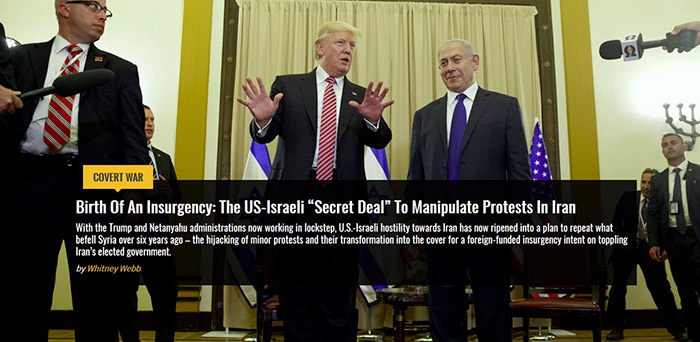
Birth of an insurgency

With the Trump and Netanyahu administrations now working in lockstep, U.S.-Israeli hostility towards Iran has now ripened into a plan to repeat what befell Syria over six years ago – the hijacking of minor protests and their transformation into the cover for a foreign-funded insurgency intent on toppling Iran’s elected government.TEHRAN, IRAN (Analysis) – Using the recent protests as cover, the governments of the United States and Israel are advancing a much larger plan for covert regime change against the Iranian government, one born out of the “secret deal” negotiated and signed between the two countries right before the widely covered but relatively small protests in Iran began in late December.

That deal, negotiated between National Security Adviser and neocon darling H.R. McMaster and his Israeli counterpart Meir Ben-Shabbat, secured the full cooperation of the Trump and Netanyahu administrations in targeting Iran’s “threatening activities” through a series of “memorandums of understanding.” As the Times of Israel reported, such cooperation is ultimately expected to translate into “steps on the ground” — a vague way of implying that aggressive actions will soon target Iran, including potential military action.

Yet, since the agreement was announced in the press, the evidence seems to point to the development of a more covert operation that is set to begin with the assassination of a top Iranian general.

Reviving a once-thwarted assassination plan

On Monday, Israeli newspaper Haaretz reported that an “American-Israeli agreement” had been forged that determined that Iranian general Qassem Soleimani, leader of the Quds Force active in fighting the Wahhabist insurgency in Syria, is a “threat to the two countries’ interests in the region.” This understanding subsequently resulted in the U.S. government giving Israel the “green light” to assassinate Soleimani, a plan Israel had unsuccessfully attempted to carry out three years earlier. The Obama administration had thwarted that operation, when Israel was allegedly “on the verge” of killing Soleimani near Damascus, by warning the Iranian government of the plan.

However, the U.S.’ failure to enact regime change in Syria – a close ally of Iran – and the Trump administration’s close relationship with Israel have apparently led the U.S. government to openly voice its support for Israel to assassinate a top general of Iran’s Revolutionary Guard, a move that would likely embroil Iran and Israel – and perhaps the rest of the Middle East – in war.

 Make no mistake: This. Will. Start. A. War.

-and sadly, that’s exactly what both, Trump and Netanyahu are aiming at. #IranProtestshttps://t.co/63C5ukzFLB

— Amir (@AmirAminiMD) January 2, 2018

Indeed, Soleimani’s force in Syria has been instrumental in aiding the Syrian government in eliminating the largely foreign-funded Wahhabist insurgency that was intended to remove Syrian president Bashar al-Assad from power, a key strategic goal of both the U.S. and Israel in the region.

Furthermore — with the disintegration of Daesh (ISIS) in Syria and, along with it, the disintegration of the U.S.-led coalition’s excuse for its illegal presence in Syria — Soleimani delivered a forceful message to the U.S. forces stationed in Northwest Syria. In that message, delivered to the U.S. via the Russian military, Soleimani warned the U.S. military command in Syria that it best remove all U.S. forces currently present in Syria “or the doors of hell will open up,” adding that “I advise you leave by your own will or you will be forced to.”

Russia later echoed Soleimani, albeit less forcefully, by advising that U.S. forces vacate Syria, as the terrorist threat has been largely eliminated and the U.S.’ continued presence in the country would be in violation of the Syrian government’s sovereignty.

However, the U.S. has made it clear that it has no plans to leave Syria anytime soon. Last Friday, U.S. Secretary of Defense James Mattis insisted that the “war is not over” in Syria or Iraq, as much works remain to be done to prevent a potential resurgence of Daesh. Mattis’ words came just days after reports surfaced alleging that U.S. forces in Northwestern Syria are retraining Daesh fighters from areas “liberated” by U.S. proxy forces.

The endgame of this U.S. operation is likely the exportation of insurgents from Northwestern Syria through Iraqi Kurdistan, where U.S. forces are still present, and into eastern Iran where the fomentation of an armed insurgency will be used to destabilize and hijack the protests currently taking place in Iran. Most of the recent growth in reported unrest has been concentrated in eastern Iran.

In order for such a program to achieve its goal, the U.S. must be able to continue illegally occupying northwestern Syria. With Soleimani out of the picture and the Quds Force in Syria thus weakened, that occupation would be significantly easier to prolong.

Building blocks of regime-change insurgency: sanctions, protests, “peaceful” uprising

While a U.S.-Israeli plan to create a terrorist pipeline from Syria to Iran has yet to be definitively established, regime-change plans specifically targeting Iran have included such strategies for toppling the Iranian government. For instance, the Brookings Institution — a prominent, hawkish U.S. think tank — published a manual in 2009 titled “Which Path to Persia? Options for a New American Strategy toward Iran.” The manual, divided into four parts, includes an entire section devoted to enacting regime change. This section includes three chapters, the first two of which focus on “supporting a popular uprising” and “inspiring an insurgency” by “supporting Iranian minority and opposition groups.”

When the protests against the neoliberal economic policies of the Rouhani-led government began just days ago, the U.S. and Israeli political establishments — and their supporters — quickly took advantage of the situation. Though the protests have been small in size, intentional misreporting from the corporate media and on social media has sought to combine these protests with regime-change aspirations while also exaggerating their size.

Both neocons and their liberal counterparts have posted publicly their support for the protests, claiming to support the Iranian people despite their past support for the sanctions that damaged Iran’s economy – the very factor that allegedly inspired the protests in the first place.

In the first 24 Hours of #IranianProtests ,

72,200 tweeted w/ this hashtag ” #تظاهرات_سراسرى ”

that invited Iranian to protest ,

-74% of them were from out of #Iran

-35% of them were in Arabic Language

-Saudis tweets 27% were more than Iranians 25%

-UK in 3rd place at 7% pic.twitter.com/NZtMn7n9qN

— Goudarz Eghtedari (@goudarz) December 31, 2017

The Iranian people, especially the young, are protesting for the freedom and future they deserve. I hope their government responds peacefully and supports their hopes.

— Hillary Clinton (@HillaryClinton) December 31, 2017

Though the plan to support a popular uprising depended on the organic emergence of some unrest, however minimal, within Iran, the plan to inspire an insurgency requires more careful preparation. Given the establishment of a new CIA “mission center” focused on “turning up the heat” in Iran last June — which has sought to make Iran “a higher priority target for American spies” — along with the U.S. operation in Syria, the groundwork for such an insurgency has now been laid.

Of particular concern is the fact that the CIA officer in charge of the center is Michael D’Andrea, a Wahhabist who has overseen the agency’s drone bombing program and was a key player in the CIA’s torture program. According to Moon of Alabama, he is believed to be the mastermind behind U.S. cooperation with extreme Wahhabi groups in Libya, Iraq and Syria.

In addition, Israel has openly worked with terrorist groups active in Iran in the past, namely the Jundallah terrorist group that Israeli Mossad hired to kill nuclear experts in Iran and for other tasks in its covert war against the Islamic Republic.

Arming the uprising

As the protests in Iran have unfolded, the increase in violent incidents suggests that U.S.-Israeli support for both a popular uprising and their support for a budding insurgency have merged and are taking place simultaneously. For instance, there has been a precipitous rise in the number of “armed protesters” since the ostensibly “peaceful” protests began, including a group of armed individuals that attempted to overtake government buildings and military bases.

Others have killed police and participated in the wanton destruction of property. Others still have shot innocent bystanders, who were then threatened into saying that the police had been the shooters. Eyewitness reports have claimed that many of the more violent protesters are “non-native” (i.e., foreign).

#Iran This is how they did it in #Daraa, #Syria, attacking police. See my video on it. https://t.co/nwDWwRTGU4 https://t.co/drL9kSyEZC

— Kurt Nimmo (@kurt_nimmo) January 2, 2018

#IranianProtest #IranProtests #IranianProtests #IranProtests2017 #Iranprotesters

Iran #AryanSpringhttps://t.co/dUOxPz3hqg

— Nardeep Pujji (@AWAKEALERT) January 2, 2018

However, the most telling evidence has been the emergence of terrorist activity in eastern Iran. As the protests were beginning, a Sunni jihadist group known as Ansar al-Furqan exploded an Iranian oil pipeline in the Khuzestan province. The group — which, according to the Terrorism Research and Analysis Consortium, has ties to al-Nusra Front in Syria — claimed that it carried out the attack in order to “inflict losses on the economy of the criminal Iranian regime.”

Both the U.S. and Israel have close ties to al-Nusra Front in Syria. The U.S., for its part, funneled weapons to al-Nusra by continuing weapons shipments to Syrian opposition groups in Idlib even as they declared allegiance to al-Nusra en masse, and even took al-Nusra Front off the terror watch list after it changed its name. An al-Nusra Front commander also infamously claimed in 2016 that “the Americans are on our side.” Meanwhile, Israel’s long-standing commitment to aiding and funding the terrorist group, while also treating their wounded, has been an open secret for years.

In addition, the terrorist group Mujahideen-e-Khalq, popularly known as MEK in the West, has been active in the current protests as well. Despite its record of killing innocent civilians, Western media has cited MEK spokespeople and members in its reporting on the protests as “proof” that the Iranian people are calling for regime change, while ignoring the massive pro-government rallies that have coincided with the protests. Little mention has been made of the fact the MEK fighters have been trained by the U.S. military in the past and share connections with Israeli Mossad.

Conclusion: with Syria plan in tatters, U.S. and Israel roll it out again for Iran

President Donald Trump escorts Israeli Prime Minister Benjamin Netanyahu into the White House in Washington, Wednesday, Feb. 15, 2017. (AP/Evan Vucci)

The hostility of the U.S. and Israel towards Iran is well known. Yet, with the Trump and Netanyahu administrations now working in lockstep, that hostility has now ripened into a plan to repeat what befell Syria over six years ago – the hijacking of minor protests and their transformation into the cover for a foreign-funded insurgency intent on toppling the elected government of Iran.

Whether or not such an effort will be successful is yet to be seen. However, it’s unlikely that either Israel or the United States will be willing to accept another failure like their venture in Syria, lest they be forced to give up on their regional ambitions entirely.

By Whitney Webb @_whitneywebb , Mintpressnews.com

January 8, 2018 0 comments
FacebookTwitterPinterestWhatsappTelegramSkypeEmail
Mujahedin Khalq Organization as a terrorist group

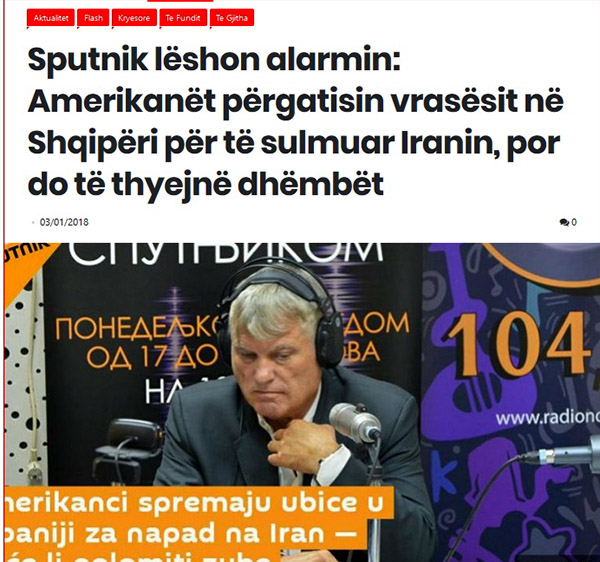
Americans prepare assassins in Albania to attack Iran, but will break teeth

At a time when Iranian protests against corruption and bad living conditions have turned into protests against the government in Iran in which people have been killed, the Kremlin’s Sputnik Portal, in today’s paper, has accused the Americans and Albania. According to them, the CIA is preparing killers in Albania to attack and fight with the Iranian regime.

The editorial is part of a show they have created for Radio Sputnik in Serbian, which is broadcast on the internet as well as on normal radio waves.

In the interview given to journalists, political analyst Aleksandar Pavic has made some strong allegations.

Pavic says that the United States has very serious goals when it comes to Iran and recalls that “President Trump is closely associated with the Israeli lobby, which influenced the decision to transfer the US embassy to Jerusalem. The United States claims that Iran is a terrorist state and an exporter of terrorism. We know this is not true, because if we speak the truth, the number one terrorist state is Saudi Arabia.

The Mujahedin-e-Khalq, one of the main opponents of Iran’s government, emigrated to Albania last year. They were transferred there [from Iraq] by the Americans. There are about 3,000 members at this headquarters and they have a website to closely monitor the situation in Iran. It is a strange organization that has organized terrorist attacks against Iranian authorities in Iran over the past ten years, Pavic said

This accusation by Pavic is highlighted in the article. Trump, along with Israel, has a clear plan and this is being activated today by Albania. The CIA and Israeli services are preparing soldiers to send them to war in Iran to overthrow the regime but that will be impossible, says Pavic.

Today the head of Iran’s Revolutionary Guards has declared the defeat of the “uprising” in the country.

Major Majti Mohammad Ali Jafari made the announcement before the mass of people who participated in pro-government rallies called to counter the riots.

The protests were initially against corruption, but turned into wider anti-government sentiment.

General Jafari said: “Today we can say that this is the end of the uprising.”

He said, “the willingness of the people’s security and vigilance” had led to the loss of “enemies”. He added: “There were a maximum of 1,500 in each county and the number of protests did not exceed 15,000 people nationwide.”

“Enemies” have tried to create “cultural, economic and security threats against Islamic Iran,” he said.

His comments echoed those of Supreme Leader Ayatollah Ali Khamenei, who also blamed the unspeakable “enemies”, referring to the United States, Israel and Saudi Arabia. (B.H / Faxweb)

Fax Web, Tirana, Albania, Translated by Iran Interlink

January 7, 2018 0 comments
FacebookTwitterPinterestWhatsappTelegramSkypeEmail
Iran Interlink Weekly Digest

Iran Interlink Weekly Digest – 216

++ Many commentators say they have observed that the MEK is fully under the thumb of Saudi Arabia – not Israel or America. They ask, ‘why are you in Tirana and not in Riyadh?’ Others have pointed out that the MEK and Saudi intel services have openly joined together to run Al Arabiya media outlet. The MEK features in it all the time. ‘It’s just like in the time of Saddam’, say critics.

++ In Albania ex-members are under serious pressure to work on social media, create accounts, liking and promoting posts, and creating memes and fake images. These people are becoming run down and ill while at the same time the MEK is cutting their allowances and punishing and threatening them.

In English:

++ A two-part interview with Anne Khodabandeh during a fact-finding mission in Albania last Autumn was published by Sputnik in Serbia. Iran-interlink published a ‘Google translate’ in English.

++ Sahar Family Foundation reported on conditions in Albania. MEK leaders have given an ultimatum to ex-members based on their financial dependence on the cult. “When the individuals approached the MEK to receive their allowances, they found out that from the beginning of the year 2018, it would be reduced to two thirds of the actual amount. To get even this reduced money they now had to sign a document admitting that they owe this money to the cult and that they will repay their debt once they get money in future… “The Rajavi cult is imposing this pressure on the former members in order to force them to either go back to the organization or leave Albania. They are told that they would have much better opportunities in neighboring countries. The aim of the cult is to send them out of Albania where they act as role models for other discontented members who wish to gain their freedom.”

++ An article by Philip Giraldi in Global Research asked a pertinent question considering the events which ensued in Iran: ‘Who Are the Leading State Sponsors of Terrorism?’ Giraldi says, “A recent detailed analysis by former US intelligence officers has demonstrated just how the claim that Iran is the world’s leading sponsor of terrorism is almost completely fabricated. The analysis explains how these false narratives are contrived and how they become part of the Washington background noise…

“The reality is that terrorism, defined by the United Nations as ‘criminal acts intended or calculated to provoke a state of terror in the general public,’ is most employed at the state level by the United States and its allies Israel and Saudi Arabia, not by Iran.”

++ Tehran Times reported foreign interference in the widespread protests inside Iran. “Sources close to security bodies have said of over 500 people arrested during the disturbances in different cities in Iran, more than 80 percent have admitted receiving money and ordered from outside the country to misuse the people’s protest against price rises and high unemployment.” The paper also said, “Maryam Rajavi, the MKO terrorist leader, has urged more violence and chaos in a twitter message.”

++ Borzou Daragahi, Middle East correspondent for BuzzFeed News, based in Istanbul wrote an analytical article saying ‘Iran’s Rouhani Acknowledges Right To Protest, But Blasts Trump For Encouraging It’. Daragahi describes the nature of the protests as they moved from peaceful to violent, the demographic of participants and how the country’s leaders and security authorities responded. He also noted that there was evidence of MEK involvement in the organisation of protests. In addition, Mehr News Agency “issued an ominous warning that Sunni jihadis were rumored to be preparing violence against demonstrators in what many Iranians considered a pretext for violent attacks on protests”.

++ TeleSur wrote in Iranian.com ‘Russia Warns Against Foreign Meddling In Iran As Separatism, Extremism Voiced In Unrest’. The MEK was mentioned as “anti-government extremists that are unpopular within the country”.

++ The Daily Mail (UK) reported that since a visit by French President Macron was cancelled due to unrest in Iran, President Rouhani spoke with him by telephone instead. In the conversation, Rouhani demanded “action against a ‘terrorist’ Iranian opposition group he accused of fomenting recent protests.

“’We criticise the fact that a terrorist group has a base in France and acts against the Iranian people… and we await action from the French government against this terrorist group,’ Rouhani told Macron, according to a report on Iranian state television.

“He was referring to an exiled Iranian opposition group based in Paris and called the Mujahedeen-e-Khalq. Iranian authorities accuse the group, which the regime describes as ‘hypocrites’, of fuelling the unrest rocking the Islamic republic and of links with regional Sunni rival Saudi Arabia.”

++ Tasnim News, Tehran, “Many rioters arrested in the recent unrest in Iran have been trained by the terrorist Mojahedin-e Khalq Organization (MKO), the IRGC commander Major Genera Ali Jafari said, adding that enemies have even dispatched a number of Daesh (ISIL) terrorists to Iran for acts of sabotage.”

++ After six days of protests in Iran, Moon of Alabama published a critique of western reporting of these events. According to this report, fake pictures and false ‘evidence’ is produced to show violence: “The terrorist group MEK (NCRI, MKO) ‘leaked’ fake protocols of an alleged government meeting which it claims shows panic over the protests. Allegedly the government fears the leader of the MEK, Maryam Rajavi. The MEK has paid large sums to get support from politicians, including John McCain in Washington and elsewhere. During the Iraq-Iran war it fought against Iran on the side of Iraq. After the U.S. invaded Iraq the MEK was held in special camps under U.S. control. According to a 2012 Seymour Hersh report the U.S. military trained MEK fighters in the U.S. in sabotage and insurgency technics. These people are deeply hated in Iran but feared they are not. Their early engagement in the ‘protests’ via their website and propaganda ops in Iran may point to deeper role in the riots.”

++ Executive Intelligence Review issued a Press Release stating that ‘Saudis Back Terrorist MeK as ‘Alternative’ in Iran’. Al Arabiya is quoted supporting Maryam Rajavi and the MEK.

++ Fax Web, Tirana, Albania – ‘Sputnik raises the alarm: Americans prepare assassins in Albania to attack Iran’. “The CIA is preparing killers in Albania to attack and fight with the Iranian regime. The editorial is… for Radio Sputnik in Serbian, which is broadcast on the internet as well as on normal radio waves. In the interview given to journalists, political analyst Aleksandar Pavic has made some strong allegations… Trump, along with Israel, has a clear plan and this is being activated today by Albania. The CIA and Israeli services are preparing soldiers to send them to war in Iran to overthrow the regime but that will be impossible, says Pavic.”

++ Olsi Jazexhi, Albanian academic and historian, spoke with Fax Web about MEK involvement in the protests in Iran. He said that “Many of the protesters, people associated with the Mojahedin Khalq (MEK, MKO) who are based in Albania, have used violence in the past, killing hundreds of workers or ordinary citizens.” Jazexhi also “emphasized the fact that the protests started for economic reasons, but were later manipulated by being converted into political protests. ‘Foreign-controlled protesters manipulated the protests by turning them into violent protests. The problem is that the governments in the US and Israel were able to take advantage of these protests. Today, there were protests against the government, announcing the end of violence against the institutions’.”

January 05, 2018

January 7, 2018 0 comments
FacebookTwitterPinterestWhatsappTelegramSkypeEmail
Olsi Jazexhi
Mujahedin Khalq Organization as a terrorist group

Protests in Iran were also manipulated by Mojahedin Khalq in Albania

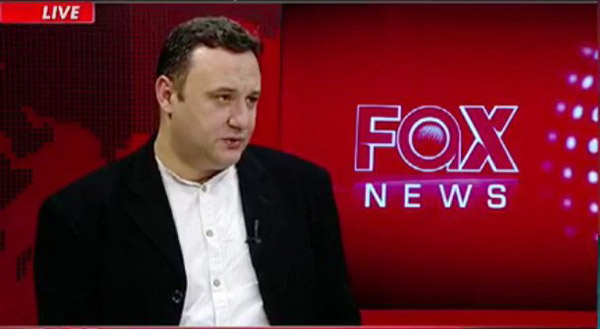
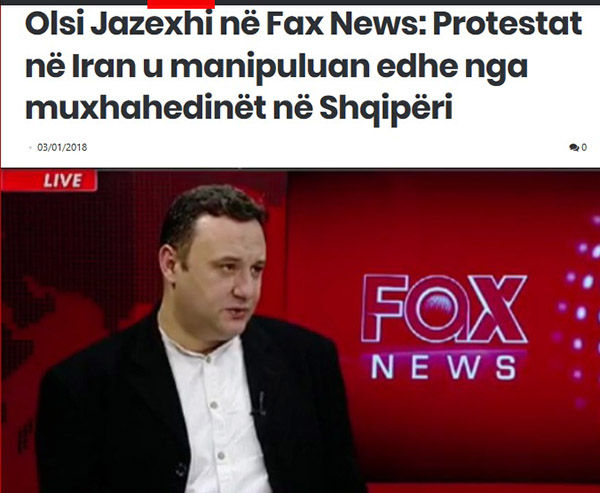
Fax News invited Dr Olsi Jazexhi, an academic and historian, to comment on the recent protests in Iran. He said the protests were manipulated by foreign agents.

He also emphasized the fact that the protests started for economic reasons, but were later manipulated by being converted into political protests.

“Foreign-controlled protesters manipulated the protests by turning them into violent protests. The problem is that the governments in the US and Israel were able to take advantage of these protests. Today, there were protests against the government, announcing the end of violence against the institutions.

The protests have been taken hostage and officials from the Iranian government accuse them of being infiltrated by foreigners. They are students belonging to terrorist organizations.

Iran has a strong embargo on restricting economic exchanges. Traders are free and this freedom has led to abuses, causing consumer goods to become more expensive for many citizens. Social assistance benefits have been limited and the price of fuel has been raised. These are among the measures that have caused dissatisfaction. The protests in 2009 were due to elections which was another movement.

Today, the situation is worse economically as sanctions continue against Iran. The president was elected promising the country’s liberalization. The Americans did not keep their promises. Most of them condemned the protests when economic protests became politicized and turned violent. Many of the protesters, people associated with the Mojahedin Khalq (MEK, MKO) who are based in Albania, have used violence in the past, killing hundreds of guard workers or ordinary citizens.

With the establishment of ISIS, the Iranian government intervened to support Iraq and Syria against ISIS.

Iran, Russia and Turkey have become a common force and struggle to maintain stability. This fact raises concerns for the Americans and Israel, who are trying to promote conflicts. There has been a manipulation of economic protest and convention in a political protest”,  said Jazexhi. (M.Q / Faxweb)

Olsi Jazexhi, Fox Web, Tirana, Albania, Translated by Iran Interlink

January 7, 2018 0 comments
FacebookTwitterPinterestWhatsappTelegramSkypeEmail
MEK mercenaries
Mujahedin Khalq; A proxy force

Saudis Back Terrorist MeK as ‘Alternative’ in Iran 

One of the striking characteristics of the past week of protests in Iran is the apparent lack of a leadership organization behind them. The Green Movement that lead the protests against the tainted presidential election of 2009, mostly made up of the reformist faction, has remained absent this time around, with the reformist leaders mostly distancing themselves from the protesters. There doesn’t appear to be a government-in-waiting that those who dream of “regime-change” in Tehran can install in place of the ayatollahs. However, Al Arabiya, the Saudi-owned news network, has a suggestion: the National Council For the Resistance In Iran, the political front for the terrorist Mujahadeen e-Khalq Organization (MeK or MKO). The MeK was on the U.S. State Department’s list of foreign terrorist organizations from 1997 to 2012 because of its decades- long history of violence and terrorism, including against Americans in the 1970’s.

This history apparently is no obstacle to Saudi support of the MeK as an alternative political leadership for Iran, however.

“The ongoing protests in different cities against the regime reveal the explosive state of Iranian society and the people’s desire for regime change,” Al Arabiya quotes NCRI president Maryam Rajavi as saying. Rajavi added that the

“Iranian people demand the overthrow of the ruling religious dictatorship. It is their right to topple this repressive regime. And I emphasize: Regime change in Iran is within reach.”

Al Arabiya gushes that Rajavi’s ten-point plan for Iran

“is a clear blueprint for a free and democratic Iran void of nuclear weapons; in peace and harmony with its neighbors and the rest of the world; upholds women’s rights and the rights of ethnic and religious minorities in the country and many more progressive plans for Iran.”

Al Arabiya further reports that the MeK

“has put to use its widespread network inside Iran and its satellite TV Simay-Azadi’s citizen reporters are sending their video and internet messages of Iran’s cities to the world 24/7.”

In the United States, the neo-conservatives have long seen the MeK as a tool for overthrowing the government of Iran and the religious clerics who dominate it. They waged a long campaign for the delisting of the MeK as a terrorist group, which finally succeed in 2012 when then-Secretary of State Hillary Clinton issued a statement claiming that they had renounced violence. The neo-cons’ relationship with the MeK continues to this day, as was shown in August when three senior Republican members of the U.S. Senate—Roy Blunt (Mo.), John Cornyn (Tex.), and Thom Tillis (N.C.)—met with Rajavi in Tirana, Albania, in August of 2017.

Iranian President Hassan Rouhani raised the issue of the MeK in a phone call with French President Emmanuel Macron, yesterday. Rouhani bluntly told Macron that the MeK, which has maintained its headquarters in Paris for decades, must be shut down.

“We expect the French government to take its legal responsibility to combat terrorism and violence,” said Rouhani, criticizing the allowance of a terrorist group maintaining a base in Paris, operating against the Iranian people, and provoking and persuading people to take violent actions in Iran, according to Tasnim.

Executive Intelligence Review (EIR)

January 7, 2018 0 comments
FacebookTwitterPinterestWhatsappTelegramSkypeEmail
Arrest
Terror Teams of the MEK

France based ‘MKO’ trained rioters arrested in Iran

Many rioters arrested in the recent unrest in Iran have been trained by the terrorist Mojahedin-e Khalq Organization (MKO), the IRGC commander said, adding that enemies have even dispatched a number of Isis terrorists to Iran for acts of sabotage.

In comments on Wednesday, Commander of the Islamic Revolution Guards Corps (IRGC) Major General Mohammad Ali Jafari said many rioters arrested after December 29 amid violent unrest in some cities of Iran have been trained by the anti-revolutionary forces and the MKO terrorists.

The timely public move to counter the riots helped security forces capture the ringleaders of sedition quickly, the general added, saying that the IRGC forces took limited action only in three provinces of Isfahan, Lorestan and Hamedan to quell the riots.

According to the commander, the US, Zionists and Al Saud have ordered a number of offense teams of the Daesh terrorist group to enter Iran for acts of sabotage and blasts, but stressed that Iran has gotten all of those attack teams under control.

Weaker teams of the terrorist group would not even dare to cross the Iranian border, he added.

Major General Jafari also disclosed a seditious plot by the rioters and their masters for a rise in the death toll from the unrest in Iran and blaming it on the government.

The “casualty-creating” scenario was carried out in the cities of Qahdarijan, Izeh and Najafabad, as even two voluntary forces were martyred by rifle pellets and stabbing, the commander went on to say.

Riots broke out in some Iranian cities last week amid peaceful rallies in protest at price hikes and economic woes.

Security forces have arrested a number of leading rioters and mercenaries affiliated with foreign intelligence services, a chief judiciary official in Tehran said.

On Tuesday, Leader of the Islamic Revolution Ayatollah Seyed Ali Khamenei highlighted the role of enemies in the recent events in Iran, saying the adversaries have employed various tools at their disposal, including money, weapon, politics and security organizations, to harm the Islamic Republic.

On Wednesday, people held demonstrations in many cities across Iran to condemn the riots and acts of vandalism.

January 6, 2018 0 comments
FacebookTwitterPinterestWhatsappTelegramSkypeEmail
Mujahedin Khalq Organization as a terrorist group

Iran busts MKO cell in western Borujerd City

Iran’s security forces have disbanded a local of the Mujahedin-e Khalq Organization (MKO) terrorist group which had carried out acts of sabotage during recent protests in some Iranian cities over rising prices and economic problems.

According to Lorestan Province’s intelligence office, the MKO-affiliated terrorists were identified and arrested in the city of Borujerd on Friday.

It added that four members of the terrorist cell have been arrested through intelligence operations and one of them has been injured in clashes.

The terrorists have been involved in many acts of sabotage in Lorestan, particularly in Borujerd, over recent days.

Last week, a number of protests over economic problems broke out in several Iranian cities, but the gatherings turned violent when groups of participants, some of them armed, vandalized public property and launched attacks on police stations and government buildings.

Over a dozen people have been killed in the ensuing violence in Iran, according to state media reports.

Iran’s Intelligence Ministry said in a statement on Thursday that Iranian security forces have dismantled a terrorist group and arrested its members in the country’s northwestern province of West Azarbaijan.

PressTV-Iranian forces dismantle terror group in northwest

The Intelligence Ministry says security forces have dismantled a terrorist group in the northwestern province of West Azarbaijan.

According to the statement, the terrorist group “which had infiltrated into Iran with the aim of fueling the recent unrest” were put under surveillance in the city of Piranshahr.

In a statement on Monday, Iran’s Intelligence Ministry said it has identified and arrested some of the agents behind riots, which followed the recent protests against economic conditions.

PressTV-Iran arrests several agents behind riots

Iran’s Intelligence Ministry says it has identified and arrested some of the agents behind the recent protests in the country.

It added that some of the peaceful gatherings held in recent days in order to express public demands had turned violent”due to the presence of suspicious and aggressive elements”who damaged public property and caused casualties.

January 6, 2018 0 comments
FacebookTwitterPinterestWhatsappTelegramSkypeEmail
Newer Posts
Older Posts

Recent Posts

  • Fourteen years after US delisting, MKO terror cult’s political rebranding collides with its violent legacy

    September 30, 2026
  • How Did Maryam Rajavi Become All-Powerful in the MEK?

    September 29, 2026
  • Soraya Abdollahi’s Letter to International Human Rights Bodies

    September 28, 2026
  • How Did Maryam Rajavi Become All-Powerful in the MEK?

    September 27, 2026
  • Yazdan Teimorian’s Family:  We Are so Heart-Broken!

    September 23, 2026
  • Facebook
  • Twitter
  • Instagram
  • Youtube

© 2003 - 2025 NEJAT Society . All Rights Reserved. NejatNGO.org


Back To Top
Nejat Society
  • Home
  • Articles
  • Media
    • Cartoons
    • NewsPics
    • Photo Gallery
    • Videos
  • Publications
    • Books
    • Nejat NewsLetter
    • Pars Brief
  • About Us
  • Contact us
  • Editions
    • عربي
    • فارسی
    • Shqip