Nejat Society
  • Home
  • Articles
  • Media
    • Cartoons
    • NewsPics
    • Photo Gallery
    • Videos
  • Publications
    • Books
    • Nejat NewsLetter
    • Pars Brief
  • About Us
  • Contact us
  • Editions
    • عربي
    • فارسی
    • Shqip
Nejat Society
Nejat Society
  • Home
  • Articles
  • Media
    • Cartoons
    • NewsPics
    • Photo Gallery
    • Videos
  • Publications
    • Books
    • Nejat NewsLetter
    • Pars Brief
  • About Us
  • Contact us
  • Editions
    • عربي
    • فارسی
    • Shqip
© 2003 - 2024 NEJAT Society. nejatngo.org
Mujahedin Khalq; A proxy force

Has the MEK changed?

We examine why the US has decided to de-list the Iranian group Mujahedin-e-Khalq as a terrorist organisation.

TO VIEW THE VIDEO FILE CLICK HERE

The US has designated the Iranian group Mujahedin-e-Khalq (MEK) as a terrorist organisation since it began keeping a terrorist list in 1997.

The group’s supporters say it represents Iran’s democratic opposition, and is working for a nuclear-free Iran. But critics argue it has a violent history that dates back to the reign of Shah Reza Pahlavi.

“What may have happened in the past few months is the US essentially cut the best deal to relieve this headache of having the MEK in Iraq, that is to get the members out of Camp Ashraf and into Camp Liberty, and as many of them as possible resettled into third countries.”

– Ali Gharib, a senior editor of Open Zion blog

The group was sheltered by Saddam Hussein, Iraq’s former leader, as it carried out attacks against Iran during the Iran-Iraq war.

In fact, as the US made its case for invading Iraq in 2003, it cited the Iraqi leader’s support for the MEK as evidence of his support for terrorism.

But now, after a two-year lobbying campaign that enlisted many prominent US politicians and former military officers, the group will no longer be considered a terrorist organisation.

Former US officials have received tens of thousands of dollars to give speeches to and on behalf of the MEK.

Millions of dollars have been spent on a campaign to get the MEK dropped from the banned list of terror groups.

Three top Washington lobby firms have been paid a total of nearly $1.5m over the past year to press the US administration and legislators to support the de-listing if the group.

The US treasury department is believed to be investigating whether speaking fees paid to MEK supporters are restricted by a law that prohibits Americans from doing business with designated terrorist groups.

Ed Rendell, the former Democratic governor of Pennsylvania, has accepted more than $150,000 in speaking fees at events in support of the MEK’s unbanning.

Tom Ridge, who served as secretary of homeland security under George Bush, has also received speaking fees.

“They certainly appeared on the list at a time which was politically very convenient for the US government which was trying to reach out to Iranian government … it was the Iranian government that brought to their [US] attention that the MEK was not on the list.”

– Patrick Clawson, the research director at the Washington Institute

Ileana Ros-Lehtinen, the Republican chair of the House of Representatives foreign affairs committee, has accepted at least $20,000 and has spoken out against the ban.

Other prominent American politicians who have spoken in favour of the MEK include Democratic governors and former presidential candidates Howard Dean and Bill Richardson. Another Democratic support is NATO commander Wesley Clark.

And Republican Rudolph Giuliani, the former New York mayor, has also called for the ban to be dropped.

In addition to the MEK, the US state department lists 52 foreign terrorist organisations including al-Qaeda, Hamas, Islamic Jihad, Hezbollah, as well as the Real IRA and the Continuity IRA.

So what is the MEK and why is it being removed from the US terrorist list now? Has the group really changed?

Joining Inside Story Americas for the discussion with presenter Shihab Rattansi are guests: Ali Gharib, a senior editor for the Daily Beast’s blog, Open Zion; Patrick Clawson, the director of research at the Washington Institute for Near East Policy; and Jeremiah Goulka, the lead author of The Mujahedin-e-Khalq in Iraq: A Policy Conundrum, and a former justice department lawyer.

“After the Iran-Iraq war the leaders of the MEK Massoud and Maryam Rajavi turned the group into a cult, partly because they were unable to get new recruits from Iran … the move to join Saddam Hussein ended any legitimacy that the MEK had among the Iranians.”

Jeremiah Goulka, a former US government lawyer

——————————————————————————–

WHO IS THE MEK?

•Founded in 1965 by Islamic-Marxist students, the group helped to overthrow the Iranian government in 1979, prompting a clampdown following the revolution
•The group began an armed struggle against the US-backed Shah of Iran in 1971
•Saddam Hussein, the former Iraqi leader, used them for attacks against Iran and the Kurds
•In 1981, the group launched a bombing campaign attacking the Islamic Party headquarters, killing Iran’s president and the prime minister
•The US disarmed them following the 2003 invasion of Iraq, which the MEK agreed to in exchange for protection.
•The US turned over MEK refugees to the Iraqi government in 2011
•Massoud Rajavi led the group since 1972 but has not been seen since 2003. His wife Maryam Rajavi is the group’s public face now
•Many members are refugees in both Iraq and France, and the group’s leaders continue to live and operate in France
902

Inside Story Americas,Aljazeera.com

Download Has the MEK changed?

September 27, 2012 0 comments
FacebookTwitterPinterestWhatsappTelegramSkypeEmail
Mujahedin Khalq; A proxy force

MEK Still Isn’t OK

The group is set to be taken off the foreign terrorist organization list, but it remains an unwelcome bedfellow on the Iran issue.

This past Friday, the State Department announced that it will remove the Mujahedin-e Khalq (MEK)—a fringe Iranian dissident group that has been criticized for its cultish practices—from its list of terrorist groups. The State Department may have satisfied a court-imposed deadline and could help the group’s members escape their current stateless limbo, but the decision will enable the MEK to put more effort into pushing the United States toward war with Iran in its campaign to become the new government in Tehran.

The court’s deadline comes from a lawsuit brought by the MEK arguing that its designation as a foreign terrorist organization (FTO)—which it has held since 1997—is no longer appropriate because it claims to have abandoned violence in 2002; in 2003, when its members in Iraq were disarmed by the U.S. military, the group signed documents promising to use only peaceful means of protest to advocate for its goals. In June, the U.S. Court of Appeals for the D.C. Circuit gave Secretary of State Hillary Clinton until October 1 to decide whether the group still belonged on the list or the court would delist the group.

Whether the MEK still belongs on the FTO list presents a legal question. If it has abandoned violence—including the capability and intent to commit terrorism—then perhaps it’s earned removal. The group’s many critics point to rumors that the MEK has been collaborating with the American and Israeli militaries and intelligence services (for example, here). But the FTO statute counts only terrorism or terrorist activity that “threatens the security of United States nationals or the national security of the United States”; even if unsubstantiated rumors about MEK’s collaboration with the U.S. military are true, they would not qualify the MEK for FTO status under the statute. This highlights the problem: The law as written gives a pass to groups whose activities are viewed as useful to the United States, just as it could fail to apply to unsavory groups that do not pose a danger to the country.

Aside from highlighting problems with the way U.S. law classifies terrorist organizations, the MEK decision creates a few practical problems. First, though, let’s look at two potential benefits. The Iraqi government wants the MEK out of the country—in part because it is close to the Tehran regime and in part because Iraqi Kurds and Shias despise the MEK for helping Saddam Hussein suppress their uprisings after the 1991 Gulf War. Iraq has demonstrated an unwillingness to respect its responsibility under international law to protect people who are essentially refugees; Iraqi security forces killed some 49 members during clashes with the group after the United States turned responsibility of Camp Ashraf over to the Iraqi government in 2009. The MEK can’t just be sent home to Iran because it is a crime to be a member of the group there. They need to go somewhere else, but no country was willing to welcome MEK members so long as the group was on the U.S.’s FTO list, and the MEK wouldn’t cooperate in the resettlement process until the State Department held out the carrot of delisting. This decision brings some hope, however limited and tenuous, that they may be able to find new, permanent homes, bringing an end to their stateless limbo.

Should members be resettled, another possible humanitarian benefit of the decision could be that they might then be able to engage with the wider world, and some might even consider leaving the cult. This is particularly relevant to the 70 percent or so of the group’s membership who joined after the MEK allied itself with Saddam Hussein, lost its support in Iran, transformed into a highly insular organization, and took up deceptive recruitment practices.

Those are the potential benefits. Now we turn to the problems with the decision. In light of the unprecedented lobbying effort made to get the MEK delisted, in which prominent former officials received tens of thousands of dollars to speak on the group’s behalf, it looks highly politicized. The MEK will make it look like delisting was a symbol of U.S. approbation. With regards to our complicated relationship with Iran, Tehran will see the decision as—in the words of CIA veteran and Georgetown University professor Paul Pillar—“one more indication that the United States is interested only in hostility and pressure toward the Islamic Republic, rather than coming to terms with it.” Some fear that it will undermine American credibility as a force for democracy in Iran (to the extent that the U.S. has such credibility).

The most significant concern is how it will unleash the MEK to further ratchet up the probability of violent conflict with Iran. As I have written here and here, the MEK has had two major goals: an immediate one of getting off the FTO list and a long-term one of taking power in Tehran (it already has a “parliament in exile” and a “president-elect” in its National Council of Resistance of Iran). Now that it has accomplished its short-term goal of getting off the list, it can focus on its core objective.

If the MEK were really what it claims to be—“the largest peaceful, secular, pro-democratic Iranian dissident group” and it didn’t need our help—we wouldn’t need to worry much. But it’s not. The MEK has almost no support among the Iranian people, who vilify the group for signing up with Saddam Hussein, killing Iranians, and then becoming a cult—or see it as a joke. There are only two ways that the MEK could achieve its goal: money or arms. Both options would likely involve the United States, and it is hard to imagine the MEK getting into power by money alone.

The MEK has been pumping up fears of Iran for years. I don’t want to discount the risks of Iran building a nuclear weapon someday, but the MEK plays up the issue for its own uses. The MEK will continue to encourage fear of Iran on Capitol Hill, maintain its ongoing public-relations campaign that promotes wildly exaggerated fears of Iran among the American public, and likely offer its services as a proxy-force ally against Iran, as it has for years.

We should worry that removing the MEK from the FTO list will open the door to a repeat in Iran of what we experienced in Iraq thanks to the embrace of Ahmed Chalabi and his Iraqi National Congress. It started with us funding the Iraqi émigré banker-turned-politician, and it ended with us invading Iraq and putting him in charge of the interim governing council. Even if it was just a relatively small bunch of neocons in the Bush administration and Congress who bought Chalabi’s rosy picture of having huge support in Iraq and a ready-made government, it wasn’t as if the rest of Congress or the media put a stop to their push for war. It was more like full speed ahead.

To limit the damage from its decision, the State Department needs to make it powerfully clear that the United States does not support the MEK. That will take a lot of work, because the MEK will flaunt the delisting.

More important, the U.S. government should not engage with the MEK going forward. Congress should ignore the group. Some officials will inevitably think that working with the MEK makes sense or is convenient. They will be wrong. The White House should consider making it policy for the government not to fund, employ, or otherwise collaborate with the group. The MEK is not our ally. Its interests are its own, not ours. The State Department’s decision may be legally sound, and it’s good to help MEK members find a new home, but when it comes to American policy, the group is not to be trusted. To quote Ambassador John Limbert, former embassy hostage and the first deputy assistant secretary of state for Iran, the MEK has “a very dubious history and a similarly dubious present.” Let’s have nothing to do with its dubious future.

By Jeremiah Goulka ,Prospect.org

September 26, 2012 0 comments
FacebookTwitterPinterestWhatsappTelegramSkypeEmail
Mujahedin Khalq; A proxy force

Taming the Crocodile: Reasons to Doubt U.S. Decision to De-List MEK

The New York Times, among other news organizations, published a remarkable story over the weekend: Secretary of State Hillary Clinton has purportedly sent to Congress a classified letter indicating her intent to remove the Mujaheddin-e-Khalq organization (MEK or MKO) from the list of designated terrorist organizations. (The English spelling of the organization is inconsistent, and is sometimes seen as Mojahedin-e Khalq or other variants. It is also sometimes referred to as the People’s Mujaheddin Organization of Iran (PMOI).)Taming the Crocodile: Reasons to Doubt U.S. Decision to De-List MEK

Such a list is authorized by Section 219 of the Immigration and Nationality Act (INA), codified at 8 U.S.C. § 1189. That section of law was inserted into the INA in early 1996 after a variety of terrorism-related outrages in the years preceding the amendment, such as the first World Trade Center bombing in 1993. Members, associates, and affiliates of listed organizations are subject to criminal prosecution for material support of a terrorist organization and also to deportation and exclusion from the United States.

The first list was published in the Federal Register some months after Section 219 came into being, and the MEK was among the first organizations to be listed, in 1997.

The MEK was a Marxist organization formed to oppose the regime of the Shah of Iran — and the United States, which supported the Shah in ways both obvious and covert. From the start, violence formed a part of its strategy and tactics, as is evident even from their organizational logo, which depicts a raised arm bearing a rifle crossed with a sickle.

During the 1970s, leading up to the Shah’s deposition, MEK operatives engaged in, and claimed credit for, a series of bombings and assassinations that included six Americans, some of whom were military officers posted to Iran in a diplomatic capacity. The violence was calculated to destabilize society and undermine the regime. Imagine their surprise then, when the Iranian revolution in 1979 gave birth to a hardline Islamic Republic that had no use for godless communists. Forced to flee the country, the MEK made a devil’s bargain for sanctuary — the devil in this case being embodied by Iraqi dictator Saddam Hussein. From the safety of Iraq, they engaged in a series of cross-border violent acts against the ayatollahs; no doubt Saddam derived great pleasure in using the MEK to figuratively shove his thumb into the eye of his regional nemesis.

MEK cadres even fought on the side of Iraq during the long-enduring and shockingly murderous Iran-Iraq war from 1980-1988, in which over half a million soldiers and civilians from both sides were killed.

But that was not all they did; apparently there were other strings attached to their Faustian bargain with Saddam. Many credible human rights groups, analysts, and scholars believe that they also acted as a kind of mercenary killing force on the regime’s behalf in Saddam’s brutal campaigns against suspect domestic ethnic groups — the Kurds in the north of Iraq, and the Shi’a "marsh Arabs" in the coastal waterways of south Iraq — and even of viciously abusing the organization’s own dissident members.

The MEK claims to have abandoned violence and disarmed in the early 2000s. This appears to have occurred about the same time that the U.S. military was engaged in "shock and awe" carpet bombing preparatory to invading Iraq and, ultimately, disarming the Baathist regime’s military. Looked at from this perspective, the MEK’s claim of disarmament appears to be necessity draped in virtue’s clothing and nothing more. What choice did they have, post-invasion, faced with overwhelming American military force?

According to the Christian Science Monitor, in 2004 — substantially after the MEK "change of heart" — the FBI reported, using "data corroborated by French and German wiretaps — that MEK cells in the United States, Europe, and Camp Ashraf were ‘actively … planning and executing acts of terrorism.’"

How did they manage to stage this coup of being "de-listed"? The answer seems to lie in three things we in modern American society are all too familiar with: a savvy intermingling of

•money,
•litigiousness,
•politics, and
•public relations
First came the National Council of Resistance of Iran (NCRI) — a front group that appears to have the same function that Sinn Fein did when the Irish Republican Army was most active (and violent). You know the type, populated by men and women in business suits, speaking in well-modulated tones, sounding like the voice of reason. The NCRI also took advantage of a provision in Section 219 that permits filing of a federal lawsuit to have an organization removed from the list. They did so. As late as 2009, the State Department’s own filings in the case to sustain the listing asserted that the MEK had trained women at Ashraf to conduct suicide attacks in the Iraqi city of Karbala, holy to Iraqi and Iranian practitioners of Shi’a Islam.

So why has this happened?

The NCRI, with a strong presence in our nation’s capital, has relentlessly raised funds, which it was smart enough to use to hire well-paid, politically connected public relations consultants, including former Attorney General Michael Mukasey, former national security adviser James Jones, former Homeland Security Secretary Tom Ridge, and Rudolph Giuliani. (Remember him? The man-who-would-be-president and mayor of New York City during the nation’s most significant terrorist attack.) Some prominent members of Congress have also stood behind the MEK. The Christian Science Monitor published a 10-page special report in August 2011 outlining the big names of both political parties (and the big money) involved in this burnishing of the group’s reputation. It is well worth taking the time to read the report, which serves as both primer and indictment on the corrupting influence of money on even such fundamental matters as our national security interests.

It would seem that big money and big influence are having their way. Of course, there is the added benefit that, just as with Saddam, there is that extra little bit of satisfaction at kidney punching the Islamic Republic by de-listing the MEK. And who knows what additional shadowy deals have been struck? The organization has exhibited a surprising ability to survive and even prosper in the worst circumstances, and has of course also shown its willingness to engage in devil’s bargains. But is it worth it to the United States?

I have serious misgivings about the current course of action. This is a bloody-minded, bloody-handed organization with a past history of assassination and involvement in ethnic cleansing, murder, and human rights abuses on a large scale.

Does the United States really think it can adopt its own extremist organization, domesticated and house-trained like a well-mannered pet to be used against Iran, without consequence? That’s the equivalent of trying to tame a crocodile. Treat it as kindly as you like, feed it choice chicken carcasses daily, and even give it exclusive access to your backyard pool. There is every reason to believe that, sooner or later, when you reach your hand out to pat that ugly snout, it’s going to snap down and sever it from your wrist. It’s in the beast’s nature.

By W.D. Reasoner,

September 26, 2012 0 comments
FacebookTwitterPinterestWhatsappTelegramSkypeEmail
Mujahedin Khalq; A proxy force

Our Favorite Terrorists

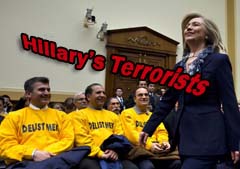
On September 21st, Hillary Clinton signed a finding that the MEK, Muhajadin E-Khalil, or Peoples Muhadejin of Iran was in the process of no longer being considered a terrorist group. You should Our Favorite Terroristsknow that MEK was only taken off of the US’ terrorist list after years of high pressure lobbying by a veritable galaxy of the some of the biggest and most expensive stars in Washington. Bill Clinton placed them on the terrorist list in 1997, and this decision was reaffirmed by the Bush administration in 2007.

It’s a sad commentary on the way things get done in DC, but it’s extremely doubtful whether the terrorist designation change on MEK could have been accomplished any other way. Political celebrities were hired by the dozens to sing the praises of MEK. If you want Democrats, you could find Howard Dean, former Congressman Patrick Kennedy, or Pennsylvania Governor Ed Rendell. For Republicans some of the hired guns include former GOP Speaker of the House Denny Hassert, Rudy Guiliani, Dick Armey, Bush II Attorney General Michael Mukasey, just to name some of the bigwigs.

Did they hire any national security types? The answer is "Yes — from both parties!" For the Democrats MEK hired former Clinton CIA chief James Woolsey. And W’s CIA chief Porter Goss got a stipend for supporting MEK, too. Other national security nabobs include former FBI director Louis Freeh, Homeland Security Chief Tom Ridge, and Obama’s former National Security Advisor Jim Jones. And don’t forget the ever lovable Richard Perle.

How about journalists? Well Chicago Tribune Clarence Page was on board for some buckolas, as was Washington Post figure Carl Bernstein. Congressmen no doubt got in on the gravy train as well, but only Democrat Deborah Ros-Lehtinen and Republican Dana Rohrbacher made major appearances. Who knows how many other lesser lights received cash from MEK while it was still classified as a terrorist organization? The only thing that we know for sure is that none of these people come cheap. We’re probably talking about tens of millions of dollars being spent by MEK to get itself off of the terrorist list.

WHAT PUT MEK ON THE TERRORIST LIST IN THE FIRST PLACE?

We have to go back all the way to 1970s Iran for that answer. Originally MEK was fighting to eliminate the Shah, and they were aligned with the Ayatollah Khomenei. It was during this time that they killed six US military men and defense contractors. However, they had a falling out with the new Iranian government, and they quickly aligned themselves with Saddam Hussein. MEK personnel fought on the side of Saddam in the Iran-Iraq War including assisting Saddam in the rape of Kurdistan after the Gulf War. It’s been an open secret that since then MEK has been stationed in Iraq at US military bases.

To be charitable, both the Iraqi and Iranian government hate their guts. Even the Green Revolution in Iran wants nothing to to with them. The Iranian American Council has denounced MEK, saying that recognition of MEK by the United States will actually increase the chance of war between the two countries

In 2005, Donald Rumsfeld used MEK to carry out various reconaissance and sabotage operations in Iran after they had been equipped and trained at a base in Nevada. More recently, they have been directly linked to the assasination of Iranian military scientists, now supposedly by being trained and armed by the Israeli Mossad. If this is true, it would certainly put to the lie the US finding that MEK has denounced terrorism. But the background of MEK is even stranger and sleazier than that.

According to a report issued by the RAND corporation in 2009, Maryam Rajavi, the leader of MEK is in actuality the leader of a cult. After a disastrous raid into Iran during the Iran-Iraq War, Rajavi and her late husband decided that the reason Operation Eternal Light had failed was because there was too much love in MEK between fighters and their spouses. They then ordered mass divorces, mandatory celibacy, complete cutoffs from non-MEK family members, sleep deprivation and other manipulative techniques to enforce displine.

Seven small fry supporters came under Justice Department investigation for supporting a terrorist group when they collected donations at Los Angeles International Airport on behalf of the Committee for Human Rights, a MEK front organization. No Justice Department investigation has been undertaken of the myriad big public fish like Guiliani or Howard Dean for their support of MEK to get it kicked off of the US terrorist list. The very fact that someone would be lobbying the US government for a group on the terrorist list is classified as a crime. All in all, this represents the worst kind of example of how things get done in Washington, DC.

The only mysteries that remain about this still-terrorist organization is where their ultimate financial and other support is really coming from. Is it Israel, Saudi Arabia, the CIA, or right wing neocons? And is MEK really seen as a legitimate tool to be used against Iran, or only a distraction — supplying dupes who are willing to go on suicide missions to be used as a cat’s paw in American-Iranian (and Israeli) relations?

Regardless of the answers to these questions, it’s obvious that the MEK incident ranks high on the disgust factor.

September 26, 2012 0 comments
FacebookTwitterPinterestWhatsappTelegramSkypeEmail
Mujahedin Khalq; A proxy force

Washington clears MEK for covert war

Here’s a thought experiment: imagine that there is a terrorist network in the USA that has been responsible for hundreds of thousands of civilian deaths over several decades. The group Washington clears MEK for covert wardeclares itself dedicated to destroying the US government and has been involved in car bombing urban centres, kidnapping and murdering members of the country’s security forces, and assassinating government scientists, as well as perpetrating countless random murders on businessmen and ordinary families.

Now imagine that the Iranian government announces a new policy in which it does not consider the above clandestine group a terrorist entity. That policy means that the network is free to raise money in Iran to fund its terror campaign against US citizens and to lobby for political support among Iranian lawmakers and ambassadors.

We can safely conclude that in such a far-fetched scenario, the US government would immediately declare war on Iran and proceed to carpet bomb that country mercilessly – with the Western corporate news media blasting righteous endorsements of vengeance.

Yet this scenario of aiding and abetting terrorism is far from far-fetched when it comes to actual US policy towards Iran. Just last week, US Secretary of State Hillary Clinton officially de-listed the Iranian Mujahideen e-Khalq (MEK) from its official terror watch list.

That the MEK is a terror group is beyond dispute, despite the US government’s apparent change of opinion. The term “terror group” applies objectively and accurately. It is not just a pejorative propaganda label used by the Iranian government to blacken some dissident group. Since the 1980s, the MEK network itself claims that it has killed 40,000 Iranians whom it considers legitimate targets because they are “loyal” to, that is because they are citizens of, the Islamic Republic. Lower estimates of fatalities are put at around 17,000. Proportionate to its population that would give an upper equivalent of 150,000 dead Americans – a death toll suffered by Iran which is 50 times greater than that ascribed to 9/11.

The MEK, also known as MKO, has colluded with foreign powers for the stated goal of destroying the Islamic Republic of Iran. Most notably, between 1980 and 1988 when Iran was facing a US-backed war of aggression by Iraq’s Saddam Hussein, the MEK functioned as subversives and shock troops operating “behind enemy lines” to betray their own people.

For that reason, the group has negligible, if any, popular support within Iran. It cannot claim the slightest modicum of popular mandate that might otherwise serve to give its activities a veneer of legitimacy as an “insurgency” or “freedom struggle.” Indeed, it is more accurate to call the group a sort of terrorist cult rather than a political movement. Since 2003, the MEK has not even had a base within Iran, operating clandestinely out of Iraq.

Such is the organisation’s fringe status, that even Iranian political opponents of the government in Tehran deprecated the US government move to officially de-list it as a terror group. That indicates how extreme the network is viewed by the Iranian population.

The Western mainstream media claim that Washington’s clearance of the MEK was given because the group “has renounced violence.” That renunciation was officially made 10 years ago. That is also allegedly why the European Union and the British government removed the network from their terror lists in 2009 and 2008.

How these Western governments can maintain this charade with a straight face is rather astounding. The MEK and other Iranian terror gangs, such as the al-Qaeda-linked Jundallah, have been actively plying violence unabated against the citizenry over the past decade. Even Washington officials admit it. Following the murder of Iranian nuclear scientist Mostafa Ahmadi Roshan on 11 January earlier this year with a magnetic bomb attached to his car in northern Tehran, anonymous US officials disclosed to American mainstream media that the killing was the work of the MEK in collusion with Israel’s Mossad.

Since 2007, five Iranian nuclear scientists have been assassinated. The MEK and Mossad are strongly implicated in all these murders and much worse.

Why US officials should have authoritative knowledge of such MEK activities is quite simple. It is because the US government and its military intelligence support these very terrorist activities, along with Mossad and Britain’s MI6. During the George W Bush presidency, congressional leaders secretly approved a budget of $400 million to arm and fund the MEK and Jundallah. According to investigative American journalist Seymour Hersh, US Joint Special Operations Command trained members of the MEK at a secret site in Nevada between 2005 and 2009. Training included use of weapons and explosives in the black arts of sabotage, or, in short, terrorism. During the American illegal occupation of Iraq following 2003, the MEK was given protection and immunity at a dedicated facility, known as Camp Ashraf, in Iraq from where they would launch operations into Iran. The camp has since been closed down following the large-scale American troop withdrawal from the country.

So, the “ceasefire” pretense is a bad joke. However, a substantial reason why the US has de-listed the MEK is the powerful lobbying for such a decision over many years by senior American political and military figures. They include former CIA director James Woolsey, former Homeland Security Secretary Tom Ridge, ex-New York Mayor Rudolph Giuliani and past US ambassador to the UN, John Bolton. All of these senior figures, and more, of the American ruling class have called for Washington to give clearance to the MEK – at a time when even US officials are acknowledging that the group is involved in assassinations in Iran.

The move by Washington last week is, in effect, giving full approval to the MEK’s terror and assassination campaign in Iran. It is a stark reminder of Washington’s unwavering warpath towards Iran. Recently, some commentators have tended to misread Washington as giving a rebuff to Israel’s war rhetoric against Iran. But the clearance by Washington of a terrorist campaign in Iran – one that the US government is materially assisting – is a sobering sign that war is still the order of the day. The recent alleged spats between Washington and Tel Aviv are more likely a reflection of tactical variance due to the forthcoming US presidential election than any substantive difference in aggression towards Tehran.

It is hardly a coincidence that Washington’s MEK announcement was made only days before Iran’s President Mahmoud Ahmadinejad addressed the 67th summit of the UN General Assembly in New York. The Washington regime also took the unprecedented step of denying some 20 Iranian diplomats travel visas to attend the UN assembly ¬ this week – this despite an historic agreement by the US, as host nation to the United Nations, to refrain from such obstruction of diplomats from any country regardless of bilateral disputes.

The obstructive snub to Iran’s sovereignty comes in the wake of the successful hosting of the Non-Aligned Movement (NAM) last month in which some 120 member states gathered in Tehran. And it beggars belief that such a diplomatic mugging by Washington this week is not related to Iran’s new presidency of the NAM emphasizing the urgent need for an overhaul of the UN Security Council and greater democracy within the UN General Assembly to end the abusive political domination by the US. Such an overhaul is glaringly obvious now especially in light of the American member of the “security council” supporting terrorism in Iran and denying the victims of terrorism a full hearing. (That other has-been security council power, Britain, is also a disgrace for the same reason.)

Washington’s sinister relationship with Iranian MEK terror group points up the fact of who really is the “rogue state.” White House rhetoric has long tried to paint Iran as such. But in the real world, the MEK joins the phalanx of Washington’s terror proxies and mercenaries, from the Contra to al-Qaeda, who do America’s dirty work around the world. Like the MEK, it’s probably only a matter of time before al-Qaeda is also given official clearance by Washington. Yes, the contradictions are perverse, but such is America’s real relationship with world terrorism and its rogue status par excellence.

By Finian Cunningham

September 26, 2012 0 comments
FacebookTwitterPinterestWhatsappTelegramSkypeEmail
Mujahedin Khalq; A proxy force

Obama Decision on Islamo-Marxist Terror Cult Will Lead to U.S. Funding

After a multi-million dollar lobbying campaign that unlawfully enlisted top members of the bipartisan U.S. political class, the Obama administration decided that the Mujahedin-e-Khalq Obama Decision on Islamo-Marxist Terror Cult Will Lead to U.S. Funding(MeK), an Islamo-Marxist terror cult notorious for murdering Americans, should no longer be on the State Department’s list of designated terrorist organizations. Experts say the decision paves the way to begin openly showering U.S. taxpayer money on the anti-American outfit in its bid to overthrow the Iranian regime.

The controversial decision to formally "delist" the organization came in the wake of reports charging that the federal government was already arming and training the cult-like Iranian MeK in violation of U.S. terror laws. The purpose of the alleged support, according to multiple sources, was to help wage a proxy war against Iran. Criticism of the administration’s recent decision, however, erupted quickly and forcefully.

Also known as the People’s Mujahedin Organization of Iran, the MeK was founded in an effort to advance a hybrid system incorporating communism and Islam. It officially landed on the U.S. government’s terror list some 15 years ago for perpetrating numerous terror attacks against civilians and more than a few senior American military personnel. The group was also allied with Iraqi dictator Saddam Hussein, helping him to wage a brutal war against Iran while suppressing dissidents within Iraq.

“The U.S. Department of State took the moral and strategic bankruptcy of America’s Iran policy to a new low,” observed Iran expert Flynt Leverett, a professor at Pennsylvania State University’s School of International Affairs. “Since when did murdering unarmed civilians (and, in some instances, members of their families as well) on public streets in the middle of a heavily populated urban area (Tehran) not meet even the U.S. government’s own professed standard for terrorism?”

Despite federal statutes defining as a felony the provision of any “material support” to designated terrorist organizations, the MeK managed to buy die-hard support from numerous senior U.S. politicians and former officials on both sides of the aisle. Advocates for the terror cult range from neo-conservative terror-war cheerleaders like Rudy Giuliani and Michael Mukasey to liberals like Howard Dean and Gen. James Jones. Former White House Chief of Staff Andy Card, ex-CIA and FBI bosses, and many others jumped on the pro-MeK bandwagon, too.

The paid lobbyists for the terror cult unlawfully earned massive sums of money — often tens of thousands of dollars or more. But the administration’s decision, supposedly based on “humanitarian” concerns to get the group’s members out of Iraq, sets a troubling precedent, according to analysts. “The delisting of the MEK, following a well-funded political lobby campaign, creates the dangerous impression that it is possible for terrorist organizations to buy their way off the [terrorism] list,” Mila Johns of the University of Maryland’s National Consortium for the Study of Terrorism was quoted as saying by Wired magazine.

But there is undoubtedly more to the decision to delist the group than the fact that it showered money on former U.S. officials — funds that were probably extracted from American taxpayers at some point. While well-paid shills for the group claim that the MeK has not been engaged in much terrorism recently — at least not against American targets — numerous reports indicate that the cult has been as busy as ever. As recently as 2009, for example, the U.S. State Department warned that “MEK leadership and members across the world maintain the capacity and will to commit terrorist acts in Europe, the Middle East, the United States, Canada and beyond.”

More recently, U.S. officials have even admitted that the murders of Iranian scientists over the past several years were being conducted by the MeK — apparently with support and training from the Obama administration and the Israeli government. Journalist Seymour Hersh with the New Yorker reported that members of the cult were actually receiving training from the U.S. government on American soil, a severe violation of federal law.

However, for now at least, the group’s terror campaign appears to be largely directed at Iran, which is ruled by a regime that both the Western establishment and the MeK hope to depose. So, because the Iranian regime is now the terror cult’s primary target for terrorism — it used to be capitalism, America, and the West, and probably will be again at some point — war-mongering U.S. officials have apparently found an ally.

“When these criminal politicians start speaking about the ‘war against terrorism,’ spit on your television screen, as they are the terrorists,” fumed liberty-minded analyst Daniel McAdams after the decision was made public. “They are wealthy terrorists who steal your tax dollars to send overseas and recoup to lobby in favor of bloody killers of civilians in Iran.”

Experts predict with relative certainty that U.S. taxpayer money will soon begin openly flowing to the Marxist terror cult, too. However, observers argue that collaborating with the dangerous group at all would be a terrible plan — let alone openly arming and funding it to wage a war against a foreign government.

“To limit the damage from its decision, the State Department needs to make it powerfully clear that the United States does not support the MEK,” wrote analyst Jeremiah Goulka, who studied the MeK in Iraq for the RAND Corporation. “The White House should consider making it policy for the government not to fund, employ, or otherwise collaborate with the group. The MEK is not our ally. Its interests are its own, not ours.”

Analysts also said the delisting of the terror cult would be counterproductive on multiple fronts even for goals the Obama administration purports to support. For one, it reinforces Tehran’s narrative that the lawless U.S. government intends to destroy Iran and the Iranian people no matter what — and that it has nothing to do with non-existent nuclear weapons. It also makes war more likely.

Meanwhile, the MeK, unsurprisingly, is widely despised within Iran, partly because it worked with Saddam Hussein to massacre Iranians with American support before the Iraqi tyrant found himself on the U.S. government’s enemy list. The fact that the Obama administration is now seen as openly supportive of the terror cult and may even begin openly funding it soon will decimate the genuine movement for political reform inside Iran as well.

The decision will also allow the Islamo-Marxist group to have an even larger say in U.S. government policy toward Iran as it seeks to overthrow the government and seize the reins of power. Former DNC boss Howard Dean even called for recognizing the mass-murdering cult, which, again, has virtually no support outside of Washington, D.C., as the legitimate government of Iran.

Iranians opposed to the Islamist regime, however, say that would be a terrible idea. “The MEK does not represent the Iranian-American community or the pro-democracy movement in Iran,” noted the National Iranian American Council. “We do not support the use of violence and war to replace Iran’s undemocratic regime that abuses human rights with the MEK’s undemocratic cult that tortures its own members.”

According to analysts, the controversial decision to delist the MeK has also exposed once again the lawless and hypocritical nature of U.S. government policy makers. In recent decades, no matter which political party has been in power, the U.S. government has routinely backed dictators and terrorist groups before turning against them. Critics of the latest example of such outrageous behavior say the MeK’s victory fits into that pattern perfectly.

“This MEK scam more vividly illustrates the rot and corruption at the heart of America’s DC-based political culture than almost any episode I can recall,” observed popular analyst Glenn Greenwald in the U.K. Guardian, adding that the U.S. government often “favors” terrorism despite purporting to oppose it. “The history of the U.S. list of designated terrorist organizations, and its close cousin list of state sponsors of terrorism, is simple: a country or group goes on the list when they use violence to impede U.S. interests, and they are then taken off the list when they start to use exactly the same violence to advance U.S. interests.”

Activists are still hoping that federal terror laws will be applied consistently so former U.S. officials and politicians bought by the MeK can be held accountable for providing “material support” to a designated terrorist organization. Even more important, however, are the consequences of having the U.S. government work with yet another terror group, in this case an anti-American Islamo-Communist cult. The blowback will undoubtedly come back to haunt the world — probably sooner rather than later.

by Alex Newman

September 26, 2012 0 comments
FacebookTwitterPinterestWhatsappTelegramSkypeEmail
Mujahedin Khalq; A proxy force

Money Talks: The Mujahideen-e-Khalq Episode

Money Talks: The Mujahideen-e-Khalq Episode as the Fundamental Display of Washington Lobbying Power

If you want to understand how things get done in Washington, perhaps the best lesson of the year comes from the State Department’s decision late Friday to remove the Iranian exile group Mujahideen-e-Khalq from the official list of Foreign Terrorist Organizations. The MEK never really lessened the activities that got it listed as a Foreign Terrorist Organization in the first place; in fact, they have intensified inside Iran. No, their path to de-listing came simply from buying off practically every prominent figure in Washington and rallying DC opinion to their side. It didn’t hurt also that the object of their terrorist activities happens to be a foreign country we don’t like.

But truly, the MEK went about securing their de-listing the way an oil company would secure a subsidy in an energy bill or the way a developer would secure an earmark for a new road near one of their land holdings. They just bought a bunch of lobbyists, spending millions of dollars to change their public image. And it paid off.

The campaign to bury the MEK’s bloody history of bombings and assassinations that killed American businessmen, Iranian politicians and thousands of civilians, and to portray it as a loyal US ally against the Islamic government in Tehran has seen large sums of money directed at three principal targets: members of Congress, Washington lobby groups and influential former officials.

Prominent among the members of Congress who have received fund is Ileana Ros-Lehtinen, the chair of the House of Representatives foreign affairs committee. She has accepted at least $20,000 in donations from Iranian American groups or their leaders to her political campaign fund.

Other recipients include Congressman Bob Filner, who was twice flown to address pro-MEK events in France and has pushed resolutions resolutions in the House of Representatives calling for the group to be unbanned. More than $14,000 in expenses for Filner’s Paris trips were met by the head of an Iranian American group who also paid close to $1m to a Washington lobby firm working to get the MEK unbanned.

A Texas Congressman, Ted Poe, received thousands of dollars in donations from the head of a pro-MEK group in his state at a time when he was a regular speaker on behalf of its unbanning at events across the US, describing the organisation as the ticket to regime change in Iran.

It goes on and on, with money funneled to members of both parties, and lobbyists hired from the ranks of former elected officials on both sides as well. Luminaries like Ed Rendell, Howard Dean, Bill Richardson, Tom Ridge, Newt Gingrich, Rudy Giuliani and more were all paid to extol the virtues of the MEK. Big time lobby shops like DLA Piper, Akin Gump Strauss Hauer & Feld, and DiGenova & Toensing took $1.5 million in the last year alone to work on lawmakers and the State Department to get the de-listing. Former Attorney General Michael Mukasey, former Chairman of the Joint Chiefs of Staff Hugh Shelton, former FBI Director Louis Freeh, former national security advisor James Jones and more all took MEK money and praised the organization. MEK also paid members of the Beltway media to further their efforts. Virtually everyone with a name in Washington got some piece of the action.

MEK got its money for this high-scale lobbying effort from the Iranian exile community, which has as its goal the overthrow of the current government in Iran. Their old benefactor was Saddam Hussein, who had exactly the same goal. Basically Saddam kept this group of militants on the border with Iran as his personal strike force, and George W. Bush cited the sheltering of the MEK as one of the reasons for the need to invade Iraq. All that history was forgotten when the money started flowing.

The subtext for this is that the MEK found it so easy as a known terrorist group to toss money at everyone in Washington and find purchase because their goals to overthrow Iran’s government lines up with what would be termed “pro-Israel” policies. You’re allowed to engage in terrorism, then, as long as you do it against an enemy of the United States, and in the best interest of an ally of the United States.

Glenn Greenwald takes five lessons from this episode, all of them worthwhile. Note in particular the parallels between DC establishment advocacy for a Muslim terrorist organization and the type of advocacy for other terrorist groups, which will get you prosecuted and thrown in jail faster than you can say “My Speaker’s Bureau fee is $25,000.” There’s also this:

The US government did not even pretend that terrorism had anything to do with its decision as to whether MEK should be de-listed. Instead, they used the carrot of de-listing, and the threat of remaining on the list, to pressure MEK leaders to adhere to US demands to abandon their camp in Iraq. But what does adhering to this US demand have to do with terrorism? Nothing. This list has nothing to do with terrorism. It is simply a way the US rewards those who comply with its dictates and punishes those who refuse.

Terrorism, at least in its applied sense, means little other than: violence used by enemies of the US and its allies. Violence used by the US and its allies (including stateless groups) can never be terrorism, no matter how heinous and criminal.

I think the biggest lesson is that it exposes this industry of ex-elected officials and hangers-on in Washington that form a shadow government with tremendous power, which they use in service to whoever hires them. The lobbyist class around these former policymakers makes them in many ways stronger than when they were allegedly setting policy in the first place. This way, they can actually write the legislation instead of taking dictation about it.

By: David Dayen ,Firedoglake.com

September 25, 2012 0 comments
FacebookTwitterPinterestWhatsappTelegramSkypeEmail
Nejat Publications

Pars Brief – Issue No.68

Inside This Issue: 

• Five lessons from the de-listing of MEK as a terrorist group
• Terror delisting the MEK is a cynical sham
• MEK decision: multimillion-dollar campaign led to removal from terror list
• Syrian security forces arrest five MKO terrorists
• UN envoy welcomes last major transfer of Iranian exiles MEK

Download Pars Brief – Issue No.68

September 25, 2012 0 comments
FacebookTwitterPinterestWhatsappTelegramSkypeEmail
Mujahedin Khalq; A proxy force

Iranian Cult Is No Longer Officially a Terrorist Group!

Washington’s favorite Iranian terrorist group has likely won. By a forthcoming edict of the State Department, you can now no longer call the Mujahideen-e Khalq — formerly Saddam Hussein’s proxies against the Iranian regime — a terrorist organization. Erasing its status as a cult is a different story.

The State Department is set to remove what everyone simply calls the MEK from its list of terrorist groups, in advance of a court-imposed deadline for a decision. That will leave the organization free to fundraise and operate without attracting the attention of the FBI. The impact on U.S.-Iranian relations may be marginal, but the symbolism is enormous: As tensions with Iran over its nuclear program remain high, the Obama administration is wiping away the stigma from a cultish group that wants to overthrow the Iranian regime so badly it has attacked Iranian and other civilians to advance its agenda. And it comes after a long and deep-pocketed lobbying effort attracted a host of Washington politicos to advocate for the group.

“The delisting of the MEK, following a well-funded political lobby campaign, creates the dangerous impression that it is possible for terrorist organizations to buy their way off the [terrorism] list,” says Mila Johns of the University of Maryland’s National Consortium for the Study of Terrorism and Responses to Terrorism.

The MEK’s questionable practices extend beyond attacks on Iranian civilians. In a 2004 New York Times Magazine story, Elizabeth Rubin documented the group’s cult-like behavior. “Every morning and night, the kids, beginning as young as 1 and 2, had to stand before a poster of Massoud and Maryam, salute them and shout praises to them,” a former member told Rubin, referring to the “husband-and-wife cult” of leaders Massoud and Maryam Rajavi. Life in the MEK, Rubin reported, means enforced celibacy and public confessions of sexual desires. “Mujahedeen members have no access to newspapers or radio or television,” Rubin wrote, “other than what is fed them.”

Originally founded as a student organization in the 1960s to overthrow the Shah, the MEK attacked Western targets in pre-revolutionary Iran, and their victims included three U.S. Army officers. But they fell out of step with the Islamic radicals that took control of Iran in 1979, and turned their weapons on the new regime. Saddam Hussein became their sponsor during the Iran-Iraq war, yet the leadership moved to Paris. For over a decade, the MEK carried out bombings and hijackings on regime targets inside and outside Iran, including an audacious April 1992 coordinated raid on 13 Iranian diplomatic facilities around the world. The State Department listed them as a Foreign Terrorist Organization in 1997.

But it’s been years since the MEK attempted a terrorist attack. Most of its operations have centered around endearing itself to the U.S. by portraying itself as an advocate for a democratic Iran, a source of information on Iran’s nuclear program and an implacable enemy of Washington’s Tehran enemies. It turned over its weapons at a training camp in Iraq after the U.S. invasion that until recently was a de facto U.S. protectorate called Camp Ashraf. In Washington, supporters have spent years and millions of dollars waging a lobbying campaign to remove the group’s terrorist status, holding rallies outside of Congress and slathering the sides of buses with pro-MEK posters.

The sources of that money remain undisclosed. But it purchased prominent D.C. lobbying firms like Akin Gump and advocates like Reagan administration veteran Victoria Toensing. And it got an odd collection of supporters, from former New York Mayor Rudy Giuliani on the right to former Vermont Governor Howard Dean on the left, plus retired Army Gen. Wesley Clark, ex-CIA director Michael Hayden, ex-FBI director Louis Freeh, ex-Obama national security adviser James Jones and a host of other notables.

The Iranian government, having been on the receiving end of MEK attacks, thinks the group still plans violence against it. Accordingly, some consider the MEK a diplomatic obstacle to resolving the Iranian nuclear question. The MEK also has support among U.S. Legislature who want to see the U.S. take a more bellicose turn toward Iran, so it’s possible that the group will rocket from the terrorist list to the halls of Congress.

Chances are, the State Department decision will merely entrench the impasse between Washington and Tehran. “I don’t think the world really looks that much different after the MEK delisting,” says Karim Sadjadpour, an Iran expert at the Carnegie Endowment for International Peace. “U.S.-Iran relations will remain hostile, and the MEK will remain a fringe cult with very limited appeal among Iranians.”

Byy Spencer Ackerman ,Danger Room

Danger Room senior reporter Spencer Ackerman recently won the 2012 National Magazine Award for Reporting in Digital Media.

September 25, 2012 0 comments
FacebookTwitterPinterestWhatsappTelegramSkypeEmail
Mujahedin Khalq; A proxy force

The Mistaken Decision to De-List the MEK

Paul Pillar’s response to the de-listing of the MEK is exactly right:

No good will come out of this subversion of the terrorist group list with regard to conditions in Iran, the behavior or standing of the Iranian regime, the values with which the United States is associated, or anything else. The regime in Tehran will tacitly welcome this move (while publicly denouncing it) because it helps to discredit the political opposition in Iran—a fact not lost on members of the Green Movement, who want nothing to do with the MEK. The MEK certainly is not a credible vehicle for regime change in Iran because it has almost no public support there. Meanwhile, the Iranian regime will read the move as another indication that the United States intends only to use subversion and violence against it rather than reaching any deals with it.

What may make this decision even more damaging over the long term for U.S.-Iranian relations The Mistaken Decision to De-List the MEKis that most Iranians loathe the MEK. De-listing the group is a mistake in its own right, but it is especially foolish because it does nothing but generate ill will from Iranians regardless of their views of the regime. Iranians will understandably consider the decision to remove the terrorist designation from the group as an insult, and many will take it as further proof of enduring American hostility towards Iran and Iranians and not just towards the current government.

It’s important to note that the decision by itself does not mean that the U.S. is supporting the MEK or aligning our government with the group, but it will likely be perceived that way. We shouldn’t discount the possibility that the decision to remove them from the FTO list will be exploited by the same pro-MEK advocates in the U.S. that lobbied for them until now. If they are removed from the FTO list now, it will probably be just a matter of time before Iran hawks begin agitating for funding, training, and eventually arming them to use against the Iranian government.

One of the standard, completely false talking points these advocates repeated was that the MEK was a democratic movement and the “main” Iranian opposition group. Many ex-officials, retired officers, and has-been politicians disgraced themselves with their fawning expressions of admiration for Maryam Rajavi. Leaving aside the de-listing decision for a moment, the conduct of these Americans and the absurd claims they made on behalf of a horrible political cult reflect just how corrupting and deluding anti-Iranian hawkishness can be. It shouldn’t be forgotten that these people went far beyond advocating on behalf of people at Camp Ashraf or arguing for de-listing. They were actively shilling for a monstrous, fanatical movement as if it were the legitimate representative of the Iranian people. That is something that shouldn’t be forgotten, nor should it be forgotten that several of the people speaking in support of this group serve in some capacity as advisers to the Republican presidential nominee.

By Daniel Larison

September 25, 2012 0 comments
FacebookTwitterPinterestWhatsappTelegramSkypeEmail
Newer Posts
Older Posts

Recent Posts

  • Is Rudy Giuliani so naïve to support MEK terrorists?

    July 27, 2026
  • National Pride of Iranians: Reject the Rajavis and their Patrons

    July 22, 2026
  • Italian legislators fooled by MEK’s polished presentations

    July 18, 2026
  • The Rhetorical Style and Polemical Language of the MEK

    July 15, 2026
  • Death of Lindsey Graham, notorious hardliner against Iran

    July 13, 2026
  • Facebook
  • Twitter
  • Instagram
  • Youtube

© 2003 - 2025 NEJAT Society . All Rights Reserved. NejatNGO.org


Back To Top
Nejat Society
  • Home
  • Articles
  • Media
    • Cartoons
    • NewsPics
    • Photo Gallery
    • Videos
  • Publications
    • Books
    • Nejat NewsLetter
    • Pars Brief
  • About Us
  • Contact us
  • Editions
    • عربي
    • فارسی
    • Shqip