The former speaker of the house traveled to Paris last week to speak to an Iranian exile group led by Maryam Rajavi, who also heads an officially designated terrorist group called MEK.
When Newt Gingrich arrived in Paris last week to speak to the National Council of Resistance of Iran (NCRI), an Iranian exile umbrella group that’s been based there since shortly after the 1979 revolution, he seemed to know exactly who Maryam Rajavi is. He praised Rajavi and her work several times in his speech, which he delivered as the prominent exile stood at his side. Before the speech, as he neared the end of a long line of attendees who stood in the rain to shake his hand, he turned to 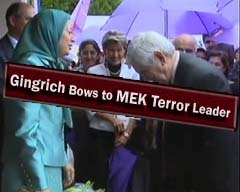 face Rajavi, smiled, and at approximately 1:02 minutes into the above video, folded at the waist and bowed solemnly. Rajavi, clothed head-to-toe in green, handed him a bouquet of flowers as the crowd cheered.
Maryam Rajavi, the woman who so warmly received Newt Gingrich’s bow, is the president-elect of the NCRI. But she’s better known as the "principal leader" of Mujahadeen-e-Khalq or MEK, which is officially designated by the United States as a terrorist group. (The MEK, designated a terrorist group by the European Union until 2009, is also the largest group within the NCRI.) The MEK participated in the 1979 Iranian revolution, but later turned against the new government, which it has opposed in part with terrorist attacks against Iranian officials, embassies, and civilians. For years, it was sponsored by Saddam Hussein. Rajavi’s husband, Massoud, is thought to lead the MEK’s armed wing.
Who, exactly, was Gingrich so happy to see in Paris last week? Here’s a helpful 2008 backgrounder on Rajavi from the Council on Foreign Relations:
Maryam Rajavi was born in 1953 to an upper-middle class Iranian family, and she joined MEK as a student in Tehran in the early 1970s. After relocating with the group to Paris in 1981, she was elected its joint leader and later became deputy commander-in-chief of its armed wing. Experts say that MEK has increasingly come to resemble a cult that is devoted to Massoud Rajavi’s secular interpretation of the Koran and is prone to sudden, dramatic ideological shifts. In June 2003, French authorities raided a MEK compound outside Paris and arrested 160 people, including Maryam Rajavi. She was released in 2006 but resides in Paris where she bases her campaign to remove the Iranian regime. Massoud Rajavi was last known to be living in Iraq, but authorities aren’t certain of his whereabouts or whether he is alive.
Gingrich is not the only U.S. politician to openly support the MEK, which a number of Congressmen and retired officials from both parties are lobbying to have de-listed as a terrorist organization. In March, the Treasury Department launched an investigation into whether some of these Americans had accepted lavish — and illegal — speaking fees from the group. Former Pennsylvania Governor Ed Rendell, a democrat, said he’d earned $150,000 speaking on behalf of the group.
Assuming that money is not a factor, why would such prominent Americans support an officially designated Iranian terrorist group? It’s a straightforward, enemy-of-my-enemy proposition: the MEK opposes the government in Tehran, and so do we. This is the logic that, according to a recent report by the New Yorker’s Seymour Hersh, that led the U.S. to arm, fund, and train some MEK fighters in 2005. In his speech, Gingrich argued, "The pressing issue regarding Iran is neither confronting the regime’s nuclear program issue nor its terrorism. The main issue is to change this regime. So long as this regime is in power, none of those issues will be resolved."
Still, even if you agree with his logic, it’s a bit jarring to see a recent front-runner for the GOP nomination for the presidency literally bowing to the leader of a terrorist organization. The bow was an odd choice, given that Iranians don’t really practice it. (When I pointed this out on Twitter, Radio Liberty’s Golnaz Esfandiari joked that maybe he’d confused Iran for Japan; CFR’s Micah Zenko suggested a "terrorist fist jab" might have been more appropriate.) To be fair, I’ve been in situations where I’m not sure whether or not a handshake would be culturally or religiously inappropriate, and it’s awkward. So, it’s hard to see his choice to bow as anything more pernicious than a bit of social clumsiness.
Other than this one uncomfortable moment, Gingrich’s visit seemed to go well. He did, however, open his speech by citing the 1979 Tehran hostage crisis, in which Iran held American embassy officials hostage for over a year, as the first strike against the U.S. and as proof of the "intolerable" and "anti-human rights" nature of the regime. "We will never have peace and we will never have justice in the region as long as that dictatorship survives," he concluded. What he didn’t seem to know is that his host, the MEK, had supported and participated in holding the Americans hostage, which is part of how they got the terrorist designation that Gingrich would like to see removed.
Update, 5:20 p.m.: Would you believe that, just three and a half months ago, Gingrich’s presidential campaign ran an ad lambasting President Obama for bowing to a foreign leader? He sure did!
In a 2009 London meeting with Saudi King Abdullah, Obama appeared to bow deeply on shaking the monarch’s hand. Conservatives lambasted Obama for his "shocking display of fealty"; an anonymous White House official countered, "It wasn’t a bow … he’s taller than King Abdullah." Gingrich resurrected the mini-controversy to attack Obama’s energy policy, insisting that America would "never again bow to a Saudi king" under a Gingrich presidency.
Here’s the ad, surfaced by the Christian Science Monitor’s Dan Murphy:
It’s a reminder that the how-dare-he-bow controversies can be a little silly; different greetings carry different meanings in different cultures, after all. Both Gingrich and Obama were probably just doing what they thought was socially appropriate, not secretly declaring "fealty" to a foreign force. Still, one important distinction is that Saudi King Abdullah is the leader of an important American ally, whereas Maryam Rajavi heads up an officially designated terrorist group.
By Max Fisher , The Atlantic
 the Mujahadin-e Khalq (MEK), an Iranian group that has been lobbying Washington to be removed from the U.S. government’s list of designated foreign terrorist organizations.
 the UN High Commission of Refugees.
 and “legitimacy” because it now can be used to carry out attacks inside Iran.