
Iraq on Monday night took a further step to expel hundreds of Iranian dissidents who received support from Saddam Hussein but who are no longer welcome as relations improve between the Shi’ite-ruled neighbours.
The Iraqi government aims to evict the People’s Mujahideen Organisation of Iran (PMOI), which opposes the clerical rulers of neighbouring Iran and fought with Saddam’s forces in the Iran-Iraq war in the 1980s.
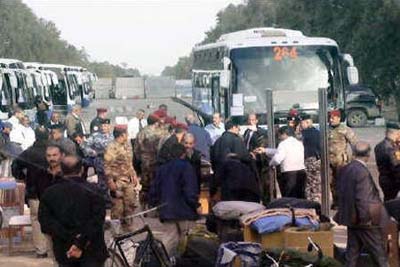
On Monday night buses moved 400 residents from Camp Ashraf – built under Saddam and which remained under the protection of U.S. forces – to a former U.S. military base in Baghdad, said Uday al-Khadran, mayor of the nearby town of Khalis.
The Iraqi government moved similar numbers of Ashraf residents to the temporary processing centre at Camp Liberty on February 18 and March 8 as part of its plans to expel them from the country.
There are now about 1,200 PMOI members at Camp Liberty and 2,000 still at Camp Ashraf. They say they fear for their safety now that U.S. troops have withdrawn from Iraq.
Residents agreed in February to move to the new camp, where the United Nations intends to process them for refugee status in other countries, but they complain that the conditions at the new base are dire. They say they have not been permitted to bring many of their personal belongings.
Behzad Saffari, a resident who moved to Camp Liberty last month and acts as a legal adviser there, said one of the new arrivals died of heart failure overnight shortly after the journey, after enduring 48 hours without sleep.
"At the movement it is a prison, with the saturation of police forces and no freedom of movement," Saffari said via telephone, since Camp Liberty is off limits to journalists.
He said others due for relocation were refusing to move to Camp Liberty until Iraqi police were withdrawn from the camp.
There is no suggestion that PMOI members will be sent back to Iran but finding refuge outside Iraq is made more complicated because the United States lists the group as a terrorist organisation. The PMOI carried out attacks decades ago including against U.S. targets but says it has long since renounced violence and shares the West’s opposition to clerical rule in Iran.
The European Union removed the PMOI from its terrorist blacklist in 2009 after being ordered to do so by a court.
(Reporting by Peter Graff in Baghdad and a Reuters correspondent in Baquba, Iraq; Writing by Peter Graff; Editing by Ben Harding)

 organization).
  more primitive than we imagine. Propaganda must therefore always be essentially simple and repetitious. The most brilliant propagandist technique will yield no success unless one fundamental principle is borne in mind constantly… it must confine itself to a few points and repeat them over and over”. And it is really a recipe for disaster if a terrorist cult clings onto this Nazi precept in its propaganda activities.
 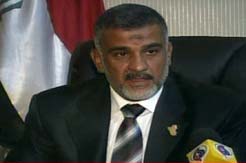 province.
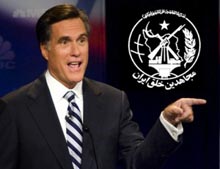 But his ignorance about what has become a lightening rod issue among the foreign policy community raises questions about their work.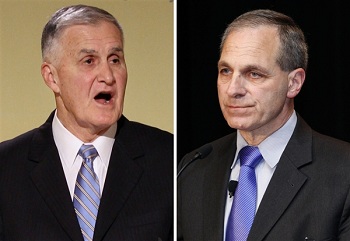
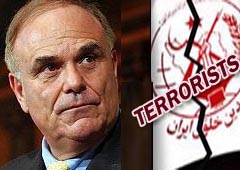
 outstation. The US Treasury Department appears to have begun an inquiry to see whether the speaking fees paid by Mojahedin Khalq Organization MKO to its American advocates who have spoken on its behalf are illegal. In an earlier report by The Washington Times, Edward G. Rendell, the former Democratic governor of Pennsylvania and an outspoken supporter of MKO, has been subpoenaed by the Treasury Department. He is asked to turn over information on his relationship with the designated terrorist group. Of course, Mr. Rendell is only one among the long list of former officials, including former directors of the Central Intelligence Agency and the Federal Bureau of Investigation, and many more, who have accepted fees to speak on behalf of MKO in Paris and Geneva as well as appearing in online videos and participating in arranged rallies. Mr. Rendell asserts that he has been paid between $150,000 to $160,000 for seven or eight speeches in support of MKO and calling for its removal from the terrorist list.
 33rd Anniversary of the Iranian Revolution at The Waldorf-Astoria on February 11, 2012.
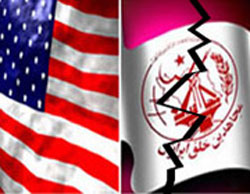 terrorism to nuclear programs, the myriad challenges have rarely provided any easy answers. One of the few clear issues pertaining to America’s Iran policy has been its designation of the Mujahedin-e Khalq (MEK) as a terrorist organization.