
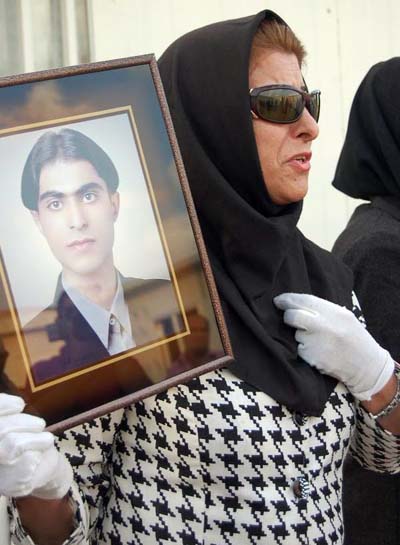
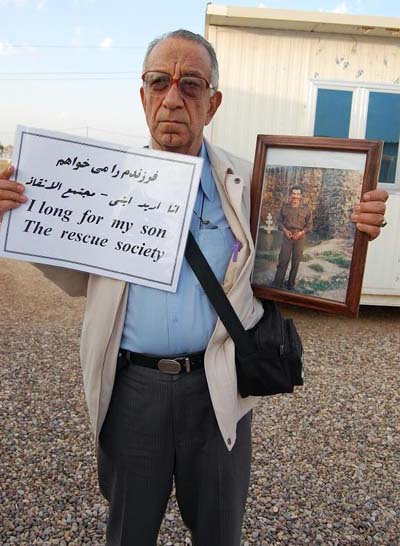
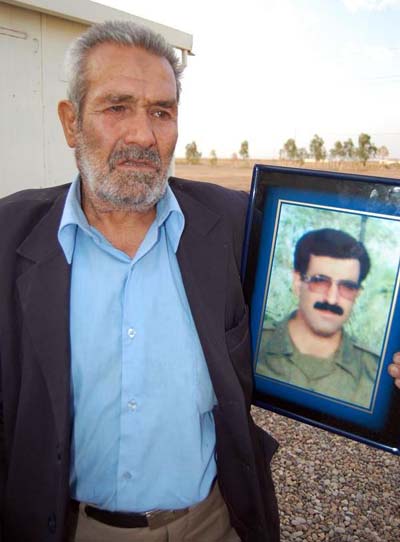
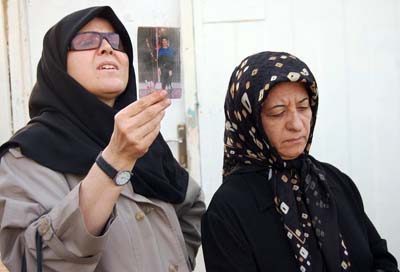
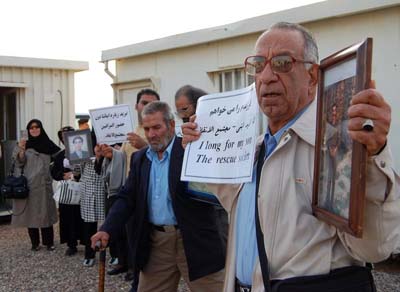
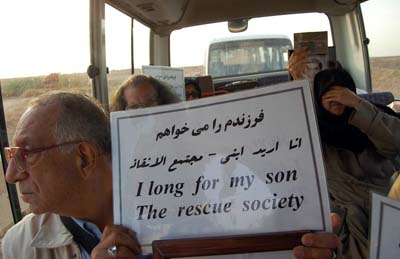
Eight families travelled to Iraq from Iran on 31th October,2009 to find and meet with their relatives who are trapped in a terrorist cult. Once again American soldiers, apparently acting as lackeys for the MKO leaders in Camp Ashraf, have blocked all attempts of these families to meet their loved ones…Despite the humanitarian efforts of the Iraqi Government, MKO leaders refused to let Iranian families meet their children in Camp Ashraf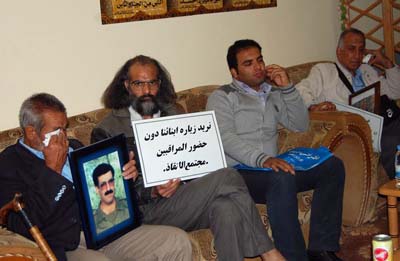
BAGHDAD- The Iraqi cabinet’s secretary general on Wednesday revealed attempts by the Iraqi government to convince European countries to host the People’s Mojahedin Organization of Iran (PMOI), which is currently based in Iraq.
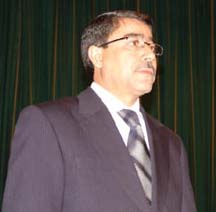
“Iran has called on Iraq to hand over the PMOI’s members, but the (Iraqi) government does not want to force them to go to a country against their wishes, just as it does not want them to stay in Iraq,” Ali al-Allaq said in an exclusive statement to Aswat al-Iraq news agency.
“There is no justification for the organization’s members to remain in Iraq,” Allaq added.
The official explained that it is not possible for the Iraqi government to look after the PMOI’s members, who are taking refuge in the country, at a time it declares security and reconstruction as its top priorities.
The PMOI, also known by the abbreviations MKO and MEK, is a militant socialist organization that advocates the overthrow of Iran’s current government. Founded in 1965, the PMOI was originally devoted to armed struggle against the Shah of Iran, capitalism and Western imperialism.
The group officially renounced violence in 2001 and today it is the main organization in the National Council of Resistance of Iran (NCRI), an “umbrella coalition” parliament-in-exile that claims to be dedicated to a democratic, secular and coalition government in Iran.
Urgent Appeal to Wijdan Mikhail Salim, Minister of Human Rights of Iraq
From eight Iranian relatives of MKO captives in Camp New Iraq (Camp Ashraf)
We have travelled a long way to Iraq to visit our family members. Some of us have not seen these close relatives – sons, daughters, husbands – for over twenty years. Now that we have arrived we have found that we have been banned from seeing our families by the Mojahedin-e Khalq leaders. Who is in charge of what happens in this country?
|
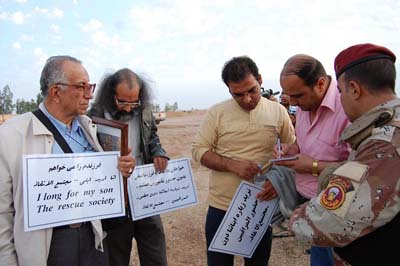
| Iranian relatives, Outside Camp "New Iraq", November 4, 2009 |
We came here because we believed that the Iraqi government had finally taken control of the camp and its inhabitants and would be able to help us. This is not so.
We are grateful for the support and accommodation provided by the Iraqi authorities at the checkpoint leading to the Camp of New Iraq which was renamed from Camp Ashraf. Even this re-naming led us to believe that the Iraqi government was in control of the camp.
Sadly, we have discovered that a terrorist cult is still calling the shots in your country and that it is because of them that we cannot see those dear relatives whom we have travelled so far, and waited so long to see. Really, what harm can the eight of us do?
As Minster of Human Rights we hold you responsible for the situation in which our relatives are kept captured. We do not believe that they are free to decide for themselves whether to meet with us or not. They are being held incommunicado and subjected to cruel and inhuman treatment which forces them to deny their natural feelings. The MKO is a cult and deliberately mistreats its members.
If they are really free to choose then why don’t the MKO leaders give them permission to come out of the camp and see us and then they can choose freely to return to their struggle without any further delay or comment from us.
Eight visiting Iranians are waiting for your answer; guests in your country. Although we are elderly and weak we have gone on hunger strike. We cannot do this for long. But we hope that you understand the strength of our feelings and the desperation of our actions and that our appeal to you to intervene on our behalf is answered by your kindest efforts to help us.
Families on hunger strike to protest American support for terrorist group which holds their loved ones hostage ..American Army established a check point to prevent families release their loved ones from a terrorist cult
Iran Interlink update on Camp Ashraf
Al Khalis, Iraq, November 04, 2009 – Eight families (named below) travelled to Iraq from Iran this week to find and meet with their relatives who are trapped in a terrorist cult. Once again American soldiers, apparently acting as lackeys for the MKO leaders in Camp Ashraf, have blocked all attempts of these families to meet their loved ones.
Efforts by the Iraqi authorities, U.N. representatives, the ICRC and others to facilitate the humanitarian move have been blocked by the Americans.
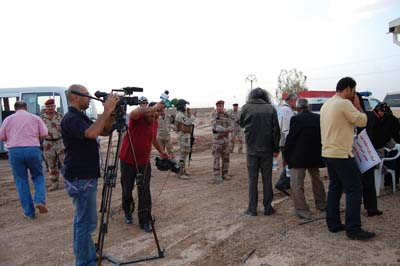
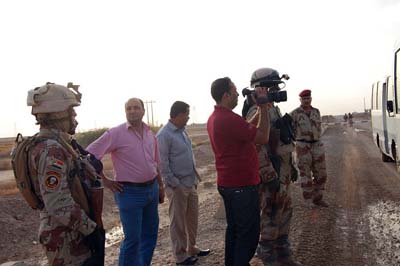
Although Iraqi police have established a base inside Camp Ashraf in an effort to enforce Iraqi law among the residents there, the American soldiers have established a further buffer checkpoint which effectively prevents them from carrying out this duty.
Families who arrived at the camp on Saturday 31 October were able to pass through the Iraqi checkpoints to the camp, but were blocked at the final checkpoint which is manned by U.S. military personnel.
The families are now staying at the first check point and an Iraqi officer is acting as liaison between them and the camp. The US army is apparently resisting the requests of the families and insists that the Iraqis should ask permission from the MKO leaders to let families see their loved ones. The MKO is not only an illegal foreign terrorist group in Iraq but has since 1997 been on the U.S. terrorism list.
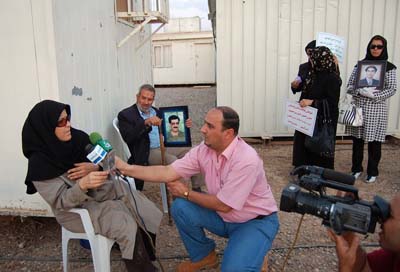
The families are living in temporary container units. They say they are grateful to the Iraqi military for accommodating them at the first check point and providing security as well as attempting to organise meetings between the families and their loved ones. It is now four days that the families are living in the military check point with the obvious lack of facilities.
From November 2 the families began a hunger strike. They demand that the Iraqi government as the only responsible body in Iraq must take charge and allow the freedom of their children.
The Iraqi government’s attempts to dismantle the terrorist camp and release the victims has been facing strong resistance from the Israeli lobby and neocons who support the return of Saddamists to Iraq. The Mojahedin Khalq Organisation has acted as their proxy in Iraq with Camp Ashraf being used as the base for gathering and coordinating the Saddamists after the American Invasion of Iraq in 2003. By order of the Pentagon, the camp was protected and held together by the U.S. until their retreat in 2008. Americans left a unit at the camp to make sure the terrorist HQ is not dismantled by the new Iraqi government.
The MKO leaders, with the backing of the U.S. army, refuse to accept families meeting their children. They say the families are “agents of the Iranian secret services” and have refused even to hand over the letters the families have written to their children.
Names of the families currently visiting Camp Ashraf:
1- Mr. Jahanshir Sassani – looking for his son Mohammad Ali Sassani . Mohammad Ali was a P.O.W. during the time of Saddam’s war with Iran. He was handed over to the MKO during the war in defiance of international law. He has been in Iraq for 21 years. This is Mr. Sassani’s fourth visit to Iraq to try to meet with his son.
2- Mr. Reza Noroozi – looking for his son Abdolmajid Nooozi. Abdolmajid was a P.O.W. during the time of Saddam’s war with Iran. He was handed over to the MKO during the war in defiance of international law. He has been in Iraq for 22 years.
3- Mr. Akbar Moradi Rizi – looking for his brother Hossein Moradi Rizi. Hossien has been in cult isolation for the past 30 years.
4- Mrs. Nasreen Lotfizadeh – looking for her daughter Soosan Banihashemi. Soosan has been in cult isolation for the past 21 years.
5- Mrs. Parvin Saberi – looking for her brother Aghil Saberi. Aghil has been in cult isolation for the past 16 years.
6- Mrs. Giti Zartoshtnia – looking for her son Roozbeh Attaee (aka: Ali Mahdavi). Roozbeh has been in cult isolation for the past 10 years.
7- Mrs. Masoumeh Mahboob – looking for her husband Arzil Dialeh and sons Mohsen and Peyman Dialeh. They have been in cult isolation for the past 7 years.
8- (…)
Despite the humanitarian efforts of the Iraqi Government, MKO leaders refused to let Iranian families meet their children in Camp Ashraf
Leaders of the Organization refused to allow the reunions of Iranian families coming from Iran to Iraq to meet with their children who are members of the organization in Camp Ashraf, although they have undergone long separations.
This news came during a visit by a number of Iranian families with the consent and support of the Iraqi government to Camp Ashraf in Diyala province on Saturday to meet their children who are from the organization’s members. The families were disappointed when officials of the organization refused to allow them to meet with members of the organization for fear that these members will leave and return to their homeland and their families.
For its part, the Government of Iraq has asked the American side and a delegation from the United Nations and International Committee of the Red Cross and international human rights organization to hold direct negotiations with the leaders of the organization for continued long hours to convince them of the need to deal with this situation in a humane and approved way and for the Iranian families to meet with their children instead of the organisation publishing statements which accuse the Iraqi government of violating human rights laws.
Ultimately the negotiations failed as a result of the absolute rejection by the leaders of the organization of this humanitarian initiative. To achieve their aims the families have begun a sit-in at Camp Ashraf to demand that the Iraqi government and international community intervene to pressure the leaders of the organization in Camp Ashraf to give their children complete freedom to make personal decisions in response to their emotions and their sentiments.
Meanwhile the Iranian families stressed the amount of suffering and pain they face at the moment and over the years as a result separation from their children. The families said that the main objective of the existence of Iranian families in Iraq is to help their children and return them to Iran to live with us in peace.
Translated by Iran Interlink
Iraq: We treat Mojahedin Khalq have no status
Listen to the Story (4min, 27Sec)
 An old Middle East aphorism says "the enemy of my enemy is my friend." With the United States and Iran at odds, it should mean warm relations between the United States and the opponents of Tehran.
But a group of 3,400 Iranian dissidents, currently living north of Baghdad, has posed a dilemma for the U.S. government.
They were given U.S. military protection in 2003 after the American-led invasion of Iraq, but now the Iraqi government wants them out. The trouble is that they don’t want to leave.
The Mujahedeen-e Khalq organization, known as MEK, was part of the alliance that overthrew the Shah of Iran in 1979. But it quickly ran afoul of the Islamic revolution. The organization moved to Iraq in the 1980s. Since then, the dissidents have lived as refugees at Camp Ashraf, north of Baghdad.
Refuge in Iraq came at a price, though. Saddam Hussein put them to work against their own country during the Iran-Iraq war. And he had other jobs for them, as well.
Ali al-Zuhairi, an Iraqi tribal sheik in the town of Khalis, near Camp Ashraf, recalls bitterly how the MEK helped Saddam put down the Shiite and Kurdish uprisings in 1991. Zuhairi claims the MEK killed rebel Iraqis and left their bodies in the street. He calls them "terrorists."
Officially, the U.S. government agrees, and designates the MEK as a foreign terrorist organization. But on the ground in Iraq, the U.S. treats the group differently, says Mohammad al-Shemari, another resident of Khalis.
Quil Lawrence, National Public Radio
Leaders of the anti-Iran terror group, the Mojahedin-e Khalq Organization (MKO), have barred the group members incarcerated in a military base – about 60km (37 miles) north of Baghdad – form visiting their family members and relatives, fearing their defection, informed sources said on Monday.
According to the Habilian website (run by the family members of Iranian terror martyrs), a number of MKO members’ families, including their mothers, fathers and relatives on Saturday went to Camp of the New Iraq (formerly known as Camp Ashraf) to meet their sons and daughters but the guards at the camp didn’t allow them to do so and reciprocated their demands with harsh and insulting behavior.
The Camp guards also disrespected representatives of the international human rights bodies dispatched to the area to accompany the families.
Statements made by the MKO leaders in response indicated that they would not allow such meetings for the fear that families might encourage their beloved offspring to defect the terrorist group.
Iraqi security forces took control of the training base of the MKO at Camp Ashraf – about 60km (37 miles) north of Baghdad – in July and detained dozens of the members of the terrorist group.
The Iraqi authority then changed the name of the military center from Camp Ashraf to the Camp of New Iraq.
The MKO has been in Iraq’s Diyala province since the 1980s. The Iraqi government and parliament have announced that they would not tolerate the group anymore and that they are seeking to expel the group from the country in the near future.
The anti-Iran terror group has been blacklisted as a terrorist organization by many international entities and countries.
The MKO is behind a slew of assassinations and bombings inside Iran, a number of EU parliamentarians said in a recent letter in which they slammed a British court decision to remove the MKO from the British terror list. The EU officials also added that the group has no public support within Iran because of their role in helping Saddam Hussein in the Iraqi imposed war on Iran (1980-1988).
Many of the MKO members abandoned the terrorist organization while most of those still remaining in the camp are said to be willing to quit but are under pressure and torture not to do so.
A May 2005 Human Rights Watch report accused the MKO of running prison camps in Iraq and committing human rights violations.
According to the Human Rights Watch report, the outlawed group puts defectors under torture and jail terms.
The group started assassination of the citizens and officials after the Islamic Revolution in Iran in a bid to take control of the newly established Islamic Republic. It killed several of Iran’s new leaders in the early years after the revolution, including the then President Mohammad Ali Rajayee, Prime Minister Mohammad Javad Bahonar and Judiciary Chief Mohammad Hossein Beheshti who were killed in bomb attacks by MKO members in 1981.
The group fled to Iraq in 1986, where it was protected by Saddam Hussein and where it helped the Iraqi dictator suppress Shiite and Kurd uprisings in the country.
The terrorist group joined Saddam’s army during the Iraqi imposed war on Iran (1980-1988) and helped Saddam and killed thousands of Iranian civilians and soldiers during the US-backed Iraqi imposed war on Iran.
The MKO was put on the US terror list in 1997 by the then President, Bill Clinton, but since the 2003 US invasion of Iraq, the group has been strongly backed by the Washington Neocons, who also argue for the MKO to be taken off the US terror list.
Mr. Bernard de Montferrand,The French Ambassador in the Federal Republic of Germany

Respectfully, we would like to acknowledge that the Iranian Pen Club is consisted of those ex-members of the MKO who managed to free themselves from the mental and even physical barriers of the Organisation. Hence, We would like to notify you about the venture presence of such cult in your country because we have all experienced their cruelty and savagery with our own flesh and bone during our captivity in that notorious cult.
Because As you know that peoples Mojahedin organization ( PMOI/MKO) which has been residing in your country for decades, had cooperated and participated in many crimes against humanity in Iraq during Saddam Hussein’s reign and they have been taking advantage of the democracy and freedom in European countries specially in your motherland, France.
The people’s Mojahedin organization which has cultic relations among its members, has been utilizing inhumane methods in its internal relations among its rank and file such as brainwashing, religious indoctrinations, and the like to further its cultic objectives and ends in European countries and France in particular. Your country has experienced the ablaze human torches who were desperate and inculcated members of this cult in 2003 in Paris. Self immolation and self burning, which are deprecated and abominable actions , are one of the horrible things that they have potentiality to do so.
Also, I would like to remind you that cults do need an isolated remote place with tall walls in order to impose their brainwashing techniques over their followers and the Ashraf garrison in Iraq and Auvers-Sur-Oise garrison in France have provided such facilities for many years for the MKO.
Hence, We would like to repeat for you about the venture presence of such cult in your country.
With many thanks and regards
The Iranian Pen Club
29.10.2009
Postfach 90 06 63
51116 Köln
Germany
00491756391365
info@iran-ghalam.de
iran-ghalam@hotmail.de
An interview with Batool Soltani on MKO self-immolations – a précis of parts 35-36
Sahar Family Foundation: Let’s continue with the suicide operations carried out following the 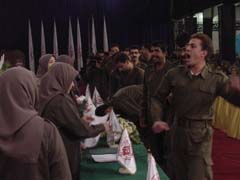 inauguration of a new phase, ‘operations of ultimate’, since the organization began a successive launch of operation in this phase mainly stressing on a strike and escape tactic. Please furnish further explanation in this respect.
Batool Soltani: You know, before the beginning of the mentioned phase which began with the end of Iraq-Iran war, in years after 1987 the organization would dispatch its military teams across the Iranian borders, of course supported by Iraqi forces, for hit and run operations. Then it became bold to carry out bigger operations like that of Aftab, Chelcheragh, and Eternal Light as the last. Soon after the ceasefire, the organization began masterminding ‘operations of ultimate’; the best instances of these operations that ceased just before fall of Saddam are assassination of Sayyad Shirazi, Lajevardi, and widespread mortar attacks. Remarkable in these operations was the score of casualties from among the civilians. I remember that the family of the victims filled complains against the organization in international courts and the organization tried to acquit itself of the charges.
But your concern in these operations is where they tie with the suicide operation. The first important thing about the members of the teams dispatched for the operations was their readiness to venture their life. In fact, they had to prove their readiness to commit suicide to stymie the risk of being arrested alive. Unlike other overt military operations, they were covert operations that had a red-line to consider and no concrete evidence had to be left by the teams to be used against the organization. As a matter of fact, the teams had to pass a test to ensure they would not fail to observe the delineated red-line.
In contrast to regular military operations that the forces had the chance of retreating to their bases back into Iraq, in these operations that the teams penetrated deep into the Iranian soil the risk of capture was very high and retreat was actually impossible if they happened to be traced. The red-line to observe was to frustrate the hope of the regime’s forces to capture teams alive by committing suicide through swallowing cyanides or any other possible means at hand. Thus, the perquisite for the dispatched teams was the degree of their preparedness for committing suicide and they were supposed martyrs before setting off for the operations.
The means of suicide had to be necessarily checked as the first priorities along with other weapons needed for the operations. They were cyanides, hand-grenades, and guns and the teams received special trainings to use them in critical situations. Of course, they received other psychological and security trainings to counteract after-arrest tortures and pressures if they failed to commit suicide and fell into the hands of the regime’s forces. In general, any thought of compromise was a taboo; there was no alternate but to kill or be killed.
They in the organization would say the arrested members had to suffer under the tortures which were one hundred times worse than being killed for once since one might fail to tolerate pressures and would surrender which was equal to an attached stigma. Then they would bring examples of those who had easily assented to cooperate with the regime to be relieved of sufferings and tortures. Thus, the teams became resolute to commit suicide when facing a serious situation that increased the risk of arrest and even the team-mates had orders of killing each other when they would reach an impasse to escape. Here, it was not important who was at the charge, regardless of any organizational ranking, any member of the team had the responsibility of judging the right time for the action, to kill himself/herself or the other mates.
SFF: How long did it take to prepare a member for the operations? Your reference to the nature of trainings indicates that it could take a longer process than the ordinary ones to prepare them.
BS: Naturally, the operation teams were different. One of the factors they deemed necessary for the ‘operations of ultimate’ was not to select the team members from among the old members. Second, the team members had to have nursed a grudge and hatred against the target/s they were dispatched to hit. In fact, the feelings that rose within them had to be spurred on by sheer personal hatred of the targets and thus, the competency and organizational ranking had the second priority. Such motivated teams were much trusted for committing suicide and I can tell you that the one they chose for the assassination of Lajevardi had hardly finished his two years of preliminary training to be accepted as a joined member and to become a veteran. What had motivated him from the very beginning to join the organization was his grudge against Lajevardi and eventually succeeded to convince the organization to be enlisted in the operation team dispatched for his assassination. In fact, the organization was thinking of exploiting new recruits who knew little and so could impart little if arrested alive.
That was one of the reasons behind the policy of replacing new recruits for the old, experienced members in the operation teams; the organization was reluctant to risk the life of the older members for the time and needed them for the influential role they could play. Besides, the confessions of these older members after their arrest could disclose what the organization strived to conceal from the lower ranks to stop them having a low opinion of the organization that could influentially affect their fighting morale.
SFF: What happened in the interim between the teams arrange and their departure?
BS: As soon as the teams were selected and arranged, the members would be lodged in isolation totally cut off from other members and received no more organizational information. In fact, they had no more contact with others and reached a zero point of no updated information. Second, they would form a new profile just like ordinary people with grown beards. There were other physical, medical and psychological tests as well as recurrently going through the details of their operation and practiced them. And then, they came to the stage of going over the methods of committing suicide; how to break and swallow cyanide capsules, use hand-grenades or guns.
They reached the mastery point when they did all things blindfolded. They also sat watching thriller and military movies that kept them morally high and motivated; the hostage-taking movies were appropriate training classes that instilled in them a working solution that could help them get out of the critical situations. Other trainings included the ways of smuggling the weapons and ammunition over the border and past the sensitive points and stations as well as drawing the outlines of camouflages that allowed them to advance without alerting the guards and police forces. One thing the organization insisted on even during the operations was regular confession sessions of cleansing; the teams had to arrange sessions among themselves regularly with the imbued belief that their success or failure all depended on the constancy of the organizational tradition.
SFF: What was the information they were kept away from while in isolation?
BS: From the time they were put in isolation, they would take part in no general meeting with the presence of Massoud and Maryam and no ranking member had the permission to contact them. As there was no new information, the old ones became outdated and thus, their latest information was limited to what they knew about four months ago. In fact, isolation washed their brains of any latest information that could be of any challenge to the organization if they happened to be arrested and talk.
Mrs. Berta Cabral ,Mayor of Ponta Delgada
Respectfully, I would like to introduce myself before anything else. I am an ex member of 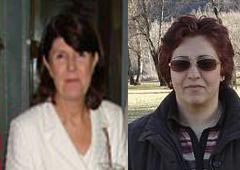 Mojahedin Khalq Organisation (MKO). In 1990 I became an outspoken critic of what is known as the "forced divorces" and special relations between the organisation and Saddam Hussein, the ousted dictator of Iraq. I was imprisoned for a few months in solitary confinement inside camps of Mojahedin Khalq Organisation in Iraq. I am living in Switzerland now.
Me and my colleagues would like to begin this letter by congratulating you on your victory in the election for the position of Mayor of Ponta Delgada against Mr. Paolo Casaca, we would like to bring to your attention a point that has had its own effect on the previous elections among the people of Portugal. The negative opinion of the people of Portugal against Mr. Casaca has undoubtedly been the result of his overt and covert relationships with the Iranian terrorist cult called Mojahedin Khalq Organisation. The group has been in close cooperation with the crimes committed by the Iraqi dictator Saddam Hussein as well as participating in human rights abuses against its own members.
I would like to inform your Excellency that MR. Paulo Casaca visited from Camp of Ashraf in Iraq many times for more help to this terrorist cult last years. But without any human rights organisation representative accompanying his good self., He visited the camp of terrorist cult without even investigating the allegations as to what is really going on behind its closed doors and he did not notice that the camp has no children inside. MR. Paulo Casaca did not think that this is because the cult leader has banned marriage and family relations?
About this news and his visiting to camp of terrorist cult in Iraq, Mr.Casaca himself admitted to the Socialist Party [and they] rejected his remaining as a candidate [for MEP] after news of the Express in the court of Ponta Delgada. ( RTP TV, Portugal, July 15, 2009 )
I am extremely pleased to announce that public opinion in Portugal and other parts of European Union is sensitive to the violent nature of cults like Mojahedin Khalq Organisation and Public opinion will certainly give its verdict against terrorism, violence and its supporters.
I wish you and your colleagues all the best for the future. like people of Portugal.
Sincerely
Batoul Maleki – 01.11.2009