Nejat Society
  • Home
  • Articles
  • Media
    • Cartoons
    • NewsPics
    • Photo Gallery
    • Videos
  • Publications
    • Books
    • Nejat NewsLetter
    • Pars Brief
  • About Us
  • Contact us
  • Editions
    • عربي
    • فارسی
    • Shqip
Nejat Society
Nejat Society
  • Home
  • Articles
  • Media
    • Cartoons
    • NewsPics
    • Photo Gallery
    • Videos
  • Publications
    • Books
    • Nejat NewsLetter
    • Pars Brief
  • About Us
  • Contact us
  • Editions
    • عربي
    • فارسی
    • Shqip
© 2003 - 2024 NEJAT Society. nejatngo.org
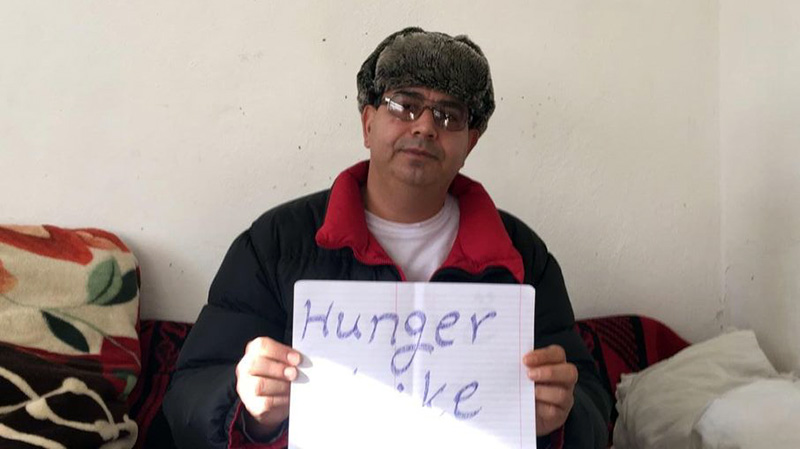
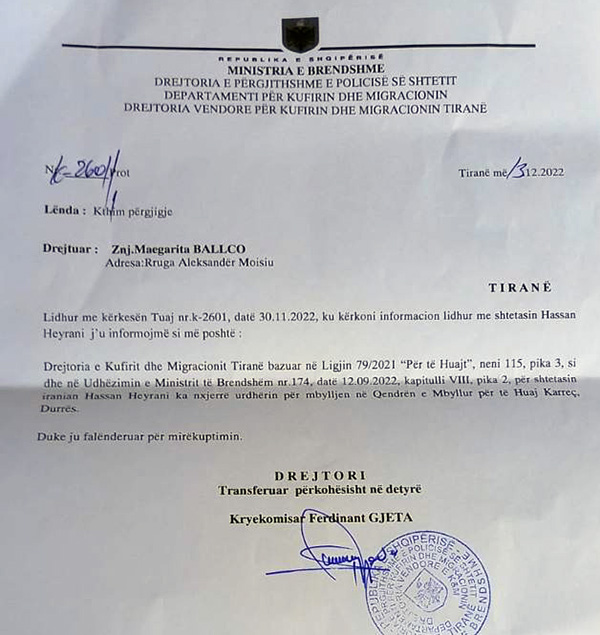
Hassan Heirani Asylum Card
Former members of the MEK

Albanian government threaten the wives of MEK defectors not to legally complain

Following the detention of six Iranian refugees in Albania, their wives were threatened not to appeal in the Albanian court. The arrest took place under the request of the Mujahedin Khalq Organization of which the arrested men had defected.

Albanian historian and journalist, Olsi Jazexhi tweeted about the detention of a number of Iranian members of ASILA(Association for the support of Iranians living in Albania). These people who are defectors of the MEK were placed under “administrative detention” by the Ministry of Interior of Albania, as Jazexhi puts, because they denounced the cult of Maryam Rajavi.
As Jazexhi reports, the agents of the Albanian government warn the remaining defectors not to ask for rights, since Edi Rama’s Police may put even them in the Karrec detention center. “Edi Rama’s thugs don’t want the issue of Iranian refugees to become internationalized,” he suggests. “They want to break the rejectionists of Rajavi one by one.”

Olsi Jazexhi tweets on detention of six MEK former members: are Hassan Heyrani, Mehdi Souleimani, Reza Shekari, Ehsan Bidi, Hassan Shahbazi and Ali Hajari

Olsi Jazexhi tweets on detention of
six MEK former members: are Hassan Heyrani, Mehdi Souleimani, Reza Shekari, Ehsan Bidi, Hassan Shahbazi and Ali Hajari

According to Dr. Jazexhi, the six detained refugees are Hassan Heyrani, Mehdi Souleimani, Reza Shekari, Ehsan Bidi, Hassan Shahbazi and Ali Hajari who have been illegally put under detention. He asserts that the act of Edi Rama’s government is against the Albanian law because they are not given permission to defend themselves in the court. He suggests that Police raids and paid media articles by MEK did not succeed to prove the claims of Rajavi that the defectors are “Iranian spies” and thus Edi Rama’s regime has finally decided to illegally remove the humanitarian asylum of MEK defectors and put them in “administrative detention”.

Mehdi Soleimani Asylum Permission

Mehdi Soleimani Asylum Permission

Hassan Heirani Asylum Card

Hassan Heirani Asylum Permission

As an American-backed entity, the Cult of Rajavi, has tried to jail defectors of MEK for the past 4 years but has failed, since Albanian prosecutors could not find anything illegal in their records. In July 2022 the group intrigued the Albanian counterterrorism police to raid homes of the defectors. The Police did not find anything illegal there.
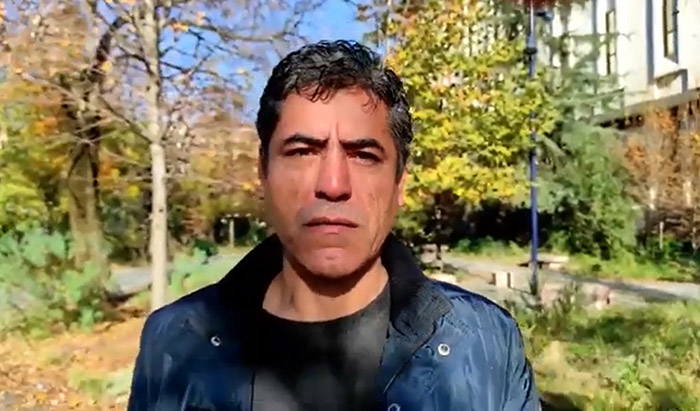
Dr. Jazexhi correctly notifies that Hassan Heyrani has been instrumental on revealing to the world the troll farm which MEK has in Manza, Albania, protected by the Albanian government. Heyrani revealed to the intercept fake identities including Heshmat Alavi and other trolls which MEK propaganda machine uses to spread fake news. Heyrani was interviewed by the BBC World, the Intercept, Al Jazeera English, BBC Persian and other international media outlets. “He and Hassan Shahbazi have been instrumental on revealing to the outside world the crime, corruption, violence and terrorism within the Mujahedin camp,” he writes.

Olsi Jazexhi tweets

Olsi Jazexhi tweets

He warns that the illegal detention of Iranian refugees in Albania is a gift which Edi Rama regime gives to “Maryam Rajavi’s mujahedin army”. Hassan Heyrani and his comrades have been very successful on liberating and facilitating the escape of many Iranians from the MEK’s camp of Manza, in north of Tirana.
“While in Saddam’s Iraq, the MEK leaders would usually kill defectors, in an Israeli-backed Albania, the Rajavi cult is using the Albanian Police to lock in prison those Iranians who dare to refuse to do terrorism on behalf of the Rajavi cult”, Jazexhi tweeted.

November 14, 2022 0 comments
FacebookTwitterPinterestWhatsappTelegramSkypeEmail
MEK women in Ashraf 3
Mujahedin Khalq as an Opposition Group

Mojahedin-e Khalq Incite Violence in Iran from Albania

In the political and social developments of the country in recent years, from protests to riots, generally the hated terrorist group of MEK (Mojahedin-e Khalq) has tried to play a role in order to achieve its forty-year-long goal of overthrowing the political system in Iran and it has not succeeded in doing so despite all sorts of methods they implemented.

In the recent developments after the death of Mahsa Amini, this reactionary terrorist cult has been provoking riots to, in their words, set the country on fire. Massoud Rajavi, leader of this terrorist cult who disappeared 20 years ago and has not published any photos of himself ever since, is extremely active in his unusual way.

Investigations show that since the beginning of the protests, Rajavi has sent 7 messages (every 2.4 days) in a period of 17 days (i.e. September 17 to October 3) encouraging violence, use of weapons, assassinating military commanders, overthrowing the government, and making threats. This is an entirely unprecedented act because the MKE leader formerly sent this number of messages within a period of 3 months from June 10 to September 13 (i.e. every 13.5 days).

Maryam Rajavi, his wife, is also engaged in provocative and violent activities from Albania by attracting foreign interventional support against Iran. For instance, she had a meeting with four American congressmen very recently. Although the relations between the representatives of the US Congress and the US Senate with the MEK are not of recent origin, such relations with a terrorist group whose background and history of terrorist activities are well documented is absolutely disgraceful.

It seems that, due to the increase in the amount of MEK’s destructive activities and inciting violence and murder by its leaders on the Albanian soil, the Albanian government is also supporting this cult in their activities and interfering in Iran’s political affairs. Not only did the officials in Tirana not limit the group’s activities and communications but they have increasingly strengthened their support for this cult. What seems desirable is that the Iranian government file a complaint against Albania in the UN Security Council for supporting a violent terrorist group. Although the MEK cannot distance itself from violent behavior due to its terrorist nature, dealing with and confronting the Albanian government as the host of this cult is the least that could be taken into consideration.

November 14, 2022 0 comments
FacebookTwitterPinterestWhatsappTelegramSkypeEmail
Albania Prime minister - Edi Rama
Albania

US-Iran clash in Albania as hopes of nuclear deal fade

Albanian authorities thwarted a second cyberattack over the weekend after Tirana, backed by the United States with pledges of support and fresh sanctions on Iran, severed all diplomatic ties with Tehran who it blames for the “sabotage”.

Meanwhile, hopes of reviving the 2015 nuclear deal continue to fade as leading European countries expressed ‘serious doubts’ about Iran’s intentions.

The latest attack in Albania comes just days after Prime Minister Edi Rama accused Iran of being behind a 15 July cyberattack that brought all government websites and digital citizens’ services offline and was described by Microsoft as “destructive.”

Edi Rama

Albanian Prime Minister Edi Rama

He ordered all Iranian diplomats to leave the country within 24 hours, severing all diplomatic ties with immediate effect.

On Saturday, Rama said the country’s border management information system (TIMS) was under “another cyber-attack by the same aggressors”, taking to social media a day later to confirm systems were back up and running.

“Beyond the heavy feeling created by the penetration into these systems, just like when they break into a house and steal, the fact is that the aggression has not achieved its goal at all, no disappearance or serious data leak!” Rama wrote on Twitter on Sunday.

Those trying to use the TIMS system, which records every person who enters and exits the country, were confronted by a message stating, “Albania is still paying for the terrorist acts of the MEK cult in Durres; this game will continue.”

Albania is home to the MEK group (People’s Mojahedin Organisation of Iran), who were transferred to Albania from an Iraqi refugee camp in 2016.

The group was founded in 1965 and engaged in militant action against the Iranian government for decades before forging an alliance with Iraq and siding with them during the Iraq-Iran war.

MEK was previously designated as a terrorist organisation by the EU, Canada, US and Japan, but this was repealed. They were given protection in 2004 by the US government under the Geneva Convention.

They aim to overthrow the Iranian government, and some 1,000 members live in a closed, heavily guarded compound 40 kilometres outside Tirana.

However, some analysts say it is not just due to MEK that Albania is being targeted. Albania is staunchly pro-American, a member of NATO and is home to a NATO airbase and, potentially, a future, a NATO naval base.

In today’s edition of the Capitals, find out more about Nord Stream 1’s 10-day maintenance causing worry for German policymakers, the Uber Files naming French President Emmanuel Macron as helping Uber enter the French market, and so much more.

Be vigilant

Lawyer and politician Kreshnik Spahiu told Euronews Albania that the government should be vigilant against attacks as it is “in a direct war with Iran.”

“Albania must be very prepared militarily, even with the intelligence services, but also as a society in terms of other attacks that in the future will no longer be on the Internet and social networks, but we will have consequences and physical victims,” he said.

The US National Security Council has also reacted to the latest news of the attack, stating it supports Albania’s recovery efforts.

“The United States condemns the September 9th cyberattack against our NATO Ally, Albania. This malicious activity against Albania follows the July 15 cyberattack conducted by the Government of Iran. The U.S. government is supporting Albania’s efforts to mitigate and recover,” a statement on Twitter reads.

On Friday, the US government imposed sanctions on Iran’s Ministry of Intelligence and Security and its head, Esmail Khatib, .for cyber-related activities against the US and its allies following a Whitehouse pledging “further action.”

The Director of the Civil Aviation Authority, Maksim Et’hemaj, said the attack was sabotage and called for establishing a Crisis Coordination Committee.

“In civil aviation, what happened with the TIMS system is classified by the definition, sabotage. In such cases, in cases of sabotage, the civil aviation asks the local authorities to set up what is called the Crisis Coordination Committee,” he told Euronews Albania.

NATO and its head, Jens Stoltenberg, on Thursday (8 September) condemned the Iranian cyberattack on Albania, which saw the country cut ties with Tehran and demand all its diplomats to leave within 24 hours on Wednesday.

But it is not just Albania that has witnessed such attacks. Digital services in Kosovo and North Macedonia have also been targeted over the last few days, although it is not yet known who is behind them.

Troll farm

Meanwhile, the MEK, in March 2021, was accused by Facebook of running a troll farm out of their base in Albania.

In a statement published on their website, Facebook said they had investigated and disrupted a “long-running operation from Albania that targeted primarily Iran”

“The network violated our policy against foreign interference, which is coordinated inauthentic behaviour on behalf of a foreign entity,” they wrote in their in-depth report.

The latest escalation comes on the backdrop of increasingly bleak hopes for reviving the so-called 2015 Joint Comprehensive Plan of Action (JCPOA) deal that gave Iran sanctions relief in return for restricting its nuclear programme.

In 2018, then US president Donald Trump unilaterally withdrew from the accord and reimposed sanctions.

Momentum for the EU-mediated new deal that seemed to be there earlier this month appears to have since faded, with Germany, France and Britain on Saturday raising “serious doubts” in a tripartite statement about Iran’s sincerity in restoring the accord.

The European nations charged that Tehran “has chosen not to seize this critical diplomatic opportunity”, adding that “instead, Iran continues to escalate its nuclear programme way beyond any plausible civilian justification”. Iran’s foreign ministry criticised those comments as “unconstructive.”, AFP reported.

Meanwhile, Israeli Prime Minister Yair Lapid arrived in Germany Sunday to persuade Western powers to ditch the tattered deal altogether.

By Alice Taylor – EURACTIV – Sep 12, 2022 (updated: Sep 26, 2022)

November 13, 2022 0 comments
FacebookTwitterPinterestWhatsappTelegramSkypeEmail
Nejat Newsletter No.99
Nejat Publications

Nejat Newsletter No. 99

– Israel, Albania and MEK to tighten alliance
The Albanian Prime Minister who hosts the Mujahedin Khalq Organization, visited Israel last week. The three-day visit took place, after the leader of the MEK, Maryam Rajavi, visited the Israeli ambassador to Tirana in her headquarters in Albania.

– The MeK, a Predecessor of ISIS in Attack on WorshipersNejat Newsletter No.99
As a result of a terrorist attack on the holy shrine of Shah-e Cheragh in Iran’s southern city of Shiraz on October 26, 13 people have been killed and 30 others wounded.

– They took my children as hostages to make me commit suicide
In June 2003, when Maryam Rajavi was arrested by French Police in her headquarters in the Parisian suburb, Auver sur d’Oise, Mostafa Mohammadi was a sympathizer of the group and two of his children Somayeh and Mohammad were serving as child soldiers in the Mujahedin-e Khalq’s military camp in Iraq

– The MEK; useful and good terrorists Albania must host
Could hosting a banned Iranian dissident group compromise Albania’s security? Some 30 kilometres west from Albania’s capital Tirana, nestled between a mountain range and the Adriatic Sea, lies the town of Manëz.

– Israeli ambassador meets with MEK terror group head
Albanian media reveals that a public and official meeting took place between the Israeli occupation’s ambassador and the head of the MEK terror organization, Maryam Rajavi.

– Ask the MEK, how to make a violent insurgent out of a normal protester
Civil protests in Iran often ends with the arrest of some MEKaffiliated insurgents who have committed acts of violence in the scenes of peaceful protests. In recent protests in Iran that was sparked by the death of Mahsa Amini, a number of arrested ones turned out to have been manipulated by the troll farm of the Mujahedin Khalq.

– Maryam Rajavi keeps her cyber army under systematic monitoring
Since the disarmament of the Mujahedin Khalq Organization by the US military in 2003, the group has been focused on a cyber warfare against the Iranian government. The war in cludes cyber attacks on computer systems and a disinformation campaign based on fake accounts in social media.

– Iran’s interior Minister on the terrorist act in Shah Cheragh Shrine
Shiraz, IRNA – Interior minister said combination war plot of enemies against Iran will lead nowhere, and terrorist act in Shah Cheragh Holy Shrine by shooting at innocent people and their children was a sign of enemies’ desperateness.

– British sociologist sees hands of foreign terrorists in Iran unrest
The recent unrest in Iran has its roots in foreign terrorist organizations’ attempt to provoke people to pursue their own agenda, which is overthrowing the political establishment, a British sociologist believes. David Miller told IRNA on Monday that some foreign elements who pursue their own geopolitical agendas fanned the flame of the recent protests in Iran to pursue a regime change policy.

– IRAN. Behind the protests of the veil, the terrorism of the Mojahedin-e Khalq
The death of the young Kurdish girl Mahsa Amini, after being arrested for not wearing the veil correctly, sparked protests, demonstrations and exploitation. I do not want to discuss the legitimacy of these protests but I am struck by the news of October

To view the pdf file click here

November 12, 2022 0 comments
FacebookTwitterPinterestWhatsappTelegramSkypeEmail
Edi Rama
Mujahedin Khalq; A proxy force

Albania teams up with Israel and U.S. against Iran: Foreign Policy

TEHRAN – Harun Karcic, a journalist and political analyst covering the Balkans, says Albanian is aligning with Israel and the United States against Iran.

Following is a major part of his article published in Foreign Policy:

Late last month, Albanian Prime Minister Edi Rama paid a high-profile three-day visit to Israel, where he met with Israeli Prime Minister Yair Lapid, President Isaac Herzog, Knesset Speaker Mickey Levy, Finance Minister Avigdor Lieberman, and the head of Israel’s National Cyber Directorate, Gaby Portnoy. Both sides discussed enhancing security cooperation, particularly in the cybersphere, and organizing a summit of Balkan leaders in Israel next year.

Rama’s visit to Israel came after Albania claimed Iran was behind a series of cyberattacks in July and September that temporarily shut down numerous online Albanian government services and websites. Rama also expelled Iranian diplomats from the country.

Edi Rama

Edi Rama visited the head of Israel’s National Cyber Directorate, Gaby Portnoy

Washington also backed Tirana’s decision to cut ties with Tehran and sanctioned Iran’s Ministry of Intelligence for its alleged role in the cyberattacks. Tehran rejected the charges that it was behind the cyberattacks and accused Albania of complicity in an American-Israeli campaign against Iran.

In fact, Iran and Albania have been at odds for years, ever since the Balkan state began hosting—at the request of the United States—members of the exiled Iranian terrorist group People’s Mujahideen of Iran, or Mujahedeen-e-Khalq (MEK), on its soil. The group has had a presence in Albania since at least 2013.

The U.S. continues to train the secretive, cult-like MEK in Albania against Iran.

Morphing into a secretive, cult-like group, the MEK lived in exile under former Iraqi President Saddam Hussein’s patronage starting in the 1980s and was designated as a “Foreign Terrorist Organization” by the United States, European Union, Canada, Japan, and Great Britain because of its alleged killings of U.S. nationals.

The United States removed the MEK from the terrorist list in 2003 following the U.S. invasion of Iraq and planned at the time to use the MEK in a potential overthrow of the Iranian government (a plan most recently voiced by former U.S. national security advisor John Bolton in 2018). However, such a plan never came to fruition. Hussein’s toppling and the ensuing chaos in Iraq required the group to find a new sanctuary, and the United States urged Albania to host MEK members.

Currently, about 3,000 MEK members are estimated to live in Albania’s Camp Ashraf-3, a heavily fortified compound protected by Albanian private security.

Since 2013, the MEK has regularly hosted events and summits in Albania that have attracted conservative U.S. Republicans, including former Secretary of State Mike Pompeo and former Vice President Mike Pence, the latter of whom delivered a keynote address at an event in Albania in June. Even today, many Republicans and congressional aides view the MEK as an important voice calling for regime change in Iran. Albanian media outlets have also reported on contacts between the Israeli embassy in Tirana and representatives of the MEK. Most recently, in October, the Israeli ambassador to Albania, Galit Peleg, apparently met with MEK leader Maryam Rajavi during the former’s trip to southern Albania.

These contacts have been closely followed in Tehran.

For obvious reasons, Iran is not thrilled with Albania for hosting the MEK, though Tehran tends to put most of the blame on the United States. Iranian Foreign Ministry spokesperson Nasser Kanaani criticized the United States for “forcing” the Albanian government to host the MEK and for “training and equipping them in cyber technology.” The group, he said, has “constantly served and still serves as a tool in the hands of U.S. to carry out acts of terror, cyberattacks, and wage psychosocial war against the Iranian government and nation.”

The idea to host MEK was not an Albanian initiative but rather a U.S.-Israeli agreement.

This raises the question of why Albania would willingly drag itself into one of the world’s most tense geopolitical standoffs, involving the United States, Israel, and Iran, by agreeing to host such a controversial group. A number of Albanian analysts have told me that the idea was not an Albanian initiative but rather a U.S.-Israeli agreement. To paraphrase my favorite line from the 1997 film Wag the Dog: ‘‘Why Albania? … Why not?’’ And the Albanian government, eager to showcase its pro-Western credentials, went along with it.

A former communist dictatorship that broke off ties with both the Soviet Union and Mao Zedong’s China to tread its own path, Albania is now yet another NATO member in a region surrounded by NATO member states. Eager to stand out as a steadfast U.S. ally, it often entangles itself in complex geopolitical issues far from its shores—from being the only country to accept Uyghurs from the U.S. prison at Guantánamo Bay who were cleared of terrorist charges, to accepting nearly 4,000 Afghans (mostly translators and support staff of the U.S. military), to hosting the MEK—a foreign-policy approach considered fruitful by major political forces in Albania.

Albanian analysts have told me that this way, Albania hopes to strengthen its role in the region and its diplomatic relations with the United States and Israel. Back in 2011, then-Prime Minister Sali Berisha declared Iran “a Nazi state” and backed Israel at the United Nations against the Palestinian bid for statehood. Then, much like today, the idea of gaining access to the United States via Israel was certainly on Rama’s mind.

For its part, Israel’s approach to the Balkans can be framed as a classic securitization policy: securing the regime beyond its borders by military and intelligence cooperation, political deals, and intelligence sharing. Israel has gradually and discreetly formed partnerships with Balkan countries such as Romania, Bulgaria, Albania, and Serbia. Israeli investments, both private and government-linked, in Greece and Serbia have been increasing, as have the number of Israeli tourists visiting the region, including Israeli Arabs visiting Bosnia and Herzegovina.

Indeed, Israeli sources confirmed to me that the person organizing Rama’s recent Israel visit was Alexander Machkevitch, a billionaire businessman and the chairman of Eurasian Resources Group, one of the largest global producers of essential metals and minerals, employing some 80,000 people. Machkevitch is also an Israeli citizen and a good friend of Rama’s.

Over the past few years, Israel has also emerged as one of the main diplomatic backers of Bosnia’s highly autonomous Republika Srpska, where Lieberman has cultivated a close working relationship with the pro-Russian Bosnian Serb hard-liner Milorad Dodik. Israel has also been nurturing military and diplomatic ties with Greece, Croatia, and Macedonia. On a more diplomatic level, it has engaged Balkan states through the Craiova State Forum, which brings together heads of government from Serbia, Romania, Bulgaria, and Greece, and focuses on improving infrastructure and energy cooperation.

Having a diplomatic presence in the Balkans is tempting for Israel. Nested between the Black Sea and the Adriatic, its geography places it at the crossroads between trade routes. Croatia, Montenegro, Albania, and Greece all have maritime access to North Africa and the Middle East; Hungary and Serbia connect the Balkan Peninsula with Central Europe; and Romania and Bulgaria have access to the Black Sea. Turkey’s booming exports destined for the European Union all pass through the Balkans, the shortest and most economical route. Just recently, Israeli company Elbit Systems opened a flight school in the southern city of Kalamata that will train Greek pilots in combat missions.

Israel is not the only Middle Eastern player making overtures in the Balkans: Turkey, the United Arab Emirates, and Saudi Arabia have made forays in the past, in addition to China and Russia. Security experts in the region have told me that Israel is trying to carve a place for itself in a region that is seen as the new chessboard in a great power competition.

Looking from a broader perspective, the Balkans fall into Israel’s “periphery doctrine”—its strategy of outflanking Arab neighbors deemed hostile by enhancing its security and economic ties with non-Arab Muslim states including in the Balkans, the Caucasus, and Central Asia. This was a starting point in Israel’s decades-long relationships with Turkey and Azerbaijan.

The Balkans are clearly emerging as a distinct region in which Israel wants to play a leading role. It is establishing itself as a leader in tech innovation, the defense sector, and cybersecurity. So far, Israel has managed to forge a system of bilateral working relationships with Serbia, Albania, Croatia, and Kosovo.

In the case of Albania, all three sides win: Albania gets Israel’s support in terms of intelligence and showcases its loyalty to Washington; Israel forges closer ties with yet another non-Arab Muslim-majority country on its periphery; and the United States continues training a group in Albania that politically and militarily opposes its archnemesis—a card that can be pulled out should circumstances call for it.

November 12, 2022 0 comments
FacebookTwitterPinterestWhatsappTelegramSkypeEmail
Mohammad Sahimi
Mujahedin Khalq; A proxy force

The Murder of Mahsa Amini and the Role of Outside Forces

On September 13 Mahsa Amini (called Zhina by her own family), a 22-year-old woman from the Kurdistan province in western Iran, was in Tehran to visit her family and friends. She was detained by Iran’s “guidance patrol” (referred to as “morality police” in the Western press) because, supposedly, she did not have the proper mandatory Islamic Hijab. While in detention, she collapsed and was taken to a hospital. Although the Iranian government claimed that she had suffered a stroke followed by a heart attack, eyewitnesses, including some that had presumably been detained with her and transferred by the same police car to the detention center, reported that she had been mistreated and violence had been used, and that her skull might have cracked. They also reported that, after she collapsed, it took some time before she was taken to a hospital. Three days later, on September 16, she passed away.

Amini’s outrageous murder sparked widespread protests throughout Iran. Tens of thousands of people took to streets to protest her death and, more generally, the discriminations against women and their constant humiliation by the hardliners, mismanagement of national affairs including pollution of the environment and wasting of limited sources of water (Iran has been suffering from a severe draught), deeply-rooted corruption, and tight restrictions on political and social freedom. Add to that the suffocating economic sanctions imposed by the Trump administration and continued by the Biden administration, and the result is a country of 87 million people in despair. The demonstrations have continued ever since, although their intensity and the size of the demonstrating population have decreased very significantly.

The most important aspect of these demonstrations is that they are led by young people, particularly the university students, who are mostly in their 20s, and even in their teens. A secret report by the government that was leaked to the press stated that the average age of those that have been detained by the security forces during the demonstration has been 17. This is unlike the previous large-scale demonstrations in 2009 that were led by the middle class, and the protests in 2018 and 2019 that were led by the poor people in smaller towns. The young generation, born after 1995, has no memory of the dictatorship of Shah Mohammad Reza Pahlavi before the 1979 Revolution, and has only lived under a theocratic system that not only has been unable to address their economic concerns, but has also continuously tried to impose a strict way of life on the population. In the age of global communication and social networks, young people everywhere have access to information and are aware of the developments around the globe, and the Iranian youth is no exception.

Similar to the widespread protests in 2009 during the Green Movement, following the disputed presidential elections, as well as the protests in January 2018 and November 2019, recent protests were totally peaceful during the first few days, after which they turned violent. [..]

Propaganda by Iran’s Foes

To be sure, aside from the back-breaking effect of U.S. economic sanctions, Iran’s troubles are domestically made, with the chief culprit being the hardliners who not only have proven not to be capable of running at least an efficient economy, but also prevent other groups to take power and stir the nation into a more constructive direction. Therefore, the protests by the Iranian people are completely justified and legitimate. But this does not imply that outside forces do not play any role in the current crisis. They have also tried to exploit the situation in order to advance their own agenda against Iran.

Using an American-built base in Iraq, a Kurdish separatist group, the Party of Free Kurdistan, widely known by its Kurdish acronym PAK, has been attacking Iran. During the war with the Jihadi Islamic State, known as ISIS, PAK forces received training and weapons from the United States, which are now using them against Iran. PAK forces may also have received aid from Saudi Arabia, Iran’s archenemy. Other small separatist groups have also been active, and have even hired lobbyists in Washington.

Another terrorist group, Jaish ul-Adl (meaning “army of justice”), a Salafi Jihadist group linked with al-Qaeda, has been operating in Baluchestan and attacking the security forces. On October 26 ISIS carried out a terrorist attack in Shah Cheragh shrine in city of Shiraz in southern Iran, killing at least 15 people and wounding 19. The United States did not condemn the attack.

Saudi Arabia’s regime has also been hard at work. In addition to its Wahabi-Salafi ideology that provides the “spiritual” backbone for all Sunni terrorist groups, including Jaish ul-Adl, thousands of Twitter, Telegram, Facebook, and Instagram accounts seemingly owned by “Iranians” have been traced back to Saudi Arabia. These accounts constantly post provocative statements, spread false rumors, support the small separatist groups that operate from Iraq or Pakistan, and attack anyone who opposes what they espouse.

At the same time, Iran International, a TV channel based in London and funded by a firm widely believed to have links to the Saudi Arabia regime, broadcasts Farsi programs into Iran. These programs almost always attribute their reports to “sources in Iran” without any specification, and have played a leading role in inciting unrest and demonstrations. The TV refers to demonstrations as the “revolutionary movement of the Iranian people,” whereas the protests represent neither a revolution, nor even a movement—at least not yet—but rather are the manifestation of the deep and justified anger of the Iranian people against the terrible state of their nation and their theocratic regime. The aforementioned secret government report estimated that, overall, 175,000 people in all of Iran took part in the demonstrations, and this is a country of 87 million people.

Almost all the “experts” who take part in Iran International programs either advocate “regime change” in Iran—code words for military attacks—or support economic sanctions against the Iranian people, or belong to small separatist groups, or even all of them. The image of Iran that they draw for the audience is one of a nation without any hope for change from within, hence necessitating intervention by the international community.
Iran International had live broadcast of a gathering of MEK supporters, an Iranian exiled opposition group, which caused deep anger among Iranians. Until 2012 the MEK was listed by the State Department as a terrorist organization. It is universally despised by all Iranians due to its collaboration with the Iraqi regime of Saddam Hussein during the war with Iran in the 1980s, its spying on Iran’s nuclear program on behalf of Israel and the United States, and its collaboration with Israel in carrying out assassination and sabotage in Iran.

Iran International also interviewed a leader of al-Aḥwāz, a terrorist separatist group operating in Iran’s province of Khuzestan in southwest Iran, right after it had carried out a terrorist attack in 2018, which also deeply angered Iranian people. A review of Iran International programs clearly demonstrates that what it advocates is completely aligned with the goals of the Saudi Arabia regime regarding Iran, which is why many refer to it derisively as Saudi International TV or the Bin Salman TV, a reference to the de-facto ruler of that country, Crown Prince Mohammed Bin Salman. Several Iranian journalists that worked for Iran International resigned over the content and direction of its programs.

But, Iran International is not the only Saudi-linked TV that tries to stir troubles in Iran. The Al-Arabia TV based in Riyadh, the capital of Saudi Arabia, broadcasts many programs in which they advocate support for the Iranian separatist groups.

Demonstrations Outside Iran

There have also been many demonstrations in support of the Iranian people in Europe and the United States. While many well-intentioned Iranians have taken part in these demonstrations, as they should, many of such protests have been driven mainly by that part of Iran’s exiled opposition popularly referred to as the “fake opposition,” i.e., those who have supported economic sanctions, or military attacks, or efforts by the separatists to separate from Iran, or even all of them.

One of the key organizers of recent demonstrations has been Hamed Esmaeilion, an Iranian-Canadian author and dentist, who lost his wife and young daughter when Ukraine International Airlines flight 752, taking off from Tehran on January 8, 2020, was shot down by Iran’s military, killing all 176 people onboard. Before this tragedy, Esmaeilion was not a political activist, but he is now being promoted as a key figure in the exiled opposition.
While there is great sympathy for Esmaeilion, the plight of his loved ones, his quest for shedding light on what actually happened that led to the tragic downing of the passenger aircraft, and holding accountable all those who were responsible, his positions regarding Iran have raised many questions. Esmaeilion has stated that he is not political and is not after gaining power, but his actions speak otherwise. He has supported expelling Iranian diplomats from the G7 countries, continuing the sanctions regime (although he says that he supports “targeted” sanctions), and banning civilian flights to Iran, effectively making Iran a no-flight zone, all reminiscent of what happened to Libya before the so-called humanitarian intervention of NATO in 2011, which has destroyed the country and has partitioned it into several zones controlled by warlords.

Esmaeilion’s relations with some exiled Iranians who have always advocated harsh sanctions or military attacks on Iran has also raised many troubling questions. In particular, he has worked closely with Kaveh Shahrooz, a senior fellow at Macdonald-Laurier Institute in Canada, a right-wing “think tank” that advocated taking China and Iran to international courts for supposedly spreading COVID-19. Shahrooz has always advocated harsh economic sanctions against Iran, and is behind the drive to expel Iranian diplomats from the G7 countries. He also has close relations with Irwin Cotler, who played a key role in bringing Maryam Rajavi, the leader of the MEK, to Canada in 2014 to talk about violations of human rights in Iran, whereas the MEK itself, a cult-like organization, has a long history of terrorism and has committed too many atrocities. Cotler also played a key role in lobbying for MEK to be removed from the State Department’s terrorist list in 2012. He is also a member of the advisory board of United Against Nuclear Iran, a lobby for Israel.

But the relation between the trio does not end here. Esmaeilion is the head of an organization called the Association of Families of Flight PS752 Victims, representing the families of passengers of the Ukrainian aircraft shot down in Iran. Looking at the website of the Association, it quickly becomes clear that it is has gone well beyond seeking justice for the victims and their families, which all the reasonable people support. Last year, the Association published a “fact-finding” report about the flight, describing how the leaders of the Islamic Republic had reacted during the first week after downing of the aircraft, and its main claim that Iran’s military had deliberately shot down the airliner. It also made recommendations to Western powers and international officials about how to force the Iranian leaders to own up what they had done, including taking them to the International Criminal Court (ICC), imposing sanctions on those official who were presumably responsible for the catastrophe, and other suggestions. The family members have in fact asked the ICC to take up the case as a war crime.

It turned out, however, that the report, which in principle could be quite useful if it is objective without politicizing the tragedy, was prepared in collaboration with the Raoul Wallenberg Centre for Human Rights, a Canadian organization whose international chair is none other than Cotler. The center issued a statement in which it acknowledged its role in the preparation of the report, which it has apparently even sent it to the United Nations. The statement was signed by three people; Esmaeilion, Yonah Diamond, who is the legal counsel of the Center, and Oliveah Numan, strategic communication associate of the Sussex Strategy Group, a lobbying, communications, and consulting group in Canada, which is lobbying on behalf of Esmaeilion’s Association. Therefore, as already mentioned above, the Association has gone well beyond seeking justice for the victims of the downed Ukrainian aircraft, and is actively lobbying both in Canada and at the international level. This has created dissent within the Association, with at least two of founders, who also lost their loved ones, condemning the direction that the Association has taken; see here and here.

I believe Esmaeilion can play a constructive role in the protests about what is going on in Iran, provided that he cuts off his relationships with Shahrooz, Cotler, and any other entity that advocate harsh economic sanctions or military attacks on Iran, and declares unambiguously that Iran’s territorial integrity is non-negotiable.

The Biden Administration: Stirring Unrest and Promoting “Leaders” for the Protesters

The Biden administration has also gotten involved, trying to exploit the situation to advance its agenda regarding Iran, continuing yet another policy of the Trump administration. In addition to continuing the economic sanctions that its predecessor imposed on Iran, and adding even more to them, it has been actively pursuing a two-pronged strategy: stirring trouble, and promoting “future leaders” for Iran.

On September 16, The Washington Post reported that the Pentagon was carrying out a wide-ranging review of all its online psyops efforts, because a number of bot and troll accounts operated by its Central Command (CENTCOM), responsible for all US military operations in the Middle East, including Iran, had been exposed and banned by major social networks and online spaces. The social media research firm Graphika and Stanford Internet Observatory carried out a five-year evaluation of pro-West covert influence operations, which exposed the CENTOM role. Of course, as Kit Klarenberg, the British investigative journalist, wrote, it would be ludicrous, as The Washington Post had done, to suggest the United States’ “umbrage stemmed from CENTCOM’s egregious, manipulative activities which could compromise U.S. ‘values’ and its ‘moral high ground,’ [rather] it is abundantly clear that the real problem was CENTCOM being exposed.”

Klarenberg continued,

A key strategy employed by US military psyops specialists is the creation of multiple sham media outlets publishing content in Farsi. Numerous online channels were maintained for these platforms, spanning Twitter, Facebook, Instagram, YouTube and even Telegram. In some cases, too, fake journalists and pundits, with numerous “followers” on those platforms emerged, along with profile photos created via artificial intelligence.
For example, Fahim News claimed to provide “accurate news and information” on events in Iran, prominently publishing posts declaring “the regime uses all of its efforts to censor and filter the internet,” and encouraging readers to stick to online sources as a result. Meanwhile, Daricheh News claimed to be an “independent website unaffiliated with any group or organization,” committed to providing “uncensored and unbiased news” to Iranians within and without the country, in particular information on “the destructive role of the Islamic Revolutionary Guard Corps in all the affairs and issues of Iran and the region.” Their respective YouTube channels pumped out numerous short-form videos, presumably in the hope they would be mistaken for organic content, and go viral on other social networks. The Graphika and Stanford Internet Observatory researchers identified one instance in which media outlets elsewhere had embedded Dariche News content into articles…
Other CENTCOM psychological warfare (psywar) narratives have direct relevance to the protests that have engulfed Iran. There was a particular focus among one group of bots and trolls on women’s rights. Dozens of posts compared Iranian women’s opportunities abroad with those in Iran – one meme on this theme contrasted photos of an astronaut with a victim of violent spousal abuse – while others promoted protests against the hijab…

On the second front, Jake Sullivan, President Biden’s national security adviser, has met and kept in constant contact with Masoumeh Alinejad Ghomi, usually referred to as Masih Alinejad, a controversial political activist, and former Reformist journalist. I have already written about her. As I explained in my report last year, Alinejad is not even a political refugee, or former political prisoner in Iran. In fact, unlike many political activists, both within Iran and in exile, she never spent a single day in detention or jail.

Alinejad moved to Britain in 2005 where she was active as a Reformist journalist in exile, and still wearing some sort of Islamic hijab. In 2009 she asked the U.S. Embassy in London to grant her visa in order to interview the newly-elected President Barack Obama, which was granted in April 2009. She returned home briefly and, unlike the claim that she “fled” Iran, received her Iranian passport and left permanently in June 2009, right before Iran’s presidential elections and the birth of the Green Movement.

But Alinejad did not immediately join the “fake opposition” in the U.S. For six years she was not even a leading exile, and for a while was still covering part of her head as a symbol of the hijab. A well-known source in Washington, who wished to remain anonymous, told the author that Alinejad even called him at that time and complained about the behavior of many exiled Iranians, their unpatriotic attitude towards their homeland, and the fact that they were trying to provoke a war in Iran.

But in 2015 Alinejad was introduced by another exiled Iranian in Washington to General David Petraeus, former CIA director, former commander of U.S. forces in Afghanistan, and former Central Command commander responsible for all the U.S. forces in the Middle East. The two met in London. A most interesting aspect of this meeting is that, whereas Alinejad always proudly reports on and publishes about her meetings with various U.S. officials, such as former Secretaries of State Mike Pompeo and the late Madeleine Albright, as well as Senators William Hagerty (R-TN) and James Risch (R-ID), both of whom are ardent supporters of Israel, she has kept completely silent about her meeting with Petraeus.

A while after meeting Petraeus, Alinejad began her work in the Persian division of Voice of America (VOA)—whether there is a relation between the meeting with Petraeus and working at VOA is not clear—the official U.S. propaganda machine broadcasting into Iran, and a division of U.S. Agency for Global Media (USAGM), the institution behind numerous propaganda media such as Voice of America, Radio Free Europe, Radio Marti, and the Middle East Broadcasting Network, whose endeavors are aimed at spreading the “good news” about U.S. militarism. Its predecessor was the United States Information Agency (USIA) with the mission “to understand, inform and influence foreign publics in promotion of the national interest…” Documents show that since 2015 Alinejad has been paid at least $628,050 by the VOA.

The most ridiculous aspect of Alinejad’s paid work for the VOA is that she claims her work for the VOA is “separate” from her political activity. In an interview with BBC World News, she said that she does not care who funds her, and that “I was kicked out of my country,” which is a sheer lie, because as I explained earlier, she received her passport and, unlike many brave political activists who have stayed in Iran and continued their struggle, left Iran by her own decision. She also claimed that the Iranian people living in Iran support U.S. sanctions, which is utter nonsense.

As I explained in a Farsi profile of Alinejad, she must have a very large income from various unknown sources since, for example, one of the organizations that she has founded, My Stealthy Freedom, and a corporation that she has set up and named Masih Alinejad Media, have an office on 5th Avenue in Manhattan, New York, where the median monthly rent for every square foot is between $55 and $100. How does she pay the rent? Or does she?

U.S. media and non-profit organizations, as well as the Israel lobby, have also been lionizing Alinejad. In September, The New Yorker’s Dexter Filkins published an extensive profile of her. He quoted Alinejad as saying, “I am leading this movement.” After this self-grandiose proclamation by Alinejad, Atena Daemi, a human rights activist living in Iran who spent five years in jail, responded to her in a Tweet, saying, “Without any leader, the Iranian people came out into streets and with their slogans and protests conveyed an important message, not only to the government, but also to all the groups and persons who are pursuing power: It is the people who lead us and will build the feature.”

This month the Washington Institute for Near East Policy, another Israel lobby, will give Alinejad its Scholar-Statesman Award, whereas Alinejad is neither a scholar nor a statesman. The Washington Oxi Day Foundation awarded Alinejad its award for “her courage fighting compulsory hijab.” I suppose it does take a lot of “courage” to fight the Iranian government from her home in Brooklyn, New York, and under full protection of the FBI. The only problem is that Alinejad did not manifest such “courage” while living in Iran.

Sullivan also met with Nazanin Boniadi, the Iranian-American actress, who has had no significant history of political activism and a modest Hollywood career, but has found a new, sudden gig as a “leader” of the protests of exiled Iranians. Secretary of State Antony Blinken and Vice President Kamala Harris also met with Boniadi. This is the same woman who, living her comfortable life in the United States, has supported the harsh economic sanctions, likening them to chemotherapy that is necessary to kill “cancer.”

So, not learning anything from the history of its intervention in Iran since the CIA coup of 1953, and against its obligations for not intervening in Iran’s internal affairs, as stipulated in the Algiers Accords of January 1981 that ended the Hostage Crisis, the U.S. is again trying to bring to bring to power its preferred leaders. Point one, paragraph one of the General Principles of the Declaration of the Government of the Democratic and Popular Republic of Algeria (that is, the Algiers Accords) states,

“Non-Intervention in Iranian Affairs – The United States pledges that it is and from now on will be the policy of the United States not to intervene, directly or indirectly, politically or militarily, in Iran’s internal affairs.”

Trapped Between Rock and a Hard Place

The Iranian people are trapped between rock and a hard place. Internally, the hardliners have eliminated all the Reformists and moderate forces, jailing their leading leaders, such as Mostafa Tajzadeh, deputy Interior Minister in the government of Mohammad Khatami. He spent seven years in jail after the Green Movement in 2009, and was arrested again recently. After a show trial, he was sentenced to eight years in prison for harshly criticizing Ayatollah Ali Khamenei, the Supreme Leader. Others have been forced into silence. Brave activists, such as Abolfazl Ghadiani, have called for a referendum for deciding the form of the political system. He too spent years in jail. Even many heroes of the war with Iraq, all IRGC and the Army officers, have openly supported peaceful demonstrations by the people, demanding deep, irreversible changes in the political structure of the nation.
Externally, the Iranians in the diaspora can be divided into two groups. One group consists of a great majority that wants a peaceful transition from the Islamic Republic to a secular democratic republic. This group opposes sanctions and military threats, and rejects any separatist tendency. It is, however, mostly quiet because all the means of mass communications are controlled and dominated by the second group, a small minority that viciously attack anyone who opposes the sanctions and violence.

What is clear is that the eventual outcome of the protests in Iran will have a profound effect on the Middle East and even the world.

by Muhammad Sahimi , The Libertarian Institute

About Muhammad Sahimi
Muhammad Sahimi is a professor at the University of Southern California who analyzes Iran’s political developments, its nuclear program, and foreign policy.

November 9, 2022 0 comments
FacebookTwitterPinterestWhatsappTelegramSkypeEmail
Mohammad Mohammadi
The cult of Rajavi

Mohammad Mohammadi’s testimony on sexual abuse in the MEK

When in December 2021, former child soldiers of the Mujahedin Khalq spoke out about the abuses they endured inside the group camps and team houses, most people thought it was the first time to reveal facts on sexual abuse of children in the MEK. However, Mostafa Mohammadi might have been the first father who documented the testimonies of his son, Mohammad, on sexual assaults Mujaheds committed against him when he was in Camp Ashraf, Iraq.

Mostafa Mohammadi whose other child, his daughter, Somayeh is still taken as a hostage in the Cult of Rajavi, has the valuable habit to film many moments of his family life. The films he had taken became the basis of a documentary on the involvement of his family especially his daughter in the MEK: “An unfinished film for my daughter”.

https://dla.nejatngo.org/Media/Documentary/mohammadi-rape.mp4

to download the video file click here.

As a sympathizer of the MEK living in Canada, Mostafa admitted to send Mohammad and Somayeh to Iraq to stay with the MEK for a six-month training. Long after the end of the six-month period, the group leaders did not respond to Mostafa’s repeated requests to send back his children to Canada.

In 2003, after his unsuccessful self-immolation– which he did under coercion by the MEK– to protest the arrest of Maryam Rajavi by the French Police, the group leaders granted him the permission to travel to Iraq to visit his children at Camp Ashraf. He had shown his loyalty to Rajavi’s cult of personality and so he was given a gift.
During the short visit, Mostafa held a birthday party for his son, Mohammad who was in his early twenties. That was when Mohammad spoke of his determination to leave the group. He told his father about the reasons of his decision and the father was smart enough to record by his camera what his son recounted. He handed the camera to Somayeh and sat by the side of Mohammad in order to listen to the horrific facts his son was recounting about his life at Camp Ashraf.

In the film, Mohammad tries to speak vaguely about what he endured at nights of Camp Ashraf having difficulty to overcome his embarrassing feelings but his supportive father is there to help him talk in front of the camera in the hands of his sixteen-year-old sister.

Mohammad testified that he complained about the sexual harassments by male members of the group but the commanders did not care at all. Ultimately, Mohammad had decided not to sleep at nights!

Mohammad was a Canadian citizen so he could manage to return home but Somayeh did not succeed to get back in spite of writing letters to the government of Canada. Besides, the efforts of Mostafa and his wife to rescue their daughter was unproductive due to the obstructions the group made for them.

The next time that they went to Iraq, Somayeh had been totally brainwashed and apparently not willing to get back home. She is still in the MEK’s headquarters in Albania. Her parents were attacked by the MEK agents when they traveled to Tirana frustrating to visit Somayeh. They are still looking forward to seeing their beloved daughter who is in her thirties now.

November 7, 2022 0 comments
FacebookTwitterPinterestWhatsappTelegramSkypeEmail
Hamid Atabay
Former members of the MEK

Hamid Atabay speaks of the life in the MEK by the side of Adriatic Sea

Considering that Mujahedin-e Khalq is a destructive cult of personality, former member, Hamid Agh Atabay give a simole but clear description of the life style in the MEK. Although, there is no single description that fits the lifestyle of every destructive cult out there, there are some common characteristics.

Many ex-cult members depict a type of isolated, moment-to-moment existence in which repressing fear and anxiety forms the ruling atmosphere. Chanting slogans, self-criticism and mind control become major coping mechanisms in this regard. Cut off from family, friends, homeland and the outside world, their old life becomes like a dream. This is what Hamid Agh Atabay, the most recent defector of the Cult of Rajavi describes in his Facebook post on October 25th.

Born in North of Iran on the coast of the Caspian Sea, Hamid Atabay writes of a heart-breaking scene when he visited the beach of Adriatic Sea in Albania after his defection from the MEK. He speaks of the six years he was isolated in the MEK’s camp in Manez north of Tirana only is 25 kilometers from the sea. He was never allowed to go to the beach freely.

https://dla.nejatngo.org/Media/Defectors/Atabay-Hamid-Albania-202210.mp4

to download the video file click here.

“The MEK never allowed us to go to the beach unless there were no people there,” he writes. “They just took us there in winter and in groups of 200 members.”

Hamid Atabay was a soldier fighting in Iran-Iraq war when he was taken as prisoner of war by Iraqi forces. He was then recruited by MEK agents and this was the start of 35 years of imprisonment in the group. He was insulated by the Cult of Rajavi in Iraqi deserts for 29 years and in the Albanian village for 6 years. He left the group a few months ago and joined the free world.

Life in a destructive totalitarian cult is typically characterized by tight control. There is very little freedom in daily life: The leader prescribes what a member can and cannot do for every minute of the day. This includes what food he can eat, what books he can read, whom he can talk to, what he can wear, where he can go and how long he can sleep. The leader makes decisions, and the followers do as they are told.

This is what you can find in the simple words of Hamid Atabay: “Today I do not have to tell anyone that I want to go to the beach but when I was in the MEK, supervisors would always watch us even for a 20-meter distance inside the camp.”

November 6, 2022 0 comments
FacebookTwitterPinterestWhatsappTelegramSkypeEmail
USA influence in Albania
Albania

Albania, The Loser of a Failing Game

A long time before announcing the unilateral termination of relations between Albania and Iran, the Islamic Republic of Iran had declared its protest against Tirana because of its support for the Mojahedin-e Khalq terrorist group (MeK). Basically, these protests were not because of giving shelter to this notorious terrorist group in a European country in the Balkans as from the very beginning, the Albanians had apparently pledged that this group would not conduct any anti-Iran activities on their soil. However, Iran’s protests against Albania became stronger when Tirana manifested more direct support for MeK and employed security measures against Iran. This ever-increasing support gained momentum and took on a completely hostile approach, which in no way, represented Albania’s initial claim that there were humanitarian motives in sheltering the MeK on their soil.

USA influence in Albania

After Albania joined NATO in 2009, American influence was cemented there

With the ongoing support of Albanian authorities for a hated anti-patriotic terrorist group, and the constant visits of the current and former officials of Tirana to the camp of this group as well as the presence of American political figures there and meeting with the leader of this terrorist group all caused Iran to assume a more proactive stance in such a way that in recent months, we have witnessed a few Iranian officials’ threats against Albania. In July, this small country in the Balkans was subjected to an unprecedented cyber-attack, which targeted its infrastructure and seriously disrupted the work routine of various government departments for a while. This disruption indicated how vulnerable this country is in the face of such actions that generally occur in different parts of the world. Tirana accused Iran of this attack without providing documentation, although at the same time, Russia was also accused in some Albanian media. But in the end, Iran was considered the prime suspect in the incident. Of course, the authorities of our country have called these accusations baseless.

Acting unconventionally, Tirana unilaterally severed diplomatic ties with Iran a few weeks later. This action was strongly supported by senior American and Israeli officials indicating that the cyber-attack on Albania is probably part of a scenario designed beyond Albanian borders to put pressure on and enforce sanctions against Iran.

During the ongoing riots in the country and simultaneously with the MeK’s incitement of people from Albania to pick up arms, the stances of the Albanian authorities against Iran became more intense to the point where the Albanian Prime Minister Edi Rama spoke of resumption of diplomatic ties with Iran in a post-Islamic Republic government.

In the accelerated process of the Albanian government’s stances and actions against Iran, its joint request with the United States to hold an informal UN Security Council meeting to “focus on Iran protests” would be considered as official entry of this country into the situation which the Iranian Supreme Leader Ayatollah Khamenei has described as “Hybrid War”.

The fact that the informal meeting of the Security Council was held at the joint request of Albania and the United States shows that despite being a non-permanent member of the Security Council, Tirana has not been able to hold this anti-Iran event on its own, and in this case has been manipulated by the U.S government. It does not matter for the U.S. government what threats can adopting hostile approaches toward Tehran bring to Albania, the threats that Tirana could avoid by controlling and limiting the MeK. It seems that Albania is now playing a role in a game that the U.S. government and the MeK have planned since four decades, without knowing the real volume of dangers and threats that may be facing.

November 6, 2022 0 comments
FacebookTwitterPinterestWhatsappTelegramSkypeEmail
Sali Berisha, the former Prime Minister and the former President and also the chairman of the Democratic Party of Albania and the leader of the opposition
Albania

CEO of Nejat Society pens letter to the leader of the Albanian opposition

Ebrahim Khodabandeh, CEO of Nejat Society, wrote a letter to Prof. Dr. Sali Berisha, the former Prime Minister and the former President and also the chairman of the Democratic Party of Albania and the leader of the opposition, which is as below:

His Excellency Prof. Dr. Sali Berisha
Chairman of the Democratic Party of Albania and leader of the opposition
Greetings and respect

I am writing on behalf of the families of the members of the Mojahedin-e Khalq Organization (MEK, MKO, Rajavi Cult) who are trapped in a closed and remote camp of this organization in the city of Manëz in the province of Durrës.

The agreement of the then government of Albania to your leadership in 2012 by transferring the members of the MEK from Iraq to Albania for humanitarian reasons made the families pleased because their loved ones were supposed to be transferred to a safe place. The initial idea was that with this transfer, it will be easier for families to communicate with members, and also members will enjoy better conditions.

As you know, in the agreement between the then government of Albania and the then American government, as well as the MEK and the United Nations High Commissioner for Refugees (UNHCR) in Geneva, it was supposed that these members would be temporarily settled in Tirana, and the process of their rehabilitation and return to a normal life and then be distributed in other European countries would soon be started.

With the inauguration of the new government in 2013, the process of transferring and settling members of the MEK in Albania was gradually carried out according to the previous plan until it was completed in 2016, but later their settlement took a different form. Finally, the members of the MEK settled in a closed and remote camp in the city of Manëz in Durrës province, where they have no contact with the outside world, especially their families.
In the absence of any monitoring of its activities in Albania, the MEK was able to violate the basic human rights of its members and their families, and cases such as imprisonment, torture, suicide and even murder were reported inside the camp, which were not followed up by the police force.

Also, this organization has refrained from committing criminal acts, including human, weapons and drugs trafficking, as well as money laundering and fraud. This organization, under the support of the American Embassy in Tirana and corrupt elements in the country’s security and police apparatus, has managed to endanger the national security and interests of Albania, which desires to join the European Union.

Recently, Mr. Edi Rama, the Prime Minister of Albania, who had just returned from the United Nations General Assembly in New York, in an interview with TV KLAN in the popular program Opinion, in response to the host’s question about the presence of the MEK in Albania, explained that the Albanian government, in line with a humanitarian action, agreed to transfer the members of the MEK to the country, but the MEK, by violating the laws and frameworks governing the country of Albania, caused disturbances in the order of this country and its relations with other countries.

Has any action been taken regarding this confession of the Prime Minister for indemnification? In the meantime, are only the MEK to blame and the government has no responsibility? Why should a destructive mind-control cult with a long history of terrorism, which endangered Iraq’s national security and was expelled from that country, have an open hand to “disrupt the country and its relations with other countries”?
It is not necessary to recall the recent events in Albania due to the presence and activities of the MEK in this country, because you yourself have mentioned them well in numerous interviews. Our current problem is a human rights issue that needs special attention.

At the request of the MEK, the Albanian government does not issue visas to the families of the members to enter Albania, and those citizens of other countries who were able to enter the country not only were never allowed to meet and communicate with their loved ones, but were also insulted.

Our request is that your excellency, as the leader of the opposition, question the government why the members of the MEK live like medieval cults in the camp and experience modern slavery, and why they are not allowed to communicate with the outside world, especially with their families. The families’ wish in one sentence is the dissolution of cultic relations within the MEK and the possibility of communication with the members.
Thank you in advance for your caring attention to this issue and I am impatiently waiting for your kind reply.

Sincerely,
Ebrahim Khodabandeh
CEO of Najat Society

November 5, 2022 0 comments
FacebookTwitterPinterestWhatsappTelegramSkypeEmail
Newer Posts
Older Posts

Recent Posts

  • Nejat Society Albania’s Conference on June 20th

    June 22, 2026
  • Maryam Rajavi’s Stance, Peace or Survival Tactic?

    June 22, 2026
  • France’s foreign ministry denies asking for ban of MEK’s rally

    June 20, 2026
  • The MEK did not allow them to visit their father

    June 20, 2026
  • June 17th, 2003, a Counterproductive Event for the MEK

    June 17, 2026
  • Facebook
  • Twitter
  • Instagram
  • Youtube

© 2003 - 2025 NEJAT Society . All Rights Reserved. NejatNGO.org


Back To Top
Nejat Society
  • Home
  • Articles
  • Media
    • Cartoons
    • NewsPics
    • Photo Gallery
    • Videos
  • Publications
    • Books
    • Nejat NewsLetter
    • Pars Brief
  • About Us
  • Contact us
  • Editions
    • عربي
    • فارسی
    • Shqip