Yazdan Teimorian, was 74 years old when The Mujahedin-e Khalq (MEK) announced his death on their Persian language media, on June 15, 2026. He was a member of the group for about half a century.
When the death news was published publicly, his family got to know about it. His daughter Sepideh published a letter on her Instagram account addressed her late father in mourning for him, revealing dark aspects of the difficult and painful experience of the Teimorian family during the years of involvement with the MEK.
Consequently, his family opened an Instagram account and published photos in memory of him, although the group had not presented them any document that officially proved his death. The posts reveal some facts about Yazdan’s life in the MEK and the grieves of the whole family. The ID of the account is: Yazdan Teymourian
Some of the posts on that Instagram account indicate that the Teimorians had previously traveled to Albania to visit their beloved father before the news of his death was out. An Instagram post shows a man with this caption: “They sent this person telling us that Yazdan didn’t want to see us! It came out later that it was a lie!”
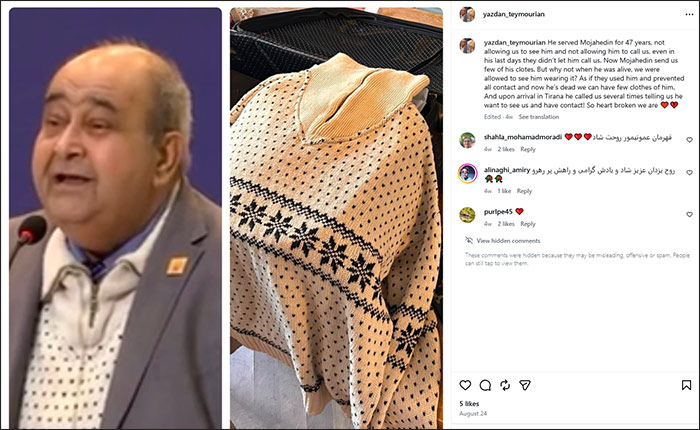
Yazdan Teimorian’s clothes that the MEK sent to his family
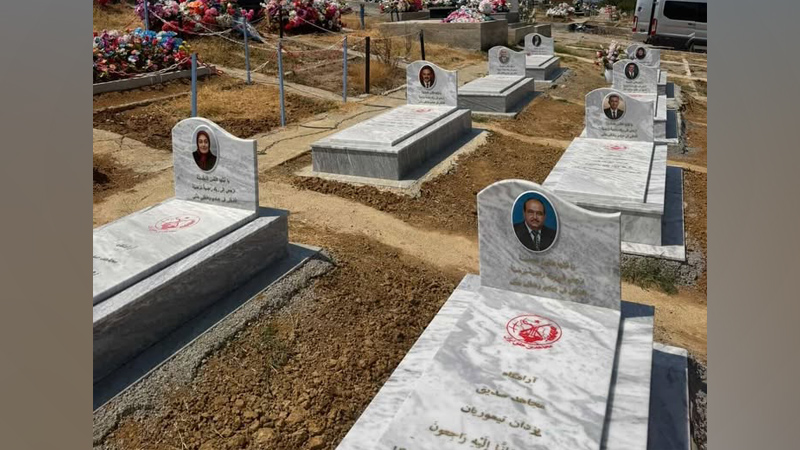
Today, the family has a picture of the grave of their deceased father in the MEK’s cemetery near Manez, Albania. They also have some of his clothes. The last post is about the belongings left behind by their father. Cherishing the memory of Yazdan, his family wrote:
“He served Mojahedin for 47 years, not allowing us to see him and not allowing him to call us, even in his last days they didn’t let him call us. Now Mojahedin send us few of his clothes. But why not when he was alive, we were allowed to see him wearing it? As if they used him and prevented all contact and now, he’s dead we can have a few clothes of him. And upon arrival in Tirana, he called us several times telling us he wanted to see us and have contact! We are so heart-broken!”
Yazdan Teimorian was married to Mina Adnani. The were forced to divorce under the rule of the MEK leader, Masoud Rajavi. The divorced couple had three children, Sahar, Sepideh and Musa.