
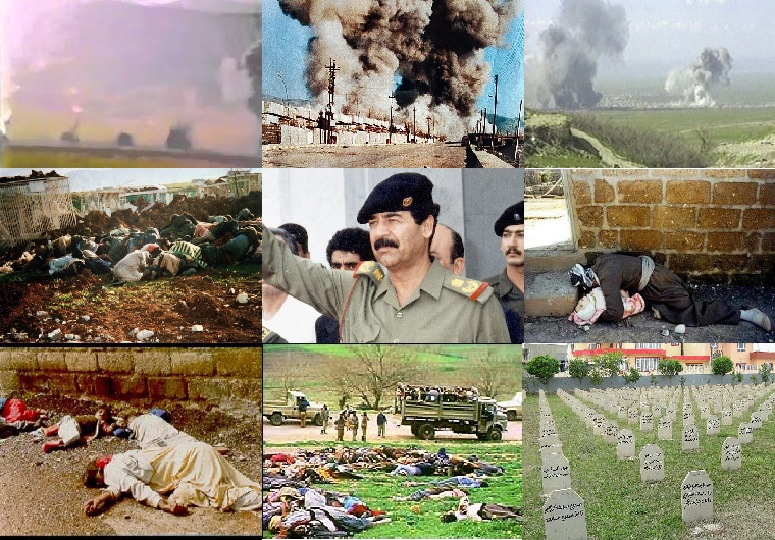
During his era (1979-2003), former Iraqi dictator Saddam Hussein suppressed virtually every major ethnic and religious group in his country. No one was safe from his reach: Sunni dissidents, Shiites in the south, Kurds in the north, and a wide range of smaller minorities, such as the Yazidis and Turkmen, were all targets of his wrath at various times.
Through patronage, bribery, and special privileges, Saddam Hussein built a loyal base and established solid networks of informers throughout the country to monitor anyone who might criticize his rule or seek to overthrow him. One of the groups loyal to Saddam Hussein was the Mujahedin-e-Khalq (MEK), which served as Saddam’s private army, and whose leader, Massoud Rajavi, had proved his loyalty to them in numerous meetings with Saddam and other Iraqi officials, in return for large-scale financial and military support, the MEK performed spying and military operations. The films of the meetings which were released after Saddam’s fall.
Saddam Hussein repeatedly engaged in open military attacks against his own people, and the MEK assisted him in suppressing the Hur Arab uprising in southern Iraq in March-April 1991 and in full-scale attacks on Kurdish rebel forces in the north of the country.
However, MEK officials vehemently deny any involvement in the crimes against Shiites and Kurds, claiming that they were attacked by joint Kurdish-Iranian forces and that the MEK did not even defend itself. The RAND Corporation report of the US Department of Defense reinforces the claims of on the MEK’s complicity with Saddam based on various press reports. These reports quote Maryam Rajavi as encouraging MEK members to “take the Kurds under your tanks and save your bullets for the Iranian Revolutionary Guard Corps.”
According to Rand, Saddam Hussein awarded Massoud Rajavi the Rafideen Medal – a first-class medal of honor in the Iraqi army – after suppressing the Kurdish and Shiite uprisings. “Whatever the truth of the matter, many Iraqis believe that the MEK committed acts of violence against Shiites and Kurds on behalf of Saddam,” according to RAND report.
A Human Rights Watch report published in June 1992 also confirms the role of the MEK in eyewitness accounts. According to the report quoting an eyewitness, “85 or 90 percent of the population crossed the mountain road. They had to cross a river near Tuz that cars cannot cross. The river is 20 to 25 meters wide. They chose this route because the Iraqis controlled the bridge and the Kefri road, and the main road was controlled by the MEK [an Iranian opposition group that supported forces loyal to Iraq]. Several children drowned while crossing the river.”
However, the testimonies of former MEK members who witnessed the MEK’s involvement in the Kurds genocide are more credible than any other testimony. Many former MEK members have written about their observations.
The most recent testimonies about the role of the MEK in the massacre of Iraqi Kurdish civilians are contained in the memoirs of Amir Yaghmaei, a former child soldier of the MEK. Although Amir Yaghmaei was a young child who had just been separated from his parents and smuggled to Europe at the time of the suppression of the Iraqi Kurdish and Shiite uprising, he makes an interesting reference to the issue of the Kurds genocide in a part of his memoirs that relates to the time of the US invasion of Iraq and the fall of Saddam Hussein in 2003.
In the fifty-sixth episode in the Iraqi deserts after the US invasion of Iraq in 2003, before the MEK leaders signed a peace and disarmament agreement with the US army. In this part of his memoirs, he writes:
“They said that the Kurdish forces supporting the Islamic Republic, the “Yekiti” group, were approaching us… The news of the Kurds’ approach was enough to throw the atmosphere of the base into chaos. Faces were blurred; whispers rose. The organization had a dark history with the Kurds, especially since the first Persian Gulf War. At that time, they had clashed with the Kurdish forces and many of them, even civilians, had been killed. The organization always said that the Kurds were to blame; they were the ones who collaborated with the IRGC and attacked first.”
But Amir Yaghmaei, like many other members of the MEK who either participated in the operation or met first-hand witnesses to the Kurds suppression operation, continues: “But I had spoken to witnesses from within the organization itself. They said that the attack was not just a defense. When the fighting began, the organization did not stop at just defending its positions. They also entered Kurdish villages, attacked with tanks and artillery, and destroyed houses.”
“One said that they leveled a house with direct tank fire. Another personally confessed to me that he himself had run over a fleeing Kurd with a tank. These tragedies later caused an international reaction, and now the organization did not want to start another crisis with the Kurds.”
After the agreement was signed between the MEK leaders and the US army, the Americans interrogated each and every resident of Camp Ashraf. They, who had good relations with the Iraqi Kurds and their leaders, including Jalal Talabani, sought information during interrogations about the role of the MEK in suppressing Kurds.
According to the Iranian Center for Documents, citing a defected member, “The information from the American forces was accurate. It seemed that they had extracted [the information] from the interrogation of their teammates and they knew that in a clash between a team from the organization and the Kurds, a person named “Mohammad Reza Mohaddes” had commanded the killing of six Kurds, and the name of the person who opened fire on them and killed them was “Nosrat,” and the interrogator had downloaded their photos from the computer.”
Mazda Parsi
