Nejat Society
  • Home
  • Articles
  • Media
    • Cartoons
    • NewsPics
    • Photo Gallery
    • Videos
  • Publications
    • Books
    • Nejat NewsLetter
    • Pars Brief
  • About Us
  • Contact us
  • Editions
    • عربي
    • فارسی
    • Shqip
Nejat Society
Nejat Society
  • Home
  • Articles
  • Media
    • Cartoons
    • NewsPics
    • Photo Gallery
    • Videos
  • Publications
    • Books
    • Nejat NewsLetter
    • Pars Brief
  • About Us
  • Contact us
  • Editions
    • عربي
    • فارسی
    • Shqip
© 2003 - 2024 NEJAT Society. nejatngo.org
camp Ashraf 3
Albania

MEK in Albania—Potential Implications and Security Concerns for Albania

Publication: Terrorism Monitor Volume: 16 Issue: 19

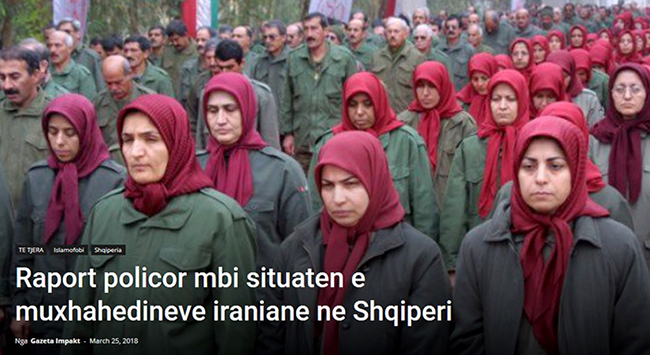
Following the U.S. invasion of Iraq, the Mujahedeen El-Khalq (MEK) was the subject of frequent attacks from Iranian-backed proxies, which overwhelmed their members residing in camps Ashraf and Liberty in Iraq. Before this, MEK, an Iranian dissident group, began living in Iraq in the early 1980s under the protection of Saddam Hussein. As a group in exile, MEK sought refuge in Iraq under the protection of Hussein, who utilized their military capacities and ties to Iran to undermine the Iranian regime. Until 2012, the MEK was identified as a terrorist organization due to its activities inside Iran and against other regional and international powers, including attacks against U.S. diplomatic personnel and businesses operating in Iran in the 1970s. [1]

Following a series of lobbying efforts by MEK leadership and supporters, the group pledged to give up their weapons and violent tactics as a means to be delisted as a designated terrorist organization. [2] As a consequence, in 2013, the U.S. government pleaded to a number of governments to provide refuge to the MEK members, including Romania, which was the preferred destination at the time. Albania­—grateful to the United States for its support during the war in Kosovo and advocating for its bid to join NATO and the EU—was the only country that responded positively to the request. Albania initially admitted some 200 members between 2013 and 2014. The United States and Albanian governments have extended the agreement since 2013, increasing the number of asylum seekers to somewhere in the range of 500-2,000 MEK members. During the summer of 2016, Tirana received the largest contingent of about 1,900 people, an operation managed by the UNHCR (Shekulli, March 12, 2016). Part of the agreement with Washington was the development of deradicalization and rehabilitation programs to be offered to members of the group.

Now, the group is residing in the outskirts of Tirana’s capital in a highly fortified camp located in Manëz. From this camp, the group is allegedly intensifying its political activities aimed at bringing down the Iranian regime (Exit.al, March 14). With emerging threats coming from radicalization and violent extremism, due to the rise of the Islamic State and other political Islamist groups in the region, the Albanian government may not be prepared or equipped to respond to the potential implications the group’s presence in Albania may bring.

MEK Activities and Support in Albania

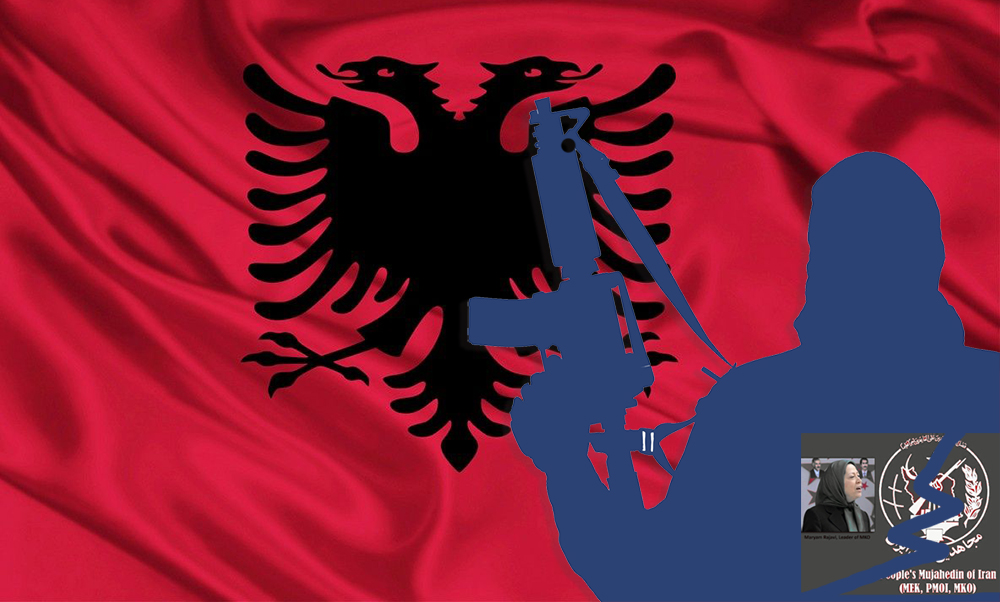
There are a number of opportunities MEK is exploiting in order to restart its political activities against the Iranian regime now that they are residing in Albania. Recent propaganda efforts by the group’s leader, Maryam Rajavi, the widow of the founder of MEK, Massoud Rajavi, suggest that she sees herself as a key actor in fostering the opposition in Iran and subsequently bringing down the Khomeini regime (Exit.al, March 14). Much of the group’s propaganda material available online is translated in Albanian and seeks to also reach out to a local audience in their host country (Iran-interlink.org).

Moreover, the group has gathered significant support from important U.S. leaders who do not shy away from expressing their support for MEK’s potential rise as Iran’s future “democratic government” (Exit.al, June 26). This sentiment is frequently expressed on a number of occasions when important figures of the U.S. political landscape have personally visited Albania and spoken at rallies organized by MEK in Tirana (KlanTV, March 21). The most recent gatherings saw figures such as John Bolton (now U.S. National Security Advisor), Rudy Giuliani, one of President Trump’s most trusted advisors and personal lawyer, and late U.S. Senator John McCain, among others. The three seemingly demonstrated their support for MEK to be at the center of regime change in Iran (Exit.al, June 26).

The reasons why the Trump administration is supporting the group’s political objectives are unclear. It is also unclear the level of support MEK still has among the population in Iran, but it is becoming increasingly obvious that MEK is also making some powerful friends in Tirana as well. Over the years, key leaders from the Albanian government and civil society organizations have similarly provided their support during rallies and conferences organized by MEK in Paris as well as in Albania, where its new headquarters are located. In May 2015, Albania’s former Prime Minister during the war in Kosovo and current Minister of Diaspora, Pandeli Majko attended the National Council of Resistance of Iran rally in Paris with a large delegation of parliament representatives, journalists, lawyers and some civil society representatives, reiterating Albania’s support for Iran’s resistance and promising his personal support for regime change. [3]

In an impassioned speech over a cheering crowd, Majko said “whether you want it or not, you have involved us in your story, in your drama, in your tragedies and we understand you very well…some years ago, an American President was in Berlin and from Berlin, this politician, this great man declared ‘Ich bin a Berliner’. And in the name of my friends and in Albania, I’ve come here to say ‘Men mujahed astam’. I have a dream to come soon to Tehran. Invited by you.” [4] At the time, Majko’s attendance in the Paris rally was not covered by local media.

Despite the group’s increasing political support, recent media reports and several incidents between MEK members and local communities in Albania expose their continuing secretive activities and ongoing struggles to receive legitimacy as a democratic organization. Over the years, several media agencies have been interested in documenting the lives of MEK members in Albania and their political struggles in Iran. Channel 4, a well-known British news agency, recently traveled to Albania to do the same. The film crew was met by hostile private security who were guarding the highly fortified Manëz camp. Camp members physically attacked Channel 4’s camera crew (Shqiptarja.com, August 19). This was an unprecedented event that raised several questions over the camp’s activities (Lapsi.al, August 19). The event was widely reported by local media, which was also able to obtain a threat assessment on the group by Albania’s Intelligence Agency. According to the report initially made available to Channel 4 and then to other Iranian and local media, the group remains “deeply indoctrinated” and some of their activities, including murders of their members, are similar to the ones in Iraq (The Iranian, August 2018).

Testimonies from dissidents who left the group in recent months speak of similar military trainings, indoctrination and pressure to follow the group’s ideology (Top Channel, February 13). Although in the early years some of their members who relocated to Albania sought opportunities to travel abroad and join family members in the West, some 200 members have fled the group and continue to live in Albania (Top Channel, February 13). There is no clarity of their legal status or the employment opportunities available in a country suffering from high unemployment rates. However, some advocacy initiatives—often seemingly pro-Russian and pro-Iranian—are already fostering opposition against the group. Some of this opposition is often portrayed by the MEK leadership as an operation conducted by Iran’s security agencies (Lapsi.al, August 19; Media e Lire, April 17; Nejat NGO, September 29) Moreover, integrating the rest of the members still in Manëz into Albania’s society does not seem to be in the immediate interest for the MEK.

Implications

The MEK’s presence and activities may have serious repercussions for Albania and Albanian policy-makers. Leaders in Tirana may not foresee the long-term consequences of expanding their role on foreign policy issues beyond the small Balkan nation’s traditional reach. The group remains an existential threat to the Iranian regime. Over the years, Tehran has supported significant raids via Hezbollah and other proxy organizations in Iraq to destroy the group and kill key MEK leaders. As a result, Albanian authorities should expect more involvement from Iran in its internal and regional affairs. At the moment, there are no clear signs that Iran’s presence is significant in the region. Authorities in both Kosovo and Macedonia, however, have raised alarm bells over Iranian-linked NGOs having ties to terrorism-related activities in the past (Balkan Insight, June 25, 2015). If no effective responses are undertaken, MEK’s presence and Iran’s attention towards the Western Balkans may inflame sectarian divides in smaller communities and amplify regional rifts. Sectarian division is a latent phenomenon among Albanian Muslims, but they also remain under the pressure of other forms of Islamist radicalization. This is due to the emergence of Islamic State and Turkey’s instrumentalization of political Islam, among others.

Albania continues to struggle with endemic corruption and organized crime and the emergence of religious radicalization as a regional security threat and potential sectarian rifts may add to the list of challenges facing Albania’s political landscape. As a result, the country may not be prepared to inherit a long-standing struggle between a major regional Middle Eastern power and a former terrorist organization. Especially since both may utilize Albania’s internal vulnerabilities for their own political gains.

Notes

1.See U.S. State Department Press Release (US State Department, September 28, 2012).
2.Pandeli Majko’s speech in Paris, May 10, 2015:
3.https://www.youtube.com/watch?v=kIR97EP_phE
4.Ibid.

First published in October 12, 2018

By: Ebi Spahiu – jamestown.org

April 4, 2021 0 comments
FacebookTwitterPinterestWhatsappTelegramSkypeEmail
MEK defectors rally in Paris
The cult of Rajavi

MEK defectors denounced the MEK crimes in Paris

A number of defectors of the Mujahedin Khalq Organization (the MKO/ MEK/ PMOI/ the Cult of Rajavi) took action to denounce the group for kidnapping another former member, Hadi SaniKhani.

MEK defectors rally in Paris

Tens of former members of the MEK distributed flyers and brochures on the case of Sanikhani among citizens of Paris and its suburb. Hadi Sanikhani was recruited by the MEK in Turkey and then smuggled to Iraq to stay in the group’s cult-like system. He escaped from the group after it was relocated in Albania but after a few years he was disappeared. The MEK propaganda websites published some papers allegedly signed by Sanikhani.

Defectors believe that the MEK leaders have probably smuggled Sanikhani to France territory. They warned the French authorities and citizens about the MEK’s unlawful activities in France.

April 3, 2021 0 comments
FacebookTwitterPinterestWhatsappTelegramSkypeEmail
US and terrorists
Iran

American Taxpayers’ Money to Fund MEK Cult

Iran’s Foreign Ministry once again slammed the US and Europe for harboring the anti-Iran Mujahedin-e-Khalq Organization (MKO or MEK) terrorists, saying Washington has long been using the money of American taxpayers to fund the terror group’s atrocities.

“MEK is, by all means, a terror cult. Europe is home to this rogue entity & American taxpayers’ money has funded the atrocities of this corrupt grouplet. Both have hands in the massacre of innocent Iranians by MEK,” the Ministry tweeted late on Sunday, June 28,2020.

7Tir Terror

Iran’s Foreign Ministry spokesman, Seyed Abbas Mousavi, earlier last week condemned Western countries for their unbridled support for this terrorist cult, saying the MKO supporters have the blood of thousands of Iranians on their hands.

Mousavi made the remarks in a tweet on Saturday, which marked the 39th anniversary of a deadly attack by the MKO terrorists, which killed scores of Iranian officials, including then-head of Supreme Judicial Council Ayatollah Mohammad Beheshti.

The MKO has carried out numerous terrorist attacks against Iranian civilians and government officials since the victory of the Islamic Revolution in Iran in 1979. Out of the nearly 17,000 Iranians killed in terrorist attacks over the past four decades, about 12,000 have fallen victim to MKO’s acts of terror.

Washington and the European Union have removed the MKO from their lists of terrorist organizations. The anti-Iran terrorists enjoy the freedom of activity in the US and Europe and even hold meetings with American and EU officials.

First published in June, 29, 2020

April 3, 2021 0 comments
FacebookTwitterPinterestWhatsappTelegramSkypeEmail
Defectors nowruz in Albania
Former members of the MEK

MEK ex- members celebrated new year in Tirana

Tens of Mujahedin-e Khalq former members celebrated Nowruz – a festival that marks the Persian New Year and the official beginning of spring, in Tirana,Albania.

This year – which in the Persian calendar is the year 1400 – the number of defectors has increased.
Based on the reports from inside Camp Ashraf 3 in Manza Albania, the number of dissidents against the MEK Cult regulations is on the rise and eventually separations from the group.

Defectors nowruz in Albania

Defectors nowruz in Albania

Defectors nowruz in Albania

March 31, 2021 0 comments
FacebookTwitterPinterestWhatsappTelegramSkypeEmail
Assadollah Asadi
Belgium

Iranian diplomat has not diplomatic immunity, Terrorists have

The Foreign Ministry of Iran strongly condemned a Belgian court’s ruling against Iranian diplomat Asadollah Asadi, saying the illegal prison sentence has been imposed under the influence of terrorist Mojahedin-e Khalq Organization (MKO).
In a statement on Thursday, Foreign Ministry Spokesperson Saeed Khatibzadeh said Tehran strongly condemns the 20-year jail term issued by a court in the Belgian city of Antwerp against Iranian diplomat Asadi.

“As we repeatedly announced earlier, all the procedures that have so far been taken against the diplomat, including his arrest, the case brought against him or the conviction, were all unlawful and amounted to blatant violation of international law, especially the 1961 Vienna Convention on Diplomatic Relations, and the Islamic Republic of Iran will never recognize it,” he said.

“Unfortunately, Belgium and some European countries have taken such illegal and unjustifiable actions under the influence of the atmosphere that has been created by the hostile MKO terrorist group on Europe’s soil,” Khatibzadeh noted.

Therefore, he added, they must be held accountable for their flagrant violation of the Iranian diplomat’s rights, including the inhumane conditions he faced under arrest in Germany and Belgium.

“The Islamic Republic of Iran reserves the right to resort to all possible legal and diplomatic means to realize the rights of Mr. Asadollah Asadi and to hold accountable the governments that have violated their international obligations,”the spokesman added, according to the Foreign Ministry’s website.

In June 2018, Belgian authorities said the police had intercepted a car carrying homemade explosives and a detonation device, claiming that Asadi had handed the materials to two people in Belgium earlier.

Asadi, himself, was apprehended in Germany the next day and told he could not apply his diplomatic immunity.
first published on February, 05, 2021

March 31, 2021 0 comments
FacebookTwitterPinterestWhatsappTelegramSkypeEmail
Ahmad Paydar Brother
Mujahedin Khalq Organization members' families

Family file complaint against Albanian Gov.

United Nations Committee on Enforced Disappearances
Office of the United Nations High Commissioner for Human Rights
United Nations Office in Geneva, Switzerland

I am (Saeid Paydar) brother of Ahmad Paydar . I have not seen my brother for almost 37 years and now I want to file my complaint against the Albanian government under the UN International Convention for the Protection of All Persons from Enforced Disappearance, of which the Albanian government is a signatory.
Ahmad Paydar was captured in 1984 on the Iranian Defense Front against the invasion of Iraq. Until 1988, he was in various prisoner-of-war camps in Iraq and communicated with his family through letters during his captivity. Until in August of the same year, we learned through the International Committee of the Red Cross that he had left the POW camp and joined the Mojahedin-e Khalq Organization (MEK or MKO) and had gone to Camp Ashraf, the headquarters of the MEK in Iraq.

Ahmad Paydar Brother

Once in 2003, my other brother managed to meet him at Camp Ashraf in Iraq

I do not know anything about him from that date until today, and I am not even sure whether he was transferred to Albania after the transfer of MEK members.

I wrote many letters to the Prime Minister and other Albanian officials, as well as European officials, asking for information about our brother situation and wellbeing. We also signed a petition with other families addressed  the Albanian government and asked to contact our relatives in the MEK camp in Albania. This petition had more than 11,000 signatures. Unfortunately, there was no reaction from the Albanian government.

It should be noted that the Albanian government does not issue visas to Iranian citizens at the request of the MEK, and therefore we are not able to travel to Albania and pursue the matter through the judicial authorities of this country.

I request the relevant international body to address this issue. I want to get into this issue and find our brother Ahmad Paydar, who has been forcibly away from me for nearly four decades, to enable him to communicate with his only brother.

Saeid Paydar
Iran – Yazd

March 30, 2021 0 comments
FacebookTwitterPinterestWhatsappTelegramSkypeEmail
Rajavis
Mujahedin Khalq Organization as a terrorist group

RAJAVI TO ASSASSINATE WITNESSES FROM ALBANIA

An Iranian judicial inquiry into allegations of human rights abuses by Massoud and Maryam Rajavi and 40 other named senior members of the organisation by 42 former members of the Mojahedin-e Khalq (MEK), prompted an aggressive reaction from Massoud Rajavi. The Presiding Judge in the hearing contacted the Judiciary of Albania and France to arrange for notifications and documents to be forwarded to them and they have been invited to introduce representatives of the 40 accused where they live in their defence. Massoud Rajavi’s wife Maryam Rajavi, the de facto leader of the MEK, and the majority of MEK members are based in Albania, while the former HQ in Paris is still active.

https://dlb.nejatngo.org/Media/Report/PressTV/PressTV-Iran-MKO-Court-202103-1.mp4

To download the video file click here

The MEK reaction came in the form of an audio statement by Massoud Rajavi [the translated transcript is reproduced below]. According to the recording, Massoud Rajavi’s voice has not changed in two decades while he has been in hiding, presumed dead. He is now aged over 70. Photographs show him as a younger man.

Rajavi begins his statement by challenging Iran’s leaders Khamenei, Rouhani and [Ebrahim] Raisi to join him in an international court. Rajavi then repeats some of the allegations made against the MEK over its history. All of which have been documented. It reads as a list of crimes which have caught up with Maryam Rajavi and which he is furious about having been exposed. One particular issue that clearly stings him is the revelation that while he was in Iraq, Saudi Arabia paid Rajavi in suitcases of gold.

Rajavis

RAJAVI TO ASSASSINATE WITNESSES FROM ALBANIA

challenge to Iran’s leaders to meet him in court is hollow and laughable. In fact, throughout the history of his leadership. Rajavi has done everything possible to avoid any legal action. As well as being unable to answer to human rights organisations such as Amnesty International and Human Rights Watch, Rajavi has evaded both legal enquiry and prosecution. Much of this has been achieved by diversions and distractions.

– In 1987, France expelled 17 MEK members to Gabon. Rajavi ordered his followers to undertake hunger strikes throughout western Europe forcing the French government to return them to Paris.

– In 2003, Maryam Rajavi and other leading members were arrested at the MEK HQ in Paris on terrorism charges. Rajavi ordered self-immolations to protest her arrest. Three members died, other members suffered severe burns, with some suffering life-changing injuries.

– In 2011, in post-Saddam Iraq, an inquiry was held into how the MEK acquired land for their camp. Farmers in the adjacent village said Saddam Hussein had confiscated their land and gifted it to the MEK. The MEK refused to engage in a legal inquiry. Instead, Rajavi sent tens of unarmed rank and file members to aggressively confront Iraqi security forces. Several MEK members died and many were injured in the incident, including 5 Iraqi security forces.

– In 2013, 52 MEK members died in an attack by unidentified assailants on Camp Ashraf. There were, at that time, only 100 members guarding the evacuated camp. The majority of members had been relocated to a new camp near Baghdad. It was later discovered that all those who died had incriminating information about Massoud and Maryam Rajavi. A 53rd victim was a former member who had been kidnapped and taken to the camp.

– Also in Baghdad, the Iraqi judiciary summoned leading members of the MEK to court accused of war crimes and crimes against humanity. They were smuggled to Albania to evade arrest.

– In Albania, a leading MEK member Behzad Saffari accused, in print, investigative journalist Gjergji Thanasi of being ‘an infamous spy of Iran’ an ‘officer of the mullah’s secret service’. Thanasi sued for defamation in August 2019. Two years later, the court case has stalled. Saffari has gone into hiding, his whereabouts is unknown, while lawyers for Saffari waste time and obfuscate. At one time, for example, Saffari’s legal team claimed he needed an English translator in court, in spite of the fact he was studying dentistry in the UK when he joined MEK and has acted as one of their main English language spokespersons throughout the past thirty years.

– Another way the MEK evades investigation and legal prosecution has been the elimination of former members of the organisation who have acted as critics and opponents. Several high profile MEK members have died in recent years under suspicious circumstances. One member Massoud Keshmiri was last seen with the MEK in Germany before disappearing. He has not been seen since. Last month former MEK member Hadi Sani Khani was trafficked by MEK from Albania to Paris. He also has not been seen since. Maryam Rajavi claims she doesn’t know where Hadi is, but Massoud Rajavi’s message makes it clear that this “former colleague of the Ministry of Intelligence in Albania” told them he was paid $500 by Iran. Yet, they don’t know what happened to him after he arrived in Paris.

It is significant that Rajavi’s audio message has not been in English, only in Farsi. It has been posted on some MEK sites but repetition and amplification of the message has been on sites specifically created for attacking former members; specifically Efshagari. This means they don’t want their own English-speaking supporters to see this.
It is also significant that Rajavi’s message is broadcast from Albania. It also carries the logo of the National Liberation Army of Iran (NLA) – the MEK’s military wing – aka Saddam’s Private Army. Rajavi still clings to this logo to pretend to his followers that they are still an army. Meanwhile, last week, an Albanian diplomat in Geneva claimed his country is fighting terrorism and that the MEK is not a terrorist organisation. Does the label ‘foreign paramilitary group trained by Saddam Hussein’s Republican Guard’ have a better ring to it for the Albanian government?

From Albania, Massoud Rajavi orders his followers to give the names and addresses of former members and critics to what he calls Resistance Cells (or terror cells), i.e., MEK members. The threat is clear. He wants to kill these people too. He is warning former MEK members, ‘if you expose me, I will kill you; especially if any want to pursue legal action’. This statement was not issued from Iraq or elsewhere, it came from Albania and is being celebrated by Maryam Rajavi and the members there. The Albanian government is responsible for the actions of Maryam Rajavi in that country. Now that there is a direct threat to the lives of those former members that MEK haven’t yet killed, Albania must take responsibility for their safety.
Rajavi’s challenge to Iran’s leaders is a deflection. This is not about Iran. He is not threatening those Iranians who are giving evidence in Tehran. If Rajavi was able to act inside Iran, he would have killed them and talked about it afterwards. But Rajavi has no power in Iran. He does, however, have power in Albania; he is backed by the US, EU, and UK. Rajavi’s claims of CIA support have not been disproved or disavowed by the US. It was the US embassy in Tirana which in 2017 halted the de-radicalization program planned by the Obama administration. We wrote in January that a quick and effective policy win on Iran for President Joe Biden would be to reinstate that plan and rid the US, Albania, the EU and the Iranian people of this toxic group. This statement reflects what happens when governments fail to curtail the MEK. It a matter of time before the MEK manages to kill again, simply because they can.
—
Translated transcript of Massoud Rajavi’s audio message:

Massoud Rajavi – Invitation to Khamenei, Rouhani and Raisi to Participate in an International Court of Justice – March 8, 2010
The curtains were drawn again. After the Antwerp trial and its historic verdict, the shop of the regime’s mercenaries abroad, who used to relay the mullah’s words line by line against the Mojahedin and the Iranian Resistance, has become so sluggish that the judiciary of the executioners itself has inevitably taken over the job.
In Ashraf, when 320 loudspeakers and 677 days of 24/7 garbage did not work, the head of executioners Qassem Soleimani replaced the so-called critics and ‘former members of the Mojahedin’. The revocation of citizenship and passports and the expulsion of mercenaries, which was the demand of the noble and free Iranian public, has shaken the limbs of agents and mercenaries so much that some employees of their own say that they have gone to lawyers to see the files of the case and its appendices and booklets to see if there is anything about them.
At the same time, a former colleague of the Ministry of Intelligence in Albania revealed that the ministry pays 500 euros a month to mercenaries for writing 12 articles against the Mojahedin, including: “Torture of dissidents, lack of freedom in Mojahedin relations, brainwashing, confession of sexual issues and moments, the severance of ties with the outside world, forced divorces, suspected killings within the Mojahedin, the killing of Kurds and Shiites in Iraq, taking of money from the United States, Israel and Saudi Arabia, and the fact that they took their nuclear information from Israel and they have no popular base or support in Iran”.
We have been well acquainted with the accusations of moral corruption, hypocrisy and espionage for the Soviet Union, the United States, Israel and Iraq since the time of the accursed Khomeini, and it is not new. What is new is the enemy’s helplessness in the face of resistance and the holding of sham exhibitions under the title of a court case, whose plaintiffs, witnesses, lawyers and judges are all its own tails. This is the rights and judiciary of the clerical government.

Once again, I call on Khamenei, Rouhani, and Raisi to come with us to an international tribunal if they dare. Bring those 17,000 killed who they give as the statistics, and those 17,000 killed who do not count in the Eternal Light operation in their statistics, and the next 17,000 who are going to be killed and brought up! This makes it clear that a great war has been going on in Iran for 40 years between the people and the Mojahedin-e Khalq organization (MEK, MKO) against the deceptive and anti-human regime.
In December 2007, we said: “The leaders of the clerical regime are turning their heels upside down for the fear of being summoned to international courts. One day they will write a warrant for us on Interpol forms! Every day, they sought our trial in Iraq, and from time to time in France, they commented on killing Sayad Shirazi and the announced operation of the Mojahedin Command Headquarters inside the country. They think that the Mojahedin are afraid of a trial. They are completely unaware of this fact and of this rule of law, that wherever there are drops of law and a speck of justice and fairness, and in any court where justice and the rule of law are relatively existent, the Mojahedin and the Iranian Resistance will undoubtedly win. I tell the mullahs and the Revolutionary Guards near and far that you have won in your plunder and trade, but we have won in our law and justice. To plunder the treasury of the Iranian nation and the oil and blood trade is your domain, and justice and the law is our territory. Now, this is the ball of game and this is the field. We also bring witnesses to the massacre of prisoners and the uprising of Aban, Sistan and Baluchestan, and witnesses to the ruined houses and the homeless.
I call on all my compatriots to provide the names and addresses of intelligence agents, mercenaries, secret servicemen, executioners, judicial operatives, the Basij elements, and the IRGC to the insurgent centers for the great day of justice and law. During the anti-monarchy revolution and at the beginning of Khomeini’s betrayal and crime, revolutionary insurgents shouted:
May our people’s weapons target the chests of traitors
https://www.iran-efshagari.com/%D9%85%D8%B3%D8%B9%D9%88%D8%AF-%D8%B1%D8%AC%D9%88%DB%8C-%D8%AF%D8%B9%D9%88%D8%AA-%D8%A7%D8%B2-%D8%AE%D8%A7%D9%85%D9%86%D9%87-%D8%A7%DB%8C%D8%8C-%D8%B1%D9%88%D8%AD%D8%A7%D9%86%DB%8C-%D9%88-%D8%B1/

March 30, 2021 0 comments
FacebookTwitterPinterestWhatsappTelegramSkypeEmail
Rajavis
The cult of Rajavi

Rajavis furious about having been exposed

Rajavis

March 30, 2021 0 comments
FacebookTwitterPinterestWhatsappTelegramSkypeEmail
Ali Rasekhi
Mujahedin Khalq Organization members' families

Why the Albanian gov. has left all our letters unanswered?!

Mr. Ali Asghar Rasekhi sent a complaint to the UN Committee on Enforced Disappearances:

United Nations Committee on Enforced Disappearances,

I respectfully inform you that we have been unaware of my brother Ali Rasekhi, who is a member of the Mojahedin-e Khalq Organization (MEK, MKO), for 40 years. I only met him once in 2004 at Camp Ashraf in Iraq. But then once in 2015, I went to a camp near Baghdad airport, which was guarded by American forces, but the officials of the organization did not allow me to visit and talk to my brother.

Ali Rasekhi

Ali Rasekhi in his youth

I have been informed that the MEK has been transferred to a camp in Albania. Unfortunately, there is no possibility for families to contact this camp, and the Albanian government has left all our letters unanswered and does not grant Iranians visas to travel to that country and pursue the matter.

I ask that international organization to investigate our complaint and provide a means for us to contact Ali Rasekhi and find out about his condition.

Thanks
Ali Asghar Rasekhi
Iran – Qom

March 28, 2021 0 comments
FacebookTwitterPinterestWhatsappTelegramSkypeEmail
Robab Razavizade
Mujahedin Khalq Organization members' families

Razavizade family complains to the UN Committee on Enforced Disappearances

United Nations Committee on Enforced Disappearances
Office of the United Nations High Commissioner for Human Rights
United Nations Office in Geneva, Switzerland

We are the sister (Robabeh) and brother (Seyed Abbas) of Seyed Hossein Razavizadeh Bahabadi. We have not seen our brother for almost 37 years and now we want to file our complaint against the Albanian government under the UN International Convention for the Protection of All Persons from Enforced Disappearance, of which the Albanian government is a signatory.

Robab Razavizade

Robab Razavizade

Seyyed Hossein Razavizadeh Bahabadi was captured in 1982 on the Iranian Defense Front against the invasion of Iraq. Until 1988, he was in various prisoner-of-war camps in Iraq and communicated with his family through letters during his captivity. Until in August of the same year, we learned through the International Committee of the Red Cross that he had left the POW camp and joined the Mojahedin-e Khalq Organization (MEK or MKO) and had gone to Camp Ashraf, the headquarters of the MEK in Iraq.

Once in 2003, our father managed to meet him at Camp Ashraf in Iraq. We do not know anything about him from that date until today, and we are not even sure whether he was transferred to Albania after the transfer of MEK members.

Seyed Hossein Razavizadeh Bahabadi

Seyed Hossein Razavizadeh Bahabadi

We wrote many letters to the Prime Minister and other Albanian officials, as well as European officials, asking for information from our brother. We also signed a petition with other families addressed to the Albanian government and asked to contact our relatives in the MEK camp in Albania. This petition had more than 11,000 signatures. Unfortunately, there was no reaction from the Albanian government.

Abbas and Robab Razavizade

Abbas and Robab Razavizade

It should be noted that the Albanian government does not issue visas to Iranian citizens at the request of the MEK, and therefore we are not able to travel to Albania and pursue the matter through the judicial authorities of this country.

We request the relevant international body to address this issue. We want to get into this issue and find our brother Seyed Hossein Razavizadeh Bahabadi, who has been forcibly away from us for nearly four decades, to enable him to communicate with his only sister and brother.

Robabeh and Seyed Abbas, sister and brother of Seyed Hossein Razavizadeh Bahabadi

Iran – Yazd

March 28, 2021 0 comments
FacebookTwitterPinterestWhatsappTelegramSkypeEmail
Newer Posts
Older Posts

Recent Posts

  • Rebranding, too Difficult for the MEK

    December 27, 2025
  • The black box of the torture camps of the MEK

    December 24, 2025
  • Pregnancy was taboo in the MEK

    December 22, 2025
  • MEPs who lack awareness about the MEK’s nature

    December 20, 2025
  • Why did Massoud Rajavi enforce divorces in the MEK?

    December 15, 2025
  • Facebook
  • Twitter
  • Instagram
  • Youtube

© 2003 - 2025 NEJAT Society . All Rights Reserved. NejatNGO.org


Back To Top
Nejat Society
  • Home
  • Articles
  • Media
    • Cartoons
    • NewsPics
    • Photo Gallery
    • Videos
  • Publications
    • Books
    • Nejat NewsLetter
    • Pars Brief
  • About Us
  • Contact us
  • Editions
    • عربي
    • فارسی
    • Shqip