Nejat Society
  • Home
  • Articles
  • Media
    • Cartoons
    • NewsPics
    • Photo Gallery
    • Videos
  • Publications
    • Books
    • Nejat NewsLetter
    • Pars Brief
  • About Us
  • Contact us
  • Editions
    • عربي
    • فارسی
    • Shqip
Nejat Society
Nejat Society
  • Home
  • Articles
  • Media
    • Cartoons
    • NewsPics
    • Photo Gallery
    • Videos
  • Publications
    • Books
    • Nejat NewsLetter
    • Pars Brief
  • About Us
  • Contact us
  • Editions
    • عربي
    • فارسی
    • Shqip
© 2003 - 2024 NEJAT Society. nejatngo.org
Pompeo
USA

Pompeo orders diplomats not to meet with MEK and other opposition groups

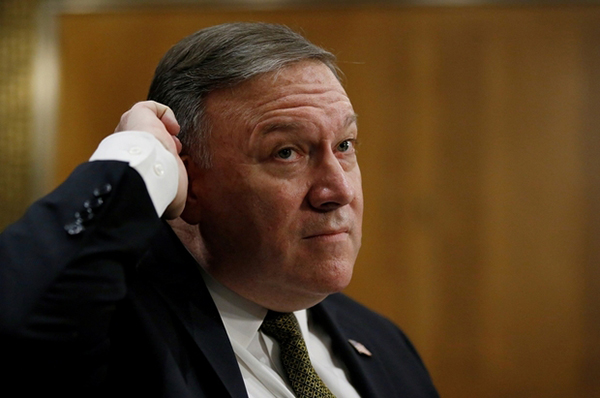
Secretary of State Mike Pompeo sent a cable to all US missions overseas ordering diplomats not to meet with Iranian opposition groups without specific approval because it could further exacerbate tensions with the Iranian regime.
The Trump Administration’s Iran Fiasco

“Many exiled Iranian opposition groups try to engage U.S. officials regularly to gain at least the appearance of tacit support and enhance their visibility and clout,”Pompeo said, according to a copy of the cable obtained by CNN. He noted that many of these groups”have previously or are currently using violent means in support of their political aims.”
“Direct U.S. government engagement with these groups could prove counterproductive to our policy goal of seeking a comprehensive deal with the Iranian regime that addresses its destabilizing behavior,”Pompeo wrote.
The cable’s existence, first reported by Bloomberg, is coming to light in the aftermath of the deadly US drone strike that President Donald Trump ordered last week to kill Iranian Gen. Qasem Soleimani.
Pompeo sent the instructions early this week and his indirect reference to attempts at diplomatic outreach to Iran comes as the Trump administration has refused to issue a visa to Iran’s top diplomat, Foreign Minister Mohammad Javad Zarif.
In recent days, Trump administration officials have not laid out any specific steps they are taking to engage in diplomacy with Iran, though they have said they are willing to do so. Iran, over the last year, has not acted upon any of Trump’s comments that he is willing to meet Iranian leadership, but Zarif said publicly he was willing to discuss prisoner exchanges.
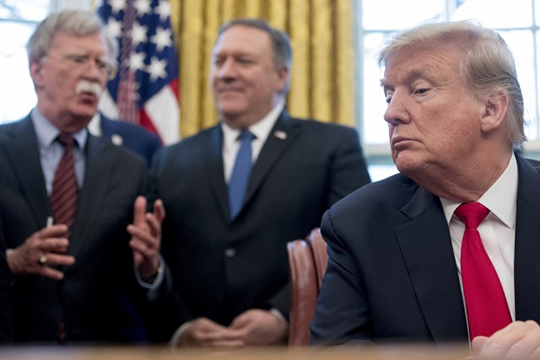
The cable lists a number of Iranian opposition groups, including Mujahedeen-e-Khalq, known as the MEK, and five other Iranian opposition groups that are off limits without specific approval. John Bolton, Trump’s former national security adviser, has previously said the MEK is a”viable opposition”to the current Iranian regime.
Last month Rudy Giuliani, Trump’s personal attorney, met with Iranian opposition groups that are linked to the MEK. Bolton and Giuliani have also given paid speeches on the group’s behalf. During one of those speeches last year, Giuliani called for regime change in Iran.
The MEK, which was previously on a US terrorism list, paid Bolton to give speeches on its behalf and once employed Giulianir.
Pompeo warned in the cable that it would be”counterproductive”to engage these groups. He said some of them have histories of using violence to achieve political objectives and that some of them seek to overthrow the Iranian regime.
Given the escalating tensions with Iran in the wake of the strike on Soleimani, the cable appears to be an attempt to demonstrate that the Trump administration wants to avoid the perception that it is conspiring with opposition groups to push for regime change.
In the cable, Pompeo cited the administration’s willingness to seek a”comprehensive deal”with Iran that covers a range of Iranian activities including”its destabilizing behavior, including its nuclear program, missile program, support for terrorism, and malign regional behavior.”
The State Department has not replied to a request for comment on the cable.
It’s not clear which Iranian officials the US administration would engage. In an NPR interview aired Tuesday, Zarif said he had requested the visa 25 days ago but the US State Department told him it”didn’t have enough time to issue a visa.”
In an interview with CNN’s Fred Pleitgen, Zarif said he wasn’t concerned about the Trump administration barring him entry to the US. When asked about his reaction to being denied the visa, Zarif answered with a laugh,”Well, what are they afraid of?”
Pompeo, speaking at the State Department on Tuesday, said that”we don’t comment on visa matters for those traveling to the United States,”and added that”we will always comply with our obligations”under the UN charter.
US officials are not completely disengaging with groups who oppose the Iranian regime. On Tuesday Brian Hook, the State Department special representative for Iran, met with leadership from the Simon Wiesenthal Center leadership, a Jewish human rights organization.
Members of the center praised the Trump administration for the Soleimani strike and one of them urged additional killings of Iranian leaders.
“The entire leadership of Iran denies the existence of the Holocaust and we have to worry about how we treat them. If they are going to kill American soldiers, we have an obligation to do what President Obama did to Osama bin Laden, what the President of Czechoslovakia did to Reinhard Heydrich, that should be done to the Iranian leaders,”Rabbi Marvin Hier, the founder of the center, said on Tuesday.
CNN’s Nicole Gaouette contributed to this report.
By Kylie Atwood,
January 8, 2020 0 comments
FacebookTwitterPinterestWhatsappTelegramSkypeEmail
VOA_Voice of America
Mujahedin Khalq; A proxy force

VOA promoting MEK regime change agenda!

Nick Muzin, a controversial Republican lobbyist and loyalist to President Donald Trump, holds a contract to provide programming services for Voice of America Persian, the American government-backed media outlet set up to produce journalistic content for the Iranian community around the world.

The government contract, which was awarded last year, is the latest sign that VOA Persian has continued transform into what former employees of the nonprofit news outlet have called “blatant propaganda” designed to promote Trump and regime change in Iran.

Muzin’s lobbying firm, Stonington Global, which was retained by VOA Persian to provide public relations and talent booking on a contract that began on May 22, 2019, does not appear to have any journalistic credentials. The firm lists a ¬¬variety of lobbying and defense procurement services on its website and is run by a team made up largely of former Republican aides. The VOA Persian statement of work stipulates that the contract will include a range editorial development duties.

Muzin, a physician and former aide to Republican Sen. Ted Cruz who also served on the Trump campaign and the transition, was one of the many operatives to move swiftly into lobbying over the last three years, helping both domestic clients and foreign governments curry favor with the administration.

Neither Muzin’s lobbying firm, Stonington Global LLC, nor the U.S. Agency for Global Media, which oversees VOA Persian, responded to a request for comment.

Muzin made headlines early last year for a controversial contract on behalf of Qatar to mend relations with officials in Washington, D.C. Along with his business partner Joey Allaham, a proprietor of high-end kosher restaurants in New York, Muzin collected $3.9 million from the Qatari government to secure meetings and win favor with people known to have connections with Trump. The plan included charting out 250 “influencers,” with Muzin securing payments from his client to the Zionist Organization of America and Mike Huckabee (the former governor of Arkansas who now has ties to the Trump administration as well as Fox) as part of the lobbying effort.

Elliott Broidy, a prominent Republican fundraiser tapped by the United Arab Emirates to lobby the U.S. to sever ties with Qatar, accused Muzin of participating in an alleged Qatari plot to hack his emails. In August, a federal judge in California dismissed Broidy’s lawsuit against Muzin and his lobbying firm on jurisdictional grounds, without ruling on the merits of the case.

Muzin was paid $500,000 by a shell company linked to Russian individuals as part of a lobbying venture to boost an Albanian political party aligned with the Russian government.

Since 1940, the American government has funded media programs as part of a foreign affairs strategy, first as a counter to Nazi Germany during World War II, then through expanded efforts to counter the Soviet Union’s influence around the world, which led to the founding of Voice of America. VOA’s broadcasts into Iran began in the early 1940s, as part of a program known initially as the Farsi Service.

VOA and its affiliates have been governed by presidential appointees under close coordination with the State Department. As the Intercept previously reported, VOA Persian once provided a relatively balanced perspective, reporting stories with mainstream journalistic standards, often even airing segments critical of the U.S.

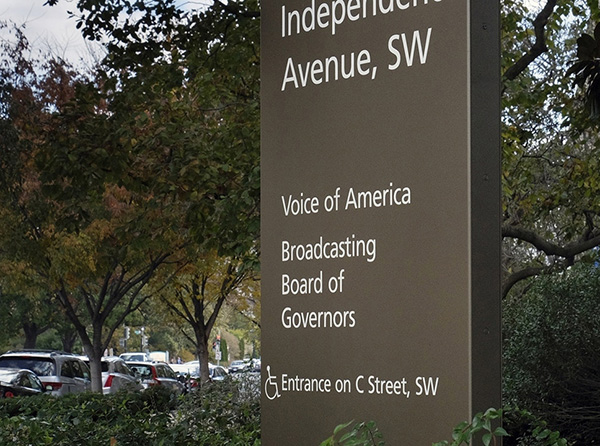
But the quality of VOA Persian, however, quickly degraded after Trump’s election. Congressional Republicans reshaped the organizational structure, handing enhanced authority to the chief executive of the U.S. Agency for Global Media (formerly known as the Broadcasting Board of Governors) that oversees the network.

Kenneth Weinstein, Trump’s pick to lead the agency, simultaneously serves as head of the Hudson Institute, a neoconservative think tank whose experts have repeatedly called for bombing Iran. One of the early appointees brought in to shape the agency’s overhaul, Vincent Trovato, previously worked for Cambridge Analytica and the Trump campaign.

VOA Persian now provides wall-to-wall positive coverage for hard-line regime change advocates. The network provides reliably favorable coverage of Mojahedin-e Khalq, or MEK, the militant opposition that has worked with Israeli intelligence to carry out assassinations of Iranian nuclear scientists, even providing a platform for Heshmat Alavi, a fake persona created by MEK. The network’s journalists have also expressed far-right sentiments that have unsettled longtime former VOA Persian reporters, including continued attacks at perceived critics of Trump. Saman Arbabi, one VOA Persian host, mockingly compared the hijab worn by Rep. Ilhan Omar, D-Minn., to a Ku Klux Klan hood.

In recent days, one VOA Persian host, Masih Alinejad, has appeared on CNN and Fox News and been quoted by major U.S. newspapers to praise Trump’s decision assassinate of Iranian Maj. Gen. Qassim Suleimani. Many outlets depicted Alinejad as an independent journalist. Responsible Statecraft, a project of the Quincy Institute, noted that every outlet failed to disclose Alinejad’s work for VOA Persian, and has received payments from the government totaling at least $305,000 since 2015.

After publication, The Intercept received the following statement from VOA spokesperson Bridget Ann Serchak: “The firm was contracted to assist VOA in booking guests in a process that was competitively bid and awarded. The firm is paid on an hourly basis. They are used occasionally (not within the past few months) when they have contacts that our journalists do not.”
Lee Fang, theintercept

January 7 2020, 11:00 p.m.
https://theintercept.com/2020/01/07/voa-persian-iran-trump-conflict-of-interest/

January 8, 2020 0 comments
FacebookTwitterPinterestWhatsappTelegramSkypeEmail
Rudy Giuliani
Mujahedin Khalq; A proxy force

UANI ties to the MEK terrorists raises new questions

Article Summary
New lobbying disclosures raise new questions about the ties between the hawkish organization United Against Nuclear Iran to the Mujahedeen-e-Khalq.

The main group pushing for regime change in Iran lobbied the head of the hawkish United Against Nuclear Iran on the sidelines of his organization’s annual event in New York last fall, new lobbying filings show.
The disclosure raises new questions about ties between United Against Nuclear Iran CEO Mark Wallace and the National Council of Resistance of Iran, a Paris-based umbrella group dominated by the Mujahedeen-e-Khalq. The council also met twice with President Donald Trump’s personal lawyer Rudy Giuliani around the time of the UN General Assembly, drawing renewed attention to Giuliani’s unregistered advocacy on behalf of the group.
The council’s US office disclosed meeting Sept. 23 with Wallace to discuss “developments in Iran” — the first time the group has reported meeting with the United Against Nuclear Iran CEO since registering to lobby in May 2013. The next day, Wallace hosted a gathering of Iranian opposition groups dominated by the Mujahedeen-e-Khalq, raising criticism from some Iran watchers distrustful of a group that the State Department designated a terrorist organization until 2012.
United Against Nuclear Iran sought to distance itself from the event at the time, saying Wallace had convened it in his personal capacity on the eve of the group’s official annual summit Sept. 25. Al-Monitor, however, reported at the time that the program for the event was listed as United Against Nuclear Iran, something the group said was in error.
The National Council of Resistance of Iran and United Against Nuclear Iran share similar views on Iran. Both applauded last week’s US airstrike that killed Iranian military commander Qasem Soleimani, with United Against Nuclear Iran calling it a “significant blow” to Iran’s military power while the council labeled it a “fatal blow” to the regime in Tehran.
United Against Nuclear Iran did not respond to a request for comment for this story.The US office of the National Council of Resistance of Iran also disclosed meeting with Giuliani, the keynote speaker at Wallace’s event, to discuss “the human rights situation in Iran” and “developments in Iran” on Sept. 23 and Sept. 25. The group previously disclosed lobbying Giuliani in September 2018.

Recruited By Giuliani,Maria Ryan is lobbying for the MEK terrorists

Giuliani has long been plagued by accusations that he is taking money from the Mujahedeen-e-Khalq and affiliated groups without properly registering as a foreign lobbyist. He told Bloomberg last year that he was paid by a US organization of Iranian-Americans rather than the France-based National Council of Resistance of Iran to speak at the council’s rallies. Such “grasstops” lobbying of influential figures who have the ear of government officials is fairly common, legal experts say, and would only require an intermediary to register as a lobbyist if he or she is shown to be acting on behalf of a foreign principal rather than simply providing a favor.
The filing of the US office of the National Council of Resistance of Iran is also notable for revealing that Washington law firm Akin Gump Strauss Hauer & Feld is serving as legal counsel to the council’s US office. In a statement to the Justice Department’s Foreign Agents Registration Act unit, the firm argues that the donors to the National Council of Resistance of Iran should be kept anonymous to avoid retaliation by Iran.
Akin Gump notably lobbies for the Public Investment Fund of Saudi Arabia and the United Arab Emirates, Iran’s biggest rivals in the Gulf. Neither Akin Gump nor the National Council of Resistance of Iran replied to a request for comment about how long the firm had represented the council as legal counsel.
Akin Gump previously lobbied on behalf of the Iranian American Community of Northern California — which has been linked to the National Council of Resistance of Iran — to get the State Department to delist the Mujahedeen-e-Khalq. The firm reported $620,000 in lobbying-related payments for those efforts in 2011 and 2012.
The council’s US office reported receiving more than $123,000 from June 1, 2019, through Nov. 30, 2019, from about 100 donors. The group reported spending more than $120,000 during that timeframe.
Julian Pecquet is the Editor of Special Projects for Al-Monitor, where he supervises the award-winning Lobbying Tracker as well as managing long-form stories. Before that he covered the US Congress for Al-Monitor. Prior to joining Al-Monitor, Pecquet led global affairs coverage for the political newspaper The Hill.

January 8, 2020 0 comments
FacebookTwitterPinterestWhatsappTelegramSkypeEmail
Mujahedin Khalq; A proxy force

Assassinations Supporting MEK Sanctions – US obeys no laws

What comes next in the Middle East

Summary: Our brutal neo-colonial policy in the Middle East – without goals, reason, or even respect for our “allies” in the region – may be entering a new phase. Trump’s stupidity might start a disastrous war, but it was doomed to fail catastrophically. Eventually.

Before predictions, clearly see the present

When reading the news, remember that US government officials usually lie. As Daniel Larson explains in “Lying Us Into War With Iran.” Much of the coverage of these events by the mainstream media has reprinted US government propaganda. The NYT perfectly captures this folly by asking “can the United States maintain a cooperative security relationship with Iraq given the upheaval the assassination has provoked?” A more rational question is can the US treat its allies with respect, not as colonies and puppet regimes? They quote Richard N. Haass, president of the Council on Foreign Relations and a former American diplomat.

“One sure result of the U.S. strike is that the era of U.S.-Iraq cooperation is over. …The U.S. diplomatic & mil presence will end b/c Iraq asks us to depart or our presence is just a target or both. The result will be greater Iranian influence, terrorism and Iraqi infighting.”

This assumes that US influence leads to regional stability. History shows that to be delusionally false. The US requires its puppet regimes to act contrary to their people’s interests, which evaporates their legitimacy and leads to domestic instability. Even more delusional is this, by Secretary of State Mike Pompeo.

“We have every expectation that people, not only in Iraq but in Iran, will view the American action last night as giving them freedom.”

For an excellent analysis of the situation in Iraq by Medea Benjamin and Nicolas J. S. Davies. Benjamin is the author of Blood on Our Hands: The American Invasion and Destruction of Iraq. Follow her on Twitter. Davies is the author of Inside Iran: The Real History and Politics of the Islamic Republic of Iran. Follow him on Twitter.

Also see Mohammad Ali Shabani‘s “Donald Trump’s assassination of Qassem Suleimani will come back to haunt him.” He is a PhD student at Soas University of London, where he focuses on implications of the Shi’a ascent to power in Iraq.

“By 2014, when he successfully halted Islamic State’s attempt to overrun Iraq, Suleimani was being feted as a hero among Iraqis alongside the local commanders, including al-Muhandis. The same response was evident in Iran, where he quickly became a household name and was rumoured to be a potential future president – a trend strengthened by the Trump administration’s unilateral withdrawal from the Iran nuclear deal in 2018.

“So the US has not merely killed an Iranian military commander but also a highly popular figure, viewed as a guardian of Iran even among secular-minded Iranians. And with the assassination of al-Muhandis, the Trump administration has put itself in the position of having killed the operational commander of a large branch of the Iraqi armed forces. …For all his crowing about the decisive blow dealt to an insolent enemy, Trump may be about to discover that the problem with martyrs is that they live forever.”

What will Iran do in response?

The news overflows with guessing by people without a clue. For a rare sensible analysis, see this by Scott Ritter: “Iranian Revenge Will Be A Dish Best Served Cold.” He is the author of 7 books; his most recent is Deal of the Century: How the Iranian Nuclear Agreement Was Won, Then Lost, and the Possible Consequences (2018).

The more likely consequences are that we are ejected from Iraq again, the Iraq – Iran alliance grows tighter, and that Iran’s regime grows stronger. I doubt anyone can predict the larger and longer-term responses. Those guessing about Iran’s response usually assume that its government will respond to popular pressure with a small but dramatic gesture. Or that they might act with cool rationality – playing the long game, using America’s aggressions to unify the region against its foreign infidel invaders.

Or this might be like July 1914, when decades of tensions unexpectedly ignite geopolitical fires that none can extinguish except with the blood of millions.

What would we do?

What would Americans do if treated by a superpower as we have treated Iran? Daniel Larison is one of the few to ask that question.

“Imagine how angrily we would respond if a foreign government assassinated a high-profile, well-liked military officer while he was traveling inside an allied country, and that might give us some idea of how Iranians perceive this attack. That matters because it means that there will be tremendous pressure on the Iranian government to respond to the attack, and it also means that there will be political support for retaliation. If the administration wanted to find a way to trigger a war with Iran that bolsters the Iranian government’s standing at home, this is how to do it.”

But that’s a tame perspective. Go back to the beginning. In 1953 the CIA’s Operation Ajax helped overthrow Iran’s elected government (Wikipedia) and installed a tyrant. The US government long denied it, admitting it in 2017. Of course, the people of Iran already knew; only Americans were still ignorant.

That tyrant remained in power with our support and his brutal secret police (SAVAK). He was ejected in a 1979 Revolution. We waged continuous war against Iran after their revolution. Justified by lies – such as claims that they were building nukes (Fear Iran’s nukes, coming very soon since 1984). We used these claims to justify economic warfare against them, assassinating their scientists, supporting insurgent terrorists (MEK), and probably more things not yet public.

Iran’s response to these attacks has been mild. They did push back to America’s occupation of Iraq, mildly compared to America’s military enforcement of its Monroe Doctrine. This points to the core aspect of this geopolitical struggle for control of the Middle East: our hypocrisy. No matter how often or brutally we attack Iran – who threatens only our imperial dreams – we see ourselves as the noble victims.

Imagine if the roles were reversed. How would America respond to a nation attacking them as we attacked Iran? Rivers of blood would flow.

A response to America’s imperial wars

We are bombing and killing people around the world 24-7, year after year. I worry that eventually we will kill one or more people whose relatives organize intelligently conducted terrorism against America. Not with political or monetary goals, just killing for revenge. Mindless killing, just as historians will see our operations around the world today. Imagine a 9/11 every month or so. Imagine copycats, dumb but numerous, doing similar operations – drawing on the millions of people we have angered.

Or something else will happen that is equally unexpected and catastrophic. I doubt we can contine our operations without some kind of bad ending for America.

“Sooner or later everyone sits down to a banquet of consequences.”
— Attributed to Robert Lewis Stevenson.

Other voices

This is a follow-up to yesterday’s important post: Let’s cheer another successful assassination!

How dare Iran do what America routinely does for the same reasons! See “Suleimani’s assassination and the muddled moralism behind it” by Robert Wright at NonZero (which has much interesting and provocative material).

About the legal doctrine used by America and Israel for its attacks: “Lies, the Bethlehem Doctrine, and the Illegal Murder of Soleimani” by former British diplomat Craig Murray.

Jeremy Scahill at The Intercept. He is an investigative reporter and author of two books, including Dirty Wars: The World Is a Battlefield

“Trump campaigned on belligerence toward Iran and trashing the Obama-led Iran nuclear deal, and he has followed through on those threats, filling his administration with the most vile, hawkish figures in the U.S. national security establishment. …

“Much as the neoconservatives came to power in 2001 after the election of George W. Bush with the goal of regime change in Iraq, Trump in his bumbling way assembled a team of extremists who viewed him as their best chance of wiping the Islamic Republic of Iran off the map.

“While Barack Obama provided crucial military and intelligence support for Saudi Arabia’s scorched earth campaign in Yemen, which killed untold numbers of civilians, Trump escalated that mass murder in a blatant effort to draw Iran militarily into a conflict. That was the agenda of the gulf monarchies and Israel, and it coincided neatly with the neoconservative dreams of overthrowing the Iranian government.”

BY Fabiusmaximus.com

January 7, 2020 0 comments
FacebookTwitterPinterestWhatsappTelegramSkypeEmail
Heshamt Alavi
Mujahedin Khalq Organization's Propaganda System

More fabrications from Heshmat Alavi deleted

It’s unlikely it’s legit.

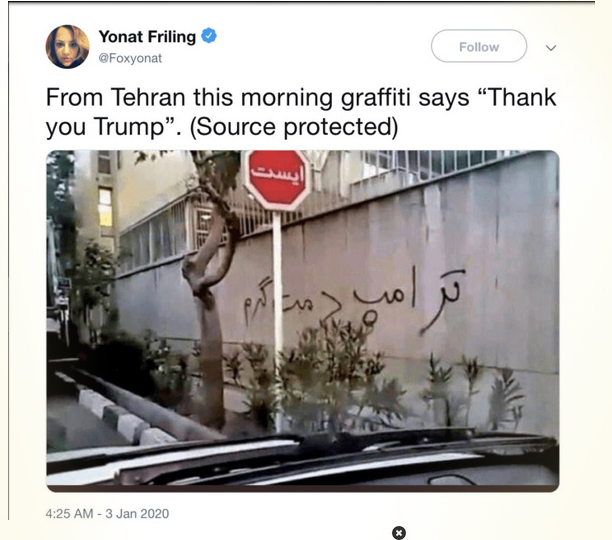
A Fox News producer tweeted out a photo of Arabic graffiti that supposedly shows Iranian support for President Donald Trump.
After a military strike killed Iranian Quds Force commander Qassem Soleimani on Thursday, Iranian protesters took to the streets to mourn Soleimani. However, Yonat Friling, from Fox News, portrayed support for Trump’s decision in Iran with a tweet on Friday.
“From Tehran this morning graffiti says ‘Thank you Trump’. (Source protected),” @Foxyonat tweeted.
Her tweet has since been deleted.

Yonat Friling tweet on Iranian people thanking trump for Soleimani's terror

The image; however, has a few suspicious qualities. First, this is not the first time it has circulated on Twitter. In 2018, an account by the name Heshmat Alavi tweeted out the photo to show support in Iran for Trump. Alavi claims to be an anti-Iranian regime activist. When Alavi posted it, he says the graffiti translates to ‘way to go Trump.’

“While #Iran‘s regime may claim of having a social base opposing U.S. President Donald Trump’s #IranDealWithdrawal, this graffiti today from Tehran shows how Iranians are actually very thankful. ‘Way to go Trump’,” @HeshmatAlavi tweeted.

What is even more mysterious is the person or people behind Alavi’s Twitter account.
The Intercept reported in June that Alavi, who has been used as a source by the White House, does not appear to be a real person. A former member of the Mojahedin-e-Khalq (MEK), an anti-Iranian organization, told the Intercept that Alavi was a facade. Hassan Heyrani was a former high-ranking member of the organization according to the Intercept.

“Heshmat Alavi is a persona run by a team of people from the political wing of the MEK,” Heyrani said. “They write whatever they are directed by their commanders and use this name to place articles in the press. This is not and has never been a real person.”

The Trump administration used an article published by Alavi to justify leaving the nuclear deal in 2018. Alavi contended that there was Iranian support for the administration’s decisions.
This morning, the Alavi account tweeted out more alleged evidence of support for Trump’s most recent military strike.

“ABSOLUTELY BEAUTIFUL! An Iranian family celebrating the killing of #Iran‘s IRGC Quds Force chief Qasem Soleimani. “Death to Dictator!” they are heard chanting,” @HeshmatAlavi tweeted.

Gizmodo reported that the support for Trump’s attack is not likely to be substantiated by the Iranian people. Dr. Pedram Partovi, an associate professor at American University, told Gizmodo that hatred for the American government far outweighs the current disdain for the Iranian regime.
“Even if the current government in Iran is unpopular with the vast majority of the Iranian population, Trump and his administration may be even more unpopular. Regular public opinion polling conducted by the University of Maryland, among others, bears this out,” Partovi wrote in an email to Gizmodo.
Friling did not respond to a request for comment from the Daily Dot.
H/T Gizmodo

Libby Cohen, dailydot.com

January 4, 2020 0 comments
FacebookTwitterPinterestWhatsappTelegramSkypeEmail
Albania

MEK Presence In Albania Hampering Dealing With Islamic Extremism

The problem of radical jihadist and Islamist infiltration in the western Balkans is real and multiform, depending on the country of reference and its institutional, political and socio-economic characteristics. In fact, this is not a phenomenon that can be understood in general terms, but is, rather, linked to specific dynamics. Indeed, radicalism with an Islamist matrix breaks through where the state is lacking or absent, where socio-economic conditions (particularly those of young people) are severe, without forgetting the history of the relative country, which can in some way contribute to the modalities with which the phenomenon develops.

In the case of Albania, whether in fact the legacy of the communist regime led by Enver Hoxha, which led to the annulment of state religion in the country and the introduction of state atheism (1967) as official doctrine, may have contributed to reducing the fertility of the grounds which radical Islamism could progressively seek to breach after the fall of the regime is still a matter of debate today.

Despite some theories, according to which, reaction to state atheism has strengthened the beliefs of the Albanian people, so far the only proven effective consequence in Albania is mutual tolerance and cooperation between the different religious communities in a majority Muslim country, but with its Catholic, Orthodox and Bektashi presence. On the other hand, it is difficult to argue that state atheism has contributed to an increase in the number of believers in a country where nationalism, so-called ‘Albanianity’, takes precedence over ethnicity and religion and where the rate of mixed marriages is particularly high. It is therefore possible to hypothesize that the remarkable interreligious tolerance is actually the result of an approach which, through state atheism, has led to the religious aspect being seen as secondary to belonging to the nation. In addition, Albania has never been the scene of religious conflicts on its territory.

Radical Islamism fueled from abroad

Islamic extremism in Albania is a problem imported from abroad and connected to various sources. There are Gulf countries and charitable organizations that have every interest in spreading Wahhabism and Salafism, financing mosques, cultural centers, charitable associations of a religious nature, importing doctrinal material for distribution and imams for indoctrinating.

On the one hand the Albanian Muslim community (Kmsh) is very careful to identify and eventually reject radical drifts, to the point that already in 2015 it asked its institutions to intervene to deal with the problem, on the other there is a reality created by radical preachers, active in unofficial Islamic centers but also on the web, some of whom returned to Albania after periods of study in Islamic schools in the Middle East. These hate preachers are not only concerned with spreading that Salafist and Wahhabi ideology based on abuse and intolerance, but also openly invoke jihad. Not surprisingly, in March 2014, the Albanian security forces dismantled one of the largest networks of propagandists and recruiters for ISIS active in the western Balkans (and the most important of Albania), headed by the two imams Genci Balla and Bujar Hysa.

Among the characters connected to the ‘Balla-Hysa’ network there was also Almir Daci, ex imam of the Leshnica mosque, who appeared with the name ‘Abu Bilqis Al-Albani’ in the well-known video on the Balkans released by ISIS in June 2015 and entitled ‘Honor is Jihad’.

The areas targeted by hate preachers are mainly the peripheral ones of Elbasan, Cerrik, Kavaja, Librazhd, Pogradec, Skutari but also the outskirts of Tirana. Their targets are largely young individuals in precarious social, cultural and economic conditions.

A further problem is the economic and political infiltration of Erdogan’s Turkey, ideologically linked to the radical Islamism of the Muslim Brotherhood. Infiltration perpetrated through the use of so-called ‘soft power’; the ability to persuade, attract and co-opt, through such means as culture and politics. This poses a far more serious danger because it is more difficult to identify and manage. An example? The great mosque of Tirana (the largest of all the Balkans), built by Erdogan a stone’s throw from the Albanian Parliament on an area of 32,000 square meters. Obviously, everything has a cost and in this case it is of an ideological-political type. In fact, it is not surprising that the sermons preached within these mosques are the same as those pronounced by the imams of the countries of origin, with contents that go beyond the theocratic doctrinal aspects and flow into politics. A very powerful weapon in the hands of regimes.

Return of jihadis and the fight against terrorism

Albania has ‘contributed’ to the jihadist cause in Syria and Iraq with around 180-200 foreign fighters out of a population of 2,873 million, but also seems to have good control of the situation. The US State Department Country Reports on Terrorism for the year 2018 has in fact highlighted how Albania, despite the scarcity of resources, has still achieved good results in countering jihadism. The collaboration between Albanian CTU and US agencies in the fight against terrorism is currently at high levels; a further important aspect is also the modernization of the Personal Identification Secure Comparison and Evaluation System (Pisces) to protect Albania’s borders, in addition to the already high controls at sea and airports.

Overall, Albania appears to be able to manage the danger deriving from jihadism linked to the return of foreign fighters and radicalization in its territory; this is certainly the result of cooperation with European and US agencies, but also the presence of an efficient internal intelligence system, a legacy of the communist period. More problematic is the management of internet propaganda which affects not only Albania but also the diaspora (a problem among other things on a global scale), propaganda that could also affect jihadists who have returned to their homeland, as well as latent ones, who never left.

The headquarters of the People’s Mojahedin of Iran

A further problem on Albanian soil is linked to the presence of the headquarters of the People’s Mojahedin of Iran (MEK), established in Manez (near Durres) since 2016, after years of activity in Iraq. A presence that has created many headaches for the institutions of Tirana.

The MEK was created in 1963 with the aim of fighting the Shah’s regime and in 1979 participated in the Islamic revolution led by Ayatollah Khomeini; however, the populist ideology (a cross between Marxism, feminism and Islamism) clashed with that of the Ayatollahs, and the Mojahedin was therefore banned and the group found refuge in Saddam Hussein’s Iraq.

With much suspicion of Israel[i involvement] and badly tolerated by many anti-Ayatollah Iranians, the MEK was previously blacklisted by the European Union, Great Britain, the USA and Canada, only to then be “cleared through customs” between 2008 and 2012, thanks also to the intervention of the then Secretary of State, Hillary Clinton.

While Washington sees in MEK “the main opposition force for promoting democracy and secularism in Iran”, on the other hand, Tehran identifies it as a “terrorist organization responsible for bombings and acts of political violence”. Whether the MEK is a promoter of “democracy and freedom” or not, it is difficult to say; it is certain that the union between Marxism-Leninism and Islam preached by the group is certainly not a guarantee of that, just as its structure which shows typical elements of a sect (cult) is not either, as recently illustrated by the BBC report.

It is worth pondering the usefulness of the MEK presence in Albanian territory, an uncomfortable, perhaps inopportune presence, which risks creating more problems than advantages in an extremely delicate context such as the Balkan one.

Inside Over, Tirana, Albania, Translated By iran-interlink

January 2, 2020 0 comments
FacebookTwitterPinterestWhatsappTelegramSkypeEmail
Mujahedin Khalq; A proxy force

Syranizing Iran Through Recent Unrest

Head of Iran’s Passive Defense Organization Brigadier General Gholamreza Jalali said that enemies were seeking to throw Iran into disarray though the recent unrests but the Iranian nation managed to foil their plots.

“People understood that that the purpose of that sedition was to Syrianize Iran,” and hence people ‘quickly’ acknowledged the difference between ‘protest’ and ‘turbulence’ which resulted in wrapping up the issue in 48 hours, Jalali said.


Iran’s Judiciary has said a number of those elements were tied to the notorious US-backed Mujahedin-e Khalq Organization (MKO) terror group, royalists as well as separatists — who were nabbed in the country’s border provinces — besides members of organized groups trained towards staging acts of sabotage. Iran has arrested over 100 ringleaders and masterminds of the violent attacks.

He made the remarks while addressing a session held in Tehran to study different aspects of the unrest that erupted in the country after the administration increased the gasoline price in mid-November.

Jalali pointed to the role of foreign-controlled social media in the recent incidents, criticizing the populist approach of some officials who support continuation of using these media in the country.

He said that cutting the internet acted like ‘water on fire’ and proved that the unrest was being organized by these social media.

The Iranian government raised gasoline prices last month in order to moderate the national consumption rate, which stands at 110 million liters per day, 40 million liters per day above the maximum domestic requirement.

The move prompted some peaceful protests, but riotous elements, taking advantage of the situation, quickly entered the scene, destroying public property, setting ablaze banks and gas stations among other facilities, and opening fire on people and security forces.

Shortly after the riots broke out, Leader of the Islamic Revolution Ayatollah Seyyed Ali Khamenei tasked the Supreme National Security Council with compiling a report detailing the reasons behind the riots and immediate attending of the families of the victims.

Iran’s Judiciary has said a number of those elements were tied to the notorious US-backed Mujahedin-e Khalq Organization (MKO) terror group, royalists as well as separatists — who were nabbed in the country’s border provinces — besides members of organized groups trained towards staging acts of sabotage.

Iran has arrested over 100 ringleaders and masterminds of the violent attacks.

December 31, 2019 0 comments
FacebookTwitterPinterestWhatsappTelegramSkypeEmail
The cult of Rajavi

In the MEK’s black and white world, departure means expulsion

The “all-or-nothing” way of thinking is one of the very destructive thinking patterns that a person can have. This thinking pattern is also called “black and white thinking”. Thinking in black and white arranges the world into extremes: good and bad, yes and no.
It’s like seeing only in black and white and ignoring the shades of gray in between. This thinking pattern leads the person to absolutism. Absolutism refers to ideas, phrases and words that denote totality, either in magnitude or probability. Absolutist thoughts are unqualified by nuance and overlook the complexity of a given subject.
Those who are not with us are against us!
For absolutists, there is nothing more than two possible positions. They do not admit that a person or group can have a neutral stance or could disagree in part with their position without entirely opposing them. In the cults of personality such as the Mujahedin Khalq (MEK, MKO, PMOI, Cult of Rajavi), the absolute leader is the main person to coerce members into such a thinking pattern.
In the MEK, any voice of dissent is forbidden and eventually will be silenced by any means. Based on interviews that he made with former members of the MEK, Aron Merat wrote in the Guardian that “MEK commanders systematically abused members to silence dissent and prevent defections – using torture, solitary confinement, the confiscation of assets and the segregation of families to maintain control over members”.
Members of the MEK often undergo sever punishment as soon as they express their willingness to leave the group. As the former high ranking member of the group Saeed Shahsavandi told the BBC inside the MEK’s ruling system “people do not leave the group, but they are expelled from the group”. According to Shahsavandi, the organization do not tolerate any criticism. “Criticism and polyphonic ideas are not tolerated, so the dissident member is considered as traitor,” he says. “In such organizations, relationships are based on zero or one hundred, black or white, you are either a servant or a traitor.”
Absolutism of the MEK leaders explains why families of the MEK members are called mercenaries of the Iranian government just because they ask the international human rights bodies to aid them contact their children who are kept like hostages in the MEK.
As absolute powers of their ruling system, dictators suffer such personal disorder. Lack of balanced thinking make the MEK leaders fail to bring together the dichotomy of both positive and negative qualities of a phenomenon. Like other totalitarian leaders such as Stalin or Hitler, Massoud Rajavi is considered as a narcissistic personality. Narcissism is one of the popular causes of the all or nothing way of thinking.
A Narcissist devalues people, considers them worthless and thinks highly of them. Therefore his mind gradually adopts the all or nothing thinking. The narcissist thinks that things are either perfect or imperfect. Massoud Rajavi calls members as “unique gems” or “freedom fighters” as far as they obey his absolute power. As soon as a member decides to leave the group, he is labeled a “traitor” or “agent of the Iranian Intelligence”.
The duality of black and white thinking prevent the MEK leaders from realizing the truth because in reality most things can be approached from multiple perspectives. The fictional black and white world that the Rajavis have built inside their cult has a very destructive effect on the members’ lives. They are hardly ever capable of leaving the group in a normal process. There is an urgent need of human rights bodies to aid the release of the group members from the bars of the Cult of Rajavi.
Mazda Parsi

December 30, 2019 0 comments
FacebookTwitterPinterestWhatsappTelegramSkypeEmail
MEK women in Ashraf 3
Albania

The MEK in Albania

The following is an interview I conducted via email with Osli Jazexhi, an Albanian-based, Canadian-Albanian historian who specializes in the history of Islam, nationalism and religious reformation in Southeastern Europe. His interest covers nationalism, radicalism, religious and ethnic identities in the Balkans. The interview was conducted between December 17 and 19.

OLSI_JAZEXHI_Albania

How popular is MEK in Albania?

MEK is a terrorist cult that resides in Albania, and which struggles to overthrow the government of a country that has done nothing wrong against Albania. As a result, the majority of the Albanians have no sympathy for this organization whose job is to wage war and terrorism against a foreign country. What MEK does is criminal and punishable according to the Albanian Penal Code and the Constitution of Albania.

MEK was brought to Albania by deception. Albanian politicians like Pandeli Majko, Fatmir Mediu, Sali Berisha etc., asked the Americans to host them in Albania without asking the Albanian people first. This is like as if German politicians were to take into Germany the ISIS army and command, and host them in their country without asking their citizens first.

The first members of MEK came to Albania in 2013. However, the bulk of them were brought in 2016, when the then US Secretary of State John Kerry announced their massive landing in Tirana. The coming of MEK created big fears in the country where many media, security analysts, journalists and the public opinion condemned the deception through which MEK was brought. From 2016 to 2018 the media in Albania has written and produced many debates against the MEK and ISIS fighters. Even the office responsible for fighting extremism classified them as an extremist organization in January 2018. The weird nature of MEK which operates as a messianic jihadi cult, whose members are mujahedeens, live isolated from the world, refuse civilian life and make continuous calls for jihad against Iran, and create fear among the peace-loving Albanians in the same way ISIS does for many people in the world. For this reason in the past years many journalists and activists have criticized the government of Prime Minister Edi Rama by blaming it for turning Albania into a safe heaven for terrorists.

In the past three years MEK has gained notoriety in Albania for its attacks against journalists, the media and any person who questions their activities. MEK defectors and their revelations have appalled the Albanians who hate the Stalinist past of their country, when they were indoctrinated and isolated like MEK does at present with its members.

When MEK first came to Albania they were housed in Tirana. Many of their members, who for many years had been kept in isolation in Iraq, started to defect en masse. Some were caught by the border police for trying to smuggle themselves into Western Europe. The stories that defectors presented to the Albanian public, which showed the brainwashing and radicalizing tactics of MEK against their members, shocked the Albanians. 2016 and 2018 have been critical for MEK, since it faced many defections and scandals from many family members of MEK jihadis who came to Albania trying to rescue their relatives from the organization. To stop this, the MEK leadership took the following steps:

1. They removed their members from Tirana and housed them in the paramilitary camp of Manza known as Ashraf 3, where they are kept locked in and not allowed to walk out of the camp.

2. They asked American and British politicians to intervene in Albania and ask the Albanian authorities to not allow any family member of MEK jihadis to come to Albania and meet their relatives. Their family members were branded as agents of Iran and the Albanian government was ordered to stop their entry in the country.

3. They spread fake news in Albania and Europe by claiming that Iran is sending terrorists to kill them and for this reason forced the Albanian government to keep them in total isolation from the outside world and discourage the media from investigating them.

4. They have asked from all the local media to never interview and investigate them, not to reveal their names and activities, by claiming that if interviewed the media will send out facts which will be used by Iran to kill them. While they succeeded in silencing the Albanian media, they failed with the Western media who have exposed them a lot.

5. They secured the shameful collaboration of the UNHCR office in Albania and Albanian government agencies through which any MEK member who escaped from the jihadi camp and wanted to de-radicalize himself was to be punished by the UNHCR and the Albanian authorities by having his / her social assistance cut, their political asylum rejected, and left without working and traveling documents. In few words, if the mojahedens abandon the jihadi organization, they were to be starved to death.

6. They co-opted some Albanian media like News 24 TV and Vizion + and paid their journalists to support their cause and propagate the fake MEK claims that Iran is a terrorist state which wants to kill them. The owners of News 24 and Vizion + did not allow any debate in their TV stations about what MEK does, how it spreads fake news and attacks their opponents without facts. Journalists like Sokol Balla who covered their events, even produced a documentary showing the jihadis as freedom fighters.

7. They demanded the Albanian authorities to close all Shia religious institutions of the country connected to Iran, block their bank accounts and expel all the Iranians from Albania. The Albanian authorities complied. A Quran foundation, a private High School and Rumi philosophical foundation that were cooperating with religious institutions and universities in Iran were all closed down. Hundreds of Albanians lost their jobs, students lost their education, many Iranians were deported back to Iran and many research projects and book publications were canceled. The Bektashi Community of Albania and other Sufi Tariqas who historically had very close relations with Iran have all been forced to severe their ties with Iran and not invite Shia religious scholars in the country anymore.

How much in the public are Maryam Rajavi and Massoud Rajavi? Do they have much support in Albania?

Massoud Rajavi, the founder of MEK is nowhere to be seen. People who study MEK believe that he is dead, probably because of an injury that the Americans inflicted on him in Iraq when MEK was on the side of Saddam Hussein and was considered a terrorist organization by the United States.

Maryam Rajavi the widow of Massoud, who leads the cult-organization, does not make public appearances. She never comes out in streets and few Albanians know where she hides. It is believed that most of the time she stays with her cult commanders who run the everyday life of the mojahedins and their subversive activities against Iran and probably Iraq.

Maryam Rajavi works mainly behind the curtains. Time after time she releases pictures of meetings with Albanian politicians, where she asks for favors and pushes them to stop the media from reporting on human rights violations that MEK does against her members. The story that MEK and Maryam Rajavi conveys to those Albanian media who have agreed to spread their fake stories is that MEK is ‘the democratic opposition of Iran’, that people in Iran live in a dictatorship and are being killed by the ‘regime’ and they are all waiting for Maryam Rajavi to go and save them from the Mullahs. MEK tries to play the victim in Albania and the West by spreading fake news against Iran and claiming that Iran is ready to conduct a major terrorist attack and kill the ‘democracy loving’ mojahedins. On the other hand, as the Albanian Deputy Minister of Interior Besfort Lamallari have accepted in a TV show, MEK, contrary to Albanian laws, runs its own secret service agency in Albania and serves as a major tool to direct Albanian policies towards Iran. In a few words, MEK has taken over Albanian foreign affairs in regard to Iran in the country, and apart from its foreign fight against Iran, conducts espionage activities inside Albania against Albanian and foreign citizens.

Even thought they spend a lot of money to counter their negative image, the Albanian public opinion and almost all the journalists and security analysts do consider MEK, at least privately, a violent terrorist organization which is hosted in Albania because the Americans have ordered it to be.

MEK has been trying hard to buy a number of Albanian politicians and NGO activists on their side by inviting them to their events in Albania and in France, and connecting them with American and European politicians. They spend a lot of money even with peasants who live in the vicinity of their village of Manza in order to recruit them on their side. There are reports that MEK is teaching its jihadi ideology to young children in the village of Manza; however, the Albanian government has done nothing to stop this dangerous indoctrination.

Nevertheless, the Albanian public opinion including the politicians do not take MEK seriously for what they do and say. MEK’s desire to do jihad and establish a utopian Rajavi cult-like regime in Iran does not make any sense for the Albanians who for 50 years lived under a MEK-like Stalinist regime of Enver Hoxha. No Albanian would ever want to live even for a day in the paramilitary camp of MEK or under the totalitarian ‘Utopia’ of Maryam Rajavi. I do not believe that any Albanian will be cheated to join the jihad of MEK against Iran as many did when they joined DAESH in Syria.

The only use that Albanian politicians have with MEK is the connections that MEK has with high neo-con politicians in the United States. Since the US Embassy has the absolute say about many things that happen in our country, having good connections with MEK for the corrupt Albanian politicians means that they will have access to the Americans and probably save themselves from being sent to jail for their crimes. For this reason, many Albanian politicians, including our president, participate in MEK meetings.

One Albanian deputy who used to seat in Albania’s Security Council in 2018 told me that ‘We know that MEK is a terrorist organization. But the Americans brought them here, and they and our British friends told us to keep them, and we are keeping them because we are told so.’

Is MEK growing in numbers and influence, or diminishing? Why do you think that is?

When the Obama administration brought MEK to Albania, the idea was that they will build an asylum where MEK terrorists will retire and die by escaping justice for their past crimes against Iran and Iraq. MEK was brought to Albania, probably as part of the Iran Nuclear Deal. Iran and Iraq did not want them in their region and the Americans had to do something in order to save them from justice. As a result of their past terrorism, no country wanted to host them. Even the Americans did not want them in the United States.

The only country which accepted them was Albania. Albania was a good choice since our country is run by criminal groups and does not have a functioning legal system like the United Kingdom, Italy or many countries in the West have. By being a lawless country with very weak legal institutions, a corrupt leadership and where the US Embassy has the final say on everything, the Americans made the right decision to bring them to Albania. The other option for MEK would have been the Guantanamo Bay. Many American senators who have visited Albania during the past years have told Prime Minister Edi Rama to protect MEK at any cost and do not allow them to be charged for the murder and crimes they have committed in the past. If MEK was to be located in the United States, United Kingdom, France or Italy, many of its members would have gone to court by now.

https://dlb.nejatngo.org/Media/Interview/IMPAKT_Mohammadi_201807_p1.mp4

After coming to Albania, many MEK members have changed their names and ID-s. Last year, when a Canadian family of Mostafa Mohammady wanted to save their daughter, Sommayeh Mohammady, who is being held in the MEK camp – Mostafa revealed to the media that many MEK commanders who appeared in the media parading his daughter in Iraq had other names. Mostafa and other defectors have revealed that some of the commanders who are today in Albania, in the past have committed crimes and even killed people. This fact has shocked the journalists and the public, but no investigation has been opened by the office of the general prosecutor. The only court case that is ongoing at present against MEK in Albania is the case of Gjergji Thanasi, an Albanian journalist who has been accused for being an Iranian spy by commander Behzad Safari. Thanasi has sued Behzad Safari for slander, libel and defamation and is asking compensation for the damage that MEK fake accusations have made against him.

While during the days of Obama administration MEK kept a low profile, their influence and profile has changed during the beginning of the Trump administration. John Bolton, the National Security Adviser to president Trump, has been instrumental on radicalizing and promoting them as ‘the democratic opposition of Iran’ and promoting them as the ISIS or Free Syrian Army version of a future war against Iran – which would bring regime change in Tehran. In the last three years MEK has transformed its profile in Albania – from an asylum seeking organization who begged Albania to host and ‘save them from Iran and Iraq’ into a militant organization which together with the US administration has pushed Albania to undertake hostile actions against Iran; like the expulsion of the Iranian Ambassador in December 2018. In the past two years MEK and Maryam Rajavi have aggressively demanded from the Albanian government to cut all ties with Iran, expel Iranian diplomats, and has been involved in a huge campaign of spreading fake news against Iran.

The Edi Rama government, who at first was surprised by their demands and was hesitant to please them, in the past year has been forced to give them support on the fake news that they spread and in their attacks against MEK defectors.

However, after the sacking of John Bolton and the investigations that have started against President Trump and Rudy Giuliani in the US, MEK seems to have gone mute. In the past months they have been less aggressive in the Albanian media, and have launched only sporadic attacks against some foreign media outlets like the BBC, Der Spiegel or Albanian journalists like me and Gjergji Thanasi who have reported on their weird activities and organization.

MEK is very vicious against the media. Unlike ISIS or the Taliban who kill the journalists, MEK who cannot do such killings; in Albania, the attacks against them are through character assassination by accusing them of being agents of Iran and working for the Mullahs. This is how they have attacked the BBC, Channel 4, the Guardian, Al Jazeera and many journalists who dare to speak and investigate them. When they attack the media, they do not use their names. They post their attacks in anonymous websites who cannot be traced where they are located. As a result, journalists like me have difficulty to sue them in courts. But the case is different with Gjergji Thanasi, who was attacked by Behzad Safari, a notorious commander of MEK who has to justify his lies in court.

The hate that MEK has against the media is partly because Maryam Rajavi and her commanders live in a totalitarian utopia. They brainwash their soldiers with fake hopes about the imminent victory of their utopian regime change in Iran. Albanian politicians like Pandeli Majko have also fallen pray to MEK radicalization. Two years ago, Majko believed that before 2019 he and Maryam Rajavi would eat ice cream in Tehran after overthrowing the democratically-elected government of Iran. However, while the people of Iran hate MEK and their regime change has never materialized, MEK hates the media and perceives them as its greatest enemy. MEK behaves like the Communist Party of China. Their camps are not much different from the Xinjiang Concentration Camps where Uyghur Muslims are brainwashed to believe that chairman Xi Jinping is the leader of the great Chinese revolution. Like the CCP, which hates the media and have placed Xinjiang in a total lockdown, MEK does the same. Journalists are not allowed to enter in their camps to investigate their members, and the only time when ‘friendly’ journalists and guests are invited they are allowed to film MEK jihadis singing and praising Maryam Rajavi. Exactly what CCP does with its imprisoned Uyghurs in the concentration camps, who when presented to the media are told to sing and dance.

However, after the sacking of John Bolton and Donald Trump’s declaration of retreat from Syria and his abandonment of the Kurds, the MEK leadership seems to be having a very hard psychological time in Albania. Some defectors have told me that MEK fears that Trump will abandoned them like he did the Kurds and this will mean the end of MEK. The Saudi money which is believed to be funding MEK’s existence will cease, and without money its members who now stay in the Manza camp or Ashraf 3 will escape and defect en mass towards Western Europe. Maryam Rajavi will be forced to close her 50-year old jihadi organization and Albania and Europe will have to deal with MEK at the same way as they are dealing with the returning ISIS fighters. Albania will be in the position of Turkey with its 3 million Syrian refugees, while the Americans will discharge the MEK problem to Europe as they are doing with ISIS returnees at present.

How strong is the international support for MEK in your estimation?

MEK had a lot of support when John McCain was alive and John Bolton was advising the White House. MEK was perceived as the Iranian version of ISIS and Free Syrian Army by American neo-cons. However, with the death of McCain and dismissal of Bolton and troubles for Rudy Giuliani, MEK seems to have lost some very important supporters in the United States. MEK is not a military asset for the United States against Iran. They are a bunch of old terrorists, many suffering severe illnesses, who no longer have tanks and cannons like they had under Saddam Hussein. From Albania they cannot easily conduct terrorist attacks against Iran like they were doing from Iraq. The best that they can do in the great regional war between Iran and the Axis of Resistance on one side and Israel and the United States on the other, is to spread lies and disinformation against Iran or to stage false flag attacks in Europe.

MEK has been quite successful on that. Many ‘terrorist’ attacks that the media attributed to Iran in 2018, have in fact been faked by MEK and its members. To date not a single Iranian or Iranian-linked individual or organization has been found guilty in Europe during the past years, even though MEK and Israeli media keep on repeating that Iran is about to mass-terrorize the Europeans.

MEK is being used by Israel and certain elements of the American deep state to serve as a poisoning tool in the relations between Iran and Europe.

Their organization, which is believed to have around 3000 members, needs a huge budget to run. Each MEK member used to take around 500 EURO / month to survive in Albania from UNHCR. The minimum budget that MEK takes to sustain its members and camp is around 1.5 million EURO per month. It is believed that this budget comes from Saudi Arabia. In a year they need at list 18 million Euros, without counting here the money that they spend for building their facilities and hosting periodic events where they invite retired and second-class politicians from the West who get free hotel, food, airplane tickets and some stipends for their attendance.

Coming back to your question how strong is MEK’s international support I could say that they have the support of some countries that are hostile to Iran, like the United States, Israel and Saudi Arabia. But no European government loves them, and the European Union despises them since they perceive them as a security threat. The Italians, the Greeks, the Macedonians, the Turks, the Russians etc., all observe MEK with great concern.

MEK tries very hard to create the impression that it has mass international support. In its periodic conferences it invites retired Europeans and Americans, students, workers etc. who, in exchange for their free holiday trip to Albania, are required to go into their gatherings and spend a few hours in photographic meetings that Maryam Rajavi does with them. MEK stages shows in its camp like the CCP does in its concentration camps in Xinjiang with foreign journalists and diplomats. China invites foreigners who receive first-class treatment and in return are expected to lie about Xinjiang and not to investigate what is going on with the Muslim detainees. MEK’s invitees do the same. They do not interrogate MEK members who do not want to do jihad and want to escape from the camp. The invitees in most of the cases are happy to sell to the world a fake story by declaring that MEK is not a terrorist cult which wants to do jihad against Iran, but it is the ‘Iranian opposition’ who ‘wants to bring democracy to Iran’. However, some brave journalist like the brave Alice Taylor who have visited the MEK camp, have revealed to the world how MEK tries to fake its image and use the paid journalists for this fake make up.

When MEK came to Albania, their presence was rejected overwhelmingly by many civil society groups, the media and the public. There were many calls for their immediate expulsion from the country. However, in the past two years MEK, with the support of many American and Western politicians, has been able to buy many individuals and silence the media criticism on them. They do this by blackmailing the media who report on them, by character assassination of journalists, or when they cannot silence the media they try to buy them by offering money. Many journalists are paid when they go to MEK camp and produce fake stories on them. MEK never accepts open debates about what they do. They do not know how to act in an open society.

Since MEK is seen as an organization which the United States supports, no politician or religious personality in Albania dares to talk about them in public. Many journalists who have opposed them in the past have been told not to do so anymore. Many media have chosen to ignore them since they know that by speaking against MEK they put themselves into trouble, and as MEK commanders say to many journalists – they will ruin their career.

Do you think MEK is a well-organized group, or is it in disarray?

MEK has three types of members. Some who are fully indoctrinated and follow the ideology of Maryam Rajavi blindly and believe that she is some kind of Holy Person who will establish an utopian Marxist – Rajavist regime in Iran. Some who know that her totalitarian ideology is non-sense, but keep quiet because they know that if they leave the cult, now that they are too old they will not be able to survive and will die in poverty. The third type of their members, who are mainly youths, hate the organization and wait for their moment to escape and live in freedom. MEK does anything in its power to keep its members isolated and scared from the outside world. The majority of its members, especially the youth, are not allowed contact with their families, the media and the outside world since this will give them the connections to escape into freedom.

MEK runs as a paramilitary organization. It has a well-organized command structure, while the rest of its members are treated as simple jihadi soldiers. Some MEK defectors who live in Tirana have told me that there is an open mutiny among the soldiers and when foreign delegations visit the camp, many members are kept locked indoors and are not allowed to attend the mass events. They want to abandon the camp where they live isolated like in prison. MEK members undergo psychological brainwashing very much like the Uyghurs in China’s concentration camps. Camp members are forced to undergo indoctrination classes every day. They do not have access to telephones, the internet and are not allowed to communicate with their families. They are kept under constant supervision, radicalized with ideas of violent jihad and monitored by surveillance cameras. Defectors have told me that Maryam Rajavi rules over them with fear. She and her command scare the mojahedins by claiming that if they leave the camp they will die of hunger or Iran will kill them with its agents.

For as long as MEK receives a budget of millions of dollars and is protected and allowed to isolate its members and abuse their human rights, it will manage to survive for a few more years as an anti-Iran warmongering organization and center of espionage. If Washington or Tel Aviv would need, some of its still-able members will be also used to commit terrorist attacks in the Middle East and Europe. However, if the organization will be left without money, Maryam Rajavi will not be able to pay ‘international supporters’ like Bolton and Giuliani for her cause and its members who will be hungry will riot and abandon the cult like many of their comrades have done in the past.

If Iran reaches a new comprehensive and long-lasting deal with the United States, MEK will very likely lose its sponsors and the organization will either be sent back to Iran or it will dismantle by itself. But even if these things do not happen, in the coming 10 to 20 years the organization will cease to exist since many of its members will be dead by that time and Maryam Rajavi, if she is still alive, will not have the chance to abduct and brainwash new jihadis against Iran.

Robert Fantina, Counter Punch

December 29, 2019 0 comments
FacebookTwitterPinterestWhatsappTelegramSkypeEmail
Maryam Rajavi

Iranian MEK Jihadis at Christmas Mass in Tirana like Pontius Pilate Who Crucified Jesus Christ

At the mass that took place at St. Paul’s Catholic Cathedral in Tirana for Christmas, besides many corrupt personalities, thieves and criminals who went on to pardon sins and appear on television as good men, there were also representatives of the former terrorist Iranian Mojahedin-e Khalq organisation (MEK).

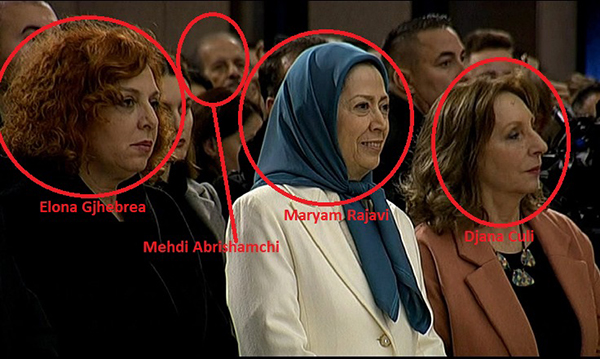
Present at the Christmas Mass was the head of the Iranian Jihadis, Maryam Rajavi. Behind Maryam Rajavi, in the photo published by an Albanian newspaper, is her first husband Mehdi Abrishamchi, who because her second husband, Massoud Rajavi, is now dead, is apparently replacing the former.

On the left of Maryam Rajavi is the feared Communist spy, Djana Culi, who is notorious in Albania for sending the brothers Blloshmi and Genc Leke to the gallows, and who is now a fiery supporter of the MEK jihad against Iran. On the right of the hijab wearing Maryam is Elona Gjhebrea, former Deputy Minister of the Interior, who is also controversial for her acquaintance with the Habilaj clan drug gang.

Attendance by the former terrorists, former communist spies and friends of drug traffickers has been welcomed by Monsignor George Frendo. In a repetition of the biblical tragedy of Pontius Pilate and the hypocritical religious leaders who condemned Jesus Christ to the cross, Monsieur George Frendo was happy with the presence of former terrorists, spies, criminals, etc. who attended the Christmas Mass. Their presence turned the Mass into a biblical tragedy.

Knowing that Maryam Rajavi presents herself to members of her cult as the messenger of Imam Mahdi who will save Iran from Islam and the Imams, the Christmas Eve Mass in Tirana resembled messianic dust. Maryam the ‘saint’ was celebrating the day of the birth of the saint Jesus Christ in the presence of many sins and sinners.

If Christ was in the grave, the night would have been a freakshow of horror!

Hallelujah!
Gazeta Impakt, Tirana, Translated by Iran Interlink

December 28, 2019 0 comments
FacebookTwitterPinterestWhatsappTelegramSkypeEmail
Newer Posts
Older Posts

Recent Posts

  • MEK agents near schools in Tirana, Albania

    October 17, 2026
  • Expectations of human rights bodies regarding censorship within the MEK

    October 13, 2026
  • The Jamalis’ Plea for Help: Save Our Brother from the MEK!

    October 11, 2026
  • Testimonies of Participants in the MEK’s Staged Propaganda Stunt in Karaj

    October 7, 2026
  • Giuliani’s MEK ties have dogged him for years

    October 6, 2026
  • Facebook
  • Twitter
  • Instagram
  • Youtube

© 2003 - 2025 NEJAT Society . All Rights Reserved. NejatNGO.org


Back To Top
Nejat Society
  • Home
  • Articles
  • Media
    • Cartoons
    • NewsPics
    • Photo Gallery
    • Videos
  • Publications
    • Books
    • Nejat NewsLetter
    • Pars Brief
  • About Us
  • Contact us
  • Editions
    • عربي
    • فارسی
    • Shqip