Nejat Society
  • Home
  • Articles
  • Media
    • Cartoons
    • NewsPics
    • Photo Gallery
    • Videos
  • Publications
    • Books
    • Nejat NewsLetter
    • Pars Brief
  • About Us
  • Contact us
  • Editions
    • عربي
    • فارسی
    • Shqip
Nejat Society
Nejat Society
  • Home
  • Articles
  • Media
    • Cartoons
    • NewsPics
    • Photo Gallery
    • Videos
  • Publications
    • Books
    • Nejat NewsLetter
    • Pars Brief
  • About Us
  • Contact us
  • Editions
    • عربي
    • فارسی
    • Shqip
© 2003 - 2024 NEJAT Society. nejatngo.org
MEK Spy
The MEK; Baath Party Accomplice

MEK conducting phone spying against Iran

Head of the Iranian Army’s Strategic Studies says members of the terrorist Mojahedin-e Khalq (MEK) are conducting espionage activities against Iran by contacting the country from Australia, Europe and the U.S.

“I do not think anyone is as skilful as the Monafiqeen in phone espionage,” Brigadier General Ahmadreza Pourdastan said on Sunday, using the term Monafiqeen, which literally means “the hypocrites”, to refer to members of the MEK.

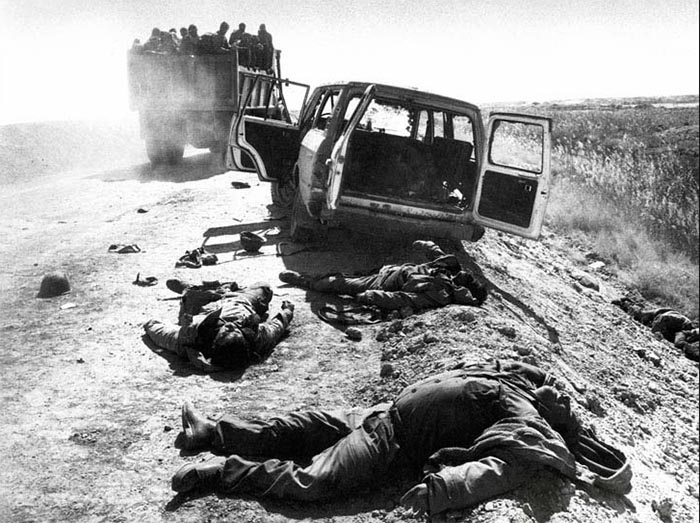
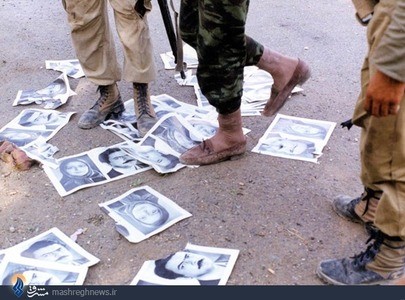
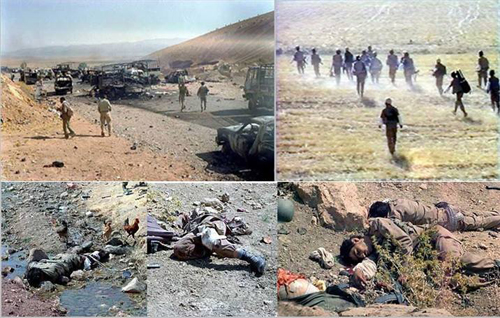
Pourdastan made the remarks at a ceremony to mark the 31st anniversary of Operation Mersad, 26–30 July 1988, which was the last major military operation of the Iran–Iraq War, involving a successful counterattack against a July 1988 military incursion from Iraq, by a military force of about 7,000 members of the MEK.

The MEK was established in the 1960s to express a mixture of Marxism and Islamism. It launched bombing campaigns against the Shah, continuing after the 1979 Islamic Revolution, against the Islamic Republic. Iran accuses the group of being responsible for 17,000 deaths.

Based in Iraq at the time, MEK members were armed and equipped by Iraq to fight against Iran alongside the Iraqi dictator Saddam Hussein during a war which lasted for 8 years.

“During Operation Mersad, the Iraqi Army provided air support and opened the road to Sarpol-e Zahab for the Monafiqeen,” Pourdastan said, adding that the MEK militiamen were then faced with a large number of people who delayed their advance, hence providing the Iranian Army with an opportunity to counter the aggression.

“Thanks to God, the Monafiqeen failed due to the commanders’ acumen and the people’s resistance,” he explained.

The general noted that the Iraqi Army’s eavesdropping became much more powerful after the MEK had joined them.

“The Monafiqeen eavesdropped all of our conversations and were familiar with the key words our warriors used,” he remarked.

Pourdastan then compared the MEK with the Daesh (ISIL) terrorist group, saying Daesh is the new version of the MEK, arguing that “we should not depict the enemy as weak and pathetic in our movies.”

Iran’s democracy foiled MEK, U.S. plots: government spokesman

Government spokesman Ali Rabiei draws a parallel between the MEK’s false belief that it had popular support in Iran when it launched attack on Iran in late July 1988, and the U.S. withdrawal from the 2015 nuclear agreement, which President Rouhani has attributed to Washington’s false belief that the Iranian people were fed-up with the system.

On Sunday, government spokesman Ali Rabiei also marked the anniversary of Operation Mersad in his press conference, hailing the victory of the Iranian Army, led by then-Ground Force Chief Brigadier General Ali Sayyad Shirazi, against the MEK.

Sayyad Shirazi was assassinated in 1999 while serving as the deputy chief of the armed forces. The MEK claimed responsibility for the assassination, which it said was in revenge for Operation Mersad.

Rabiei said, the Islamic Republic’s democracy has “foiled the plots hatched by the Monafiqeen and ill-wishers, who both wrongly assumed that the Iranian people would not support the establishment.”

He was drawing a parallel between the MEK’s false belief, before launching the attack, that it had social support in Iran, and the U.S. withdrawal from the 2015 nuclear agreement last year, which President Rouhani has attributed to Washington’s false belief that the Iranian people were fed-up with the system.

Rabiei then pointed to Washington’s “maximum pressure” campaign against the Islamic Republic, saying, “What we see today of U.S. sanctions and measures by the establishment’s ill-wishers closely resembles Monafiqeen’s aggression at the time of Operation Mersad.”

The MEK’s affiliation to the U.S. government attracted attention in 2012 when the latter removed the former from its list of foreign terrorist organizations.

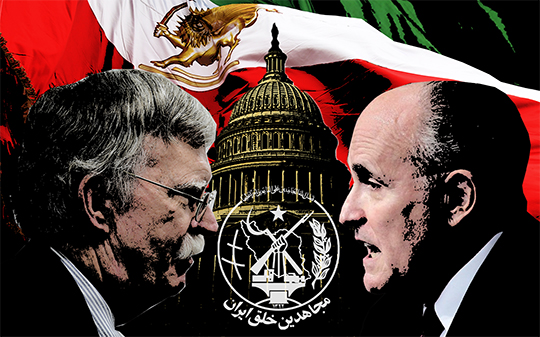
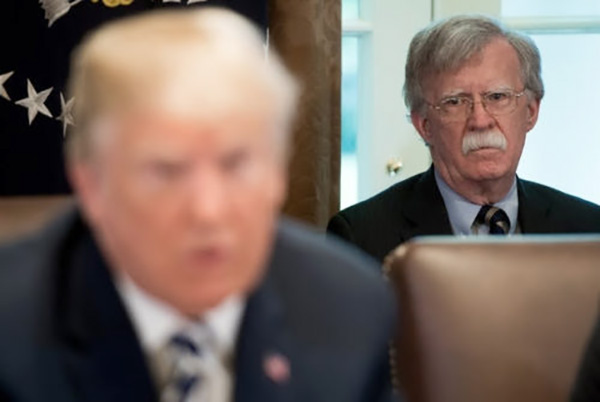
The link became more overt after U.S. President Donald Trump assumed office in 2017. Trump’s associates, including his personal lawyer Rudy Giuliani and his national security advisor John Bolton have attended the MEK’s meetings and praised the group as “democratic alternative” to the Islamic Republic.
July 30, 2019 0 comments
FacebookTwitterPinterestWhatsappTelegramSkypeEmail
Mujahedin Khalq; A proxy force

Terrorist supporters at white house

This Iranian opposition group was labeled a terrorist organization. Now it has supporters in the White House

For decades, the United States categorized the Mujahedin Khalq, or MEK, as a terrorist organization. In the Trump era, members of the Iranian dissident group, which seeks to topple the government in Iran, have found key allies in Washington.

People close to President Trump, including national security advisor John Bolton, and Trump’s personal lawyer, Rudolph W. Giuliani, are supporters of the Mujahedin Khalq. For years, Bolton and Giuliani have called for a change of government in Tehran and have described the Mujahedin Khalq as a viable alternative to the government of the Islamic Republic.
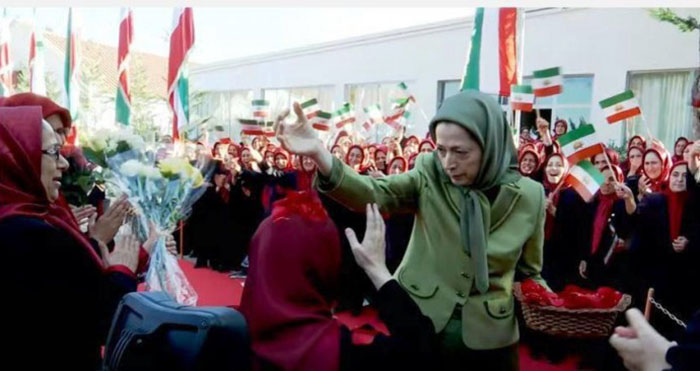
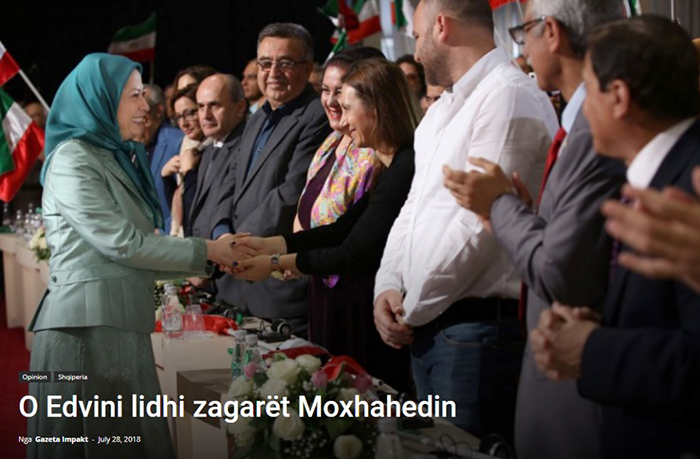
This month, Giuliani appeared at a Mujahedin Khalq conference in Albania, where he gave a speech condemning the Islamic Republic and described the group as a “government in exile.”

“This is a group that we can support. It’s a group we should stop maligning and it’s a group that should make us comfortable having regime change,” Giuliani said to a cheering audience.

During a 2017 Mujahedin Khalq conference in Paris, Bolton told a room filled with its members that U.S. policy should be “the overthrow of the mullahs’ regime in Tehran.”

He added, “There is a viable opposition to the rule of the ayatollahs and that opposition is centered in this room today.”

Both Giuliani and Bolton have received tens of thousands of dollars from the group in exchange for speaking at its rallies and conferences.

Founded five decades ago by leftist students in Iran who opposed the Western-backed monarchy of Mohammed Reza Shah Pahlavi, the Mujahedin Khalq is an insular organization with a militant past. Many Iranians despise the group and from 1997 to 2012, it was on the U.S. State Department’s list of terrorist organizations in part because of its bloody attacks in the 1970s that left American diplomats and businessmen dead.

The Mujahedin Khalq and its supporters claim that the group stands for a free and democratic Iran and that its decades-long struggle has helped make it the most qualified opposition group. But critics and human rights organizations describe the group as a cult, and many lawmakers and State Department officials don’t believe it has popular support or influence.

The group has a history of networking with U.S. politicians on both ends of the political spectrum.

“Different people come and go with each administration. We’ve had the same position and demands over the years no matter who is in the White House,” said Alireza Jafarzadeh, deputy director of the National Council of Resistance of Iran, a Mujahedin Khalq-linked group based in Washington.

But despite its continued lack of support among many in Washington, the Mujahedin Khalq feels emboldened now that tensions with Tehran have escalated and it has key supporters who have Trump’s ear. “I can’t recall in the past 40 years seeing such a two-year period where there’s been lots of developments shaping Iran,” said Jafarzadeh.

***
The Mujahedin Khalq, founded in the early 1960s by husband-and-wife team Massoud and Maryam Rajavi, carried out a series of terrorist attacks during the 1970s against Iran in which several U.S. military personnel and civilians who were working on defense projects in Tehran were killed, according to a 1994 U.S. State Department report.

The group also helped the country’s Shiite Muslim clerics topple the shah during the 1979 revolution. But it didn’t take long before the newly formed conservative theocracy headed by anti-Western Ayatollah Ruhollah Khomeini came to view the Mujahedin Khalq as a rival.
About 2,000 members of the group relocated to Iraq during the 1980s.

In addition to providing shelter, then-Iraqi President Saddam Hussein armed the group with heavy military equipment. During the Iran-Iraq war, its members teamed with Baghdad in an attempt to take down the Islamic Republic. Iraq remained a safe haven for the Mujahedin Khalq for nearly two decades.

Throughout that time, the group continued to launch attacks inside Iran and on its embassies abroad. The State Department described the Mujahedin Khalq in its 1994 report as “the single most violent underground group” in Iran.

“Shunned by most Iranians and fundamentally undemocratic,” the report said, the Mujahedin Khalq is not “a viable alternative to the current government of Iran.”

U.S. relations with the group, however, grew complicated after the American-led invasion of Iraq in 2003.

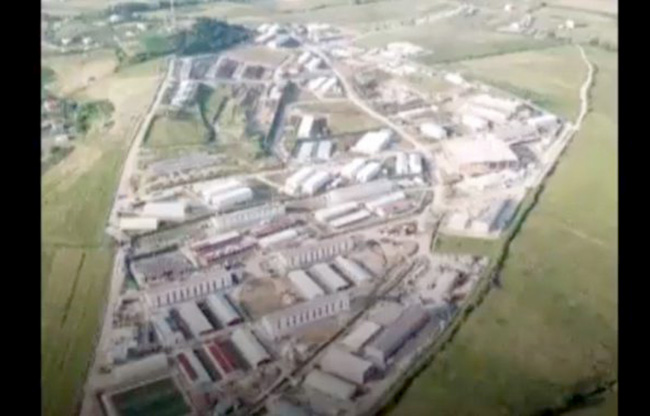
Although the group disarmed and was confined to Camp Ashraf, a 14 square-mile former Iraqi military base , the new Iraqi government wanted its members to leave. Faced with a potential humanitarian crisis, officials in Washington sought to find the Mujahedin Khalq a new home.

Daniel Benjamin, the State Department counter-terrorism coordinator under then-President Obama, said that was a factor in removing the Mujahedin Khalq from its list of foreign terrorist groups.

“All these people were the subject of violence, that’s what really caused the U.S. to look at the issue … to avoid a humanitarian catastrophe,” Benjamin said.

Eventually the U.S. brokered a deal with the government of Albania.

“The Albanian government basically wanted reassurance that they weren’t a terrorist group. I didn’t promote them as an ideal group but they didn’t deserve to be slaughtered,” said Daniel Fried, who was tasked by then-Secretary of State Hillary Clinton to find a country that would accept Mujahedin Khalq members.

Their future looked grim up until after the presidential election in 2016, when Trump’s “maximum pressure campaign” on Iran became American policy.

Already, several policies that the Mujahedin Khalq had long advocated for, such as designating Iran’s Revolutionary Guard as a terrorist group and placing U.S. sanctions on Iranian Supreme Leader Ayatollah Ali Khamenei, have been implemented under Trump.

“This administration sees ‘the enemy of my enemy as my friend.’ So any organization that opposes that Islamic Republic is fine by them,” said Barbara Slavin, the head of the Future of Iran Initiative at the Atlantic Council. “The administration knows it makes the Iranian government crazy. It sends a message of animosity.”

***

But the extent to which the Mujahedin Khalq can gain stronger credibility in Washington — even during the Trump administration — remains uncertain.

“The MEK has American blood on its hands. No serious observer or scholar of the region that I’ve met has thought that the MEK was remotely acceptable to any significant percentage of the Iranian people,” Benjamin said.

And in recent months some officials in the Trump administration have taken steps to distance it from the Mujahedin Khalq.

In April, Secretary of State Michael R. Pompeo met privately with a small group of Iranian Americans in Dallas. Michael Payma, an attorney, was one of those people invited to attend the roughly hourlong conversation.

“Pompeo said he knows Giuliani and Bolton have had some kind of relationship with the MEK, but he made it clear that neither him nor the president have any association with the group,” Payma recalled.

In June, Brian Hook, U.S. special representative for Iran, reiterated those points when he told reporters that the State Department meets with all members of the Iranian diaspora and that the future of Iran will be decided by its people, not the United States.

“We have been, I think, zealously neutral with respect to groups who all care very much about the future of Iran, and that’s going to be something which the people of Iran decide for themselves,” Hook said.

Regardless, Washington’s cozier relations with the Mujahedin Khalq has Tehran concerned.

In recent years, there has been an uptick in attacks against the group by Iran. Two Iranian suspected of surveilling the Mujahedin Khalq were arrested in Albania in 2018, and an Iranian diplomat in Vienna was arrested on suspicion of plotting to bomb a Mujahedin Khalq rally outside Paris.

Nader Karimi Juni, a Tehran-based analyst, said Iran is on edge because the Mujahedin Khalq has members and supporters in positions of power in the U.S. and Europe.

“Iran has good reason to regard the MEK as a threat,” Juni said.

By Melissa EtehadStaff Writer , latimes.com

Special correspondent Ramin Mostaghim in Tehran contributed to this report.

July 30, 2019 0 comments
FacebookTwitterPinterestWhatsappTelegramSkypeEmail
MKO defectors in Albania
Albania

work permits issued for MEK formers

Good news, MEK formers have been issued work permits.
After all the pressure the MEK and the US exerted on the UNHCR to not only give no succour to these people but to leave Albania completely, and all the pressure exerted on the Albanian government not to help or facilitate the survival of these MEK formers, they have succeeded in their aim.
With the help of hunger strikes and demonstrations and the work of lawyers, the Albanian government has backed off and as a minimum has accepted that these people exist in their own right and are separate from the group supported by the US.

They are accepted as individuals, not as commodities.
The authorities have accepted they must issue work permits for these formers who live in Tirana. Many writing about this have said this is a huge setback for the MEK because they have used this lack of status to threaten people not to leave.
They tell members ‘you will be destitute if you leave the camp’.
Many write to congratulate the ex-members for their achievement and hard work over last few months.

July 28, 2019 0 comments
FacebookTwitterPinterestWhatsappTelegramSkypeEmail
Mujahedin Khalq Organization as a terrorist group

Iran blasts US, Europe support of MEK

The top military aid to the Leader of Islamic Revolution Major General Safavi said that the terrorist group of MKO is the evilest anti-Iranian group.

Commemorating the thirty-first anniversary of the Mersad glorious operation in Kermanshah province, western Iran on Thursday, M.G Safavi noted that the terrorist group that has been assassinated and martyred countless Iranian civilians and senior clerics so far using terror attacks is under the US and European support.

“The Islamic Republic of Iran is a divine, invincible power which is increasing day by day, while on the contrary, the US and Zionists’ power is reducing year by year,”the top military aid to the Leader of Islamic Revolution stressed.

The commemoration ceremony of the 31st anniversary of MKO defeat anniversary (Mersad operation) held in Strait of Mersad, Islamabad, Western Iran with the presence of provincial officials, commanders and combatants of the eight years imposed war of Iraq against Iran.

The MKO has a dark history of assassinations and bomb attacks against the Iranian government and the Iranian people.

It notoriously sided with Saddam’s regime during the eight-year war with Iran.

July 27, 2019 0 comments
FacebookTwitterPinterestWhatsappTelegramSkypeEmail
Eternal Light Operation - Mersad
Mujahedin Khalq Organization as a terrorist group

A decisive defeat for the Mujahedin-e Khalq

On 27 July 1988, Mersad operation[Eternal Light] which took place in a narrow passageway named Mersad in Kermanshah province, western Iran, was a decisive defeat for Mujahedeen-e-Khalq (MKO) terrorist group.

The leadership of MKO was deluded in thinking that members of their terror group will face little or no resistance in Kermanshah province and will quickly reach Tehran in short period, and with the support of Saddam Hussein, the Iraqi dictator, they decided to attack Kermanshah province in western Iran.

Forces of the Islamic Revolution Guard Corps (IRGC) and the Iranian Army surrounded and destroyed the terrorist group in the Mersad operation.

July 27, 2019 0 comments
FacebookTwitterPinterestWhatsappTelegramSkypeEmail
paid advocacy
Mujahedin Khalq; A proxy force

The Magic Formula to Turn MEK Terrorists to Proxies for False Flag Ops

“Slimy with MEK blood money”, this is the logic Kurt Nimmo presents to explain why some of former American officials, politicians, and retired military officers have been cheerleading for the MEK over the past decade. [1]
Ali Harb of the Middle East Eye also wonders about the contradictions over the sponsorship of certain American figures for the formerly terror designated group, MEK.

“Beyond Giuliani and Bolton, lawmakers from both major American political parties have lauded the MEK as a pro-democracy movement despite its checkered past,” he writes. [2]

However, he gets the answer in the comments of Barbara Slavin the director of the Future of Iran Initiative at the Atlantic Council, on the MEK.

“It’s just ridiculous that they’ve been able to get the influence that they have had in the US,” Slavin told Harb, “I think that’s primarily due to the money … that they pay lobbyists to press their case. They’ve had some very influential people like John Bolton and Rudy Giuliani who have taken their side.” [3]

When a few weeks ago, Ilan Berman of the National Interest published a piece titled “Making sense of the MEK”, Daniel Larison of the American Conservative responded with an investigated report on the true nature of the MEK criticizing Berman for “whitewashing” the MEK. An example of whitewashing the MEK’s bloddy history is accurately denounced by Larison.

“For instance, he talks about the MEK’s efforts to cultivate U.S. politicians and former officials, including John Bolton and Rudy Giuliani, but he leaves out the part where they have paid their newfound supporters for their endorsement to the tune of tens of thousands of dollars per speech,” he states. [4]

In November 2016, the New York Times, “In one year — 2006 — Mr. Giuliani reported in a financial disclosure report that he had made 124 speeches, for as much as $200,000 each, and had earned a total of $11.4 million. He often made extravagant demands in return for agreeing to make a speech, including that the private plane that flew him to the engagement be a certain size.” [5]
The sums that Bolton has received from the MEK is as hefty as Rudy Guilliani’s.

“Bolton has always been the star of the show,” according to the Open Secrets News website. “Records show that the M.E.K has paid Bolton at least $180,000 in speaker fees to attend the group’s annual Paris conference for more than a decade.” [6]

The US warmongers, Saudi Arabia, the Israeli Mossad are all interlinked with the MEK—no matter the MEK was formerly considered a Foreign Terrorist Organization by the US State Department. Some magic formula, is now considered to be made up to turn former terrorists into Iranian pro-democracy patriots. MEK agents which are being brought in from Albania are organized in troll farms and may be used to carry out some false flag and blame it on Iran. Money seems to be the catalyst of these interactions. But where does the MEK’s money come from?
To be continued

By Mazda Parsi

References:
[1] Nimmo, Kurt, Pockets stuffed with terrorist cash to be MEK’s Guys, kurtnimmo.blog, July 13th, 2019.
[2] Harb, Ali, How Iranian MEK went from US terror list to halls of Congress
MiddleEastEye.net, July 17th, 2019.
[3] ibid
[4] Larison, Daniel, Whitewashing the MEK Makes No Sense, The American Conservative, July 7th, 2019.
[5] Landler, Mark & Lipton, Eric & Becker, Jo, Rudolph Giuliani’s Business Ties Viewed as Red Flag for Secretary of State Job, The New York Times, November 15th, 2016.
[6]Champlin, Reid, As tensions rise, moneyed interests pushing for hard line against Iran, Open Secrets News, May 22nd, 2019.

July 25, 2019 0 comments
FacebookTwitterPinterestWhatsappTelegramSkypeEmail
Mujahedin Khalq Organization

MEK member reveals the group’s secret meeting content

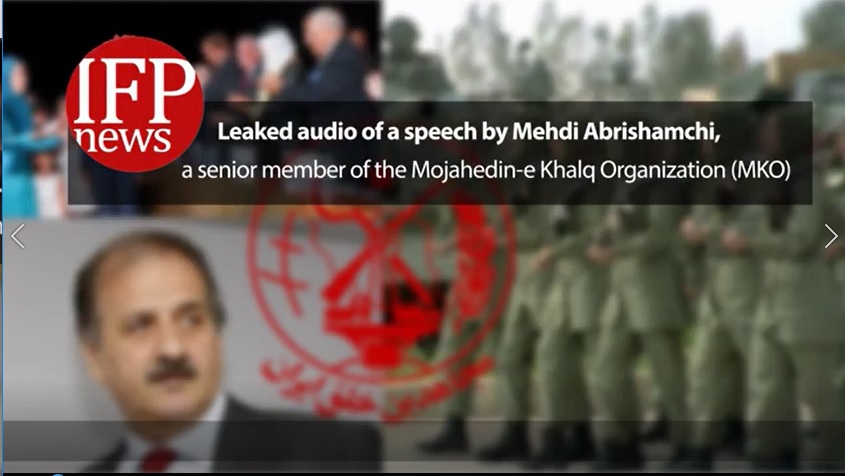
Exclusive: In Leaked Audio, Unfaithful MKO Leader Calls US Presidents ‘Criminal’

A top leader of the Mujahedhin-e Khalq Organization (MKO) calls the US an imperialist regime, and accuses its presidents – from Bill Clinton to Barack Obama – of committing crimes against the terrorist cult, a leaked audio released by the Iran Front Page reveals.

Mehdi Abrishamchi, a founding member of the anti-Iran terror group, made the remarks in a secret intra-organizational meeting, whose contents have been leaked by an MKO member.

After carrying out a chain of terrorist attacks in Iran, Abrishamchi fled the country along with a number of his comrades, including his wife Maryam Qajar-Azodanlu. However, he was later forced to divorce his wife at the request of then MKO leader Masoud Rajavi, who later married Maryam. Abrishamchi even surprised observers by attending their wedding ceremony.

The leaked audio of Abrishamchi’s speech at a gathering of the most trusted members of the Rajavi cult indicates his deep dissatisfaction with the regional approach adopted by many of US presidents, from Bill Clinton to George W. Bush and Barack Obama.

One of the reasons for his dissatisfaction is the US’ invasion of Iraq, which resulted in the overthrow of Saddam Hussein, and according to Abrishamchi, the growth of Iran’s influence in the Arab country.

He also blasts Bill Clinton for designating the MKO as a Foreign Terrorist Organization, arguing that committing acts of terrorism inside Iran is their “right”.

Without referring to the US support for the terrorist cult, the senior MKO member lashes out at the US presidents with a humiliating tone, and does not even exclude Donald Trump, whose administration has become known as a staunch supporter of the MKO.

In his remarks, he does not point to his organization’s friendly relations with Trump’s national security advisor John Bolton, his personal lawyer Rudy Giuliani, and a number of other notorious US hawks who earlier delivered speeches at the MKO gatherings.

Even in one of his MKO speeches, Bolton promised they would celebrate their victory in Tehran in 2019.

Despite the explicit support of senior Trump administration officials for the MKO at their gatherings, Abrishamchi says he does not pin any hope on Trump, and just wishes the US president would not harm them.

The MKO group, known in Iran as the Monafiqeen (‘the hypocrites’), are known to be divided in their political, social, and organizational behaviours.

What follows is the leaked audio of Abrishamchi’s remarks:

https://dlb.nejatngo.org/Media/Report/IFP_Abrishamchi_US.mp4

By IFP Editorial Staff

July 24, 2019 0 comments
FacebookTwitterPinterestWhatsappTelegramSkypeEmail
Mujahedin Khalq; A proxy force

Maryam Rajavi in Tel Aviv

MKO’s Maryam Rajavi visit to Tel Aviv planned by Trump’s advocate

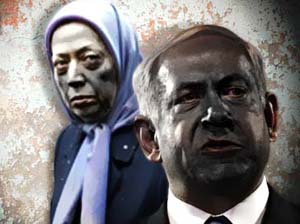
According to tweets of the French consul general for Alquds (Jerusalem) Pierre Cochard, the Ring leader of the terrorist Mojahedin Khalq Organization (MKO) Maryam Rajavi has traveled to Tel Aviv to negotiate anti-Iranian measures with the Israeli regime’s PM Benjamin Netanyahu.

“I was surprised today by the news received from a former colleague with whom I worked in Tehran; Maryam Rajavi, the co-leader of the People’s Mojahedin Organization of Iran (PMOI) visited Israel,” he tweeted on July 17.

“On July 17, Mrs. Rajavi left Tirana to join Tel Aviv.

This trip was arranged through Rudy Giuliani, the personal advocate of President Trump and Boaz Rodkin, the Israeli Ambassador to Albania,”

he added.

“Mrs. Rajavi is likely to meet Yossi Cohen, the director of Mossad who has already cooperated with the Mujahideen on the Iranian nuclear issue. During her trip to Tel Aviv, Mrs. Rajavi will also meet with the Prime Minister of Israel,” the French diplomat wrote on the same day.
“Mrs. Rajavi holds the title of Political Refugee in France. Her talks with the Jewish State have not been authorized by the French Chancellery in Israel,” he noted.
“Mr. Netanyahu announced a few days ago that he will soon reveal news about the nuclear activities of the Islamic Republic,” Cochard continued.
The MKO which is said to be a cult which turns humans into obedient robots, turned against Iran after the 1979 Revolution and has carried out several terrorist attacks killing senior officials in Iran; yet the West which says cultism is wrong and claims to be against terrorism, supports this terrorist group officially.
After the Islamic Revolution in 1979, the MKO began its enmity against Iran by killings and terrorist activities.
Maryam Rajavi has been the leader of the sect for more than 25 years, and during these years, no elections, even based on formality, has been held to select the new leader. The sect is ruled through dictatorial arrangements and far from democratic mechanisms. Some members have launched aborted attempts to escape the Liberty Camp, and generally faced with failure, they have committed suicide.
Recently many reports have been revealing the close cooperation between the Saudi and the terrorist MKO officials, too.

July 24, 2019 0 comments
FacebookTwitterPinterestWhatsappTelegramSkypeEmail
Albania

Why no other country agreed to allow the MEK into their soil

Terrorism and Corruption: Albania’s Issues with EU Accession
Albania has been longing for joining the European Union for years, but the tiny Balkan nation still faces major challenges to its hopes of joining the bloc.
Extensive economic and administrative reforms, noninterference in the judicial procedures by the government, Election transparency and combating corruption are among Brussels’s top demands from Albania before its annexation to the EU.
However, corrupt political leaders and their alleged links to organized crime which have triggered protests by people from time to time, have played a key role in turning Albania’s wish for joining the EU into an unrealized dream.

For instance, German tabloid “BILD” leaked six wiretapped conversations in June indicating collusion between Socialist Party officials and members of a notorious criminal organization regarding coercing voters in the upcoming election.
The controversial audio file has sparked rage among the opposition parties leading to calls for Prime Minister Edi Rama’s resignation and an earlier general election. Albania’s opposition parties have accused the governing party of corruption and of doctoring the results of the 2017 parliamentary election. Leader of the opposition party, Lulzim Basha, accused the Socialists of coming into power “through the votes of the crime and the mafia.” Basha’s Democratic Party relinquished their seats in Parliament in protest, and declared a boycott of the June 30 vote.

The presence of the Mujahedin-e Khalq organization (MEK, a.k.a MKO, NCRI, PMOI), an exile Iranian group perceived by many experts as a terrorist cult, in a base around Tirana could also make Albania’s situation more complicated in its EU accession talks. The MEK was relocated to Albania under the U.S. pressure after no other countries took the group in following its expulsion from Iraq.

Listed for 17 years as a terrorist organization in the United States and the European Union, with various reports published about its violations of Human Rights and acts of violence and terror, the MEK enjoyed a significant increase in its activities during the first term of Prime Minister Edi Rama’s cabinet. Despite he was expected to limit MEK’s activities to its bases in Tirana, Edi Rama allowed the group to act freely in Albania and provided it with a huge land in Durres to construct its fortified headquarters.

MEK’s generous donations to the Albanian Police, journalists and political figures have been regularly reported by the local media. Making a name for itself in the government of Edi Rama, the MEK has been able to pay a number of Albanian political figures and Parliament members to advocate for the group in its events.
A recent tweet from PM Edi Rama in which he blames Iran for fueling tensions in the Middle East, indicating his support for Iran’s adversaries including Saudi Arabia, the UAE and the U.S., resembles MEK’s stance against Iran. Considering these facts, MEK’s aids to Rama against his political opponents must be thoroughly investigated ahead of the upcoming election in Albania.
Albania should have understood in the first place why no other countries, including MEK’s top sponsor, the United States, agreed to allow the group into their soil after its relocation from Iraq. Wherever it has been, the MEK has been involved in conducting illegal activities and sabotage acts. The group’s dark past and a long list of its misconducts including violating the human rights of hundreds of its members in Albania, could cause many troubles for Tirana in the near future.
After 5 years of residence in Albania, the MEK has now become a part of the corruption process in this country and a link to its corrupted authorities. It is not unlikely at all to see MEK promote the ruling party, with which it shares common thoughts and interests, in the upcoming Albanian election. The experiences of MEK’s numerous overt and covert interventions in the Iraqi Parliamentary elections in favor of specific people through spending huge sums of money, could easily repeat in Albania and mark a more controversial situation than the 2017 Parliamentary election in Albania.
Finally, it is the Albanian people who will be the true victims of their government’s friendly policies towards the infamous MEK which has been known as a terrorist group for a long time; The policies that could negatively impact Albania’s already complicated accession negotiations with the EU.
By Reza Alghurabi, Ahtribune.com

Reza Alghurabi is an Arab journalist who lives in Iran. He is a former researcher at the Beirut Center for Middle East Studies and an independent researcher and journalist writing in Iranian newspapers including the Khorasan daily.

July 23, 2019 0 comments
FacebookTwitterPinterestWhatsappTelegramSkypeEmail
MKO members in Albania
Albania

MEK’s presence makes Albania more vulnerable than ever

“Will the Presence of Iran’s MEK Threaten Albania’s Already Shaky Stability?” wonders Frida Ghitis of the World Politics Review.

Frida Ghitis who is a world affairs columnist, a former CNN producer and correspondent and a regular contributor to CNN and The Washington Post warns about the threat of the presence of the Mujahedin Khalq Organization (the MKO/ MEK/ PMOI/ Cult of Rajavi) in Albania as a part of the already tremulous region of the Balkans:
It might have seemed like a barely consequential item amid another torrent of breaking news. But word that President Donald Trump’s lawyer, Rudy Giuliani, just attended the annual gathering of a controversial Iranian opposition group at its unlikely base in Albania should raise flags for many reasons, not least of which are concerns for Albania’s troubled and fragile democracy.

If Albania is now unexpectedly drawn into one of today’s most dangerous geopolitical conflicts—the one pitting Iran against the United States, Saudi Arabia and other Gulf states—the timing couldn’t be worse. The country is in the midst of a full-blown political crisis that has at times turned violent and whose outcome is still uncertain. A member of NATO, Albania has also been trying unsuccessfully to join the European Union for years; its current domestic turmoil makes that goal even more distant. To make matters worse, Albania’s infighting has turned it into an inviting target for malicious actors seeking to take advantage of a distracted, divided nation.
Giuliani, along with some other prominent figures, including former U.S. Sen. Joe Lieberman and British Conservative MP Matthew Offord, attended the annual “Free Iran” conference of the group known variously as the People’s Mojahedin Organization of Iran and Mujahedin-e Khalq, or MEK. A shadowy outfit committed to the overthrow of Iran’s theocratic regime, the MEK is often described as a cult and used to be classified by the State Department as a terrorist organization. Now, some of its leading backers work for Trump and his administration, putting Albania in the middle of the Iran file. Perhaps its biggest booster is John Bolton, Trump’s hawkish national security advisor, who wants the MEK to govern Iran.
The MEK has a strange and contentious history. It emerged as an Islamist-Marxist organization and militia in Iran in the 1960s and was staunchly anti-American. It killed members of the Shah’s police and played a key role in toppling him during the 1979 revolution. But it fell out with Iran’s new Islamist authorities after they took power, and was exiled from the country in the early 1980s. When Iraq under Saddam Hussein then went to war against Iran, the MEK—now fervently opposed to the Islamic Republic—sided with Baghdad and ended up building a base of operations in Iraq near the Iranian border, from which it staged attacks inside Iran.
Ghitis is concerned on the capacity of the MEK to turn into a tool in the hostile policies of Donald Trump against the Iranian Government despite the group’s unpopularity inside Iran. According to her analysis, this will draw Tehran’s attention to Tirana which is vulnerable enough to foreign meddling:
Since moving to Albania, the MEK had received only minor international attention. That changed with the Trump administration. Key administration figures have advocated for the group, some as paid supporters, others out of ideological conviction. Bolton and Giuliani in particular have promoted it as a legitimate government-in-exile that should eventually replace the Islamic Republic, even though it has little support inside Iran.
The Trump administration’s spotlight on the MEK is undoubtedly drawing the attention of Tehran at a perilous political moment in Albania. The Albanian government was plunged into crisis earlier this year when opposition parties withdrew from Parliament and demanded the resignation of Prime Minister Edi Rama, accusing him of corruption, election-rigging and ties to organized crime. Rama’s center-left Socialist Party holds a majority in Parliament, while the opposition is made up of parties to his left and right. Corruption has been endemic in Albania since the end of communist rule, but Rama generally enjoys the support of the U.S. and much of Europe.
Tensions in Tirana erupted last month after Bild, a German newspaper, leaked conversations from prosecutors’ wiretaps that suggested Rama and the Socialist Party were plotting with criminal groups to manipulate elections in 2016. Rama and his party deny any wrongdoing.
But their opponents took to the streets. Pitched battles ensued, with protesters lobbing Molotov cocktails and the police responding with water cannons. The situation got worse when the opposition declared it would boycott June’s municipal elections. President Ilir Meta then announced he was cancelling the vote and rescheduling it for October; without the opposition, he said, the elections would not be democratic.
Rama’s governing party, however, refused to accept the president’s move and said it would launch impeachment proceedings against him for it. Then it went ahead with the ballot. The turnout, unsurprisingly, was minuscule. With the elections’ winners ready to take their new posts across the country, some outgoing mayors refused to relinquish their offices.
The political scene remains tumultuous, full of tension, hyperbole and conspiracy. Meta has accused Rama of being a tool of the “deep state,” working with billionaire philanthropist George Soros to destabilize Albania and even establish a “dictatorship” encompassing Albania and Kosovo, “serving underground agendas.” The Albanian people, he told an interviewer, do not want to be a “colony in servitude of money-laundering and organized crime.” Instead, they want to be part of the democratic West, “to join NATO and the European Union.”
A deadline is looming for Albania: In October, the European Council will make a decision about formally launching accession talks with Albania. The street battles, the name-calling and the conspiracy theories all support the views of skeptics who say Albania’s democracy is not mature or stable enough to join the EU.
As if that wasn’t bad enough, trouble with Iran may be brewing over the MEK’s compound in Albania’s countryside, raising the risk of Iranian interference. Iran took notice of the gathering that Giuliani and others attended in Albania this week, with its state-backed media chastising the U.S. and other Western countries for siding with what it calls a terrorist organization…
The WPR correspondent finds the MEK and its violent approach against Iran a potential threat to democracy in Albania:
The MEK’s goal remains the overthrow of the Iranian regime, although it now says it has sworn off violence. The group’s rise in visibility amid the Trump administration’s standoff with Iran could make Albania more vulnerable than ever to outside meddling. The potential for a new crisis in Europe and within NATO, centered on Albania of all places, is very real.

World Politics Review

July 23, 2019 0 comments
FacebookTwitterPinterestWhatsappTelegramSkypeEmail
Newer Posts
Older Posts

Recent Posts

  • MEK agents near schools in Tirana, Albania

    October 17, 2026
  • Expectations of human rights bodies regarding censorship within the MEK

    October 13, 2026
  • The Jamalis’ Plea for Help: Save Our Brother from the MEK!

    October 11, 2026
  • Testimonies of Participants in the MEK’s Staged Propaganda Stunt in Karaj

    October 7, 2026
  • Giuliani’s MEK ties have dogged him for years

    October 6, 2026
  • Facebook
  • Twitter
  • Instagram
  • Youtube

© 2003 - 2025 NEJAT Society . All Rights Reserved. NejatNGO.org


Back To Top
Nejat Society
  • Home
  • Articles
  • Media
    • Cartoons
    • NewsPics
    • Photo Gallery
    • Videos
  • Publications
    • Books
    • Nejat NewsLetter
    • Pars Brief
  • About Us
  • Contact us
  • Editions
    • عربي
    • فارسی
    • Shqip