Nejat Society
  • Home
  • Articles
  • Media
    • Cartoons
    • NewsPics
    • Photo Gallery
    • Videos
  • Publications
    • Books
    • Nejat NewsLetter
    • Pars Brief
  • About Us
  • Contact us
  • Editions
    • عربي
    • فارسی
    • Shqip
Nejat Society
Nejat Society
  • Home
  • Articles
  • Media
    • Cartoons
    • NewsPics
    • Photo Gallery
    • Videos
  • Publications
    • Books
    • Nejat NewsLetter
    • Pars Brief
  • About Us
  • Contact us
  • Editions
    • عربي
    • فارسی
    • Shqip
© 2003 - 2024 NEJAT Society. nejatngo.org
defectors of MEK un Albania
Albania

The Closure of RAMSA, emboldens the MKO cult leaders

Once the relocation of members of the Mujahedin Khalq Organization (the MKO, MEK, PMOI, the Cult of Rajavi) from Camp Liberty Iraq, to Tirana Albania, started in 2013, members of the group were supposed to be recognized as refugees and Albania was supposed to be their permanent home before their final relocation in third countries.
Six years passed and about a thousand members left the MKO to live a normal life in the free world but their departure from the group resulted in legal problems for them. It seems that they are recognized as “refugees” only if they are members of the Cult of Rajavi.
In June 2013 when the first group of the MKO members were resettled in Albaniab, the US State Department stated, “The permanent relocation of residents is essential to ensure the safety and security of residents.” However, today those residents who are no more followers of Maryam Rajavi are left homeless and money less because the UN’s Refugee and Migrant Service in Albania (RAMSA) closed its office in Tirana.
The UN High Commissioner for Refugees allegedly relocated the MKO in Albania from Iraq on “humanitarian grounds.” “But, on their arrival they were not granted UN refugee status, nor have they been issued Albanian identity documents that would allow them to work or travel,” Ann and Massoud Khodabandeh wrote in Lobelog. “Lack of residency rights also means that they cannot register for a bank account. They have no identity papers whatsoever, except the flimsy piece of paper used to fly them through international airspace from Baghdad to Tirana.”
This means that the MKO defectors’ legal case is neither supervised by the UNHCR nor by the Albanian government. There is no perspective for them for moving to a third country and this is very pleasing for the MKO leaders. The UNHCR, the US and the Albanian government “humanitarian” aids are limited to the isolated barred members in the Cult of Rajavi.
The closure of RAMSA is a gift to the MKO leaders who fear the increasing defection from the group which ends in the collapse of their cult.
Mazda Parsi

May 1, 2019 0 comments
FacebookTwitterPinterestWhatsappTelegramSkypeEmail
Jhon Bolton - warmonger - terrorist lobbist
Mujahedin Khalq; A proxy force

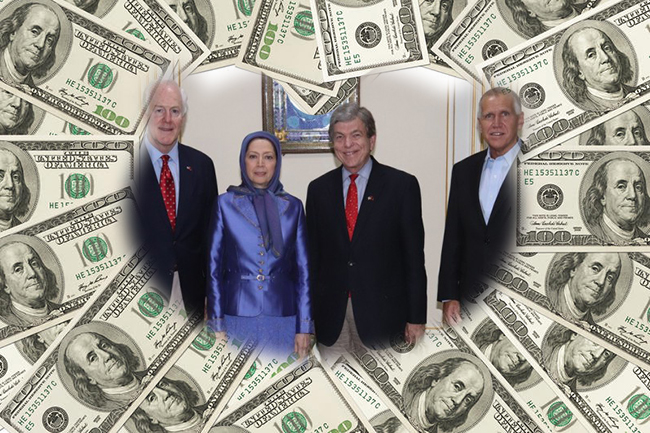
MEK uses old-fashioned greenbacks in large amounts to secure its American lobbyists

John Bolton: A complex worldview that just might work for Trump

Long before John Bolton was named as President Trump’s new national security adviser, a position he assumes on Monday , his name sparked diametrically opposite reactions in Washington.
Some have long lauded the former undersecretary of state and U.S. ambassador to the United Nations for his near absolute commitment to national sovereignty. Others have despised what they see as his lack of humility and reflex toward military force.
But who is the real John Bolton? Sometimes, he’s a man of deep civility. One old friend and Yale Law School contemporary, Supreme Court Justice Clarence Thomas, says so. In a 2013 discussion with Duke Law students, Thomas recalled the time Bolton found the future justice’s lost wallet.
“He found my wallet and returned it, and I got to meet him,”Thomas explained.”He treated me very honestly and decently and gave me some advice about studying that helped me from then on, [regarding] outlining and reducing outlines. He always treated me, not as a black student, but as a fellow student. And I really appreciated that at Yale.”
Many of Bolton’s acquaintances would suggest that Thomas’ experience casts a revealing and accurate light on Bolton’s character. If politics is not on the agenda, Washington figures such as Chicago Tribune columnist Clarence Page say that Bolton, who grew up in working-class Baltimore, is respectful, even kind.
But if politics is the topic, as it often is, the man can be more than a little different. In his positions under Presidents Ronald Reagan and George H.W. Bush, Bolton was renowned for his blunt style dealing with underlings and superiors alike, including those presidents.
As Peter Baker reported in 2008, Bolton fell out with Bush over what he regarded as the president’s insufficiently hawkish approach to countering North Korea. Although Bush might not have liked Bolton’s repudiation —”I don’t consider Bolton credible,”he told Baker at the time — the ambassador’s record on North Korea fits another major politician. And that man is going to be Bolton’s new boss.
Trump often argues that previous administrations utterly failed to resolve the challenge of a North Korea armed with nuclear weapons. Bolton’s ideology is not well-understood. Though he expresses his views with great force that sometimes seems to shade into stridency, Bolton is a hawkish nationalist and not a neoconservative.
Reuel Marc Gerecht, neoconservative scholar at the Foundation for the Defense of Democracies, who was an acquaintance of Bolton’s when they were colleagues at the American Enterprise Institute, says Bolton is”not really interested in democracy”but rather in the binding of American sovereignty and security. Gerecht offers the anecdote of a trip to France with Bolton and another AEI scholar, Gary Schmitt, during the Iraq War.
“We were being interviewed by French journalists,”Gerecht explains,”and the journalist asked John his opinion about whether Iraq could become a functioning democracy under American guidance. John pointed to Gary and me and said, ‘That’s not for me. Ask them.'”
Translation: Questions about democracy are for the neoconservatives, not for Bolton.
In a 2007 interview with BBC host Jeremy Paxman, Bolton argued that consolidating Iraqi democracy should no longer be considered a relevant American policy interest.”I don’t think there’s an American interest in what kind of Iraq emerges from the present circumstance,”Bolton said, adding,”I think the American strategic interest is in making sure that no part of Iraq be used by terrorists against us. That’s what we should focus on, not how to structure the country.”

It’s America first, stupid
Bolton’s deep suspicion of big ambitions as opposed to American strength and security does not begin and end with the occupation of Iraq.
During his 2005-06 tenure at the U.N., Bolton frequently blocked efforts to create new multilateral power structures. And he didn’t have much time for people, such as U.N. Deputy Secretary General Mark Malloch Brown, whom he believed were interfering in American domestic politics. It would be a mistake, however, to equate Bolton’s aversion to multilateralism with a dislike of alliances.
While Gerecht said Bolton is both”tenacious”and predisposed to”ruffling feathers,”he rejects as”false”the suggestion that Bolton has no regard for foreign allies. On the contrary, Bolton cares particularly about effective”transatlantic diplomacy.”

This seems clear in relation to Britain.
In a recent Fox Business appearance, Bolton challenged host Lou Dobbs in his assertion that America should distance itself from supporting aggressive British responses to Russia’s March 4 nerve agent attack on a former MI6 agent, Sergei Skripal.
Instead, the new national security adviser suggested that Britain should expel Russia’s entire diplomatic staff and shutter its embassy and all its consular offices.
United Kingdom’s Prime Minister Theresa May should find ardent U.S. support, Bolton said.
This leads to the big question about America’s policy toward Russia and Trump’s relationship with Russian President Vladimir Putin. Bolton’s appointment to head the National Security Council is no victory for Moscow. Indeed, Russian state-funded media outlets such as RT now overflow with stories about Bolton, treating him as a”hawk”who might start World War III.
Bolton’s impact as national security adviser won’t be defined solely by his own views, but rather by his management of the National Security Council bureaucracy. So, what might we expect there? Bolton’s critics fear that on sensitive issues such as North Korea and Iran, he won’t offer policy suggestions other than the ones that fit his objectives. The current White House national security team is concerned that Bolton might purge its more moderate voices.
Gerecht disagrees, saying that the 69-year-old Bolton”knows how to work the system”and has”never been fearful of debate”and thus is not as likely as critics assume to throw dissenting voices overboard. One compensating influence here might be Mike Pompeo’s arrival at State Department headquarters in Foggy Bottom.
Pompeo, a former Republican congressman, has won fans for his energetic pursuit of the CIA’s core mission, which is human intelligence collection. Assuming he adopts the same approach at State, Pompeo will probably use his close relationship with Trump to push hard for more attention to be paid to foreign service officer reporting. If Bolton resists, the dispute could become a flashpoint for a new area of palace intrigue.
While Bolton is disliked by many in the State Department and intelligence services for his outspokenness, others value his ferocious work ethic and intellect. Rosemary Kimball, widow of Frank Kimball, a 36-year career USAID officer who worked closely with Bolton, says her husband always referred to Bolton as”the smartest, most level-headed man in the room.”Similarly, a mid-level Bush administration official who worked closely with Bolton suggested that while he can be prickly, he is”fucking formidable”and”one of the hardest working people I’ve ever met.”
The official added a caveat:”If you want to be smart, you appoint John Bolton to a position where his views are congruent to your own.”
This is necessary because Bolton will be”relentless”in advancing his views. We thus arrive back at the question of if Bolton will carry his existing agenda into his new, much more influential job. The national security adviser’s job is to manage the National Security Council and give the president various policy options. If Bolton skews the options, he’ll invite conflict with Defense Secretary Jim Mattis.
Mattis has a fiercely powerful intellect of his own, but he deferred to Rex Tillerson, Pompeo’s predecessor, on efforts to renegotiate the Iran nuclear deal and to achieve a diplomatic breakthrough with North Korea. Whether Pompeo and Mattis will build a similar partnership is unclear, but it bears noticing that Bolton is deeply skeptical of the Tillerson-Mattis belief that a peaceful resolution to the North Korean nuclear crisis is possible. There is little time to resolve disagreements.
Intelligence assessments are that North Korea will be able to put a nuclear warhead on an intercontinental ballistic missile within the next six months. So, it seems highly likely that Bolton will push Mattis for military options immediately after he steps into the White House.
With Mattis also focused on checking Chinese and Russian threats, he’ll probably resist anything that he thinks risks drawing the U.S. military into simultaneous conflicts with North Korea and Iran.

The Iran problem
If Bolton is a hawk on North Korea, when it comes to Iran, he’s a dragon.
He isn’t so much opposed to the Iran deal as he is to the Islamic Republic of Iran itself. A fiery critic of Iran’s leaders, including the more moderate groupings around President Hassan Rouhani, Bolton believes Iran can be constrained only by force. He wants Trump to withdraw from the Iran nuclear agreement and then introduce a range of new sanctions targeting the mullahs’ ballistic missile program.
If this fails, Bolton says America should consider joint military action with Israel. Such views lead some to suggest that separating neoconservatism from Bolton’s views is to make a distinction where there is no difference. For Bolton, the priority is not a democratic Iran, but a pro-American Iran. Bolton has been flexible in pursuit of this end.
Enter the Iranian Mujahedin, or MEK. It was listed by the State Department as a terrorist organization between 1997 and 2012, is Marxist, and seeks the overthrow of Ayatollah Ali Khamenei and his theocratic regime. Its logo is the communist sickle, but the MEK uses old-fashioned greenbacks in large amounts to secure its American lobbyists.
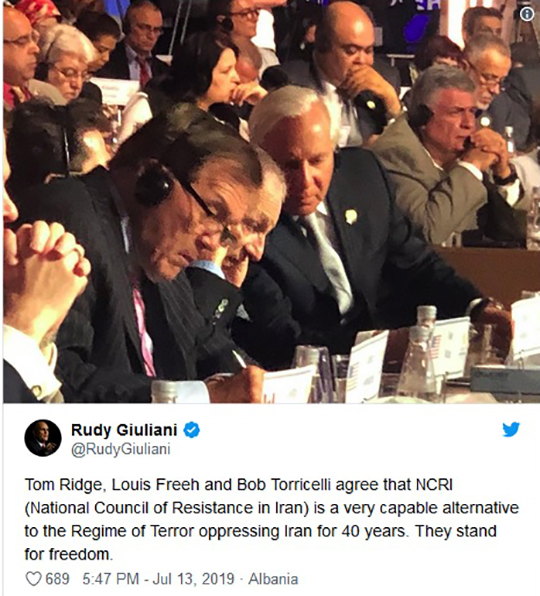
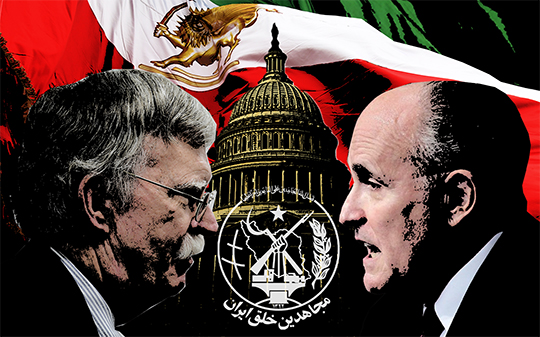
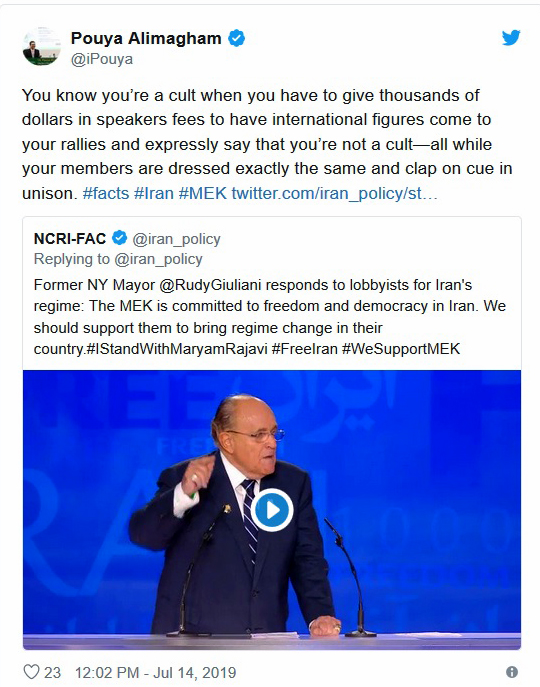
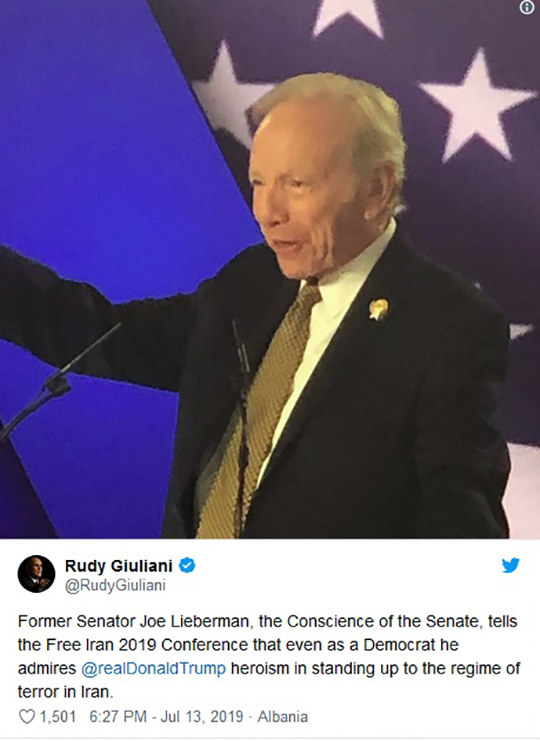
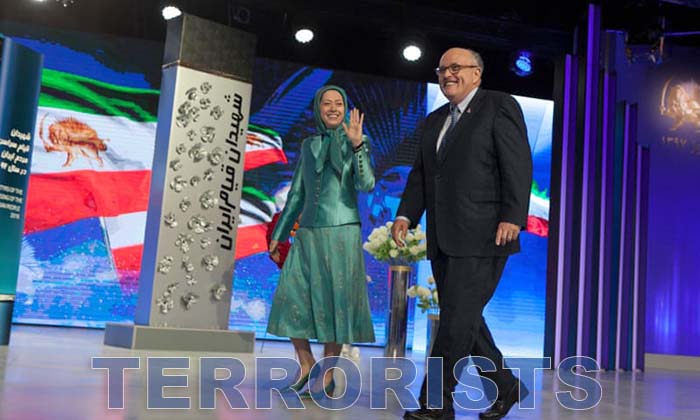
Luminaries who have spoken for the MEK include senior U.S. political figures such as Rudy Giuliani, former Homeland Security Secretary Tom Ridge, and former CIA Director Porter Goss. Their efforts eventually helped remove the group from the terrorist list. But very few have made as many speeches for the MEK as has Bolton.
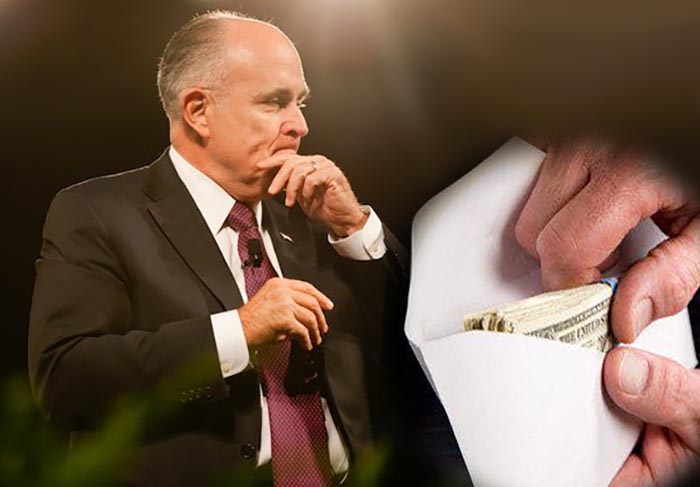
While Bolton refused to comment when asked if he was paid for his speeches, the Wall Street Journal’s Farnaz Fassihi and Seymour Hersh have accused Bolton of receiving payments. Another source, speaking to the Washington Examiner, supported these claims.
Bolton’s MEK connections may simply reflect his belief that the group serves an America-first agenda. After all, for Bolton and the MEK, the ayatollah’s fall is a shared win. But how does this play into Bolton’s advice to Trump on Iran?
It seems obvious why Trump and Bolton have clicked so well. Neither has much time for deference or protocol, both revel in speed of action, and both prioritize the pursuit of near-term U.S. interests. Will he last longer than his predecessors, H.R. McMaster and Michael Flynn? We’re about to find out.
by Tom Rogan,Washington Examiner

April 30, 2019 0 comments
FacebookTwitterPinterestWhatsappTelegramSkypeEmail
John Bolton
Mujahedin Khalq; A proxy force

Bolton haunted by MEK association

U.S. National Security Advisor John Bolton on Sunday rejected accusations by Iranian Foreign Minister Javad Zarif that he and a small cabal of Mideast hawks were pushing President Trump into a conflict with Iran. He also joked that he was having “a pretty good week” after verbal attacks by the regimes in Tehran, Pyongyang and Havana.
Bolton was speaking on Fox News Sunday about Zarif’s claim, made on the program and in several other appearances in recent days, that Bolton, Israeli Prime Minister Binyamin Netanyahu, and the crown princes of Saudi Arabia and the UAE, Mohammed bin Salman and Mohammed bin Zayed, were goading Trump to war. (Zarif dubbed the four the “B team,” based on the letter “b” in their names.)
“Foreign Minister Zarif says you’re part of the ‘B team,’” said host Chris Wallace. “A small group of leaders – you in the U.S., others in the Middle East, Bibi Netanyahu, Bin Salman, Bin Zayed – who are working to try to steer President Trump into a conflict with Iran. Your response?”
“Well, he also said in another interview he wished he were working with the ‘A team,’” began Bolton with a smile. “You know, in the past few days the North Koreans have also called me ‘dim-sighted,’ the Cubans have said I’m a ‘pathological liar.’ I’d say I’ve had a pretty good week.”
(North Korea’s foreign minister last weekend called Bolton “dim-sighted” for saying in an interview Pyongyang needs to give a “real indication” of its readiness to give up nuclear weapons before Trump will meet with Kim Jong Un for a third summit. Days later Cuba’s foreign minister described Bolton as a “pathological liar” over allegations of Cuban troops propping up Venezuela’s Maduro regime.)
Bolton disputed that he was fomenting a conflict with the Iranian regime, saying the president’s policy on Iran, one of “maximum pressure” to compel a change of behavior, had been clear well before he joined the administration a year ago.
In his interview with Wallace, Zarif accused Bolton and the others of having “shown an interest in dragging the United States into a conflict,” and said he does not believe that is what Trump wants, having run “on a campaign promise of not bringing the United States into another war.”
Bolton described Zarif’s interview as a “carefully-prepared propaganda script” designed to “sow disinformation into the American body politic.”
Zarif also brought up Bolton’s past associations with the exiled Iranian opposition group National Council of Resistance of Iran (NCRI)/Mujahideen-e Khalq (MEK).

The group was a U.S.-designated foreign terrorist organization until delisted by the Obama State Department in 2012, citing its renunciation of violence and “the absence of confirmed acts of terrorism by the MEK for more than a decade.” It counts some high-profile Republican and Democratic figures among its supporters.

Zarif said Bolton had told the group at a rally “that he would celebrate the 40th anniversary of the Islamic revolution, in Tehran with that terrorist organization.”
(At an NCRI rally in Paris in 2017, Bolton said it should be U.S. policy to ensure that the regime in Tehran does “not last until its 40th birthday” – that is, 2019.)
Zarif said Bolton had made the same comment since becoming national security advisor.
In fact, since taking up the post, Bolton has stressed repeatedly that “regime change” in Iran is not this administration’s policy.
“You know who took the MEK off the U.S. list of foreign terrorist organizations?” Bolton said, when asked by Wallace about Zarif’s remarks. “Hillary Clinton, that well-known right-wing Republican.”
“Don’t you want to see regime change?” Wallace pressed. “Isn’t that the only way to get an Iran that isn’t a threat to the neighborhood?”
Bolton replied that the Iranian people “deserve a better government, there’s absolutely no doubt about it.”
“The trouble is, it’s not just a theological dictatorship, it’s a military dictatorship too,” he continued. “That’s a very difficult circumstance. We’ll see what happens as the economic pressure continues to grow.”

CNS News, By Patrick

April 30, 2019 0 comments
FacebookTwitterPinterestWhatsappTelegramSkypeEmail
Mujahedin Khalq; A proxy force

Spain’s Vox Party Hates Muslims—Except the Ones Who Fund It (MEK)

MEK, Iranian friends of the Far Right Spanish VOX

The upstart far-right party is unapologetically Islamophobic, but without donations from Iranian exiles, it may have never gotten off the ground.

Spain’s far-right party Vox launched its 2019 election campaign this month in the tiny town of Covadonga. Situated in a lush valley in the northern region of Asturias, with fewer than 100 inhabitants, Covadonga is sometimes referred to as the “cradle of Spain.” According to the historical narrative of Spanish conservatives, Covadonga was the site of the first victory by Christian Hispania against Spain’s then-Muslim rulers, and the start of the Reconquista, the 780-year process of reclaiming Iberian lands for Christendom.

“Europe is what it is thanks to Spain—thanks to our contribution, ever since the Middle Ages, of stopping the spread and the expanse of Islam,” Iván Espinosa de los Monteros, Vox’s vice secretary of international relations and a candidate in the April 28 elections, told Foreign Policy over the phone on his way to Covadonga. At the campaign launch, Vox leader Santiago Abascal added: “History matters, and we shouldn’t be afraid of that,” to cries of “¡Viva España!”

While Spain’s right-wing has previously been relatively light on anti-Islam rhetoric, preferring to rail against secessionists in Catalonia and elsewhere, Vox has no such compunction. One of the party’s earliest controversies was a wildly Islamophobic video conjuring a future in which Muslims had imposed sharia in southern Spain, turning the Cathedral of Córdoba back into a mosque and forcing women to cover up. Recently, Vox’s No. 2, Javier Ortega Smith, was investigated by Spanish prosecutors for hate speech after he spoke of an “Islamist invasion” that was the “enemy of Europe.”

Given Vox’s staunch Islamophobia, it was an embarrassment for the party when reports of Iranian funding emerged in January.

Vox’s racist, homophobic, and sexist policies had already provided plenty of ammunition for its critics and rival parties; the claims that Vox had been established with the help of Iranian money in 2013 was less expected. However, Vox was not actually funded by Iran itself. The reality is even more surprising.

Documents leaked to the Spanish newspaper El País show that almost 1 million euros donated to Vox between its founding in December 2013 and the European Parliament elections in May 2014 came via supporters of the National Council of Resistance of Iran (NCRI), an exiled Iranian group. The NCRI was set up in the 1980s by Mojahedin-e-Khalq (MEK) and a number of other Iranian dissidents and opposition groups. The MEK’s allies later abandoned the NCRI, making the organization functionally an alias for the MEK.

The MEK and NCRI dispute that they are synonymous, but many disagree, including Daniel Benjamin, a former coordinator for counterterrorism at the U.S. State Department, who refers to the NCRI as the MEK’s “front organization.” The MEK and NCRI also share the same leader, Maryam Rajavi. The U.S. government and a U.S. Court of Appeals decision affirm that the NCRI is an alias of the MEK, while a 2009 Rand Corp. report sponsored by the U.S. Office of the Secretary of Defense refers to the NCRI as an “MeK subsidiary.”

The MEK is billed by U.S. politicians like Rudy Giuliani and current National Security Advisor John Bolton as the legitimate opposition to the current Iranian government. But the MEK also happens to be a former Islamist-Marxist organization that was only taken off the U.S. list of terrorist organizations in 2012—raising the question of why supporters of such a group would want to back an Islamophobic, hard-right Spanish party like Vox.

In Spain, much has been made of Vox’s links to U.S. President Donald Trump’s former chief strategist Steve Bannon, who met a senior figure from the party in Washington last year, and has promised to tour Spain in the near future. But the mysterious MEK-linked funding points to another controversial relationship.

With Vox poised to win more than 10 percent of the vote in this weekend’s Spanish elections, the party could end up propping up a new right-wing government, as happened in regional elections in Spain’s southern region of Andalusia in December. It would be the first time a Spanish government has depended on a far-right party since Francisco Franco, and this would send shockwaves through Spain’s entire political system.

The question of Vox’s funding is now more burning than ever.

In 1953, a U.S.- and British-backed coup overthrew the democratically elected prime minister of Iran and propped up a monarchical dictatorship led by Shah Mohammad Reza Pahlavi. Waves of oppression followed, including scores of executions, thousands of incarcerations, and the choking of civil society. In the ensuing political vacuum, many radical groups popped up. One such group, the MEK, or People’s Mojahedin Organization of Iran, combined both Marxism and Islamism. The MEK set about fighting the Western-backed dictatorship, staging attacks against the shah’s regime and U.S. targets. The shah responded in kind, torturing and executing opposition leaders, including those of the MEK.

In the months preceding the Islamic Revolution of 1979, thousands of prisoners were set free, including Massoud Rajavi, a prominent MEK figure. Rajavi was a young, charismatic orator, who rejuvenated the organization and even met Ayatollah Ruhollah Khomeini, the revolution’s leader, hoping to secure his endorsement for the MEK. Khomeini refused. Rajavi then tried to run as a candidate in Iran’s first-ever presidential election, but confronted with Khomeini’s disapproval, he was forced to drop out. The winner of that election, Abolhassan Banisadr, was not an ally of Khomeini either. The MEK saw an opening and allied itself with Banisadr.

In 1981, Rajavi and Banisadr fled Iran together after Banisadr was impeached and removed from office with Khomeini’s blessing and MEK followers had lost deadly street battles with Khomeini loyalists that had threatened to turn into a civil war. The MEK was now an official enemy of the Islamic Republic, which was at the time fighting a bloody war with Iraq, so the MEK came to see Iraq’s Saddam Hussein as a viable ally. The MEK started helping Saddam in his war against Iran.

Since that moment, the group has been widely seen as a pariah among the Iranian public. Later, the MEK reportedly helped Saddam in his massacres of Kurds and Iraqi Shiites. As stated in the Rand report: “MEK officials strenuously deny any involvement in the atrocities against the Shia and Kurds. … However, the allegations of the group’s complicity with Saddam are corroborated by press reports that quote Maryam Rajavi encouraging MEK members to ‘take the Kurds under your tanks, and save your bullets for the Iranian Revolutionary Guards,’ as well as the timing of Saddam’s conferring the Rafedeen Medallion—a high honor in the Iraqi military—on Masoud Rajavi.” In return, Saddam gave the MEK near-unlimited funding and a stretch of land to build itself a city, about 60 miles north of Baghdad and just 50 miles away from the Iranian border.

When the U.S. invasion of Iraq in 2003 overthrew Saddam, the MEK lost its biggest ally.

The country was now ruled by parties and people the MEK had helped suppress, friends of Iran’s Islamic Republic, and a United States at the height of its global war on terrorism and which had designated the MEK as a terrorist group. What’s more, the MEK had by now morphed into something resembling a cult, according to allegations by various people who have left the group.

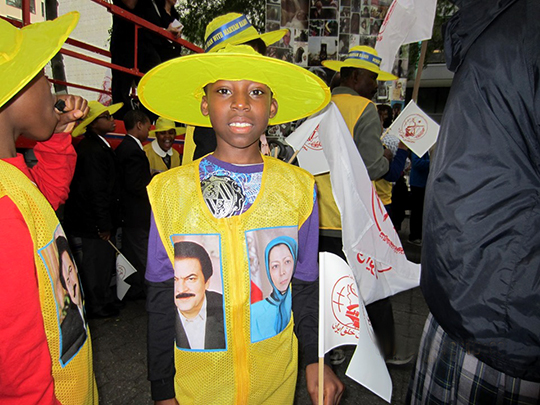
Hassan Heyrani, a former member of the MEK’s political department who defected in 2018, told Foreign Policy about group rituals and routines designed to completely subjugate the individual self, including members’ sexual lives and the slightest hint of free thinking, while forcing near-religious worship of MEK leader Massoud Rajavi. Women were made to adhere to a strict dress code. Members were obliged to record the details of their daily activities and thoughts in personal notebooks and then share them in group meetings, with the risk of public shaming and punishments, according to Heyrani. The MEK did not respond to requests for comment for this article, but its representatives have denied such claims in the past.

Despite the MEK’s metamorphosis from an opposition group to designated terrorist organization, hawks in the George W. Bush administration decided that they could use the MEK in their redrawing of the Middle East. Instead of apprehending members of the group as terrorists, during the occupation the U.S. Army was instructed to defend the MEK’s base from possible attacks by Iraqi forces, various Iraqi militias, or forces loyal to the Iranian government.

The MEK quickly seized on Washington’s change of heart. The organization started an intense lobbying campaign to have itself removed from terrorist lists in the United States and European Union. A vast and impressive range of current and former U.S. politicians and officials ended up being linked to this effort, from Giuliani and Bolton on the right to Democratic Sen. Bob Menendez and former Democratic National Committee chairman Howard Dean on the left. In Europe, the list included Alejo Vidal-Quadras, a now-retired Spanish politician, who previously served as one of the 14 vice presidents in the EU Parliament. The MEK was finally delisted by the U.S. government in 2012 and by the EU in 2009.

Spain’s Vidal-Quadras went on to help found Vox in late 2013. And supporters of the NCRI provided the funding needed to launch the right-wing party and contest the 2014 European elections, according to El País.

“From the day it was founded in December 2013—the same day that it registered as a political party with the Spanish Ministry of Interior—Vox started to receive Iranian funds,” said Joaquín Gil, one of the El País journalists who first reported on NCRI-linked funding of Vox. The donations came from dozens of individual sources, from several countries including the United States, Germany, Switzerland, Canada, and Italy in amounts ranging from 60 to 35,000 euros, totaling almost 972,000 euros, in the period from December 2013 to April 2014, shortly before the European parliamentary elections.

According to Gil, Vidal-Quadras said he had “asked his friends at NCRI … to instruct its followers to make a series of money transfers.” Vidal-Quadras told El País that he had informed the current leader of the party, Abascal, about his relationship with the organization and that the NCRI would finance the party. Vidal-Quadras has confirmed that the NCRI organized the international fundraising campaign for Vox and the group was willing to discuss the matter with Spanish journalists. “We knew that it was a new party, but not a far-right one,” a spokesperson for the NCRI told El País.

This money would be fundamental to the launch of the party—without it, Gil suggested, Vox wouldn’t exist. But the NCRI had already achieved the goal of having the MEK removed from the EU terrorist list years earlier, so why did its supporters agree to fund a fringe Spanish party? “It’s totally surreal,” Gil admitted.

When asked about the party’s links to the NCRI, Espinosa, the Vox vice secretary of international relations, told Foreign Policy: “We don’t have any relationship with them.” The funding of Vox by the NCRI came out of a “personal relationship” with Vidal-Quadras, who had supported the Iranian organization throughout his stint in the EU Parliament until 2014, when he lost his race to win a seat as part of the newly founded Vox. (Vidal-Quadras had previously been a lifetime member of Spain’s conservative People’s Party, or PP.) “They supported him,” Espinosa claimed. “Not the party so much as him. And when he left,” Espinosa added, “when the campaign was over, they never came back.” Like the NCRI and MEK, Vidal-Quadras did not respond to multiple requests for comment for this article.

In December 2013, Spain’s electoral commission reminded the political parties that foreigners were not allowed to finance parties during the 2014 European elections campaign. Spain’s electoral law prohibits parties from receiving money from foreign entities or individuals 54 days before elections, although foreign funding is permitted outside of the campaign period.

While there is no evidence that Vox has broken Spanish or EU funding rules, Espinosa clearly had no qualms about accepting foreign funding:

“I try to get as much funding from abroad as I can—not to say that it’s significant, but I’d be lying if I told you nobody from abroad [had made donations].”

Espinosa, who was part of Vox’s European parliamentary candidates list in 2014 alongside Vidal-Quadras (Vox narrowly missed winning a seat), went on to emphasize that the noncampaign funding was entirely legal, transparent, and came through verified bank wires by “professionals—lawyers, bankers, dentists, doctors who live abroad.” Other parties remain suspicious.

Spain’s ruling Socialist Workers’ Party (PSOE), currently in a minority in the Senate, has asked the Senate’s majority party, the PP, to request that Vox appear in front of the Commission of Investigation for Funding of Parties. The conservative PP, which would likely need Vox’s support to have any chance of forming a right-wing coalition government after the election, has expressed concerns about Vox’s funding but has stopped short of a Senate investigation, instead urging Spain’s Court of Auditors to investigate Vox. Espinosa told Foreign Policy that the party has presented all the related documents to the Court of Auditors.

Espinosa also insisted that Vox’s funding had never come from “foundations, organizations, parties”—only individuals. But while the donations to Vox technically came from followers of the MEK rather than directly from the organization, the distinction between “members,” as in those actually part of the MEK, and so-called “supporters” outside the organization itself is false, claimed Heyrani. “Those in other countries are also members. They have daily schedules. There are circles led by MEK offices in each country, and they act upon their orders,” he said. NCRI and MEK representatives have not responded to requests from Foreign Policy for comment on this allegation.

The MEK may have just been returning the favor to a long ally, Vidal-Quadras, who has been supportive of the MEK for years. But as one former member of the MEK executive committee told Foreign Policy, the financial resources the group gained under Saddam Hussein have likely run out—which suggests that it may have another source of funding today.

“Mojahedin [MEK] are the tool, not the funders. They aren’t that big. They facilitate,” said Massoud Khodabandeh, who once served in the MEK’s security department; Khodabandeh defected in 1996, a year before the MEK was designated by the U.S. State Department as a terrorist organization. “You look at it and say, ‘Oh, Mojahedin are funding [Vox].’ No, they are not. The ones that are funding that party are funding Mojahedin as well.”

Khodabandeh said he himself was involved in moving money for the MEK and its funders during the reign of Saddam Hussein. “I went to Riyadh and recovered three trucks of gold bars from agents of [the] Saudi intelligence agency [at that time] led by Prince Turki bin Faisal. We transferred them to Baghdad and then to Jordan. We sold the bars in Jordan,” he claimed.

Khodabandeh’s account raises the question of where the MEK’s money is coming from today. Heyrani, the recent MEK defector, also handled parts of the organization’s finances in Iraq and was blunt when asked about the current financial backing of the MEK: “Saudi Arabia. Without a doubt,” he said. Once the MEK was given a safe haven in Albania after U.S. withdrawal from Iraq, with no U.S. Army to defend the group’s camp and the Iraqi government wanting them gone, one of the ranking members of the political department told Heyrani that Saudi Prince Turki bin Faisal Al Saud had finally laid a “golden egg.”

The so-called egg was the massive installation, or camp, based just outside Tirana, Albania, which has been used by the MEK as its base of operations since 2016. “Habib Rezaei [a top-ranking member] told me that we will bring some U.S. senators to parade in front of Albanians so that they know who they’re dealing with,” Heyrani said. (In August 2017, Republican Sens. Roy Blunt, John Cornyn, and Thom Tillis visited the MEK in Albania and met with Maryam Rajavi.)

Saudi Arabia’s state-run television channels have given friendly coverage to the MEK, and Prince Turki al-Faisal, Saudi Arabia’s former intelligence chief, even appeared in July 2016 at an MEK rally in Paris.

“I want to topple the regime too,” the prince said, to cheers. It has also been widely reported that the MEK has collaborated with Israel’s Mossad, including in attacks against Iranian nuclear scientists, according to U.S. officials. The MEK has called the allegations of their role in assassinating Iranian nuclear scientists “patently false.”

There is evidence that Gulf leaders, fearful of Iranian influence and Islamist movements at home, are warming to anti-Islam parties in Europe, as Ola Salem and Hassan Hassan have argued in Foreign Policy. Khodabandeh agreed. “It’s all over Europe,” he said. “Far-right, anti-EU parties have support that comes from lots of places. … There is outside backing. This backing is the same as [those backing] MEK.”

Experts in the United States have reached similar conclusions about the source of the MEK’s funds. “Group supporters claimed the money came from the contributions of ordinary Iranians in exile, but the sums seemed far too great,” wrote Benjamin, the former State Department counterterrorism official, who added that some believed Arab governments of the Persian Gulf to be behind the MEK “lucre,” as he put it.

Even so, a fringe party in Spain just getting off the ground does not seem to be a natural destination for supporters of an organization dedicated to overthrowing the Iranian government, much less a party whose ideology was not known to the NCRI and MEK at the time of those donations, according to an NCRI spokesperson quoted in the El País report. Moreover, Spain’s governments and its royal family have long enjoyed amicable relations with the Gulf monarchies, reducing the likelihood of these governments wanting to prop up an extremist far-right party in Spain.

Ultimately, the revelations by El País about MEK-linked funding being used to establish Vox leave more questions than answers. As Benjamin wrote in 2016, the removal of the MEK from the list of foreign terrorist organizations ended “any hope of gathering more information from MEK proponents on their financial relations with the group, or where all that money came from.”

Renowned enemies of the Iranian government may have been happy to see their funding reach a European supporter of the MEK, given that the organization has been promoted internationally by some as the legitimate Iranian opposition-in-exile, but either these alleged financial backers didn’t realize their cash would ultimately be used to fund a far-right party—or they didn’t care.

Sohail Jannessari is a doctoral candidate in political science at Barcelona’s Pompeu Fabra University and a contributor to BBC Persian TV and other Persian-language media. Twitter: @SoJannessari

Darren Loucaides is a British writer who covers politics, populism, and identity. Twitter: @DarrenLoucaides

Sohail Jannessar, Darren Loucaides, Foreign Policy

April 29, 2019 0 comments
FacebookTwitterPinterestWhatsappTelegramSkypeEmail
Mujahedin Khalq; A proxy force

Iranian “Khalq” for MEK, Pompeo and Bolton

More good news for the Mujahedin Khalq Organization (the MKO/ MEK/ PMOI/ the Cult of Rajavi): “The Trump administration will sharply accelerate its goal of driving Iran’s oil exports to zero, ending sanctions exemptions that it previously granted to some of the Islamic Republic’s biggest customers.” [1]
The “maximum pressure” campaign by the White House, Treasury Department, and State Department is welcome by the Mujahedin Khalq Organization who claim to be holly warriors for the Iranian people.( Khalq is the Arabic term for people)
This is while the group’s most prominent American supporter John Bolton bluntly admits that the sanctions against Iran “only hurts the Iranian people”. He posted on his tweeter account on April 22nd after Secretary Pompeo announced that the United States would force China, India, Japan, South Korea, and Turkey to cease all imports of Iranian oil or face severe U.S. sanctions. “The Iranian regime should understand that it must change its behavior now or continue to pay the cost for its destabilizing behavior, which only hurts the Iranian people”, Bolton tweeted.

But, the MEK’s propaganda figure, Maryam Rajavi once more teams up her cult-like violent group with the Iranian people claiming that the Iranian people welcome such detrimental sanctions against their life, well-being and health. “The Iranian people and Resistance have been demanding the imposition of an oil and arms embargo on the mullahs’ anti-human, anti-Iranian regime since 4 decades”, she tweets.

The MEK’s false claims had been also denounced in a closed-door meeting with Iranian-American community leaders last Monday when Pompeo was asked how he could guarantee that the Trump administration’s tough new sanctions wouldn’t hurt the people of Iran, he replied:”There are no guarantees.”Pompeo implied that the Iranian people are not separated from the Iranian government. [2]
Besides, the meeting had bad news for the MKO. “Pompeo also distanced the administration from the People’s Mujahedin of Iran, or MEK (Mujahedin-e Khalq), an anti-regime group that the U.S. once designated as a foreign terrorist organization,” Axios reported. “ Several people in the room told Pompeo they worried about what message it sent for close Trump allies — National Security Adviser John Bolton and Trump’s personal lawyer Rudy Giuliani among them — to appear friendly with the MEK, whom some in the room described as worse than the current regime.” [3]
And this was the secretary’s response:”Ambassador Bolton spoke at an MEK rally. President Trump and I have not.”
“He acknowledged that John Bolton and Rudy Giuliani had connections or ties, whatever you want to call it … with the MEK, but he did say that he and the president did not,”Texas attorney Michael Payma –another person who was in the room– told Axios. [4]
Furthermore, whether the MEK is embraced by the US administration or not, one thing is for sure. The MEK is not the representative of the Iranian “Khalq” but it is against the khalq. It is always supporting the most hostile policies and actions against Iranian nation.
During the 1980s, the MEK formed “Saddam’s private army” and fought against its countrymen in the eight years of Iran-Iraq war. Following the collapse of the Iraqi dictator, it turned into the henchmen of the Israeli and US intelligence. The MEK agents were Mossad’s operational arms to assassinate the Iranian nuclear scientists in the 2000s. And, today the MEK is in all fronts against the Iranian people, no matter the enemies of Iran want it or not.
Mazda Parsi
[1] DiChristopher, Tom, Trump aims to drive Iran’s oil exports to zero by ending sanctions waivers, CNBC, April 22nd, 2019.
[2] Swan, Jonathan, Scoop: Trump administration opposes military intervention in Iran, AXIOS, April 22nd, 2019.
[3] ibid
[4] ibid

April 28, 2019 0 comments
FacebookTwitterPinterestWhatsappTelegramSkypeEmail
Rudy Giuliani
Mujahedin Khalq; A proxy force

Trump’s Strange, Tense Campaign Against Iran

At the 2017 U.N. General Assembly, President Trump asked French President Emmanuel Macron to relay a private message to Iranian President Hassan Rouhani. Trump wanted to meet, in secret, with the Iranian leader, according to Western and Iranian officials. Macron called Rouhani and asked if he was interested. The Iranian leader and members of his delegation were astonished. Trump had just given a blistering speech in front of more than a hundred world leaders declaring that Iran was a corrupt dictatorship whose leaders had turned a wealthy country “into an economically depleted rogue state whose chief exports are violence, bloodshed, and chaos.” He had called on “the entire world to join us in demanding that Iran’s government end its pursuit of death and destruction.” From the U.N. pulpit, Trump warned Tehran’s revolutionary leaders, “Oppressive regimes cannot endure forever.” Rouhani rebuffed the overture. He told Macron that he had had enough problems at home after taking a telephone call from President Obama, in 2013—and Obama hadn’t publicly insulted him. “We said, ‘Are you joking?’” the foreign minister, Mohammad Javad Zarif, told me.

A year later, the three leaders were again at the United Nations. At the end of his meeting with Trump, Macron said that he was scheduled to see Rouhani later that day. Did Trump want him to relay another message? “No,” Trump reportedly replied. “They have to suffer more first.”

In the past month, the Trump Administration has been “dramatically accelerating”—in the words of the Secretary of State, Mike Pompeo—its efforts to inflict more pain on Iran. On April 8th, in an unprecedented step, Trump designated Iran’s Revolutionary Guards a terrorist organization. No leader of any nation has ever designated another country’s standing Army as a terrorist organization—not even George W. Bush before the invasion of Saddam Hussein’s Iraq, in 2003. The move was all the more striking because the United States and Iran are not at war—yet.

Iran’s parliament responded in kind, passing legislation that designated the U.S. Central Command—or centcom, the military branch that runs operations in the Middle East and South Asia—as a terrorist organization. In a show of support, Iranian legislators also wore uniforms of the Revolutionary Guard into parliament.

This week, the Administration extended its “maximum pressure” campaign against Iran. The White House announced that it would sanction any country or company—even longtime allies—that buys Iranian oil. The five largest importers of Iranian oil are China, India, Japan, South Korea, and Turkey. In the past, Washington has granted waivers as long as imports from Iran at least decreased. No longer. The U.S. goal is to eliminate all Iranian oil sales, a move designed to cripple the country economically. Since Trump announced that he would re-impose sanctions, last May, Iran has lost at least ten billion dollars—around thirty million dollars a day—in oil revenues, the State Department claimed this week. No past punitive U.S. or international sanctions—applied during the 1979-1982 hostage crisis, the eight-year Iran-Iraq War, or by the U.N. between 2006 and 2016—totally cut off Iran’s exports.

“We will continue to apply maximum pressure on the Iranian regime until its leaders change their destructive behavior, respect the rights of the Iranian people, and return to the negotiating table,” Pompeo said, on Monday. Trump, who last year abandoned the 2015 nuclear deal brokered by six major powers, has demanded that Tehran negotiate a new and bigger pact that also covers Iran’s missiles, support for extremist movements, intervention in the Middle East, and human-rights abuses.

On Wednesday, Iran dismissed the U.S. threat but expressed concern that escalating tensions could trigger a military confrontation. “President Trump believes that by pushing us, by imposing economic pressure on us, we will sell our dignity. Not gonna happen,” Zarif said, at the Asia Society, in New York, on Wednesday. “We don’t look at history in terms of two-, four-, and six-year terms as usually people do over there—the members of Congress or in the Administration or in the Senate. We look at history in millennia. And our dignity is not up for sale.”

The matching terrorist designations by both countries have fuelled speculation in Washington’s foreign-policy community, and among elected officials of both parties, about intentional or accidental military conflict. Last month, Senator Richard Durbin, of Illinois, and Senator Tom Udall, of New Mexico, warned in a Washington Post op-ed of the similarities between the U.S. language against Iran today and the rhetoric about Iraq under Saddam Hussein.
“Sixteen years after the U.S. invasion of Iraq, we are again barrelling toward another unnecessary conflict in the Middle East based on faulty and misleading logic,” they wrote. “The Trump administration’s Iran policy, built on the ashes of the failed Iraq strategy, is pushing us to take military action aimed at regime change in Tehran. We must not repeat the mistakes of the past, and Congress must act urgently to ensure that.”

In New York, on Wednesday, Zarif said that he did not believe President Trump wants a war with Iran, but said that others in the Administration—as well as countries with influence at the White House—did. “It is not a crisis yet, but it is a dangerous situation. Accidents, plotted accidents, are possible,” Zarif said. “The plot is to push Iran into taking action. And then use that.” He charged that “the B-Team,” after their initials—the national-security adviser, John Bolton; the Israeli Prime Minister, Benjamin Netanyahu; the Saudi crownprince, Mohammed bin Salman; and the U.A.E. crown prince, Mohammed bin Zayed—wanted some kind of military showdown between the United States and Iran. “I wouldn’t discount the B-team plotting an accident anywhere in the region, particularly as we get closer to the [2020 U.S.] election,” Zarif said. “The B-Team wants regime change at the very least. They want the disintegration of Iran, as their objective.”

Zarif’s comments underscored a widely held view among diplomats and analysts in Washington that Trump, Bolton, and Pompeo ultimately differ in their goals on Iran—and on how far they are willing to go to achieve them. The President campaigned against another war in the region—citing the trillions of dollars spent in the lengthy wars in Iraq and Afghanistan. Senior Western diplomats who are engaged with the White House believe that, despite his inflammatory language, the President still does not want to deploy troops to fight Iran. Shortly after Bolton was appointed last year, a Western envoy recalled hearing Trump say to him, with teasing seriousness, “You’re not going to bring me into a war, are you?“ The President also said publicly that he was willing to meet Iran’s Supreme Leader, Ayatollah Ali Khamenei.

Bolton, however, has long advocated regime change—and the use of military force to achieve it. In 2015, he wrote an op-ed in the Times titled “To Stop Iran’s Bomb, Bomb Iran.” “The inconvenient truth is that only military action like Israel’s 1981 attack on Saddam Hussein’s Osirak reactor in Iraq or its 2007 destruction of a Syrian reactor, designed and built by North Korea, can accomplish what is required,” he wrote. “Time is terribly short, but a strike can still succeed.” (Iran was actually then well into negotiations with the six major powers about the nuclear deal that was signed three months later.)

Before going to the White House, Bolton was also a longtime supporter of the Mujahideen-e-Khalq (M.E.K.), or People’s Warriors, an exiled group that advocates overthrowing the Iranian government. The M.E.K. was on the U.S. list of terrorist organizations until 2012 and was long allied with Saddam Hussein. Bolton was a keynote speaker at its annual conference, in Paris, for eight years. At its 2017 annual conference, he vowed that their rally on the fortieth anniversary of the revolution, this past February, would be held in Tehran.

Pompeo also called for regime change when he was in Congress, representing Kansas. Since becoming Secretary of State, he has claimed that the Administration is instead seeking to change the regime’s “behavior.” But, last May, he outlined a list of twelve demands for Iran so sweeping that they were widely perceived as a call for regime change. At a closed-door meeting with a group of Iranian-Americans in Dallas, last week, Pompeo reportedly said, “Our best interest is a non-revolutionary set of leaders leading Iran.” Yet he also said,this week, that the United States does not support the M.E.K.

Iran’s reciprocal threats have escalated the risks of confrontation. After the United States issued its global ban on importing Iranian oil, Tehran threatened to close the Strait of Hormuz, through which up to thirty per cent of seaborne global oil trade flows. Zarif vowed that Iran would flout the U.S. ban on oil sales. “We will continue to use the Strait of Hormuz as a safe transit passage for the sale of our oil,” Zarif said, on Wednesday. “But if the United States takes the crazy measure of trying to prevent us from doing that, then it should be prepared for the consequences.”

In his speech at the Asia Society, Zarif did hold out one possibility for talks with the United States. For the first time, he offered publicly to arrange a swap of American and Iranian prisoners held in each country’s jails. There are at least six Americans, dual-nationals or U.S. permanent residents, imprisoned in Iran, with another two out on bail. Iran has not said how many of its citizens are being held in U.S. prisons, but a review of publicized cases indicates that there may be more than a dozen Iranians or dual-nationals charged, indicted, or convicted. Iran made the offer privately last year. But the Trump Administration had not shown an interest in pursuing it until recently, and only after pressure from families of detainees, according to U.S. sources familiar with the overture.

“I put this offer on the table publicly now,” Zarif said. “Exchange them. All these people that are in prison inside the United States, on extradition requests from the United States, we believe their charges are phony. The United States believes the charges against these people in Iran are phony. Why? Let’s not discuss that. Let’s have an exchange. I’m ready to do it. And I have authority to do it. We informed the government of the United States six months ago that we are ready. Not a response yet.”

Under the Trump Administration, the prospects of dialogue with the Islamic Republic on detainees, diplomatic détente, or any other subject seems more remote than ever—and the risk of escalating tensions is ever higher.

Robin Wright has been a contributing writer to The New Yorker since 1988. She is the author of “Rock the Casbah: Rage and Rebellion Across the Islamic World.”
Robin Wright, The New Yorker

April 27, 2019 0 comments
FacebookTwitterPinterestWhatsappTelegramSkypeEmail
Arrest
IranMujahedin Khalq Organization as a terrorist group

Sixty MKO members nabbed last year in single province

An Iranian intelligence official said the security forces in the northwestern province of East Azarbaijan arrested 60 elements that had links with the terrorist Mojahedin-e Khalq Organization (MKO) last year.

Head of the Intelligence Ministry’s office in East Azarbaijan province said the intelligence forces have arrested a number of spies and infiltrators in the provincial organizations.

He also noted that the MKO terrorist group intensified its efforts in the previous year to take advantage of the economic woes in Iran, adding that 60 elements affiliated with the MKO’s leading members have been arrested.

The detainees had plans to acquire arms and carry out terrorist operations, he added.

The MKO or MEK – listed as a terrorist organization by much of the international community – fled Iran in 1986 for Iraq and was given a camp by former Iraqi dictator Saddam Hussein.

They fought on the side of Saddam during the Iraqi imposed war on Iran (1980-88). They were also involved in the bloody repression of Shiite Muslims in southern Iraq in 1991 and the massacre of Iraqi Kurds.

The notorious group is also responsible for killing thousands of Iranian civilians and officials after the victory of the Islamic revolution in 1979.

More than 17,000 Iranians, many of them civilians, have been killed at the hands of the MKO in different acts of terrorism including bombings in public places, and targeted killings.

April 27, 2019 0 comments
FacebookTwitterPinterestWhatsappTelegramSkypeEmail
USA

US admin not backing MEK Terrorists

President Donald Trump moves to cut off Iran oil exports; decision could roil markets

WASHINGTON – Seeking to cut off Iran’s top source of income, the Trump administration announced Monday it would sanction any country, including U.S. allies, that imports Iranian oil, a move that quickly roiled global energy markets.

“The goal remains simple: to deprive the outlaw regime of the funds it has used to destabilize the Middle East for decades,”Secretary of State Mike Pompeo said Monday.

Pompeo said the sanctions will take effect May 2 and won’t include exemptions for close American partners, such as Japan and India. The move drew immediate backlash from China and could escalate tensions with Beijing as the United States and China are engaged in delicate trade negotiations.

Geng Shuang, a spokesman for China’s Foreign Ministry, accused the United States of going beyond its jurisdiction and said all of China’s dealings with Iran are legitimate and transparent. China is one of the largest buyers of Iranian oil.

“China opposes the unilateral sanctions and so-called ‘long-arm jurisdictions’ imposed by the U.S.,”Geng said in Beijing.

Turkish Foreign Minister Mevlut Cavusoglu slammed the United States for what he said was meddling in Turkey’s ability to conduct business with its neighbors.

Monday’s decision could fuel perceptions that the Trump administration’s aim is to bring about regime change in Iran.

Sunday, Axios reported that Pompeo privately told a group of Iranian Americans that the United States would not conduct”a military exercise inside Iran”to bring about regime change.

Monday, Pompeo offered an ambiguous response when asked about that.”We’re happy to get the outcome however we can achieve it,”he said.”If Americans are attacked, we will respond in a serious way.”

He said the Trump administration is not directly backing a controversial exiled Iranian opposition group known as MEK, for the Mujahedin-e-Khalq, though prominent Trump allies, including the president’s lawyer Rudy Giuliani, have spoken at the group’s events.

“We’re supporting the Iranian people, not any particular group,”Pompeo said Monday.

Pompeo said the oil sanctions would reduce Iran’s ability to fund terror groups and spread its influence across the Middle East. He said up to 40% of the regime’s revenue comes from oil.

He said the administration worked with Saudi Arabia and the United Arab Emirates to ensure “market stability” and try to stave off a spike in oil prices. The White House said in a statement that Saudi Arabia, the United Arab Emirates, other allies and the United States itself would increase oil production and”are committed to ensuring that global oil markets remain adequately supplied.”

“We have agreed to take timely action to assure that global demand is met as all Iranian oil is removed from the market,”the White House statement said.

Oil prices spiked to a six-month high Monday before the administration’s announcement.

Crude oil futures closed at $65.70, according to the Chicago Mercantile Exchange, an increase of about 2.7%.

Republicans in Congress welcomed the administration’s decision.

“The Trump Administration pushback against the Iranian regime has been effective and will pay dividends over time,”Sen. Lindsey Graham, R-S.C., said in a tweet.”This is the clearest signal yet that if you do business with the Iranian regime you will NOT do business with America.”

Monday’s announcement is part of the administration’s “maximum pressure” strategy to isolate Iran’s regime and strangle its economy. That campaign included withdrawing from an agreement intended to get Iran to give up its nuclear program.

The administration first slapped sanctions on Iran’s oil sector in November and launched an intense campaign to pressure other countries to stop importing Iran’s oil. The State Department granted waivers to eight countries – including U.S. allies such as South Korea, Japan and India – from the sanctions. The waiver list also included China and Turkey.

Officials said that was designed to allow those countries time to reorient their oil industry to new suppliers. Pompeo said that grace period would end May 2.
David Jackson and Deirdre Shesgreen USA TODAY

April 24, 2019 0 comments
FacebookTwitterPinterestWhatsappTelegramSkypeEmail
Missions of Nejat Society

The great gathering of Nejat families

Families gathered together at the invitation of Nejat Society office of Tehran branch and the “Mothers, Forgotten Victims” association on the occasion of New Iranian year.
Mr. Ebrahim Khodabande welcomed the families. The executive director of Nejat Society defined the establishment of “Mothers, Forgotten Victims” association. He also outlined the agendas of the Nejat Society for the New Year.
Ms. Soraya Abdollahi whose son is captivated by the cult of MKO and Mr. Bakhshali alizade – former member of the cult answered the families’ questions and defined the situation of MKO members in Albania.

Nejat Society meeting - Tehran

April 23, 2019 0 comments
FacebookTwitterPinterestWhatsappTelegramSkypeEmail
Arrest
Mujahedin Khalq; A proxy force

Iran dismantles CIA backed MEK cells

Iran’s intelligence forces have managed to discover a CIA’s espionage network in the country and in the region, said Intelligence Minister Mahmoud Alavi on Friday.
“In a complicated process against the US Central Intelligence Agency, its espionage network was identified with 290 spies in different countries, including Iran,” he said, adding that the information was offered to friend countries which led to arrest of CIA agents.
He made the remarks before the start of Tehran’s Friday prayers while briefing the nation about achievements of Intelligence Ministry.
The forces have also given a similar blow to UK’s MI6, he highlighted, noting that details of both these operations will be announced soon.
Alavi went on to say that dozens of spies who had been working in the country’s sensitive sections have been identified and arrested.
In the past [Iranian calendar] year 1397 (March 2018-March 2019), intelligence forces have dismantled 114 Takfiri terrorist teams, 116 circles related to MKO, 44 anti-Revolution teams, and 380 drug smuggling bands, he added.
Furthermore, the ministry has neutralized 188 operations, he noted, adding that the last of which was carried out in the south of the country, leading to the arrest of 4 individuals and seizing 15,000 Ak47 bullets.

April 22, 2019 0 comments
FacebookTwitterPinterestWhatsappTelegramSkypeEmail
Newer Posts
Older Posts

Recent Posts

  • Pregnancy was taboo in the MEK

    December 22, 2025
  • MEPs who lack awareness about the MEK’s nature

    December 20, 2025
  • Why did Massoud Rajavi enforce divorces in the MEK?

    December 15, 2025
  • Massoud Rajavi and widespread sexual abuse of female members

    December 10, 2025
  • Farman Shafabin, MEK member who committed suicide

    December 3, 2025
  • Facebook
  • Twitter
  • Instagram
  • Youtube

© 2003 - 2025 NEJAT Society . All Rights Reserved. NejatNGO.org


Back To Top
Nejat Society
  • Home
  • Articles
  • Media
    • Cartoons
    • NewsPics
    • Photo Gallery
    • Videos
  • Publications
    • Books
    • Nejat NewsLetter
    • Pars Brief
  • About Us
  • Contact us
  • Editions
    • عربي
    • فارسی
    • Shqip