Nejat Society
  • Home
  • Articles
  • Media
    • Cartoons
    • NewsPics
    • Photo Gallery
    • Videos
  • Publications
    • Books
    • Nejat NewsLetter
    • Pars Brief
  • About Us
  • Contact us
  • Editions
    • عربي
    • فارسی
    • Shqip
Nejat Society
Nejat Society
  • Home
  • Articles
  • Media
    • Cartoons
    • NewsPics
    • Photo Gallery
    • Videos
  • Publications
    • Books
    • Nejat NewsLetter
    • Pars Brief
  • About Us
  • Contact us
  • Editions
    • عربي
    • فارسی
    • Shqip
© 2003 - 2024 NEJAT Society. nejatngo.org
MEK troll farm in Albania
Mujahedin Khalq; A proxy force

MEK Trolls New US weapons against Iranians

False Identities Become the New Weapon: War with Iran Promoted by Fake Journalists

One of the claims made about alleged Russian interference in the 2016 U.S. election was that Kremlin-controlled entities were using fake identities to create dissension and confusion on social network sites. This should surprise no one, if it is true, as intelligence operatives have been using false names since Sumerian times.
The concern over fake identities no doubt comes from the deception involved, meaning that if you are dealing with a real person you at least have some handle on making as assessment of what something means and what is likely to occur. A false persona, however, can pretend to be anything and can advocate or do something without any yardstick to measure what is actually taking place. In other words, if Mike Pompeo says something you know that he is a liar and can judge his words accordingly but if it is someone otherwise unknown named Qwert Uiop you have to wonder if he or she just might be telling the truth. You might even give them the benefit of the doubt.

A prime example of a false internet persona has recently surfaced in the form of an alleged “activist” invented by the Iranian terrorist group Mojahedin e Khalq (MEK). MEK is a curious hybrid creature in any event in that it pretends to be an alternative government option for Iran even though it is despised by nearly all Iranians. At the same time, it is greatly loved by the Washington Establishment which would like to see the Mullahs deposed and replaced by something more amenable to western and Israeli worldviews.

MEK is run like a cult by its leader Maryam Rajavi, with a number of rules that restrict and control the behavior of its members. One commentary likens membership in MEK to a modern day equivalent of slavery. The group currently operates out of a secretive, heavily guarded 84 acre compound in Albania that is covertly supported by the United States, as well as through a “political wing” front office in Paris, where it refers to itself as the National Council of Resistance of Iran.

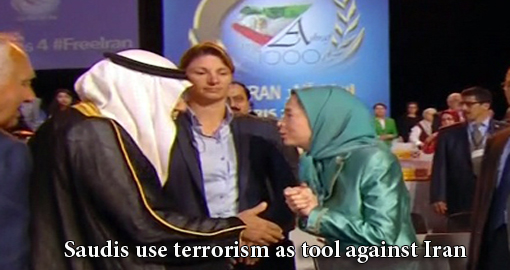
MEK, which is financially supported by Saudi Arabia, stages events in the United States in Europe where it generously pays politicians like John Bolton, Rudy Giuliani and Elaine Chao to make fifteen-minute speeches praising the organization and everything it does.

It’s paying of inside the Beltway power brokers proved so successful that it was removed from the State Department terrorist list in 2012 by Hillary Clinton even though it had killed Americans in the 1970s. MEK also finds favor in Washington because it is used by Israel as a resource for anti-Iranian terrorism acts currently, including assassinations carried out in Tehran.
MEK’s fake journalist, who has recently been exposed by The Intercept, is named Heshmat Alavi. He, or if you prefer “it,” has very successfully gained access to a considerable body of generally conservative mainstream western media, including Forbes, The Hill, the Daily Beast and The Federalist. Alavi has placed scores of articles as “an activist with a passion for human rights,” aimed at discrediting Iran and its government while also subtly praising MEK as an alternative to the current regime. His bona fides have never been questioned, even by Forbes, which placed no less than 61 articles under the name between April 2017 and April 2018.

The pieces appearing allegedly by Alavi are reportedly composed at a “troll factory” as a so-called “group account” in Albania where MEK members who belong to the organization’s “political wing” toil under tight security.

Alavi’s contribution to the damning of Iran has not been insignificant. An article written by him/it that appeared in Forbes claiming that the Mullahs had been able to increase their military budget due to having money freed up by the Joint Comprehensive Plan of Action (JCPOA) agreement. The article reached the White House and reportedly helped convince the Trump Administration to withdraw from the pact.
To supplement the Alavi propaganda effort, MEK’s Albania operation uses banks of computers manned by followers, some of whom are fluent in English, who serve as bots unleashing scores of comments supporting regime change in Iran while also directing waves of criticism against any pro-Iranian pieces that appear on social media, to include Facebook and Twitter.

By one account, more than a thousand MEK supporters manage thousands of accounts on social media simultaneously. The objective of all the chatter is to convince the mostly English-speaking audience that there is a large body of Iranians who are hostile to the regime and supportive of MEK as a replacement.

While the Iranian government and MEK might well be regarded by most Americans as a far-away problem, there was considerable shock expressed even by congress and the media when it was learned shortly before The Intercept’s revelations that the United States government had been funding a so-called Iran Disinformation Project that was employing tactics remarkably similar to those of MEK in an attempt to control the discussion over Iran policy.
The project, run by the State Department’s global engagement center, consisted of a trolling campaign which targeted online American citizens critical of the government’s Iran policy, labeling them as disloyal to the United States and tools of the Iranian government. It used, for example, the website IranDisInfo.org and the hashtag #NIACLobbies4Mullahs. Iranian-American activist and long-time State Department contractor Mariam Memarsadeghi headed the program, receiving hundreds of thousands of dollars to “relentlessly attack critics of the Iran policy on social media…accusing them of being paid operatives of the regime in Tehran.” In all, the “Iran Disinfo” operation received over $1.5 million through the Memarsadeghi contract entity the oddly named E-Collaborative for Civic Education.
The investigation of Iran Disinfo also revealed that the neoconservative Foundation for Defense of Democracies (FDD), which has been leading the charge for war with Iran, had at least one employee working with E-Collaborative. FDD, which has been advising the Trump White House on a more aggressive policy towards Iran, has also been actively involved in the State Department effort and cross-posting material from the Disinfo campaign.
FDD has long been targeting Iran. It received $3.63 million in 2017 from Bernard Marcus, co-founder of Home Depot. Marcus is a hard-core Zionist who hates Iran and once referred to that nation as “the devil.” FDD has also received billions from Las Vegas casino mega billionaire Sheldon Adelson, the GOP’s largest individual donor, who has advocated dropping a nuclear bomb on Iran to send a message. The link between major Republican donors supporting FDD and an increase in FDD quasi-overt cooperation with the Trump Administration in demonizing Iran should not surprise anyone.
Even though the State Department operation was relatively insignificant compared to similar initiatives undertaken by Israel, the idea that an ostensibly democratic government should propagate lies to defend its own policies was definitely unsettling. Some might think that disinformation on Iran is of little importance, that it has little impact on actual policy, but they would be wrong. Bad information that is allowed to circulate freely creates its own reality. Most Americans believe that Iran actually threatens the United States, though they would be at a loss to explain exactly how that could be the case. Dubious stories that originated with Reuters about corruption in Iran have been used by Mike Pompeo to justify sanctions against the regime on humanitarian grounds, measures which have ironically hurt average Iranians disproportionately. The same story was also used in at least four books to discredit the Iranian leadership.
To be sure, the mainstream media is itself largely at fault, as it was with Heshmat Alavi, for not vetting their sources more carefully, particularly when a story is clearly providing unique information or representing a point of view that might be considered controversial. In some cases, of course, the news outlet wants the story to be perceived as true even when it knows that it is not, so it becomes an accomplice in the propaganda effort. A recent attempt to create a mechanism to establish standards by determining the reliability of online news content has, in fact, been little more than a neoconservative scheme to discredit sites that do not support the neocon point of view.
Since governments and various non-governmental constituencies now, by their own admission, are heavily into the game of providing false information and discrediting critics, most Americans will completely tune out of the process, meaning that there will be little or no measurable difference between truth and lies. One already hears complaints from all across the political spectrum that most news is fake. When one reaches the point where such skepticism becomes the consensus, both elections and democracy itself will be rendered pretty much meaningless.

BY Philip Giraldi , ahtribune.com

June 19, 2019 0 comments
FacebookTwitterPinterestWhatsappTelegramSkypeEmail
Mujahedin Khalq; A proxy force

MEK B Team and the Rogue Gallery

Iran Can Be Trump’s Nemesis

What a coincidence that a leaked document from the Organization for the Prohibition of Chemical Weapons (OPCW) just exposed that the chemical weapons attack in Douma, Syria in April, 2018 was most likely staged. In security parlance, it was a false flag operation — stage-managed cunningly to create the alibi for a ‘humanitarian intervention’ by the West in Syria.
As it happened, the US and France did stage a missile strike at Syrian government targets in July that year, alleging that Damascus was culpable for what happened in Douma, ignoring the protests by Russia.
False flag operations are not uncommon, but the US holds a PhD on that genre. The most famous one in modern history was the Gulf of Tonkin incident of August 1964 where the US government deliberately misrepresented facts to justify a war against Vietnam.
Prima facie, there is enough circumstantial evidence to estimate that the attack on two tankers in the Gulf of Oman on June 13 has been a false flag operation. The attack on the two tankers with cargo heading for Japan took place just as the Japanese PM Shinzo Abe sat down for the meeting yesterday with Iran’s Supreme Leader Ayatollah Ali Khamenei in Tehran.
The fact of the matter is that Abe was on a delicate mission to try to kickstart talks between the US and Iran. It is one of those delicate moments when a slight push can derail or even undermine the nascent move for dialogue. True, in the first round, Khamenei rejected talks with the US. But, as Abe said later, more efforts are needed for easing tensions between the US and Iran.
Therefore, as regards the incident yesterday in the Gulf of Oman, the question to be asked is: Who stands to gain? Most certainly, it cannot be Iran, which has just laid on the table in plain terms what it takes for negotiations to commence between the US and Iran — President Trump abandoning what Tehran calls the US’ ‘economic terrorism’ against it. [Ayatollah]Khamenei told Abe with great frankness that it is futile to negotiate with the US, which keeps resiling from international agreements. No doubt, Trump has been highly erratic by making overtures to Iran on the one hand and tightening the screw on the other hand.
Simply put, Iran has no axe to grind by undermining Abe’s mission, especially since Japan is the only western power, which, historically speaking, never ever acted against Iran but on the contrary consistently maintained friendly ties and showed goodwill. (Once in 1953, Japan even ignored the British-American embargo against Iran and went ahead to import Iranian oil.)
However, this much cannot be said about certain regional states — which Iran has called the ‘B Team’ — that are bent on perpetuating the US-Iran standoff and incrementally degrade Iran to a point that a military confrontation ensues at some point in which American power dispatches that country to the “Stone Age”, as the present US National Security Advisor John Bolton once put it.
In this rogues’ gallery, apart from Israel, there is also Saudi Arabia and the UAE. Bolton, of course, is mentored by Israel and it is an established fact that he has received money for services rendered from the Mojahedin-e Khalq, MEK, the anti-Iran terrorist group based in France, which espouses the overthrow of the Islamic regime in Tehran.
Iran has sounded warnings in recent weeks, including at the level of Foreign Minister Javad Zarif, that this ‘B Team’ would at some point stage false flag operations to ratchet up tensions and/ or precipitate a crisis situation, that would in turn prompt Trump to order some sort of military action against Iran.
To be sure, the stakes are very high for Israel, Saudi Arabia and the UAE if Abe’s mission advances further.and the current tensions begins to ease. An added factor for the ‘B Team’ is that time is the essence of the matter. It increasingly seems that Bolton’s job as NSA is in danger. Trump has hinted more than once that he does not subscribe to Bolton’s warmongering. The well-known ex-CIA officer and commentator John Kiriakou wrote this week that the White House has “very quietly and discreetly begun informal meetings with a list of a half-dozen possible replacements for Bolton.” (See the commentary in Consortium News titled JOHN KIRIAKOU: Bolton’s Long Goodbye.) It is crucial for the ‘B Team’ that Bolton keeps his job in the White House. And there is no better way to hold back Trump from sacking his NSA when a crisis situation looms large in the Middle East.
Be that as it may, the US Secretary of State Mike Pompeo has announced that Iran is responsible for the incident in the Gulf of Oman. He claimed in a statement, “This assessment is based on intelligence, the weapons used, the level of expertise needed to execute the operation, recent similar Iranian attacks on shipping, and the fact that no proxy group operating in the area has the resources and proficiency to act with such a high degree of sophistication.”
Now, doesn’t Israel too have the intelligence capability, weapons and expertise to execute such a false flag operation? Read Pompeo’s statement carefully and its laboured tone gives away that the ex-CIA Director (who recently even bragged openly about the art of lying in diplomacy and politics) was far from convincing.
So, where’s the beef? Pompeo has instructed that the UN Ambassador Jonathan Cohen raised the matter in the UN Security Council. There is an eerie similarity to what once one of Pompeo’s predecessors as state secretary, Colin Powell did — manufacturing evidence of WMD program by Saddam Hussein to pave the way for the US to invade Iraq.
What needs to be factored in is that the US anticipates that in another fortnight, Iran’s 60-day deadline for the European countries will expire to come up with concrete steps to fulfil their commitments under the 2015 Iran nuclear deal. The German Foreign Minister Heiko Maas’s visit to Tehran last week was a calculated attempt to persuade Iran to accept the stark reality that it must unilaterally fulfil its commitments under the nuclear deal while there is little EU can do in practical terms to defy the US sanctions. Maas tried to persuade Iran to accept the US’ demand that non-nuclear issues (such as Iran’s missile programme, regional policies, etc.) also be negotiated under a new pact. Quite obviously, the European powers, despite their bravado (in words), are falling in line with Trump’s strategy of ‘maximum pressure’ against Iran.
If Iran decides to reject the idea of unilaterally observing the 2015 deal (without any reciprocal acts by the international community), the US and its western allies will want to take the matter to the UN SC to revive the UN’s past (pre-2015) sanctions against Iran. The big question is whether Russia and China would allow such a turn of events. Tehran has categorically denied any involvement in yesterday’s incident. And Iran is playing it cool. President Hassan Rouhani and Foreign Minister Javad Zarif left Tehran for Bishkek on June 13, as scheduled previously, to participate in the Shanghai Cooperation summit.
Meanwhile, the US has made an additional deployment to the region. But then, the US Central Command has also signalled to Tehran in a statement: “We have no interest in engaging in a new conflict in the Middle East. We will defend our interests, but a war with Iran is not in our strategic interest, nor in the best interest of the international community.”
At this point, the logical thing to do will be to insist on an impartial investigation by the UN SC on the incident. But, curiously, no country is willing to bell the cat. Russia, which is usually quick on demanding facts before reaching any definitive opinion on such murky situations, is also not in a hurry to demand investigation. Can it be that everyone understands that this was a false flag operation and could only be Bolton’s last waltz with Netanyahu?
Trump is walking a fine line. He has blamed Iran, but refrained from saying what he proposed to do. The fact remains that a highly dangerous situation is developing in and around the Straits of Hormuz, which is a choke point for oil tankers.
An entanglement with Iran’s Pasdaran is the last thing Trump would want as he plans to announce shortly his candidacy for the 2020 election. The situation is fraught with grave political risks, if one recalls how the Iran crisis spelt doom for Jimmy Carter’s re-election campaign in 1980.
Trump has bitten more than he could chew, as the strong rebuke Iran’s Supreme Leader Ali Khamenei administered to him underscores. Iran may turn out to be Trump’s nemesis.
By M. K. Bhadrakumar,

June 19, 2019 0 comments
FacebookTwitterPinterestWhatsappTelegramSkypeEmail
Mujahedin Khalq; A proxy force

The MEK and somebody’s money

MEK Impunity Undermining America’s Democracy

Even before its inception, the Trump administration was accused of foreign interference and repeated counter allegations that such charges are fake news. Now, even as House Democrats are squeezing whatever advantage they can from the Mueller investigation into Russian influence, a fresh allegation of foreign interference has emerged.

Heshamt Alavi

An investigation by The Intercept revealed that the White House used an article written by “Heshmat Alavi” to justify President Trump’s withdrawal from the Iran nuclear deal in 2018. After probing the propaganda element in Alavi’s other articles, former members of the Iranian Mojahedin-e Khalq (MEK) have confirmed that the group is linked to the article. According to one such former member, Hassan Heyrani, “Heshmat Alavi is a persona run by a team of people from the political wing of the MEK. This is not and has never been a real person.”
Heyrani said the fake persona has been managed by a team of MEK operatives in Albania, where the group has one of its bases, and is used to spread its message online. Heyrani’s account is echoed by Sara Zahiri, a Farsi-language researcher who focuses on the MEK. Zahiri, who has sources among Iranian government cybersecurity officials, said that Alavi is known inside Iran to be a “group account” run by a team of MEK members and that Alavi himself does not exist.
This new scandal—Heshmatgate—involves a wide political and media class that has become so besotted with an unrealistic anti-Iran agenda that it has left the door open to an unchecked, unverified flow of MEK propaganda throughout American politics and the media. Thanks to these regime-change advocates, a foreign group funded by a foreign government has easily manufactured a false narrative aimed at sending American soldiers to die in a war with Iran that is against U.S. national interests.

The MEK’s target audience is not Iran or Iranians. It barely services its Farsi language outlets. The MEK is almost universally hated by Iranians everywhere and has no credibility among them.

After 2003, the MEK’s military strategy in Iraq under benefactor Saddam Hussein gave way to an intelligence-based strategy under the patronage of Prince Turki Al Faisal, the former intelligence chief of Saudi Arabia.

The MEK is now based in Albania where, under more favourable conditions facilitated by the Trump administration, it has been allowed to build and equip a troll farm using the infamous slave labour of its hapless members. Its aim is to influence people in the English-speaking world through online activity.

The Intercept revealed just one case of MEK’s deceptive anti-Iran work. But this is the tip of the iceberg. MEK interference in the internal affairs of America goes well beyond online attacks on Iran. In 2016, the Organization of Iranian American Communities in the US—a front for the MEK—announced a “General Elections Mobilization Effort,” publicly urging its members to “fulfill their civic duty through active engagement in the 2016 general elections to help inform candidates of our communities’ policy priorities.”
In America, warmongers and regime change pundits, John Bolton and Rudi Giuliani in particular, openly support the MEK. The MEK exploits this impunity to the full.

Critics of the MEK are subjected to character assassination and defamation campaigns. Journalist Jason Rezaian writes, “These efforts actively sought to undermine our credibility about the best approach to deal with Iran and resorted to personal attacks in order to do so.”

This revelation comes at the tail end of another scandal, the Iran Disinformation Project. This project, funded by the State Department, was ostensibly launched to expose and counter Iranian government propaganda.

It paid for social media accounts to smear and discredit Iranian-American human rights activists, academics and journalists who criticize the Trump administration’s hard-line policies on Iran.

Secretary of State Mike Pompeo must answer for the actions of the State Department, but who is behind the MEK and the mysterious Heshmat Alavi? How much influence does the MEK wield in Washington? And on whose behalf?
The formula for MEK activity is “the MEK and somebody’s money.” This explains how, back in 2014 just before the European Parliament elections, “somebody’s” money was used to fund the campaign of an Islamophobic far-right party called Vox.

Investigations into electoral misconduct revealed that “at least 971,890 euros” was gifted through thousands of contributions ranging from 200 to 5,000 euros from individual MEK members and supporters. The money did not originate with the MEK, but the money laundering was facilitated through the organization by Vox co-founder Alejo Vidal-Quadras, a long-term MEK advocate while he was vice-president of the European Parliament.

In Albania, enjoying the freedom granted by such money and impunity, the MEK is playing out in microcosm what it does in North America and Western Europe. After the MEK arrived in Albania, local journalists were disturbed by its bizarre behavior and filed reports on this activity. In response, the MEK used bribery and corruption to buy publishers and a broadcaster there. They use intimidation tactics to silence journalists. One journalist confessed to me he felt afraid in his own country when the MEK, accompanied by hired armed Albanian security personnel, followed him. In a public space, they photographed him and made verbal threats, demanding that he hand over his phone on which he had earlier filmed activity outside the MEK camp gate.
MEK corruption and deception is insidious and highly dangerous. In America, neoconservatives use the MEK as tool to destroy the Democratic Party.

MEK members inside the Albanian troll farms have admitted to me that, in addition to the usual “regime change” and “nuclear” tags they use, more recent additions include the names of various U.S. political candidates and “Virginia” with a view to swaying electoral opinion in the primaries.

Since the MEK is not a benign group, it is under heavy surveillance. It would be naïve to believe that the intelligence services do not know the identity of the three individuals behind the Heshmat Alavi persona as well as the others who work in the troll farm.
Saudi money and U.S. political advocacy help the MEK exploit America’s democratic systems to expand its influence. According to The Independent, “MEK articles were picked up by US government funded Voice of America’s Persian-language service.” In 2003, I gave testimony to the UK parliament that the MEK’s cult nature was an even greater threat than its terrorist or violent behavior. The MEK regards its needs superior to any considerations of law, morality, or mortality.
Back in 2001, commentator Elizabeth Rubin warned that the MEK “is not only irrelevant to the cause of Iran’s democratic activists, but a totalitarian cult that will come back to haunt us.”
Massoud Khodabandeh is the director of Middle East Strategy Consultants and has worked long-term with the authorities in Iraq to bring about a peaceful solution to the impasse at Camp Liberty and help rescue other victims of the Mojahedin-e Khalq cult. Among other publications, he co-authored the book “The Life of Camp Ashraf: Victims of Many Masters” with his wife Anne Singleton. They also published an academic paper on the MEK’s use of the Internet.

June 18, 2019 0 comments
FacebookTwitterPinterestWhatsappTelegramSkypeEmail
Mahvash Sepehri a torturer of the MKO
Members of the MEK

Who is Mahvash Sepehri?

Mahvash Sepehri nicknamed Nasrin is one of the most high-ranking members of the Mujahedin Khalq Organization (the MKO/ MEK/ PMOI/ the Cult of Rajavi) positioned after Massoud and Maryam Rajavi in the hierarchy of the group. She was born in Sanandaj in 1956.

Mahvash Sepehri

Sepehri was assigned as the forth head of the Elite Council in 1997. This way she got in the same rank as Maryam Rajavi was. The rank was called”the orbit of the ideological leader”.
Sepehri is notoriously known by the majority of MEK members and defectors. After Massoud and Maryam, she was the first person who was authorized to hold ideological sessions in the group. Ideological meetings are routine brainwashing sessions held in the MEK in which members undergo the most severe cult jargons including self-criticism, peer pressure and even verbal and physical abuse. Thus, she has had a key role to suppress dissident members and those who were willing to leave the group.

According to the testimonies of Maryam Sanjabi, former member of the group, in the early 2000s, Sepehri personally put about two hundred members of the group on trial. She sentenced them to imprisonment and torture and in several cases delivered them to the Iraqi notorious prison, Abu Quraib. The group leaders had labeled these members as “weak circles”!

“A building with a big hall was allocated to her to hold the trial sessions for dissident members”, Sanjabi writes.

“The sessions were exhausting and unbearable. The bitter memoirs of those days will not be wiped of the minds of those people. Mahvash Sepehri ordered her servants to beat and insult the tried person, spitting on him or her and throwing chairs on him or her. “

Mahvash Sepehri was the avant-garde of promoting the culture of violence and insult inside the MEK. She has also been a significant figure to coerce the women of the Elite Council of the group.

“Mahvash Sepehri officially declared in the meetings of the Elite Council that any woman who wanted to leave the establishment, would be slaughtered,” Sanjabi recalls. “Leaving the Elite Council was equal to death. That proper person had to swallow her cyanide capsule before leaving the group.”

Hamed Sarrafpour who defected the group after the collapse of Saddam Hussein and the disarmament of the group, recalls a conference at Camp Ashraf after the disappearance of Massoud Rajavi following the fall of his master Saddam. The MEK members in the conference were addressed by Massoud via phone call. He tried to introduce Sepehri as a role model for every Mujahed.

“Massoud described Mahvash Sepehri as a member who has totally denied her individuality,” Sarrafpour writes. “Then she was introduced by Maryam Rajavi as the head of the Elite Council! She seemed to be qualified for the position.”

Mahvash Sepehri could reach the unattainable position that was at the same level of the leadership just because she was perfectly radicalized by the leaders. Sanjabi believes that Sepehri was simply radicalized and turned into a zealous devotee of Massoud Rajavi because she had never been a knowledgeable person in politics or even in military issues. Her brain was shallow enough to receive any cult-like training by Massoud and Maryam Rajavi. She easily turned into the torturer of the MEK. “A large number of former members of the MEK who survived the group’s jail in Iraq, remember her as their head torturer,” Sanjabi states.

June 17, 2019 0 comments
FacebookTwitterPinterestWhatsappTelegramSkypeEmail
Aljazeera on Heshamt Alavi
Mujahedin Khalq; A proxy force

Iran disinformation & the curious case of Heshmat Alavi

US-Iran debates: Fake writers and state-funded trolling | The Listening Post

On The Listening Post this week: Taxpayer-funded smears and a well-published but fake activist – worrying twists in the US-Iran online battle. Plus, the YouTube influencers of the Algerian protests.

https://dlb.nejatngo.org/Media/Report/Aljazeera_Alavi_MEK.mp4

As the Trump administration continues with its hawkish talk on Iran, we need to look at how that story is being crafted and by whom: Heshmat Alavi was once cited by the White House as a credible commentator on Iran. Shame he doesn’t exist.
It turns out he is a fictional persona reportedly created by the Mujahedin-e-Khalq (MEK), a shadowy group opposed to the Iranian government and supported by Washington.
Then there is the Iran Disinformation Project funded entirely by the American taxpayer, ostensibly to counter Iranian propaganda, it trolls and sometimes smears Iranian-American commentators and journalists online.

Contributors
Negar Mortazavi – consultant editor, The Independent
Maral Karimi – author, The Iranian Green Movement of 2009
Trita Parsi – founder, National Iranian American Council
Tara Sepehri Far – Iran researcher, Human Rights Watch

June 16, 2019 0 comments
FacebookTwitterPinterestWhatsappTelegramSkypeEmail
MEK troll farm in Albania
Mujahedin Khalq; A proxy force

Disinfo troll farms reason to Doubt US VER of Gulf-of-Oman Incident

7 Reasons to Doubt US Version of Gulf-of-Oman Incident

Given Pompeo’s regime-change agenda for Iran, Caitlin Johnstone pours cold water over his version of events.
In a move that surprised exactly zero people, Secretary of State Mike Pompeo has wasted no time scrambling to blame Iran for damage done to two sea vessels in the Gulf of Oman on Thursday, citing exactly zero evidence.

“This assessment is based on intelligence, the weapons used, the level of expertise needed to execute the operation, recent similar Iranian attacks on shipping, and the fact that no proxy group operating in the area has the resources and proficiency to act with such a high-degree of sophistication,” Pompeo told the press in a statement.

“The United States will defend its forces, interests, and stand with our partners and allies to safeguard global commerce and regional stability. And we call upon all nations threatened by Iran’s provocative acts to join us in that endeavor,” Pompeo concluded before hastily shambling off, taking exactly zero questions.
Here are seven reasons to be extremely skeptical of everything Pompeo said:
No. 1: Pompeo is a known liar, especially when it comes to Iran.
Pompeo has a well-established history of circulating blatant lies about Iran. He recently told an audience at Texas A&M University that when he was leading the CIA, “We lied, we cheated, we stole. We had entire training courses.”
No. 2: The US empire is known to use lies and false flags to start wars.
The U.S.-centralized power alliance has an extensive and well-documented history of advancing preexisting military agendas using lies, false flags and psyops to make targeted governments appear to be the aggressors. This is such a well-established pattern that “Gulf of Tonkin” briefly trended on Twitter after the Gulf of Oman incident. Any number of government agencies could have been involved from any number of the nations in this alliance, including the U.S., the U.K., Saudi Arabia, the UAE or Israel.
No. 3: John Bolton has openly endorsed lying to advance military agendas.
I wrote an article about this last month because the Trump administration had already begun rapidly escalating against Iran in ways that happen to align perfectly with the longtime agendas of Trump’s psychopathic Iran hawk National security adviser. At that time people were so aware of the possibility that Bolton might involve himself in staging yet another Middle Eastern war based on lies that The Onion was already spoofing it.
On a December 2010 episode of Fox News’ “Freedom Watch,” Bolton and the show’s host Andrew Napolitano were debating about recent WikiLeaks publications, and naturally the subject of government secrecy came up.
“Now I want to make the case for secrecy in government when it comes to the conduct of national security affairs, and possibly for deception where that’s appropriate,” Bolton said. “You know Winston Churchill said during World War Two that in wartime truth is so important it should be surrounded by a bodyguard of lies.”
“Do you really believe that?” asked an incredulous Napolitano.
“Absolutely,” Bolton replied.
“You would lie in order to preserve the truth?”
“If I had to say something I knew was false to protect American national security, I would do it,” Bolton answered.

John Bolton – defender of Zion, promoter of MEK terrorism – fees revealed

This would be the same John Bolton who has been paid exorbitant speaking fees by the pro-regime change MEK terror cult, promising the cult in a 2017 speech that they’d be celebrating regime change in Tehran together before 2019. This would also be the same John Bolton who once threatened to murder an OPCW official’s children if he didn’t stop getting in the way of his Iraq war agenda.

No. 4: Using false flags to start a war with Iran is already an established idea in the DC swamp.

Back in 2012 at a forum for the Washington Institute of Near East Policy think tank, the group’s Director of Research Patrick Clawson openly talked about the possibility of using a false flag to provoke a war with Iran, citing the various ways the U.S. has done exactly that with its previous wars.
“I frankly think that crisis initiation is really tough, and it’s very hard for me to see how the United States president can get us to war with Iran,” Clawson began.
“Which leads me to conclude that if in fact compromise is not coming, that the traditional way that America gets to war is what would be best for U.S. interests,” Clawson added. “Some people might think that Mr. Roosevelt wanted to get us into the war… you may recall we had to wait for Pearl Harbor. Some people might think that Mr. Wilson wanted to get us into World War One; you may recall we had to wait for the Lusitania episode. Some people might think that Mr. Johnson wanted to get us into Vietnam; you may recall we had to wait for the Gulf of Tonkin episode. We didn’t go to war with Spain until the USS Maine exploded. And may I point out that Mr. Lincoln did not feel that he could call out the Army until Fort Sumter was attacked, which is why he ordered the commander at Fort Sumter to do exactly that thing which the South Carolinians said would cause an attack.”
“So if, in fact, the Iranians aren’t going to compromise, it would be best if somebody else started the war,” Clawson continued. “One can combine other means of pressure with sanctions. I mentioned that explosion on August 17th. We could step up the pressure. I mean look people, Iranian submarines periodically go down. Some day, one of them might not come up. Who would know why? [Smattering of sociopathic laughter from the crowd.] We can do a variety of things, if we wish to increase the pressure (I’m not advocating that) but I’m just suggesting that this is not an either/or proposition — just sanctions have to succeed or other things. We are in the game of using covert means against the Iranians. We could get nastier at that.”
No. 5: The US State Department has already been running psyops to manipulate the public Iran narrative.
State Department officials admitted to congressional staff at a closed-door meeting on Monday that a $1.5 million troll farm had gone “beyond the scope of its mandate” by aggressively smearing American critics of the Trump administration’s Iran policy as propagandists for the Iranian government, according to a new report from The Independent. That “mandate” had reportedly consisted of “countering propaganda from Iran,” also known as conducting anti-Iran propaganda.
“Critics in Washington have gone further, saying that the programme resembled the type of troll farms used by autocratic regimes abroad,” says The Independent.

“One woman behind the harassment campaign, a longtime Iranian-American activist, has received hundreds of thousands of dollars from the State Department over the years to promote ‘freedom of expression and free access to information,’” the report reads.

No. 6: The Gulf of Oman narrative makes no sense.
One of the ships damaged in the attacks was Japanese-owned, and the other was bound for Japan. This happened just as Japanese Prime Minister Shinzo Abe was in Tehran attempting to negotiate a de-escalation between the U.S. and Iran with Trump’s blessing, and just after Iran had released a prisoner accused of conducting espionage for the U.S. in what many took to be a gesture of good faith.
Iran has been conducting itself with remarkable restraint in the face of relentless sanctions and provocations from the U.S. and its allies. It wouldn’t make much sense for it to suddenly abandon that restraint with attacks on sea vessels, then rescue their crew, then deny perpetrating the attacks, during a time of diplomatic exchanges and while trying to preserve the nuclear deal with Europe. If Tehran did perpetrate the attacks in order to send a strong message to the Americans, it would have been a very mixed message sent in a very weird way with very odd timing.
No. 7: Even if Iran did perpetrate the attack, Pompeo would still be lying.
Pompeo’s statement uses the words “unprovoked” twice and “Iran’s provocative acts” once, explicitly claiming that the U.S. empire was just minding its own business leaving Iran alone when it was attacked out of the blue by a violent aggressor. Sometimes the things put out by the U.S. State Department feel like they’re conducting experiments on us, just to test the limits of our stupidity.
As noted in this article by Moon of Alabama and this discussion on the Ron Paul Liberty Report, the U.S. has been provoking Iran with extremely aggressive and steadily tightening sanctions, which means that even if Tehran is behind the attacks, it would not be the aggressor and the attacks would most certainly not have been “unprovoked.” Economic sanctions are an act of war; if China were to do to America’s economy what America is doing to Iran’s, the U.S. would be in a hot war with China immediately. It could technically be possible that Iran is pushing back on U.S. aggressions and provocations, albeit in a strange and neoconservatively convenient fashion.
Either way, we have seen exactly zero evidence supporting Pompeo’s claims, so anyone you see hastening to blame Iran for the Gulf of Oman incident is either a war whore or a slobbering moron, or both. Knowing what we know about the U.S.-centralized empire and its pre-existing regime change agenda against Iran, there is no reason to believe Pompeo and many reasons not to.
By Caitlin Johnstone, CaitlinJohnstone.com

June 15, 2019 0 comments
FacebookTwitterPinterestWhatsappTelegramSkypeEmail
US Warmonger Hawks
Mujahedin Khalq; A proxy force

From Trump-MEK Iran disinfo to Gulf of Tonkin incident

Backing Pompeo’s ‘Gulf of Tonkin’ incident is a massive anti-Iran online propaganda campaign

Twitter has announced that it is removing 4,779 accounts associated or backed by Tehran, the latest strike in the ongoing anti-Iran campaign perfectly timed to coincide with the attack on two oil tankers in the Gulf of Oman.
Secretary of State Mike Pompeo was already blaming Iran hours after the incident, offering not a shred of proof aside from a few other dubious incidents in the Middle East that the US has previously pinned on Iran, without evidence. Even the mainstream media has initially been reluctant to take his word for it, mostly because the narrative is so improbable. Japan’s PM Shinzo Abe was in Tehran, promising to use his”utmost effort”to de-escalate tensions, when as if on cue, a Japanese ship was hit along with a Norwegian vessel.
When even CNN is acknowledging that the attack”doesn’t appear to benefit any of the protagonists in the region,”and Bloomberg admits”Iran has little to gain”from blowing up the ship of its esteemed guest, Pompeo must realize another route of influence is required. Who better to call in for reinforcements than Twitter, which has demonstrated time and again its willingness to serve the US’ preferred narrative with mass deplatformings?

Some 4,779 accounts were removed for nothing more than tweeting”global news content, often with an angle that benefited the diplomatic and geostrategic views of the Iranian state.”This was deemed”platform manipulation,”and therefore unacceptable, the company declared in a blog post.

Just the tip of anti-Iran campaign iceberg?
Tweeting with an angle that benefits the diplomatic and geostrategic views of the American state, however, is just fine – at least, it wasn’t Twitter that brought the “Iran Disinformation Project”crashing to a halt earlier this week. The State Department shut down the social media campaign it created to”counter Iranian propaganda” after it supposedly went rogue, smearing any and all critics of Trump’s hawkish Iran policy as paid operatives of the Iranian government.
Human rights activists, students, journalists, academics, even insufficiently-militant American propagandists at RFE/RL, Voice of America and other US-funded outlets were attacked by @IranDisinfo – all on the US taxpayer’s dime.
Congress only learned of the project in a closed-door hearing on Monday, when the State Department confessed the troll campaign had taken $1.5 million in taxpayer money to attack those same taxpayers – all in the name of promoting”freedom of expression and free access to information.”
The group contracted to operate Iran Disinfo is run by an Iranian immigrant and claims to focus on strengthening”civil society”and”democracy”back home, though its work is almost exclusively US-focused and its connections with pro-war think tanks like the Foundation for Defense of Democracies have alarmed congressional staffers.
While the State Department was long barred from directing government-funded propaganda at its own citizens, that rule was quietly repealed in 2013 with the passage of the Smith-Mundt Modernization Act, which gave US government narrative-spinners free reign to run influence operations at home.
The Pentagon is also technically forbidden from running psychological operations (“psy-ops”) against American citizens, but that rule goes out the window in case of”domestic emergencies”– and the domestic emergency declared by then-President George W. Bush days after the September 11 terror attacks remains in effect, 18 years later.

Trump’s favorite Iran troll exposed?
Nor was the State Department’s trolling operation the only anti-Iran psy-op to be unmasked this week. Heshmat Alavi, a virulently anti-Iranian columnist promoted by the Trump administration and published in Forbes, the Hill, and several other outlets, was unmasked as a propaganda construct operated by the Mojahedin-e Khalq (MEK), a controversial Iranian exile group often called a cult that has only recently lobbied its way off the US’ terror list. The MEK is notorious for buying the endorsement of American political figures, and national security adviser John Bolton, Senator Bob Menendez (D-New Jersey), and former New York mayor Rudy Giuliani are among those who have spoken at its events.
The fictional Alavi’s stories were used to sell Trump’s withdrawal from the Iran deal to the Washington Post and other more reputable outlets, as well as to promote the MEK as a”main Iranian opposition group” and viable option for leadership post-regime-change.

In reality, it is very much a fringe group, hated by the majority of Iranians for fighting on the side of Iraq during the Iran-Iraq war of the 1980s.

Indeed, Alavi’s relentless advocacy for the group may have scared off a few of the sites that initially published his work – the Diplomat and the Daily Caller both quit publishing him in 2017, citing quality concerns.

“We were always active in making false news stories to spread to the foreign press and in Iran,”a Canadian MEK defector told the Intercept, describing a comprehensive online propaganda mill run out of the group’s former base in Iraq that sought to control the narrative about Iran on Facebook and Twitter.

Alavi may have been unmasked, but there could be thousands more where he came from. Twitter’s attempts to aid the US war effort by deplatforming thousands of pro-Iran accounts is an implicit endorsement of their activities. The Intercept’s comprehensive investigation of the Alavi persona essentially dropped the key to the MEK’s propaganda network in Twitter’s lap; their refusal to act on this information, merely removing the Alavi account without investigating the swamp of”coordinated inauthentic behavior”surrounding it, indicates they are content with being weaponized in the US propaganda war against Iran. Trolling is fine, as long as it’s”our guys”doing it.
Helen Buyniski

June 15, 2019 0 comments
FacebookTwitterPinterestWhatsappTelegramSkypeEmail
Russia Today on Alavi
Mujahedin Khalq; A proxy force

RT: Fake News, Fake writer, real policy

Fake Iranian activist ‘Heshmat Alavi’ exposed
The White House has used a completely made-up Iranian journalist to justify sanctions.

https://dlb.nejatngo.org/Media/Report/RT_Alavi_MEK.mp4

June 13, 2019 0 comments
FacebookTwitterPinterestWhatsappTelegramSkypeEmail
TYT on Heshamt alavi
Mujahedin Khalq; A proxy force

Fake Forbes Newsman is an MEK Front

Fake Newsman: Anti-Iran Forbes “Writer” is a People’s Jihadi Front

“Heshmat Alavi” who has published anti-Iran screeds in Forbes, the Daily Caller and other substandard rightwing venues, does not, according to The Intercept, actually exist.

The name is a front propaganda efforts of the People’s Jihadis (Mojahedin-e Khalq or MEK). The MEK has committed numerous acts of terrorism in Iran and then collaborated with Iraqi dictator Saddam Hussein. It was listed as a terrorist organization the the US until a few years ago and it is mysterious why it was ever taken off the list. My own suspicion is that bribes were taken or influence peddling was practiced.

NBC news once reported that the People’s Jihadis has links to the Israeli intelligence organization, Mossad. Others have alleged Saudi money and support.

Rudi Giuliani, John Bolton and Mike Pompeo, who now make US foreign policy, have taken large bribes from this terrorist organization.

The idea of blacklisting the Iranian Revolutionary Guards Corps as a terrorist organization (nonsensical because it is a national guard, not a non-state actor) was first recently floated by the non-person “Heshmat Alavi” in the non-news-source “Daily Caller.” Then Trump followed through. Putin’s hold on the Trump administration is feeble as a kitten’s compared to that of People’s Jihadi cult leader Maryam Rajavi in Albania.
The Young Turks interview the Intercept Washington Bureau Chief on the story:

https://dlb.nejatngo.org/Media/Interview/TYT_Alavi_MEK.mp4

June 12, 2019 0 comments
FacebookTwitterPinterestWhatsappTelegramSkypeEmail
paid advocacy
Mujahedin Khalq; A proxy force

outrage over US-funded scheme to shape Iran debate

Outrage on Capitol Hill over ‘completely unacceptable’ US-funded scheme to shape Iran debate

‘This is something that happens in authoritarian regimes, not democracies’

United States officials say they are outraged by a government-funded troll campaign that has targeted American citizens critical of the administration’s hardline Iran policy and accused critics of being loyal to the Tehran regime.
State Department officials admitted to Congressional staff in a closed-door meeting on Monday that a project they had funded to counter Iranian propaganda had gone off the rails. Critics in Washington have gone further, saying that the programme resembled the type of troll farms used by autocratic regimes abroad.

“It’s completely unacceptable that American taxpayer dollars supported a project that attacked Americans and others who are critical of the Trump administration’s policy of escalation and conflict with Iran,” a senior Congressional aide told The Independent, on condition of anonymity.
“This is something that happens in authoritarian regimes, not democracies.”

One woman behind the harassment campaign, a longtime Iranian-American activist, has received hundreds of thousands of dollars from the State Department over the years to promote “freedom of expression and free access to information.”
The campaign relentlessly attacked critics of the Iran policy on social media, including Twitter and Telegram messaging app, accusing them without evidence of being paid operatives of the regime in Tehran.
A spokeswoman for the State Department told reporters on Monday that funding for the “Iran Disinformation Project” had been suspended and is under review after it was reported that it went beyond the scope of its mandate by veering from countering propaganda from Iran to smearing domestic critics of White House policy.

State Department officials disclosed to lawmakers they had granted $1.5 for Iran Disinfo, which repeatedly targeted, harassed and smeared critics of Trump’s tough stance against Iran on social media.

Among those targeted were American activists, scholars, and journalists who challenged the Trump administration’s “maximum pressure campaign” against Iran.
The revelation that US taxpayer money was being used to attack administration critics has now sparked a flurry of queries.
“There are still so many unanswered questions here,” Congresswoman Ilhan Omar wrote on Twitter. “What rules are in place to prevent state-funded organisation from smearing American citizens? If there wasn’t public outcry, would the Administration have suspended funding for Iran Disinfo?”

Cold War-era US rules barring the use of government-funded propaganda against American citizens have been flouted for decades.
Congresswoman Barbara Lee accused the State Department of giving taxpayer money to operatives “accused of intimidating and harassing U.S. human rights activists, journalists, and academics who’ve criticized their hawkish policies on Iran.”
She added: “This is unacceptable and we will not stand for it.”
State Department officials speaking at the closed-door meeting admitted the project was out of bounds, according to Congressional staffers speaking to The Independent on condition of anonymity.
Both Democratic and Republican Congressional staffers were highly critical of the project and questioned whether US officials should continue to work with the contractor, E-Collaborative for Civic Education. The State Department spokeswoman declined to outline steps to prevent such an operation in the future.
Some have said the harassment campaign resembles those launched by the Iranian regime against its critics, as well as clandestine troll farms run by Russia, Saudi Arabia, and other autocracies in attempts to shape online debate and intimidate critics.
In a twist, Iran Disinfo has even attacked journalists deemed insufficiently supportive of the Trump administration’s policies at US-funded news outlets including Voice of America, Radio Farda, and RFE/RL.
The harassment campaign is one aspect of an Iran policy that critics have warned was overly politicised, incoherent and risky.
Defying American allies, the United Nations Security Council, and the advice of his own intelligence mandarins, Mr Trump voided the 2015 Iran nuclear deal last year and launched an unprecedented campaign of sanctions and threats against Tehran, vowing to pressure the country into cutting a “better deal” than the one it forged with his predecessor, Barack Obama.
Seeking evidence that its policies were working and popular, the administration has relied an unconventional information sources, often citing obscure right-wing news outlets and think tanks.
E-Collaborative for Civic Education, co-founded by Iranian American activist Mariam Memarsadeghi, is a long-time State Department contractor.
It purports to promote democratic political life and empower civil society inside Iran, but it appears to have no presence inside the country and instead confines itself to engaging with Iranians in the Diaspora.
Congressional officials also confirmed to The Independent that one individual working for the Foundation for Defence of Democracies, an influential Washington organisation with hawkish views on Iran, is part of the E-Collaborative for Civic Education’s Iran Disinformation Project.
One Congressional staffer said he expected the State Department would examine “the extent of coordination” between Iran Disinfo project and “pro-war think tanks like the Foundation for Defence of Democracies.”

Over the weekend, The Intercept revealed that a purported Iranian activist, who had published dozens of articles on Iran in prominent outlets such as Forbes and The Hill, does not exist and is a fake persona run by a team of operatives connected to a bizarre Iranian political cult.
The “Heshmat Alavi” persona had a strong presence on Twitter and harassed Iranian journalists, academics, and activists who are critical of the Mujahedin-e-Khalq organisation, a one-time armed guerilla group now holed up in Albania. There is no known link between the Iran Disinfo programme and the fake persona.

At least one was cited by the Trump administration as proof against the effectiveness of the Obama-era nuclear deal. Some of the MEK articles were also picked up by US government funded Voice of America’s Persian-language service.

Both the Alavi account and the US-funded account frequently accused Iranian Americans sceptical about the Trump administration of being dupes of the Tehran regime.
“It’s an outrage that the Trump Administration was funnelling taxpayer dollars to a smear campaign accusing US citizens of dual loyalty to a foreign regime,” Dylan Williams, vice president of the left-leaning Jewish-American organisation J Street, told The Independent.
“Decent people wouldn’t tolerate such state-sponsored defamation if the target was Jewish Americans and we shouldn’t when the target is Iranian-Americans.”

Negar Mortazavi and Borzou Daragahi ,

June 12, 2019 0 comments
FacebookTwitterPinterestWhatsappTelegramSkypeEmail
Newer Posts
Older Posts

Recent Posts

  • From Baghdad to Washington: How the MEK Aligns with Corrupt Global Politicians

    July 4, 2026
  • Former child soldier reveals MEK’s double standards  

    July 4, 2026
  • Slovenian PM Janez Janša, MEK & Israel promoter

    July 1, 2026
  • MKO Rally Dispersed by French Police in Humiliating Blow to Terrorist Group

    June 27, 2026
  • Nejat Society Albania’s Conference on June 20th

    June 22, 2026
  • Facebook
  • Twitter
  • Instagram
  • Youtube

© 2003 - 2025 NEJAT Society . All Rights Reserved. NejatNGO.org


Back To Top
Nejat Society
  • Home
  • Articles
  • Media
    • Cartoons
    • NewsPics
    • Photo Gallery
    • Videos
  • Publications
    • Books
    • Nejat NewsLetter
    • Pars Brief
  • About Us
  • Contact us
  • Editions
    • عربي
    • فارسی
    • Shqip