Nejat Society
  • Home
  • Articles
  • Media
    • Cartoons
    • NewsPics
    • Photo Gallery
    • Videos
  • Publications
    • Books
    • Nejat NewsLetter
    • Pars Brief
  • About Us
  • Contact us
  • Editions
    • عربي
    • فارسی
    • Shqip
Nejat Society
Nejat Society
  • Home
  • Articles
  • Media
    • Cartoons
    • NewsPics
    • Photo Gallery
    • Videos
  • Publications
    • Books
    • Nejat NewsLetter
    • Pars Brief
  • About Us
  • Contact us
  • Editions
    • عربي
    • فارسی
    • Shqip
© 2003 - 2024 NEJAT Society. nejatngo.org
Maryam Rajavi

Madam Rajavi and Public Protest

The scenes from Paris showing protesters marching down the Champs-Elysees, the grandest avenue in the city, hurling projectiles at police and being tear-gassed in return, has recently been widespread in the main stream media. “The broken glass and empty tear gas canisters have been swept away and the graffiti scrubbed off the major monuments, among them the Arc de Triumph, after a weekend of violent protests in the capital by a grass-roots movement that calls itself the Yellow Vests,” reported the New York Times.

Casualties and damages have been massive. According to the NY Times, The cost of repairing just the Arc de Triomphe — apart from the graffiti, there was damage to artifacts kept inside — could reach one million euros (about $1.15 million), according to the Center for National Monuments. On Monday, merchants and government officials were still assessing the total property damage. [1]
More than 260 people were wounded nationwide, and at least three died outside Paris on the margins of the protests over the last three weekends. More than 400 people were arrested in Paris. [2]
Meanwhile in Iran, Labor protests continued in Ahwaz and Shush (Khuzestan province) as of Wednesday, November 28. Sugar cane workers demanding back pay reportedly staged an anti-government march in Shush; protesters also clashed with police in Ahwaz during related protests. Iran’s state-run IRNA news agency is reporting that the country’s authorities have detained four workers protesting not having been paid their salaries for months in the southwestern province of Khuzestan. [3]
It seems almost natural that the propaganda media of the Mujahedin Khalq (the MKO/ MEK/ PMOI/ the Cult of Rajavi) do not give a shit to the France protests but they exaggerate the workers protests in Khuzestan, Iran, because the group’s leader Maryam Rajavi is sheltered in France and launches her anti-Iran campaign from France territory. However, she should be asked what about the protests inside her group’s camp in Durres, Albania.

The MKO, as a large populated entity –from 5000 members back in Iraq to over 2000 people in Albania—has always enjoyed a camp in which it has concentrated its forces. The group’s camp in Iraq was even called “Ashraf City”, as it was very well equipped with all facilities of a city such as hospital, factory, pool and park.

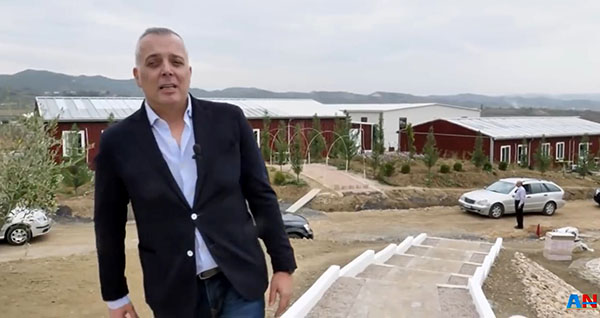
After the group’s relocation in Albania, despite the increasing process of defection from the group, the authorities of the MKO set off for building another city in Manez, Durres naming it “Ashraf 3”.
Here’s the question: In the entire history of the Mujahedin Khalq, has there ever been any public protest against the ruling system of the camps or everything was democratically managed by the group leaders?
The answer is NO. No public protest has been reported from inside the MKO camps but this does not mean that the group’s camps have been ruled democratically and everyone inside the group has been satisfied.
Evidences from inside the MKO indicates that dissent is immediately suppressed by the authorities of the MKO. Numerous documented testimonies of former members of the MKO reveal the very undemocratic and even inhumane attitude of the group leaders against any question, let alone conflicting ideas.
According to the Human Rights Watch report “NO EXIT”, human rights abuses carried out by MKO leaders against dissident members ranged from prolonged incommunicado and solitary confinement to beatings, verbal and psychological abuse, coerced confessions, threats of execution, and torture that in two cases led to death. [4]

The testimonies of the former MKO members indicate that the organization used three types of detention facilities inside its camps in Iraq. The interviewees described one type as small residential units, referred to as guesthouses (mihmansara), inside the camps. The MKO members who requested to leave the organization were held in these units during much of the time they were kept incommunicado. They were not allowed to leave the premises of their unit, to meet or talk with anyone else in the camp, or to contact their relatives and friends in the outside world. [5]

Human Rights Watch interviewed at least seven former members of the group to develop its report in 2005. A few years later, the RAND Corporation published another investigated report on what is going inside the MKO. RAND is a research organization that develops solutions to public policy challenges to help make communities throughout the world safer and more secure, healthier and more prosperous.
According to the RAND report, Physical Abuse, Imprisonment, and Lack of Exit Options were the tools of the MKO leaders to keep members inside the cult-like structure of the group and eventually to suppress dissent and departure. “Former MeK members claim that punishment was frequently meted out for such offenses as expressing or fomenting disagreement with the political/military strategy,” the report reads. Asking to leave the group is an unforgivable sin. “Recent accounts recall that punishment for disagreeing with MeK policies ranged from forced written confessions of disloyalty to incarceration in special facilities at Camp Ashraf. Former members report torture and long periods of solitary confinement as punishment for disloyalty.” [6]
Although, the above-mentioned reports are the most significant and official ones on the human rights abuses in the MKO, there are a lot more testimonies of those who have recently left the group’s camps in Albania. Most defectors of the group publish their firsthand account of enduring human right violations in the MKO just because they expressed their willingness to leave the group or in some cases because they dared to express their opposition to the group’s attitudes.
Gholamreza Shokri spent 27 years of his life in the MKO. He was only 20 years old and willing to find a good job in Europe when he was recruited by the MKO in Iraq. The MKO agents promised to help him get the European visa only if he stayed in their camp for a few months. As soon as he entered the organization, they confiscated his ID documents and never gave him back.” whenever I asked for my ID, they would say that they had no idea where it was.” [7]
Thus, Shokri had no way out of the MKO camp but he frequently used to ask the leaders when he could leave the cult. This question was considered a sin by the leaders. Departure from the MKO was forbidden and showing your willingness for leaving the group would be faced with suppression, imprisonment and torture. So he was imprisoned in solitary confinement. [8]

Shokri said that they had closed their eyes and took him to a clandestine jail. “They insulted me calling me spy of the Mullah’s regime,” he recounts. “They beat me in my legs so badly that I could not walk; they were bleeding. They tied my hands with hand coughs for a week. After a week my hands had no sense; I put the fire of a cigarette on them but I didn’t feel it burn. Then they forced me to stand up for one more week. Each time that I fell down out of fatigue, they would beat me so hard that I had to stand up again.” [9]

Besides Shokri, the testimonies of a large number of defectors of the MKO are available on the Net. All have one thing in common: You have no right to protest in the MKO.
While people of all societies have the chance to express their demands, dissatisfactions and even their anger, more or less, members of the MKO are not even able to express their freewill to choose for their future. They are deprived from the most basic human rights.
Maryam Rajavi’s so-called support for the Iranian workers contradicts what is really going on in her destructive cult of personality.
Mazda Parsi

References:
[1]J Rubin, Alissa, France’s Yellow Vest Protests: The Movement That Has Put Paris on Edge, The New York Times, December 3rd, 2018.
[2] ibid
[3] The Associated Press, Report: Iran arrests 4 workers protesting unpaid salaries, November18, 2018.
[4] No Exit
[5] ibid
[6] RAND
[7] https://www.nejatngo.org/en/posts/8960
[8] ibid
[9] ibid

December 15, 2018 0 comments
FacebookTwitterPinterestWhatsappTelegramSkypeEmail
Rudy Giuliani
Mujahedin Khalq; A proxy force

The US Wants to Bring Back the Shah of Iran

The US had a great deal going from 1953 to 1979 with the Shah of Iran. For 25 years Iran was a cornerstone of the US usurping the British Empire in the Middle East, following World War Two. Iran was a base for projecting US power in the region, and strategically it bordered the Soviet Union during the Cold War.
During the early 20th century the British Empire had full control of Iran’s oil industry, and was paying Iran a flat fee for every barrel of oil it extracted. A rough calculation of Iran’s royalties is between 8% to 16% of the profits, but Iran was never allowed to look at the financial books.
Prior to the CIA-led 1953 overthrow of the democratically elected Prime Minister Mohammed Mossadegh, Iran demanded 50% of the profits and control of their oil industry. That was not unreasonable, but Iran was willing to negotiate. At the time, the US oil companies had a 50/50 profit sharing agreement with Saudi Arabia.
The British refused any negotiated settlement. It was then that the Iranian parliament led by Mossadegh voted to nationalized Iran’s oil industry. The British responded with a naval blockade, and began plotting to overthrow Mossadegh and the parliament. As the Prime Minister, Mossadegh held the most political power in Iran because the people were behind him. The Shah of Iran was mostly a figurehead, at the time.
President Harry Truman was adamantly against colonialism and sided with Iran, which infuriated the British. When President Dwight D. Eisenhower took office in 1953, he sided with the British. Eisenhower and Churchill plotted a coup d’état to overthrow Mossadegh. The frightened Shah, who was in on the plot, fled from Iran before the coup attempt just in case anything went wrong. The first attempt did fail. A second daring CIA-led coup succeeded and the US reinstalled Mohammad Reza Pahlavi as the Shah of Iran, with dictatorial power.
By its intervention, the US broke the British Empire’s monopoly on Iran’s oil. That was part of the US’s calculous. After the coup, US oil companies got 40% of Iran’s oil industry, 14% went to Royal Dutch-Shell, 6 % went to the French Petroleum Company, and the British oil company kept 40%. In addition, Iran got its 50/50 share of the net profits that it wanted in the first place. The US immediately sent financial aid to prop up the Shah, and to bolster Iran’s weakened economy from the British blockade.
If the British had initially been flexible, renegotiated a 50/50 oil deal with Prime Minister Mossadegh, then it would have made a coup less likely. Iran was developing a secular democratic government. It might have become a model for other post-colonial countries in the Middle East. Democracy and self-determination are what the US said its world mission was going back to President Woodrow Wilson in 1918:
“….every peace-loving nation which, like our own, wishes to live its own life, determine its own institutions, be assured of justice and fair dealing by the other peoples of the world as against force and selfish aggression. All the peoples of the world are in effect partners in this interest, and for our own part we see very clearly that unless justice be done to others it will not be done to us.”
Since Iran was a developing democracy, an excuse had to be found for a US intervention. Churchill accused Mossadegh of being a communist. There was no evidence that he was. Mossadegh was an anti-colonial nationalist who cared about the welfare of the Iranian people, and that was all the evidence that Eisenhower needed. Mossadegh had to be punished for standing up to the British and demanding Iran’s natural resources for the benefit of the Iranian people.
The winners from the coup were the US and the timid Shah who had ran from his own people. The US would teach him how to have a backbone. He turned out to be a good student, and with the support of the US he turned Iran into a totalitarian police state and he ruled by terror. The Shah got US protection from his own people and from foreign enemies.

The US looked the other way from the Shah’s corruption of conspicuous consumption, stuffing dollars in foreign bank accounts and lining his own pockets, and those of his cronies. The US got a big piece of the Iran oil industry, and Iran gave the US a strategically important location for a military presence. As for the people of Iran, they continued to live in abject poverty and illiteracy.
Now that the Shah is gone, the US propaganda machine and the mainstream media put out a flood of stories about how wonderful life was under the Shah. The propagandists use economic indicators of inflation, employment, gross domestic product, oil exports and the upper-class standard of living. Anybody who puts out those kinds of comparative economics deserves to flunk Economics 101.
Iran has been under sever US-imposed economic sanctions for 40 years. The US has been threatening Iran with war and “all options are on the table” for decades. The US has also instigated instability inside Iran and supported external attacks by terrorist groups such as Mujahideen-e-Khalq, or MEK.
MEK was on the US State Department’s list of terrorist organization until it was removed by former Secretary of State Hillary Rodham Clinton in 2012. [*] The fact that MEK has killed US citizens in terrorist attacks did not hinder some US politicians from accepting large speaking fees at their conventions, even when MEK was still on the US terrorist list.
The US project to destroy Iran’s economy has had a devastating impact. The husky Secretary of Defense Mike Pompeo said that it is up to Iranian’s leadership “if they want their people to eat”.[*] Because of the US, Iran lacks sufficient funds that it would like to invest in human resources and social programs. Iran’s constitution guarantees healthcare and free education for all, as well as protections of civil rights. As reflected in the drafting of the Constitution of the Islamic Republic, the vision of the economic order was:
“Social justice and economic independence were the main economic goals to be achieved, among other means, through the expansion of the welfare state, extension of public ownership, creation of an active cooperative sector, and strengthening the agricultural and industrial sectors for greater self-reliance. ….the Constitution of the Islamic Republic bears great resemblance on economic issues to the charters and constitutions of Arab “socialist” states drafted during the 1960s and 1970s.”
Constant US, Israeli and Saudi threats require Iran to divert its domestic budget more towards defense, instead of its desired economic goals. Terrorist attacks and internal dissention stirred up by the US causes Iran to increase its internal security to the detriment of civil liberties. The US and the mainstream media propaganda machines know what the deliberate effects of US aggressive actions cause, but they cruelly taunt Iran for its economic and social hardships by blaming the victim.
The US uses these same dirty tricks against Cuba, Venezuela, Nicaragua, North Korea, Russia and every other country that the US demonizes for not falling into line behind US domination in the neoliberal New World Order. The New World Order is the US foreign policy that it alone is unrestrained to “destabilize countries in order to integrate them militarily, politically and economically ….into US-style capitalism and culture”.
The US is still fighting a cold war against socialism, the welfare state, and public ownership. A cold war against Iran is not about US national security. Iran is not an existential threat to the US, or to Israel either. [*] It is about US corporations being thwarted from exploiting Iran’s natural resources, privatizing their state-owned enterprises, and “opening” Iran to unequal trade arrangements. It is also about the US being the hegemon in the Middle East.
The US is still using the same gunboat diplomacy that it has been using since the 19th century to “open” Latin America, Japan, Korea, China and the Philippians to exploitation. It is old fashioned imperialism dressed up in the jargon of “human rights, democracy, and US exceptionalism”. It is what old-world colonialism called “civilizing the heathens”.
The US will never forgive the Islamic Republic of Iran for shutting down the US deal of exploitation. With the Shah’s cut from oil companies, he was a very big customer for US weapons manufacturers, such as General Dynamics, Lockheed, and Northrop. He also aggressively bought into President Dwight D. Eisenhower’s Atoms for Peace program. At the urging of the US, Iran began its nuclear program in 1957.
Selling weapons and nuclear technology was good business for weapons manufacturers and the nuclear industry. US companies like General Electric and Westinghouse sold Iran the nuclear equipment and technology, as well as the enriched uranium fuel. They even sold the Shah highly enriched weapons grade uranium, which is the most efficient for producing electricity, and making atomic bombs, too.
As far as the US public knew the Shah was highly popular and loved by his people. Imagine the surprise when the people of Iran overthrew him in 1979. The mainstream media was shocked too, since they had swallowed their own propaganda. The images of Iranians rioting, protesting, burning the US flag and shouting Death to America were frightening, it looked irrational, and it seemed to come out of nowhere.
The US public and press became outraged when the US Embassy in Tehran was stormed by revolutionary students who took 52 Americans hostage. The students renamed the US Embassy the “Den of Spies”. The students had every reason for that name, given the cache of incriminating documents they discovered.
In the US, every nightly TV news broadcast began with the number of days that had passed since the beginning of the Iran Hostage Crisis. It lasted for 444 days, and resulted in President Carter losing his re-election bid to Ronald Reagan in 1980.
Instead of an imperial looking shah, the Iranian Revolution ushered in an Islamic leader to head the government. The thought of Iran turning into a theocracy seemed antiquated to Americans. They had not known that Ayatollah Khomeini was a national hero since the early 1960’s. He had been arrested, tortured, imprisoned and then exiled to France for his outspoken opposition to the Shah. [*] The unphotogenic image of a dour looking Ayatollah Khomeini was an easy target for Western racist and Islamophobic propaganda.
The US public could not understand why Iran became anti-US, anti-West, anti-modern, and appeared to be fanatical. The violent purging of the Shah’s cronies and of the opposition was shocking. Iranian supporters of the Shah who fled to the US brought with them wild tales of people being hung from street lamps for having televisions and toilets in their homes. They left out the part about how they lived in affluent luxury, while the vast majority of people lived in hovels. The transition was violence, and it lasted for about 2 years.
The US public had no idea why the Iranian people hated the US so much. The facts were kept secret from the public for years. The State Department documents were finally made public in 2017. [*] For many decades the public did not know that it was the US, from President Eisenhower on down through the State Department and the CIA, which overthrew the popular democratically elected government of the charismatic Prime Minister Mohammad Mossadegh. [*] But the Iranian people knew that It was the US that put the brutal regime of Mohammad Reza Pahlavi on the Peacock Throne.
The US public was uninformed of the Shah’s repression, political prisoners, torture chambers, assassinations, disappearances and executions. Not only did the US government turn a blind eye to the brutality, it was the CIA (and Israel’s Mossad) that was the overseer and mentor to the Shah’s secret police; the “Organization of National Intelligence and Security of the Nation”, known as SAVAK.
For an example of the Shah’s brutality, an Amnesty International assessment for 1974-1975 report stated:
“The shah of Iran retains his benevolent [world] image despite the highest rate of death penalties in the world, no valid system of civilian courts and a history of torture which is beyond belief.”
Once when The Shah was confronted by a journalist for the French newspaper Le Monde about his brutal repression methods he responded:
“Why should we not employ the same methods as you Europeans. We have learned sophisticated methods of torture from you. You use psychological methods to extract the truth; we do the same.”
In 1978 Amnesty International reported that nothing had changed for the better in Iran. Even the mention of the word SAVAK was enough to send chills down the backs of Iranians.
The explosion of the Iranian Revolution of 1979, the Hostage Crisis and the animosity of the Iranian people towards the US government was the direct result and blowback from 25 years of the US coddling and sheltering its shah puppet. As Kermit Roosevelt who was the CIA station chief in Tehran in 1953 said of the Shah: “He’s our boy”. It was Roosevelt who engineered and implemented the coup that brought the Shaw to power. The codename for the coup was Operation Ajax.
Just as Trump is trying to cover up for MBS (as Thomas Friedman affectionately refers to the Crown Prince of Saudi Arabia), President Jimmy “Human Rights” Carter tried to cover up and sheltered Mohammad Reza Pahlavi after the Iranian Revolution. The Iranian people wanted the Shah arrested by the US, where he had fled. They wanted him extradited to Iran to face justice.
Henry Kissinger and David Rockefeller had appealed to Carter’s compassion to admit the Shah to the US for health reasons. After much vacillation Carter agreed. [*] Carter had had a friendly personal relationship with The Shah. In 1977 Carter visited Iran and toasted the Shah for his “island of stability” and for “the admiration and love which your people give you”.
Carter admitted the Shah to the US on October 21, 1979. On November 4, 1979 revolutionary students took over the US Embassy in Tehran, and demanded the Shah in exchange for the US hostages. Carter said he refused to give in to “blackmail” to a group of “terrorists”. Still vacillating, Carter expelled the Shah from the US. He died in Egypt in 1980.
As a reaction to the Iran Hostage Crisis, the US imposed unilateral sanctions on Iran, cut off the sale of oil and froze their assets in the US. The US put an embargo on Iran, including humanitarian supplies, and the US broke diplomatic relations. Needless to say, the US stopped its “Atoms for Peace” program and cooperation with Iran in developing nuclear energy. Iran released the US hostages within hours of Ronald Reagan being sworn in as President in 1981. The circumstances and timing of the hostage release is still controversial. [*] Most likely, Carter deserves the credit for successfully negotiating the release of the hostages. [*] Why the Iranians released the hostages when they did is still a mystery.
In 1980 Iraq invaded Iran starting the Iran-Iraq war that lasted until 1988. Whether or not the US gave a “green light” to Saddam Hussein to invade Iran, the US did not try to prevent or stop Iraq’s aggression. According to Dexter Filkins, writing in the New Yorker:
Iran’s leaders took two lessons from the Iran-Iraq War. The first was that Iran was surrounded by enemies, near and far. To the regime, the invasion was not so much an Iraqi plot as a Western one. American officials were aware of Saddam’s preparations to invade Iran in 1980, and they later provided him with targeting information used in chemical-weapons attacks; the weapons themselves were built with the help of Western European firms.
The other lesson drawn from the Iran-Iraq War was the futility of fighting a head-to-head confrontation. ……Instead, they had to build the capacity to wage asymmetrical warfare—attacking stronger powers indirectly, outside of Iran.
According to the New York Times, “the Reagan Administration secretly decided shortly after taking office in January 1981 to allow Israel to ship several billion dollars’ worth of American arms and spare parts to Iran”. [*] Cynically the US later said that it gave aid to both sides “to remain neutral”; and unsaid was to keep either side from winning. Both Iran and Iraq suffered over 500,000 casualties each in the Iran-Iraq War.
If the US had hoped that the Iran-Iraq war would weaken Iran, then the unintended consequences were just the opposite, as often is the case with US duplicity. Iraq’s invasion of Iran united the Iranian people strongly behind the Iran revolutionary government. In 2003, President Bush’s invasion of Iraq would make Iran an even stronger regional power.

In 1982 Israel invaded Lebanon, and through a series of events Reagan sent US Marines to Lebanon. He called them a “peacekeeping force” to avoid having to get Congressional approval under the 1973 War Powers Resolution. In 1983 a truck bomb suicide attack on a Marine barracks in Lebanon killed 241 people, mostly US Marines. The US blamed the attack on Iran and declared Iran a “terrorist state”. More US sanctions were imposed on Iran even though there was only circumstantial evidence that Iran was the perpetrator.
In 1988 the US shot down an Iranian commercial airliner that was in Iranian airspace. All 290 passengers and crew of the airliner died. [*] The US claimed that it mistook the plane for a threatening fighter jet. Even though the US admitted that it had shot down the airliner, President George H. W. Bush refused to apologize, saying “I’m not an apologize-for-America kind of guy”.
Even with all the turmoil of the 1980’s, Iran continued to work on its nuclear program. It had signed the Nuclear Non-Proliferation Treaty (NPT) in 1970. Iran has every right under the treaty to a nuclear energy program. In fact, under the treaty the nuclear-weapons countries are obligated to cooperate with the non-nuclear-weapons countries in the peaceful development of atomic energy.
Instead of abiding by the NPT, the US used the red herring that Iran had a nuclear weapons program. Without proof, the US slapped unilateral economic sanctions on Iran. So, Iran turned to France, Russia and other countries to purchase material, equipment and technology for its nuclear energy program.
After the Iraq invasion of Kuwait in 1990, and the US war with Iraq, the US imposed sanctions on both Iraq and Iran. While Iran had declared neutrality in the war, the US accused Iran of secretly aiding Iraq. The real reason why the US imposed sanctions on Iran was that it was concerned that a weakened Iraq would strengthen Iran as a regional power, which is exactly what it did.
Then in 1996 under President Bill Clinton, what was to become known as the Iran and Libya Sanctions Act was passed by Congress. l*] This act penalized any US or foreign entities that invested in Iran’s oil and gas industry. The supposed rational was that investing in Iran’s oil and gas industry would provide Iran with the funds to develop weapons of mass destruction. Since money is fungible, the same logic could be used about all trade with Iran, and eventually it was. Still there is no proof, except circumstantial, that Iran has ever had a nuclear weapons program.
The real reason for economic sanctions is that the US is engaging in economic warfare against Iran. It is angry because their puppet shah was overthrown. US economic sanctions are an attempt to destroy Iran’s economy. As the most powerful and influential economic nation in the world the US can exert tremendous financial penalties, hardships and isolation on other countries. Most of the suffering from sanctions are borne by civilians.
Does supporting the aggressor in a war, aiding the aggressor in the use of banned chemical weapons, giving both sides weapons to kill each other, and shooting down a civilian airliner qualify as “state sponsored terrorism”? Since 1979 the US has killed millions of people is covert operations such as in Afghanistan, and in illegal wars of aggression in the Middle East, such as the 2003 invasion of Iraq.
Yet, Iran is condemned by the US as the world’s “leading state sponsor of terrorism”? Such accusations by the US against Iran are hypocritical and politically motivated hyperbole. [*] The motive for US propaganda is to aid the cause of overthrowing, one way or another, the internationally recognized legal government of Iran. [*] The world’s leading sponsor of state terrorism is surely the US, and its partners in terrorism are the UK, Israel, and Saudi Arabia, and the other Gulf Cooperation Council countries.
The definition of terrorism according to Webster’s dictionary is “the unlawful use of violence and intimidation, especially against civilians, in the pursuit of political aims”.
The victims of US economic sanctions call it financial terrorism. It is and it does hurt mostly civilians financially, and it causes them unnecessary suffering and deaths from the lack of nutrition and medicines for curable and preventable diseases. There is also tremendous emotional distress on the civilian population caused by economic sanctions. Alcoholism, drug addiction, divorce, crime and many other social conditions are exacerbated.
Economic sanctions meet the definition of terrorism, and that makes economic sanctions a crime against humanity. Even UN authorized economic sanctions overstep the Geneva Conventions and are immoral and may be unlawful. The International Committee of the Red Cross has cautioned the United Nations Security Council that the “Security Council is bound to observe the principles of international humanitarian law when designing, monitoring and reviewing sanctions regimes.”
The US wants to turn the clock back to 1953 and a return of the Shah of Iran. Why not? The US had a great deal going with the Shah of Iran for a quarter of a century, until the Iranian Revolution of 1979. That is why the US hates the current government and wants to overthrow it.
The US is determined to undermine the government of Iran. President Trump’s violation of the JCPOA, “Iran Deal”, has put “all options on the table” again: economic sanctions, terrorism, war and even the use of nuclear weapons. Iran is now in its 40th year of the Islamic Republic. [*] Speaking to the terrorist group MEK in 2017, John Bolton said that President Trump’s policies should be that “Ayatollah Khomeini’s 1979 revolution will not last until its 40th birthday.” [*] The 40th anniversary of Iran’s Islamic Revolution will take place in a few months, on February 11, 2019. Obviously, Bolton is not invited.
Trump says that the Iran Deal is the worst deal in history. What the US wants is the old deal that it had with Iran from 1953 to 1979. That was the “Greatest Iran Deal in History”. The CIA already has their man ready. They have been grooming him since he was 17 years old. He lives not far from the CIA headquarters in Langley, Virginia. He is Reza Pahlavi, the Crown Prince of Iran. He is the last heir apparent to his father’s defunct Peacock Throne. He is waiting in the wings for the job opening for a new Shah of Iran.
References
[*] Glide your mouse over the stars in the article for hyperlinks to supporting attributions.
“The Plot to Attack Iran: How the CIA and the Deep State Have Conspired to Vilify Iran”, by Dan Kovalik.
“Shah of Shahs”, by Ryszard Kapuscinski.
“All the Shah’s Men: An American Coup and the Roots of Middle East Terror”, by Stephen Kinzer.
[Bio: David William Pear is a columnist writing on U.S. foreign policy, economic and political issues, human rights and social issues. David is a Senior Contributing Editor of The Greanville Post (TGP) and a prior Senior Editor for OpEdNews (OEN). David has been writing for The Real News Network (TRNN) and other publications for over 10 years. David is a member of Veterans for Peace, Saint Pete (Florida) for Peace, CodePink, and the Palestinian-led non-violent organization International Solidarity Movement. This article is licensed under a Creative Commons Attribution, Non-Commercial 4.0 International License.]
Ends
By David William Pear,Scoop Media

December 12, 2018 0 comments
FacebookTwitterPinterestWhatsappTelegramSkypeEmail
Nejat Publications

Nejat Newsletter No. 58

Inside This Issue:

Greetings from Many Miles Away

Western Journalists Disclose Severe Human Rights Abuses in The MEK 

Over 50 Survivors of Mojahedin Khalq Write To UNHCR

Meet MEK: The Terrorist Cult Supported By Trump Administration

Recently Defected Sadollah Seifi at Nejat Society Office

How the US Uses the “Leftist” MEK Group for Soft Aggression against Iran

European Support of MKO against Security Council Resolutions

To download the PDF file click here

December 11, 2018 0 comments
FacebookTwitterPinterestWhatsappTelegramSkypeEmail
Mujahedin Khalq Organization members' families

The MKO abused my family

Some of the families of the Rajavi cult hostages attended the Nejat Society Office of Kermanshah Branch to discuss the ways to help their beloveds’ rescue from the MKO Cult.   

The Nejat families also invited the newly defected ; Mr. Saadollah seifi , to get information from the situation of their loved ones.

Mr. Seifi explained the manipulation techniques of the MKO cult and the way it abuses its members. He said about the group’s abusing and making trouble for his family writing letters on Saadollah’s behalf and sending to his family…

 The families calledon the international human rights bodies to help their family members with liberating them form the cult of the Mujahedin-e Khalq.  

December 11, 2018 0 comments
FacebookTwitterPinterestWhatsappTelegramSkypeEmail
MEK Cult
The cult of Rajavi

The Mujahedin Khalq, “a Cultish Death Squad”

The violent nature of the Mujahedin Khalq Organization (the MKO/ MEK/ PMOI/ the Cult of Rajavi) has always been the important issue of critics and arguments between journalists, analysts and those politicians who support the group and consider it as a democratic alternative to the Iranian government.

“The MEK’s efforts over the past two decades to convey a benign public image completely at odds with this internal reality, and to pose as a force for democracy in Iran, have depended on buying the public endorsements of well-known public figures,” write Paul pillar on the National Interest.  “This has required money—lots of it. Five-figure speaking fees have flowed freely. Public disclosure forms indicate Bolton received $40,000 for a single appearance at an MEK event in Paris last year.” [1]

Western Analysts agree that the MEK lacks the capacity or support to overthrow the Iranian government. “They [the MKO sponsors in the US] are probably smart enough to know that this group is not democratic and anyway has no constituency inside Iran,” Paul Pillar told the Guardian. “Trump and his Iran hawks are not concerned with replacing the current regime so much as causing it to crumble. They are pursuing anything that would disrupt the political order in Iran so they and the president can cite such an outcome as a supposed victory no matter what comes afterwards.” [2]

Pillar believes that the MKO has only the capacity to commit violence, and is not able to change the government in Tehran as a democratic force. “They appear to be less interested in democracy in Iran than in the capability for sabotage, destruction, and assassination in Iran—a capability that the MEK still has despite its claims to have forsaken violence,” he writes. [3]

Julia Kassem of the Geopolitics Alert also asserts that “Washington’s pulling out of the Iran nuclear deal and subsequently renewed sanctions come as US National Security Advisor appointee John Bolton’s existential objective to destroy Iran by any means necessary even if it means leveraging the soft power of a cultish death squad.” [4]

She suggests that Trump administration has made large investments on the Iranian opposition groups. “Congress had previously allocated over $20 million for “democracy promotion” in Iran, following accusations that Iran possessed nuclear weapons,” she writes. “It was the MEK that had given false and misleading information to US intelligence on Iran’s alleged possession of nuclear weapons in 2002, a year before the US destabilized Iraq over accusations of “weapons of mass destruction.” This polemic, inspiring an odd part of then-president George W Bush’s “Axis of Evil” speech, is also solidified in MEK leader Maryam Rajavi 10-point plan. The last point demands a “non-nuclear Iran,” calls for the Islamic Republic be “free of weapons of mass destruction.” [5]

Julia Kassem suggests that the double standards of the West in dealing with terrorist groups including the MKO is shared with the entire NATO members. “Various NATO powers have hosted and given the separatist groups coverage in attempts of strengthening support and ties with the United States,” she writes. “They Include France, where the MEK and its umbrella organization NCRI is based, Denmark and the Netherlands, housing Arab Struggle Movement for the Liberation of Ahvaz (ASMLA), and Albania, where a MEK camp, housing a training ground and even Twitter troll-farm, pumping out anti-government tweets and pro-Rajavi propaganda, is based.” [6]

Paul pillar confirmed the US hypocrisy in an interview with Tehran Times. “If the MEK is opposed to the current political order in Tehran, that’s all that matters to the Trump administration,” he said. [7]

He states that the removal of the MKO from the US State Department Terrorist list has been part of the anti-Iran Policy. “A rationale for removing the MEK from the U.S. terrorism list was that in recent years the group has not been involved in killing Americans,” he told Tehran Times. “The law governing the list could be construed that way, although more often, decisions on listing and delisting are not made from such a narrow perspective.  A terrorist group is still a terrorist group even if the blood it spills is not American blood.  The MEK certainly has been involved in lethal political violence since 2009.” [8]

Western supporters should be warned that associating with the MKO will increase Iranian`s hatred feelings toward the US. Iranians will never forget the violent background of MEK in which thousands of innocent people were massacred by this group. Therefore, US should not try to ignore the terrorist nature of MEK and its cruel treatment towards its members.  

By  Mazda Parsi

References:

[1] Pillar, Paul, The MEK and the Bankrupt U.S. Policy on Iran, National Interest, November 13, 2018.

[2] Merat, Arron, Terrorists, cultists – or champions of Iranian democracy? The wild wild story of the MEK, the Guardian,November 9, 2018.

[3] Pillar, Paul, The MEK and the Bankrupt U.S. Policy on Iran, National Interest, November 13, 2018.

[4] Kassem, Julia (Samar), How the US Uses the “Leftist” MEK Group for Soft Aggression against Iran, Geopolitics Alert, November 27, 2018.

[5] ibid

[6] ibid

[7] Heirannia, Javad, MEK Sources of funds are Iran’s regional rivals: ex-CIA official, Tehran Times, December 1, 2018.

[8] ibid

December 10, 2018 0 comments
FacebookTwitterPinterestWhatsappTelegramSkypeEmail
Former members of the MEK

Photo Exhibition Press Club, Brussels –International Terrorism Mojahedin Khalq

A Photo Exhibition was held at the Press Club in Brussels between 3 – 7 December, 2018. The exhibition was formally opened by a panel of speakers who outlined the content and purpose of the photo exhibition. The exhibition aims to enlighten reporters and media to the dangerous consequences of blind support for the MEK. Three of the participants gave interviews in English afterwards in which they explained why the MEK is a danger to Europe and that although they joined MEK to fight for freedom and democracy in Iran, they soon discovered this was a lie, but were trapped inside the MEK by imprisonment and torture.

Anne Khodabandeh, Open Minds De-Radicalization Consultant placed the MEK’s current survival in the context of Neoconservative support. This means that in spite of well documented severe human rights violations, the MEK’s ‘regime change’ narrative is supported by paid advocates. The danger however is that the MEK will escalate their false flag ops in Europe which are blamed on Iran, only this time Europeans may be killed.

Reza Jabelli, Service Etat Civil et Population – Aawa Association, related his history with the MEK from his teenage years to the time he managed to escape the cult in Iraq when the US army guarded the MEK camp. He said that when he joined the MEK he believed it was fighting for freedom and democracy. When he discovered this was a lie, the MEK held him captive for many years, sometimes in solitary confinement, in an attempt to force him to change his mind. Jabelli said that when Maryam Rajavi was arrested by French counter terrorism police in Paris in 2003, she ordered her followers to set fire to themselves. This example shows that the MEK can pose a serious threat to peace and security in Europe because the group has not given up its belief in violence and terrorism.

Edvard Termador introduced himself as anArmenian-Iranian and a Christian. He explained how he had been a Prisoner ofWar in Iraq for nine years as a result of the Iran-Iraq war. Although he hadthe opportunity to return to Iran at the end of the war, he chose to join theMEK because he believed they would bring freedom and democracy to Iran. When herealised this was a deception, he was imprisoned inside MEK camps before beinghanded over to the Abu Ghraib political prison of Saddam Hussein. He warnedagainst believing the MEK’s false presentations of democracy.

https://dlb.nejatngo.org/Media/Report/Brussels_201812/Singleton_Ann.mp4

Anne Khodabandeh, Open Minds,De-Radicalisation Consultant, PHOTO-EXHIBITION in Bruxelles

(International Terrorism Mojahedin Khalq, MEK, NCRI, Rajavi cult)

https://dlb.nejatngo.org/Media/Report/Brussels_201812/Jebelli.mp4

Reza Jabelli, Service Etat Civil et Population, PHOTO-EXHIBITION in Bruxelles

(International Terrorism Mojahedin Khalq, MEK, NCRI, Rajavi cult)

https://dlb.nejatngo.org/Media/Report/Brussels_201812/Tremado_Edvard.mp4

Edward Termado, Christian, Armenian-Iranian,PHOTO-EXHIBITION in Bruxelles

December 9, 2018 0 comments
FacebookTwitterPinterestWhatsappTelegramSkypeEmail
weekly digest
Iran Interlink Weekly Digest

Iran Interlink Weekly Digest – 248


++ Several MEK survivors have published accounts of recentevents, in particular Mohammad Azim Mishmast and Gholamali Mirzaei. The news isabout the people who have left MEK but are still paid by the group on conditionthey remain silent and do not speak about the group. This week when they wentto collect their MEK money they were shown photographs of Mishmast, Mirzaei andsome others alongside their families and children who are not in Albania. MEKtold them, ‘If you talk to these people you will get no money’. They were thenbriefed on behalf of Maryam Rajavi that ‘the enemy’ are the ex-members. Theyare the forefront and we are keeping our bullets for them. The writing of thesurvivors say it is obvious that even their supporters in America no longergive a damn about them, so in order to keep people on board they threaten themlike this to divert attention from the main issue which is that even as amercenary force they are not needed.

++ Zahra Mirbagheri from Nejat Association has published a screen shot from an MEK site which shows Maryam Rajavi, Struan Stevenson and a couple of other permanent lobbyists, with the title ‘They meet each other, they take pictures and they pretend it’s a discussion’. Mirbagheri gives links to every one of these people who have openly lobbied for MEK for years and who each head different organizations which have been created by MEK. Mirbagheri goes on to say that this is the level they have been reduced to after they have achieved nothing. They have even lost the actual support of the likes of McCain and Bolton etc.

++ A week-long Exhibition and introductory Speakers panel were held at the Press Club in Brussels this week, organised by Aawa Association of Germany. The panel was chaired by Reza Jabelli, Service Etat Civil et Population. Panellists were Anne Khodabandeh, Open Minds, De-Radicalization Consultant, and two female MEK survivors, Batoul Soltani and Homeira Mohammad Nejad.

In English:

++ Arron Merat’s Long Read article for The Guardian ‘Terrorists, cultists – or champions of Iranian democracy? The wild wild story of the MEK’ was released as a podcast. The article says MEK are promoted by Trump White House hardliners as tools for regime change, but ex members accuse Maryam Rajavi of coordinating routine sexual abuse inside the cult.

++ After Sokol Balla, a presenter on Vision Plus TV in Albania, was taken to the camp in Manez by the MEK, several people wrote objecting to his report. The writers accused Balla of taking part in a whitewash of MEK history and gave accounts of their own experience inside the MEK. One said, “I suggest that the next time you want to report about the MEK, it would be better to ask them about their past, about forced divorces, working with Saddam Hussein, and imprisonment and torture inside Camp Ashraf. And in addition, invite investigative delegations to establish the truth.”

++ Mazda Parsi of Nejat Bloggers writes about the interview by Der Spiegel with MEK survivor Gholam Reza Shekari who left thegroup in Albania in 2017. Parsi refers to the 2005 Human Rights Watch report‘No Exit’ which detailed torture and murder of internal dissidents in the MEK.Shekari is one of those victims who can now recount his experience andknowledge of what the MEK did at that time. “Shekari spent 27 years of his lifein the cult-like MKO. He was only 20 years old and willing to find a good jobin Europe when he was recruited by the MKO in Iraq. The MKO agents promised tohelp him get the European visa only if he stayed in their camp for a fewmonths.

As soon as he entered the organization, they confiscated his ID documents and never gave him back. ‘whenever I asked for my ID, they would say that they had no idea where it was’.

Thus, Shekari had no way out of the MKO camp but he frequently used to ask the leaders when he could leave the cult. This question was considered a sin by the leaders. Departure from the MKO was forbidden and showing your willingness for leaving the group would be faced with suppression, imprisonment and torture. So he was imprisoned in solitary confinement.”

++ James Carden with Dr. Trita Parsi, The Nation, ‘The Trump Administration Rattles the Saber at Iran’ This is a Q&A with Dr. Trita Parsi, author of Losing an Enemy: Obama, Iran, and the Triumph of Diplomacy. Parsi analyses current US policy toward Iran, saying he believes Trump does not want war or regime change, but wants ‘regime collapse’ in which Iran is plunged into chaos but America is not responsible for creating an alternative government. According to Parsi, MEK’s role in this scenario is thus: “Whereas the MeK is of little use if the objective is regime change, due to their immense unpopularity in Iran, the Trump administration seems to believe that they can be helpful for regime collapse and a potential Civil War, mindful of this terrorist organization’s extensive experience in sabotage, terrorism, assassinations, and even regular warfare.”

http://iran-interlink.org/wordpress/iran-interlink-weekly-digest-december-07-2018/
December 9, 2018 0 comments
FacebookTwitterPinterestWhatsappTelegramSkypeEmail
Trita Parsi
Mujahedin Khalq; A proxy force

The Trump Administration Rattles the Saber at Iran

A Q&A with Dr. Trita Parsi, author of Losing an Enemy: Obama, Iran, and the Triumph of Diplomacy.

In a recent speech to the International Institute for Strategic Studies Manama Dialogue in Bahrain, US Secretary of Defense James Mattis went on the (rhetorical) offensive against Iran. Said Mattis:

Like-minded nations here today do not seek war or conflict, yet, we cannot ignore the malign influence and destabilizing behavior pursued by violent extremist organizations and by Iran’s “outlaw regime”…The Iranian regime does not speak for the Iranian people, who have a right to live and prosper in a safe, secure and peaceful region…. An Iranian regime that ignores the needs of citizens feels free to escalate and initiate costly conflicts that serve no one’s interests.

Mattis also claimed that “Nothing is more emblematic of Iran’s malign activities in the Middle East than its support for Assad’s murderous regime,” a line of thinking that was seconded by US Presidential Envoy for the Global Coalition to Defeat ISIS Brett McGurk.

In Manama, McGurk seemed to be signaling the Trump administration’s willingness to confront Iranian fighters in Syria. According to McGurk, “No one wants them there. We even hear from the Russians that they shouldn’t be there. We’ve taken that and said for a stable Syria these forces must leave.” Still more, according to McGurk, “We will not help reconstruct any of the areas that were retaken by the Assad regime with the help of the Iranians and the Russians.”

Worryingly, these comments by Mattis and McGurk echo all too clearly the regime-change rhetoric employed by successive US administrations dating at least as far back as the late George H.W. Bush, whereby American politicians attempt to conceal their true intentions (regime change) in the soft language of human rights. In the lead-up to any of the seven regime change wars initiated by the United States over the past 25 years, one can find instances of high US government officials repeating, as though a mantra, the claim that America’s quarrel is not with the people of (insert name of about-to-be-invaded-country), it is with the government of (insert name of about-to-be-invaded-country).

To help make sense of the current round of saber rattling by the Trump administration, I spoke with Dr. Trita Parsi, author of Losing an Enemy: Obama, Iran, and the Triumph of Diplomacy.

James Carden: I was struck by how closely Mattis’s bill of indictment against Iran in Manama echoed the rationale used by previous administrations to sell regime-change wars. Is the Trump administration setting the stage for an actual military conflict with Tehran, or is this more bluff and bluster from a strategically and intellectually shallow administration?

Dr. Trita Parsi: I think the way to understand this is that Trump, his administration and the entities pushing him on this—from Sheldon Adelson, to Saudi Arabia to Netanyahu—ultimately agree that the goal is to weaken Iran and shift the balance of power away from Iran and towards Israel and Saudi Arabia. The paths to that goal can vary; from crippling sanctions, to regime change, to regime collapse, to war or a combination of these policies.

But they have different preferences. Donald Trump, I believe, neither wants war nor regime change. Not out of humanitarian concerns, but because he knows that both war and regime change are very costly. So I suspect they will gravitate towards the one option that is the least costly but yet achieves their goal of shifting the balance of power in the region: regime collapse.

Unlike regime change, a policy of regime collapse is less costly, because you don’t take responsibility for setting up the next government in Iran. In fact, you don’t want a new government. You want chaos and even civil war. In that scenario, Iran’s power would be consumed internally and it would no longer have the ability to project power in the region. Consequently, the balance of power would shift away from Iran and towards Israel and Saudi Arabia—but without the cost of war or regime change.

Of course, this would destabilize much of the region and send massive refugee flows towards Europe. But that appears not to be much of a concern for either Trump or the rulers in Tel Aviv and Riyadh.

JC: I want to ask about Syria. When US Envoy Brett McGurk said the US will not help with Syrian reconstruction in areas freed from the terrorists by Russia and Iran and, further, that the Iranian-backed forces “must leave,” what is he signaling here? Is he giving an advance preview of the administration’s justification for a wider war in Syria if Iran doesn’t “get out”?

TP: I think Syria scholar Joshua Landis has explained this best: Trump’s Syria policy is not to win, but to deny Russia, Iran, and Assad their victory. To achieve that objective, the United States will do everything it can to prevent the reconstruction of Syria. Rather than signaling justification for war with Iran in Syria, I think this is reflective of the policy of keeping the civil war going as long as possible and ensuring that neither Assad, Russia nor Iran can have a true victory, even if this comes at the expense of the destruction of the entire country.

JC: Picking up on the theme of regime collapse. Such a policy—as opposed to regime change—would seem to imply that Trump would prefer not to effectuate a change in Tehran through direct military action but rather to try and destabilize the country from within. If so, it would seem that anti-regime elements such as the terror-cult MeK would have a role to play. You’ve written about MeK, notably in an essay in The New York Review of Books. For readers unfamiliar with them, could you explain, broadly, who they are and how they came to acquire such a powerful US domestic lobby?

TP: Yes, my assessment is that Trump prefers to achieve his objectives without taking military action because of the cost. Note, not because of any particular humanitarian concerns. And that will drive him towards regime collapse instead of war or regime change, because regime change too is costly.

Whereas the MeK is of little use if the objective is regime change, due to their immense unpopularity in Iran, the Trump administration seems to believe that they can be helpful for regime collapse and a potential Civil War, mindful of this terrorist organization’s extensive experience in sabotage, terrorism, assassinations, and even regular warfare.

The MeK is a violent terrorist cult that first started killing Americans and officials of the Shah’s regime back in the 1960s and ’70s. They were in support of the Islamic revolution but had a fallout with Ayatollah Khomeini and ended up seeking refuge with Saddam Hussein during the Iraq-Iran War. They ended up siding with Iraq during the war, which cost them almost all of their support inside of Iran.

Once the war ended, Saddam started using them as his personal ethnic-cleansing army against Shia in the south of Iraq and Kurds in the north.

While fighting for Saddam, the MeK began establishing a very strong lobbying presence on Capitol Hill by giving extensive campaign funds to Democratic and Republican members of Congress alike. Flush with financing from Saudi Arabia, they of course pushed an open door because their meagre was that the regime in Iran is bad and needs to be overthrown. Despite betting on the US terrorist list, they were still free to engage in this extensive lobbying effort which culminated in them lobbying to get off the terror lost in 2012.

JC: Another pillar of the regime-collapse strategy is clearly sanctions. The neocon operative who now serves are the US special representative for Iran, Brian Hook, recently said, “Our goal remains getting countries to zero imports of Iranian oil.” Meanwhile, the administration’s decision to reimpose nuclear-related sanctions in October has prompted an outcry from the Europeans, who are taking specific action (via the “special-purpose vehicle”) to circumvent US efforts to completely isolate Tehran from the global financial system. Seems the effort to re-isolate Iran is going to be trickier this time around, what do you think accounts for that?

TP: The effort has essentially failed. Trump was forced to issue eight waivers because oil prices would shoot up if he didn’t. The effort to get the Saudis to replace Iranian oil failed. Oil demand may come down next year, which may enable trump to get a bit more oil of of the Iranian market, but he’s neither going to reach zero or a small enough amount of Iranian exhorts to cause the collapse of the Iranian economy.

This failure has also caused Trump to lose the psychological war. Had he succeeded, the calculation was that it would instill panic in the Iranian population and cause them to lose faith in the government’s capacity to weather the same storm. That in turn would have led to a critical mass of people taking to the streets and pushing for the regime’s collapse, the calculation was.

By failing to live up to his promise of eliminating Iranian oil exports, Trump also failed to instill panic and cause the population to lose faith in the government’s capacity to handle the sanctions for the thanks to years.

That said, this does not mean that he’s not hurting the Iranian economy. On the contrary, it is extremely painful and the population is hurting immensely due to the sanctions. But pain alone is not going to cause the collapse of the economy or the regime.

JC: Expectations are that probably 20 or so Democrats will enter the 2020 presidential primaries. As the author of a book, Losing an Enemy, that gave the inside story of the Obama administration’s efforts to secure the JCPOA, what advice would you give the next Democratic president in order to get back on the right diplomatic track with Iran and, importantly, the other signatories of the JCPOA, whom Trump gone out of his way to offend?

TP: If the JCPOA survives for the next two years and Trump loses in 2020, then the next administration must seek to reenter the agreement. There needs to be strong support for this in Congress, in fact, this should be part of the Democratic Party platform.

Any renewed engagement with Iran will be tricky. The Iranians will have reasons not to trust the commitments of the US. But it can still be fruitful, but only if the US approaches it with realistic goals and a diplomatic strategy that is centered on both incentives and disincentives rather than being solely focused on coercion.

James Carden with Dr. Trita Parsi, The Nation

December 8, 2018 0 comments
FacebookTwitterPinterestWhatsappTelegramSkypeEmail
Mujahedin Khalq Organization members' families

To my dear sisters

Mr. Abdolreza Dolfi visited Nejat Society members of Khuzestan branch. His two sisters; Lela & Maryam, are members of the Mujahedin-e Khalq cult. They were deceived into joining the group. They have had no contacts with their family members during the years of membership to the MKO Cult.

Mr. Abdolreza Dolfi says:” my dear sisters, we love you and missed you a lot. Our mum died heavy-heartedly. She was always waiting to see you once more. Why didn’t you call her even once?!

I want you to decide for your fate independently. I wish you to live a happy life far from the cult affairs. Please think about your life and destination.

December 6, 2018 0 comments
FacebookTwitterPinterestWhatsappTelegramSkypeEmail
Mujahedin Khalq Organization members' families

Tell my son; your mum is very sick

The photo shows the mother of one of the Mujahedin-e Khalq cult members; Asadollah Fayaz dyzaj.

The ailing, aged mother is at the hospital now. She has been unaware of her son’s conditions and well-being for many years. She is sick of her son’s being far away.

She says:” tell my son; Asadollah, your mum is very sick. Let her hear your voice. .. I am a mother. This is my certain right to hear my son’s voice.. “

To the cult leaders:”

If you are right and Asadollah is not captivated behind your cult’s physical and mental barriers, let him contact his ailing mother.

December 4, 2018 0 comments
FacebookTwitterPinterestWhatsappTelegramSkypeEmail
Newer Posts
Older Posts

Recent Posts

  • Soraya Abdollahi’s Letter to International Human Rights Bodies

    September 28, 2026
  • How Did Maryam Rajavi Become All-Powerful in the MEK?

    September 27, 2026
  • Yazdan Teimorian’s Family:  We Are so Heart-Broken!

    September 23, 2026
  • Blackman’s relationship with the MEK should be investigated

    September 19, 2026
  • Democracy Cannot Be Built with Fake Voices

    September 14, 2026
  • Facebook
  • Twitter
  • Instagram
  • Youtube

© 2003 - 2025 NEJAT Society . All Rights Reserved. NejatNGO.org


Back To Top
Nejat Society
  • Home
  • Articles
  • Media
    • Cartoons
    • NewsPics
    • Photo Gallery
    • Videos
  • Publications
    • Books
    • Nejat NewsLetter
    • Pars Brief
  • About Us
  • Contact us
  • Editions
    • عربي
    • فارسی
    • Shqip