Nejat Society
  • Home
  • Articles
  • Media
    • Cartoons
    • NewsPics
    • Photo Gallery
    • Videos
  • Publications
    • Books
    • Nejat NewsLetter
    • Pars Brief
  • About Us
  • Contact us
  • Editions
    • عربي
    • فارسی
    • Shqip
Nejat Society
Nejat Society
  • Home
  • Articles
  • Media
    • Cartoons
    • NewsPics
    • Photo Gallery
    • Videos
  • Publications
    • Books
    • Nejat NewsLetter
    • Pars Brief
  • About Us
  • Contact us
  • Editions
    • عربي
    • فارسی
    • Shqip
© 2003 - 2024 NEJAT Society. nejatngo.org
USA

Risk with Iran Deal Decision

In 2002 and 2003, as the United States geared up for the invasion of Iraq, many protests broke out across the country, as did a passionate public debate about why America was going to war and whether it should. That debate, sadly, was not proportionately reflected on Capitol Hill, but it still mattered.

The invasion destroyed Iraq as well as the dual containment policy that, despite its many flaws, had kept a relative lid on Iraq’s ambitions and Iraq’s ability to upset regional stability. The ensuing years of combat spawned the Islamic State and other terrorist groups, and destabilized the entire region, most severely affecting Syria.
Now, the same forces have come together to take down the most significant diplomatic achievement in the Middle East in recent memory and create a new, highly unstable future. Donald Trump today announced the reimposition of sanctions on Iran, putting the United States in direct violation of the Joint Comprehensive Plan of Action (JCPOA), colloquially called the Iran nuclear deal. In Iraq, the United States went in with no exit strategy. The Trump administration likewise has no plan for the day after exiting the Iran nuclear deal. In both cases, however, the real goal is regime change.
While this diplomatic debacle is going on in Washington, Israel has gone on high alert in anticipation of an Iranian attack. The Israeli military has said that it has detected “unusual” Iranian movements in Syria, and it has been anticipating an Iranian attack since Israel struck Iranian positions in Syria last month.
Such a high alert is not common for Israel unless an attack is imminent. But it would mark a departure for Iran, a country that has generally avoided direct conflict with Israel, the United States, and Saudi Arabia. If an attack does happen, it will mean things have changed, as they inevitably will now that Trump has violated the JCPOA by reinstating sanctions.

A Post-JCPOA World

Once Trump decided to scuttle the Iran nuclear deal, whatever brinksmanship Iran and Israel are playing at in Syria took on greater significance. With the lone exception of Defense Secretary Jim Mattis (who has advocated attacking Iran in the past), Trump is surrounded by pro-war voices. His new lawyer, Rudy Giuliani took time out from deepening Trump’s legal troubles with his gaffes to tell an audience on Saturday that Trump is “as committed to regime change as we are.” That event, incidentally, was organized by the Organization of Iranian-American Communities, a front group for the Mojahedin-e Khalq-e Iran, or MEK, a notorious cult that advocates for regime change in Iran. The MEK has been banned from Iran and, until only a few years ago, was labeled a terrorist organization even by the US.
It is the season of regime change in Washington and Jerusalem. Pulling out of the nuclear deal was the first, key step. But it seems unlikely that Trump and Israeli Prime Minister Benjamin Netanyahu are going to just sit back and hope that Iran takes some provocative action. No doubt, the Europeans, and very likely the Russians as well, will take steps to convince Iran to keep the JCPOA alive and not retaliate against Trump’s action.
To justify upping the military ante, therefore, will require whipping up greater anger at Iran. There is more than enough apprehension over Iran in Israel. But the military leadership there continues to oppose regime change, preferring to focus strictly on pushing Iran out of Syria. That could lead to a wider conflict, which would please Israel’s political leadership.
In the US, there is still a strong, bipartisan distaste for getting involved in another Middle East conflict. There will no doubt be a large public relations blitz reminding every American that Iran is the greatest threat to stability in the world, the “leading state sponsor of terrorism,” and even the devil incarnate.
It’s unclear, however, whether such a blitz could overcome the current aversion to any military escalation.
Iran in Perspective
The hatred of Iran in both the United States and Israel is visceral. When the Shah was deposed in 1979, the protesters who led the rebellion and, later, the religious leaders who came to power were fiery anti-Zionists who, rightly, blamed the United States for years of autocratic rule under the Shah. The subsequent hostage drama made Iran even more hated and reviled in the US than the Soviet Union.
Iran is a theocracy, and a Muslim one, so it is easy for many Americans to view it as a barbaric and backward country, despite how far removed from reality that is. Iran has done little to hamper the United States directly in the region, but it is a competitor—albeit one punching above its weight—to U.S. ally, Saudi Arabia. And, of course, its support for Hezbollah and, sometimes, Hamas demonstrates its enmity to Israel in a concrete way.
The Iranian regime is also quite repressive and a frequent human rights violator. But in this, it runs a long way behind Saudi Arabia. And although Iran surely meddles in the foreign affairs of other countries in the region—usually by supporting one side in a conflict or, in the case of Lebanon, a political competition—it again lags far behind Saudi Arabia in this.
The US loves to repeat that Iran is the “world’s leading state sponsor of terrorism,” but this has always been a disingenuous statement. Iran’s support for Hezbollah, the Houthis in Yemen, Hamas, and various Shi’a militias has always been relatively transparent. As Daniel Byman of the Brookings Institute points out,
Understanding Saudi Arabia’s relationship with terrorists…is far more difficult than assessing Iran’s backing of terrorism, which is open, extensive, and state-sponsored. Much of Saudi support is done by non-state actors. Yet being ‘non-state’ does not absolve the Saudi government of responsibility. These non-state actors enjoy a range of relationships to the Saudi regime. Some receive or did receive official patronage. Others, particularly those tied to leading clerics in the Kingdom, are embraced indirectly by the regime’s self-proclaimed role as Defender of the Faithful. And still others are truly private, acting independently of the government and in times in opposition to it.

Iran is certainly not a free and open society, but it has far more elaborate parliamentary systems and genuine, complex politics than many U.S. allies in the region, including Saudi Arabia. It has cracked down on protesters, as has been widely noted, and its elections are restricted to candidates approved by the Supreme Leader, Ayatollah Ali Khamenei. But these elections produce different results, as was evident in the change in policy from Mahmoud Ahmadinejad to Hassan Rouhani.
The point is not to defend a problematic regime. But any suggestion that the Iranian regime is uniquely evil and should therefore be pushed out is nonsense. Similarly, although the majority of Iranians favor better relations with the West, any move toward regime change is going to turn that same majority against the United States.
A Manufactured Crisis
Trump has betrayed the world and US national interests. He has shown that the commitments of the United States cannot be trusted. Iran abided by the deal it signed. That deal was not the horribly flawed one Trump claimed. It took away most of Iran’s enriched uranium and its plutonium. It allowed by far the most intrusive inspection regime ever implemented. And even if Iran had tried to get around it, the deal substantially lengthened the time it would take Iran to develop a weapon.
It was not only an historically good deal, it was one that Iran continued to abide by even though the US under Trump was violating the deal on a daily basis by frightening international investors away from investing in Iran, something the US specifically committed to refrain from. Now that Trump has backed out of the deal, he has created a crisis in the region and for the US that didn’t exist before.
This is something more Americans need to have the courage to say. The march to war will only be slowed or stopped if Americans stand up and say that Washington does not have the right to push for regime change anywhere, let alone in a country where it led to disaster the last time the United States did it.
The next step in the regime change plan will be winning the narrative. If Trump can do that, war will not be far behind. Neither Europe nor anyone else can help with that. This is a struggle that only Americans can decide. History will not look kindly on us if the regime changers win.
Mitchell Plitnick, Lobelog

May 9, 2018 0 comments
FacebookTwitterPinterestWhatsappTelegramSkypeEmail
Trump and Netanyahu
Duplicity of the MEK nature

Trump Hired Israeli Intelligence Firm to Target Former Obama Officials & NIAC

We were angered and shocked to find out over the weekend that NIAC had been targeted by operatives of Black Cube – a private Israeli Intelligence firm that conducted “dirty ops” against former Obama Administration officials as part of a campaign to discredit and silence supporters of diplomacy with Iran. What makes the matter even worse is that Black Cube was hired by the Trump Administration.

These reports have been met by public outrage and the Trump Administration now faces intense scrutiny as it decides whether to withdraw the U.S. from the Iran deal this weekend. Donald Trump’s utilization of foreign agents to target former U.S. government officials and organizations like ours warrants a full investigation by the Justice Department as well as Congress. NIAC is now actively reviewing our own legal options to hold the perpetrators of this Nixonian campaign accountable.
These revelations confirm the lengths to which this Administration will go to unravel the Iran deal and set the stage for a war.
It also shows how those who want war with Iran have sought to target NIAC and prevent Iranian Americans from having a powerful, politically effective voice for peace. This latest campaign against us is just the most recent example of the coordinated effort to divide and weaken our community.
While they are targeting pro-peace voices within the Iranian-American community, there is also an effort to elevate the voices for war. The revelation about Black Cube came on the same day as the MEK terrorist organization hosted its first conference in Washington, DC in 12 years, featuring Trump lawyer and confidante Rudy Giuliani as its keynote speaker.
The aim of the event, which received significant media coverage around Giuliani’s call for U.S.-sponsored regime change and tearing up the Iran deal, was to establish the MEK as the voice of Iranian Americans.
As Iranian Americans, we cannot succumb and allow Trump, Netanyahu, or the MEK to target us and claim to speak for our community.
The overwhelming majority of Iranian Americans do not want war with Iran and do not want the U.S. to turn Iran into another Iraq. With the clouds of war gathering, it is incumbent that our community unite now behind an organized effort to stop military action and raise our voices rather than allow a former terrorist group to speak for us.
Trump and Black Cube’s targeting of us has only doubled our determination not to be silenced or intimidated from carrying out our mission of ensuring that the Iranian-American community has the power to shape the issues that most affect us. We will do everything we can, along with our allies, to empower our community and prevent this Administration from taking the US into an unjustified and unnecessary war with Iran.
Stand with us. Stand for peace.
Jamal Abdi joined the National Iranian American Council as Policy Director in November 2009, directing NIAC’s efforts to monitor policies and legislation, and to educate and advocate on behalf of the Iranian-American community. Abdi joined NIAC’s team following his work in the US Congress as Policy Advisor to Representative Brian Baird (D-WA). Jamal tweets at @jabdi.

May 9, 2018 0 comments
FacebookTwitterPinterestWhatsappTelegramSkypeEmail
Mujahedin Khalq; A proxy force

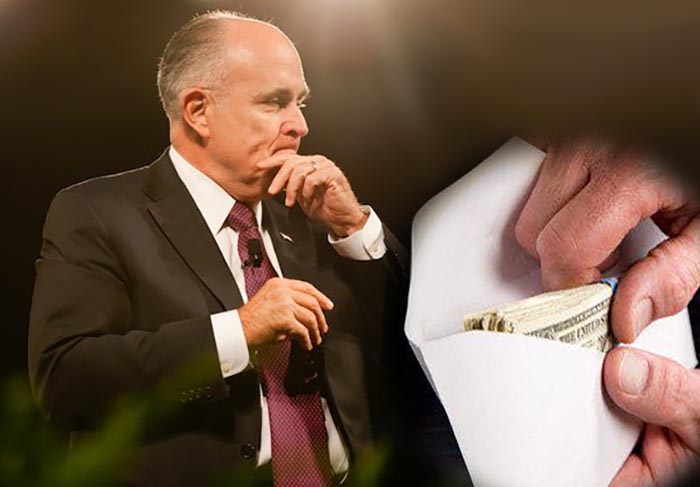
Where’s Rudy Getting the Money?

I mentioned a few days ago that just last March Rudy Giuliani went to Albania to speak before an Iranian exile group which is widely regarded as a cult and was for many years a US-government designated terrorist group. Giuliani is a long-time recipient of money (for speeches and lobbying) from the MEK and its various front groups. (There’s no word yet on what he was paid if anything for the March appearance.)

Did Rudy get paid for this speech, like he has in other cases? How much?

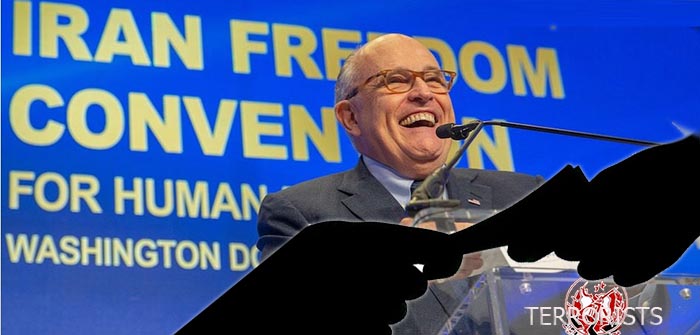
This evening we have news that Giuliani spoke in Washington today before a group called the Organization of Iranian-American Communities and promised that President Trump (for whom Giuliani now works as lead personal lawyer) remains “committed” to regime change in Iran.

I don’t know if Giuliani was paid for this appearance as well. But few if any of the news reports note that the OIAC is a front group for the MeK, the cult group noted above.

It’s not clear to me that as the President’s personal lawyer Giuliani has any disclosure obligations that would reveal his financial ties to the MeK. But he is clearly acting as a representative of the President on Iran policy as well as representing him in the Mueller probe.

By Josh Marshall , talkingpointsmemo.com

May 8, 2018 0 comments
FacebookTwitterPinterestWhatsappTelegramSkypeEmail
Rudy Giuliani
Mujahedin Khalq; A proxy force

Giuliani’s MEK Pandering and Trump’s Iran Obsession

Known Mujahideen-e Khalq (MEK) shill Rudy Giuliani claimed that Trump is on board with pursuing regime change in Iran:

Rudy Giuliani pushed for regime change in Iran on Saturday, saying President Donald Trump is “as committed to regime change as we are.”

Rudy Giuliani

Giuliani has been paid to recite pro-MEK talking points for years, so this might just be more of the same, but considering Trump’s general hostility to Iran it isn’t hard to believe that he supports regime change there. When a long-time MEK advocate is now Trump’s National Security Advisor and another is a member of his legal team, it is not a stretch to think that the president could agree with their fanatical views on Iran. At the very least, Giuliani’s remarks should remind us how dangerous it is if this cult and its allies have influence over U.S. policy towards Iran.

What the Politico article doesn’t explain is that the organization hosting the event where Giuliani spoke is a front organization for the MEK and lobbies on their behalf. Since the MEK is a deranged totalitarian cult that used to be recognized as a terrorist group, it is more than a little misleading to say that their front organization is “a group that aims to promote democracy in the Islamic Republic.” That is certainly what that organization wants Americans to believe, but it would be extremely foolish to take this group or any other linked with MEK at face value.

It bears repeating that the MEK is widely hated in Iran because the group fought against Iran in the Iran-Iraq war, and the vast majority of Iranians wants nothing to do with them. Treating this group or any of its fronts as a legitimate or serious Iranian opposition movement is a horrible mistake, and the former and current officials that support the MEK should be held accountable for helping to promote an awful group in the service of a bad cause that most Iranians don’t support.

By Daniel Larison

May 7, 2018 0 comments
FacebookTwitterPinterestWhatsappTelegramSkypeEmail
Rudy Giuliani
Mujahedin Khalq; A proxy force

The MeK has paid Giuliani handsomely for years

Rudolph W. Giuliani, a Republican Party grandee and President Trump’s newly appointed lawyer, made a telling remark over the weekend. At a gathering organized by a group of activists opposed to Iran’s government, the former New York mayor seemed to suggest that the nuclear deal with Iran was doomed and that the Trump administration anticipated yet more havoc in the Middle East.

“We have a president who is tough,”Giuliani said on Saturday.”We have a president who is as committed to regime change as we are.”Confronting Iran, he added, is”more important than an Israeli-Palestinian deal.”

Since coming to power, Trump has blasted the agreement forged in 2015 between Iran and world powers. He repeatedly lambastes the Obama-era pact as a shameful concession to a rogue state and looks poised to violate its terms by reimposing certain sanctions on Iran later this week. He also apes the views of Washington’s neoconservatives and right-wing Israeli Prime Minister Benjamin Netanyahu, casting the Islamic Republic as the greatest menace facing the Middle East.

But if regime change is on the agenda, Trump has been far more circumspect about how it would happen. Dethroning the mullahs would likely involve waging war against Iran, a prospect at odds with his own stated desire to withdraw from Syria and disentangle the United States from a generation of costly conflicts in the Middle East. Trump tweeted his solidarity when Iranians took to the streets in protests earlier this year, but that has been the extent of his tangible support.

But the more traditional hawks in Trump’s inner circle have no such ambivalence. Newly installed Secretary of State Mike Pompeo has advocated regime change and a bombing campaign of the country, as has the new national security adviser, John Bolton.

Bolton, Giuliani and a host of Washington politicos from both parties have supported — and likely taken money from — front groups directly related to the Mujahideen-e-Khalq (MEK), an Iranian resistance group that operates in exile. Its agents have been implicated in the deaths of Americans and thousands of Iranians, many stemming from its coordination with Iraqi dictator Saddam Hussein in the 1980s amid the war between Baghdad and Tehran.

The MEK was once listed as a terrorist group by the State Department — which also views it as a”cult”— before a sustained lobbying campaign saw its designation changed in 2012. It was behind the event at which Giuliani spoke this weekend, marking yet another episode in his long, cozy relationship with the organization.

“The MeK has paid Giuliani handsomely for years—$20,000 or more, and possibly a lot more—for brief appearances before the group and for lobbying to have it removed from the State Department’s list of Foreign Terrorist Organizations (FTO), which occurred in 2012,”noted Politico.

Jason Rezaian, The Washington Post’s former Tehran correspondent who was detained unjustly by the Iranian regime for a year and a half, points to the widespread contempt for the MEK among ordinary Iranians, who view the organization as a craven, treacherous outfit.

“In the seven years I lived in Iran, many people expressed criticism of the ruling establishment — at great potential risk to themselves,”noted Rezaian.”In all that time, though, I never met a person who thought the MEK should, or could, present a viable alternative.”

Nevertheless, its American allies are now in a commanding position. And in the event of the nuclear deal’s collapse, they may seek to further their ultimate goal of toppling the Islamic Republic.

“To those who claim that the nuclear deal isn’t working, regime change remains the only solution,”wrote Rezaian.”For the MEK, and Bolton, if his words are to be taken at face value, the only path to that could be war. The group has long been prepared to do whatever it takes to see that happen, including presenting fake intelligence about Iran’s nuclear program.”

The Trump camp itself also appears open to the dark arts. Over the weekend, the Guardian alleged that aides linked to Trump recently employed an Israeli intelligence firm to wage a”dirty ops”campaign against Obama administration officials involved in brokering the nuclear deal.”The idea was that people acting for Trump would discredit those who were pivotal in selling the deal, making it easier to pull out of it,”a source told the British newspaper. It remains unclear what became of the research the company conducted.

Trump’s moves against the Iran deal are chiefly motivated by his desire to unwind Obama’s legacy and play to his political base at home. His lieutenants, though, seem ideologically invested in breaking the deal apart, even as a host of domestic critics and European allies urges them to reconsider. Even in Israel, many prominent figures in the country’s security establishment have come out in defense of the agreement, arguing that its demise may play into Tehran’s hands.

“An American announcement that it’s withdrawing from the agreement would let Iran drive a wedge between the world powers and gradually loosen international oversight over its nuclear program,”retired Israeli general Amos Gilad told Haaretz.”If the Americans abandon the agreement, they have to prepare for alternatives, and I don’t see this being done.”

Giuliani’s regime-change comments over the weekend marked the bluntest articulation yet by a Trump aide of a potential”alternative.”That has many others justifiably worried.

“I’m hopeful that one day the Iranian people will find a way to get rid of the Islamic Republic, but I am skeptical about America’s ability to accelerate such a development without unintended consequences, and worried that some of what the hawks propose could make things worse,”wrote Philip Gordon, a former official in the Obama administration.”The Iran nuclear deal is far from ideal, as I and others have always acknowledged, but we live in a messy, complicated world, and sometimes the best actually is the enemy of the good.”

by Ishaan Tharoor

Ishaan Tharoor writes about foreign affairs for The Washington Post. He previously was a senior editor and correspondent at Time magazine, based first in Hong Kong and later in New York.

Follow @ishaantharoor


May 7, 2018 0 comments
FacebookTwitterPinterestWhatsappTelegramSkypeEmail
Rudy Giuliani
Mujahedin Khalq; A proxy force

Rudy Went to Albania to Hang Out with A Iran Regime Change Cult

Mujahideen-e Khalq (MEK) is a notorious cult-like group of Iranian exiles which appears to have close to literally zero support inside Iran but has for years cultivated significant ties to DC Iran “regime change” advocates as well as a bipartisan list of shills willing to take their money (of which they have quite a lot).

It’s an odd group which mixes Islam, Marxism and neocon-inflected DC Pay-to-Play values into a bizarre amalgam run by current cult leader Maryam Rajavi. Until just a few years ago the US State Department listed them as a terrorist organization. They appear to be mainly out of the terrorism business now. But they’re still a treacherous and dangerous group. With all this you’ll be glad to learn that one of their biggest backers is none other than Trump National Security Advisor John Bolton. And perhaps they’re most high profile and ardent supporter (and recipient of their cash) is Rudy Giuliani.

I just found out this afternoon that back in March of this year Rudy traveled to Tirana, Albania to headline a major MEK event. Here you can see him with Rajavi in a North Korea-like pose at the event in Tirana.

Needless to say, Rudy’s close ties to President Trump were played up aggressively.

Here’s Rudy at the Tirana event leading a “regime change” chant after promising the group that John Bolton remains loyal to them and that “you need to be in charge in [Iran].” It’s nuts.

Did Rudy get paid for this speech, like he has in other cases? How much?

By Josh Marshall , talkingpointsmemo.com

May 6, 2018 0 comments
FacebookTwitterPinterestWhatsappTelegramSkypeEmail
Mujahedin Khalq; A proxy force

The Latest Act in Israel’s Iran Nuclear Disinformation Campaign

Israeli Prime Minister Benjamin Netanyahu’s claim in his theatrical 20-minute presentation of an Israeli physical seizure of Iran’s “atomic archive” in Tehran would certainly have been the “great intelligence achievement” he boasted if it had actually happened. But the claim does not hold up under careful scrutiny, and his assertion that Israel now possesses a vast documentary record of a covert Iranian nuclear weapons program is certainly fraudulent.

Netanyahu’s tale of an Israeli intelligence raid right in Tehran that carted off 55,000 paper files and another 55,000 CDs from a “highly secret location” requires that we accept a proposition that is absurd on its face: that Iranian policymakers decided to store their most sensitive military secrets in a small tin-roofed hut with nothing to protect it from heat (thus almost certainly ensuring loss of data on CDs within a few years) and no sign of any security, based on the satellite image shown in the slide show. (As Steve Simon observed in The New York Times the door did not even appear to have a lock on it.)

The laughable explanation suggested by Israeli officials to The Daily Telegraph– that the Iranian government was afraid the files might be found by international inspectors if they remained at “major bases” — merely reveals the utter contempt that Netanyahu has for Western governments and news media. Even if Iran were pursuing nuclear weapons secretly, their files on the subject would be kept at the Ministry of Defense, not at military bases. And of course the alleged but wholly implausible move to an implausible new location came just as Netanyahu needed a dramatic new story to galvanize Trump to resist the European allies’ strong insistence on preserving the Joint Comprehensive Plan of Act (JCPOA) nuclear deal with Iran.

In fact, there is no massive treasure trove of secret files about an Iran “Manhattan Project.” The shelves of black binders and CDs that Netanyahu revealed with such a dramatic flourish date back to 2003 (after which a U.S. National Intelligence Estimate (NIE) said Iran had abandoned any nuclear weapons program) and became nothing more than stage props like the cartoon bomb that Netanyahu used at the United Nations in 2012.

Disinformation Campaign

Netanyahu’s claim about how Israel acquired this “atomic archive” is only the latest manifestation of a long-term disinformation campaign that the Israeli government began to work on in 2002-03. The documents to which Netanyahu referred in the presentation were introduced to the news media and the International Atomic Energy Agency (IAEA) beginning in 2005 as coming originally from a secret Iranian nuclear weapons research program. For many years US news media have accepted those documents as authentic. But despite the solid media united front behind that narrative, we now know with certainty that those earlier documents were fabrications and that they were created by Israel’s Mossad.

That evidence of fraud begins with the alleged origins of the entire collection of documents. Senior intelligence officials in the George W. Bush administration had told reporters that the documents came from “a stolen Iranian laptop computer”, as The New York Times reported in November 2005. The Times quoted unnamed intelligence officials as insisting that the documents had not come from an Iranian resistance group, which would cast serious doubt on their reliability.

But it turned that the assurances from those intelligence officials were part of an official dissimulation. The first reliable account of the documents’ path to the United States came only in 2013, when former senior German foreign office official Karsten Voigt, who retired from his longtime position as coordinator of German-North American cooperation, spoke with this writer on the record.

Voigt recalled how senior officials of the German foreign intelligence agency, the Bundesnachtrendeinst or BND, had explained to him in November 2004 that they were familiar with the documents on the alleged Iran nuclear weapons program, because a sometime source – but not an actual intelligence agent – had provided them earlier that year. Furthermore, the BND officials explained that they had viewed the source as “doubtful,” he recalled, because the source had belonged to the Mujahideen-E Khalq, the armed Iranian opposition group that had fought Iran on behalf of Iraq during the eight year war.

BND officials were concerned that the Bush administration had begun citing those documents as evidence against Iran, because of their experience with “Curveball” – the Iraqi engineer in Germany who had told stories of Iraqi mobile bioweapons labs that had turned to be false. As a result of that meeting with BND officials, Voigt had given an interview to TheWall Street Journal in which he had contradicted the assurance of the unnamed US intelligence officials to the Times and warned that the Bush administration should not base its policy on the documents it was beginning to cite as evidence of an Iranian nuclear weapons program, because they had indeed come from “an Iranian dissident group.”

Using the MEK

The Bush administration’s desire to steer press coverage of the supposedly internal Iranian documents away from the MEK is understandable: the truth about the MEK role would immediately lead to Israel, because it was well known, that Israel’s intelligence agency Mossad had used the MEK to make public information that the Israelis did not want attributed to itself – including the precise location of Iran’s Natanz enrichment facility. As Israeli journalists Yossi Melman and Meir Javadanfar observed in their 2007 book on the Iran nuclear program, based on U.S., British and Israeli officials, “Information is ‘filtered’ to the IAEA via Iranian opposition groups, especially the National Resistance Council of Iran.”

Mossad used the MEK repeatedly in the 1990s and the early 2000’s to get the IAEA to inspect any site the Israelis suspected might possibly be nuclear-related, earning their Iranian clients a very poor reputation at the IAEA. No one familiar with the record of the MEK could have believed that it was capable of creating the detailed documents that were passed to the German government. That required an organization with the expertise in nuclear weapons and experience in fabricating documents – both of which Israel’s Mossad had in abundance.

Bush administration officials had highlighted a set of 18 schematic drawings of the Shahab-3 missile’s reentry vehicle or nosecone of the missile in each of which there was a round shape representing a nuclear weapon. Those drawings were described to foreign governments and the International Atomic Energy Agency as 18 different attempts to integrate a nuclear weapon into the Shahab-3.

Netanyahu gave the public its first glimpse of one of those drawings Monday when he pointed to it triumphantly as visually striking evidence of Iranian nuclear perfidy. But that schematic drawing had a fundamental flaw that proved that it and others in the set could not have been genuine: it showed the “dunce cap” shaped reentry vehicle design of the original Shahab-3 missile that had been tested from 1998 to 2000. That was the shape that intelligence analysts outside Iran had assumed in 2002 and 2003 Iran would continue to use in its ballistic missile.

New Nose Cone

It is now well established, however, that Iran had begun redesigning the Shahab-3 missile with a conical reentry vehicle or nosecone as early as 2000 and replaced it with a completely different design that had a “triconic” or “baby bottle” shape. It made it a missile with very different flight capabilities and was ultimately called the Ghadr-1. Michael Elleman, the world’s leading expert on Iranian ballistic missiles, documented the redesign of the missile in his path-breaking 2010 study of Iran’s missile program.

Iran kept its newly-designed missile with the baby bottle reentry vehicle secret from the outside world until its first test in mid-2004. Elleman concluded that Iran was deliberately misleading the rest of the world – and especially the Israelis, who represented the most immediate threat of attack on Iran – to believe that the old model was the missile of the future while already shifting its planning to the new design, which would bring all of Israel within reach for the first time.

The authors of the drawings that Netanyahu displayed on the screen were thus in the dark about the change in the Iranian design. The earliest date of a document on the redesign of the reentry vehicle in the collection obtained by US intelligence was August 28, 2002 – about two years after the actual redesign had begun. That major error indicates unmistakably that the schematic drawings showing a nuclear weapon in a Shahab-3 reentry vehicle – what Netanyahu called “integrated warhead design” were fabrications.

Netanyahu’s slide show highlighted a series of alleged revelations that he said came from the newly acquired “atomic archive” concerning the so-called “Amad Plan” and the continuation of the activities of the Iranian who was said to have led that covert nuclear weapons project. But the single pages of Farsi language documents he flashed on the screen were also clearly from the same cache of documents that we now know came from the MEK-Israeli combination. Those documents were never authenticated, and IAEA Director-General Mohamed ElBaradei, who was skeptical of their authenticity, had insisted that without such authentication, he could not accuse Iran of having a nuclear weapons program.

More Fraud

There are other indications of fraud in that collection of documents as well. A second element of the supposed covert arms program given the name “Amad Plan” was a “process flow chart” of a bench-scale system for converting uranium ore for enrichment. It had the code name “Project 5.13”, according to a briefing by the IAEA Deputy Director Olli Heinonen, and was part of a larger so-called “Project 5”, according to an official IAEA report. Another sub-project under that rubric was “Project 5.15”, which involved ore processing at the Gchine Mine.” Both sub-projects were said to be carried out by a consulting firm named Kimia Maadan.

But documents that Iran later provided to the IAEA proved that, in fact, “Project 5.15” did exist, but was a civilian project of the Atomic Energy Organization of Iran, not part of a covert nuclear weapons program, and that the decision had been made in August 1999 – two years before the beginning of the alleged “Amad Plan” was said to have begun.

The role of Kimia Maadan in both sub-projects explains why an ore processing project would be included in the supposed secret nuclear weapons program. One of the very few documents included in the cache that could actually be verified as authentic was a letter from Kimia Maadan on another subject, which suggests that the authors of the documents were building the collection around a few documents that could be authenticated.

Netanyahu also lingered over Iran’s denial that it had done any work on “MPI” or (“Multi-Point Initiation”) technology “in hemispheric geometry”. He asserted that “the files” showed Iran had done “extensive work” or “MPI” experiments. He did not elaborate on the point. But Israel did discover the alleged evidence of such experiments in a tin-roofed shack in Tehran. The issue of whether Iran had done such experiments was a central issue in the IAEA’s inquiry after 2008. The agency described it in a September 2008 report, which purported to be about Iran’s “experimentation in connection with symmetrical initiation of a hemispherical high explosive charge suitable for an implosion type nuclear device.”

No Official Seals

The IAEA refused to reveal which member country had provided the document to the IAEA. But former Director-General ElBaradei revealed in his memoirs that Israel had passed a series of documents to the Agency in order to establish the case that Iran had continued its nuclear weapons experiments until “at least 2007.” ElBaradei was referring to convenient timing of the report’s appearance within a few months of the US NIE of November 2007 concluding that Iran had ended its nuclear weapons-related research in 2003.

Netanyahu pointed to a series of documents on the screen as well a number of drawings, photographs and technical figures, and even a grainy old black and white film, as evidence of Iran’s nuclear weapons work. But absolutely nothing about them provides an evidentiary link to the Iranian government. As Tariq Rauf, who was head of the IAEA’s Verification and Security Policy Coordination Office from 2002 to 2012, noted in an e-mail, none of the pages of text on the screen show official seals or marks that would identify them as actual Iranian government documents. The purported Iranian documents given to the IAEA in 2005 similarly lacked such official markings, as an IAEA official conceded to me in 2008.

Netanyahu’s slide show revealed more than just his over-the-top style of persuasion on the subject of Iran. It provided further evidence that the claims that had successfully swayed the US and Israeli allies to join in punishing Iran for having had a nuclear weapons program were based on fabricated documents that originated in the state that had the strongest motive to make that case – Israel.

Gareth Porter, an investigative historian and journalist specializing in US national security policy, received the UK-based Gellhorn Prize for journalism for 2011 for articles on the U.S. war in Afghanistan. His new book is Manufactured Crisis: the Untold Story of the Iran Nuclear Scare. He can be contacted at porter.gareth50@gmail.com. Reprinted from Consortium News with the author’s permission.

by Gareth Porter

May 6, 2018 0 comments
FacebookTwitterPinterestWhatsappTelegramSkypeEmail
Asqar Kamyab Dad
Mujahedin Khalq Organization members' families

I’m counting down the minutes, till my son’s return

Mr. Asghar Mohammadi Kamyab was a 18- year old soldier at Iran-Iraq war fighting the invading forces and defending his countries’ soil. In 1986 he was captured by the Mujahedin-e Khalq forces.

Since then Asghar’s family succeeded to visit him just once in 2002 under the severe control of the MKO elements. Asghar’s mother says:” I couldn’t talk to my dear son alone, still his eyes revealed everything. He was full of anxiety, hopelessness and distress… . Though I could understand my son’s feelings, I could do nothing… ”

In July 2017, the Kamyab family went to the MKO Camps once more to visit Asghar or at least get a news of him. However the cult leaders did not let them meet.

Asghar’s father says:” I’m counting down the minutes, till my son’s return “

May 3, 2018 0 comments
FacebookTwitterPinterestWhatsappTelegramSkypeEmail
Azim Alizadeh family - the mko cult hostage
Mujahedin Khalq Organization members' families

My brother is denied the right to live freely

Mr. Azim Alizadeh Rad was a prisoner of Iran-Iraq war when the Mujahedin-e Khalq deceived him into joining the group.

Azim Alizadeh family - the mko cult hostage

His suffering mother attended the Nejat Society office of Gilan branch along with her other son, Kazem. The aging mother says:” … despite our efforts and several travels to Iraq, Camps Ashraf and liberty, we couldn’t meet our dear Azim. We were harassed and offended by the cult elements. Albania differs from Iraq however. Albania is a European country. How does it come that we cannot visit our dear ones in that country?!I am sure that some deals are done behind the scene…”

Azim Alizadeh family - the MKO cult hostage

Mr. Kazem Alizadeh rad says:” my brother was a soldier… he has been denied the right to live a real life for more than thirty years..”

May 1, 2018 0 comments
FacebookTwitterPinterestWhatsappTelegramSkypeEmail
torture
Albania

Albania! Be careful of torture and abuse in the MKO camps

When in May2005, the Human Rights Watch published the NO Exit report on the human rights abuses committed by the Mojahedin Khalq Organization (MKO/MEK/ PMOI/ the Cult of Rajavi), the group’s propaganda made efforts to deny the facts that were testified based on numerous testimonies by former members of the group. The HRW responded to the allegations of the group’s propaganda and its paid supporters in a detailed report in February 2006.

MEK Camp in Albania

The report revealed cases of human rights abuses inside the MKO’s military camps in Iraq from 1991 to February 2003, prior to the fall of their former landlord Saddam Hussein .One of the most horrific cases of imprisonment and torture in Camp Ashraf was Parviz Ahmadi who died due to severe beating and torture.

The death of Parviz is meticulously explained in the newly published book by Mohsen Zaal, titled “the Organization of Massoud” based on the testimonies of former members of the MKO:

“In another case, Parviz Ahmadi is picked up by Asadullah Mosana’s Jeep after he comes back from a dentist’s office in Baghdad. Under the pretext that the female commander Batul Rajaiee has summoned him, he is taken to prison. He is interrogated at the very night and is thrown in the cell after a few hours with torn clothes, swollen face and beaten body. He is being severely tortured even in the corridor to the cell where some of the men who are under his command are imprisoned too.

“He is faced with people who were once under his command and now he is beaten and accused of spying before their eyes. This is a disaster for him; he cries all night long. In the morning, one of the men of his unit tries to sympathize with him offer sympathy to him. This is a very unique rare moment in the organization. Two comrades get close to each other and make a personal and humane relationship rather than organizational relations which is dominated by cold regulations and duties.[…]

“Parviz accepts the cigarettes his cellmates offers him although he is not a smoker. Speaking sadly he tells them that he is accused of being the agent of the Iranian Intelligence Ministry to assassinate the Ideological leader [Massoud Rajavi]. However, some of the prisoners guess that this is a test to select operatives for the next cross border operation teams. Some others think that this is an ideological test to evaluate member’s loyalty to the organization and the leader.

“The next day Parvis is taken by Mokhtar and Nariman for interrogation an hour before Iftar [the meal after sunset in Ramadan fast] and is thrown back to the cell hours after midnight at Sahar [the meal before sunrise in Ramadan]. His catastrophic condition shocks his cellmates. He is just identifiable by his clothes. His face is awfully swollen and bruised, his nose and ears are broken and bloody. He cannot breathe by his nose. He cannot open his swollen injured eyes. Fingers are broken, hands are bruised up to elbows. His pants are torn. Legs are wounded and completely bruised. The cellmates try to help him to breathe better. They ask Mokhtar to give them some warm water but he refuses saying that “this mercenary is showing off. He is OK”. Then he closes the window of the cell and leaves. Parviz gets a seizure and passes away in the arms of one of his comrades before the tearing eyes of his cellmates. They call to Mokhtar. He takes Parviz’s dead body to the corridor indifferently. After a while Mokhtar gets back and tells Parviz’s cellmates,” Save Parviz’ meal. He will get back”. But Parviz never gets back to the cell and is not seen in the group anymore. (Jamali/ 6)

“After the death of Parviz, Massoud Rajavi brings up his case in a meeting. Admiring him, Massoud calls Parviz a martyr. He claims that Parviz has been killed in a clash with Iranian forces in Kermanshah. He even gives some details on the location and the way he was killed. (Mesdaghi/ 92/136)”

According to the writer of “the Organization of Massoud”, imprisonment and eventually torture and assassination of the rank and file increased after the dissension was on the rise in the group. During the 1990s a large number of members had started challenging the group’s attitudes. So a large number of members were arrested by the authorities of the group under the charge of being the agents of the Iranian government. The estimated number of detainees mounts from 250 to 800 people. The number is not clear because imprisonments were secret until the fall of Saddam Hussein.

That situation is very similar to the conditions ruling inside the group in Albania now. There are a large number of dissident members who seek to leave the group but they are intimidated by the group leaders who use any tools to keep members in the Cult of Rajavi.

The Albanian government and the UNHCR authorities should be watchful about what is going on inside the MKO. Human rights violations are committed in the destructive cults on the daily basis. The MKO is actually proved to be a destructive cult and documented facts about various cases of human rights abuses including the HRW report are quiet accessible to everyone.

By Mazda Parsi

April 29, 2018 0 comments
FacebookTwitterPinterestWhatsappTelegramSkypeEmail
Newer Posts
Older Posts

Recent Posts

  • The black box of the torture camps of the MEK

    December 24, 2025
  • Pregnancy was taboo in the MEK

    December 22, 2025
  • MEPs who lack awareness about the MEK’s nature

    December 20, 2025
  • Why did Massoud Rajavi enforce divorces in the MEK?

    December 15, 2025
  • Massoud Rajavi and widespread sexual abuse of female members

    December 10, 2025
  • Facebook
  • Twitter
  • Instagram
  • Youtube

© 2003 - 2025 NEJAT Society . All Rights Reserved. NejatNGO.org


Back To Top
Nejat Society
  • Home
  • Articles
  • Media
    • Cartoons
    • NewsPics
    • Photo Gallery
    • Videos
  • Publications
    • Books
    • Nejat NewsLetter
    • Pars Brief
  • About Us
  • Contact us
  • Editions
    • عربي
    • فارسی
    • Shqip