Nejat Society
  • Home
  • Articles
  • Media
    • Cartoons
    • NewsPics
    • Photo Gallery
    • Videos
  • Publications
    • Books
    • Nejat NewsLetter
    • Pars Brief
  • About Us
  • Contact us
  • Editions
    • عربي
    • فارسی
    • Shqip
Nejat Society
Nejat Society
  • Home
  • Articles
  • Media
    • Cartoons
    • NewsPics
    • Photo Gallery
    • Videos
  • Publications
    • Books
    • Nejat NewsLetter
    • Pars Brief
  • About Us
  • Contact us
  • Editions
    • عربي
    • فارسی
    • Shqip
© 2003 - 2024 NEJAT Society. nejatngo.org
NIAC
Mujahedin Khalq; A proxy force

With Bolton Pick, Trump is Assembling an Iran War Cabinet

Washington, DC – Trita Parsi, President of the National Iranian American Council, issued the following statement regarding the appointment of John Bolton as National Security Advisor:
NIAC

“Donald Trump may have just effectively declared war on Iran. With the appointment of John Bolton, and nomination of Mike Pompeo at State, Trump is clearly putting together a war cabinet. As the world awaits Trump’s May 12 decision as to whether he will abandon the Iran nuclear deal, all of the signs now point to a decision to move to war footing.

“Bolton is an unhinged advocate for waging World War III. He has explicitly called for bombing Iran for the past ten years and has suggested the U.S. engage in nuclear first strikes in North Korea. Bolton’s first order of business will be to convince Trump to exit the Iran nuclear deal and lay the groundwork for the war he has urged over the past decade. Additionally, he has has called for ending all visas for Iranians, shipping bunker busting weapons to Israel, and supporting the Mujahedin-e Khalq (MEK) terrorist organization and other separatist groups inside of Iran. The Iranian-American community and our pro-peace, pro-human rights allies will organize to stop Bolton’s plans from becoming a reality.

“Congress must do everything in its power to convince Trump to reconsider this decision and exert maximal pressure to constrain Bolton’s ability to impose irreparable harm to the U.S. and global security. To begin with, the Senate must block Mike Pompeo from becoming Secretary of State.

“Bolton now represents the greatest threat to the United States. This is a dangerous time for our country and a slap in the face even to Trump’s supporters who thought he would break from waging disastrous foreign wars and military occupations.“Bolton was a key player in the march to the disastrous war in Iraq that Trump has criticized as a major foreign policy blunder. He famously demonstrated that he was a ‘kiss-up, kick-down sorta guy’ who dismissed intelligence on Iraq’s WMD program that didn’t fit his predetermined policy preference. The fact that one of Trump’s key advisers is likely to stroke the President’s ego while blocking key intelligence or intimidating any objective analysts that might be underneath him is of deep concern. Of further concern, Bolton fails to acknowledge that the Iraq war was a mistake and only regrets that the Bush administration didn’t overthrow more countries while it was in office.

“Bolton’s ties to the cultish MEK should also immediately disqualify him. Bolton routinely meets with and accepts payments from the group – which has murdered Iranians and American service members alike and is deeply unpopular among ordinary Iranians. Yet, Bolton sees this illegitimate group that commits human rights abuses against its own members as a ‘viable opposition’ that he wants to use to overthrow the Iranian government. Bolton promised an MEK crowd last July, before 2019, we here will celebrate in Tehran!’”

NIAC Staff
April 10, 2018 0 comments
FacebookTwitterPinterestWhatsappTelegramSkypeEmail
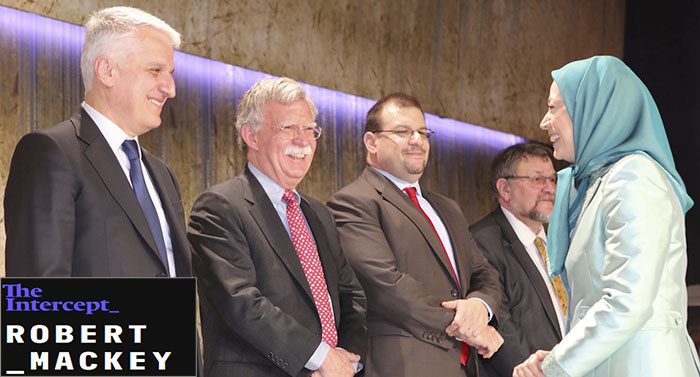
Bolton and Rajavi
Mujahedin Khalq; A proxy force

Here’s John Bolton Promising Regime Change in Iran by the End of 2018

Among those most alarmed by President Donald Trump’s selection of John Bolton as his new national security adviser on Thursday were supporters of the Iran nuclear deal, the 2015 international agreement that curbed Iran’s nuclear program in exchange for a partial lifting of economic sanctions.

Rob Malley, who coordinated Middle East policy in the Obama administration, observed that Bolton’s appointment, along with the nomination of Iran deal critic Mike Pompeo as secretary of state, seemed to signal that the agreement would most likely be “dead and buried” within months. Trita Parsi, leader of the National Iranian American Council wrote on Twitter: “People, let this be very clear: The appointment of Bolton is essentially a declaration of war with Iran. With Pompeo and Bolton, Trump is assembling a WAR CABINET.”

Their alarm was understandable. Bolton, who made his name as a belligerent member of George W. Bush’s State Department and a Fox News contributor, has not only demanded that the Trump administration withdraw from the nuclear deal, he also previously advocated bombing Iran instead. Bolton has spent the better part of a decade calling for the United States to help overthrow the theocratic government in Tehran and hand power to a cult-like group of Iranian exiles with no real support inside the country.

Withdrawing from the Iran #NuclearDeal should be a top @realDonaldTrump administration priority.

— John Bolton (@AmbJohnBolton) July 17, 2017

Just eight months ago, at a Paris gathering, Bolton told members of the Iranian exile group, known as the Mujahedeen Khalq, MEK, or People’s Mujahedeen, that the Trump administration should embrace their goal of immediate regime change in Iran and recognize their group as a “viable” alternative.

“The outcome of the president’s policy review should be to determine that the Ayatollah Khomeini’s 1979 revolution will not last until its 40th birthday,” Bolton said. (The 40th anniversary of the Iranian revolution will be on February 11, 2019.) “The declared policy of the United States should be the overthrow of the mullahs’ regime in Tehran,” Bolton added. “The behavior and the objectives of the regime are not going to change and, therefore, the only solution is to change the regime itself.”

As the Iranian expatriate journalist Bahman Kalbasi noted, Bolton concluded his address to the exiles with a rousing promise: “And that’s why, before 2019, we here will celebrate in Tehran!”

#JohnBolton 8 months ago among MEK supporters tells them they will overthrow #Iran’s regime and celebrate in #Tehran with Bolton himself present, “before 2019” pic.twitter.com/H7oaaU3faU

— Bahman Kalbasi (@BahmanKalbasi) March 22, 2018

To understand how extraordinary it is that the man about to become the president’s most senior national security official made this promise to the MEK, it is important to know that, until recently, the Iranian dissidents had spent three decades trying to achieve their aims through violence, including terrorist attacks.

After members of the MEK helped foment the 1979 revolution, in part by killing American civilians working in Tehran, the group then lost a bitter struggle for power to the Islamists led by the revolution’s leader, Ayatollah Ruhollah Khomeini. With its leadership forced to flee Iran in 1981, the MEK’s members set up a government-in-exile in France and established a military base in Iraq, where they were given arms and training by Saddam Hussein, as part of a strategy to destabilize the government in Tehran that he was at war with.

In recent years, as The Intercept has reported, the MEK has poured millions of dollars into reinventing itself as a moderate political group ready to take power in Iran if Western-backed regime change ever takes place. To that end, it lobbied successfully to be removed from the State Department’s list of foreign terrorist organizations in 2012. The Iranian exiles achieved this over the apparent opposition of then-Secretary of State Hillary Clinton, in part by paying a long list of former U.S. officials hefty speaking fees of between $10,000 to $50,000 for hymns of praise like the one Bolton delivered last July.

But, according to Ariane Tabatabai, a Georgetown University scholar, the “cult-like dissident group” — whose married members were reportedly forced to divorce and take a vow of lifelong celibacy — “has no viable chance of seizing power in Iran.”

If the current government is not Iranians’ first choice for a government, the MEK is not even their last — and for good reason. The MEK supported Saddam Hussein during the Iran-Iraq War. The people’s discontent with the Iranian government at that time did not translate into their supporting an external enemy that was firing Scuds into Tehran, using chemical weapons and killing hundreds of thousands of Iranians, including many civilians. Today, the MEK is viewed negatively by most Iranians, who would prefer to maintain the status quo than rush to the arms of what they consider a corrupt, criminal cult.

Despite such doubts that the MEK’s political wing, the National Council of Resistance of Iran, is any more reliable than Ahmad Chalabi’s Iraqi National Congress proved to be, spending lavishly on paid endorsements has earned the group a bipartisan roster of Washington politicians willing to sign up as supporters. At a previous gala, in 2016, Bolton was joined in singing the group’s praises by another former U.N. ambassador, Bill Richardson; a former attorney general, Michael Mukasey; the former State Department spokesperson P.J. Crowley; the former Homeland Security adviser Frances Townsend; the former Rep. Patrick Kennedy, D-R.I.; and the former Vermont Gov. Howard Dean. That Paris gala was hosted by Linda Chavez, a former Reagan administration official.

At a similar event this January, the backdrop behind former Speaker of the House Newt Gingrich, as he praised MEK leader Maryam Rajavi, made the aim of the group’s investment in American politicians clear.

Unsurprisingly, leading figures from among the exile group’s Washington followers have expressed delight over Bolton’s impending elevation to the White House

.@AmbJohnBolton has the right vision and great understanding of the whole region especially the threat from the Iranian regime and the need for a #FreeIran. https://t.co/zlJocvDwgT

— Alireza Jafarzadeh (@A_Jafarzadeh) March 22, 2018

Congratulations to @AmbJohnBolton for the new post. Well deserved. https://t.co/TuXgvx9ApY

— Shirin Nariman (@ShirinNariman) March 22, 2018

At the group’s celebration of Nowruz, the Persian New Year, in Albania on Tuesday, Rajavi was joined on stage by Rudy Giuliani, the former mayor of New York City.

Mr. Giuliani reiterated that unlike other countries in the region, there is an alternative to the ruling regime in Iran. Thus, its overthrow will lead to peace and tranquillity in a region that has been severely threatened by the clerical regime.#Iran#IranProtests pic.twitter.com/BFb5fWcFgs

— Maryam Rajavi (@Maryam_Rajavi) March 20, 2018

Although the official announcement from the White House was not made until Thursday, Giuliani told the group, to loud applause, that Bolton “is going to be President Trump’s national security adviser.”

In case there was any doubt among the exiles that Bolton might not advise Trump to overthrow Iran’s government, Giuliani assured them that “if anything, John Bolton has become more determined that there needs to be regime change in Iran, that the nuclear agreement needs to be burned, and that you need to be in charge of that country.”

Moments later, Giuliani led the crowd in chanting “regime change.”

Despite the fact that Trump ran for office as a critic of the decision to invade Iraq, Bolton still refuses to call the preemptive attack a mistake. That position stunned even Fox News’s Tucker Carlson, during an interview two weeks ago. After Carlson pointed out that Bolton had called for regime change in Iraq, Libya, Iran, and Syria, and the first of those had been “a disaster,” Bolton disagreed, saying, “I think your analysis is simple-minded, frankly.”

“I think the overthrow of Saddam Hussein, that military action, was a resounding success,” Bolton told Carlson. The chaos that followed in Iraq, he said, was caused by a poorly executed occupation that ended too soon. On the bright side, Bolton said, the mistakes the U.S. made in Iraq offered “lessons about what to do after a regime is overthrown” in the future.

The Intercept.com, Robert Mackey

April 10, 2018 0 comments
FacebookTwitterPinterestWhatsappTelegramSkypeEmail
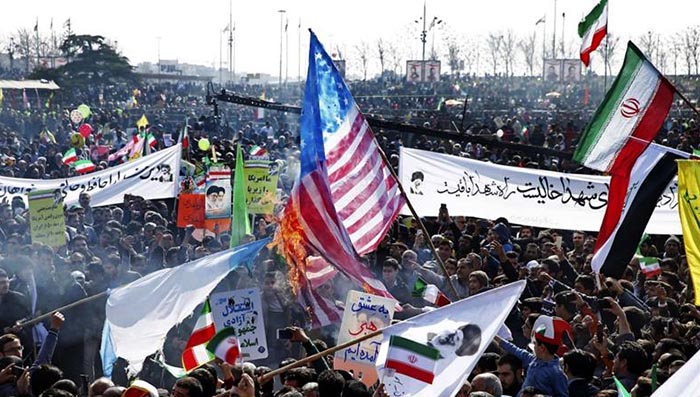
Iran rally
Mujahedin Khalq; A proxy force

There are no viable alternatives that Trump could bring to power in Iran

By choosing Mike Pompeo as his new Secretary of State and John Bolton as National Security Adviser, US President Donald Trump has formed a hawkish anti-Iran team, indicating that he is planning to bypass diplomacy, scrap the Iran nuclear deal and possibly resort to regime change or military action.

Iran rally

Trump’s anti-Iran team is backed by its regional allies. He held meetings at the White House with Israeli Prime Minister Benjamin Netanyahu on March 5 and Saudi Crown Prince Mohammed bin Salman on March 20 to seal the cooperation. Additionally, on March 23, American, Saudi and UAE national security advisers got together in the White House to discuss how “to counter the Iranian regime’s malign influence and provocative behaviour”.

President Trump may have his teams in place, but it still won’t be easy for him to take decisive action on Iran. Trump is expected to scrap the nuclear deal in May as a first step, however, even this won’t be an easy decision for him to make. In the same month, he is planning to hold a crucial first meeting with North Korean leader Kim Jong-un, who would likely be disinclined to trust a president who has just opted out of an international accord.

He may decide to face all possible repercussions and scrap the deal anyway, but then he would be left with an even harder question: what to do with Iran after breaking the deal? His most likely option would be to try and create some form of chaos to destabilise Iran and push the Iranian establishment out of its comfort zone so the US can dictate terms and get the upper hand.This could be through sending logistic and financial support to the opposition inside Iran, funding proxy “terror” attacks, meddling in elections or supporting internal protests and demonstrations.

Even though there is widespread anger in the country about lack of economic progress; the leaderless and unorganised opposition forces in Iran are unlikely to knowingly cooperate with the US to topple the Iranian establishment. They know that any such move would be brutally dealt with by Iran’s security forces. Also, the memory of the 1953 coup instigated by the US is still fresh in Iranians’ minds so it is unlikely that the opposition would support another US-backed coup or regime change.

Moreover, the strongest opposition force in Iran is already in power. Moderate President Hassan Rouhani has formed an alliance with the reformist camps, and together they are pushing for creating openings within the system through the very limited means available to them. Their mode of cooperation with the West was through the Iran nuclear deal and scrapping it would be the last straw for them.

John Bolton has in the past advocated a joint attack by Israel and the US on Iran’s nuclear facilities, combined with “vigorous American support for Iran’s opposition, aimed at regime change in Tehran”. This is a futile and dangerous solution.

Attacking Iran’s nuclear installations would provoke a fierce response from Iran’s Revolutionary Guard Corps (IRGC), engulfing the entire region and possibly leading to confrontation with Israel.

The idea of regime change without a viable alternative has also proved problematic in the most recent cases of Iraq and Libya. The seven-year US attempt at replacing Bashar al-Assad of Syria has also failed.

Moreover, Bolton advocates bringing to power in Iran a former “terrorist” group, Mujahedin-E Khalq Organisation (MEK), which he regards as a “viable” alternative to the Islamic Republic.

Bolton’s belief in the MEK is ill-founded. The group with a catalogue of human rights abuses has an ideology that blends Islam and Marxism and is referred to as “a cult” by some experts. Although it claims to have adopted moderate policies since 2012 when it was removed from the US “terror” list, most Iranians continue to take a strong exception to its decision to fight in support of Saddam Hussein during the Iran-Iraq War in the 1980s.

Research at Boston College shows that the US tried to change other countries’ governments 72 times during the Cold War and in 66 cases this was done by covert action. According to the data, most of these attempts failed, demonstrating that attempts at regime change “rarely work out as the intervening states expect”.

Moreover, 40 percent of the states that have had foreign-imposed governments have experienced civil wars within the next 10 years.

These results prove that when a regime is dictatorial or corrupt, there are complex underlying reasons that cannot simply be resolved through “regime change”.

“Americans are pushing for harder policies towards Iran, and we need to strengthen our view towards the East, especially China and Russia,” Alaeddin Boroujerdi, head of Iranian parliament‘s National Security Commission told ISNA news agency.

President Trump’s trade war with China, his unprecedented diplomatic war with Russia, combined with the hardening of his stance towards Iran can only further strengthen Iran’s military and economic ties with the two eastern powers to the detriment of the West.

With Russia and Iran both isolated, they would cooperate more on covert action in areas of particular US interest such as Afghanistan and consolidate their victories in Syria. Iran would pour far more funds in support of Hezbollah, Palestinians, the Assad regime, and the Houthis in Yemen.

As of March 2018, the Trump administration has moved away from diplomacy towards increasing the deployment of special operations forces to 149 countries – up from 138 in 2016.

Trump certainly appears to have all but lost the chance to create some kind of platform for direct talks with Iran. But his options for an alternative, hawkish approach also seems to be extremely limited.

The views expressed in this article are the author’s own and do not necessarily reflect Al Jazeera’s editorial stance.

by Massoumeh Torfeh

April 9, 2018 0 comments
FacebookTwitterPinterestWhatsappTelegramSkypeEmail
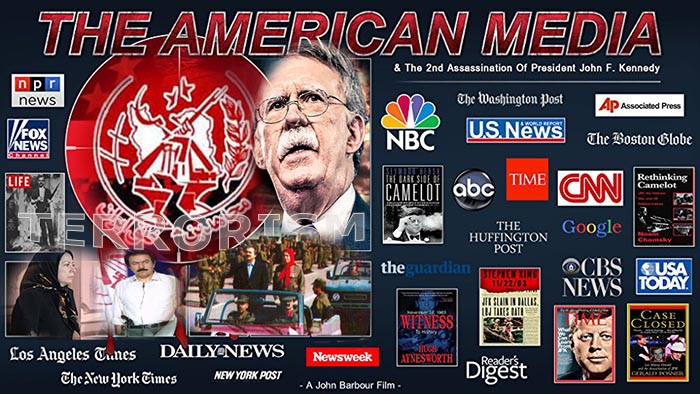
US_Media_MKO
Mujahedin Khalq; A proxy force

Shameful Truth about the MKO in the American Media

The appointment of John Bolton as US national security adviser by the US president Donald Trump opened an opportunity for journalists and analysts to loom light on Bolton’s notorious connections with the Mujahedin Khalq Organization (the MKO/ MEK/ PMOI/ the Cult of Rajavi). Many reports and articles were eventually published in the American media to warn about the MKO’s threat for the US foreign policy following the appointment of Bolton since as he is a long standing supporter of the formerly-terrorist designated group, the MKO.

US_Media_MKO

The analysis included five aspects of the MKO’s nature:

Totalitarian Cult

Daniel Larison of the American Conservative, a long standing critic of the MKO, posted several articles on the MKO-Bolton ties in the magazine. “The MEK may not be on the U.S. list of foreign terrorist organizations any longer, but it is still a disreputable and despicable group”, he writes. “It is considered a totalitarian cult for good reason.”

Jason Rezaian explains why the MKO is considered a cult: “But it is the group’s activities in the decades since that have cemented its reputation as a deranged cult. For decades its command center was a compound in Iraq’s Diyala province, where more than 3,000 members lived in virtual captivity. The few who were able to escape told of being cut off from their loved ones, forced into arranged marriages, brainwashed, sexually abused and tortured.

“All this was carried out under the supervision of the group’s leaders, Massoud and Maryam Rajavi, the husband and wife at the top of the organization’s pyramid.”

Terrorist entity

“MEK are Terrorists, Even According to Their US Sponsors”, wrote Tony Cartalucci at the New Eastern Outlook. “Despite claims by a growing army of MEK advocates spanning various social media platforms, MEK is without doubt a dangerous terrorist organization. Even those seeking to sponsor MEK as a militant proxy against Iran have admitted as much.”

Cartalucci states that the US State Department admits that the organization carried out terrorism in the past and continues today with abuses toward its own members. The US State Department’s 2012 statement titled, “Delisting of the Mujahedin-e Khalq” would claim:

“With today’s actions, the Department does not overlook or forget the MEK’s past acts of terrorism, including its involvement in the killing of U.S. citizens in Iran in the 1970s and an attack on U.S. soil in 1992. The Department also has serious concerns about the MEK as an organization, particularly with regard to allegations of abuse committed against its own members.”

Larison cites from Elizabeth Rubin the prominent journalist of the New York Times Magazine who was the first to call the MKO as “the Cult of Rajavi” in an article titled the same in June 2003. Rubin had also written about the MKO and its “American fan club” back in 2011:

As a senior State Department official told me, “They are the best financed and organized, but they are so despised inside Iran that they have no traction.” Iranian democracy activists say the group, if it had had the chance, could have become the Khmer Rouge of Iran.

“They areconsidered traitors and killers of Iranian kids,” said the official, who spoke on the condition of anonymity because the Mujahedeen Khalq’s status on the terrorist list is under review.

Misinformation broadcaster

Jason Rezaian comments on Bolton’s enthusiasm for the Mujahideen-e Khalq (MEK) and what it means for U.S. Iran policy:

“The MEK is the type of fringe group that sets up camp across the street from 1600 Pennsylvania Avenue and hands out fliers filled with unsubstantiated claims. This is America— we let crazy people talk. That’s their right, and I would never suggest that they be prohibited from doing that. But giving the MEK a voice in the White House is a terrible idea.”

Larison warns about the penetration of MKO’s propaganda machine in the US policy after Bolton takes the position. “Now that Bolton is in such an influential position in the Trump administration, his connection with and support for the MEK pose some real dangers for the U.S. He could use his position to funnel misinformation from the MEK to the president to distort U.S. policy in their favor,” he says.

Despised by Iranians

Approximately all the journalists share the idea that the MKO is very unpopular in Iran. “It is a measure of how terrible his judgment is and how fanatical his desire for regime change in Iran is that he has become are liable booster of a group that most Iranians despise,” writes Larison.

Jason Rezaian also states, ”The group is loathed by most Iranians, mainly for the traitorous act of fighting alongside the enemy.”

“The group was long a fixture on the State Department’s list of terrorist organizations for having killed American citizens,” he writes. “Bolton and others successfully lobbied to have the designation removed in2012. That did little to change how average Iranians think of the organization.”

He recounts his own authentic experience of living in Iran: “In the seven years I lived in Iran, many people expressed criticism of the ruling establishment — at great potential risk to themselves. Some hoped for regime change by military force, others dreamed of a return of the monarchy and many more wanted to see a peaceful transition to a secular alternative to clerical rule. In all that time, though, I never met a person who thought the MEK should, or could, present a viable alternative.”

Multi-Million Lobbying Campaign

The MKO’s well paid lobbying campaign in the US Congress and administration has been always discussed as a crucial issue of Hypocrisy in the US government. The lobby had been active even during the time the group was in the Foreign Terrorist list of the State Department. Cartalucci criticizes the  MKO’s lobby, “Worst of all, the terrorist organization Bolton lobbied for was literally listed on the US State Department’s Foreign Terrorist Organizations list during his lobbying activities – in direct violation of US counter-terrorism laws.”

“There has been a shameful parade of former U.S. officials, retired military officers, and has-been politicians making their annual pilgrimage to pay tribute to Maryam Rajavi in Paris every year,” Daniel Larison writes. “Bolton has been a faithful devotee for the last decade, and when he was just a former Bush administration official few people cared that he was disgracing himself with his appearances there.”

April 8, 2018 0 comments
FacebookTwitterPinterestWhatsappTelegramSkypeEmail
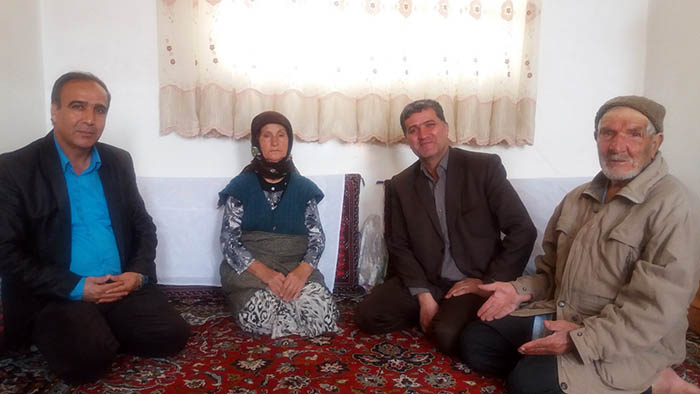
Mujahedin Khalq Organization members' families

I have vowed to God, not to die till I visit my son

Nejat Society members of Zanjan Province Branch met a MKO hostage parents.

Morteza Ghadimi is behind the bars of the Mujahedin-e Khalq now for long years. He has not contact his family during these years. His ailing, aged parents are impatiently waiting to visit their beloved son again.

Morteza’s mother says:” I have vowed to my God, not to die till I visit my loved son”


April 7, 2018 0 comments
FacebookTwitterPinterestWhatsappTelegramSkypeEmail
weekly digest
Iran Interlink Weekly Digest

Iran Interlink Weekly Digest – 227

++ Jim Lobe, Lobelog: Even Bill Kristol is Worried about Bolton’. “Kristol, who remains probably the single most influential figure …

++ Last week there were some small protests in Khuzestan against a TV programme which had used a map, with dolls displaying ethnicity, which had omitted to show Arab clothes. The protests soon died away after the producer apologised. All last week the Saudi backed MEK have talked endlessly about the separation of Khuzestan based on that incident. Farsi reaction to this is again ‘Rajavi, shut up!’ Many commentators published documents showing the MEK killing Arabs in the south of Iraq and Kurds in the north of Iraq. They say the last people who can talk about ethnicity with that background are the MEK.

++ In Tirana this week the MEK held a big celebration over the appointment of John Bolton. People inside reported that Mehdi Abrishamchi (Rajavi’s first husband) got up and danced. There was also a statement from (the late) Massoud Rajavi read out saying, “It is done and finished, the war has started, and we have won”. All this has become a gif-worthy joke among many commentators.

++ London Kayhan published an article about Iranian oppositions, saying it is necessary for them to get together and find common cause. The article referred to the past crimes of the MEK but indicated that if the MEK reject what they did, they can still join the opposition. ‘You have wasted people’s energies until now, stop that and become a real opposition with us.’ In response to this article, ex-member Davoud Baghervand Arshad has written a lengthy explanation about how the MEK have always fought against other opposition groups and tried to eliminate them so as to be the only one, instead of opposing the IRI. His article concludes, ‘if you still think there is a one in a million chance of bringing along this cult and integrating it into the opposition groups then you are badly mistaken and still don’t get who they are’.

In English:

++ An article by Ted Regencia in Aljazeera charts the MEK’s violent history, before showing that the group’s claim to have given up violence does not match with its continued support for regime change as expressed by John Bolton and Turki bin Faisal al Saud. Regencia quotes analysts and reports which confirm the Iranian people’s deep hatred and mistrust of the group because of its anti-Iranian behaviour.“I have not heard anyone asking them [MEK] to make a comeback [in Iran] or anything like that,” said Tehran-based journalist Saeed Jalili. MEK advocate Senator Robert Torricelli did not comment for the article, “But in an article published in Politico in 2016, Torricelli said he has seen ‘no evidence’ that the MEK ‘took part in terrorist activities against Iranians or Americans’. Torricelli said the group saved American lives following the 2003 US invasion of Iraq, by identifying locations of improvised explosive devices.”

++ Tony Cartalucci, Global Research, writes ‘US National Security Advisor John Bolton Backs MEK Terrorists’. As well as Bolton’s role in George Bush’s Iraq war, his lobbying for a dangerous terrorist organisation – MEK – has greater implications. Even Bolton’s supporters are worried. “A National Security Advisor openly guilty of violating US anti-terrorism laws having provided material support to a US State Department-listed foreign terrorist organization for years illustrates just how profoundly compromised US institutions are and reflects an agenda that not only exclusively serves special interests – but does so at the cost of the American people’s actual security.”

++ Jim Lobe, Lobelog: Even Bill Kristol is Worried about Bolton’. “Kristol, who remains probably the single most influential figure in the increasingly fractious neoconservative movement, expressed some serious discomfort about the appointment” of John Bolton. Apparently even the most hawkish anti-Iran pundits find Bolton ‘utterly unfitted’ for office in the White House. Of course, Bolton’s long-term support for the MEK contributes to that view.

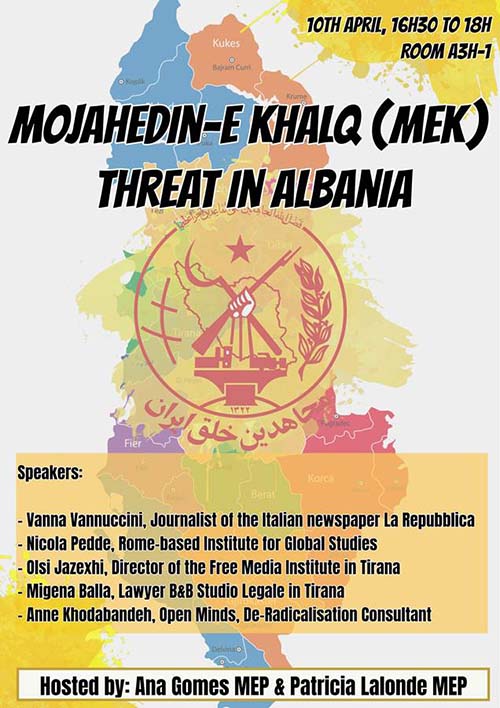
++ MEP Ana Gomes and MEP Patricia Lalonde will host a debate in the European Parliament next week about the MEK threat in Albania. Interested persons are asked to contact Ms Gomes’ office. Speakers include Anne Khodabandeh, De-Radicalisation Consultant.

 April 06, 2018

April 7, 2018 0 comments
FacebookTwitterPinterestWhatsappTelegramSkypeEmail
Albania

EUP Debate: Mojahedin-e Khaq (MEK) threat in Albania

The office of Ana Gomes MEP,

10th April, 16H30 to 18H

Speakers:

Vabba Vannuccini. Journalist of the Italian newspaper La Repubblica

Nicola Pedde, Rome based Institute for Global Studies

Olsi Jazexhi, Director of the Free Media Institute in Tirana

Migena Balla, Lawyer B&B Stutio Legale in Tirana

Anne Khodabandeh, Open Minds, De-Radicalisation Consultant.

Hosted by: Anna Gomes MEP & Particia Lalonde MEP

MEP Ana Gomes and MEP Patricia Lalonde would like to invite you to attend their event: “Mojahedin-E Khalq (MEK) threat in Albania” on April 10th, from 16h30 to 18h.

This event will take place at the European Parliament, in room A3H-1.

If you wish to attend, we would kindly ask you to provide the following information if an accreditation to the European Parliament is needed:

First name:

Last name:

Date of Birth:

Nationality:

ID Card or Passport number:

Type of identification document (if it is ID or Passport):

April 7, 2018 0 comments
FacebookTwitterPinterestWhatsappTelegramSkypeEmail
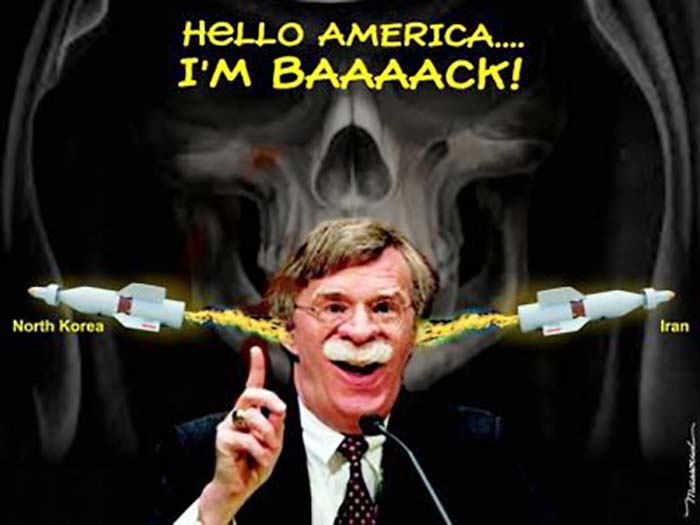
Jhon Bolton - warmonger - terrorist lobbist
Mujahedin Khalq; A proxy force

The Bolton threat to the Iran nuclear deal

On the campaign trail, Donald Trump often denounced the failures of the US foreign policy establishment, including the trigger-happy Washington insiders who, too often, had led the country down the path of devastating wars. In particular, leading up to and since his election, President Trump has often invoked the example of the 2003 invasion of Iraq as a monumental mistake in contemporary US foreign policy. But, recently, President Trump appointed one of the architects of the Iraq war, John Bolton, to serve as his third national security adviser, replacing H.R. McMaster, a three-star general with a moderate outlook. Bolton’s track record in the nonproliferation space—as the undersecretary of state for arms control and international security affairs from 2001 to 2005, his brief tenure as the US Ambassador to the United Nations in 2005 to 2006, and his writings and media appearances in recent years—all point to the end of the nuclear deal with Iran and a generally more aggressive stance on the Islamic Republic.

Jhon Bolton - warmonger - terrorist lobbist

The Trump administration’s approach has largely been one of increased pressure. If a country’s foreign policy toolbox includes a number of tools, ranging from sticks to carrots, the President’s Iran policy has largely consisted of sticks. But the administration has so far only utilized some of these tools, mainly the adoption of harsher rhetoric, including denunciations at international fora, particularly as undertaken by Ambassador Nikki Haley at the UN Security Council, and sanctions and designations. Hence, so far, Washington has steered away from an all-out confrontation with Iran. The President has long expressed his opposition to the nuclear deal, and his administration has increased the uncertainty surrounding its future and refused to recertify the agreement. But the administration has so far decided not to pull the trigger and withdraw from the deal, as Trump had promised on the campaign trail. Several key administration officials can be credited with moderating the administration’s stance vis-à-vis the nuclear deal, including former Secretary of State Rex Tillerson, Secretary of Defense James Mattis, and McMaster.

But McMaster’s ousting and Bolton’s arrival, potentially coupled with Mike Pompeo’s ascendance at the State Department as Tillerson’s replacement, make it much likelier for the administration to pull out of the nuclear deal and potentially even confront Iran militarily.

To understand why this may be the case, it’s imperative to examine Bolton’s worldview, nonproliferation track record, and stance on Iran.

Bolton largely sees the US foreign policy toolkit through the prism of what most national security professionals view as the last resort: military action. Indeed, Bolton has long advocated for bombing countries to settle disputes and mitigate threats, before such options as negotiations, sanctions, and naming and shaming on the international stage are fully exhausted. In particular, Bolton famously called for attacking Iran to address the challenge stemming from the country’s nuclear ambitions—and this, as the negotiators were working toward a comprehensive agreement achieving strict limits on those ambitions. Likewise, Bolton has often brushed aside the need for multilateralism. In fact, Bolton seems to distrust and disdain negotiations, particularly those requiring American concessions. Multilateralism and the use of the broad American foreign policy toolbox—including incentives, economic and political pressure, the threat of the use of force, and diplomacy—were central to the nuclear talks and resulting agreement. And they also yielded more lasting results at a lower cost than military action would have entailed.

Bolton’s nonproliferation track record is predominantly one of missed opportunities and outright failures. He advocated for the US invasion of Iraq, based on the idea that Saddam Hussein’s regime had retained threatening weapons of mass destruction programs. As he put it then, Bolton was “confident” that Saddam was hiding such weapons facilities. While the Iraqi regime did have WMD programs and even deployed chemical weapons during the Iran-Iraq War (1980-88), that was no longer the case when America attacked the country in 2003. In fact, in a situation reminiscent of the Trump administration’s (and Bolton’s) stance toward Iran, international inspectors were on the ground in 2003 and verifying the state of Iraq’s WMD program, but they were not given a fair chance to complete their work and present their findings before the United States invaded. In fact, in a closer look at the developments leading to the Iraq war, one can spot many similarities between the claims presented by those arguing that time was ticking so the United States had to attack Iraq to prevent catastrophe, and the arguments put forward now by Bolton on Iran. Today, nearly 15 years after the start of Iraq war—where America still sees no end in sight—Bolton continues to support the conflict. And in another situation with parallels to the Iranian controversy, Bolton supported nixing the 1994 Agreed Framework with North Korea. While that agreement was nowhere as comprehensive and strong as the Iran nuclear deal, its collapse did lead to today’s standoff on the Korean peninsula, with Pyongyang possessing a small but growing nuclear arsenal that either has or likely will soon have the capability to hit the United States.

From these foreign policy failures, Bolton has concluded that the use of force and the abrogation of international agreements are the ways for the United States to achieve its goals—despite abundant evidence to the contrary.

But perhaps most troubling is Bolton’s cozy relationship with the Mujahedin-e Khalq (meK), an Iranian opposition group that he hails as a viable alternative to the Islamic Republic, a champion of democracy and human rights, and an agent for a change of behavior by Iran. But the MeK is neither a viable alternative to the current Iranian government nor a force for democracy and human rights, as I have written elsewhere. Instead, it’s a cult-like organization that has abused its own members and is already publishing lists of journalists for its sympathizers to target. It enjoys little support inside Iran and is responsible for a number of terrorist attacks on Iranians and Americans alike. Moreover, there’s no guarantee that the MeK would adopt a policy on the country’s nuclear program or other nefarious activities that is different from the current regime’s. More important yet, the very idea that regime change, Bolton’s preferred foreign policy option to deal with Iran, would be successful and yield a sustainable outcome is put in question by the legacy of the wars in Afghanistan and Iraq.

In that sense, Bolton’s worldview and approach to Iran differ from President Trump’s “America First” policy, which seeks to minimize American involvement in various theaters. But with moderate voices largely isolated and sidelined in the Trump administration, the nuclear deal’s days seem numbered and a potential confrontation with Iran likely.

It must be remembered that US intelligence community has found no evidence of nuclear weapon activities in Iran since 2009. Despite its shortcomings, the Iran nuclear deal has significantly scaled back Tehran’s nuclear program. By May 12, the president will have to choose whether to reissue waivers of the nuclear-related sanctions on Iran, as provided for in the nuclear deal. The administration has already indicated to European negotiating partners and the rest of the world that the President may refuse to do so if no “fixes” to the deal’s shortcomings, as outlined by the Trump team, are found. The administration may refuse to waive the sanctions without withdrawing from the agreement, or simply withdraw from it altogether. While neither scenario is ideal, the latter would be much more complex to rectify down the line than the former.

Indeed, if the deal collapses altogether—which, absent the United States, it will, whether it dies slowly, or immediately because Iran pulls out as well—the Iranians aren’t likely to return to the negotiating table for the foreseeable future. Indeed, as the winter 2017-18 protests in Iran demonstrated, the general public there is fed up with the country’s economic situation, and it increasingly views the nuclear deal as a series of empty promises made in exchange for real nuclear concessions by Iran. Regime hardliners regularly target President Hassan Rouhani and his team that negotiated the deal. And the deal has lost the support of key power centers, including the Supreme Leader and the Revolutionary Guards. The best approach to rectifying the agreement’s shortcomings lie in an option the administration has ruled out altogether: preserving the nuclear deal and building on it, by leveraging the channels of communication that resulted from it, to address other areas of concern in Iran’s behavior, including limitations on the country’s missile program.

For the time being, despite increased pessimism about the fate of the nuclear deal, the Europeans continue to have some leverage over and credibility in Iran—although their attempt to impose sanctions on Iran to appease the Trump administration and push it to preserve the deal may backfire. Whether the implementation of the agreement continues will largely depend on them. The Europeans must continue to engage Iran and preserve the channels of communication that are critical to deescalating the tensions likely to arise from the toxic combination of hawkish voices gaining prominence in Washington—now including John Bolton’s—and hardline pushback in Tehran.

Ariane Tabatabai, The Bulletin.org

Ariane M. Tabatabai is the director of curriculum and an assistant teaching professor of security studies in the Georgetown University…


April 5, 2018 0 comments
FacebookTwitterPinterestWhatsappTelegramSkypeEmail
Female members of the Mujahedin-e Khalq at Camp Ashraf
Mujahedin Khalq; A proxy force

John Bolton´s Plan: Regime Change in Iran in 2018

Sputnik 26 March 2018 :

Shaul Mofaz, former Chief of Staff of the Israeli Defense Forces and ex Minister of Defense: “I have known John Bolton since his days as US ambassador to the United Nations. He tried to convince me that Israel must attack Iran,” Shaul Mofaz said.

The Intercept 23 March 2018:

Rob Malley, who coordinated Middle East policy in the Obama administration, observed that Bolton’s appointment, along with the nomination of Iran deal critic Mike Pompeo as secretary of state, seemed to signal that the (Iran nuclear)  agreement would most likely be “dead and buried” within months. Trita Parsi, leader of the National Iranian American Council wrote on Twitter: “People, let this be very clear: The appointment of Bolton is essentially a declaration of war with Iran. With Pompeo and Bolton, Trump is assembling a WAR CABINET.”

Just eight months ago, at a Paris gathering, Bolton told members of the Iranian exile group, known as the Mujahedeen-e-Khalq, MEK, or People’s Mujahedeen, that the Trump administration should embrace their goal of immediate regime change in Iran and recognize their group as a “viable” alternative.

“The outcome of the president’s policy review should be to determine that the Ayatollah Khomeini’s 1979 revolution will not last until its 40th birthday,” Bolton said. (The 40th anniversary of the Iranian revolution will be on February 11, 2019.) “The declared policy of the United States should be the overthrow of the mullahs’ regime in Tehran,” Bolton added. “The behavior and the objectives of the regime are not going to change and, therefore, the only solution is to change the regime itself.”

As the Iranian expatriate journalist Bahman Kalbasi noted, Bolton concluded his address to the exiles with a rousing promise: “And that’s why, before 2019, we here will celebrate in Tehran!”

To understand how extraordinary it is that the man about to become the president’s most senior national security official made this promise to the MEK, it is important to know that, until recently, the Iranian dissidents had spent three decades trying to achieve their aims through violence, including terrorist attacks.

The MEK supported Saddam Hussein during the Iran-Iraq war. Today, the MEK is viewed negatively by most Iranians, who would prefer to maintain the status quo instead of embracing what they consider a corrupt, criminal cult that killed many Iranians during the war.

Sputnik 25 March 2018: Iran’s secretary of the Supreme National  Security Council Ali Shamkhani has lashed out at the appointment of former US ambassador John Bolton as US National Security adviser, said the Iranian Fars news agency. The secretary specifically pointed out Bolton’s ties to the Mujahedeen-e-Khalq (MEK) group, the Iranian Marxist opposition seeking to overthrow the Ayatollah government and had been on terrorist group lists both in Europe and the US for a long time (until it was removed in 2009 and 2012 respectively) and still is in Iran.

“It is a shame that the United States National Security Adviser is being paid by a terrorist group,” Ali Shamkhani said.

Bolton has been attending conferences organized by MEK for years, which consider themselves Iranian exile government.

by Anders, The bulletin.org

April 4, 2018 0 comments
FacebookTwitterPinterestWhatsappTelegramSkypeEmail
Nejat Publications

Nejat Newsletter No. 53

Inside This Issue:

  1. Nowruz Day 21 MarchNejat Newsletter
  2. Is Albania a Partner of the US in Supporting International Terrorism?
  3. The MKO in the Past One Year
  4. Albanian Media Fooled By MEK ‘Misdirection’
  5. Police Report on the Situation of the Iranian Mojahedin in Albania
  6. In Brief
April 4, 2018 0 comments
FacebookTwitterPinterestWhatsappTelegramSkypeEmail
Newer Posts
Older Posts

Recent Posts

  • Soraya Abdollahi’s Letter to International Human Rights Bodies

    September 28, 2026
  • How Did Maryam Rajavi Become All-Powerful in the MEK?

    September 27, 2026
  • Yazdan Teimorian’s Family:  We Are so Heart-Broken!

    September 23, 2026
  • Blackman’s relationship with the MEK should be investigated

    September 19, 2026
  • Democracy Cannot Be Built with Fake Voices

    September 14, 2026
  • Facebook
  • Twitter
  • Instagram
  • Youtube

© 2003 - 2025 NEJAT Society . All Rights Reserved. NejatNGO.org


Back To Top
Nejat Society
  • Home
  • Articles
  • Media
    • Cartoons
    • NewsPics
    • Photo Gallery
    • Videos
  • Publications
    • Books
    • Nejat NewsLetter
    • Pars Brief
  • About Us
  • Contact us
  • Editions
    • عربي
    • فارسی
    • Shqip