Nejat Society
  • Home
  • Articles
  • Media
    • Cartoons
    • NewsPics
    • Photo Gallery
    • Videos
  • Publications
    • Books
    • Nejat NewsLetter
    • Pars Brief
  • About Us
  • Contact us
  • Editions
    • عربي
    • فارسی
    • Shqip
Nejat Society
Nejat Society
  • Home
  • Articles
  • Media
    • Cartoons
    • NewsPics
    • Photo Gallery
    • Videos
  • Publications
    • Books
    • Nejat NewsLetter
    • Pars Brief
  • About Us
  • Contact us
  • Editions
    • عربي
    • فارسی
    • Shqip
© 2003 - 2024 NEJAT Society. nejatngo.org
France

Open letter to Bernard Cazeneuve ;Rajavi supports ISIS from France

The honorable French Minister of Interior Mr. Bernard Cazeneuve ,

greetings
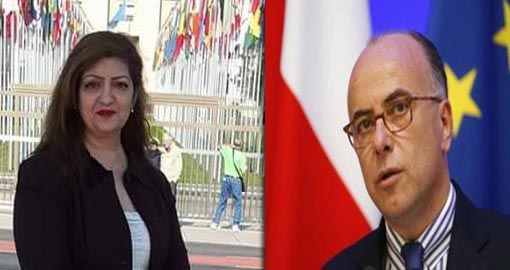
The unfortunate incidents which happened in Paris , and as a result of that many innocent people ,women and men , lost their lives , have brought sorrow and sadness for all freedom loving people and this sorrow and sadness has opened our eyes and ears about these horrible incidents and we should ask the humane conscience this question , for what reason those innocent people lost their lives and were murdered ?

Mr. Minister I am Zahra Moeini , a German citizen , who had been a captive in Iraq in Ashraf Garrison for many years and i had experienced the life in people’s mojahedin organization ruled by Massoud and Maryam Rajavi . In 1992 when Maryam Rajavi called herself the president of national council of resistance of Iran !! i became a member of her security team and i left Iraq to Paris with her and after a while i went to Germany. the Rajavi’s terrorist cult told me that ;Germany is a very good country in Europe for asylum and we can fool the German government for our activities easily ; . After a while i found out about their ominous intentions and their crimes , so i decided to separate from them and right now i am a human rights activist in Germany. I had witnessed their crime such as money laundering and theft of the operatives of this organization .

Mr. Minister In the beginning of 1987 , the French government which was ruled by Mr. Jacques Chirac had incarcerated some of the pmoi officials because of violence and terrorist activities and extortion and send them to exile in Gabon . When it happened , Massoud and Maryam Rajavi both were in Iraq and Massoud Rajavi one year before it happened left France to Iraq . They both were angry and were saying that they wont forget this work of the French Government and they vowed that they will retaliate against the French government when they overthrow the Iranian government and they mentioned that it will be a good lesson to the world not to interfere in Iranian resistance affaires.

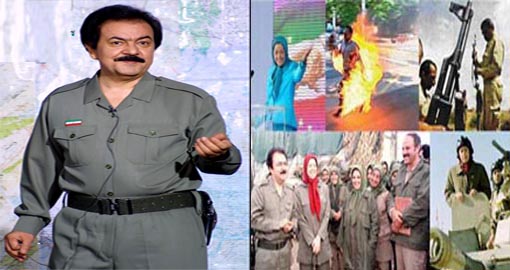
In 2003 when Maryam Rajavi and some of pmoi operatives got arrested in France , 11 million dollars was found in their headquarter in Auvers sur Oise . The PMOI leadership forced some of their followers and members in France and in Europe in front of the French Embassy and in USA to set themselves on fire to show their anger about the arrest of Maryam Rajavi . the leadership of pmoi wanted to create panic and fear among the French people to force The French government to release Maryam Rajavi as soon as possible . unfortunately two of those who set themselves on fire died of severe burning. those two were Mrs. Sedigheh Mojaveri and Miss Neda Hassani.

Mr. Minister As you see despite of huge amount of money which this terrorist cult spends for its shows and its existance in France , the leader of this terrorist cult , Maryam Rajavi , does not do anything to rescue the residents of Camp liberty from the hell hole of Iraq . This cult has a very dangerous essence and it is run by cultish rules . The main leader of this dangerous cult(the guru) , Massoud Rajavi has threatened all his critics and separated members to death, he wants to create a wave of fear and horror among his critics and separated members but his threat against his critics and separated members will begets panic and fear among the people of France and other European countries as well.

Mr. Minister do you think the leaders of this terrorist cult are suitable to run the government in Iran ? you should know that Maryam Rajavi has not been elected as president of the national council of resistance by the Iranian people who live in foreign countries or the captive members of this notorious cult in Iraq , for that reason she is not the representative of Iranian people and she can not represent Iranian people .

Mr. Minister I wrote a letter to the mayor of Auvers sur Oise while ago and i thanked her because she hosted two families of those captive members in camp liberty in Iraq . I urge you to stop their activities before witnessing another crime which they will perpetrate. Mr. Minister I have requested Maryam Rajavi many times to have a debate with me in a TV even in their own TV program but i have not received any answer except the death threat which i and others received from them.

Mr . Minister i share with you some of the crimes of Massoud and Maryam Rajavi : In 1989 Massoud and Maryam Rajavi ordered all pmoi members to separate from their husband or wife (compulsory divorce). By the direct order of Massoud and Maryam Rajavi all children ranging from 6 months old to the age before maturity were separated from their parents and they were sent away to an unknown destiny and future , some of those children got lost or were sent back to Iran or some of them got raped which was mentioned by some of Rajavi cult followers . The separated and divorced women in Rajavi cult by the direct order of Maryam Rajavi had to sleep with Massoud Rajavi for their own salvation !!! and they were ordered to go under surgical operation to take off their womb before sleeping with him.

Mr. Minister People’s mojahedin organization , PMOI, as the speaker of French external affaires explained , is a violent cult and its existance in France is illegal . i would like to reiterate that all the iranian members who are in the cult’s headquarter in Auvers sur Oise are the top officials of this cult and they are all commanders of the war and terrorist missions in Iraq and Iran. There is no difference between their thoughts and ideology with ISIS (Daesh) but because they are defeated and many of their members have separated from them and they have lost their popularity among Iranian People , the leaders of this cult in western countries specially in France are trying their best to show themselves as freedom lovers and pro-democracy organization and they pretend that they are against terrorism to wash their bloody hands and hide their real essence behind the mask of democracy and freedom . Supporting ISIS (Daesh) by Massoud and Maryam Rajavi goes to 9/11/ 2001 and in that day when the terrorists attacked the twin towers in New York city by the airplanes which they had hijacked and killed 3000 innocent American men and women , Massoud and Maryam Rajavi ordered to show the horrible scenes of those terrorist attacks many times in the gathering in Bagherzadeh garrison in Iraq and while they were clapping their hands , Massoud Rajavi said, I adore Islam which in this fanatic form has created such a damage to USA and imperalism, now wait and see what is going to happen to imperalism when our revolutionary Islam comes on power, .

There is no doubt that the reason behind their happiness and satisfaction about the terrorist attacks in 9/11 was their violent essence and their crave for bloodshed ,violence and armed struggle . There is no doubt that on the basics Rajavi , Daesh and Al ghaedeh have the same violent and fanatic thoughts and during the years i was in that cult ,all Rajavi’s interpretations of Ghoran were in support of violent and fanatic thoughts . Last year when Daesh took over the city of Mosel in Iraq and began its terrorist actions on Iraq soil , this cult and its leadership began supporting Daesh in its official websites and mentioned them as the revolutionary people of Iraq , the revolutionary tribes of Iraq !!. http://www.mojahedin.org/news/139413 (Le site de l’OMPI: Les révolutionnaires et les nomades révolutionnaires de l’Irak ont saisi toute la ville de Mossoul) in this link which is the pmoi official website you can see their support of Daesh with French translation .

Mr. Minister With all those facts mentioned above , for security and safety of your country , you should put an end to their cultish activities in Europe and in France , because they have supported Daesh in their official websites many times and their thoughts and cultish and terrorist behaviours during past 40 years substantiate that they have the same thought and behaviour as Daesh has . We should not forget that Rajavi cult carried out the suicidal operation in Iran in 1980,s and in 2003 suicidal operation on French soil by setting themselves on fire on streets of paris and they mentioned it proudly in their official websites . Those years which pmoi was carrying out those bloody suicidal operations and attacks against its targets , Daesh did not exist and i believe that Daesh had learned those suicidal operations from Rajavi cult.

All the best,

Zahra Moeini Germany, Iran Zanan Association,
December 27, 2015 0 comments
FacebookTwitterPinterestWhatsappTelegramSkypeEmail
Iran Interlink Weekly Digest

Iran Interlink Weekly Digest – 126

++ Ebrahim Mohammad Rahimi spent many years with the MEK. He eventually managed to escape the camp in Iraq by taking refuge in the American run TIPF for four years before getting back to London. During the internal revolution of the MEK, Rahimi sent his son, Sepher, live with his grandparents in Iran. Sepher has now returned to London where his father is terminally ill in hospital. Sepher’s mother is still with the MEK and Rahimi and his son have tried to make contact with her before he dies. They have now begun asking MEK lobbyists for help since the MEK leaders only reacted by calling them “agents of the Iranian regime”. MEK Internal Critics such asIraj Mesdaghi, Hamneshinbahar, Esmail Yaghmai and others, have jumped on the issue and published articles decrying the human rights abuses of the MEK. However, this is not an isolated incident. This week Atefeh Eghbal wrote pointing out that for the MEK some families are good but others are “agents”. This week many articles have exposed the hypocrisy of the internal critics for misusing the human rights issue themselves. They are afraid of being labelled by the MEK, so instead of defending the right of all families to find their loved ones, they separate the families into ‘mine and yours’. They advocate for the human rights of Rahimi and Sepher, but not for other families. This is the same thing the MEK does; if you are with us you are a ‘family’, if not you are an ‘agent’. Many articles write that in all the years that Mohammad Rahimi was in London, he loved to exaggerate to everyone about the time he suffered in prison in Iran. Yet he has never managed to offer any support for other families who tried to contact their loved ones. Now the situation has affected him, it is a reminder to everyone that even if you keep quiet for fear of MEK labelling, they will still come after you and cause you grief.

++ This week another person has left the MEK in Albania. Mehdi Baghban Khatib, who was among ten others who have left, was open about his dissent. He says others don’t talk because they are under pressure from the MEK and the ground staff of the UNHCR in Tirana are listening to the MEK more than their own bosses. In that respect, Iran Pen Association has written an open letter to the UNHCR to explain that UN help is not reaching individuals but is being paid to Rajavi, and urging them to investigate and pay support direct to individuals so they have a choice.

In English:

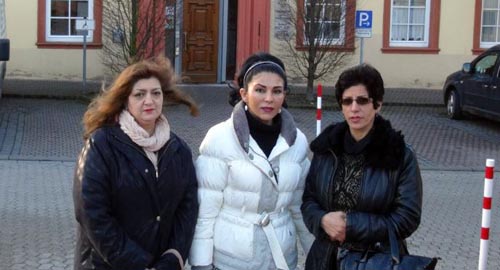
++ On December 18, 2015 members of the Women Association visited an Albanian official in the country’s Embassy in Berlin. They described their bitter experiences of their long-time imprisonment in the Mujahedin Khalq Organization (MKO). They also recounted how they were released from the group. They warned that unless the Albanian authorities take control and supervise the group’s activities in that country, the MEK will continue to violate the basic human rights of the members.

++ Former British diplomat Peter Jenkins writing in Lobelog criticises the IAEA’s Intelligence Acquisition Practices and suggests how this could be improved. The article identifies the fake information fed to the IAEA by the MEK as part of the politicisation of the Iran file.

++ Zahra Moeini who lives in Germany and is a member of Iran Zanan Association, writes an Open letter to Mr. Bernard Cazeneuve, the French Interior Minister. Her letter points out that “despite of huge amount of money which this terrorist cult spends for its shows and its existance in France , the leader of this terrorist cult, Maryam Rajavi, does not do anything to rescue the residents of Camp liberty from the hell hole of Iraq.” Moeini goes on to urge Cazeneuve to do more to curtail the MEK’s activities in France.

December 25, 2015

December 27, 2015 0 comments
FacebookTwitterPinterestWhatsappTelegramSkypeEmail
The cult of Rajavi

True Threat of Terrorism: Human Beings who turned into “acolytes” of Rajavi

Over the past decades, much of the attention of the world have been focused on the radical extremist groups such as AlQaeda and ISIS. But the true threat actually comes from the cult-like structure of these groups. Cult-like controlling system and the indoctrination methodology of these groups finally results in the most horrible acts of violence.

The Mujahedin Khalq Organization (the MKO/MEK) is characterized as one of these destructive cults that threat the world’s security. Elizabeth Rubin the prominent journalist of the New York Times, was first to call the MKO, “the Cult of Rajavi”. The phrase was based on her first-hand experience of visiting the group’s base in Iraq, Camp Ashraf.  About the world she witnessed in the MKO camp, she wrote:

 “When I arrived at Camp Ashraf, the base of the group’s operations, in April 2003, I thought I’d entered a fictional world of female worker bees. Everywhere I saw women dressed exactly alike, in khaki uniforms and mud-colored head scarves, driving back and forth in white pickup trucks, staring ahead in a daze as if they were working at a factory in Maoist China. I met dozens of young women buried in the mouths of tanks, busily tinkering with the engines. One by one, the girls bounded up to me and my two minders to recite their transformations from human beings to acolytes of Ms. Rajavi. “[1]

As Rubin asserts, members of the Cult of Rajavi transformed from “human beings to acolytes of Rajavi “. But what the leaders of the cult want to show off is entirely different from what they really are. Jeremiah Goulka is one of the authors of the RAND Corporation report on the Mujahedin Khalq. He criticizes the US high profiles who support the group and finally removed it from the list of terrorist organization. ”Accidentally or not, though, the speakers were helping to raise the profile and legitimize the aims of a cult group that will not bring democracy to Iran and has no popular support in the country,” he warned. [2]

The group will not bring democracy because it has not practiced democracy in its four-decade history. “After my visit, I met and spoke to men and women who had escaped from the group’s clutches,” Rubin writes. “Many had to be deprogrammed. They recounted how people were locked up if they disagreed with the leadership or tried to escape; some were even killed.” [3]

“Friendships and all emotional relationships are forbidden. From the time they are toddlers, boys and girls are not allowed to speak to each other. Each day at Camp Ashraf you had to report your dreams and thoughts.” [4]

Rubin also refers to RAND report, “ A 2009 RAND Corporation study found that up to 70 percent of the group’s members there might have been held against their will. “ [5]

Regarding the cult-like terrorist substance of the MKO, its leaders’ efforts to pretend the group as a democratic alternative to the Islamic republic is ridiculous. The so-called president elect of the group starts her fabrications in an article raising the issue of the “radical factions” who shake “the world with their ability to convince ordinary people to commit unspeakable atrocities.”

 As leaders of a cult, Massoud Rajavi and his wife definitely know how “to convince ordinary people to commit unspeakable atrocities”. The “acolytes” of Massoud and Maryam Rajavi, committed numerous acts of violence including military operations, mortar attacks, suicide attacks and assassinations. One significant example of the MKO’s “unspeakable atrocities” was the suppression of Kurdish uprising in Iraq. Read Rubin’s account of the story: “In 1991, when Mr. Hussein crushed a Shiite uprising in the south and attempted to carry out a genocide against the Kurds in the north, the Rajavis and their army joined his forces in mowing down fleeing Kurds.

“Ms. Rajavi told her disciples, “Take the Kurds under your tanks, and save your bullets for the Iranian Revolutionary Guards.” Many followers escaped in disgust.” [6]

Today, with the increasing growth of defection from the MKO and the decline of the group following the relocation of its rank and file from Iraq to Europe, the group leaders make efforts to hook their survival to the West. In their masquerades to boast a democratic portrait, Rajavi introduces her cult as “moderate Muslim” that is suppressed by the Islamic Republic. 

Presenting a solution to the trouble of the region, she tries to pass her cult off as “an interpretation of genuine Islam that is both democratic and tolerant” that should be accompanied with “military campaigns and intelligence operations in the region”.

Jeremiah Goulka correctly suggests that the MKO’s real aim is “to have the United States install the MEK as Iran’s new government”. He warns, “That would mean war. The MEK may deny wanting violent regime change, but the only conceivable way it could become the next government in Tehran would be at the head of a U.S. invasion force.”[7]

Goulka advises the American supporters of the MKO, “Aligning ourselves with the MEK would undermine any attempt at credibility among Iranians because it would make us look like dupes.” [8] He is absolutely right but looking like “dupes” is the least danger that a community in which the MKO followers are living is posed to.

Brainwashed members of the Cult of Rajavi have several times showed their ability to commit “unspeakable atrocities”. A dozen of them set themselves on fire to protest the arrest of their leader by the French Police, in June 2003. Two female members of the cult lost their life because of self-immolation.

The Rajavis are definitely professional on the most effective methods to turn ordinary people into devotees who commit appalling violence.

By Mazda Parsi

Sources:

[1] RUBIN, ELIZABETH, An Iranian Cult and Its American Friends, The New York Times, August 13, 2011

[2] Goulka, Jeremiah, The Cult of MEK, The American Prospect, July 18, 2012

[3] RUBIN, ELIZABETH, An Iranian Cult and Its American Friends, The New York Times, August 13, 2011

[4] ibid

[5] ibid

[6] ibid

[7] Goulka, Jeremiah, The Cult of MEK, The American Prospect, July 18, 2012

[8]ibid

December 26, 2015 0 comments
FacebookTwitterPinterestWhatsappTelegramSkypeEmail
Former members of the MEK

Mehdi Baghban Khatib defects the Mujahedin-e Khalq Cult

Mehdi Baghbab Khatib separated the MKO after 27 years.

Mehdi was enslaved within the MKO Camps along with his mother. He was among the children who were involuntary grew up and stayed within the Cult.
When he was just 14 years old, Cult leaders enrolled him to the group’s military units despite the International Laws.

Mehdi separated the MKO even though he was under the manipulation and cult-like practices of the cult from childhood.

December 24, 2015 0 comments
FacebookTwitterPinterestWhatsappTelegramSkypeEmail
Human Rights Abuse in the MEK

Let Ayoub Lorestani’s lawyer contact him at Camp Liberty

The family of Ayoub Lorestani; Camp Liberty resident wrote an open letter to Maryam Rajavi.

The Soltani family are worried about the fate of their beloved son.

Some parts of the letter reads:

" Ms. Maryam Rajavi

We are the family members of “Ayoub Lorestani” who resides in Camp Liberty. We are very worried about his life. 14 years ago Ayoub left Iran to Turkey. His plan was to go to Europe from Turkey; however he met some members of the MKO and was transferred to Camp Ashraf, Iraq.

During all these years we were happy we could occasionally hear his voice. But during the last two years we have had no news of him. We just hear the news of Camp Liberty rocket attack. Do you really reward your worriers’ families in this way?

Our demand is to be sure of Ayoub’s welfare. We want him to be transferred to a safe country.  

Even though we keep track on Ayoub’s transfer to a third country via a lawyer in Australia and the UNHCR has accepted to cooperate on the issue, the Mujahedin-e Khalq are not cooperative.   

During these two years we have several times contacted the MKO officials; however they do not reply us. .. ….. Do the MKO members’ families deserve such behaviors?!…

Since all our efforts have remained fruitless, we wrote this letter to ask you accelerate the transfer of Ayoub to Albania or any other safe country. Or let Ayoub’s lawyer contact him and persuade his move."

Masoumeh Lorestani,14 December 2015

“Campaign for Camp Liberty residents’ quick transfer to third country” published the letter in Persian.

December 22, 2015 0 comments
FacebookTwitterPinterestWhatsappTelegramSkypeEmail
Mujahedin Khalq; A proxy force

IAEA Intelligence Acquisition Practices

Tariq Rauf, a former Canadian diplomat, and Robert Kelley, a former US nuclear weapon scientist, have published an assessment of the International Atomic Energy Agency’s (IAEA) handling of the Iranian case on the website of the Stockholm International Peace Research Institute (SIPRI).

Both were working in the IAEA secretariat during the years that followed Iran’s 2003 admission that it had failed to declare certain nuclear material and activities, Rauf in the external relations division and Kelley in the safeguards department. So their assessment benefits from first-hand knowledge gained on the inside.

The following passage concludes their assessment:

A structural weakness of the IAEA is that there is no transparent process for the supply of intelligence information and confirmation of its authenticity. The usual process is for a Member State(s) to provide the intelligence information either in documentation or electronic form to a special assistant in the Director General’s office and/or to the Deputy Director General for Safeguards, alternatively to give a closed briefing in its embassy/mission. The IAEA then deals with the information as described in an earlier section above. There is no established process to share such information with the accused State or with the Board of Governors….

The supply and use of intelligence information is a sensitive yet complex issue…. The IAEA cannot serve as a feedback loop to intelligence agencies on the veracity of information provided by them…. Nor can or should the IAEA rely on such information without confirming its authenticity. This obviously leaves the IAEA in a difficult position as is clearly evidenced by the Iran PMD file where the Agency seems to have been caught short.

The authors recommend that the Board put in place a methodology for the acceptance and use of intelligence information drawing from the practices of the Organization for the Prohibition of Chemical Weapons (OPCW) and the Comprehensive Nuclear-Test-Ban Treaty Organization (CTBTO). In these two organizations, allegations of non-compliance can be raised by any State Party which provides information to the Director General, who in turn shares it with the Executive Council. The Executive Council is convened; the Accuser State puts forward its case on allegations of non-compliance or suspicious activities in another State along with supporting information/evidence. The Accused State has the opportunity to present its defence. Following deliberations, the Executive Council can stop a challenge inspection in the case of the OPCW or authorize an on-site inspection in the case of the CTBTO. Such a practice could serve the IAEA well…. In fact, the JCPOA contains a somewhat similar provision for the Joint Commission in paragraph 36 on dispute resolution…

It is essential that the IAEA Board expeditiously come up with a mechanism governing the provision and handling of intelligence information to the IAEA Secretariat. There is great potential for misuse of such information and of suborning the independence of the Agency in the absence of such a mechanism, as abundantly demonstrated by the cases of Iraq, Iran and Syria in recent times.”

A Lack of Confidence

This passage contains echoes of an intervention by the Russian Federation’s governor to the IAEA, Grigory Berdennikov, at an IAEA safeguards symposium in October 2014:

The Secretariat has the right to use for safeguards implementation all safeguards relevant information available to the Agency about a State. This information includes, inter alia, data from open sources and data provided by third parties. It should be noted that third parties include not only States that provide information with regard to another State but also organizations and even private individuals. 

No  proper  mechanism  that  could  guarantee  the accuracy and  authenticity  of information  used for safeguards purposes  is  provided for [in the report under consideration].  In essence it  is suggested that  all analysis  should  be done by the Secretariat as decisions on whether certain  data  can  be  used  for  safeguards purposes are left entirely with the Secretariat. Member States, according to this approach, should simply trust the Secretariat’s choice of information.

The risk here is obvious. False allegations generated by interested parties in order to exercise political pressure on a State unfortunately remain part of the current international landscape.  They  are  quite  common  in  many  areas, including  non-proliferation,  and  one  should  admit  could  be  very  important,  sometimes involving issues of war and peace.  

We think that if the Secretariat decides to use any information, except for data obtained through its own inspection activity, it should duly disclose its origin and be ready to defend its credibility in an open discussion at the Board of Governors. Every State should have the right  to  publicly  defend  itself  against  false  allegations  and accusations generated by interested  third  parties  or  by  the  media.”

These passages reflect a lack of confidence in the authenticity of some of the intelligence material on Iran submitted to the Agency by member states. There is no proof that any of this information was fabricated. But that lack of confidence is not unreasonable, because motives for fabrication can be imagined without straying far into the thickets of conspiracy theory.

Grounds for Doubt

Gareth Porter has written in A Manufactured Crisis that, according to a former German foreign ministry official, German intelligence obtained the “alleged studies” that underpinned the PMD case against Iran from a member of the Mujahideen E-Khalq (MEK) in 2004. MEK hostility to the Islamic Republic is well-documented. Is it inconceivable that this source forged or fabricated that material? The material was never shown to Iran in full and it contains factual inaccuracies and anomalies for which a satisfactory explanation has never been offered.

In autumn 2007, the US, UK, France, and Israel were furious with the Agency’s then Director General Mohamad El Baradei because he had agreed to a work-plan with Iran and was well on his way to clearing the Agency’s last remaining “issues of concern.” Those issues cleared, these states would be bereft of sources of pressure on Iran to submit to their demands.

In that situation there could have been a temptation to produce information that would appear to corroborate aspects of the “alleged studies.” Initially El Baradei and some of his advisers had doubted the authenticity of these studies. But in early 2008 the studies, apparently corroborated by fresh information, metamorphosed into a “possible military dimension.” From then on they were the West’s instrument of choice for keeping Iran under international pressure. In November 2011, they formed the core of an IAEA assessment that persuaded EU member states to adopt harsh economic sanctions against Iran, and Asian states to comply with US secondary sanctions.

Was any temptation to fabricate resisted? One would like to think so. But, given the Stuxnet program to sabotage Iran’s centrifuge machines, and hints that a hostile intelligence agency commissioned the assassination of Iranian nuclear scientists, one has to wonder whether certain states would have hesitated to resort to fabrication to get themselves out of a spot of difficulty in autumn 2007.

Such speculations explain the lack of confidence implicit in the recommendations of Rauf and Kelley, and the intervention of Berdennikov. The IAEA Board of Governors can ignore that lack of confidence—and may well choose to do so. But that will be short-sighted. Over time allowing distrust in the Agency’s intelligence-acquisition practices to fester can weaken international acceptance of the Agency as an impartial and objective verifier of compliance with the Nuclear Non-Proliferation Treaty.

Rauf and Kelley recommend drawing lessons from OPCW and CTBT practices and provisions. No doubt there are other options. Reconciling source protection with transparency and due process may not be easy. But a collective Board effort to find a solution can heal some of the divisions within the IAEA membership that perceptions of Western lack of scruples in prosecuting the case against Iran have helped to cause.

About the Author

Peter Jenkins was a British career diplomat for 33 years, following studies at the Universities of Cambridge and Harvard. He served in Vienna (twice), Washington, Paris, Brasilia and Geneva. He specialized in global economic and security issues. His last assignment (2001-06) was that of UK Ambassador to the IAEA and UN (Vienna). Since 2006 he has represented the Renewable Energy and Energy Efficiency Partnership, advised the Director of IIASA and set up a partnership, ADRgAmbassadors, with former diplomatic colleagues, to offer the corporate sector dispute resolution and solutions to cross-border problems. He was an associate fellow of the Geneva Centre for Security Policy from 2010 to 2012. He writes and speaks on nuclear and trade policy issues.

by Peter Jenkins

December 21, 2015 0 comments
FacebookTwitterPinterestWhatsappTelegramSkypeEmail
Mujahedin Khalq Organization

MKO labels Russia as enemy

In a quite hostile move, the website of the terrorist Mujahedin-e Khalq Organization (MKO, a.k.a. MEK) described the downed Russian drone in Syria as the “enemy’s aircraft”.

Supporting the Takfiri and terrorist groups in Syria during the previous years, MKO’s latest reaction to shooting down the Russian drone is a clear hostile move lining up against Moscow.

Even after the Turkey’s shooting down of a Russian plane in November, the MKO made an all-out effort to put the blame on Russia saying it had violated Turkish airspace.

Being concerned about Russia’s bombarding Takfiri positions in Syria, MKO back the terrorists and condemn Moscow’s acts as war crimes.

December 20, 2015 0 comments
FacebookTwitterPinterestWhatsappTelegramSkypeEmail
Human Rights Abuse in the MEK

Women Association Meet Official of the Albanian Embassy

On December18, 2015 members of Women Association visited an Albanian official in the country’s Embassy in Berlin.

Members of Women Association described their bitter experiences of their long-time imprisonment in the Mujahedin Khalq Organization (the MKO). They also recounted how they were released from the group.

Then, they raised the following issues to enlighten the Albanian authority:

Warning on the presence and activities of the cult of Rajavi (the MKO) in the Albanian territory considering their true nature as a sect.
Concern of families whose loved ones are taken as hostages in the group; they have not had the least information on the situation of their loved ones for many years; and even after their relocation to Europe, the leadership of the group continues this inhumane policy.
Submitting a list of suffering families together with their photos and identities.
Members of the Association warned that the relocated ones in Albania are kept under a severe controlling system that forbids them from having free access to the Internet, mobile and media. They are not allowed to get married. They have to obey all orders by the leaders. In case of necessity, members are made to commit sabotage in line with the group’s aims.

Women Association presented pictures and brochures on the organized self-immolation operations that brainwashed members of the group committed in Europe in 2003, following the arrest of Maryam Rajavi by the French Police.

They advised the Albanian official that the MKO is the obstacle between its members and the governmental and international authorities so practically members are not authorized to take any action for their future. The group tries to keep them isolated and dependent on the organization. This way, it can have more control over them and unfortunately the Albanian government do not care about this issue.

Women Association demanded the followings from Albanian Ambassador and eventually Albanian state:

Providing the possibility for families to contact their relatives without intervention of the group officials.
Recognizing of all members as refugees
Providing independent journalists and reporters with an opportunity to visit members of the cult.
Control and supervision of the Albanian State over the activities of the group as a cult that was listed as a terrorist organization until recently, considering the fact that the group believes in armed struggle and violence.

Iran Women [Iran-Zanan] Association,Translated by Nejat Society

December 20, 2015 0 comments
FacebookTwitterPinterestWhatsappTelegramSkypeEmail
Iran Interlink

Iran Interlink Weekly Digest – 125

++ Habilian published a thoroughly researched online book. This charts the suicide operations conducted by the Mojahedin Khalq after the revolution. The evidence mostly comes from claims in the MEK’s own newspaper and websites. The book covers the various kinds of suicide operation from bombing to self-immolations. In addition to MEK produced documents the book refers to evidence from the US authorities, including the 2012 Department of State report which rejected efforts to have the MEK removed from the US terrorism list. Other documents like the 2009 RAND report explain the nature of the group. It is worth remembering that the MEK started its violent trajectory by assassinating six American personnel at the time of Shah. And the MEK’s first so-called martyr was Reza Rezai, the commander of these operations, who blew himself up with a grenade to evade capture.

++ Fereshteh Hedayati this week announced her separation from the MEK. In her Facebook page she writes with the title ‘Don’t be silent’. Her defection has been welcomed by other former members, many of whom knew her from the Iraqi camps. Hedayati was from the MEK’s Central Council, its current top level. Some commentators have explained that when Batoul Soltani and other members of the all-female Leadership Council left, Rajavi tried to dilute this by adding more members. When that didn’t work, he disbanded it and created the Central Council, little knowing that within months another of these top ranking women would escape. Several bloggers write about the effect this will have on the lower ranks. Rajavi claimed he is pro-women, so people will question why they left. MEK rank and file are forced to accept these women as saints, but saints don’t run away. These defections are bound to increase since the MEK are leaving Iraq and defections are reaching up to ten per week now.

++ Following the closure of Iran’s case at the Atomic Agency, some wrote about the negotiations that no party has lost from this whole process except Rajavi, who was banking on war and destruction. Suddenly, Rajavi has gone quiet on the nuclear issue – which used to be his bread and butter – and is now hysterically attacking Russia and Syria while madly supporting Saudi actions in Yemen and Turkey’s actions in Kurdistan. In a desperate effort to close ranks with Turkey, Rajavi’s propaganda said “the enemy’s plane was downed by Turkey” – he doesn’t name Russia but describes it as the enemy. Considering the active negotiations to end the war in Syria, Rajavi doesn’t really have much hope in this arena either.

++ Ghorban Ali Hossein Nejad wrote an open letter to several Arabic and Islamic scholars informing them that Rajavi is misusing their names. Using screen shots from MEK sites he says “they come to you and ask for support on a humanitarian issue, but on their site they show that you support terrorism”.

++ Farsi writers have picked up on the acceleration in UNHCR relocations of Camp Liberty residents to third countries and predict that more will be defecting as a result. Twenty-six more were moved on December 15 and their names published to help their families identify them.

In English:

++ Aawa Association published Reza Akbarinasab’s letter from Tabriz to the UN Secretary General Ban Ki Moon. Akbarinasab asks for help to contact his long estranged brother in Camp Liberty. His nephew died under suspicious circumstances in the camp some years ago. The MEK refused to allow an autopsy of his body.

++ Iran Interlink wrote to The Daily Telegraph online to inform them about one of their bloggers. No other than the notorious Ali Safavi who is wanted in Iraq for crimes committed as a member of Saddam’s Private Army.

++ An article in Reuters by Isabel Coles and Ned Parker and titled ‘How Saddam’s Men Help ISIL Rule’ is an example of why Massoud Rajavi keeps the MEK in Iraq – to join with ISIL when they take over the country!

++ UNHCR gave an update on the accelerated transfer of Camp Liberty residents to the safety of third countries. Nejat published a list of names of recent transferees to Albania to help their families identify them and get in touch.

++ Another top ranking woman member, Fereshteh Hedayati, successfully escaped the MEK and announced her separation in an article she published on her Facebook page.

++ Translated by Nejat Association, Italian l’interferenza site published a long, interesting article by Stefano Zecchinelli exposing the MEK and its faux political activities. The MEK has a history of human rights abuses and violence, “Yet, despite this, the leaders of the Mujahedin continue to give instructions in the EU institutions on democratic rights, especially civil and political.” The article also asks “How does the MKO make a living?” and says “The MEK is an ‘organization of a dubious purpose with strong connections with the most militaristic right-wing American imperialist sectors. The Washington’s high-profiles enjoy the MEK’s donations whose men are allowed to move freely, organizing activities and events planned to delegitimize what they call ‘the anti-democratic governments in Iran’. The figures in these donations are large, the New York Times has a precious revelation: ‘Many of the American supporters, though not all, accepted fees of $ 15,000 to $ 30,000 to give speeches to the group, as well as travel expenses to attend MEK rallies in Paris. Edward G. Rendell, the former Democratic governor of Pennsylvania, said in March he that had been paid a total of $ 150,000 to $ 160,000’”.

++ Gareth Porter’s article ‘The IAEA’s “Final Assessment”’, published in Counter Punch contains the “unsavoury truth” about the provenance of dodgy intelligence documents: “in 2013, former senior German foreign office official Karsten Voigt revealed to me in an interview that German intelligence had obtained the documents in 2004 from a sometime source whom they knew to be a member of the Mujahideen E-Khalq (MEK). A cult-like Iranian exile terrorist group, MEK had once carried out terror operations for the Saddam Hussein regime but later developed a patron-client relationship with Israeli intelligence.”

December 18, 2015

December 19, 2015 0 comments
FacebookTwitterPinterestWhatsappTelegramSkypeEmail
Mujahedin Khalq; A proxy force

The IAEA’s “Final Assessment”

The International Atomic Energy Agency (IAEA) assessment has cleared the way for the board of governors to end the Agency’s extraordinary investigation into accusations of Iran’s past nuclear weapons work. But a closer examination of the document reveals much more about the political role that the Agency has played in managing the Iran file.

Contrary to the supposed neutral and technical role that Director General Yukiya Amano has constantly invoked and the news media has long accepted without question, the Agency has actually been serving as prosecutor for the United States in making a case that Iran has had a nuclear weapons program.

The first signs of such an IAEA role appeared in 2008 after the Bush administration insisted that the Agency make a mysterious collection of intelligence documents on a purported Iranian nuclear weapons research program the centerpiece of its Iran inquiry. The Agency’s partisan role was fully developed, however, only after Amano took charge in late 2009. Amano got U.S. political support for the top position in 2009 because he had enthusiastically supported the Bush administration’s pressure on Mohammed ElBaradei on those documents when Amano was Japan’s permanent representative to the IAEA in 2008.

Amano delivered the Agency’s November 2011 report just when the Obama administration needed additional impetus for its campaign to line up international support for “crippling sanctions” on Iran. He continued to defend that hardline position and accuse Iran of failing to cooperate as the Obama administration sought to maximize the pressure on Iran from 2012 to 2015.

When the Obama administration’s interests shifted from pressuring Iran to ensuring that the nuclear agreement with Iran would be completed and fully implemented, Amano’s role suddenly shifted as well. In late June, according to Iranian officials involved in the Vienna negotiations, Secretary of State John Kerry reached agreement with both the Iranians and Amano that the “possible military dimensions” (PMD) issue would be resolved through a report by Amano before the end of the year.

Based on that agreement, Amano would write a report that would reach no definitive conclusion about the accusations of nuclear weapons work but nevertheless bring the PMD inquiry to an end . The report was still far from even-handed. It could not be, because Amano had embraced the intelligence documents that the United States and Israel had provided to the IAEA, around which the entire investigation had been organized.

Dodgy Intelligence Documents

Iran had insisted from the beginning that the intelligence documents given to the IAEA were fraudulent, and ElBaradei had repeatedly stated publicly from late 2005 through 2009 that the documents had not been authenticated. ElBaradei observes in his 2011 memoirs that he could never get a straight answer from the Bush administration about how the documents had been acquired. Different cover stories had been leaked to the media over the years suggesting that either an Iranian scientist involved in the alleged weapons program or a German spy had managed to get the documents out of Iran. But in 2013, former senior German foreign office official Karsten Voigt revealed to me in an interview that German intelligence had obtained the documents in 2004 from a sometime source whom they knew to be a member of the Mujahideen E-Khalq (MEK). A cult-like Iranian exile terrorist group, MEK had once carried out terror operations for the Saddam Hussein regime but later developed a patron-client relationship with Israeli intelligence.

Quite apart from the unsavory truth about the origins of the documents, the burden of proof in the IAEA inquiry should have been on the United States to make the case for their authenticity. There is a good reason why U.S. judicial rules of evidence require that “the proponent must produce evidence sufficient to support a finding that the item is what the proponent claims it is.”

But instead Amano has required Iran, in effect, to prove the negative. Since it is logically impossible for Iran to do so, that de facto demand has systematically skewed the entire IAEA investigation toward the conclusion that Iran is guilty of the covert activities charged in the intelligence documents. And the Agency has reinforced that distorted frame in its final assessment by constantly making the point that Iran possesses technology that could have been used for the development of a nuclear weapon. Every time Iran produced evidence that a technology that the IAEA had suggested was being used for the development of nuclear weapons was actually for non-nuclear applications, the Agency cast that evidence in a suspicious light by arguing that it bore some characteristics that are “consistent with” or “relevant to” work on nuclear weapons. The “final assessment” uses that same tactic to frame not only Iranian development of various technologies but its organizations, facilities, and research activities as inherently suspicious regardless of evidence provided by Iran that they were for other purposes.

Another tactic the IAEA had used in the past to attack Iran’s credibility is the suggestion that the government actually made a partial confession. In May 2008, the IAEA had claimed in a quarterly report that Iran “did not dispute that some of the information contained in the documents was factually accurate but said the events and activities concerned involved civil or conventional military applications.” That statement had clearly conveyed the impression that Iran has admitted to details about activities shown in the documents. But in fact Iran had only confirmed information that was already publicly known, such as certain names, organizations, and official addresses, as the IAEA itself acknowledged in 2011. Furthermore, Iran had also submitted a 117-page paper in which it had pointed out that “some of the organizations and individuals named in those documents were nonexistent.”

The IAEA resorted to the same kind of deceptive tactic in the final assessment’s discussion of “organizational structure.” It stated, “A significant proportion of the information available to the Agency on the existence of organizational structures was confirmed by Iran during implementation of the Road-map.” That sentence implied that Iran had acknowledged facts about the organizations that supported the purported intelligence claims of a nuclear weapons research program. But it actually meant only that Iran confirmed the same kind of publicly available information as it had in 2008.

On the issue of whether an Iranian organization to carry out nuclear-weapons research and development had existed, the final assessment again uses suggestive but ultimately meaningless language: “[B]efore the end of 2003, an organizational structure was in place in Iran suitable for the coordination of a range of activities relevant to the development of a nuclear explosive device.”

Similar language implying accusation without actually stating it directly can be found in most of the assessments in the document. In the section on “procurement activities,” the report refers to “indications of procurements and attempted procurements of items with relevance, inter alia, to the development of a nuclear device.” That language actually means nothing more than that Iranians had sought to purchase dual-use items, but it preserves the illusion that the procurement is inherently suspicious.

EBW and MIP

The use of “relevance” language was, in fact, the IAEA’s favorite tactic for obscuring the fact that it had no real evidence of nuclear weapons work. On the issue of the purported intelligence documents showing that Iran had developed and experimented with Exploding Bridge-Wire (EBW) technology for the detonation of a nuclear weapon, Iran had gone to great lengths to prove that its work on EBW technology was clearly focused on non-nuclear applications. It provided detailed information about its development of the technology, including videos of activities it had carried out, to show that for the objective of the work was to develop safer conventional explosives.

The IAEA responded by saying “ that the EBW detonators developed by Iran have characteristics relevant to a nuclear device.” By that same logic, of course, a prosecutor could name an individual as a suspect in a crime simply because his behavior showed “characteristics relevant” to that crime.

A similar tactic appears in the assessment of the “initiation of high explosives” issue. The 2011 IAEA report had recorded the intelligence passed on by the Israelis that Iran had done an experiment with a high explosives detonation technology called multipoint initiation (MIP) that the Agency said was “consistent with” a publication by a “foreign expert” who had worked in Iran. That was a reference to the Ukrainian scientist Vyacheslav Danilenko, but he was an expert on producing nanodiamonds through explosives, not on nuclear weapons development. And the open-source publication by Danilenko was not about experiments related to nuclear weapons but only about measuring shock waves from explosions using fiber optic cables.

The 2011 report also had referred to “information” from an unnamed member state that Iran had carried out the “large scale high explosives experiments” in question in the “region of Marivan.” In its final assessment, the Agency says it now believes that those experiments were carried out in a “location called ‘Marivan’,” rather than in the “region of Marivan.” But although Iran has offered repeatedly to allow the IAEA to visit Marivan to determine whether such experiments were carried out,the IAEA has refused to carry out such an inspection and has offered no explanation for its refusal.

The Agency relies on its standard evasive language to cover its climb-down from the 2011 assessment. “The Agency assesses that the MPI technology developed by Iran has characteristics relevant to a nuclear device,” it said, “as well as to a small number of alternative applications.” That wording—combined with its refusal to make any effort to check on the one specific claim of Iranian experiments at Marivan—makes it clear that the Agency knows very well that it has no real evidence of the alleged experiments but is unwilling to say so straightforwardly.

The Agency did the same thing in regard to the alleged “integration into a missile delivery system.” A key set of purported intelligence documents had shown a series of efforts to integrate a “new spherical payload” into the existing payload chamber of the Shahab-3 missile. The final assessment avoids mention of the technical errors in those studies, which were so significant that Sandia National Laboratories found through computer simulations that not a single one of the proposed redesign efforts would have worked. And it later became apparent that Iran had begun redesigning the entire missile system—including an entirely different reentry vehicle shape from the one shown in the drawings—well before the start date of the purported nuclear weapons work.

But the IAEA was only interested in whether the workshops portrayed in the purported intelligence were in fact workshops used by the Iranian government. Iran allowed the Agency to visit two of the workshops, and the final assessment declares that it has “verified that the workshops are those described in the alleged studies documentation” and that “the workshop’s features and capabilities are consistent with those described in the alleged studies documentation.”

Flawed Computer Modeling

One of the most egregious cover-ups in the assessment is its treatment of the alleged computer modeling of nuclear explosions. The agency recalled that it had “received information from Member States” that Iran had done modeling of “nuclear explosive configurations based on implosion technology.” Unfortunately for the credibility of that “information,” soon after that 2011 report was published someone leaked a graph of one of the alleged computer modeling efforts attributed to Iran to Associated Press reporter George Jahn. The graph was so similar to one published in a scholarly journal in January 2009 that Scott Kemp, an assistant professor of nuclear science and engineering at the Massachusetts Institute of Technology (MIT), said he suspected the graph had been “adapted from the open literature.”

Furthermore the information in the graph turned out to be inaccurate by four orders of magnitude. In response to that revelation, a senior IAEA official told Jahn that the Agency knew that the graph was “flawed” as soon as it had obtained it but that IAEA officials “believe it remains important as a clue to Iranian intentions.” In fact the official revealed to Jahn that the Agency had come up with a bizarre theory that Iranian scientists deliberately falsified the diagram to sell the idea to government officials of a nuclear explosion far larger than any by the United States or Russia.

That episode surely marks the apogee of the IAEA’s contorted rationalizations of the highly suspect “information” the Agency had been fed by the Israelis. In the final report, the Agency ignores that embarrassing episode and “assesses that Iran conducted computer modeling of a nuclear explosive device prior to 2004 and between 2005 and 2009,” even though it describes the modeling, enigmatically, as “incomplete and fragmentary.

The assessment further “notes some similarity between the Iranian open source publications and the studies featured in the information from Member States, in terms of textual matches, and certain dimensional and other parameters used.” Unless the Agency received the “information” from the unidentified states before the dates of the open-source publications, which one would expect to be noted if true, such similarities could be evidence of fraudulent intelligence rather than of Iranian wrong-doing. But the assessment provides no clarification of the issue.

Nuclear Material

On the issue it calls “nuclear material acquisition,” however, the Agency makes a startling retreat from its previous position that has far-reaching implications for the entire collection of intelligence documents. In its 2011 report, the IAEA had presented a one-page flow sheet showing a process for converting “yellow cake” into “green salt” (i.e., uranium that can be enriched) as a scheme to “secure a source of uranium suitable for use in an undisclosed enrichment program.”

But the final assessment explicitly rejects that conclusion, pronouncing the process design in question “technically flawed” and “of low quality in comparison with what was available to Iran as part of its declared nuclear fuel cycle.” In other words, Iran would have had no rational reason to try to seek an entirely new conversion process and then turn the project over to incompetent engineers. Those were precisely the arguments that Iran had made in 2008 to buttress its case that the documents were fabricated.

The assessment carefully avoids the obvious implication of these new findings—that the anomalies surrounding the “green salt” documents make it very likely that they have were fabricated. To acknowledge that fact would cast doubt on the entire collection. But the surprising backtracking on the “green salt’ evidence underlines just how far the IAEA has gone in the past to cover up awkward questions about the intelligence at the center of the case.

Now that the Obama administration has settled on a nuclear agreement with Iran, the IAEA will no longer have to find contorted language to discuss Iran’s past and present nuclear program. Nevertheless, the Agency remains a highly political actor, and its role in monitoring and reporting on the implementation of the agreement may bring more occasions for official assessments that reflect the political interest of the U.S.-led dominant coalition in the IAEA board of governors rather than the objective reality of the issue under review.

Gareth Porter is an independent investigative journalist and winner of the 2012 Gellhorn Prize for journalism. He is the author of the newly published Manufactured Crisis: The Untold Story of the Iran Nuclear Scare.

Counter punch,

December 19, 2015 0 comments
FacebookTwitterPinterestWhatsappTelegramSkypeEmail
Newer Posts
Older Posts

Recent Posts

  • Fourteen years after US delisting, MKO terror cult’s political rebranding collides with its violent legacy

    September 30, 2026
  • How Did Maryam Rajavi Become All-Powerful in the MEK?

    September 29, 2026
  • Soraya Abdollahi’s Letter to International Human Rights Bodies

    September 28, 2026
  • How Did Maryam Rajavi Become All-Powerful in the MEK?

    September 27, 2026
  • Yazdan Teimorian’s Family:  We Are so Heart-Broken!

    September 23, 2026
  • Facebook
  • Twitter
  • Instagram
  • Youtube

© 2003 - 2025 NEJAT Society . All Rights Reserved. NejatNGO.org


Back To Top
Nejat Society
  • Home
  • Articles
  • Media
    • Cartoons
    • NewsPics
    • Photo Gallery
    • Videos
  • Publications
    • Books
    • Nejat NewsLetter
    • Pars Brief
  • About Us
  • Contact us
  • Editions
    • عربي
    • فارسی
    • Shqip