Nejat Society
  • Home
  • Articles
  • Media
    • Cartoons
    • NewsPics
    • Photo Gallery
    • Videos
  • Publications
    • Books
    • Nejat NewsLetter
    • Pars Brief
  • About Us
  • Contact us
  • Editions
    • عربي
    • فارسی
    • Shqip
Nejat Society
Nejat Society
  • Home
  • Articles
  • Media
    • Cartoons
    • NewsPics
    • Photo Gallery
    • Videos
  • Publications
    • Books
    • Nejat NewsLetter
    • Pars Brief
  • About Us
  • Contact us
  • Editions
    • عربي
    • فارسی
    • Shqip
© 2003 - 2024 NEJAT Society. nejatngo.org
Mujahedin Khalq; A proxy force

Arutz Sheva urges Tel Aviv to support MEK terrorists

The Israeli news media Arutz Sheva has published an Op-Ed in which it has urged the Zionist regime "not to step back" and help the Mujahedin-e Khalq terrorists in Iraq.

It adds that an Iraqi militia, AAH, is just moments away from destroying what he called "the only hope the Iranian people – and the world – have to develop a real peace between nations," referring to the MEK terrorist group.

The similarity of the claims to those of the MEK and its western backers were to the point that it said, Camp Liberty "is a detention center" where 2900 members of the "Iranian Resistance" are living.

"Camp Liberty is a concentration camp where the residents have been abandoned by the US, the United Nations and its Iraqi envoy Martin Kobler," said Rudy Guiliani addressing an MEK gathering in Paris on June 2013.

Arutz Sheva said that "by standing to one side," Israel risks allowing another "potential ally" fall by the wayside, adding that by stepping back and letting AAH to finish off the Iranian Resistance in Iraq, Israel would be sacrificing a future friend in favour of a future enemy.

June 23, 2014 0 comments
FacebookTwitterPinterestWhatsappTelegramSkypeEmail
Terrorist groups and the MEK

ISIS parading the streets of Paris

The heartrending photos and footages of Islamic State of Iraq and Levant (ISIS) mass killings and beheadings shocks every human being. The group claimed that they executed 1700 Iraqi soldiers, posting grisly photos of a mass execution in Tikrit as evidence.

The ISIS widespread crimes against humanity have drew condemnations from around the world, including UN Security Council, UN Human Rights chief, Human Rights Watch, United States, and the Arab League.

The European countries, on the other side, are concerned about the recruitment efforts of the ISIS and thus step up efforts against the group’s activities in their countries.

Spain’s Interior Ministry stated on Monday June 16 that at least eight people were arrested on suspicion of being involved in the international terrorist recruiting network, the Islamic State in Iraq and the Levant (ISIS).

European governments continue to mount security to prevent nationals from being recruited by the militant group and will restrict those returning from fighting in Syria and Iraq from carrying out attacks at home.

Meanwhile, the French authorities allow the major supporter of ISIS hold meetings in Paris, which shows that they are at least turning a blind eye to their citizens’ security.

The terrorist Mujahedin-e Khalq (MEK, a.k.a. MKO) and it’s political wing, NCRI, which were until recently on the list of the US State Department list of Foreign Terrorist Organizations is organizing a gathering to be held on June 27, 2014.

The video footages of the previous years of the gathering proves that the MKO gathered a large number of people from a wide range of nationalities, including Afghanistan, Tajikistan, Africa etc.

Earlier in June 28, 2013, Alina Alymkulova, who studies Journalism and Mass Communication in Kyrgyzstan, told RFE/RL how she was recruited to travel from Prague to Paris to attend the June 23 rally of the MKO. She said that an advertisement caught her eye which offered "a weekend trip to Paris". “The price was amazingly cheap — round-trip by bus and bed and breakfast at a four-star hotel would cost me only 35 euros ($46),” she added. “I met many Russians, Ukrainians, Czechs, and students from Asian countries who were all recruited via the Internet.

Unfortunately, some former US and European politicians, who were on most part unaware of the group’s past history, attended the gathering.

One certain outcome of this gathering will be improving the spirit of ISIS militants and paving the way for recruiting more European citizens to ISIS. That is very interesting that why the French decision makers are unaware of the threat.

Masoud Rajavi, leader of the MKO whose whereabouts is unknown since 2003, was in cahoots with Saddam’s Baath Party. According to the evidence which became available after the fall of Saddam Hussein, the MKO received millions of dollars in Oil-for-Food program subsidies from Saddam. Some video footage of MKO operatives providing Iraqi commanders with information on Iranian installations during the Iraqi war on Iran, and receiving suitcases of money in return were also found.

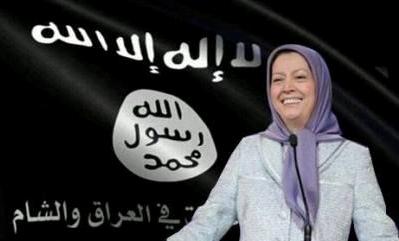
The Mujahedin-e Khalq describes the ISIS militants in Iraq as "revolutionaries" fighting against Nuri al-Maliki and struggles for their victory. They have been supporting ISIS since some 3 years ago by backing and condoning ISIS activities in Syria and Iraq. However, the French authorities did nothing, perhaps in a bid to pressure or displease Iran.

But this time, things are going awry, since giving permission to the MEK to hold gatherings stimulates ISIS supporters who has tremendous potential of joining the terrorist group in Iraq and Syria. Hence, the French streets should expect the parade of ISIS and the threat they will bring to the citizens.

June 23, 2014 0 comments
FacebookTwitterPinterestWhatsappTelegramSkypeEmail
The cult of Rajavi

Self-immolation anniversary of MKO members in France

June 17 marks the day when a group of MKO members set themselves ablaze on streets as a response to the French police detention of their leader, Maryam Rajavi.

On June 17, 20, 2003 more than 1,300 French Police kicked their way into the walled compound of the Mujahedin-e Khalq (MEK, a.k.a. MKO) in Auvers-Sur-Oise, north of Paris that has served as the terrorist group’s headquarters.

Masked and heavily armed police detained activists on suspicion of plotting terrorist attacks in France and building a support base for operations abroad.

French authorities detained 159 people in the raids on the compound north of Paris and 12 other sites outside the city. The authorities seized $1.3 million in U.S. currency, mostly 100-dollar bills, along with computers and satellite telecommunications equipment.

Among those arrested was Maryam Rajavi, wife of then Iraq-based MKO leader Massoud Rajavi and current leader of the MKO.

The raids were carried out on orders of French anti-terrorism Judge Jean-Louis Bruguiere for “criminal association aimed at preparing terrorism acts and for financing a terrorist enterprise,” the Interior Ministry said.

Upon the arrest of the MKO co-leader Maryam Rajavi, MKO members took to the streets and engaged in self-immolation outside the French Embassy in London. Two women died as a result. These horrible acts of self-immolations revealed the cult-like devotion of the MKO members.

According to Madeline Landau Tobias and Janja Lalich authors of Captive Hearts, Captive Minds, a book dealing with the cults, "this induction of whole hearted devotion does not happen spontaneously but is the result of the cult leader’s skillful use of thought-reform techniques."

One of America’s leading think tanks and research institutes, the RAND Corporation published a 105-page report on the MKO in 2009 titled “The Mujahedin-e Khalq in Iraq: A Policy Conundrum,” and highlighted the cult-like practices of the MKO.

The monograph says the MKO leadership had confiscated members’ identity documents, threatened them with persecution in Iran and prosecution for illegal immigration in Iraq, and prevented those who wished to do so from returning to their home country.

The report adds that Masoud Rajavi turned the MKO into an "inward-looking cult". "Rajavi instituted what he termed an “ideological revolution” in 1985, which, over time, imbued the MeK with many of the typical characteristics of a cult, such as authoritarian control, confiscation of assets, sexual control (including mandatory divorce and celibacy), emotional isolation, forced labor, sleep deprivation, physical abuse, and limited exit options."

On July 13, 2003, Elizabeth Rubin’s New York Times wrote an article titled “The Cult of Rajavi”. In this article Rubin details her encounters with MKO members she met in Camp Ashraf. Rubin wrote, "men and women had to participate in ‘weekly ideological cleansings,’ in which they would publicly confess their sexual desires. It was not only a form of control but also a means to delete all remnants of individual thought."

June 23, 2014 0 comments
FacebookTwitterPinterestWhatsappTelegramSkypeEmail
Mujahedin Khalq Organization

Media: MKO Terrorists to be Moved to Iraqi Kurdistan Region

Reports coming out of Iraq’s Kurdistan Region suggest that members of the anti-Iran terrorist Mojahedin-e Khalq Organization (MKO) are going to be transferred to the autonomous region in the north MKO Terrorists to be Moved to Iraqi Kurdistan Regionof the Arab country.

The MKO representatives and the president of the Iraqi Kurdistan region Masoud Barzani, have reportedly agreed on the transfer.

The Kurdistan Change Movement (Gorran) claimed on its website on Friday that the MKO intends to move its forces from Baghdad to Kurdistan.

Based on the report, the issue had been discussed by Barzani and the president of the Syrian National Coalition Ahmad Jarba during their France meeting earlier in May.

The MKO – listed as a terrorist organization by much of the international community – fled Iran in 1986 for Iraq and was given a camp by former Iraqi dictator Saddam Hussein. They fought on the side of Saddam during the Iraqi imposed war on Iran (1980-88). They were also involved in the bloody repression of Shiite Muslims in southern Iraq in 1991 and the massacre of Iraqi Kurds.

The notorious group is also responsible for killing thousands of Iranian civilians and officials after the victory of the Islamic revolution in 1979. More than 17,000 Iranians, many of them civilians, have been killed at the hands of the MKO in different acts of terrorism including bombings in public places, and targeted killings.

June 22, 2014 0 comments
FacebookTwitterPinterestWhatsappTelegramSkypeEmail
Iran Interlink Weekly Digest

Iran Interlink Weekly Digest – 57

++Last week rumours circulated that while he was in Paris, Kurdistan Region President Massoud Barzani had met with Maryam Rajavi. This week Nazim Dabbagh, the representative of the Kurdistan Regional Government (KRG) in Tehran announced that “no such meeting has ever taken place and our position toward this group has always been clear. Over the past few years we have repeatedly said that the MEK have massacred many Kurdish villagers and we can’t ignore that”.

++ A report from Albania states that the number of former Camp Liberty residents who have separated from the MEK after arriving in Tirana is now greater than those remaining loyal. Out of 210 individuals, more than half have now officially separated from the cult.

++ The majority of writing about the MEK in Farsi this week has concentrated on the MEK’s overt support for ISIS. This comes from as wide a spectrum as could be imagined; ex members, internal critics, various Iranian opposition inside and outside the country, people and groups from every direction, all have articles which express disgust for the MEK.

++ Many people, including the families of those in Camp Liberty have deep concerns about the MEK position in relation to ISIS. They believe Massoud Rajavi is trying to render the MEK residents of Camp Liberty legitimate targets by supporting ISIS and fuelling hatred among various Iraqi factions. His aim is to get rid of them as witnesses to his crimes. Some writers criticise those Americans and Israelis who support this group. They point out that the MEK can’t be trusted and this support will backfire at some point. The MEK are now openly supporting ISIS rather than being covert about it. Of course, these writers argue, the MEK may be at the end of their line and this kind of thing is to be expected, but surely the US and Israel cannot be so desperate.

++ Still in the context of MEK support for ISIS, other writers link it with the MEK rally in Paris on 27 June which celebrates armed struggle. The articles touch on the MEK’s history of violence and terrorism. They conclude that although the MEK was removed from the terrorist lists of several countries, the group has always remained a terrorist entity and have never given up this role. For anyone who claims otherwise, like the MEK’s Western supporters, this shows exactly where they stand in relation to terrorism. Ali Jahani from Germany wrote a detailed article titled ‘Rajavi’s cult 33 years after 30 Khordad 1360′. He examines the historical episodes and events which reveal the MEK as violent murderers and terrorists.

++ There has been much complaint among the MEK’s critics about the support for ISIS. Ali Behrouz (writing as Ali Nazer) sums it up in one sentence, “Rajavi, don’t be mistaken, this is not the smell of kebab, it is the smell of branding donkeys!” He points out that Rajavi claims to be Shia. Of course neither ISIS nor the Saddamists ever accept him. Nothing will come out of it for Rajavi in the end.

++ Massoud Rajavi gave a message to the residents of Camp Liberty. He told them, “We [sic] must face giving the final sacrifice, we either win [he means ISIS wins] or we are all going to die”. Internal critic Ismael Vafa Yaghmai wrote an article in response titled ‘Long Live the Crevice’. He goes through the whole history of the MEK identifying how they have always found a crack or a division or a fight to push themselves into and exist there for a while. And if that crack closes, they go and find a new one and live there – a bit like a parasite. Because the MEK have nothing from themselves to live on, they have ended in the parasitical position they have now of taking the side of ISIS. In one part he asks “have you ever thought, as I think, that the leader of this group knows more than anyone else what he is up to and what cards he plays on the table. I think he is running out of cards and these are among the last ones he is putting down. If Camp Liberty had been moved he would have been playing a different hand, but since that didn’t happen he is now placating ISIS and Iraqi tribal leaders with his last speech when he said ‘we have given hundreds of thousands of martyrs, we won’t hesitate to give these three thousand either’”.

++ Some articles and posts were written about the anniversary of the MEK self-immolations in 2003 and how the participants – two of whom died – were ordered to do this. Habilian Association in Iran has an article in English about this.

++ A press conference in Brussels on June 11 provoked many reactions in Farsi and an important article in English by Eldar Mamedov published in Lobelog. Mamedov identifies a handful of now former MEPs who have created the ‘European Iraqi Freedom Association (EIFA), a “new NGO with the mission of improving the political and human rights situation in Iraq.”’ While the world looked on in horror at the actions of jihadist extremists from ISIS, the MEPs downplayed this by claiming “these actions were not carried out by ISIS, but were “part of a popular uprising” against Prime Minister Nouri al-Maliki.” The root of this stance appears to be their support for the MEK: “After years of unchecked lobbying efforts, the MEK has convinced some MEPs to advocate in its favor. In addition to the leftist groups who uncritically support the MEK because it claims to have Marxist beliefs (along with Islamic ones!), right-wing MEPs seem taken in by its fervent anti-Iranian government stance. It is therefore not surprising that the individuals endorsing the EIFA have also endorsed the MEK.” Straun Stevenson, Alejo Vidal Quadras and Paulo Casaca have all been fervent supporters of the terrorist MEK. None will continue as MEPs in the new session of the European Parliament. Mamedov says that the MEK will try to recruit among new MEPs whom he warns against “associating with an organization that attempts to minimize the acts of a group so murderous and fanatical that even al-Qaeda has declared it too extreme”.

++ Farsi articles about the same event in Brussels say it is clear that those who back ISIS, Saddamists and the MEK are the same people, and they have influence in London, Washington and Brussels. As much as they claim to oppose terrorism, it is Westerners like these in Brussels who give it their full support.

In English:

Mazda Parsi writing in Nejat Bloggers examines the links between ISIS and the MEK. “This devil alliance between Baathists, extremists and cultists is not accidental. It actually originates in the cult-like violence which exists in the substance of such groups. Definitely, the cult of Rajavi and ISIS resort to violence and terror as their only solution to the world’s problems. The most crucial factor in the rule of both which is based in violence is that dissident voice must be silenced by killing and bloodshed… The MKO leaders also deal out harsh treatment against their own members in their camps. Members including hundreds of women are isolated from the outside world just like the so-called Islamic state of ISIS in Mosul under which women are banned from getting out of house or being uncovered.”

++ According to Fars News, an entreaty by Kazzem Jalali (Head of the Majlis’s Friendship Group with the European Parliament), in Tehran on Sunday, prompted Elmar Brok (Chairman of the European Parliament Committee on Foreign Affairs) to stress that “that the new European Parliament lays emphasis on the importance of the relations with Iran, and said, “The majority of the European Parliament do not like cooperation with groups such as MKO and only a minority group in the Parliament support the MKO.” Jalali had expressed surprise at the presence of a “shameless” group like the terrorist Mojahedin-e Khalq Organization in the European Parliament, and said, “Even the critics of Iran’s political system do not recognize the MKO and the European Parliament had better try to listen to the Iranian nation, statesmen and people’s true representatives.”

++ Henriette Johansen in Middle East Monitor writes: ‘Mossad used Mojahedin Khalq for years – Global fear of Iran’s ‘controversial’ nuclear programme is a ‘US-Israeli construct’. One interviewee, Ellie Geranmayeh, Iran expert at the European Council on Foreign Relations (ECFR) insisted, “In the same way that any potential military dimensions of Iran’s nuclear programme needs to be explained to the United Nations, the West also needs to explain the basis of its accusations and suspicions.”

++ Nejat Society Gilan office celebrated the reunion of Mr. Rajabzadeh and his beloved children who were barely 5 years old when their father left home as a an Iranian soldier to fight Iraqi Baa’th regime. Mr. Rajabzadeh was a war prisoner when the MKO recruiters deceived him to join their cult. Under the mind control system of the cult, he lost his youth and family. While hugging his father, the son of Mr. Rajabzadeh, Mehran cried , “Shame on Rajavi who separated me and my sister from our father for 27 years! He made us live in grief and suffering.” Rajabzadeh’s daughter, Razieh hugged and kissed her father. She appreciated the efforts of Nejat Society for the return of her father. Reza Rajabzadeh who could hardly ever control his tears said:” I’m sorry… I love my children… Shame on Rajavi who broke down a lot of families! I will not stop denouncing him and his cult unless all prisoners of Camp liberty are released.” Reza Rajabzadeh left the MKO about two years ago. After his release, he stayed in a hotel in Baghdad as he wanted. He was one of the active ex-members of the group who revealed the notorious safe house of Masoud Rajavi, Base 49.

20 June 2014

June 21, 2014 0 comments
FacebookTwitterPinterestWhatsappTelegramSkypeEmail
Terrorist groups and the MEK

European MEK Supporters Downplay ISIS Role in Iraq

While the world watched in horror as jihadist extremists from the Islamic State of Iraq and Syria (ISIS) seized the Iraqi city of Mosul, some members of the European Parliament (MEPs) claimed that these actions were not carried out by ISIS, but were “part of a popular uprising” against Prime Minister Nouri al-Maliki.

At the same time that ISIS was reportedly committing mass executions in Mosul, these MEPs “disputed” that Mosul and Tikrit had been taken by ISIS, and announced the creation of the European Iraqi Freedom Association (EIFA), a “new NGO with the mission of improving the political and human rights situation in Iraq.”

The comments were made at a June 11 press conference in Brussels, according to a press release for the event.

The ousting of Maliki and the “complete eviction of the Iranian regime from Iraq” are the group’s primary goals, according to the press release of the EIFA, which has no website other than a Facebook page that was created on May 6.

There is no shortage of people arguing that Iran holds excessive influence over Iraq and that Maliki has aggravated many of Iraq’s problems, so why did these MEPs resort to downplaying the horrors of ISIS’ actions in calling for an end to Tehran’s hold on Baghdad?

A clue appears in the EIFA’s emphasis on the security situations of Camps Ashraf and Liberty.

Camp Ashraf became the Iraqi base of the exiled Iranian dissident organization, the Mujahedin-e Khalq, (aka MEK, MKO, PMOI and NCRI), in the 1980s after its exodus from the Islamic Republic following a power struggle and regime-orchestrated persecution.

The MEK, frequently described as a “cult”, was classified as a terrorist organization by the EU until 2009 and by the US until 2012, and has been accused of human rights abuses.

Despite its expensive claims to the contrary (MEK op-eds and advertisements regularly appear in Western media outlets), the NCRI, the MEK’s “parliament-in-exile” and political wing, has no popular support in Iran. In fact, the MEK sided with Saddam Hussein during the 1981-88 Iran-Iraq war and even attempted to take Iranian territory. The vast majority of Iranians inside Iran either consider the group insignificant or harmful to reformist efforts. The MEK is also despised by many Iraqis for its role in crushing Shia and Kurdish uprisings against Saddam’s dictatorial rule. Yet thanks to well-funded lobbying and advocacy efforts, the MEK has still been endorsed by some Western politicians in the US and Europe as a legitimate Iranian opposition movement.

Before setting its sights on the United States, the MEK, through the NCRI, embarked on a well-organized campaign to bring European politicians to its side. After years of unchecked lobbying efforts, the MEK has convinced some MEPs to advocate in its favor. In addition to the leftist groups who uncritically support the MEK because it claims to have Marxist beliefs (along with Islamic ones!), right-wing MEPs seem taken in by its fervent anti-Iranian government stance. It is therefore not surprising that the individuals endorsing the EIFA have also endorsed the MEK.

The foremost MEK-EIFA endorser is Struan Stevenson, a British conservative who chaired the European Parliament (EP) delegation for relations with Iraq in 2009-2014. Under his watch, the delegation has devoted disproportionate attention to the security of Camp Ashraf while almost completely neglecting the more relevant economic, social, security and human rights challenges facing Iraq. When the EP negotiated a 2014 resolution addressing the surge of violence in Iraq in February, Stevenson made every effort to downplay the involvement of ISIS, while directing all blame towards Maliki and Iran.

Another notable promoter of the EIFA is Alejo Vidal-Quadras, a Spanish conservative. During his tenure as Vice President of the EP (2009-14), he functioned as one of the NCRI’s chief supporters. The EIFA has also been endorsed by former Portuguese socialist MEP Paulo Casaca (2004-09), a self-styled “expert on Iraq” who reportedly employed a MEK member as one of his personal assistants during his parliamentary stint.

Seen in the light of their MEK connections, it’s clear why these MEPs are trying to downplay the role of ISIS as a serious threat to the stability of Iraq and the broader region. The MEK and its supporters view Maliki as an Iranian pawn and believe that if Maliki goes, the Iranian government (which the MEK detests) will suffer. So in following the proverb, “the enemy of my enemy is my friend”, the MEK’s supporters and ISIS have found a common cause in pushing for Maliki’s ouster.

Even though Vidal-Quadras, Stevenson and Casaca will not be serving in the incoming European Parliament as of July 1, the MEK will surely try to recruit more MEPs for its cause, including with new tools like the EIFA. Of course, whoever is approached by the MEK — and most MEPs will be approached if they haven’t already — would be wise to think twice about associating with an organization that attempts to minimize the acts of a group so murderous and fanatical that even al-Qaeda has declared it too extreme.

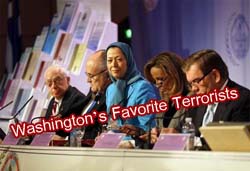
Photo: The European Iraqi Freedom Association’s (EIFA) June 11 press conference in Brussels featuring European members of parliament Stephen Hughes, Struan Stevenson, Alejo Vidal-Quadras, and Paulo Casaca.

by Eldar Mamedov

About the Author

Eldar Mamedov has degrees from the University of Latvia and the Diplomatic School in Madrid, Spain. He has worked in the Ministry of Foreign Affairs of Latvia and as a diplomat in Latvian embassies in Washington D.C. and Madrid. Since 2007, Mamedov has served as a political adviser for the social-democrats in the Foreign Affairs Committee of the European Parliament (EP) and is in charge of the delegation for inter-parliamentary relations between the EP and Iran.

June 21, 2014 0 comments
FacebookTwitterPinterestWhatsappTelegramSkypeEmail
Mujahedin Khalq; A proxy force

Mossad used Mojahedin Khalq for years

Global fear of Iran’s ‘controversial’ nuclear programme is a ‘US-Israeli construct’

‘Iran will have enough enriched uranium for nuclear bomb by next summer’ – Netanyahu at the UN General Assembly in Sep 2012

Iran’s nuclear talks with the P5+1[1] are taking place in Vienna. A “solid commitment” from Iran is needed, ensuring that its stated peaceful atomic energy programme is not a clandestine attempt to build nuclear weapons. The Iranians have found themselves needing to make a leap towards lifting the crushing international sanctions, notably those imposed by the US. It is the basis of these sanctions that MEMO has re-examined with a group of senior researchers in the field.

When Ellie Geranmayeh, Iran expert at the European Council on Foreign Relations (ECFR) spoke with MEMO, she insisted, “In the same way that any potential military dimensions of Iran’s nuclear programme needs to be explained to the United Nations, the West also needs to explain the basis of its accusations and suspicions.”

Ever since the International Atomic Energy Agency (IAEA) reported “sensitive enrichment and reprocessing activity” in Iran in 2003, the country has been under close supervision. The UN Security Council decided to impose economic sanctions for Iran’s non-compliance with its previous request to suspend enrichment activities before extending them in 2007, 2008 and 2010. According to Reuters, Washington was recently pushing for an even more severe attack on the Iranian economy, but this was rejected by the Security Council. Iran’s former president, Mahmoud Ahmadinejad, argued that the sanctions are “illegal” and imposed by “arrogant leaders”. The sanctions are devastating the Iranian economy and have been imposed despite the fact that Iran’s uranium enrichment is being held below 5 per cent, consistent with developing fuel for a civilian nuclear power plant. US pressure has led several nuclear contracts between Iran and foreign governments to fall through.

The United States Enrichment Corporation (USEC)[2], meanwhile, has used its official website to “call for action” to change the course of its declining share of the global enrichment market, underscoring the need to “limit the spread of enrichment technologies to rogue states”. This controversial Western centric use of the phrase “rogue states” demands a thorough investigation, according to many experts.

Furthermore, the West’s foundation for these claims against Iran has too many fault lines “to begin to even list them,” claims historian and Iran nuclear expert Dr Gareth Porter. The single biggest factor pushing “the elite’s obsession over Iran as a threat and as an enemy,” he says, “is that the basic premise was laid down early at the end of the Cold War.” His ground-breaking work recently received the annual Martha Gellhorn Prize for Journalism from the London-based journalists’ Frontline Club. MEMO spoke to Porter about the trajectory of the “imminent Iranian nuclear threat” and its construct by a handful of powerful actors with a particular political agenda and documents “with little reliability” that the media over the last decade have had no qualms about accepting and sharing as (unauthenticated) “evidence”.

1)”The laptop documents”

One of the main anomalies in America’s porous trajectory on Iran is the pseudo-crucial “laptop documents”. Presented by the US to the Security Council, these 1,000 pages are alleged to contain research on nuclear weapons-related activities, stolen from the computer of an Iranian scientist or engineer who was, it is claimed, involved in the programme. “This was a trick to cover the truth,” said Porter. He recapped how the documents were passed to Germany’s intelligence agency by a member of the Mujahideen-E-Khalq (MEK) an Iranian terrorist organisation in exile, which has been a client of Israel’s Mossad spy agency for several years. German intelligence and many other government officials, including ex-US Secretary of State Colin Powell, warned that the US and EU should not make the mistake of basing policy on this information.

2) Redesigned Iranian missile

Another central anomaly is the “discovery” that the Iranian missile re-entry vehicle is depicted in the documents as being redesigned to accommodate a nuclear payload. “This was one that had been discarded by Iran at least two years before the drawings were said to have been made,” Porter argues, “not according to Iranian sources, but an authoritative Western source: the London-based International Institute for Strategic Studies (IISS).”

3)Technical errors

“The discovery that the same drawings of an alleged effort to redesign the re-entry vehicle of the Shahab-3 missile contained numerous technical errors,” Gareth Porter contends, “indicated again that they had not been done by those involved in Iran’s missile programme.”

4) Codename (5.15)

This was given to one of the sub-projects in the alleged nuclear weapons research programme that was, in truth, the number assigned to a contract with the civilian atomic energy organisation of Iran or an ore processing facility and was signed two years before the supposed covert research programme was even said to have begun.

Israel’s position

Last week, at the Herzliya Conference, Israel’s platform for the articulation of national policy, Global Jewish News Source reported major Israeli politicians with strong beliefs in this propaganda. “What is at stake is not merely Israel’s position in the Middle East,” argued Likud’s Yuval Steinitz, “what is at stake is the fate of the entire world… Iran is a nuclear threshold state. It just hasn’t created the weapons yet.”

Lina Khatib of the Carnegie Endowment for International Peace think-tank explained to MEMO how Israel been trying to push the US to take military action against Iran to stop its nuclear enrichment programme. Further, the government in Tel Aviv has also been engaging in “clandestine intelligence operations to halt Iran’s nuclear developments, for example through cyber-attacks,” she warned. In response, America pushed back against Israel’s request for military strikes against Iran, and is not likely to include Israel as a formal partner in the Vienna negotiations over the nuclear file, “though the US will ensure that Israeli interests are represented during the talks”.

“Overwhelming” evidence exists, according to Dr Gareth Porter, that it was Israel’s Mossad that produced the falsified documents that have propelled the “manufactured crisis” forward, “not just once, but twice”. First came the “laptop documents” that surfaced in 2004 followed in 2008-2009, two years into his research, when a series of intelligence reports and allegedly Iranian documents were given to the IAEA directly by the Israelis, “resulting in more accusations following the November 2011 IAEA report”.

According to Porter, Israeli’s pressure on the Obama administration to make demands of Iran will ensure that the talks fail. “Thus far that Israeli strategy has succeeded, because the Obama administration has demanded a cut in Iranian centrifuges that makes it difficult to envision a final compromise.” Basing any military action on false dossiers would be as irresponsible as the invasion of Iraq in 2003; the world witnessed what consequences that had, when soldiers on the ground had no clue about what was going on.

Current talks

Iran has been talking separately with most of the members of the P5+1 group in advance of the formal meetings week. Although reports have been modestly positive about the potential outcome, the final accord date set as July 20 is already predicted to be given a six-month extension by government officials from most of the countries involved.

Porter remains “very worried” that the talks will fail because of America’s “hard-line” refusal to tolerate any Iranian enrichment of uranium to support even its present nuclear reactor, “much less future reactors”. He recently interviewed Iranian Foreign Minister Javad Zarif, who has not given up hope of renewed and extended diplomatic flexibility on behalf of the US. Even so, he indicated that statements had been made in the talks, as well as to the media, that were “posturing”. He implied that this was politically dangerous because it would make later adjustment in the US negotiation stance very difficult.

According to Lina Khatib, we will see the lifting of some sanctions, but a comprehensive deal will take time to be made and implemented. However, as Iran’s nuclear programme is primarily, she says, “aimed at giving Iran political weight in the Middle East and international recognition as a major regional player, rather than at preparing to conduct a nuclear attack,” there might be more “muscle-flexing” involved than seen so far.

The threat of an ISIS take-over of major Iraqi cities near the border with Iran has collided with the current negotiations on the country’s nuclear programme and arguably paved the way for an indirect willingness to reach an agreement with America. The pace of events means that Iran, which in the 1980s fought former Iraqi dictator Saddam Hussein for eight years, may be willing to cooperate with Washington to bolster Iraq’s Shi’ite Prime Minister Nouri al-Maliki. Iranian President Hassan Rouhani has said that he will consider such cooperation, if the US takes action in Iraq.

However, a US official cautioned against reading too much into the latest talks: “No one should expect that all of a sudden, overnight, even if we resolve the nuclear agreement, that everything will change. It will not. The fundamentals remain exactly as they are. Until we resolve the nuclear issue there cannot be any kind of fundamental change in this relationship.”

Footnotes

[1] Iran has had meetings with China, France, Germany, Russia, the United Kingdom and the United States. These six are known as the P5+1 (the permanent five members of the UN Security Council plus Germany) or alternatively as the E3+3, used by European countries. These meetings are intended to resolve concerns about Iran’s nuclear programme.

[2] USEC: the American corporation that contracts with the United States Department of Energy to produce enriched uranium for use in nuclear power plants.

Henriette Johansen, Middle East Monitor,

June 19, 2014 0 comments
FacebookTwitterPinterestWhatsappTelegramSkypeEmail
Former members of the MEK

MKO defector Reza Rajabzadeh is back home

Former member of the Mujahedin Khalq Organization  (the MKO) returned home after 25 years of imprisonment in the Cult of Rajavi.

Nejat Society Gilan office celebrated the reunion of Mr. Rajabzadeh and his beloved children who were barely 5 years old when their father left home as a an Iranian soldier to fight Iraqi Baa’th regime. Mr.  Rajabzadeh was a war prisoner when the MKO recruiters deceived him to join their cult. Under the mind control system of the cult, he lost his youth and family.
While hugging his father, the son of Mr. Rajabzadeh,  Mehran cried , "Shame on Rajavi who separated me and my sister from our father for 27 years! He made us live in grief and suffering."
Rajabzadeh’s daughter, Razieh hugged and kissed her father. She appreciated the efforts of Nejat Society for the return of her father.
Reza Rajabzadeh who could hardly ever control his tears said:" I’m sorry…I love my children…Shame on Rajavi who broke down a lot of families! I will not stop denouncing him and his cult unless all prisoners of Camp liberty are released."
Reza Rajabzadeh left the MKO about two years ago. After his release, He stayed in a hotel in Baghdad as he wanted. He was one of the active ex-members of the group who revealed the notorious safe house of Masoud Rajavi, Base 49.

June 18, 2014 0 comments
FacebookTwitterPinterestWhatsappTelegramSkypeEmail
Europe

Brok: Majority of Eu Parliament do not like MKO

Chairman of the European Parliament Committee on Foreign Affairs Elmar Brok underlined that the new European Parliament is aware of the importance of ties with Iran.

Brok made the remarks in a meeting with Head of the Iranian legislature’s Friendship Group with the European Parliament Kazzem Jalali in Tehran on Sunday.

During the meeting, Jalali pointed to the talks between Iran and the Group 5+1 (the five permanent UN Security Council members plus Germany), and said, "The nuclear talks were underway in desirable conditions, but unfortunately the (European Parliament’s Human Rights) resolution against Iran changed the overall atmosphere of the negotiations."

Jalali expressed surprise at the presence of a "shameless" group like the terrorist Mojahedin-e Khalq Organization (MKO, also known as MEK, PMOI and NCRI) in the European Parliament, and said, "Even the critics of Iran’s political system do not recognize the MKO and the European Parliament had better try to listen to the Iranian nation, statesmen and people’s true representatives."

Jalali reiterated that the talks between Iran and European Parliament can be a prelude to a bigger agreement in the future, "but harnessing the radicals, specially at the European Parliament, is the prerequisite for such an agreement".

Brok, for his part, said that the new European Parliament lays emphasis on the importance of the relations with Iran, and said, "The majority of the European Parliament do not like cooperation with groups such as MKO and only a minority group in the Parliament support the MKO."

Brok said that the EP welcomes achievement of a final deal by Iran and the G5+1, and added, "It will be in the interest of both sides in economic and political terms to resolve Iran’s nuclear issue and I believe that Iran is entitled to run civilian nuclear activities and I hope that the international community take this into consideration as well."

The EP adopted a resolution against the human rights conditions in Iran in April. The resolution came under harsh criticism by the Iranian Parliament Speaker, Ali Larijani, who described it as "distressed words".

"As a matter of fact, this resolution is nothing more than a political statement in terms of the method used for compiling the contents to show the European Parliament’s symbolic position which has no executive power… and a type of distressed wording is seen in this composition-like text," Larijani said, addressing the Iranian legislators in an open session of the parliament in April.

He said that the resolution welcomes expansion of ties with Iran, progress in talks between Tehran and the world powers and cooperation with Iran on Syria and fighting terrorism on one hand, and raises allegations against issues, including elections in Iran, human rights situation and women’s rights, which are considered as meddling in the country’s internal affairs, on the other hand.

Larijani questioned the wisdom of the European legislators who, he said, show willingness to increase extended cooperation with Iran in nuclear, regional and technological fields while uttering such "cheap and baseless words".

The resolution adopted by the European Parliament in a meeting in Brussels called for meetings between EU delegations and Iranian dissidents and opposition leaders and criticized the presidential elections in Iran.

The European’s move angered officials in Tehran as it was adopted after the western states voiced their consent and pleasure in the betterment of ties with Iran following a breakthrough deal over Tehran’s nuclear program.

June 17, 2014 0 comments
FacebookTwitterPinterestWhatsappTelegramSkypeEmail
Terrorist groups and the MEK

What makes MKO and ISIS brothers?

The legacy of Osama bin Laden and Saddam Hussein appears in a more dangerous group called Islamic Iraqi State and the Levant (Daesh in Arabic).     

ISIS was formed in April 2013 and grew out of al-Qaeda in Iraq (AQI). It has since been disavowed by al-Qaeda, but become one of the main jihadist groups fighting government forces in Syria and is making military gains in Iraq according to BBC.

Correspondents say it appears to be surpassing al-Qaeda as the world’s most dangerous jihadist group. Some suggest that Al Qaida rejects ISIS because it is too extreme!

One part of the ISIS’s supporters in Iraq includes elements of former Iraqi Baa’th regime that severely oppose the government of Nouri al Maliki. Eventually, as "Saddam’s Private Army" the Mujahedin Khalq Organization (the MKO) is naturally one of their sponsors in their distressing acts of violence and terror in Iraq and Syria.

Baathists welcome ISIS and MKO welcomes both. Saddam Hussein’s daughter in Jordan, with whom the MKO is in close collaboration, went further and thanked the Saudi government for supporting ISIS, reported Iran Interlink.

This devil alliance between Baathists, extremists and cultists is not accidental. It is actually originated in the cult-like violence which exists in the substance of such groups. Definitely, the cult of Rajavi and ISIS resort to violence and terror as their only solution to the world’s problems.

The most crucial factor in the rule of both which is based in violence is that dissident voice must be silenced by killing and bloodshed. This essential rule was instructed to them by their main masters Saddam Hussein and Osama. However, today they are more aggressive that their predecessors.

The MKO leaders also deal out harsh treatment against their own members in their camps. Members including hundreds of women are isolated from the outside world just like the so-called Islamic state of ISIS in Mosul under which women are banned from getting out of house or being uncovered.

The cult’s website praises the ISIS’s statement in which it promises to kill the government forces unless they surrender. Calling the ISIS terrorists as “Revolutionary forces” the MKO propaganda expresses solidarity with them.

ISIS forces are considered brothers by the MKO because they are the group’s ideological brothers if not biological brothers.

Mazda Parsi

June 15, 2014 0 comments
FacebookTwitterPinterestWhatsappTelegramSkypeEmail
Newer Posts
Older Posts

Recent Posts

  • National Pride of Iranians: Reject the Rajavis and their Patrons

    July 22, 2026
  • Italian legislators fooled by MEK’s polished presentations

    July 18, 2026
  • The Rhetorical Style and Polemical Language of the MEK

    July 15, 2026
  • Death of Lindsey Graham, notorious hardliner against Iran

    July 13, 2026
  • Nejat Society Albania’s 2026 Peace Delegation

    July 11, 2026
  • Facebook
  • Twitter
  • Instagram
  • Youtube

© 2003 - 2025 NEJAT Society . All Rights Reserved. NejatNGO.org


Back To Top
Nejat Society
  • Home
  • Articles
  • Media
    • Cartoons
    • NewsPics
    • Photo Gallery
    • Videos
  • Publications
    • Books
    • Nejat NewsLetter
    • Pars Brief
  • About Us
  • Contact us
  • Editions
    • عربي
    • فارسی
    • Shqip