Nejat Society
  • Home
  • Articles
  • Media
    • Cartoons
    • NewsPics
    • Photo Gallery
    • Videos
  • Publications
    • Books
    • Nejat NewsLetter
    • Pars Brief
  • About Us
  • Contact us
  • Editions
    • عربي
    • فارسی
    • Shqip
Nejat Society
Nejat Society
  • Home
  • Articles
  • Media
    • Cartoons
    • NewsPics
    • Photo Gallery
    • Videos
  • Publications
    • Books
    • Nejat NewsLetter
    • Pars Brief
  • About Us
  • Contact us
  • Editions
    • عربي
    • فارسی
    • Shqip
© 2003 - 2024 NEJAT Society. nejatngo.org
Iran Interlink Weekly Digest

Iran Interlink Weekly Digest – 52

++ Iraj Shokri, a famous writer who left the MEK some time ago, has blogged to reject some of the quotes used by the MEK when they wrote about Kamal Rafatsafai (a poet who recently died who also left the MEK and became very critical over their human rights record). Shokri says that although he doesn’t usually answer the MEK, this time they sneakily used his name and he has had to refute their misuse of his quotes.

++ Nejat Association reports about the situation inside Camp Liberty. Apparently, runaways have become a serious problem for the MEK and they have added more sentry posts around the residential blocks in an attempt to prevent this. The MEK says its last hope is its commanders keeping control of the rank and file. Also, the MEK have expressed disappointment with the Iraqi election result. They had already acknowledged that if the elections in Iraq don’t work out for them with the return of some Baathists they are finished.

++ Reports from Albania show pictures of around eight people who were among the children evacuated from Camp Ashraf in 1991 to Europe, before being sent back to Iraq again for military training. Because they all have residential history in European countries, the reports say, the MEK have deliberately sent them to Albania in order to delay their arrival in these European countries and to prevent them from talking. To keep them quiet in Albania, the MEK henchmen Ismael Mortezai and Hassan Nayebagha from Paris, are threatening them from one side – we will kill you if you act without our approval – and on the other side promising that if they get refugee status from the UNHCR in Tirana the MEK itself will transfer them elsewhere in Europe.

++ Mohammad Alavi on Aryia Iran website has written an article titled: ‘One thousand Ashraf camps in Europe and toppling the regime with photoshop’. He says everyone is aware the MEK are busy touring refugee camps to buy people for their 30 June event to celebrate the start of their armed struggle. This year the event is to be held on 27 June in Villepinte in north Paris. Alavi details the history of these events over the last few years and provides links to coverage in Le Monde, France 24 and Radio Farda which have all exposed the pretence. The article also has links to other media items in which people have admitted they were paid either to speak or to attend. Some other ex members write on same subject revealing that the MEK visit travel agencies as well as refugee camps and offer free trips to Paris and a hand-out of money in exchange for two hours attendance in their meeting. They reveal that this year the meeting will include performances of singing and dancing as well as speeches in order to attract people and fool them about the true nature of the event.

++ The Iraqi election is finished and the official result will be out next week, and it is already clear that Maliki’s coalition has come out on top and is widely supported. There will now follow negotiations between the various factions to agree roles and responsibilities. But it is clear the new government, whatever its configuration, contains many fewer Saddamists, Danesh and other MEK sympathisers.

++ Homayoun Kohzadi has published a short note in Yaran Association website saying that several people who have escaped from Camp Liberty have contacted him. They say that Massoud Rajavi has again made an announcement declaring that these are the last days of the Iranian regime. He has ordered an alert to be ready. Rajavi says, while Maryam is doing the last bits of toppling by creating one thousand Camp Ashrafs in Europe, the combatants in Camp Liberty have to be ready for the last attack toward Iran. Kohzadi begs the question, ‘why does Rajavi not look at himself in the mirror?’ “Your audience” he tells Rajavi, “has no weaponry, the government of Iraq is in charge so you won’t even get to border. But putting even these obstacles aside, how can these old and sick people go to war? They would die on the way.” He finishes by saying, “Rajavi has gone mad.”

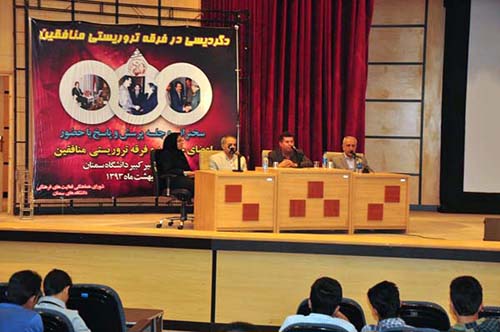
++ Mojahadin.com reported a meeting at the University of Semnan in which Ebrahim Khodabandeh gave a speech to the students and staff about cults. Khodabandeh said, “I have been in the MEK’s camps and I have been in Evin prison. With reference to the problems in Section 350, one thing I am certain of is that the amount of contact the Evin prisoners have with the outside world is not comparable with the contact MEK members have with the outside because the MEK have none!” He also announced that through research he can now say that the number of ex members is well over the number of current MEK members. He concluded that although we don’t have the power to rescue the people who have fallen into this trap, my friends and I will make sure they can’t drag new people into their trap.

++ Mohammad Karami from Paris and some others have responded to an article in Iran Global written under pseudonyms. The writers claim they are a group working with the Intelligence Service of the Netherlands who are responsible for trapping ex MEK member Behzad Alishahi through various sting scenarios so that he would be arrested under national security laws. The group uses this article to threaten every other critic of the MEK that “if you don’t stop this criticism of the MEK we have the power to deal with you the same way we did Alishahi”. This threat follows previous reports, particularly from Albania where MEK henchmen carry Pentagon ID cards, of MEK intimidation and threats in the West. Karami and others have exposed this ‘group’ as a man called Amrollah Ebrahimi, an ex member from TIPF who was bought by the MEK and who is working directly under the supervision of Hadi Roshanravan (a commanders in the MEK’s Intelligence Section who has been highly trained by Saddam’s Mokhaberat). Karami and other writers question what is behind publishing this on Iran Global website in particular, and conclude that since the MEK has been exposed to be behind the intimidation of ex members through their own websites, they have outsourced this to Iran Global so it doesn’t look like the MEK are behind it.

++ Razieh Kermanshahi has died from a heart attack in Albania. She was 57. Rajavi has been quick to add her to the list of martyrs from the Leadership Council. But many who knew her say that she had heart problems for many years which the MEK deliberately neglected. Essentially they sent her to Albania to die. In this respect Javad FIrouzmand wrote an article for Aryia Iran naming several other people who suffered neglect or have been denied medical attention by the MEK. He reveals how they have been eliminated in this way from the time of Saddam up until the present.

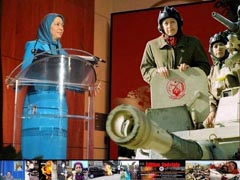
++ This week Maryam Rajavi has put on a show for internal purposes. She was photographed strolling around a display of pictures of the MEK’s so called martyrs from the time of the revolution until now. This was published on their Farsi websites. Edalaat Association wrote an analysis about why Maryam has done this while 99% of her time is spent with the Israeli lobby and the like. The article says there is an identity crisis inside the MEK among members and unpaid supporters who cannot understand what is the MEK’s relation to Israel, Al Qaida, Syria, Nigeria, and etc. Rajavi has taken these pictures to prevent the internal forces from collapsing.

In English:

++ Fox News published a reply by Hamid Babaei, counselor and head of the Press Office for the Permanent Mission of the Islamic Republic of Iran to the United Nations in New York, to an op-ed by former New York City Mayor Rudolph Giuliani. Babaei described Guiliani’s “warm embrace of the MEK terrorist organization” as “shocking and deplorable”, describing it as “a repressive cult despised by most Iranians and Iraqis.”

++ Elsa S. Vejo Destrella Digital (Digital Star) spoke with Alejo Vidal- Quadras MEP as the key man in Spanish political relations with the Iranian People’s Mujahedeen. She writes the question of where the MEK gets its money? “The question still remains unresolved and the experts bring to the fore the question of where does the MEK get all the money it costs to maintain this important network of contacts and support . According to Vidal-Quadras, solely from the Iranians in the diaspora, “some of them are very wealthy”. Although other politicians we consulted doubt this. “I am not so naive to think that the contributions of all Iranians in exile are sufficient to maintain that infrastructure. I do not rule out that there may be powers that are instrumental in acting in their favor”, admits Gari Duran Sen. PP Baleares, and one of the Mojahedin’s greatest defenders in Spain. The USA , Israel and Saudi Arabia are among the possible hidden funders. Duran, however, says she does not care about that; “I have seen people on hunger strike, I have seen the pictures of the dead and have heard their mothers talk, and unless you have to conclude that this is a giant deception, to me it is real.””

++ Nejat Association wrote an open letter to Ms Laura Boldrini, President of the Chamber of Deputies of Italy, asking to meet with her during her visit to Iran with a 10-member delegation, headed by co-chairman of Iran-Italy parliamentary friendship group Ettore Rosato. Nejat said it wanted to meet to find a way to rescue the members in Iraq and try to put them in contact with their families in Iran.

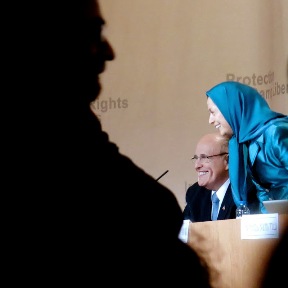
++ Ali Gharib writing ‘Controversial Iranian Exile Shakes up Canadian Parliament’s Human Rights Program’ in The Nation, exposed the damage caused by the inclusion of Maryam Rajavi by Skype in the event. According to Gharib, “Dr. Ahmed Shaheed, the UN Special Rapporteur on the situation of human rights in Iran, Shaheed requested to withdraw from the official Iran Accountability Week proceedings. He agreed, an assistant said, to brief lawmakers “in a different context than Accountability Week.” Asked why, Shaheed’s representative responded, “He just didn’t think it was appropriate.” The assistant explained that Shaheed felt the event’s framing “made it feel less like a briefing and more of something that encroached upon what he believes is his independence on the issue” of human rights in Iran.” “…Another human rights advocate working on Iran, who asked not to be named, raised the issue of other advocates sharing a platform with the head of the MEK, which the activist called “toxic and irrelevant”—a view widely held among Iranians of all political stripes, save members of the MEK itself.”

16 May 2014
May 17, 2014 0 comments
FacebookTwitterPinterestWhatsappTelegramSkypeEmail
Maryam Rajavi

Introducing Maryam Rajavi as a human rights activist is the wrong tool for the wrong job

Although Canada is not party to the P5+1 nuclear negotiations, the Canadian parliament’s all-party Iran Accountability Week aimed to put pressure on Iran over its human rights record. Instead, it degenerated

Introducing Maryam Rajavi as a human rights activist is the wrong tool for the wrong jobinto another crude attempt to fuel enmity and hatred and prevent any rapprochement between Iran and western powers, even a clumsy attempt to create conditions which would derail the negotiating process. The weeklong series of events backfired badly as Ali Gharib writing in The Nation revealed.
The inclusion of the Mojahedin Khalq’s notorious second in command, Maryam Rajavi, who describes herself as the ‘president-elect’ of a future Iran, was guaranteed to create controversy. The MEK itself has a well documented history of human rights violations. The group is hated by Iranians inside and outside the country.

Predictably, several participants pulled out of the event. Most notably Dr. Ahmed Shaheed, the UN Special Rapporteur on the situation of human rights in Iran.

Among the others there were divisions. Some indicated that the inclusion of Maryam Rajavi is not in the benefit of Israel, others clearly scorned her presence, as Ali Gharib reported: “One human rights advocate working on Iran, who asked not to be named, raised the issue of other advocates’ sharing a platform with the head of the MEK, which the activist called “toxic and irrelevant”—a view widely held among Iranians of all political stripes, save members of the MEK itself.”

The result was that Maryam Rajavi’s backers were forced to get her to water down her speech, to narrow it down to talking about the MEK’s camps in Iraq and what is happening there and not to use the event as a platform for wider anti-Iranian attacks. Even then Rajavi had nothing but MEK propaganda, riddled with lies and misinformation, to tell the assembly.

The Skype appearance followed a failed attempt to get Rajavi a US visa during the P5+1 negotiations on May 8. It was known that Rajavi had also applied to visit Canada, but apparently she wasn’t welcome there either, and in the end Rajavi’s speech from her headquarters outside Paris had to be censored to render it bearable if not credible for real human rights advocates and activists who attended. Even then they felt they had been deceived and tricked into listening to someone contemptible.

The presence of Maryam Rajavi – an advocate of the Saddamists, Al Qaida and ISIS in Iraq – exposes the real agenda behind the so-called human rights advocates who invited her. While it is understandable that MOSSAD may use the MEK as a mercenary force to assassinate Iranian scientists or for information laundry, nobody will accept the MEK as humanitarian. This is simply the wrong tool for the wrong job.

Anne Khodabandeh (Singleton), Middle East Strategy Consultants,

May 17, 2014 0 comments
FacebookTwitterPinterestWhatsappTelegramSkypeEmail
European Union

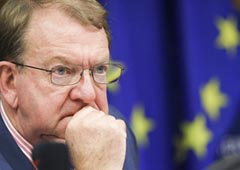
Open Letter of Iran Pen Association to Mr. Struan Stevenson MEP

To The Honorable Mr. Struan Stevenson MEP and President of the European Parliament’s Delegation for

Relations with Iraq,

Recently in MEK / PMOI related websites there was a statement published in your name in which you expressed concern about the situation of Iraqi people as well as the undemocratic Iraqi Elections and the interference of Iranian Regime in that country.

Iran Pen Association consists of former MEK/PMOI cadres each with more than 20 years of membership in MEK, who have been critical of this organization and also campaign as human rights activists in western countries. In regards to the related statement to you, we would like to bring the following to your attention:

1. You express concern for the elections in Iraq and lack of democracy in that country, while you have been lobbying for and supporting an undemocratic cult, i.e. MEK/PMOI and repetitively relay the dictated rhetorics of this cult in your statement published in MEK websites.

2. In a grave contradiction to your concerns about democracy in Iraq, you ask the US Government to step in and interfere in the Iraqi elections and its outcome.

Dear Mr. Stevenson,

We believe that whatever the result of the Iraqi elections may be, it is the internal affair and destiny of the Iraqi people and Iraqi political parties to decide for themselves. How, in your mind, the US interference in another country and specifically in the elections of another country can result in democracy in that country that you want US to meddle in the Iraqi elections?

Mr. President,

In our opinion your statement has been word by word and directly dictated by the MEK/PMOI cult. It has been written with specific political objectives that represent MEK/PMOI’s intensions to meddle further more in political arena of Iraq. The MEK/PMOI plans for a pro-MEK government in Iraq to take office so that this Cult can remain in Iraqi soil and at the same time continue the rule of suppression on its forces in Camp Liberty in Baghdad.

Dear Sir,

While you have been even more fanatic and radical to support this Cult than its members and keep relaying MEK’s rehtorics against Iraq and the government of Nuri Al-Maleki, we challenge you to answer our questions below in a written statement:

a. Are you aware of the grave violations of human rights committed by MEK/PMOI leaders inside the MEK/PMOI, including in Camp Liberty? Do you know that children under the age of 18 have been recruited and used in military operations by MEK/PMOI? Have you heard that MEK/PMOI members are forbidden to contact or meet their families for many years? Haven’t you heard and read reports of the abuse of women members in MEK/PMOI, including sexual harassments, women being forced to divorce their husbands, children being forcibly separated from their parents?

b. Are you not aware that there is absolutely no democracy in MEK/PMOI and that there is systematic suppression of members with a widespread censorship throughout this Cult?

c. Don’t you know of MEK/PMOI’s money laundering network in the west?

d. Have you no knowledge that MEK/PMOI were mercenaries of Saddam Husain and that its forces participated in many operations against the Iraqi Kurds and against the Shiie in south of Iraq in the 1990’s and against the Iranian soldiers during Iran-Iraq war?

e. Do you not know anything about MEK/PMOI terrorist activities inside Iran during Saddam Husain’s era, including mortar attacks on civilian targets in Iran which resulted in the loss of many civilian’s lives?

f. Are you not aware of MEK/PMOI interference and meddling in internal affairs of Iraqis and the political arena of the country in post-Saddam Iraq? Do you know that one of the main reasons for attacks against Camps Ashraf and Liberty in Iraq which have resulted in many deaths and casualties is due to the meddling and agitation by MEK/PMOI in Iraq?

g. Have you no knowledge of the systematic brain wash and mind manipulation practices that the members of the Cult are subjected to and have you never read reports of such practices by the leaders? Do you not know of horrific limitations imposed on the members of this Cult and that no one has the right to decide his or her destiny in MEK/PMOI?

And finally, Mr. Stevenson; while you are so concerned about democracy in Iraq, we ask you to use your conscience and also be worried about the abolition of democracy and human rights in this Cult of MEK/PMOI and stop supporting and lobbying for such a decadent cult. Instead we urge you to worry for the destiny and plight of the captive people in Camp Liberty and try hard for their liberty and exit from the insecure and volatile circumstances in Iraq.

Regards,

Iran Pen Association

May 15, 2014 0 comments
FacebookTwitterPinterestWhatsappTelegramSkypeEmail
Nejat Publications

Pars Brief – Issue No. 79

Inside this issue:

  1. Five Camp Liberty residents fled the Cult
  2. Embrace of Mojahedin Khalq (MKO, MEK, NCRI, Rajavi cult) shocking, deplorable
  3. The MEK’s Influence in EU Politics Matters
  4. SPAINISH POLITICIAN’S DANGEROUS RELATION
  5. Progressive MeK, what an absurd idea!
  6. Current Iran “Crisis” Began With Overthrow of Democratically Elected Government in 1953

Download Pars Brief – Issue No. 79

May 15, 2014 0 comments
FacebookTwitterPinterestWhatsappTelegramSkypeEmail
Missions of Nejat Society

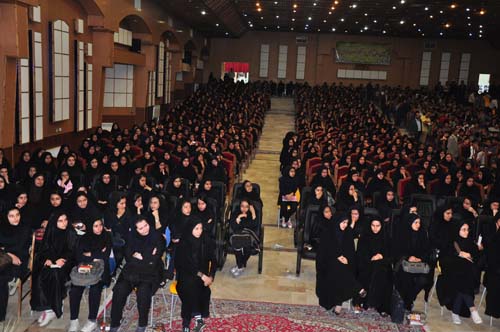
Nejat Society holds meeting in Semnan

Former members of the Mujahedin Khalq Organization attended press conference in Semnan.

The meeting titled “Metamorphosis of the MKO” organized by Nejat Society on Saturday May3rd, 2014. The four former members of the MKO who addressed the audience described the current condition of the group in Iraq.

Ronak Dashti, Ibrahim Khodabandeh, Ali Ekrami and Iraj salehi spoke of the support of US and Israel for the MKO terrorist cult.

Ebrahim Khodabandeh, former official of the MKO’s international relations and former member of the so-called National Council of Resistance ,declared that over 500 MKO members have returned to Iran,” Today 3000 people are residing in Camp Liberty,” he added.

Ebrahim Khodabandeh who was a member of the group for 23 years said:”Nejat Society’s objective is to get humanitarian aid to rescue the 3000 individuals who are taken as hostages by MKO.”

“Considering that the MKO is not a political , social or security issue right now but it is a humanitarian issue, we should do our best to help them release and to relieve their families,” said Mr. Khodabandeh.

He added:”The main victims of the cult are always their members.”

Regarding Israel and the American warmongers as the only supporters of the MKO, Khodabandeh revealed that the group’s financial resources actually come from Israel, Saudi Arabia and its fraudulent charity works.

Iraj Salehi, former member of the MKO’s Central Council stated that Camp Ashraf has been shut down and the MKO members are residing in a 25000 square meter area. A few dozen of Liberty residents have been relocated in European countries including Germany and Albania where a number of these asylum seekers defected the group.

Ronak Dashti, another former member addressed the conference:”The situation of female members of the group is much worse than male members.”

“While I was never affiliated with the group, I was kidnapped by its recruiters,” she said. She described how she was deceived to join the group, “I had gone to Turkey to continue my studies but my uncle who was the group’s member took me to Iraq where I was imprisoned in the cult structure for several years.”

Ali Einakian, former member of the group Foreign Relations and its central Council told reporters,” The US and Zionists view the MKO worse and more despised than monarchists but their interests and policies make them support the group.”

Noting the alleged list of global terrorists that the US provides every year, Einakian said,” This list is the list of terrorists but it is the list that clarifies the US’s enemies and friends. Those who kill people in Syria are not in the list but a half of Lebanon’s parliament members or Palestine statesmen are in the list. Those who slaughter people are not in the list because they want to be independent.”

The MKO former members representing Nejat Society organize series of meeting title “Metamorphosis “of the MKO to enlighten the Iranian youth and students in Semnan province. The first meeting was held in shahroud.

May 12, 2014 0 comments
FacebookTwitterPinterestWhatsappTelegramSkypeEmail
Mujahedin Khalq; A proxy force

SPAINISH POLITICIAN’S DANGEROUS RELATION

 Alejo Vidal-Quadras , the best friend of the Mojahedin Khalq

The President of Vox admits to 13-years working for an astonishing cause: remove the Iranian Mojahedin Khalq from the terrorism list and rehabilitate the group. He says Spanish politicians should support this organization, which is an ” ally ” of the CIA.

Alejo Vidal- Quadras is the key man in Spanish political relations with the Iranian People’s Mujahedeen. The ‘ ex-popular ‘ and current president of Vox was the first Spanish politician to begin having a liking for the “Iranian democratic opposition in exile.” This is how he defines it: “The year was 2000 and I had just been elected to the European Parliament. I was soon to be in Brussels when I met a socialist Portuguese MEP, Paulo Casaca. He had spent a few years working with the Iranian democratic opposition and asked me to receive some representatives of this movement. We had a long conversation and I was provided with documents and they explained to me the circumstances of Iran and the Mojahedin’s history. Here began our relationship…

Since then, he gave his full support to this cause. Since being in the European Parliament, he has “13 years” working for the Iranian National Resistance Council – according to many experts, the political arm of the Iranian People’s Mujahedeen – to achieve its objectives. First, get them off the list of terrorist organizations, in which the group was included in 1997 in the U.S. and 2002 in the EU, being accused of the murder of several Americans in the 1970s and the attempted attack in 1992 against the Iranian mission to the United Nations in New York. And second, to have it recognized as the “legitimate alternative” opposition in the eyes of the international community. To do this, the ‘lobbying activity’ performed for more than 20 years by the organization has been fundamental. And the support of the Spanish politician – a leading member of the group Friends of Free Iran, consisting of around 70 MEPs – has been essential to take the message into international institutions.

The first objective has already been met. In 2009 the Council of the European Union withdrew the terrorist designation. “But it was a strictly judicial procedure,” Vidal-Quadras quickly justified . “It’s been the courts that have ruled that they are not terrorists,” insists the ex-popular, referring to the judgment issued in 2008 by the Court of Justice in Luxembourg, claiming that no evidence was found of the MEK terrorist threat. After this victory in the EU, the Mojahedin also began their specific crusade in Washington. “I lived very close to this process. I had a long meeting with lawyers to raise the issue in the U.S.. We explained how the dispute had been worked out in Europe”. The result? In 2012, the U.S. State Department also stopped considering them terrorists.

What could motivate the U.S. to take them off the blacklist?

Academic researchers, however, rule out that the only reason to get them out of the blacklist was legal. Hillary Clinton warned that the department she headed would not “ignore” or “forget ” past events ” including the MEK’s involvement in the murder of U.S. citizens in Iran in the 1970s and an attack on U.S. soil in 1992 “, but in the opinion of the experts we consulted there are several reasons that led the U.S. government to take this decision.

First, in 2002 the Iranian People’s Mojahedin allegedly discovered Iran ‘s nuclear program and enabled the U.S. to declare ‘war’ on the regime of the ayatollahs. Second, when the U.S. invaded Iraq, after the Mojahedin were captured as prisoners of war, the U.S. granted them the status of “protected persons”. According to official versions, the MEK was “voluntarily disarmed”. According to the unofficial version, the CIA and the Israeli Mossad is training the Mojahedin for their own benefit. So much so, that in January 2012, Ilan Mizrahi, former head of the secret Israeli intelligence service, disclosed the involvement of the Mojahedin in the “secret war” against Iran that had already cost the lives of four Iranian nuclear scientists. And thirdly, for years, U.S. politicians supported the Mojahedin cause as an instrument of pressure against the Iranian regime. “They speak Farsi and still maintain important contacts within the regime. Useful for the USA, justify the experts we consulted.

Of course what these experts do not believe is that this support is selfless. In the U.S. there are precedents. The New York Times reported years ago on the Mojahedin’s alleged bribery of influential politicians to support its cause. Then there was talk of fees of between 15,000 and 30,000 dollars; and even the former governor of Pennsylvania, Edward G. Rendell, had to face an investigation by the Department of Treasury of the United States for having taken more than 150,000 dollars from this group which was still included in the terrorism list at the time. And in the case of the European Union it is the same. DIGITAL STAR has unveiled two Spanish presidents attended meetings in Paris annually in June to take payments. “But other politicians who support them do not charge a euro”, Alejo Vidal- Quadras hastens to clarify. “In the world there are still regimes that crush human rights, such as Cuba , North Korea and Iran. I believe it is the duty of any democrat to help transform Iran into a democracy”, concludes the current president of Vox.

Who funds the Mojahedin?

The question still remains unresolved and the experts bring to the fore the question of where does the MEK get all the money it costs to maintain this important network of contacts and support . According to Vidal-Quadras, solely from the Iranians in the diaspora, “some of them are very wealthy”. Although other politicians we consulted doubt this. “I am not so naive to think that the contributions of all Iranians in exile are sufficient to maintain that infrastructure. I do not rule out that there may be powers that are instrumental in acting in their favor”, admits Gari Duran Sen. PP Baleares, and one of the Mojahedin’s greatest defenders in Spain. The USA , Israel and Saudi Arabia are among the possible hidden funders. Duran, however, says she does not care about that; “I have seen people on hunger strike, I have seen the pictures of the dead and have heard their mothers talk, and unless you have to conclude that this is a giant deception, to me it is real.”

The deaths of 40,000 Iranians during the Iraq- Iran war are attributed to the Mojahedin, as are the assassination of the Iranian president Ali Rajaei and Prime Minister Javad Bohanar and many Kurds, and the Mojahedin is now active in supporting the Syrian opposition. And in some reports by the UNHCR it confirms that this is a movement which does not respect human rights. But Vidal- Quadras does not give credence to any of these charges and insists it is Iranian propaganda. A message that its leader, Maryam Rajavi, constantly repeats in all the parliaments that she visits. She does so in Europe two times a year when she visits and has done so in Spain in December 2012 during a flying visit to Madrid where she also took the opportunity to meet with the mayor, Ana Botella – interestingly the wife of one of the politicians the Mojahedin paid in exchange for public support.

Elsa S. Vejo Destrella Digital (Digital Star), Translated by Iran Interlink

May 11, 2014 0 comments
FacebookTwitterPinterestWhatsappTelegramSkypeEmail
Mujahedin Khalq; A proxy force

Embrace of MEK shocking, deplorable

Editor’s note: The following is a response to an op-ed by former New York City Mayor Rudolph Giuliani, "Team Obama keeps miscalculating Iran — ‘change’ under Rouhani is a mirage" that appeared in Fox News Opinion on May 7.

Mr. Guiliani’s warm embrace of the MEK terrorist organization is shocking and deplorable.

Journalists and think tanks across the world have sounded the alarm regarding the "cult-like" practices of the MEK, such as forcing members to give up their children in order to dedicate more time to the cause, and their decades long reign of terror and brutality has been well established by many including the U.S. Department of State when it designated it as terrorist organization in 1997 while describing it as a "repressive cult despised by most Iranians and Iraqis."

But through what the RAND Corp. called "cultic practices and its deceptive recruitment and public relations strategies" as well as giving millions of dollars to politicians and lobbyists in Washington — where it seems everyone has a price tag as campaign donation or "speakers fees," the MEK managed to get itself removed from the list.

It also should be noted that this group supported Saddam Hussein during the Iran-Iraq war and played a major role in the violent crackdown on the civilian uprising in the early 90s while living in Iraq as a private militia for Saddam Hussein.

The people of Iraq despise them and want them out, as well they should.

Hamid Babaei is counselor and head of the Press Office for the Permanent Mission of the Islamic Republic of Iran to the United Nations in New York.

By Hamid Babaei,

May 11, 2014 0 comments
FacebookTwitterPinterestWhatsappTelegramSkypeEmail
Italy

Open letter of Nejat Society to Ms. Laura Boldrini,

The President of the Chamber of Deputies of Italy

Dear Madam,

Nejat Society is an NGO consisting of the former members of the Mojahedin-e Khalq Organization (MKO, MEK) and the families of present members trapped in Iraq in the hands of Massoud Rajavi.
As you are aware a 10-member delegation, headed by co-chairman of Iran-Italy parliamentary friendship group Ettore Rosato, arrived in Tehran on Saturday morning for a four-day visit.

Amongst the members of the delegation were some who signed petitions in favor of MKO to condemn the Islamic Republic of Iran and to support Massoud and Maryam Rajavi.

We requested the members of the delegation to visit the members of our society and the victims of this mind control destructive cult, but they refused to do so.

If these parliamentarians claim that they work for Human Rights, Freedom and Justice, and yet openly support the MKO; it would have been a fare policy to listen to the victims of the MKO who have suffered from the violation of Human Rights inside the organization.

The aim of Nejat Society to request visiting the Italian members of parliament was merely to find a way to rescue the members in Iraq and try to put them in contact with their families in Iran.

Surprisingly, they support a terrorist organization under the name of defending human rights, but they refuse to listen to the victims of this terrorist organization.

Yours faithfully

Nejat Society

Copy to:

President of the Italian Senate

The Head of the Italian delegation to Tehran

May 11, 2014 0 comments
FacebookTwitterPinterestWhatsappTelegramSkypeEmail
Mujahedin Khalq; A proxy force

MKO terrorists used for information laundry

Gareth Porter on the true history of Iran’s nuclear program

In all the discussion of Iran’s nuclear program, the consequent international economic blockade directed by the United States, and the ongoing negotiations to resolve the issue, Washington’s official history of the program has rarely been challenged. In Manufactured Crisis, The Untold Story of the Iran Nuclear Scare (Just World Books), award-winning investigative journalist Gareth Porter traces the true history of the program, as well as how and by whom the official narrative was constructed. I put six questions to Porter about his book.
1. Although the Iraqi nuclear “threat” was discredited as an utter fraud years ago, the idea that across the border Iran has sought, at least in the past, to build a nuclear weapon has long been widely accepted in political and media circles. Are you saying that the claim of secret work on nuclear weapons is equally fraudulent, and that the Iranians have never had a nuclear-weapons program?

Yes. In Manufactured Crisis, I show that the claim of an Iranian nuclear-weapons program has been based on false history and falsified records. The description of the Iranian nuclear program presented in official documents, in commentaries by think-tank “experts,” and in the media bears no resemblance to the essential historical facts. One would never know from the narrative available to the public over the years that Iran had been prepared in the early 1980s to rely entirely on a French-based company for enriched uranium fuel for its Bushehr reactor, rather than on enriching uranium itself. Nor would one learn that the Reagan Administration sought to strangle Iran’s nuclear program, which was admitted to have presented no proliferation threat, in its cradle by pressuring Germany and France to refuse to cooperate in any way. The significance of that missing piece of history is that Iran was confronted with a choice of submitting to the U.S. effort to deprive Iran of its right to a peaceful nuclear program under the Non-Proliferation Treaty or else acquiring its own enrichment capability.

Not surprisingly, the Iranians chose the latter course, and went to the black market in defiance of what was by that point a unilateral U.S. policy. Their decision is now described in the popular narrative as evidence that Iran was seeking nuclear weapons early on.

The other relevant historical reality that has been systematically excised from the story of the Iranian nuclear program is what happened in regard to chemical weapons during the Iran–Iraq war. Contrary to disinformation issued by the U.S. Defense and State departments, which suggested that both sides had used chemical weapons in the Iraqi city of Halabja in 1988, the evidence is very clear that Iran never used chemical weapons during the war. The only explanation consistent with the historical record is that Ayatollah Khomeini forbade the use of such weapons, on the ground that both the possession and use of weapons of mass destruction are illicit under Islamic jurisprudence.

This policy, maintained despite the terrible losses Iran was suffering from Iraqi chemical attacks, represents powerful evidence that Shia jurisprudence is a fundamental constraint on Iranian policy toward weapons of mass destruction. It also makes credible the claim that Iran is forbidden by a fatwa from Supreme Leader Ali Khamenei from possessing nuclear weapons. But senior Iranian officials, including a former president of Iran, Hashami Rafsanjani, have been making cogent arguments against nuclear weapons based on strategic grounds since the early 1990s.

2. The U.S. produced various items of evidence over the years to demonstrate the felonious intent of the Iranian program. Where did this evidence come from, and how well does it stand up to scrutiny?

The evidence adduced to prove that Iran secretly worked on nuclear weapons represents an even more serious falsification of intelligence than we saw in the run-up to the war in Iraq. I tell the real story behind a large collection of intelligence documents that appeared mysteriously in 2004 and have been crucial to the Iran nuclear narrative. They supposedly came from the purloined laptop of an Iranian participant in a nuclear-weapons research project, but a former senior official with the German foreign office told me the real story: the documents were provided to Germany’s intelligence service by an occasional source who was part of the Iranian-exile terrorist organization Mojahedin-e-Khalq (MEK).

The obviously self-interested MEK member was thus the Iranian equivalent of the now-discredited Iraqi source known as “Curveball,” whose tales of mobile bioweapons labs in Saddam’s Iraq became the centerpiece of the Bush case for invading Iraq. It is well documented, however, that the Israeli Mossad was using the MEK to launder intelligence it didn’t want attributed to Israel, with the aim of influencing the International Atomic Energy Agency (IAEA) and foreign governments. Further pointing to the Israeli origins of the documents is the fact that Israel was the only country in the world known to have a special office responsible for influencing news coverage of Iran’s nuclear program.

Some key points in the documents give away the fact that they were falsified. The most important example is a set of studies, supposedly done in 2002 and 2003 on the Shahab-3 missile’s reentry vehicle, with the purported aim of allowing the missile to accommodate a nuclear weapon. Evidence from the U.S. intelligence community and authoritative independent sources shows that the Iranians had already abandoned the Shahab-3 by then, and were far along in developing an improved missile with a reentry vehicle that bore no resemblance to the one depicted in the studies. And we now know from Mohamed ElBaradei’s 2011 memoirs that in 2009 Israel provided a new series of intelligence reports and documents to the IAEA that offered further claims of Iranian work on nuclear weapons both before and after 2003.

Those claims were ultimately published in an IAEA dossier of intelligence reports in November 2011. The most sensational assertion made there was that Iran had constructed a large metal cylinder for testing nuclear-weapons designs at its military-research base at Parchin in 2000. This led officials from the IAEA and some of its member states, including the United States, to charge that Iran was altering the site to eliminate evidence. But as I document in the book, Iran had allowed the IAEA to carry out inspections at ten sites of the agency’s choosing on two different occasions in 2005. Furthermore the IAEA obtained satellite images of the site covering February 2005 to February 2012, and found no indication that Iran had been concerned about hiding anything. Finally, a former chief IAEA inspector in Iraq, Robert Kelley, has said that the agency’s description of the alleged cylinder made no technical sense.

3. How did the IAEA end up endorsing the notion that the Iranians have had a covert bomb program in the past and may still have one today?

The IAEA was crucial in legitimizing claims of a covert Iranian nuclear-weapons program, because it was seen as a neutral actor. That image was largely the result of the independence of its former director general, Mohamed ElBaradei, from the Bush Administration. In 2005, when the IAEA received the documents that had come in through Germany’s intelligence service, ElBaradei was deeply skeptical of their authenticity and warned publicly against using them as evidence in a case against Iran.

But his control over the Iran issue was eroded starting in 2008, when the head of the IAEA’s Department of Safeguards, Olli Heinonen, began collaborating with U.S. officials on how to treat the documents. Diplomatic cables released by WikiLeaks, when read against the background of 2008 IAEA reports, show that Heinonen and his Western allies came up with a strategy to falsely portray Iran as having conceded the authenticity of some of the documentation. Their aim was to justify IAEA demands for highly classified information on Iran’s missile and conventional-weapons programs. When Iran predictably refused, the IAEA and a U.S.-led coalition cited this as evidence of a cover-up.

The IAEA came to play an even more partisan role after Yukia Amano of Japan replaced ElBaradei in November 2009. A WikiLeaks cable from July 2009 reveals that Amano promised U.S. officials he would be firmly in their camp on Iran in return for American support of his election as director general. “In their camp” could only have meant that he would support the publication of the intelligence dossier — based entirely on intelligence reports and documents from Israel — that ElBaradei had refused to authorize. The dossier’s November 2011 publication date was timed to provide a political boost to the U.S.-led campaign for crippling international sanctions against Iran.

4. The U.S. intelligence community became a global laughingstock when its assessments of Iraqi WMDs were revealed as entirely bogus. Yet its pronouncements about the Iranian nuclear program are treated with deferential respect. How do you compare the performance of the U.S. intelligence community on Iran with its record on Iraq?

The same political and institutional dynamics drove both failures. The March 2005 Robb–Silberman Commission Report cited analysts who worked on the Iraq WMD file as admitting freely that they had effectively reversed the burden of proof, refusing to believe that Iraq didn’t have WMD unless a highly credible human source said otherwise.

The same thing happened on Iran. It began in 1991, when then CIA director Robert M. Gates singled out Iran as the premier assessment target for the agency’s new center for proliferation issues. Not surprisingly, analysts immediately began interpreting even the most ambiguous evidence as indicating Iran’s intention to develop nuclear weapons. This predisposition just happened to be in line with American policy of forbidding its allies from providing nuclear technology to Iran. In other words, the intelligence followed the policy, not the other way around.

CIA brass apparently went so far as to suppress WMD intelligence obtained by one of its best covert agents in the Middle East because it didn’t fit the conclusion they knew George W. Bush’s administration wanted. I reveal for the first time in the book that a former undercover operative who brought a lawsuit against CIA leadership in 2004 claimed that a highly respected source in Iran had told him in 2001 that Iran had no intention of “weaponizing” its nuclear program. The CIA apparently never informed the White House of that information, and refused to circulate it within the intelligence community.

National Intelligence Estimates in 2001 and 2005, and a draft estimate in mid-2007, all concluded that Iran had a nuclear-weapons program. Paul Pillar, a former National Intelligence Officer for the Near East who participated in the 2001 and 2005 exercises, has recalled that no hard evidence of weaponization informed either estimate, and that their conclusion was based on inference. In the 2005 estimate and the 2007 draft estimate, the conclusion was influenced by the intelligence documents that had come from Israel by way of the MEK. The failure of the CIA’s well-staffed weapons-proliferation center to detect the fraud paralleled its failure to notice the obvious signs that the “Nigergate” document offered as evidence of Iraqi uranium-shopping in Niger was a rather amateurish fabrication.

The final 2007 NIE, which was issued in November, asserted that the 2005 NIE and the mid-2007 draft had both been dead wrong in their assertions that Iranian still had a nuclear-weapons program at the time of their writing. It concluded, rather, that based on intercepted “snippets of conversation,” Iran had had a nuclear-weapons program as of 2003, then stopped it. This finding, which gave additional credibility to the official narrative of Iran’s nuclear intentions, is itself highly questionable. It is very likely that the 2007 NIE authors interpreted evidence of one or more individuals’ work as confirmation of the existence of a full-fledged program — a belief in which they had clearly acquired a strong vested interest.

5. The news media generally disgraced itself in its coverage of the Iraqi nuclear issue. How has it comported itself with respect to Iran?

With Iraq, there was at least dissent over issues like its alleged illegal importation of aluminum tubes, which reflected debates within the intelligence community. Coverage of Iran, on the other hand, has been virtually unanimous in reporting the official line without the slightest indication of curiosity about whether it might be false or misleading. The closest we got to investigative work in the commercial media were hints, buried inside longer stories in the Washington Post, of skepticism in the intelligence community about the 2004 laptop documents.

Some of the most egregious misinformation came in late 2007 and early 2008, in stories in the New York Times and Washington Post about two IAEA reports containing the final results of a major agency investigation. Rather than reporting the fact that the agency had been unable to challenge any of Iran’s explanations of the six issues under investigation, the Times and Post stories simply quoted Bush Administration officials and an unnamed IAEA official as dismissing the Iranian responses.

When the media challenged the official line, it was only because that line wasn’t hawkish enough. David Sanger of the New York Times carried out a relentless campaign in innumerable articles after the 2007 NIE attacking its conclusion that Iran had ceased work on nuclear weapons in 2003.

6. What impact do you believe the essentially unquestioned acceptance of this fraudulent nuclear narrative is likely to have on negotiations with Iran and beyond?

It creates serious obstacles. For one, it makes the Obama Administration much more vulnerable to the arguments of Israel and its followers in Washington that Iran cannot be allowed to have any enrichment capacity. But then, the administration itself has absorbed the essential elements of the narrative into its own analysis, notably via the creation of the “breakout” concept.

“Breakout” is defined as the time it would take Iran to enrich enough uranium to weapons-grade level to allow it to construct a single nuclear bomb. But it was a bogus idea from the beginning, because it assumed that Iran had the desire to rush-build a nuclear weapon. Furthermore it was based on highly unlikely worst-case scenarios for very rapid Iranian enrichment of uranium to a level sufficient for a bomb. According to the worst-case scenarios conjured up by conservative U.S. think tanks and others promoting the myth, Iran has had the same theoretical capacity for breakout — a month or two — since 2010. But rather than racing for a bomb, it has instead converted much of the uranium it enriched to a concentration of 20 percent uranium-235 (the enrichment level that has most worried the United States) to an oxide form that makes it unavailable for enrichment to weapons-grade level.

Nevertheless, the Obama Administration has been so intimidated by the breakout drumbeat that it has now adopted a policy of limiting Iran’s breakout period to between six and twelve months. That translates into a demand that Iran agree to be stripped of 80 percent of its centrifuges, which is all but certain to ensure the breakdown of the talks. Unless the administration changes its posture — which became less likely after it publicly cited that goal as a baseline — fear-mongering propagandists may well succeed in pushing the United States into a situation of increased tension with Iran, including the possible mutual escalation of military threats. That, of course, would be the result that Israeli prime minister Benjamin Netanyahu has long sought.

Andrew Cockburn, Harper’s Magazine

May 10, 2014 0 comments
FacebookTwitterPinterestWhatsappTelegramSkypeEmail
Iraq

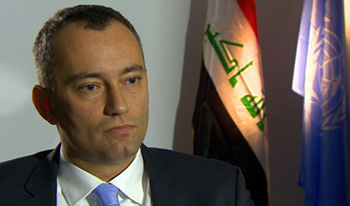
Nikolay Mladenov: Election Was ‘Entirely Iraqi-Owned Process’.

 Mojahedin Khalq will be expelled soon

UN Secretary-General Ban Ki-moon’s Special Representative for Iraq and Head of the United Nations Assistance Mission for Iraq (UNAMI) Nikolay Mladenov was in Iraq for the country’s parliamentary election on April 30. He talked with RFE/RL’s Radio Free Iraq correspondent Faris Omar about his assessment of the voting process.

RFE/RL: The parliamentary election on April 30 was the first since U.S. troops left Iraq a little over two years ago. How smoothly did the election go, in your opinion?

Nikolay Mladenov: This was the first entirely Iraqi-owned process in which the United Nations had an advisory role but the leading role was with the Iraqi authorities. And they deserve a lot of credit for a very professional manner in which they approached the organization of the election.”

RFE/RL: The election took place against a backdrop of rising violence in Iraq, which is in the midst of its worst unrest since the country came near to civil war in 2008. At the same time, security forces are actively fighting insurgents in two key cities of Anbar province — Fallujah and the outskirts of Ramadi. Did the security situation have much impact on the election?

Mladenov: The security situation in Iraq is very difficult and inevitably this places a burden on the voting process and on the country at large. Therefore, the fact that 60 percent of people did come out to vote is even more remarkable. The legitimacy of the vote, the acceptance of the results — we will see how the public will react to that once the results are finalized.

RFE/RL: Do you think the election will help Iraq address some of its biggest internal political problems? For example, the disputed border of the autonomous Kurdish region, a dispute which is causing tension between different communities in the north of Iraq, including the Kurds, Turkomans, and Arabs?

Mladenov: I am hopeful that, once the new parliament convenes and the new government is formed, we will — with the cooperation of the federal government in Baghdad and the regional government in Irbil — be able to get back to…resolving the disputed internal boundaries.”

RFE/RL: When we look at Iraq’s conflicts, they often seem to be along sectarian and religious lines. Are you optimistic that Iraq will be able to overcome these divides, partly through democratic processes like this recent election?

Mladenov: Iraqis have for many years been one of the societies in the region that has seen the highest number of intermarriages between faiths and ethnic groups. The people of this country are tired of sectarian divisions and are tired of being labeled in different ways.

RFE/RL: Finally, on a slightly different subject, the UN is involved in the difficult task of trying to resolve the fate of the remaining members of the Iranian opposition group — the Mujahedin-e Khalq — who are still interned at Camp Ashraf and Camp Liberty in Iraq as they await countries to take them as refugees. What are the prospects for finishing this process and closing the camps?

Mladenov: The UN has appointed a special representative to seek relocation opportunities for this group. We are working closely with our American friends and partners who also are looking to such opportunities. It is not an easy process but it is a very important process to find a way for these people to leave the country and to continue their lives in other parts of the world.

May 10, 2014 0 comments
FacebookTwitterPinterestWhatsappTelegramSkypeEmail
Newer Posts
Older Posts

Recent Posts

  • The Tragic Impact of MEK Isolation on Yazdan Teimorian and His Family

    October 5, 2026
  • How the MEK tried to sell a stage stunt as grassroots support?

    October 4, 2026
  • Why Mike Pompeo’s Embrace of the MEK Ignores Its Lack of Popular Base

    October 3, 2026
  • Fourteen years after US delisting, MKO terror cult’s political rebranding collides with its violent legacy

    September 30, 2026
  • How Did Maryam Rajavi Become All-Powerful in the MEK?

    September 29, 2026
  • Facebook
  • Twitter
  • Instagram
  • Youtube

© 2003 - 2025 NEJAT Society . All Rights Reserved. NejatNGO.org


Back To Top
Nejat Society
  • Home
  • Articles
  • Media
    • Cartoons
    • NewsPics
    • Photo Gallery
    • Videos
  • Publications
    • Books
    • Nejat NewsLetter
    • Pars Brief
  • About Us
  • Contact us
  • Editions
    • عربي
    • فارسی
    • Shqip