Nejat Society
  • Home
  • Articles
  • Media
    • Cartoons
    • NewsPics
    • Photo Gallery
    • Videos
  • Publications
    • Books
    • Nejat NewsLetter
    • Pars Brief
  • About Us
  • Contact us
  • Editions
    • عربي
    • فارسی
    • Shqip
Nejat Society
Nejat Society
  • Home
  • Articles
  • Media
    • Cartoons
    • NewsPics
    • Photo Gallery
    • Videos
  • Publications
    • Books
    • Nejat NewsLetter
    • Pars Brief
  • About Us
  • Contact us
  • Editions
    • عربي
    • فارسی
    • Shqip
© 2003 - 2024 NEJAT Society. nejatngo.org
Iraqi Authorities' stance on the MEK

Pentagon supports MEK, insurgent group collaboration

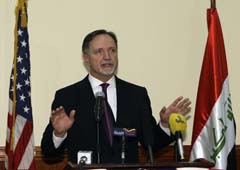
A former independent member of Iraq’s House of Representatives, Hussein al-Falluji, has revealed that from the time of their arrival, the occupying American forces granted the Mojahedin Khalq organisation immunity and freedom of movement within the country to coordinate with some other groups and political parties in Iraq.

Al-Falluji told Ashraf News that the Mojahedin Khalq enjoys unconditional support from the U.S. Department of Defense, adding that “the existence of this organization in Iraq poses a challenge for the country, especially with the growing violence in the country and the events experienced by Syria”.

He concluded that the situation posed by the MEK and the increasing number of extremist armed groups which are waiting for the opportunity to work together to target the security of Iraq poses a challenge. He called on the Iraqi government to work hard to remove the MEK from the country while respecting the internationally agreed human rights aspect.

Ashraf News, Baghdad , Translated by Iran Interlink

August 26, 2013 0 comments
FacebookTwitterPinterestWhatsappTelegramSkypeEmail
Iraq

Iraq denies halting services to MEK

Iraqi authorities deny allegations of shutting off power and water to Camp Ashraf

MEK, an Iranian dissident group, has accused the Iraqi authorities of cutting off water and electricity to a contested northern camp used by its members, a charge the Iraqi government denied Sunday.

The dueling accounts over services are the latest twist in a long-running dispute between the Mujahedeen-e-Khalq dissident group and the Iraqi government over Camp Ashraf, a Saddam Hussein-era community in northeast Iraq that the exiles never wanted to leave.

The dissident group, known by the acronym MEK, alleges that Iraqi authorities shut off power and water supplies to Camp Ashraf on Aug. 10. It claims that Iraqi forces are hauling off parts of the camp’s water system, and says some of the roughly 100 residents are becoming dehydrated inside the camp from a lack of water.

Georges Bakoos, who oversees the MEK issue for the Iraqi government, dismissed the dissident group’s allegations as “propaganda.” He acknowledged there are occasional power cuts at the camp but said they are no different as those in other parts of Iraq.

“I can assure you no order was given” to cut off supplies, he said. Iraqi officials are, however, moving ahead with court proceedings to evict the Camp Ashraf holdouts, possibly as soon as in the next few weeks, Bakoos said.

Most of Iraq lacks a steady supply of electricity. The power supply grows even spottier when demand spikes during the sweltering summer months.

A spokesman for the MEK, Shahriar Kia, said late Sunday that authorities had agreed to provide “limited hours of water and electricity” after more than two weeks of what he described as a total cut of the services.

The MEK is an opposition group to Iran’s clerical regime that fought alongside Saddam’s forces in the 1980-88 Iran-Iraq war. Several thousand of its members were given sanctuary at Camp Ashraf. The group renounced violence in 2001 and was taken off the U.S. terrorism list last September.

Iraq’s current Shiite-led government, which has strengthened ties with neighboring Shiite powerhouse Iran, considers the MEK’s presence in Iraq illegal and wants its followers out of the country. It has been working with the United Nations to resettle MEK members, but the process has been slow.

The spokeswoman for the U.N. mission to Iraq, Eliana Nabaa, said U.N. officials are not on the ground at Camp Ashraf and could not confirm the claims about the power and water cuts.

“We take it seriously and are in constant touch with the government of Iraq, and continue taking it up with them to make sure that delivery of Camp Ashraf residents’ humanitarian needs is secured,” she said.

More than 3,000 MEK members who once lived at Ashraf reluctantly relocated to a former U.S. military base near Baghdad last year. It is meant to be a way station for the exiles while the U.N. works to resettle them outside Iraq.

Two raids by Iraqi security forces on Camp Ashraf before residents were transferred to the Baghdad camp left more than three dozen people dead.

The Baghdad-area camp, known as Camp Liberty, has since been targeted by militants in rocket attacks that have killed 10 people and injured many more, according to the MEK.

A total of 162 MEK members have been resettled abroad so far, mostly in Albania.

By ADAM SCHRECK

August 26, 2013 0 comments
FacebookTwitterPinterestWhatsappTelegramSkypeEmail
Mujahedin Khalq; A proxy force

US Likely to Use MKO as Private Army for Conspiracies

It is my fear that the MKO (the Mojahedin-e Khalq Organization also known as the MKO, MEK, NCR and PMOI)–if not stopped, will be used as a private army for America, Israel and the West to murder even more Idaho-based political analyst; Mark Glennpeople than it already has, says an Idaho-based political analyst.

“I am very excited about what Iran is doing these days in steering the discussion into the right place with regard to terrorism, Israel, Zionism, Imperialism and the rest,” said Mark Glenn, from The Crescent and Cross Solidarity Movement, in an interview with Habilian Association.

"There is no other country like Iran in this regard, standing up to powerful countries with a strong, fearless voice and saying what needs to be said," he added.

He went on to describe the MKO as “an extremely dangerous entity,” due to the fact that “now it has been loosed from its cage and enjoys an air of respectability that it certainly does not deserve as a result of being taken off the terrorist list maintained by the government of the US.”

“It is a mercenary army of cult members who long ago surrendered their identities and their souls to an ideology that is alien to all that is good,” added Mark Glenn, of The Ugly Truth Radio Network.

“Once a person or a group of them has been robbed of their humanity, then all restraints are gone and they are capable of doing the worst, which the MKO clearly has done,” he added.

He underscored that the US government delisted MKO from its list of terrorist organizations only at the behest of Israel.

“My personal prediction is that the MKO–being Iranian–means that it is best suited for carrying out terrorist acts both in Iran and in other places such as the US and Europe where Iran can then be blamed.”

“Given that this organization was willing/able to kill as many as 17,000 of its own people, why would anyone think these animals would have any moral reservations about killing others from other countries?”

He concluded that horrific acts of terrorism, such as school bombings, killing of innocent children, etc, can be carried out by these murderous automatons and which can be then blamed on Iran in the interest of creating war hysteria in the West.

August 25, 2013 0 comments
FacebookTwitterPinterestWhatsappTelegramSkypeEmail
Mujahedin Khalq; A proxy force

Rajavi has difficulty to please the US

Rajavi has difficulty to please the US, When will the US put the MKO aside?

While the Mujahedin Khalq Organization’s propaganda arm spends large amounts of money to buy the support of American high-profiles, US government is not willingRajavi has difficulty to please the US, When will the US put the MKO aside? to make strategically friendly relationship with the group.

In September 2012, the US State Department removed the Mujahedin Khalq Organization from its list of Foreign Terrorist Organizations but American prudent approach to the MKO as a cult-like group that maintains the capacity to commit terrorist acts was clear in the statement the department published to announce the delisting. "With today’s actions, the department does not overlook or forget the MEK’s past acts of terrorism, including its involvement in the killing of US soil in 1992”, the statement reads. “The Department also has serious concerns about the MEK as an organization, particularly with regard to allegations of abuse committed against its own members.”

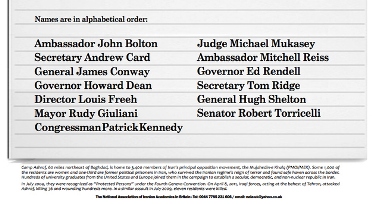
The US history is full of examples of temporary tactical alliances with terrorist groups such as Taliban, Al-Qaida…. Based on such historical facts, the American prominent scientist and political critic, Noam Chomsky concludes, ”The United States is a leading Terrorist State.” However, none of the above mentioned alliances last forever. They get expired in accordance with the American interests. In the process of the MKO’s relocation from Camp Ashraf to Camp Liberty, the US administration aided the UN Special representative in Iraq and after the relocation to Liberty and the consequent transfer of a number of Liberty residents to Albania, appreciated the efforts of Martin Kobler on different occasions. On the other hand, the MKO’s American advocates including Rep. Tom Ridge, Attorney General Michael Mukasey, Rep. Howard Dean and Democratic Rep. Judy Chu and many other paid advocates of the group call on returning the residents of Camp Liberty to Camp Ashraf.

Although after the delisting, the MKO was allowed to open its office in Washington DC, its position in the US territory is very fragile. What if the US-Iran relations come in to a peaceful conclusion? Will the US stay a safe haven for the MKO? The United States is mchoosier than the MKO leaders to make friends among former enemies of its nation. The MKO’s anti-imperialist long-time strategy is always considered as a dark point by the US.

This is what the MKO fears the most: A normal US – Iran relation which is more likely after the election of an Iranian moderate president. To stop such a “night mare” taking place, the MKO’s propaganda beats harder on war drums trying to portray Dr. Hassan Rouhani as what they call "theocrat”.

Actually, the options are left to the US to whether use or abuse the MKO. The MKO can never be a long-time ally for the US.

By Mazda Parsi

August 24, 2013 0 comments
FacebookTwitterPinterestWhatsappTelegramSkypeEmail
Iran Interlink Weekly Digest

Iran Interlink Weekly Digest – 18

++ In English language media, the MEK have been on overdrive to convey the message that Iran’s President Rohani is not a moderate, and also that the MEK haven’t killed anyone and these accusations are lies created by the Iranian regime and therefore the west should not talk to Iran but instead talk to the MEK. Among these lobbyists, Raymond Tanter has unexpectedly been given a platform in Foreign Policy magazine. The reaction of the readers has been nothing but criticism of the magazine’s editors for allowing the MEK to misuse their publication. In a similar vein The Hill has published an item on its blog by a member of the British House of Lords, Lord Kenneth Maginnis of Drumglass, with a specifically MEK version of Iranian history.

++ In English there have been various articles questioning the MEK’s use of paid lobbyists like Bob Filner, and how the influence of Israeli interests in US foreign policy is shown by support for terrorist groups like the MEK.

++ In English Ebrahim Khodabandeh has written in response to Massoud Rajavi’s message telling his followers to “get lost”. Khodabandeh compares Rajavi to the deposed Shah saying, “the extent of Rajavi’s rudeness is beyond imagining. He used his vicious tongue to lash those who are the most loyal and supportive of his followers. The Shah at least did not call those who want to leave [Iran] traitors and did not insult them and was, in any case, talking to those who were against him from the beginning, and not those who had given everything for him.” In conclusion Khodabandeh addresses the MEK’s supporters directly and suggests: “Rajavi’s supporters should observe how he deals with his most self-sacrificing followers and how he rewards them after years of loyalty. What would have happened if Rajavi had real power, how would he have dealt with his opponents? Wouldn’t he be worse than any dictator in the world? And so I must ask: “isn’t it time for those who continue to support Rajavi to recognise their mistake and keep their distance from him?””

++ Over this week Hanif Heydar Nejat has published the last parts of his examination of the Forough Javidan operation from his personal point of view. Reading through this, it is abundantly clear that although he only describes his own experiences and has not even mentioned things that other ex-member claim, there is more than enough here to shed light on the inside working of the MEK and in a normal court to convict Rajavi for crimes against humanity and war crimes.

++ Mohammad Razaghi, ex-member and human rights activist in France, was this week’s guest on Mardom TV. He expanded on the reasons that Karim Ghassim has given for his resignation from NCRI and then went on to produce evidence of torture and murder inside the MEK with the names and addresses of both victims and perpetrators of these crimes.

++ Edward Termador in Germany has written an open letter to Pope Francis explaining his situation as a Christian inside the MEK during the time of Saddam Hussein. Edward was a POW in the Iraqi camps for nine years before being given to the MEK where he spent another twelve years. During this time the MEK would use his Christian background to advertise themselves to the church in Baghdad, but when he stopped cooperating with them he was, as usual, put under immense pressure and ended up in Ramardi refugee camp. In Ramardi, while still under pressure from the MEK, he rejected an offer by the Vatican to take him to Italy and instead he insisted on staying to ‘help the MEK to bring democracy to Iran’. Termador describes the situation at that time – closed doors, no contact with the outside world – and says this has not changed. He asks the new Pope to help the current hostages in Camp Liberty.

++ Within the framework of its attacks on President Rohani, the MEK held a picket in Paris with paid speakers and asylum seekers being given 50 Euros to attend. The picket was ridiculed by many including Iran based Edaalat Association which represents the victims of MEK terrorism. Edaalat published pictures of the small gathering of tens of people and asks how did the MEK argument move from attacking Rohani to the demand that they all be moved back to Camp Ashraf. This is, it points out, while their own supporters have signed a petition to ask Rajavi to send these people to third countries and have this week written many articles among themselves pleading with Rajavi to let their friends go to third countries in the west.

++ Many articles have been written in response to Rajavi’s ‘get lost’ speech criticising Rajavi’s backers – the US and Israel – for their inhumane way of pursuing their political agenda. They say Rajavi is a known creature but you shouldn’t do the same.

++ Rumours have arisen that Massoud Rajavi has been seen in Tel Aviv, alleging that he is currently living under an American protection programme there. But although the rumours come from various knowledgeable sources, no concrete proof has been offered to back them up.

++ Manouchehr Hezarkhani, the last non-MEK member of the NCRI, who everyone knows is there because he has nowhere else to go and has financial problems, has emerged this week in an interview on the MEK’s TV to support Rajavi and dismiss his critics, both external and internal. Hezarkhani says ‘why is everyone asking everything from Rajavi?’ Many reacted to this, including Hamed Sarafpour, who says that for 30 years many people have been putting their trust and lives in Rajavi’s hands not knowing that he was selling them to Saddam and his likes for money. He says, ‘We are not asking questions, we want him in court to answer for what he has done. We are not expecting answers from him, we want justice’. (Hezarkhani has been under pressure since the latest resignations and round of internal criticisms to join the rest of those who are paid by Rajavi to swear at others like Ghasim and Rowhani, but he has refused to do so. Many believe that coming out now in support of Rajavi is the nearest thing the MEK have been able to get out of him so they can say ‘OK he did his bit as well’.)

++ The Security and Defence Committee of Iraq’s Parliament announced this week that the remains of Mojahedin Khalq cult is a serious threat to the security of the country. Ghasem Alarajab, a member of the committee, told reporters that clear evidence is available that the MEK and Al Qaida in Iraq and the remains of Saddam’s regime are working hand in hand as one group in Iraq. He adds that this is not a new phenomenon as this cooperation started in the 1980s. He also said there is clear evidence that these three groups are actively involved in terrorism in Syria today. Therefore they are not only a threat to Iraq, but are a threat to the whole region. Alarajab added that dealing with the MEK is difficult because it is openly supported by the Americans. The Americans clearly support terrorism in Iraq under the guise of supposedly protecting the human rights of the individuals involved.

++ Hassoun Al Fathlavi, another member of Iraq’s Security and Defence Committee, has said that ‘no Iraqi would wish to have this terrorist cult on our soil and as much as their backers want to use our country as a base for terrorism in the region, we will clear up our country and root out terrorism from Iraq’. He goes on to say that the country’s constitution states that Iraq cannot be used as a platform to attack neighbouring countries, especially Iran. ‘The new Iraq is not the same as during the era of Saddam and we will not bow to the pressure of the backers of terrorism in our country’, he said.

++ Many have reacted to the MEK announcements which have been made through paid adverts in western media saying they are worried that Camp Liberty will be attacked. Many have linked this claim to the impending visit of President Rohani to the UN General Assembly and say that the MEK will probably create a Self-Inflicted-Wound in order to create the grounds to undermine theirs and Israel’s main worry which is the new government in Iran.

++ Razieh Matini (Iraj Mesdaghi’s wife) writes in Pejvak Iran about her own experience in Iran and as a prisoner and how she left the country. She goes on to say that the MEK have dealt in lies and have character assassinated everyone for all this time, including Mesdaghi himself. She poses the question that even if one accepts the 30 years of lies and deception (calling people agents of the regime, etc) why the MEK still can’t give even a small answer to their questions. Basically, the MEK cannot answer people’s questions but these will not go away no matter how much the MEK swear at everyone.

++ Irandidban has translated into Farsi an article by Greg Scoblete in The Compass on August 20 2013, ‘Why Is There Bipartisan Support for the MEK? Because Politicians Like Getting Paid’, highlighting the corruption and influence of money in the top circles of American political life. The article lists various financial rewards which the MEK pays and points out that these figures were being paid to speakers and lobbyists even before the US removed the MEK from its terrorism list. Money is somehow replacing justice and national policy in America.

++ Sahar Family Foundation published an article pointing out that the internal questioning and doubt is increasing whether in Liberty or in Europe. The problem is not confined to Mesdaghi’s letter or the resignation of NCRI members. It is the internal questioning that worries Rajavi and he is trying to keep it under control. But according to information which Sahar has from inside the MEK it is only getting more and more. Questions, for example, such as: ‘Why does everyone become an Iranian agent straight after – or even before – leaving the MEK?’ Yaghmai, Ghassim, Rowhani and Mesdaghi are named in this respect. Another question they can’t stop is ‘Where is Rajavi after ten years?’ This question has been banned but they can’t contain it any more. Another popular question is ‘Where is the national in the National Council of Resistance?, why is it only the MEK and no other news or statement issues from it except about the MEK?’ Yet another awkward question is ‘Why it is that the audience at Maryam Rajavi’s events comprises mostly non-Iranians and the speakers are all non-Iranians?’ A more specific question is, ‘The MEK used to have many supporters in Scandinavia, but not many of these Iranians come to Paris any more, why?’ The MEK reacted desperately by holding meetings in various cities around Europe and trying to approach supporters in a conciliatory way about these questions. Although the MEK has given up saying the questions are banned, instead they merely listen to placate the supporters, but never give answers to their questions. The same situation prevails in Camp Liberty. During the meeting in which Rajavi told his followers to ‘get lost’, the audience were told, if you have questions please write them down. To the question, ‘When will the regime be toppled?’, Rajavi answered, “Nobody knows, and I don’t know either. My responsibility is your situation on The Day of Judgement, I have to rescue you in preparation for that.” Therefore, after thirty year of using his followers he is now saying don’t ask questions I only have to make sure you are OK when you die. Rajavi apparently believes he is responsible for heaven and hell and has no need to answer for what he does in this world. This is while Rajavi has now admitted that Khomeini won the revolution through the mosques and with popular support – up to this time Rajavi has always claimed that Khomeini stole his right to be the leader of the revolution. Rajavi seems to have given up on this world and is now only worried about the next world. Sahar’s article concludes that it is clear that the collapse of the organisation is not far away because as a cult it only survives by stopping people’s questions through various means of manipulation and deception. Once the questions start, there is no way back.

August 23 2013

August 24, 2013 0 comments
FacebookTwitterPinterestWhatsappTelegramSkypeEmail
Mujahedin Khalq as an Opposition Group

Document proves role of MKO in AMIA case accusations

Document proves role of MKO in AMIA case accusations

January 27, 2013 will probably be remembered decades from now as a new starting point in relations between Argentina and Iran.

That date the governments of both countries decided to turn the page of a history besmirched by accusations that have not served to find the truth about the 1994 bombing of the AMIA Jewish community center in the Argentine capital city.

The Memorandum of Understanding signed between Buenos Aires and Tehran earlier this year has been praised by many here, from ruling party MPs and experts to social, political and religious leaders who have long-battled foreign interests’ interference in the investigation.

But the MoU has also found strong resistance that has hindered efforts to know the one thing that matters: Who is truly responsible for the killing of 85 Argentineans?

AMIA special prosecutor Alberto Nisman blamed Tehran and issued arrest warrants for top Iranian officials in 2006. But what did he base his certainty on?

According to the recently released arrest warrant document, Nisman solely listened to the testimonies of members of Mujahedin-e Khalq Organization, which is an anti-Iran terrorist group.

The MKO-with a history of bombings in Iran and which has been paradoxically removed from the US State Department’s list of terrorist groups- seems to have convinced Nisman regarding AMIA center killing.

Did they convince him? Or are there other players in this case?

The MoU sets the creation of a Truth Commission and will allow Argentine judicial officials to question the alleged suspects targeted by prosecutor Nisman. The MoU has been approved by both the Congress of Argentina and the government of Iran.

Despite the information revealed by the intelligence document, a 500-page report released by Argentine prosecutor Alberto Nisman claims that Iran is increasing its influence in Latin America. This has provided pro-Israel lobbies with a new pretext to continue their condemnation of the AMIA Memorandum.

Download Document proves role of MKO in AMIA case accusations

August 24, 2013 0 comments
FacebookTwitterPinterestWhatsappTelegramSkypeEmail
Mujahedin Khalq; A proxy force

Homeland Security Made in Israel

If there should happen to be an al-Qaeda attack in Calhoun County Alabama,   Sheriff Larry Amerson will presumably know what to do. That is because he and   a number of colleagues in law enforcement have received paid trips to Israel   to learn how to deal with the terrorist threat. The Washington-based Jewish   Institute for National Security Affairs (JINSA) sponsors a Law Enforcement Exchange Program “in order to learn how to better protect   the U.S. communities from terrorist attacks.” The program takes law enforcement   officials from the United States and sends them to Israel for training in the   “strategies and techniques perfected by Israeli law enforcement.”   Amerson, past president of the National Sheriff’s Association, made his trip   in 2012. Along the way, he reportedly benefited from a “greater understanding   of the situation in Israel as it relates to terrorist threats.” JINSA also   hosts conferences in the U.S. where Israeli officers are brought over to brief   American law enforcement officials.

The American Israel Public Affairs Committee (AIPAC) is also involved in the   effort to indoctrinate the U.S. law enforcement community. Its website’s Homeland   Security Monitor chronicles numerous meetings between Israeli intelligence   and police officials and their U.S. counterparts, to include numerous trips   to Israel to learn from the masters of the craft about various aspects of security,   including controlling borders and airports. Even firemen have made the journey,   presumably to learn how a fire in Israel differs from a fire in the United States.

Ironically, American law enforcement and emergency services are every bit   as capable as those in Israel and really have nothing to learn. The difference   in practice is that Israel uses extensive profiling to identify threats, which   means Arabs are regularly stopped and questioned. Exposure to that dubious technique   is often paid for by the U.S. taxpayer as much of the travel to Israel is funded   by the Department of Homeland Security (DHS), which provides billions of dollars   in training   grants to cover the expenses. Marc Kahlberg of International Security Consulting    offers a package that   is called “Eye of the Storm.” He promises “an exclusive learning   tour into the heart of Hebron. You will have the opportunity to see first-hand   how the police there are dealing with a daily volatile situation. You will feel   the adrenalin, but be completely safe and will be the guests of the Israeli   Police Commander.” As Hebron is the largest Arab city on the West Bank with a population of 250,000 that   against its will hosts an illegal Israeli settlement of 1,000 protected by the   police and army, it promises to be an interesting experience.

It has been reported that when the United States was attacked on 9/11 Israeli   Prime Minister Benjamin Netanyahu was pleased because he understood that Washington and Tel Aviv would now be joined at the   hip in their mutual response to what Israel has been defining as terrorism.   When Netanyahu spoke before congress shortly afterwards he said “We are all targets” before   engaging in a number of meetings instructing Washington regarding what must   be done. Netanyahu’s Israel succeeded beyond its wildest dreams, exploiting   the incident to such an extent that the United States has adopted wholesale   Israeli perceptions of Middle Eastern politics. As Scott McConnell has observed,   there exists “a transmission belt, conveying Israeli ideas on how the United   States should conduct itself in a contested and volatile part of the world.   To a great extent, a receptive American political class now views the Middle   East and their country’s role in it through Israel’s eyes.”

Beyond that political assessment, the Israel-terrorism nexus operates on a   number of levels. It has been sometimes noted that the United States has adopted   the Israeli model to deal with terrorism, so much so that American politicians   sometimes consider Israel a component of U.S. national security. Republican   Vice Presidential candidate Paul Ryan’s website included “Israel” under the category “Homeland Security.”

The federal bureaucracy has also been changed to accommodate the new reality.   Since the Clinton Administration, every senior diplomat or official dealing   with the Middle East region has had to pass through a vetting process to ensure   full support of and deference to Israeli interests, which include its view of   the terrorist threat. Non-compliance is career ending. Chas Freeman, who was   named to head the National Security Council in 2009, was quickly forced to step   down when it was determined that he was not sufficiently pro-Israel.

Since 2001, many senior appointees throughout the federal government have gone   one step farther, no longer making any effort to hide their strongly pro-Israel   sentiments. Witness the ascendancy of Paul Wolfowitz, Doug Feith, William Boykin,   and Eric Edelman at the Defense Department under George W. Bush. Given the openly   expressed identification with Israel at the Pentagon and National Security Council   it is no surprise that Washington and Tel Aviv appear to align completely on   how to combat terrorism. Both claim the right to engage in preemptive warfare   and to assassinate people in other countries without any transparent legal process.   Both operate lethal drones to kill suspected militants on the ground, both have   engaged in torture, and both operate high security prisons containing numerous   suspects who are described as terrorists but who have never been and quite likely   never will be tried. Many of the detainees have been confined for years and   will undoubtedly die in prison without ever being charged with a crime. Some   of them are surely innocent.

The Israeli-American model for dealing with terrorism is itself unusual. Historically   speaking, countries that have been plagued with a terrorism problem have focused   on countering that specific threat without seeking to expand the conflict. But   that has not been the case for post 9/11 America, with George W. Bush grandiloquently   proclaiming a global war on terror which was later euphemized into a “global   freedom mission” under Bush and as “overseas contingency operations”   under Barack Obama. Bush set the United States up as an international policeman   with the rest of the world relegated to being either “with us or against   us.” Israel meanwhile set the framework for the program, defining the terrorist   threat against itself and Washington as “radical Islam,” a phrase   that has been readily picked up by American politicians and the media. Radical   Islam implies a worldwide struggle that is frequently conflated into a complete   rejection of political Islam and suspicion regarding the intentions of anyone   who is a practicing Muslim, a predisposition that is playing out currently vis-a-vis   Egypt.

Israel has also done much to name the players and define the playing field.   The hypocrisy of the process is evident when groups like Hezbollah and Hamas   are thereby identified by Washington as “terrorists” even though they   do not threaten the United States and see themselves as national liberation   movements for the Palestinian and Lebanese people. Meanwhile, groups like the   Mujaheddin e Khalq (MEK), which have actually killed Americans, have been removed from the State Department list because they are perceived as enemies of the   regime in Iran and are therefore by extension friends of Israel and its allies   in Congress and the media.

Less visible is Israel’s hand in shaping and profiting from the domestic agenda   against terrorism, which is where Sheriff Amerson comes in. The Lobby and its   friends are intent on projecting a positive image of Israel as a bulwark against   terrorism and the “only democracy in the Middle East.” The disparate   groups that make up The Lobby are active in creating the tie that binds regarding   the perception of terrorism on the ground and they do it through exchange programs   and the actual involvement of Israeli security companies and contractors in   the lucrative homeland security marketplace. Israel is a militarized state and   the United States over the past twelve years has also moved in the same direction   vis-a-vis its own police forces, a development that again reflects the priorities   of national and local governments and the predilection to deal with the perceived   terrorism threat through the use of overwhelming force and intimidation. New   York City’s unconstitutional “stop and frisk” police activity is a   preemptive doctrine modeled on Israeli counter-terrorism practice and it should   be no surprise that the New York Police Department has an overseas office in   Tel Aviv.

It has been noted that the terrorism threat itself is greatly exaggerated,   with more Americans killed by falling television sets than by terrorist action,   but this has not stopped the proliferation of state level departments of homeland   security, fusion centers for sharing information, and the introduction of consultants   and security service providers at all levels. Much of the activity is either   wasteful, redundant, or completely unnecessary. America’s seventy-two fusion   centers, where many of the Israeli contractors and advisers wind up, have been   denounced in a Senate   report as useless, ineffective, and frequently engaged in spying on American   citizens, particularly Arabs, but also including anti-abortionists and Ron Paul   supporters.

This effort to turn a buck from the woefully mismanaged Department of Homeland   Security is multifaceted. The Israeli newspaper Haaretz reports that fully 97% of DHS discretionary grants are given to Jewish organizations   even though Janet Napolitano has admitted that there is no “specific, credible   threat” against Jewish targets. And the flow of money is combined with   similar efforts being undertaken by other elements in the Israel Lobby to influence   opinion and create an American national consensus unshakably favorable to Israel.   The Israeli arms   and security industry, which is partially “covert” so it can sell   to countries and rulers on arms embargo lists, is a partner to the process.   It is now the fourth largest weapons exporter in the world, behind only the   U.S., Russia, and France. It has 6,800 licensed arms and security services providers,   making it the largest industry in Israel. Israeli companies can and do bid on   federal and local government contracts in the U.S. and they are also able to   export their products freely to America thanks to the Israel-United States Free   Trade Agreement of 1985 and the Counterterrorism Cooperation Accord Between   the Government of the State of Israel and the Government of the United States   of America of 1996. This direct involvement of Israel in American security has   been recently expanded through passage of 2012’s United States-Israel Enhanced   Security Cooperation Act.

Israeli companies dominate the international airline security industry, frequently   doing double duty as the covert, local Mossad station, but their failures are   better known than their successes, including the case of the Nigerian underwear   bomber Umar Farouk Abdulmutallab who was ultimately detected by an alert passenger.   Israeli technology companies also produce many of the devices used by police   departments and the FBI to tap telephone conversations and record call data.   And the employment of their high tech telecommunications equipment comes at   a national security price as, for example, they exploited a back door in the technology to listen in to White House phone conversations   during the Clinton Administration.

Israeli contractors and companies dot the homeland security landscape but   only rarely attract any attention. One notable exception to that rule was the   2002 attempt by New   Jersey governor Jim McGreevey to appoint an Israeli Golan Cipel, who was also   his lover, as his Homeland Security adviser. The companies sometimes boast about   their role in the occupation of the Palestinian West Bank. They claim to provide   what they describe as “real” experience and expertise based on their   recurring conflict with their Arab neighbors. They often combine that narrative   with proselytizing their point of view about the politics of the Middle East.   The Israel Law Center (Shurat HaDin) is currently offering an October “Israeli Adventure of a Lifetime – the Ultimate Mission to Israel,”   which includes meetings with Mossad officials, observing a trial of a Hamas   terrorist, riding an ATV on the Golan Heights, and a briefing by Israeli soldier   heroes, all experienced while residing in five star accommodations. It is something   like Disneyland with guns and real live Arabs to shoot at.

If one starts looking, scores or even hundreds of Israeli companies and consultants   pop up nearly everywhere in U.S. national security while a search of the Israel-America   Chamber of Commerce website did not identify   even a single American security company operating in Israel attempting to obtain   Israeli government and private sector contracts. Israel’s Security Solutions   International offers U.S. taxpayer funded training courses using “Israeli veterans” as   instructors. Defense contractor Elbit Systems is providing spy towers on the Arizona border with Mexico. Magal Security Systems, which   has four subsidiary companies in the U.S., has a contract for security at American nuclear power plants. Rozin Security Consulting provides security at Mall of America, using its trademarked Suspicion Indicators Recognition   and Assessment System, which is basically profiling. Global Security International,   with offices in New York City, offers consulting services relating to counter-terrorism operations.

The broader question American taxpayers should be asking themselves is whether   the hundreds of billions of dollars being spent on national security is money   well spent. Israel has a vested interest in making the terrorist threat appear   more real than it actually is and also to present itself as the only reliable   partner of the United States in the war against global terror. It also profits   substantially as its companies and former security officers have exploited their   “real experience” credentials to entrench themselves in U.S. homeland   security at all levels. With the aid of the domestic Israel Lobby, Tel Aviv   has become adept at selling a product, which includes the fals depiction of   Israel as the victim in the Middle East. This victimhood has apparently obtained   traction in the United States, where politicians and the mainstream media persist   in describing the nation with the world’s largest economy and most powerful   military and security forces as somehow threatened. As a result, as Professor   Steven Walt has described   it, Washington is “chasing spooks and ghosts all over the world,”   convinced that it is “very, very vulnerable.” Israel has certainly   done its best to encourage that mindset.

Philip Giraldi,

August 24, 2013 0 comments
FacebookTwitterPinterestWhatsappTelegramSkypeEmail
Mujahedin Khalq; A proxy force

Filner’s friends, the Iranian MEK

So, exactly why did Mayor Filner rush off to Paris in June with little notice and less information about his purpose for going there?Filner’s friends, the Iranian MEK

Who or what had the clout to demand our mayor drop everything and appear in Paris forthwith?

The mayor’s staff did aver that a teeny part of the trip was to promote employment in San Diego through some vague ooh-lah-lahing in gay Paree.

That transparent dodge is laughable.

I hereby enter a California Public Records Request that the city announce any job, other than additional law-enforcement investigators, that resulted from that Gallic escapade.

The answer to those first two questions seem to be, in this order, Mr. Masoud Rajavi, and his Marxist-Muslim organization known as the Mujahedeen-e-Khalq (translated “the people’s army) now known internationally as the MEK.

We get our first hint of all this by looking at the name of the organization that purportedly paid for this trip and a prior one.

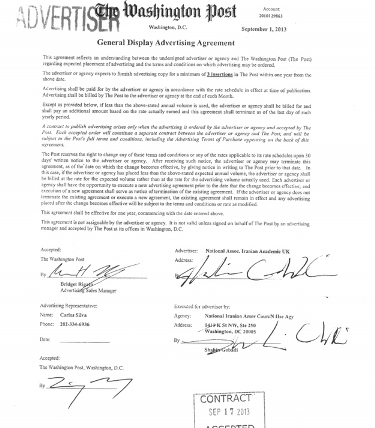
The original report was that the trip was paid for by the Organization of Iranian-American Communities, a self-described IRS 501(c) authorized contributor.

And his purpose for going was ostensibly to attend a rally of the National Council of Resistance to Iran.

Yeah, right! Why would our mayor be required at their rally?

Too bad for that liar. The U-T Watchdog had the temerity to check with the IRS and found no such named organization in their files.

That didn’t faze the National Council’s representative because he is a practitioner of “taqiyya” the Islamic principle that one may lie about anything as long as it promotes his cause.

Sounds exactly like the American political left of which Mr. Filner is a card-carrying cardinal.

Oh, and there was no rally. Nor did Mayor Bob attend one of the city-related conferences that was the nominal rationale for the trip.

So what was really going on?

An easy check of open Internet sources, along with insight from some Iranian friends, paints a clear picture of Filner’s sinister conduct toward not only his city but his country.

Bob Filner is what used to be called a “red-diaper baby.”

These were the children of active communists.

Bob’s dad was Joseph Filner a senior official with the Communist Party of Pennsylvania.

Filner pere and his fellow Pittsburgh communist buddies were rewarded by the Soviet state with a franchise to market and otherwise dispose of Russian national assets while laundering Soviet currency making themselves wealthy, while millions of others suffered privation and death in the Soviet gulags.

The Filners, pere et fils, ought to be ashamed of their ill-gotten wealth.

Bob did not stray far from the political tree. He is a long-time member of the Democratic Socialists of America (DSA).

As a member of Congress, he helped found and was a member of the Congressional Progressive Caucus created by the DSA.

The Progressive Caucus is now chaired by Keith Ellison, the first Muslim to be elected to the Congress.

Former Rep. Allen West was the only member brave enough to call them what they are: “…nearly all communists.”

Muslims and godless communists have nothing in common except their hostility to capitalism and democracy, so they make fine bedfellows for the time being.

When that nitwit Jimmy Carter ceded Iran to the Islamic terrorists and threw our secular ally Shah Reza Pahlavi under the Muslim juggernaut, he opened the country up to a vicious internal power struggle between the two major forces that brought the shah down.

One force was headed by the eventual winner, Ayatollah Ruhollah Khomeini and his Shia Islamists.

They defeated Maroud Rajavi, the founder and leader of the Mujahedeen-e-Khalq, supposedly a Marxist-Muslim Party but actually the Soviet Communist proxy that was attempting to bring Iran within the Soviet ambit.

When the battle was over, Khomeini assured the peace by murdering a reported 6,000 MEK members in one night of terror.

That may be why there are hundreds of MEK members hiding in the United States under the organizational name given as the donor for Filner’s trip.

Any wonder that Rajavi, too, moved out of Iran? But where does he live now? You guessed it, Paris.

And that is who was able to and did have the clout to summon our mayor, on short notice, to appear at his residence in Paris to deal with a problem among the MEK and the U.S. Department of State, and the E.U. Foreign Affairs Office.

Once summoned, Filner had to attend because the MEK leader commands his respect, but also knows all there is to know about Filner and his work on behalf of the communists not only in the United States, but also throughout the Middle East.

The MEK was listed as a terrorist organization for many years because of its front-man status for the Soviets.

When the Soviet state collapsed because of the inherent flaw in socialism, the MEK was left without a sponsor.

No doubt they submerged their hatred for the “Great Satan” long enough to begin currying favor with the United States by providing intelligence about the Iranian nuclear program in exchange for being allowed to “come in out of the cold.”

How many tax dollars did Filner broker for the MEK in exchange for their help against their own old enemies?

It is likely that some fallout from this political back flip required Filner’s urgent attention.

Filner is likely helping this butcher’s organization through his ties to Muslim activist Keith Ellison and the rest of the DSA, oops I mean his Progressive Caucus colleagues.

I doubt if our chief of police knew any of this when he supposedly insisted that two of our officers, on our taxpayer’s dime, accompany Filner.

Did the chief know about Filner’s ties to the MEK and the danger that entailed anywhere in Europe where Iranian agents would have no trouble hurting our officers while trying to get at Filner?

In addition to Filner’s sexual peccadilloes, he hates everything decent Americans stand for and has spent his life trying to undermine our freedom and way of life.

Filner must be the master political charlatan to hide his MEK buddies and his lust for women from the thousands that voted for him in this last election.

Stirling, a former U.S. Army officer, has been elected to the San Diego City Council, state Assembly and state Senate. He also served as a municipal and superior court judge in San Diego. Send comments to larry.stirling@sddt.com. Comments may be published as Letters to the Editor.

By Larry Stirling, sddt.com

August 24, 2013 0 comments
FacebookTwitterPinterestWhatsappTelegramSkypeEmail
Mujahedin Khalq; A proxy force

60 years after the 1953 coup, US back the MKO

An unhappy 60th birthday: The CIA coup of 1953 still resonates in Iran. Operation Ajax remembered

Mohammed Mossadeq under arrest in 1953.To disseminate [views of Iranian Prime Minister Mohammed Mossadeq as a fanatic], the British press attaché in Tehran sent his counterpart in Washington "a steady supply of suitable poison too venomous for the BBC." The Washington attaché reported American columnists made "good use of this poison." He boasted he even helped them write some their pieces on Iran. Drew Pearson—the venerable dean of American journalism and lead columnist for the Washington Post—circulated a completely fabricated story about how Fastemi, Mossadeq’s right hand, had multiple convictions of embezzlement and jury tampering. […] Stewart Alsop and his brother Joseph—both leading columnists for The New York Herald—warned that unless the United States took a firm stand, "all the little Musaddiqs would be tempted to cause trouble."—Ervand Abrahamian in The Coup: 1953, The CIA, and the Roots of Modern U.S.-Iranian Relations, p. 100

••• •••

It would make a great movie. But a tad different than Argo.

Straightforward plot. Characters bigger than life. Stunning success against difficult odds after initial failure.

At the behest of two of the most powerful brothers in U.S. history, the aristocratic grandson of a famous president engineers a coup d’etat against a secular, democratically minded reformist leader and replaces him with a pro-Nazi prime minister overseen by a spoiled, craven monarch who proceeds to keep democracy at bay, the oil flowing and the torture chambers full for the next quarter century, after which he is ousted only to be replaced by a theocratic regime. From this flows the most devastating example of blowback America has ever felt. Blowback that continues today. Blowback that has contributed to internal wrangling within three U.S. administrations between those who choose not to make war beyond sanctions and assassinations and those who want to go full out.

Unfortunately, all this is not a script being pitched to a Hollywood studio. It is history. Operation Ajax. Planning and control: CIA. Partner: MI-6. Target: Iran. The date: Aug. 19, 1953. Objective: Its oil, its near-Soviet locale and overthrow of its democratically elected prime minister, Mohammad Mossadeq, to be replaced by a weak-willed wastrel, the hereditary monarch, Mohammad Reza Shah Pahlavi.

No short commentary can possibly do justice to any complex subject, and the Iranian coup and its fall-out is no exception. Condensing inevitably damages nuance. Interpretation across cultural divides cannot help but get many little matters and some essential ones wrong. Despite these pitfalls, however, it’s important for Americans to understand how the policies conducted before 85 percent of the U.S. population and 95 percent of the Iranian population were born still has a serious impact and creates perils today.

After all, it’s a rare month that goes by without saber-rattling from some high-up U.S. politicians about the need to use U.S. firepower to "fix" Iran. Tactics aside, there is bipartisan consensus in the heights of U.S. foreign policy circles for curtailing Iran, particularly what is usually labeled its "nuclear ambitions." While conventional war, the bomb-bomb-bomb Iran approach has been so far avoided because that still remains a last resort of the bipartisan consensus, other attacks on Iran have continued, including by means of Stuxnet, the cyber-weapon built by the National Security Agency together with CIA and Israeli intelligence and used to temporarily cripple the uranium enrichment operations in Natanz, Iran. There are, in addition, assassinations of Iranian nuclear scientists by the Iranian terrorist organization Mojahedin-e-Khalq assisted with funding and training assistance of America’s ally Israel.

by Meteor Blades , Daily KOS

August 22, 2013 0 comments
FacebookTwitterPinterestWhatsappTelegramSkypeEmail
Mujahedin Khalq; A proxy force

Prof. Wilkerson: U.S. move to delist the MEK very hypocritical

Supporting Terrorists Is Not A New Policy For The U.S.: Prof. Lawrence Wilkerson

Iran Review Exclusive Interview with Lawrence Wilkerson

The election of Dr. Hassan Rouhani as Iran’s 7th president renewed hopes around the world that a new era of Lawrence Wilkersoninteraction and cooperation between Iran and the international community will begin soon. The government of “prudence and hope” promised to improve Iran’s foreign relations and find a negotiated solution to Iran’s nuclear stalemate after almost one decade of confrontation and dispute.

Iran has had no official ties with the United States for nearly 3 decades, and relation with the U.S. has always been a controversial and contentious point in Iran’s foreign policy. President Rouhani has pledged to find a way for settling the disputes with the United States, if the officials in the White House and Congress recognize and admit that talks based on mutual respect and on equal footing should replace the language of sanctions and threats against Iran.

In order to investigate the future of Iran-U.S. relations, Washington’s approach toward Iran following the Islamic Revolution in 1979, the White House’s reactions to the election of President Rouhani in Iran’s June 14 presidential elections and the missed opportunities of reconciliation between Iran and the United States, Iran Review conducted an interview with Lawerence Wilkerson, political scientist, former U.S. Army Colonel and chief of staff to United States Secretary of State Colin Powell.

Wilkerson has been a vocal critic of the U.S. foreign policy after stepping down and has written several articles and taken part in different interviews rebuking the Iraq War and the United States’ tacit and implicit sponsorship of global terrorism.

Prof. Wilkerson kindly accepted our request for an interview and responded to some of our important questions. What follows is the text of the interview.

Q: In his State of the Union Address on January 29, 2002, President George W. Bush talked of an Axis of Evil which stretches from North Korea to the Middle East and encompasses Iran and Iraq. He called Iran a threat to the international peace and security. This is while Iran’s former president Mohammad Khatami who was a reformist figure with a reconciliatory foreign policy which was based on détente and easing the tensions with the West had cooperated with the United States and the EU on a number of issues and his promotion of the idea of the Dialogue of Civilization was embraced internationally. Don’t you think this branding Iran a member of the so-called Axis of Evil was a strategic mistake by President Bush?

A: This was a strategic mistake if the strategic objective one imagines the U.S. pursuing is advancing the fundamental interests of the U.S., its allies, and friends in the world and, importantly, if one’s overall objective is world peace. It was not a strategic mistake if the strategic objectives of the U.S. were turmoil in western Asia, support of Israel’s continued aggression, increased U.S. control over the region’s oil reserves, and a state of perpetual war. Two of the three members of the Axis harbor close to a quarter of world oil reserves; Israel’s aggression has not ceased—indeed, it has increased; and the region is in turmoil. The U.S. is in an interminable state of war. The Axis of Evil speech helped to achieve these results. Some people in the U.S.—and Israel—wanted these results.

Q: So you think certain extremist elements in Washington and Tel Aviv benefit from confrontation between Iran and the United States. What about the state of bilateral relations between the two nations under President Khatami? He had signaled his willingness to engage in bilateral negotiations with the United States when he was in power. He was one of the first world leaders who sent a message of condolences to the U.S. government following the 9/11 tragedy. However, it seems that President Bush was not willing to react positively as he turned down Khatami’s message. Can we consider President Bush guilty for the failure of the attempts to bring Iran and the United States to the negotiation table?

A: President George W. Bush was not sufficiently knowledgeable to have contrived to produce failed diplomatic circumstances with Iran. His Vice President, Richard Cheney, worked to produce this failure. Cheney maintained an adamant policy that there would be no negotiations with Iran. He sold this policy to the unwitting President. Later, in 2003, when there was again an opportunity to start meaningful negotiations with Tehran, Cheney had captured the entire government with his views. Even Secretary of State Colin Powell opposed the Iranian initiative in 2003. See my answer to your question number one: Cheney is one of those who wanted the results I have described in my answer.

Q: It’s widely believed that the CIA had close ties with the Afghan rebels in 1990s that later on formed and shaped the inner circles of Al-Qaeda and Taliban. Some political scientists cite evidence showing that the United States had supported the Afghan Mujaheedin to fight the Soviet forces in 1990s. Do you deny the view that the U.S. intelligentsia furtively provided arms and dollars to the Taliban and Al-Qaeda prior to the 9/11 attacks?

A: I do not deny it at all. The U.S. is as much responsible for the Mujahidin who fought against the Soviets in Afghanistan as any other factor. The CIA term for this sort of activity is “blowback”. What it means, simply, is that secret actions taken by the CIA in one period, come back to haunt the U.S. in a later period.

Q: Prominent investigative journalists and political commentators Seymour Hersh and Glenn Greenwald have released reliable evidence that CIA, with the help of Israel and Saudi Arabia, has been providing arms, ammunitions and financial support to the exiled anti-Iranian terrorist cult Mujahedin-e-Khalq in the past 10 years in a bid to impose political pressure on Iran. Do you confirm these clandestine and underground ties?

A: I cannot confirm these ties because I have not had an active security clearance since 2005. However, if I were a betting man, I would bet that what Hersh and Greenwald asserted is correct.

Q: Let’s get to the next question. The U.S. played its last card in 2012 by removing the name of MKO from its list of foreign terrorist organizations. What’s your viewpoint on this controversial decision? Isn’t it a dualistic and somewhat hypocritical approach toward terrorism and human rights?

A: The U.S. move to delist the MEK was a very hypocritical move—and even a very stupid move. It was based on a passionate but irrational dependence on Israel, large amounts of money changing hands, and an utterly unreasonable desire to punish Iran through any means possible. The MEK are bloodthirsty terrorists. But the U.S. harbors Luis Posada Carrilles in its very midst, the terrorist responsible for bringing down a Cuban airliner in 1976 and killing everyone on board, and for bombing Havana hotels in 1997. So supporting terrorists is not a new policy for the U.S.

Q: One question on the growing wave of Islamophobia in the United States. The Muslim minority in the United States has been under a lot of pressure in the past years, and it’s widely believed that the Bush administration, with his fierce anti-Islamic rhetoric, contributed a great deal to the promotion of Islamophobia and the portrayal of Muslims as a fanatic and extremist group of people. The Muslims have been denied their basic rights in the West following the 9/11 attacks, and were shown as terrorists who want to debilitate the Western democratic values. What’s your take on that?

A: I don’t believe President Bush was that unwise; in fact, he went out of his way to state publicly that the U.S. was not at war with Islam. However, other people in the U.S.—some of whom are quite wealthy—began a campaign to denigrate Islam and Muslims in general. They made movies, ran public advertising, and gave talks aimed at vilifying Islam and Muslims. They are still doing it. Many of these elements are connected directly with right-wing elements in Israel. I believe they are also connected to people such as Richard Cheney and Karl Rove.

Q: What’s your viewpoint regarding the United States’ reaction to Iran’s 2013 presidential elections? Have the U.S. statesmen and Congressmen received the message the Iranian people intended to impart by electing a reform-minded, moderate president?

A: The U.S. Congress has been sending mixed messages. More than one hundred members recently sent a letter to President Obama that asked him to take this opportunity of a new Iranian president to achieve a diplomatic solution to U.S.-Iran concerns. At the same time, more than two-thirds of the Congress voted to increase sanctions. The U.S. Congress, like Iran’s majlis , does not seem to know what it wants. But, that said, its collective actions have been more damaging than helpful over the past several years.

Q: As you correctly mentioned, the U.S. House of Representatives passed a bill on July 31 that imposed new sanctions on Iran’s oil, mining and automobile sector. Wasn’t this hasty decision detrimental to the forthcoming nuclear talks between Iran and the P5+1, especially given that President Rouhani hasn’t even appointed his nuclear negotiation team and his foreign minister is yet to receive a confidence vote from the Parliament (Majlis)? Of course the new round of sanctions undermines President Rouhani’s efforts for resolving Iran’s nuclear standoff in a peaceful manner. What’s your viewpoint on that?

A: I agree. Most actions of the U.S. Congress have been decidedly unhelpful.

Q: And finally, what’s your prediction for the future of Iran-U.S. relations in President Rouhani’s administration? What steps should the U.S. take in order to defuse the tensions, and what confidence-building measures should Iran adopt for more transparency in its nuclear activities?

A: The U.S. should make substantive sanctions-relief [as] a major negotiating point. In return for such relief, Iran should allow the IAEA to examine thoroughly its past actions to create a nuclear weapon, stop enhancing uranium above 5%, send out of country or use itself in a short, IAEA-supervised period of time all on-hand uranium enhanced above 5%, agree to a rigorous inspection regime by the IAEA for at least 5 years, or until the international community is satisfied with the strictly civilian nature of Iran’s nuclear program, and strive to live within the parameters of the NPT, safeguards agreement, and additional protocols. The U.S. should start off negotiations by recognizing Iran as a member of the community of nations with all the rights and privileges appertaining thereto. The U. S. should also state that its overall objective vis-à-vis Iran is not regime change. Once these opening moves produce success, all issues should be on the table, from support of terrorism to the situations in Iraq, Syria, and Afghanistan.

My prediction, however, for the upcoming talks is that because of Iranian intransigence and U.S. obduracy—and, with regard to President Obama, a decided lack of political and moral courage—no meaningful success will be achieved. There is simply too much mistrust and there are too many people—on both sides—who are heavily invested in the failure of negotiations. There are people in Iran and people in the U.S. who do not want a diplomatic solution. There are also such people in Tel Aviv.

Kourosh Ziabari is an award-winning Iranian journalist and media correspondent. He writes for Global Research, CounterCurrents.org, Tehran Times, Iran Review and other publications across the world. His articles and interviews have been translated in 10 languages. His website is http://kouroshziabari.com

Interview by Kourosh Ziabari, Iran Review

August 22, 2013 0 comments
FacebookTwitterPinterestWhatsappTelegramSkypeEmail
Newer Posts
Older Posts

Recent Posts

  • Rebranding, too Difficult for the MEK

    December 27, 2025
  • The black box of the torture camps of the MEK

    December 24, 2025
  • Pregnancy was taboo in the MEK

    December 22, 2025
  • MEPs who lack awareness about the MEK’s nature

    December 20, 2025
  • Why did Massoud Rajavi enforce divorces in the MEK?

    December 15, 2025
  • Facebook
  • Twitter
  • Instagram
  • Youtube

© 2003 - 2025 NEJAT Society . All Rights Reserved. NejatNGO.org


Back To Top
Nejat Society
  • Home
  • Articles
  • Media
    • Cartoons
    • NewsPics
    • Photo Gallery
    • Videos
  • Publications
    • Books
    • Nejat NewsLetter
    • Pars Brief
  • About Us
  • Contact us
  • Editions
    • عربي
    • فارسی
    • Shqip