Nejat Society
  • Home
  • Articles
  • Media
    • Cartoons
    • NewsPics
    • Photo Gallery
    • Videos
  • Publications
    • Books
    • Nejat NewsLetter
    • Pars Brief
  • About Us
  • Contact us
  • Editions
    • عربي
    • فارسی
    • Shqip
Nejat Society
Nejat Society
  • Home
  • Articles
  • Media
    • Cartoons
    • NewsPics
    • Photo Gallery
    • Videos
  • Publications
    • Books
    • Nejat NewsLetter
    • Pars Brief
  • About Us
  • Contact us
  • Editions
    • عربي
    • فارسی
    • Shqip
© 2003 - 2024 NEJAT Society. nejatngo.org
Mujahedin Khalq Organization's Propaganda System

Fear of Election in the MKO

While the Iranian nation was practicing democracy at the polling stations on Friday to elect their new president, the Mujahedin Khalq Organization that has always boycotted the elections in the Islamic Republic seemed to Fear of Election in the MKOgo nuts with the 36 million voters who have no sympathy for the MKO but welcomed the Presidential Elections in Iran.

The MKO propaganda makes efforts to boycott each and every election in Iran labeling it as "sham elections", "rigged elections" and claiming "low voter turnout" despite the fact that the large majority of Iranians hardly ever know the MKO and those who remember them as an Iranian guerilla group hardly ever trust them.

Susan Cornwell of Reuters writes of the group’s well-paid lobbying campaign in the US despite lack of support among its own nation. In her piece "Far from Iran elections former guerrillas lobby Washington", Cornwell analyzes the controversial situation of the MKO among in the United States. " But as Iran elects a new president on Friday, the MEK has no discernible role in politics at home, where it is mistrusted – even by government critics – for having been allied with Iraq’s Saddam Hussein during the 1980s Iran-Iraq war", suggests the Reuters correspondent.[1]

As the Reuters asserts that the MKO tries to compensate its lack of reliability in Iran by running wealthy lobbies in the land of the enemy of the Iranian Government –actually the land of former enemy of the MKO, US Imperialism. Unable to operate openly in Iran, the MEK is instead waging some of its battles in Washington. It opened an attractive new office in April just a five-minute walk from the White House, according to the Reuters. [2]

Despite interviewing a number of prominent supporters of the group in the Unites States the author of the Reuters piece believes that the MKO is a "Tough Sell" in America because of its dark record against the U.S. which for many years has blamed it for the killing of six Americans in Iran in the 1970. [3]

Following the election of Iran’s reformist-backed presidential candidate Hassan Rowhani, it is believed that the US and other Western States see an opening in the process of nuclear negotiations. The New York Times’ piece dated June 13 suggests Rowhani as "the West’s best hope" –although the author tries to convince the audience that the election in Iran is "deeply flawed". However, he views the election in Iran as" important" because "it gives Iran and the United States a fresh diplomatic opportunity to avoid a dangerous confrontation over Iran’s nuclear program". Nuclear talks have always been a nightmare for the MKO. The group has been working for years to use the Iranian nuclear program as a justification to grow animosity against Iran in the world. "Once the election is over, it also needs to step up diplomatic efforts, testing through intermediaries if there is any willingness by the new president", asserts the NY Times. [4]

The above-mentioned hypothesis is what the MKO leaders fear the most because according to several arguments the MKO is seeking a Syrian style or Iraqi style –better to say Chalabi Style — regime change in Iran although it always claims "peaceful" regime change. As an organization with so little support in Iran "peaceful" change is never likely." They’ll deny it, but I think it’s pretty simple: their goal is to keep pushing the politics in America to lead to an invasion, some kind of major unsettlement of Iran, that they can sweep into as a new government," Jeremiah Goulka, author of the RAND study told the Reuters.[5]

The previous time a moderate figure, Mohammad Khatami was elected as an Iranian President, the MKO was left with grave consequences. It is widely believed that the designation of the group as a Foreign Terrorist Organization in 1997 was "a move that has been described as a nod to Iran’s then-new reformist president ". [6] The whole story contends that the MKO is not more than a bargaining chip in the hands of Western politicians.

Shortly after the declaration of winner of Iran’s Presidential Election, the U.S. Secretary of State as well as many other governments’ officials welcomed the preference of the Iranian people expressing their readiness for engagement with the Islamic Republic. The press statement of the US Secretary of State, John Kerry read, "We, along with our international partners, remain ready to engage directly with the Iranian government. We hope they will honor their international obligations to the rest of the world in order to reach a diplomatic solution that will fully address the international community’s concerns about Iran’s nuclear program."[7]

The MKO propaganda is awfully obsessed with the elections in Iran. With the actual result of the elections their fear is said to get more serious. Regardless of what the future of Iran- US relations will be like, it seems that the MKO has to spend more and more money, time and energy to reimburse the loss they incur by the side of the Iranian people.

Mazda Parsi

References:

[1] Cornwell, Susan, Far from Iran election, former guerrillas lobby Washington, Reuters, June 14, 2013

[2]ibid

[3]ibid

[4]The New York Times The Editorial Board, Who will succeed the President Ahmadinejad?, June 13, 2013

[5]Cornwell, Susan, Far from Iran election, former guerrillas lobby Washington, Reuters, June 14, 2013

[6]Lach, Eric, MEK Event Sponsor: Iranian Group Is Not A Terror Organization, TPMMuckraker, January 31, 2011

 [7]Indian Express, Ready to engage directly with Iran says John Kerry, June 16, 2013

June 19, 2013 0 comments
FacebookTwitterPinterestWhatsappTelegramSkypeEmail
Camp Liberty

Iraqi group claims responsibility for attack on MKO

Iraq’s Hezbollah has claimed responsibility for the Saturday’s attack on Camp Liberty, where it houses around 3000 members of the terrorist Mujahedin-e Khalq Organization .

MKO’s transient home near Baghdad International Airport came under mortar attack on Saturday, killing 2 and wounding 27 members of the terrorist group.Wathiq al-Battat, a top member of Iraq’s Hezbollah movement

In a statement, Wathiq al-Battat, a top member of Iraq’s Hezbollah movement, claimed the group was behind the mortar attack, Habilian Association reported on Sunday.

It was the second attack on the remaining members of terrorist MKO in Iraq since February. The previous one took place in February 9, which led to a number of deaths and injuries. Al-Battat took responsibility for that attack as well, and warned of further attacks until they leave Iraq.

Al-Battat said they had 120 rockets ready to hit Camp Liberty on Saturday, but they managed to fire 13 of them. He again threatened further attacks against members of the terrorist group in Iraq.

Iraqi group claims responsibility for attack on MKOMKO’s socializing with Iraqi politicians supporting al-Qaeda and other militant groups was the stated motivation behind Saturday’s attack.

Some 3000 MKO members have been relocated from their decades-long paramilitary base in northeastern Iraq to a former US military base in Baghdad.

The relocation was in line with the memorandum of understanding signed on December 25, 2011 between Iraq and United Nations to temporarily transfer them to a transient home for the UNHCR to determine their refugee status.

Albania became the first country to offer a home to over 200 MKO members. Forty-four MKO members have been so far resettled in this country in two groups of 14 and 30.

June 18, 2013 0 comments
FacebookTwitterPinterestWhatsappTelegramSkypeEmail
MEK Camp Ashraf

Advanced Cell Phones Found in Food Shipment for MKO Members

An Iraqi official revealed that 80 advanced cell phones were discovered in a consignment of food destined for Camp Ashraf, MKO’s former paramilitary base in Northern Iraq.

"Iraq’s security forces stopped the Camp Ashraf-bound shipment for inspection and discovered these advanced cell phones," said Uday al-Khadran, governor of Iraqi Khalis town, during a press conference, Habilian Association reported on Monday.

Camp Ashraf is the former paramilitary headquarters of the terrorist Mojahedin-e Khalq Organization (MKO, also known as the MEK, PMOI and NCRI), in which they used to live for nearly three decades. Some 3100 of them have been relocated to Camp Liberty near Baghdad International Airport, and nearly 100 others still remain at their long-held base. The relocation follows a deal between the United Nations and the Iraqi government on the expulsion of the MKO members from Iraq.

In late May, the acting Assistant Secretary for Near Eastern Affairs at the US State Department told a House Foreign Affairs subcommittee that although US officials have worked hard to persuade the MKO’s leadership to cooperate in the departures, "very few have been allowed to move."

The US State Department official responsible for Near Eastern affairs appealed the group for cooperation.

Al-Khadran said the secret transfer of these mobile phones reveals the fact that they were intended for illegal purposes.

The governor of Khalis called on the government of Iraq to launch a probe into the case.

Many of the MKO members have abandoned the terrorist organization while most of those still remaining in the group are said to be willing to quit but are under pressure and torture not to do so.

A recent Human Rights Watch report accused the MKO of running prison camps in Iraq and committing human rights violations.

According to the Human Rights Watch report, the outlawed group puts defectors under torture and jail terms.

The group, founded in the 1960s, blended elements of Islamism and Stalinism and participated in the overthrow of the US-backed Shah of Iran in 1979. Ahead of the revolution, the MKO conducted attacks and assassinations against both Iranian and Western targets.

The group started assassination of the citizens and officials after the revolution in a bid to take control of the newly-established Islamic Republic. It killed several of Iran’s new leaders in the early years after the revolution, including the then President, Mohammad Ali Rajayee, Prime Minister, Mohammad Javad Bahonar and the Judiciary Chief, Mohammad Hossein Beheshti who were killed in bomb attacks by MKO members in 1981.

The group fled to Iraq in 1986, where it was protected by Saddam Hussein and where it helped the Iraqi dictator suppress Shiite and Kurd uprisings in the country.

The terrorist group joined Saddam’s army during the Iraqi imposed war on Iran (1980-1988) and helped Saddam and killed thousands of Iranian civilians and soldiers during the US-backed Iraqi imposed war on Iran.

Since the 2003 US invasion of Iraq, the group, which now adheres to a pro-free-market philosophy, has been strongly backed by neo-conservatives in the United States, who eventually took the MKO off the US terror list.

The US formally removed the MKO from its list of terror organizations in early September 2012, one week after Secretary of State Hillary Clinton sent the US Congress a classified communication about the move. The decision made by Clinton enabled the group to have its assets under US jurisdiction unfrozen and do business with American entities, the State Department said in a statement at the time.

June 18, 2013 0 comments
FacebookTwitterPinterestWhatsappTelegramSkypeEmail
Camp Liberty

UN officials strongly condemn attack on camp liberty in Iraq

Two United Nations officials today strongly condemned an attack on Camp Liberty, an Iranian exile camp in Iraq, and called on the Government to assist and protect camp residents in need.
According to media reports two people were killed and dozens injured in a mortar attack to the camp, which is located near western Baghdad.
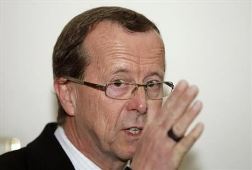
The Secretary-General’s Special Representative for Iraq, Martin Kobler and the country representative for the Office of the UN High Commissioner for Refugees (UNHCR), Claire Bourgeois, said they are “deeply concerned that today’s tragic violence has occurred despite their repeated requests to the Government of Iraq to provide Camp Liberty and its residents with protective measures, including T-Walls.”
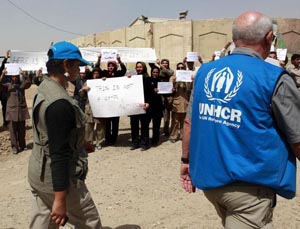
More than 3,000 residents, most of them members of a group known as the People’s Mojahedeen of Iran, are temporarily housed in Camp Liberty – a transit facility also know as Camp Hurriya – while UNHCR carries out a process to determine their refugee status.
The camp had previously been attacked in February while most of the residents were sleeping. The attack resulted in six deaths and various injuries.
Camp residents were previously situated at Camp Ashraf in eastern Iraq, but were relocated last year, in line with an agreement signed in December 2011 between the UN and the Iraqi Government.
Mr. Kobler reminded the Government of its responsibility to guarantee the security and safety of Camp Liberty as well as Camp Ashraf’s residents, throughout the relocation process.
He also called on authorities to do everything possible to provide immediate assistance to the injured.
 “Today’s second terror attack on camp Liberty is a reminder to third countries to come forward with serious offers to resettle Camp Liberty residents outside Iraq,” Mr. Kobler said. “Third countries must step forward and open their doors to relocation.”
 

June 17, 2013 0 comments
FacebookTwitterPinterestWhatsappTelegramSkypeEmail
USA

Far from Iran election, former guerrillas lobby Washington

WASHINGTON – For decades, an Iranian dissident group has seemed to be on the wrong side of history. Suppressed by both the Shah of Iran and then the ayatollahs who deposed him in 1979, its supporters have faced prison, death and exile, and were shunned in the United States as members of a cult-like terrorist organization.
The Mujahadin-e-Khalq (MEK) former guerrilla movement began to shake off its painful past last year when the State Department took it off the official U.S. list of terrorist organizations. The European Union made a similar decision in 2009 after a prolonged court battle.
But as Iran elects a new president on Friday, the MEK has no discernible role in politics at home, where it is mistrusted – even by government critics – for having been allied with Iraq’s Saddam Hussein during the 1980s Iran-Iraq war.
Yet Iran’s clerical rulers remain obsessed with a perceived threat from the group, frequently warning Western governments against any giving the MEK shelter or support, diplomats say.
Unable to operate openly in Iran, the MEK is instead waging some of its battles in Washington. It opened an attractive new office in April just a five-minute walk from the White House.
Long active as an advocacy group in the United States and Europe, the MEK is now formalizing its campaign to pressure the Obama administration to maintain a hard line – including in multilateral nuclear talks – with the Islamic Republic, which it hopes will one day crumble.
Now that it is no longer on the U.S. blacklist, the MEK can hire registered lobbyists and raise funds on its own, rather than rely on wealthy Iranian-American sympathizers.
Democratic former Senator Robert Torricelli signed up as a lobbyist earlier this year for the National Council of Resistance of Iran, the Paris-based political arm of the MEK.
"They (the MEK) deserve to have a voice in Washington, to be heard, and to (show) what the Iranian people are actually looking for in the future of Iran: a non-nuclear Iran, a government that is based on democratic values," said Soona Samsami, the U.S. representative of the NCRI.
Once one of Capitol Hill’s biggest fund raisers, Torricelli pulled out of the race for a second Senate term in 2002 amid an ethics scandal.
His lobby registration form says he will be "meeting with U.S. government and congressional officials, and advising on general strategy."
Other notable backers of the MEK include former Pennsylvania governor Ed Rendell and ex-CIA director James Woolsey.
A TOUGH SELL
Even though it has renounced violence, the MEK is a tough sell in the United States, which for many years has blamed it for the killing of six Americans in Iran in the 1970s.
A 2009 study by the RAND Corporation think tank depicted the MEK as a cult-like movement run with military-style discipline, gender separation and "near-religious devotion" to its Paris-based leaders – a description the MEK denies.
"I can’t believe the U.S. government is going to be particularly excited about working with them … because in the U.S. government, I would hope there would be people who would understand that this is not where the political future of Iran lies," said Patrick Clawson, director of research at the Washington Institute for Near East Policy.
Some U.S. policymakers are mistrustful of Middle East exile groups following Washington’s reliance on Iraqi expatriates who pushed America toward war in Iraq in 2003.
Calls from MEK representatives for "regime change" in Iran remind some of Ahmad Chalabi and his Iraqi National Congress, which helped convince the administration of former President George W. Bush that Saddam had weapons of mass destruction.
"They’ll deny it, but I think it’s pretty simple: their goal is to keep pushing the politics in America to lead to an invasion, some kind of major unsettlement of Iran, that they can sweep into as a new government," said Jeremiah Goulka, author of the RAND study.
Some in the U.S. government also share that suspicion – but the MEK resents comparisons to Iraqi exiles of 10 years ago.
"We’ve never been in favor of a war. We’ve never tried to push things towards that direction," said Alireza Jafarzadeh, the deputy U.S. representative of the NCRI. The MEK is "not the U.S. creature that Chalabi was," he said.
Attempts to make over the MEK’s image have been boosted by a report from a former senior State Department official who questions whether the group really committed the killings of six Americans in Iran in the 1970s that are often blamed on it.
The killings, during a guerrilla campaign against the U.S.-backed Shah, were actually the work of a faction that later broke away from MEK, said Lincoln Bloomfield, whose report has just been published as a book by the University of Baltimore.
"Not a single person you could name in the MEK had any knowledge of it or had anything to do with it," he said.
The study grew out of a 2011 memo Bloomfield wrote as a consultant for a law firm that lobbied to remove MEK from the terrorism list on behalf of the Iranian-American Community of Northern California. The author said he had no financial interest in the book, and proceeds are going to the university.
The MEK still has some 3,000 members in Iraq, many of whom were invited by Saddam in the 1980s. The group fell out of favor after his 2003 downfall and current Iraqi officials have applied pressure for them to leave.
After clashes with Iraqi security forces in 2011 in which 34 people were killed, the residents were moved last year as part of a plan in which the United Nations intends to process them for refugee status in other countries.
But progress has been slow, and their temporary home at a former U.S. military compound in Baghdad known as Camp Liberty came under fire in February when eight people were killed in a rocket attack by unknown assailants.
U.S. officials have tentatively identified a handful of Camp Liberty residents who may be allowed to move to the United States. But they would be expected to renounce their membership in MEK, the officials told Reuters.
Forty-four residents of the camp have left over the last month for Albania, which has offered to take up to 210 of them.
Susan Cornwell (Editing by Alistair Bell and Jackie Frank)

June 16, 2013 0 comments
FacebookTwitterPinterestWhatsappTelegramSkypeEmail
Former members of the MEK

Why such a reaction to defection of two NCR members?

Following the resignation of the two last non-MEK members of the National Council of Resistance, the secretariat of the NCR published an announcement denouncing the two defectors, Mr. Karim Ghasim and Mr. Mohammad Reza Rowhani! The announcement was a reaction to the common statement the two defected member issued after their resignation.
Ghasim and Rowhani criticized the NCR leader for their undemocratic approach during the years of their membership in the council although they seemed reluctant to openly question the organization. However, the NCR announcement calls their allegedly unexpected resignation as treason! Ghorban Ali Hossein nejad former Rajavi’s personal interpreter –who himself was harshly verbally harassed by Massoud Rajavi after his defection from the Mujahedin Khalq Organization/ MKO—condemned the group’s attitude regarding defection of the members of the NCR.
“Where in the world leaving a party or a political organization is considered treason and joining the enemy?”, Hossein nejad asks the group leaders.”Why you never answered a single question they asked about the council’s functions and decisions in 30 years?”As the two individuals have noted in their statement the reason of their resignation is the lack of responsiveness in the MKO.
Comparing the MKO with the Communist party of the Soviet Union, Ghorban Ali Hosseinnejad wants the MKO authorities to respond the criticism the defectors of the NCR presented in their statement.
The announcement of the NCR was allegedly signed by the so-called signatories who signed the group’s announcement against Qasim and Rowhani and according to Hossein nejad 90 percent of them are currently in Iraq so they  were absent at the NCR’s meeting held in Paris! Therefore, no challenge and criticism was posed in the meeting. Basically members of the MKO especially those who are residing in Camp Liberty, Iraq, never dare to refuse signing the indoctrinated documents. Former translator of Massoud Rajavi puts: ”Besides, I know individuals among the signatories with whom I used to work when I was in the group and I know them well. I know that they were serious critics of   the council’s leader who is also the MKO’s leader but they were forced to sign the announcement under Rajavi’s oppressive system and heavy pressure ruling Liberty.”
 

June 15, 2013 0 comments
FacebookTwitterPinterestWhatsappTelegramSkypeEmail
Mujahedin Khalq; A proxy force

A brief review on US-MKO ties

Founded in 1965 by a group of leftist Iranian college students, the “Mujahedin-e Khalq Organization (MKO, a.k.a MEK and NCRI)” was mainly devoted to opposing the rule of the Shah before the Islamic revolution. In its first five years, the group primarily engaged in ideological work, their interpretation of Islam and economic and political ideas. The MKO preached a combination of Marxism and Islamism.
Soon following the Iranian Islamic revolution, the organization started a phase of armed struggle in a bid to destabilize the newly formed regime and have its revenge of failing to assume a share in the power. As a result, MKO’s dedicated terrorist teams launched numerous blind suicide operations, bombings, gun-shot assassinations as well as street gun-battles in which many innocent civilians and key officials were killed. The atrocities and crimes of Mojahedin-e Khalq Organization set up one of the bloodiest chapters of Iranian history.
But one of the first times the MKO adopted terrorism as a tool goes back to the era of Shah regime; When the MKO was involved in assassination of American businessmen, military personnel, and even a senior American diplomat in Iran before the 1979 revolution. Some of the attacks on U.S. citizens were reflected in American newspapers back in the 70s. The St. Petersburg independent published an article titled ‘Terrorists Slay Americans in Iran’ in May 21, 1975. It is written in a part of the article: ‘A Woman telephoned the Associated Press office anonymously at noon and said: “The execution of American officers today was a reply to the execution of nine Iranian revolutionaries in prison last month”. Identifying herself as a spokesman for the Iranian People’s Warriors Association, she said Shah Mohammed Reza Pahlavi is a “stooge of the Americans, therefore we murder Americans.”
Following is a short review on US government’s stance on MKO issue since 1984 until 2013:
In December 1984, the US State Department wrote to Rep. Lee Hamilton, then Chairman of the Subcommittee on Europe and the Middle East, to clarify its official views on the MKO: “The Iranian Mujahedin remains a highly nationalistic, Islamic, left-wing and anti-western organization…”
On June 14, 1985, the US State Department issued another statement against the MKO. In this statement, the MKO was referred to as “a militantly Islamic, anti-democratic, anti-American, anti-Western collectivist organization.”
On July 24, 1985, 10 years after the MKO assassinated US citizens, Richard W. Murphy, US assistant secretary of state for Middle East affairs, stated to the US House Foreign Affairs Subcommittee on Middle East affairs that the MKO was “ militantly Islamic, anti-democratic, anti-American, and continue to employ terrorism and violence as standard instruments of their policies.” He also identified the MKO as having been active in bringing down the former Shah and as being Marxist.
These statements shaped the earliest stances the US had taken on the MKO issue. Some people believe at that time, the US government was trying to persuade Iran to help release American soldiers who were arrested in Lebanon so they pressured the MKO to impress Iran.
About a year later, the US government somehow shifted its policy towards the MKO. The State Department apparently contacted the MKO’s Washington office in November 1986, to arrange a meeting.
At a hearing on April 21, 1987, in line with the change in policy, Mr. Murphy did an about-face when asked about the Department’s MKO statements. He said: “I will very freely admit that there were gaps in our knowledge about the organization,” adding, “We meet, have met with the Mojahedin Organization here in Washington. They are a player in Iran…We are not boycotting them.” This policy shift took place exactly at the time the Iranian forces were achieving big victories in the battle against the Iraqi Ba’ath forces who had started the war on Iran. The MKO was at Saddam’s service at the time and the group needed to be strong enough to help Saddam against Iran.
A couple of years later, the MKO was despised again by the US government. In September 1989, the US State Department replied to a letter from Congressman Mervyn Dymally to Secretary of State James Baker. The congressman had asked the Secretary of State to resume talks with the MKO. The State Department rejected his request and again referred to MKO as an anti-American, anti-Western collectivist organization that continues to employ terrorism and violence as standard instruments of its policies.
In November 1992, The US Secretary of State submitted "a report detailing the structure, current activities, external support, and history of the people’s Mojahedin of Iran”. The report was prepared at the request of US Congress.
Some of the report highlights are as following (all direct quotes):
“The Mojahedin revolutionaries developed and disseminated an eclectic ideology based on their personal interpretation of Shi’a Islamic theology and Marxist tenets. Then as now the Mojahedin advocated a two-pronged strategy of armed struggle and the use of propaganda to gain their political objectives.”
“They assassinated at least six American citizens, supported the takeover of the U.S. embassy, and opposed the release of American hostages. In the post-revolutionary political chaos, however, the Mojahedin lost political power to Iran’s Islamic clergy. They then applied their dedication to armed struggle and the use of propaganda against the new Iranian government, launching a violent and polemical cycle of attack and reprisal. In 1981, the Mojahedin leadership fled to France and with other Iranian opposition movements formed the National Council of Resistance (NCR).”
“In 1986, France expelled the leader of the Mojahedin, Masud Rajavi.”
“After his expulsion form France, Rajavi relocated to Baghdad, Iraq, adopting Saddam Hussein as his patron, In 1987.”
“Rajavi announced the formation of the National Liberation Army (NLA), the military wing of the Mojahedin, which conducted raids into Iran during the latter years of the 1980-1988 Iran-Iraq war. The NLA’s last major offensive reportedly was conducted against Iraqi Kurds in 1991, when it joined Saddam Hussein’s brutal repression of the Kurdish rebellion. In addition to occasional acts of sabotage, the Mojahedin are responsible for violent attacks in Iran that victimize civilians. They also engage in violence against Iranian government targets in the West.”
“Since their leadership’s expulsion from Iran, the Mojahedin have conducted a public relations campaign among Western press and public officials, seeking political support and financial backing. Exploiting Western opprobrium of the behavior of the current government of Iran, the Mojahedin posit themselves as the alternative. To achieve that goal, they claim they have the support of a majority of Iranians. This claim is much disputed by academics and other specialists on Iran, who assert that in fact the Mojahedin-e Khalq have little support among Iranians. They argue that the Mojahedin’s activities since the group’s leadership fled from Iran in 1981– particularly their alliance with Iraq and the group’s internal oppression — have discredited them among the Iranian polity. “
“Despite Mojahedin assertions that the group has abandoned its revolutionary ideology and now favors a liberal democracy, there is no written or public record of discussion or debate about the dramatic reversals in the Mojahedin’s stated positions. Moreover, the Mojahedin’s 29-year record of behavior does not substantiate its capability or intention to be democratic. Internally, the Mojahedin run their organization autocratically, suppressing dissent and eschewing tolerance of differing viewpoints. Rajavi, who heads the Mojahedin’s political and military wings, has fostered a cult of personality around himself. These characteristics have alienated most Iranian expatriates, who assert they do not want to replace one objectionable regime for another. Given these attributes, it is no coincidence that the only government in the world that supports the Mojahedin politically and financially is the totalitarian regime of Saddam Hussein.”
“The Mojahedin’s actual military efforts have consisted of occasional strikes against border towns, industrial targets (particularly oil installations), and civilian targets. “
“At the border the Mojahedin’s military record is limited. The group launched its most significant incursion in June and July 1988, when they coordinated an advance into Iran with Iraqi forces. During the same offensive, Iraqi units in other sectors of the front used chemical weapons against Iran. “
United States government’s view on the MKO barely changed until during Clinton presidency, the group was put on the US State Department list of foreign terrorist organizations in 1997. Some believe MKO’s designation as a terrorist organization was a goodwill gesture to the newly elected Iranian government. The MKO was kept on the list for some 15 years in 3 different administrations.
The Bush administration cited Saddam’s support of MKO as a reason to invade Iraq. When the Bush administration sought to justify its attack on Iraq in 2003 by accusing Saddam Hussein of being a sponsor of “international terrorism”, one of its prime examples was Iraq’s “sheltering” of the MKO.
But despite the group was referred to as a terrorist organization and Saddam’s support of it would lead to invasion of Iraq, the MKO enjoyed the support from the US government indirectly and secretly after the US invaded Iraq. The US had planned to use MKO’s terrorist capabilities to confront Iran.
U.S. Congressman Dennis J. Kucinich, The former Ranking Member on the House Government Reform Subcommittee on National Security, Emerging Threats and International Relations, gave a speech during House debate HR 282, the Iran Freedom and Support Act in which he criticized the U.S. government’s support of the Mujahedin e-Khalq terrorist group.
“HR 282 supports anti-government advocates in Iran promoting regime change. This is highly problematic. While an important amendment offered by Congressman Blumenauer was adopted into this bill during markup, to prohibit U.S. assistance to groups that are on the State Department’s list of terrorist organizations, or have been on that list for the last 4 years, there are ways around this. For example, according to a Newsweek article from February 14, 2005, the US has been recruiting individuals from the MKO, a group currently labeled as “terrorist” by the State Department, who have agreed to form a new group with the same mission of the MKO: regime change in Iran. These individuals have been conducting military activity in Iran with the United States’ support. I just want to remind everyone that the MKO was the group responsible for the U.S. Embassy takeover in Tehran in 1979. The MKO also had a camp in Iraq where Osama bin Laden’s first fighters were reportedly trained. The MKO also trained and supported Taliban fighters. Now we’re recruiting help from members of the MKO, which makes a total mockery of this so-called War on Terror.” Kucinich said.
The renowned investigative journalist Seymour Hersh also revealed striking details of his findings on the aim of the $400 million budgeted US covert operations inside Iran in an article published in New Yorker in July 2008, titled ‘Preparing the battlefield’. He provided valuable information on US military preparations to strike Iran, on the total expansion of the Bush Administration’s executive power, about the US recognition of Iran’s overall positive role in Iraq and on the US support for the anti-Iran terrorist organizations Jondollah, PJAK and MKO. He explained how the Bush Administration’s policy of “my enemy’s enemy is my friend” has led the US to support the Baluchi organisation Jondollah and the MKO (Mujahideen-e-Khalq a.k.a PMOI), both of which have clear track records of terrorist activities including against the US. He reiterated that the US has been giving arms and cash to the terrorists in the MKO for years and reveals that “most of the [MKO] leaders have been taking our money and cashing it in an awful lot of bank accounts in London.” He also revealed for the first time that the US has trained MKO teams in the state of Nevada and that “they do a lot of crazy stuff inside Iran”.
As reported by Seymour Hersh, Illegal military and financial support of MKO was not limited to the Bush administration. In April 2012, Seymour Hersh reported at the New Yorker that the Joint Special Operations Command (JSOC) of the US military gave members of the Mojahedin-e Khalq (MEK) training in signals intelligence at a facility in Nevada during the Bush era. The MEK was then on the US State Department’s terrorism watch list, so the Pentagon’s deployment of this group was quite illegal.
Hersh revealed a trail of blatant hypocrisy on the part of the US government. The U.S. favorite terrorists are not terrorists even if they have blown up non-combatants, but national liberation groups such as Hezbollah in Lebanon are designated terrorists. The U.S. Government officials have even brandished the word “terrorism” to describe perfectly peaceful protesters and dissidents inside the US, while JSOC was flying dyed-in-the-wool terrorists to Nevada for training.
Finally, after the United States played all those games with its favorite terrorists, the Obama administration started a new game and removed MKO’s name from the list of foreign terrorist organizations. They also allowed the former terrorists to open an office in Washington. Again what didn’t matter here at all was the MKO itself. It was about politics and a leverage to pressure Iran.
With a brief review on US-MKO relations, it can be seen the MKO has always been perceived by various US governments as a tool to be used against Iran. In fact, what doesn’t really matter is the terrorist group. It is all about the United States and Iran. MKO is just a terrorist group with a black record that could only serve its Master’s wishes without any independency. The only reason the MKO continues to exist today, is that its masters believe they can still use it to pressure Iran.
 

June 13, 2013 0 comments
FacebookTwitterPinterestWhatsappTelegramSkypeEmail
France

Nejat Society Letter to French MEP

The honorable Mr. Pascal Deguilhem
French National Assembly
126  L’Universite St.
75355 Paris 07 SP

Dear Mr. Deguilhem,
We are pleased to introduce our NGO, "Nejat Society" based in Iran. Nejat Society was founded by a number of former members of the Mujahedin Khalq Organization (MKO) and Families of those who are still held as hostages by the group leaders. The main objective of our NGO is to help the families of those who are held in the camps of the MKO and have had no contact with their loved ones for many years.
As we heard that you are supposed to speak at the rally the group is going to hold in  Villepint, on june 22, 2013 we are concerned about a few issues.
A large number of The MKO members who are currently kept in Camp Liberty, Iraq do not enjoy proper mental and physical conditions. The Camp facilities are not enough and members are under constant psychological pressure; they have to attend daily self-criticism and brainwashing sessions under the manipulative system of the group. They have no access to the outside world. They are exposed to the world outside the group camps –weather in Baghdad or Ouver Sur d’Oise– only by what the cult-like system of the group offers them.
Regarding such conditions, just a few individuals could manage to escape the MKO camps during the past decade. You may want to study the ”No Exit" report published by the Human Rights Watch in 2005, based on testimonies of the former members of the Cult of Rajavi.As our duty is to provide families of the MKO members with possibilities to contact their loved ones in the MKO or at least to get news about them, we firmly ask the international community to pave the way for free access to Liberty residents in accordance with the international laws.
The group authorities annually spend large amounts of money to hire speakers and attendees for the gathering of June. You may want to take a look at the audience in the MKO gatherings to get to know about the number of Iranians and non-Iranians present there! You may want to ask the speakers at the gathering about their speaking fees!
This letter is not to challenge your sincerity in your beliefs but as a Socialist Republican deputy, do you really feel happy to attend the so-called gathering which is in no way the icon of the Iranians’ pro-democratic aspirations? Don’t you think that you are just used by the Rajavis as a means to run their ambitions?
Dear Sir
Compared with your socialist ideals, advocacy for a cult-like group with a dark history of human rights abuses, makes us confused and also concerned about the situation of our children behind the bars of the MKO. However, if you are still willing to attend the June 22 rally we appeal to you to at least use your political social and cultural influence to ask the group leaders Massoud and Maryam Rajavi to fully cooperate with the UN mission in Iraq for the relocation of Liberty residents to third countries and also to provide us with an opening to get in touch with the residents in a free atmosphere without the supervision of the group officials.
Sincerely,
Nejat Society

June 12, 2013 0 comments
FacebookTwitterPinterestWhatsappTelegramSkypeEmail
Terrorist groups and the MEK

Le Figaro: the anti-Iranian People’s Mujahedin Fight in Syria

Two members of the Iranian opposition group, People’s Mujahedin Organization were found dead a month ago in the Idlib region in Western Syria, reported a European MEP in contact with anti Bashar Al-assad rebels.
They fought alongside insurgents seeking the overthrow of the Syrian regime backed by Iran. Considered by France as a terrorist organization, the People’s Mujahedin have a base in Iraq and their headquarters in Parisian suburb. Western and Arab intelligence services would use them against Iranian interests and the allies of Tehran such as Syria.
Georges Malbrunot, Figaro Blog, May 30, 2013

June 11, 2013 0 comments
FacebookTwitterPinterestWhatsappTelegramSkypeEmail
Mujahedin Khalq 's Function

Discovery and seizure of telecom devices in food convoy entering Camp Ashraf

Discovery and seizure of advanced telecom devices in MEK food convoy entering Camp Ashraf – Khalis Mayor calls for investigation
Mayor of Khalis in Diyala province, Uday Al Khadran, called on the Iraqi government to open an urgent investigation after advanced telecom devices were seized in Camp Ashraf which is home to a number of the Mojahedin Khalq terrorist group.
In a press statement Al Khadran said that the security services had found 80 phones hidden in a suspicious manner inside a shipment carrying food. The shipment came from one of the Arab companies which had bid to secure the needs of the MEK members in the camp.
Al Khadran said that the way the devices had been hidden demonstrates an intention to use them in a non-legal framework that is unlawful activities. He said, “these devices and the sophisticated way they were hidden show the MEK’s intention to use them illegally”.
 

June 10, 2013 0 comments
FacebookTwitterPinterestWhatsappTelegramSkypeEmail
Newer Posts
Older Posts

Recent Posts

  • National Pride of Iranians: Reject the Rajavis and their Patrons

    July 22, 2026
  • Italian legislators fooled by MEK’s polished presentations

    July 18, 2026
  • The Rhetorical Style and Polemical Language of the MEK

    July 15, 2026
  • Death of Lindsey Graham, notorious hardliner against Iran

    July 13, 2026
  • Nejat Society Albania’s 2026 Peace Delegation

    July 11, 2026
  • Facebook
  • Twitter
  • Instagram
  • Youtube

© 2003 - 2025 NEJAT Society . All Rights Reserved. NejatNGO.org


Back To Top
Nejat Society
  • Home
  • Articles
  • Media
    • Cartoons
    • NewsPics
    • Photo Gallery
    • Videos
  • Publications
    • Books
    • Nejat NewsLetter
    • Pars Brief
  • About Us
  • Contact us
  • Editions
    • عربي
    • فارسی
    • Shqip