Nejat Society
  • Home
  • Articles
  • Media
    • Cartoons
    • NewsPics
    • Photo Gallery
    • Videos
  • Publications
    • Books
    • Nejat NewsLetter
    • Pars Brief
  • About Us
  • Contact us
  • Editions
    • عربي
    • فارسی
    • Shqip
Nejat Society
Nejat Society
  • Home
  • Articles
  • Media
    • Cartoons
    • NewsPics
    • Photo Gallery
    • Videos
  • Publications
    • Books
    • Nejat NewsLetter
    • Pars Brief
  • About Us
  • Contact us
  • Editions
    • عربي
    • فارسی
    • Shqip
© 2003 - 2024 NEJAT Society. nejatngo.org
Mujahedin Khalq; A proxy force

Dividing the World into Terrorists and the Rest

The common American tendency to view the outside world in starkly divided Manichean terms between friends, allies and good guys on one side and adversaries and evil-doers on the other side arises in many circumstances but seems especially marked in discussions of terrorism. The tendency is most visible in how the lists that have become mainstays of counterterrorist policy are widely perceived. The U.S. list of foreign terrorist organizations had an almost mundane purpose when it was established by the Antiterrorism and Effective Death Penalty Act of 1996. One of the principal features of that legislation was to criminalize the provision of material support to any foreign terrorist organization. This made necessary clear definitions not only of material support but also of foreign terrorist organizations. Hence the creation of the list, entries on which are determined by the secretary of state with the participation of other executive departments and according to criteria specified in the statute.
Notwithstanding this purpose—support to the enforcement of a criminal law—the list of foreign terrorist organizations gets regarded as if it were a more general act of condemnation that embodies what overall U.S. policy toward a given group is or ought to be. It is taken as a declaration of who is in the bad guys’ camp and who is not. Listing or delisting of a particular group gets promoted by those with an agenda that has nothing to do with enforcement of a criminal statute. This has been seen most obviously with the well-financed campaign to delist the Iranian cult-cum-terrorist group the Mujahedin-e Khalq. Or pushing for a particular group’s listing is a way of making a statement, as has most recently been the case with the question of whether to list the Haqqani group of Afghanistan and Pakistan.

This way of looking at the list has several disadvantages. It constitutes pressure to politicize what is supposed to be an administrative and legal decision. It increases the potential negative consequences of listing a group because non-Americans follow the American lead in looking at listing as a general act of condemnation. Listing of the Haqqani group, however much it may be legally warranted under the terms of the relevant statute, might complicate not only U.S. relations with Pakistan but also any future efforts to negotiate an Afghan peace with the Taliban.

Sharply dividing groups into ones that get the terrorist label and thus are to be condemned and those that are not so labeled and condemned does not correspond to the messy reality of what groups do and don’t do. Lebanese Hezbollah is perhaps the foremost example of a group that is known (and listed) in the United States as a terrorist group but is also much more than that. Instead of exploring different options in intelligently dealing with this multifaceted group, more attention gets devoted in a simplistic way to U.S.-European differences on whether Hezbollah “is” a terrorist group—i.e., is officially listed and branded as such.

A related problem is how putting a group on the bad side of the good guys/bad guys divide reduces one’s policy flexibility because this one act of branding tends to preclude any engagement with the group, no matter how much such engagement would make sense. Probably the premier example is Hamas. The International Crisis Group recently observed that the ostracism of Hamas may entail yet another costly missed opportunity in the Middle East.

The rigid perceptual division of friends and enemies and the tendency to associate bad behavior such as terrorism only with the enemies does not correspond to actual behavioral patterns. It means, for example, overlooking in the Middle East Jewish terrorism until it occurs frequently enough to make it impossible to overlook entirely. In the United States it means a tendency to consider all terrorism worth worrying about to be Islamist and to discourage attention to other varieties that, based on what has been happening inside the United States, are worth worrying about at least as much.

We would be better advised to remember that terrorism is a tactic, not a fixed set of protagonists who are the only ones ever to use it. We should also remember that good and evil are pretty widely distributed in the world and not just confined to different parts of it.

Paul R. Pillar ,National Interest.org
September 5, 2012 0 comments
FacebookTwitterPinterestWhatsappTelegramSkypeEmail
The MEK to launch Armed Struggle

Terror In The Name Of Democracy

Terror In The Name Of Democracy: The Outset of a Phase of Violence

As the bankrupts of democracy, MKO began casting shadows of terrorism over Iran

“Patriots always talk of dying for their country but never of killing for their country.” (Bertrand Russell)

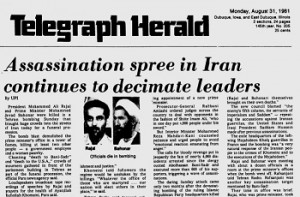
The number of the word’s presidents and prime ministers assassinated since the mid-twentieth century reaches just about 50. Out of them, those assassinated by the use of the most violent and horrific methods, suicide or bomb blast, hardly outnumber a hand’s fingers. But the concurrent assassination of a president and his prime minister in a terrorist strike has a single record in its kind. And the untold about the event that may never repeat in the history is the key role of an ousted president as an accomplice to erase his successor. And the bare but shocking truth about the event is that almost all people being a high authority to investigate the complicated case or initiate prosecution for the terrorist offense turned to become the target and the victims of terrorism themselves. And it was just one of many shadows of terror that terrorists cast over Iran.


On August 30, 1981, a bomb explosion at a meeting of the National Security Council held at the Prime Minister’s office led to three immediate deaths: Mohammad Ali Rajai, the Iranian President, Mohammad Javad Bahonar, the Prime Minister, and Abdolhussein Daftarian, the prime ministry’s authority. Hushang Dastjerdi, the head of the national police, the fourth victim, passed away 6 days later as a result of the injuries. The terrorist plot, although incomparable with the preceding June 28 explosion quantitatively, the explosion in the Islamic Republic Party IRP killing at least 74 high-profile personalities, has its record as a bloody chapter in Iranian post-revolution history, a mysterious and complicated plot with many aspects still remaining ambiguous and many questions unanswered.

No doubt, the perpetrators of such ruthless, violent plots fail to provide the slightest justification for proven terrorist acts that are tantamount to a declaration of war against a nation. The responsible group, Mojahedin Khalq Organization (MKO/MEK/PMOI/NCR), after tolerating ultimate failures in winning public trust in two preceding presidential and parliament elections, had already started inventing pretexts to declare its war. In its military communiqué that implied a blatant declaration of a violent warfare against the Islamic Republic and was documented as a clear vindication of the group’s perpetrated terrorist crimes, MKO complained of misbehavior and “illegal and unlawful” undertaking against the still in office president, Abolhassan Bani-Sadr, whose conspiratorial collaboration with some opposition groups made the Iranian parliament to hold a debate on his presidency competence that finally led to his impeachment.

Sparks of Animosity

The president Bani-Sadr’s close connection and sympathy with a wide range of opposition groups, particularly his direct and strong support of MKO and giving the group a free hand in social and political affairs, as well as his incompetent function as the commander of the armed forces to confront the invaliding Saddam’s army made Ayatollah Khomeini to reclaim the power of Commander-in-Chief on 10 June 1981. Just 10 days later, Ali-Akbar Hashemi Rafsanjani, the Parliament Speaker at the time, apprised Ayatollah Khomeini of deputies’ decision about stripping Bani-Sadr of his presidential power. The response was clear; as the leader with the constitutional authority, Ayatollah Khomeini signed dismissal of Bani-Sadr.

In its first political-military issued communique No. 25 dated 17 June 1981, just three days prior to the first violent moves, MKO made references to events that motivated the organization to make a blatant decision to wage an armed warfare against the Islamic Republic:

“… At the same time, we are witnessing illegal arrests of the members of the presidential office whose names and the news of their arrests are not announced in some instances. Of course, they [the regime] are preparing a comprehensive plan of arresting progressive-seeking characters and antagonists of monopoly in the country. Mojahedin Khalq Organization, while protesting such unlawful and counterrevolutionary actions, thereby obtains permission from the hero Iranian people, and by the help of God, to adopt the most decisive revolutionary resistance through any possible means for the preservation of its members, especially those central cadres of the organization that are in fact considered a pivotal part of the people and revolution.”

On the evening of 20 June 1981, when the Parliament resumed its impeachment debate, MKO orchestrated a series of mass demonstrations that shook Tehran and some other Iranian provincial towns. Rioters had orders to carry small arms and cold weapons and soon the demonstrations turned into street battles that lasted more than three hours. The battles reportedly left heavy casualties and MKO rioters overturned buses and set the parked cars and motorcycles on fire. Although MKO’s plot to cause a widespread civil disturbance to lead the country into a serious civil war faced a total failure, the group adopted a different violent tactic since the day after.

To be continued

September 5, 2012 0 comments
FacebookTwitterPinterestWhatsappTelegramSkypeEmail
Mujahedin Khalq Organization members' families

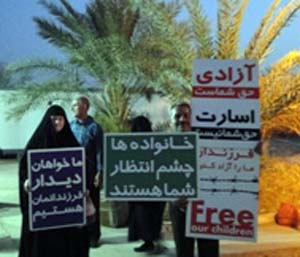
Families from Kermanshah and Lorestan enter camp Ashraf, Iraq

Twenty people of MKO members’ families who are from Kermanshah and Lorestan provinces joined other families picketing at Camp Ashraf chanting the slogan:

“Our message hope, Our promise, freedom”.

They entered Iraq to visit their loved ones, imprisoned in the Cult of Rajavi.“Our message hope, Our promise, freedom”.

All those MKO members who recently defected the Cult notified that families’ presence at Camp Ashraf and hearing their voice via loudspeakers have been a very motivating and hope-giving to members.

The families suffer the hardships of traveling to Iraq in order to give the hope of salvation to their loved ones held as hostages in hands of the cult-monsters.

Such a determination will definitely win and thank to the God, the promised day of the salvation of hostages of Rajavi’s Cult is not far away.

Translated by Nejat Society

TO VIEW MORE PHOTOS OF NEWLY ARRVIED FAMILIES CLICK HERE

September 5, 2012 0 comments
FacebookTwitterPinterestWhatsappTelegramSkypeEmail
Mujahedin Khalq Organization as a terrorist group

Night vision goggles and military equipment inside MKO deportee’s bags

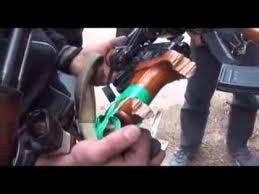
 A security source closely related to the terrorist MEK camp said, that the security forces, which oversaw the deportation of the first group of the remaining residents of Camp Ashraf, have foundNight vision goggles and military equipment inside MKO deportee's bags materials used for military purposes inside MEK women’s bags and clothes.

The source said that many shields, shoes and uniforms have been found in these bags, and added that 3 night vision goggles hidden in women’s clothing have been found.

The source said that the number of deportees today [August 29, 2012] is 400 people out of 1,200 people, and the inspection process so far is still ongoing since nine o’clock in the morning.

The terrorist organization had participated in the majority of the repression of the 1991 uprising. It also has a very close hand in hundreds of terrorist operations that took place in many areas .

Ashraf News

September 4, 2012 0 comments
FacebookTwitterPinterestWhatsappTelegramSkypeEmail
Mujahedin Khalq; A proxy force

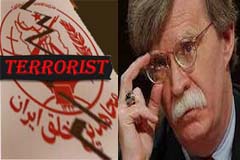
John Bolton Shockingly Denies Being a ‘Terrorist Supporter’

The American Conservative’s Jordon Bloom ran into a befuddled John Bolton at the Republican National Convention yesterday and had a timely question for him:
John Bolton Shockingly Denies Being a ‘Terrorist Supporter’
He was on his way in to observe the speeches, and I knew he wouldn’t have much time to answer more than a question or two in passing. So I asked the most important one: given the definition laid out in Holder v. Humanitarian Law Project, was he at all concerned that his advocacy on behalf of the Iranian dissident group the MEK could be defined as material support for terrorism under the PATRIOT Act?

Bolton, visibly flustered at the suggestion that he is a terrorist supporter, disputed the premise before cutting me off:

“I don’t know what you’re up to, but you’re flatly wrong, and I’m busy, so if you’ll excuse me.”

He is indeed a busy man, but if he ever cares to take some time out of his day to explain why I’m wrong, my email is jbloom[at]theamericanconservative.com. Or he could take it up with Glenn Greenwald or Larison.

Oh, how I’d love such an inquiry from Bolton. Perhaps Jordan could also ask why Bolton’s former employer, George W. Bush, included Saddam Hussein’s support for terrorists like MEK in his propaganda justifying the invasion of Iraq in 2003. “Iraq shelters terrorist groups including the Mujahedin-e-Khalq Organization,” reads a document in the archives of the White House’s website, “which has used terrorist violence against Iran and in the 1970s was responsible for killing several U.S. military personnel and U.S. civilians.” Is Bolton proud of this point of commonality between him and Saddam?

John Glaser

September 4, 2012 0 comments
FacebookTwitterPinterestWhatsappTelegramSkypeEmail
Mujahedin Khalq; A proxy force

Why do the western media whitewash MEK terrorists?

Once again, western newspapers are carrying water for recalcitrant Mujahedin-e Khalq terrorists by whitewashing their disobedience towards the Iraqi government.Why do the western media whitewash MEK terrorists?

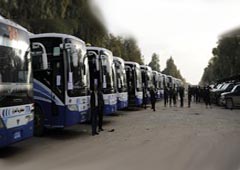
These days the government of Iraq is involved with the transfer of the sixth convoy of terrorist anti-Iran MEK from their long-hold base in Diyala province to a former U.S. military base in Baghdad which has been stalled for more than three months over the group’s complaints regarding the conditions of their new temporary home.

According to the reports, some of the Ashraf residents attacked Iraqi police in a bid to prevent them from inspecting their belongings.

But the story does not end here! The terrorist group issued a statement condemning Iraq for beating and injuring its members. The story reverberated around the western news media that “a statement by the People’s Mujahedeen Organization of Iran said its members were beaten with sticks, metal bars, stones and other objects, leaving 20 people wounded.”

Ironically, the U.S. Department of State made no reference to such horrible (!) events in its press statement released Wednesday August 29, 2012. Instead, the Department’s spokesperson appreciated the government of Iraq since it “has made considerable efforts to achieve a peaceful and secure resolution for the residents of Camp Ashraf.”

On another occasion on Tuesday August 28, 2012, Victoria Nuland who leads the Daily Press Briefing at the State Department reiterated, “We commend the fact that the Iraqis are working well to help move these individuals.”

The question is here that why the mainstream media give cold shoulder to these statements as well as the remarks of an Iraqi official when he says “we found military equipment in the group’s stuff.”

You can see the statement of a terrorist group published in many news agencies, but you will not see the remarks of Diyala province police commander when he says that a number of body armors, combat boots and night vision cameras have been discovered inside the suitcases of some female members of the group.

Jamil al-Shamri added that the attack was due to the inspection of their stuff.

The United Nations has said frequently that it “monitors the relocation process,” but the terrorist group also accused UN special representative for Iraq of lying and misrepresenting conditions at Camp Liberty.

Is the true nature of this group hidden to them? Didn’t they notice the frequent insubordinations of the terrorist group towards the government of Iraq and United Nations? How about the late-July U.S. State Department’s statement in which Victoria Nuland praised positive measures of the Iraqi Government, such as “transporting the cargo convoy of 300 additional air conditioners, several large water tanks, additional generators, and three specially-equipped vehicles for residents with disabilities” from Camp Ashraf to Camp Liberty and its commitment to a “peaceful resolution” of the stalemate?

She added that the time is now for the leadership of the Ashraf residents to “take a similarly constructive step and immediately resume the relocation of residents” from Camp Ashraf to Camp Liberty.

Is there anyone out there who is not familiar with the bloody history of MEK and its cooperation with Saddam Hussein?

The terrorist group was founded in 1965 to oppose the U.S. backed Pahlavi regime and adopted Marxism as its ideology.

After the victory of Islamic Revolution in 1979, the group supported the take-over of the U.S. embassy but soon turned against the Islamic Republic and waged an armed conflict against the Islamic government and ordinary people.

During the Iraqi imposed war on Iran, MEK members took sides with the Iraqi dictator and betrayed their own motherland.

Iraqi executed dictator, Saddam Hussein provided MEK with military support and financial assistance. From then on, MEK members have been housed in a paramilitary camp in Diyala Province, Camp Ashraf.

Iraq considers MEK a threat to its national security, and urges the closure of their long-hold paramilitary base in this country and removal of its members from Iraqi soil. They have pledged to close down the Camp by December 31, 2011; however, in early December, United Nations urged the government of Iraq to extend the year-end deadline for shutting down the camp.

Finally in December 25, 2011, an agreement signed between Iraq and the United Nations to relocate residents of Camp Ashraf to a temporary transit location where the UN High Commissioner for Refugees will start a process of refugee status determination, “a necessary first step for their resettlement outside Iraq.”

Iraq started relocating members of the terrorist anti-Iran group, and the group’s ringleaders started voicing complaints about the conditions at Camp Liberty, which was once house of hundreds of thousands of American soldiers, and furthermore its “humanitarian standards” have been approved by the U.S. and the U.N. officials who have visited it.

MEK has always shown that its true nature is always there and never changes.

September 3, 2012 0 comments
FacebookTwitterPinterestWhatsappTelegramSkypeEmail
Terrorist groups and the MEK

More MEK money fallout: Journalist paid $12,000 for speech

The Mujahadin-e Khalq – an Iranian exile group opposed to the current regime there and backed by Democratic congressman and San Diego mayoral candidate Bob Filner – has returned to theMore MEK money fallout: Journalist paid $12,000 for speech news, this time with a report that ex-Washington Post reporter Carl Bernstein was paid $12,000 to give a speech at an event held on behalf of the MEK’s ongoing battle to be taken off the U.S. State Department’s list of terrorist organizations.
As previously reported here, Filner, long an outspoken advocate for the MEK, has taken two first class, all-expense-paid trips to MEK-related events in Paris, both paid for a shadowy group calling itself “Colorado’s Iranian American Community.”

We have repeatedly made requests to Filner’s office and campaign to provide more details about his Mujahadin-e Khalq-related travel, but neither he nor his aides have responded to our questions.

The online journalism site ProPublica.org reports today that Bernstein’s February address before 1500 people at New York’s Waldorf Astoria made him “one of the few journalists who has appeared at events in a years-long campaign by MEK supporters to free the group from the official terrorist label and the legal sanctions that come with it.

"He told ProPublica that he was paid $12,000 for the appearance but that, ‘I was not there as an advocate.’"

ProPublica goes on to note that the Mujahadin-e Khalq, “sometimes described as cult-like by critics, is blamed by the State Department for killing Americans in several attacks in Iran in the 1970s and in attacking Iranian targets through the early 2000s.

“The MEK now says it has renounced violence and has sued to be removed from the terrorist list. (Bernstein’s speech also referred to the “murderous bureaucracy” that runs Iran, “against whom the MEK has courageously fought.”)

"The public push in the U.S. is notable both because it has brought together a large bipartisan group of former top military officials and veteran politicians from both parties and also because of the large sums of money paid for those appearances."

In today’s ProPublica account, Bernstein is quoted as saying that "the pro-MEK events are ‘obviously … part of a lobbying campaign’ but [that] his speech was ‘largely about using the designation of terrorist and subversive organizations as a smokescreen for other things.’

"He said that stories focusing on speakers at pro-MEK events rather than on ‘the substance of what the controversy is’ amounted to ‘journalistic McCarthyism.’"

By Matt Potter, Sandiego Reader

September 3, 2012 0 comments
FacebookTwitterPinterestWhatsappTelegramSkypeEmail
MEK Camp Ashraf

Camp Ashraf will be completely emptied by end of September

PARIS — An Iranian opposition organisation said that a final convoy of 680 of its members will leave Camp Ashraf on September 12 for the new Hurriya transit centre near Baghdad.Camp Ashraf will be completely emptied by end of September

"Around 680 Ashraf residents will be ready to move from Ashraf to Camp Liberty (Hurriya) on September 12 and they could start loading their belongings from tomorrow (Saturday)," Maryam Rajavi, president of the Paris-based National Council of Resistance of Iran (NCRI), which includes the People’s Mujahedeen Organisation of Iran, said in a statement.

Earlier this week the United States welcomed renewed efforts to relocate the residents of Camp Ashraf which has housed members of an exiled Iranian opposition group for years.

State Department spokeswoman Victoria Nuland noted the "safe arrival" last week of a sixth convoy of about 400 residents of Camp Ashraf to Camp Hurriya, a former US military base once known as Camp Liberty.

A US official who asked not to be named said the camp could be completely empty "before the end of September."

Iraq has been locked in a dispute with the People’s Mujahedeen of Iran over plans to relocate them to Camp Hurriya.

Camp Ashraf is located 50 miles (80 kilometers) northeast of Baghdad. Hurriya is just outside the Iraqi capital.

Under a December 2011 agreement between the United Nations and the Iraqi government, Baghdad was due to transfer the refugees from Ashraf to Hurriya.

About 2,000 of the refugees have been transferred but the relocation of 1,200 others stalled in early May.

In early August, the NCRI said evacuations had resumed.

Rajavi said that the Special Representative of the UN Secretary General (SRSG) had assured that the September 12 convoy "has to be prioritized and Iraqi officials should not obstruct the transfer."

She also stressed US State Department assurances that Washington "will take the appropriate measures" to ensure the safety and essential humanitarian needs of the transferees "of the last convoy which will move to Liberty on September 12."

September 2, 2012 0 comments
FacebookTwitterPinterestWhatsappTelegramSkypeEmail
Mujahedin Khalq; A proxy force

NAM attendees visit exhibitions on assassinated Iran nuclear scientists

The ministers and delegates of foreign countries paid a visit to two exhibitions organized to commemorate the assassinated Iranian nuclear scientists on Monday 27 August night on the sidelines of the NAM Summit in Tehran, state radio reported. NAM attendees visit exhibitions on assassinated Iran nuclear scientists

The exhibitions consisted of books and pictures, which showed that assassinations and creating insecurity are the two main agendas of Western spy agencies in Iran, the report added.

The report further said that the remains of the three exploded vehicles in which the martyred scientists were travelling were placed at the entrance of the exhibitions.

Other information on the Mojahedin-e Khalq Group’s (MKO) "crimes" was also presented at the exhibitions.

Today at the NAM foreign ministers’ meeting, Alireza, son of martyred nuclear scientist Motafa Ahmadi-Rowshan, and Armita, daughter of martyred nuclear scientist Daryush Reza’inezhad, will present flowers to the participants and guests as peace ambassadors, the report added.

Source: Voice of the Islamic Republic of Iran, Tehran, in Persian 0330gmt 28 Aug 12

September 1, 2012 0 comments
FacebookTwitterPinterestWhatsappTelegramSkypeEmail
Mujahedin Khalq Organization's Propaganda System

Terrorists Propagate by Doing Violence

MKO’s terrorist deeds approves a fact that it could never distinguish justification from legitimacy

Truth can never be propagated by doing violence. Those who believe in the justice of their cause have need to possess boundless patience, and those alone are fit to offer civil disobedience who are above committing criminal disobedience or doing violence. (Mahatma Gandhi)

On 30 August 1981, Mojahedin Khalq Organization (MKO/MEK/PMOI) set off a bomb in Iranian Prime Minister’s Office at 3 pm where the National Security Council was holding a meeting. The blast killed the new Iranian President, Muhammad-Ali Rajai, and his recently named Prime Minister, Mohammed Javad Bahonar. Now nearly three decades after the terrorist perpetration, it can be studied from different aspects.

The terrorist act, one of the most outrageous and blamable form of terrorism in the world history, was somehow endorsed by the West when they deliberately preferred to remain silent on the act that would trigger a global tension if it happened in a Western country. At the same time, none of the Western countries approved use of terrorism as a means of implacable determination to achieve undemocratic and ambitious ends. Oddly enough, it was committed at a time when MKO was plotting its terrorist plans in its Paris safe-haven under French protection.

Bombings perpetrated by MKO not only arouse outrage and anger among the nation, but also were condemned by a global consensus on the issue. That is true that some countries for certain political motives and interests, including that of seeking a degree of political autonomy or invading other countries, hardly respect the principles of combating the truculent phenomena of terrorism, the global consensus to combat terrorism in no way justifies use of terrorism in any form.

An analysis of any terrorist deed with the cost and impact imposed on the society among whom it has been committed illuminates dark aspects of the reason behind the deed. In fact, any terrorist act carries indirect messages from its perpetrators to the target societies. In other words, it can be said that any terrorist act is an abrupt undemocratic reaction against democratic and legal practices within a society. MKO’s terrorist deeds that plagued Iran following its defeat in both political and social fronts after its nationwide uprising of 20 June 1981 each carry coded messages which MKO’s terrorist campaign aims to convey. The prime target of the August 30th blast, Muhammad-Ali Rajai, won a landslide presidentialt election to replace the ousted Bani-Sadr. His prime minister, Mohammad Javad Bahonar, won a unanimous vote of the parliament as the head of the cabinet. In fact, MKO’s terrorist act did not aimed two leading figures of the regime but directly targeted the vote of people and their representatives.

MKO issued no immediate announcement to accept the responsibility of the operation and took no clear position. However, in a telephone interview reflected in some Western newspapers at the time, Massoud Rajavi said that the fatal bombing at the prime minister’s office was carried out “by the legitimate resistance movement”. But his further explanation made it explicit who he meant by the ‘resistance movement’: “I am not informed at this time exactly who planted the bomb, but it was the resistance movement and I do not deny that the Mujahedeen make up the majority of that movement”.

MKO claimed to have committed the crime as a legitimate resistance on behalf of the nation, but there is no record of when and where people voted to recognize the legitimacy of a self-proclaimed resistance that possessed no patience to fit social disobedience. Moreover, MKO’s candidates, especially its leader Massoud Rajavi, had failed in the two earlier elections of the parliament and the Assembly of Experts which indicates they won no considerable publicity in spite of their hot campaigns claiming to be revolutionary avant-gardes. It is common in most democratic countries that struggle for power is conducted through free, democratic elections and no loser engages in aggressive, violent activities to revenge his defeat. Being great losers in political scene, MKO’s terrorist, violent deeds imply that the group in no way respected the democratic principles exercised by people.

The message Agust 30th blast conveys is that MKO never stands for any legitimacy; if MKO were to receive no political recognition to assume power, then, neither could the legitimacy of any election be recognized nor the votes of the very same people whose legitimate right decides for the legitimacy of any power structure. Actually playing no decisive role in Iranian revolution, MKO later came to arrogate the right of the leadership. The flight of Rajavi and Bani-Sadr to France, from where they conducted the terrorist operation of blasting the prime minister’s office in Tehran, approves a fact that they could never distinguish justification from legitimacy, that “truth can never be propagated by doing violence.”

September 1, 2012 0 comments
FacebookTwitterPinterestWhatsappTelegramSkypeEmail
Newer Posts
Older Posts

Recent Posts

  • Testimonies of Participants in the MEK’s Staged Propaganda Stunt in Karaj

    October 7, 2026
  • Giuliani’s MEK ties have dogged him for years

    October 6, 2026
  • The Tragic Impact of MEK Isolation on Yazdan Teimorian and His Family

    October 5, 2026
  • How the MEK tried to sell a stage stunt as grassroots support?

    October 4, 2026
  • Why Mike Pompeo’s Embrace of the MEK Ignores Its Lack of Popular Base

    October 3, 2026
  • Facebook
  • Twitter
  • Instagram
  • Youtube

© 2003 - 2025 NEJAT Society . All Rights Reserved. NejatNGO.org


Back To Top
Nejat Society
  • Home
  • Articles
  • Media
    • Cartoons
    • NewsPics
    • Photo Gallery
    • Videos
  • Publications
    • Books
    • Nejat NewsLetter
    • Pars Brief
  • About Us
  • Contact us
  • Editions
    • عربي
    • فارسی
    • Shqip