Nejat Society
  • Home
  • Articles
  • Media
    • Cartoons
    • NewsPics
    • Photo Gallery
    • Videos
  • Publications
    • Books
    • Nejat NewsLetter
    • Pars Brief
  • About Us
  • Contact us
  • Editions
    • عربي
    • فارسی
    • Shqip
Nejat Society
Nejat Society
  • Home
  • Articles
  • Media
    • Cartoons
    • NewsPics
    • Photo Gallery
    • Videos
  • Publications
    • Books
    • Nejat NewsLetter
    • Pars Brief
  • About Us
  • Contact us
  • Editions
    • عربي
    • فارسی
    • Shqip
© 2003 - 2024 NEJAT Society. nejatngo.org
UN

UN puts forward roadmap for relocation of MKO

 The United Nations mission in Iraq today presented a roadmap to the Government suggesting a series of steps to complete the peaceful relocation of Iranian exiles from Camp Ashraf to Camp Martin KoblerHurriya.

The roadmap has been designed to address the concerns of both the residents and the Government of Iraq, the UN Assistance Mission in Iraq (UNAMI) said in a news release, adding that its roadmap outlines preparations to be made and a “step-by-step approach for the relocation,” which addresses issues such as water and power supply and other humanitarian needs.

“Our commitment is strictly humanitarian: to facilitate a voluntary temporary relocation of residents to Camp Hurriya as a first step of resettlement to countries outside Iraq,” said the Special Representative of the Secretary-General for Iraq, Mr. Martin Kobler.

Camp Ashraf – made up of several thousand Iranian exiles, many of them members of a group known as the People’s Mojahedeen of Iran – has been one of the main issues dealt with by UNAMI for more than 18 months.

In line with a memorandum of understanding signed in December by the UN and the Iraqi Government to resolve the situation, some two-thirds of the residents, or 2,000 people, were re-located to a temporary transit location near Baghdad known as Camp Hurriya – formerly known as Camp Liberty – where a process to determine refugee status is being carried out by the Office of the UN High Commissioner for Refugees (UNHCR).

To facilitate the remaining moves that will lead to the closure of Camp Ashraf, UNAMI called on the residents “to start the preparations for the next move without delay,” and asked the Government of Iraq “to be generous when it comes to the humanitarian needs of the residents and to continue to seek a peaceful solution to this issue under any circumstances.”

July 25, 2012 0 comments
FacebookTwitterPinterestWhatsappTelegramSkypeEmail
Iran

US seeks to keep MKO in eastern Iraq: Iran lawmaker

An Iranian lawmaker says the US and certain political factions in Iraq seek to keep the terrorist Mujahedin-e Khalq Organization (MKO) near the country’s eastern borders with Iran.

“The US and certain Iraqi political factions are trying to keep the MKO near the country (Iraq)’s eastern borders in order to use them to pursue their own interests,” Mohammad Saleh Jowkar said on Sunday.

The US plans to use this group against the Iraqi nation and Iran, he added.

“The Baghdad government must firmly stand against the US and insist on the demand of the Iraqi nation for the MKO to leave the country,” the Iranian lawmaker said.

The MKO fled to Iraq in 1986, where it enjoyed the support of the country’s executed dictator Saddam Hussein, and set up its camp near the Iranian border.

..in 1991, and the massacre of Iraqi Kurds in the country’s north under Saddam’s dictatorship.

In December 2011, the United Nations and Baghdad agreed to relocate some 3,000 MKO members from Camp New Iraq, formerly known as Camp Ashraf, in Diyala province to Camp Liberty – a former US military base near Baghdad International Airport.

Tehran has repeatedly called on the Iraqi government to expel the terrorist group, but the US has been blocking the expulsion by pressuring the Iraqi government.

July 24, 2012 0 comments
FacebookTwitterPinterestWhatsappTelegramSkypeEmail
Iraq

Iraqi Rights Group Files Lawsuit Against MKO Terrorists

Families of Iraqi victims of terrorist attacks by the terrorist Mujahedin-e Khalq Organization (MEK, a.k.a. MKO and PMOI) along with a group of Iraqi lawyers have filed a lawsuit in various European courts against the terrorist group.Iraqi Rights Group Files Lawsuit Against MKO Terrorists

According to a report published by Habilian Foundation website, head of the Association of Justice to Defend Iraqi Victims of MKO, Dr. Nafe al-Isa, told AKnews that the human rights group along with five lawyers have filed lawsuits in the courts of Turkey, Germany, and Spain against MKO terror group for its crimes against the Iraqi people, particularly people of the Tuz Khormato in northern Iraq.

“If we overcome financial problems, we will do the job in the French Court too,” said Dr. Isa.

The Association of Justice to Defend Iraqi Victims of MKO is a human rights group comprising a number of lawyers and human rights activists aim to defend the rights of the Iraqi terror victims assassinated by terrorist MKO group.

“The courts welcomed the lawsuits,” he said regarding the reaction of the courts to the complaints.

He went on to say that they are going to bring Iraqi politicians and members of the Parliament who are in contact with the terrorist group to trial.

July 24, 2012 0 comments
FacebookTwitterPinterestWhatsappTelegramSkypeEmail
The MEK Expulsion from Iraq

Liberty conditions comply with UN living standards

Addressing the Security Council on July 19th, the top United Nations envoy in Iraq highlighted the key role played by the UN Mission in the country, stressing that there is still much to be done to improve the political, economic, and social situation in the Middle Eastern nation.

The envoy voiced concern about the delay in the relocation of the residents of Camp New Iraq – formerly known as Camp Ashraf – to a new location, Camp Hurriya, prior to their resettlement in third countries.

“Time is running out to find a sustainable situation,” Mr. Kobler said, urging the Camp Ashraf residents to cooperate with the Iraqi authorities and to relocate. He also urged Member States to offer resettlement to eligible former Ashraf residents, as “without prospect for resettlement the ongoing process runs the risk of collapsing.”

Through UNAMI’s facilitation, about two thirds of the residents have moved to the new location in the past months, but 1,200 residents still remain in Camp Ashraf.

Following his official report and briefing situation on Iraq Martin Kobler, appeared before the reporters to share his informal comments to the media.

In his comments, he verified the UN 24/7 hours monitoring at the Liberty and stated that the situation in Camp Liberty is ideal and humanitarian according to the UN living standards. He stressed that the UN monitoring team observed the needed water and electricity therein.

He also declared that the camp could afford to accommodate the remaining 1200 members at Camp Ashraf and the necessity of the residents’ cooperation with the Iraqi authorities.Download Liberty conditions comply with UN living standards

July 23, 2012 0 comments
FacebookTwitterPinterestWhatsappTelegramSkypeEmail
Mujahedin Khalq; A proxy force

MKO bad ally for Washington: Ex-Bush administration lawyer

This deceptive cult is pouring millions of dollars into an effort to steer the United States toward war.”

A lawyer in the former US President Bush Justice Department believes the terrorist Mujahedin-e Khalq Organization (MKO) is trying to steer its supporters in the United States towards a war with Iran, describing it as a bad ally.

“….This deceptive cult is pouring millions of dollars into an effort to steer the United States toward war,” Jeremiah Goulka pointed out in a recent article published in The American Prospect magazine.

..
Goulka stressed that Washington’s alignment with the MKO would undermine any attempt at credibility among Iranians because it would make Americans look like dupes.

He noted that the MKO has been lobbying Washington in its bid to get off the State Department’s foreign terrorist organization list.

Goulka added that the MKO has persuaded a number of onetime officials, including former Homeland Security Secretary Tom Ridge, former Homeland Security Adviser Francis Fragos Townsend, former Pennsylvania Governor Ed Rendell, former New York City Mayor Rudy Giuliani, and former Vermont Governor Howard Dean, to argue its case.

This comes as Clarence Page, a Pulitzer Prize-winning columnist and member of the Chicago Tribune editorial board, is under fire over his speech at an event supporting the MKO in Paris late last month.

Page received USD 20,000 and was given travel expenses for the June 23 event. The columnist called for the MKO to be removed from the US government’s list of designated foreign terrorist organizations.

According to the US Supreme Court, “advocacy performed in coordination with, or at the direction of, a foreign terrorist organization” constitutes the federal crime of “material support of terrorism.”

The MKO fled to Iraq in 1986, where it enjoyed the support of the country’s executed dictator Saddam Hussein, and set up its camp near the Iranian border.

The group is also known to have cooperated with Saddam in suppressing the 1991 uprisings in southern Iraq and carrying out the massacre of Iraqi Kurds.

The MKO has carried out numerous acts of violence against Iranian civilians and government officials.

July 23, 2012 0 comments
FacebookTwitterPinterestWhatsappTelegramSkypeEmail
USA

Maryam Rajavi, Leader of MKO Cult Is Lying

Open letter of Mr. Karim Gholami to Mrs. Hillary Rodham Clinton

I ,as one of the former officials and authorities of the people’s mujahedin organization of Iran whoKarim Gholami have 25 years record of heavy injuries in this organization and for more than 24 years I have been forcibly using the wheelchair , would like to draw your attention to the situation of the patients as well as injured people in this organization , because recently , Maryam Rajavi and the people’s mujahedin organization by announcements and attending to the security officials of the camp Liberty and by creating different pretexts and excuses like building roads for the patients and injured people and the ridiculous plan of planting trees , are looking for creating more excuses to buy time to convert the Liberty camp to a new Ashraf camp. Truly , you specified a deadline for the closure and evacuation of Ashraf camp because according to the leaders of the people’s mujahedin organization ¨any logic word and cooperation is a sign of weakness¨ for that reason , they do not cooperate by no means , the only logic that the leaders of this organization understand is the language of power.
Becoming more informed about the situation of the captives specially the patients and the injured people in people’s mujahedin organization , I would like to draw your attention to the following topics :

1. The people’s mujahedin organization is a cultic organization which its members do not have any option and authority to make decision . the Iranian people who are captive in this organization , have been deprived of having any access to the media and the press for many years. The members of this organization have been deprived of having any access to the preliminary facilities like Radio , Television , Telephone, Internet, and newspaper . the news which is given to these members , are all censored and chosen by the cult leadership ,for this reason the members of this cult do not have any knowledge about their rights and international laws to decide deliberately and freely .

2. The leaders of this cult by political strangulation and severe suppression inside of the organization and by insult and threat against all the separated members has created severe fear inside the organization so the members of the cult ,by the fear of the separating punishment , do not dare to leave the organization. the members who want to separate will be confronted with the severe punishments like holding the brainwashing sessions for them and beating them up in those sessions and in continuation ,prison and torture and even in some cases the dissidents were disappeared and executed .

3. This cult brainwashes its members by different methods . one of these methods is the long brainwashing sessions . this cult during many years and by repetitive sessions has filled its members’ brains with lots of lies and rumors , the lies like this ¨any person who separate from the organization , he or she will be followed and chased by the Iranian intelligence service as well as the Iraqi government and will be incarcerated, tortured , and executed , for this reason the members of this cult because of their fear for their lives , do not dare to leave this cult .

4. From 2003 to 2009 the Ashraf camp was under the supervision and control of the American army and they were helping them by giving medication, medical facilities and fuel and foodstuff, but none of those items mentioned above reached to the hands of the members of this cult . those items either were sold in the Iraq black market or was in monopolization of the cult leaders. For instance I programmed a database for the Ashraf garrison’s pharmacy . during one year I was supposed to work on this database in the mentioned pharmacy . I witnessed many times that the big boxes in 2-cubic meter full of medicine and medication were delivered to this pharmacy by the US army , but during all these years I had not seen any of those medicines and medications in the hands of the members of this cult and the leaders of this cult were telling to their sick members that ¨the Iraqi government does not allow us to receive those medicines and medications and for that reason we do not have any medicine to give you !¨

5. The death of the patients and the wounded of this cult as a result of the lack of treatment : I would like to draw your attention to the health situation of the two of my friends , the first one Mr. Abbas Haj Husseini who in one of the cult military operations in 1988 got wounded by a bullet in his Cervical Spinal Cord and he got paralyzed , Abbas always wanted to go to Europe to be treated and cured but the leaders of this cult not only did not pay attention to his request , but also as I saw twice he was threatened by the leader of this cult ,Massoud Rajavi , to be handed over to the Iranian government. The first time was in 1995 and the second time was in 2002 , but unfortunately as a result of the lack of attention and treatment , he died and was buried in pmoi cemetery called Ghatayeh Morvarid( The Pearl) in Ashraf.
My second friend , Mr. Farhad……… who in one of the pmoi military operations in 1986 got wounded by a bullet in his Lumbar Spinal Cord and he got paralyzed . Farhad always wanted to leave this cult but the leaders of this cult rejected his request every time and finally in 2008 as a result of the foot bone fracture and the lack of treatment ,his foot got infected and he died.

6. In all the announcements ,the pmoi leaders have claimed that their members are forced to evacuate their properties in the hot weather of Iraq by their hands and they have requested the appropriate tools such as lift-truck and……etc ,all those requests are just excuses and pretexts, because you do not see any lift-truck in Ashraf camp , the members of this cult were moving the goods and heavy stuffs by their hands for years. Under the hot weather of Iraq , the members of this cult had to work all day long ,and even the patients were not allowed to rest and each person had to work 18 hours a day . one of the forced labors was making the containers . working inside those containers which were made of metal during the hot summers of Iraq , was like working in the hell itself. The leaders of this cult do not care and do not pay attention to the well being and the health of their members specially the patients and injured by no means ,and the only thing which is important for them is to keep this cult alive as long as possible ,and convert the liberty camp to another prison like Ashraf .

According to the facts mentioned above , I am urging you to pay special attention to those patients and wounded ,and their juridical situation be prioritized ,so they can be able to have access to the doctor and medicine as soon as possible to prevent the death of many more.
The liberty camp is a temporary transit location and the people who are residing in there are not supposed to stay there for ever so planting trees , making new buildings ,and tools and the machinery requests are just to postpone the dismantling of this cult . I am urging you not to retreat vis a vis the pressures of the mujahedin’s leaders and put them under severe pressures to dismantle this retarded and religious cult , mujahidin organization, as soon as possible and for ever.
To help these people , first you should take them out of the cult perimeter ,so they can meet their medical needs and get familiar with their rights to make a decision for their future and life freely and consciously . in this regard I am ready to cooperate with you voluntarily and even, if it is necessary , I am ready to go to Iraq to help those people .

Respectfully
Karim Gholami, Iran Pen Association, Germay,

July 22, 2012 0 comments
FacebookTwitterPinterestWhatsappTelegramSkypeEmail
Iran

Iranian MP condemns US support for MKO terrorists

An Iranian lawmaker says US support for the terrorist Mujahedin-e Khalq Organization (MKO) emboldens the group to carry out acts of terror, stressing that they should be expelled from Iraq.

“This group, backed by the United States, is seeking to win concessions from the Iraqi government to continue its terrorist and spy operations in the region,” ICANA quoted Seyyed Ramezan Shojaei Kiasari as saying on Friday.

Kiasari pointed to MKO crimes against the Iraqi and Iranian nations and called on Baghdad to meet the demands of both countries’ people by immediately deporting the terrorists group’s leaders to Iran.

“By relying on its constitution which bans activities of terrorist groups [in Iraq], the Baghdad government must strongly resist behind-the-scene pressure from world powers and deliver these criminals to the Islamic Republic of Iran in line with the interests of the Iraqi nation and its neighbors,” he urged.

Kiasari criticized international human rights organizations for their "paradoxical silence" on the MKO’s crimes, saying that such behavior is in line with "the authoritarian approach and policies of the United States and arrogant powers."

The MKO — listed as a terrorist organization by much of the international community — is notorious for carrying out numerous acts of terror against Iranian civilians and officials, involvement in the bloody repression of the 1991 Shia Muslims in southern Iraq, and the massacre of Iraqi Kurds in the country’s north under executed dictator Saddam Hussein.

In December 2011, the United Nations and Baghdad agreed to relocate some 3,000 MKO members from Camp New Iraq, formerly known as Camp Ashraf, in Diyala province to Camp Liberty — a former US military base near Baghdad International Airport.

Tehran has repeatedly called on the Iraqi government to expel the terrorist group, but the US has been blocking the expulsion by pressuring the Iraqi government.
Fri Jul 20, 2012
http://www.presstv.com/detail/2012/07/20/251897/iran-mp-condemns-us-support-for-mko/

July 22, 2012 0 comments
FacebookTwitterPinterestWhatsappTelegramSkypeEmail
MEK Camp Ashraf

Camp Ashraf: Promoting a Peaceful Resolution

Through its political mission in Iraq, UNAMI, the United Nations has worked on many fronts to promote stability and reconciliation in the country, helping authorities there to organize landmark elections, draft development plans, improve relations with neighbors and promote national dialogue and compromise between communities.

One of its lesser known, though potentially life-saving contributions, could be UNAMI’s ongoing efforts at preventive diplomacy to avert bloodshed over the situation of Camp Ashraf, where a tense standoff has persisted between the government and an exiled Iranian opposition group.


For decades, the group known as the Mujahedin-e Khalq, or (MeK), occupied the Camp, a self-contained site only a few hours drive from Baghdad. Yet as Iraqi politics shifted dramatically following the fall of Saddam Hussein, so did the stance of the country’s authorities towards the group.

Closing of Camp

The current Iraqi government has made it clear that it wants Camp Ashraf shut down and the MeK – which once fought alongside Hussein and is designated by the United States as a terrorist organization – to leave Iraq. Baghdad sees its presence, in a place which is off-limits to the government, as an affront to national sovereignty.

When the Government announced late last-year that it would be closing the camp by 31 December, many feared a repeat of the violence of April 2011, when dozens of Ashraf residents were killed in clashes with Iraqi security forces at the camp. An earlier incident in 2009 cost the lives of at least 10 residents.

Diplomatic Marathon

To prevent a similar outcome, the United Nations initiated intensive diplomatic efforts to find a peaceful solution to the crisis. UN Secretary-General Ban Ki-moon urged Prime Minister Nuri al-Maliki to extend the deadline for the camp’s closure, which he agreed to do. This provided time and space for a marathon exercise in preventive diplomacy led by Martin Kobler, the Secretary-General’s Special Representative for Iraq, who has mediated between the Iraqi government and the group.

“As an impartial actor the United Nations could interact with both parties,” Kobler said.

With support from other governments, including the United States, Kobler was able to bridge the gaps between the two actors and find an agreement that both respects Iraq’s sovereignty and provides the people of Camp Ashraf with a safe and voluntary path to a more hopeful life outside of Iraq.

Voluntary Relocation

The final memorandum of understanding signed by the UN and the Iraqi government in late December 2011, takes the main concerns of both actors into account. Under its terms, Camp Ashraf will be shut down, its residents relocated voluntarily to a temporary transit location, Camp Hurriya, a former U.S. Marine base near the airport in Baghdad.

The government of Iraq has accepted full responsibility for the safety and security of the residents, from the relocation throughout their stay at Camp Hurriya. The accord provides that none will be returned forcibly to Iran or resettled in third countries against their will.
The challenge, to which UNAMI has put considerable effort, is to ensure the relocation of camp residents takes place without violence.

As a result of UNAMI’s diplomatic efforts, a first convoy of Camp Ashraf residents crossed the Iraqi desert on 17 February, carrying 400 people to their temporary homes in Camp Hurriya. By the end of June, a total of almost 2,000 persons, or two-thirds of the residents, had moved to the new location while an estimated 1,200 remained in the previous camp awaiting transfer.

The moves carry long caravans of vehicles across dangerous territory, where roadside attacks have been common in the past, and involve complicated security and logistical preparations. UNAMI monitors the relocation process and provides round-the-clock human rights monitoring at Camp Hurriya.

Ongoing Mediation

Since the signing of the agreements, UNAMI has continued to mediate between the residents and the government to keep the process on track. This involves everything from high-level talks to keep the parties committed to the process, to the negotiation of practical and humanitarian problems of camp management.

“How much water the residents are allowed to consume per day, how the sewage and garbage systems are organized – these detailed and time-consuming negotiations all go through us, too,” Kobler says.

Resettlement Outside of Iraq

In the meantime, the UN Refugee Agency (UNHCR) has begun to determine the residents’ eligibility for refugee status, paving the way for a longer-term solution: their resettlement outside of Iraq.

“As Camp Hurriya is only a temporary solution, resettlement is the key to the success of this effort. There must be countries that are willing to accept Camp Ashraf residents after they obtain registered refugee status,“ says Kobler.

So far, however, commitments by governments to receive Ashraf residents have been limited. Kobler has been vocal in calling on states to seriously consider taking them in.

Fragile Situation

There has been no eruption of violence, to date, since the beginning of the process. Yet a slowdown in the relocation process during May and June prompted renewed tensions and recriminations, requiring renewed high-level diplomacy with the hope of resuming the process as soon as possible.

“The situation continues to be fragile,” says Kobler. “It is the responsibility of the Iraqi government and the camp residents to finalize the relocation in a peaceful and orderly way.”

July 22, 2012 0 comments
FacebookTwitterPinterestWhatsappTelegramSkypeEmail
Mujahedin Khalq Organization

Mujahadeen-e-Khalq

Mujahadeen-e-Khalq (MEK) (aka People’s Mujahedin of Iran or PMOI)

Introduction
The People’s Mujahedeen of Iran, more commonly known as the Mujahedeen-e-Khalq or MEK, is listed as a Foreign Terrorist Organization (FTO) by the United States for its killing of U.S. personnel in Iran during the 1970s and its links to Saddam Hussein in the 1980s and 1990s. The U.S. State Department is considering whether to delist the group, a decision expected later this year.

— — The MEK helped Islamists overthrow the Western-backed Shah in 1979, but broke violently with the clerics shortly after the revolution and were forced into exile in France in 1981. The group moved its base of operations to eastern Iraq in 1986, but a new Iraqi regime has called for the group to be resettled elsewhere in 2012. International efforts have been under way to relocate the group to a temporary base outside Baghdad and then eventually to other countries. The State Department considers MEK’s successful relocation as a "key factor" in its forthcoming decision about delisting. The group publicly renounced terrorism in 2001 and has waged a sophisticated lobbying campaign in Washington to have its official status changed.

Roots of Resistance
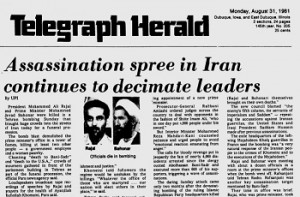
MEK was founded in 1963 by leftist Iranian students opposed to the monarchy of Shah Mohammad Reza Pahlavi and its supporters in the West, including the United States. Many of MEK’s leaders–including current chief Massoud Rajavi–were imprisoned by the Shah in the 1970s, and several were executed. MEK participated in the 1979 revolution that swept Ayatollah Khomeini into power and supported the takeover of the U.S. Embassy that year. However, MEK’s ideology–a blend of Marxism, feminism, and Islamism–put it at odds with the Ayatollah Khomeini government. The group soon began plotting against the Islamic new government, killing dozens of senior government officials, including the president and prime minister. The clerics retaliated with the arrest and execution of Mujahedeen. Eventually the group was driven into exile in Paris, where Rajavi set up the National Council of Resistance in Iran (NCRI), also known as MEK’s "parliament in exile."

In 1987, the Chirac government expelled Rajavi and much of the MEK as part of a French-Iranian deal (NYT) that freed French hostages held by pro-Iranian groups in Lebanon. The MEK was welcomed into Iraq, where it helped Saddam Hussein wage the eight-year Iran-Iraq War and battle Kurdish uprisings in the north. According to the U.S. State Department, Baghdad armed MEK near the end of the Iran conflict (1980-88) "with heavy military equipment and deployed thousands of MEK fighters in suicidal, mass wave attacks against Iranian forces." Iran’s Revolutionary Guard killed some two thousand MEK in this failed assault, known as "Operation Eternal Light."

MEK’s campaign against the Islamic Republic, including the assassination of high-ranking officials, continued throughout the 1990s and early 2000s. Following the 2003 invasion of Iraq, U.S. forces disarmed the group of heavy weaponry and sequestered it in Camp Ashraf, a 14-square-mile former Iraqi military base in the country’s northeast.

Leadership & Ideology
MEK is led jointly by husband-and-wife team Massoud and Maryam Rajavi, and represents the largest militant Iranian opposition group committed to the overthrow of the Islamic Republic. It is also "the only army in the world with a commander corps composed mostly of women," says former CFR press fellow Elizabeth Rubin. Maryam Rajavi joined the resistance as a student in Tehran in the early 1970s and, at the behest of her husband, assumed joint control of the group in 1985. Feminism and allegiance to the Rajavi family are pillars of MEK ideology, which was founded on both Islam and Marxism–though the group has denied its affiliation with the latter, Rubin says. Some analysts have characterized MEK as a cult (BBC), citing the group’s ardent fealty to the Rajavis and the observance of bizarre practices such as "eternal divorce" and celibacy. Older women were required to divorce their husbands in the late 1980s, and younger girls cannot marry or have children.

Maryam Rajavi was chosen as president-elect of the NCRI in 1993 and, according to the group’s website, expects to oversee a six-month democratic transition in Iran "once the mullahs are toppled." Based out of Paris, she also serves as the group’s chief ambassador to the international community. NCRI’s political platform includes support for human rights, women, capitalism, religious freedom, minority rights, and Iran’s integration into the global community. Massoud Rajavi disappeared following the invasion of Iraq in 2003; his whereabouts and current status are unknown. "Cult leaders generally don’t retire," says Karim Sadjadpour, an Iran expert at the Carnegie Endowment for International Peace. "They either die or go to prison. I’d be surprised if Massoud Rajavi is still alive," he says.

Size & Support Structure
The U.S. State Department puts MEK global membership between 5,000 and 10,000, with significant contingents in Paris and other European capitals where the group maintains offices, according to an August 2011 report. Approximately 3,400 MEK members reside in Iraq. As of July 2012, two-thirds of them have relocated from Camp Ashraf to Camp Liberty (AFP), a former U.S. military base outside Baghdad.

An MEK front group kept a branch in Washington, DC, until the U.S. Justice Department closed it in 2003. Nonetheless, the group continues to operate a sophisticated network of advocates in the United States (USNews), enlisting the support of dozens of high-profile advocates, including former U.S. officials such as former New York City mayor Rudolph Giuliani and former governors Edward Rendell and Howard Dean. The advocacy is centered on the campaign to delist MEK as a U.S.-designated terrorist organization.

Until 2003, the MEK received funds, arms, and state sponsorship from Saddam Hussein. Since the Iraq invasion, MEK has relied on donations from Iranian expatriates and front organizations that often campaign for greater human rights in Iran, according to the State Department.

Exodus from Ashraf
As part of the 2003 invasion, U.S. forces initially attacked MEK military targets in Iraq despite the group’s claims of neutrality. The sides eventually negotiated a cease-fire that disarmed MEK members and confined them to Camp Ashraf. In 2004, Washington granted the group "protected persons" status under the Geneva Convention. That designation expired after Iraq regained full sovereignty in January 2009.

MEK had long feared that a transition to Iraqi control of Ashraf (PDF) would result in their eviction, according to the Congressional Research Service. As U.S. forces pulled out of Ashraf in April 2011, violence broke out between the Iraqi military and camp residents. Thirty-five MEK were killed, according to the UN. After the incident, Iraq reiterated its vow to close Ashraf following full U.S. withdrawal at the end of 2011. Iraq and the UN reached an agreement with MEK in December 2011 that would relocate Ashraf residents to Camp Liberty outside Baghdad, a "temporary transit station" from which group members could eventually be taken in by other countries. As of July 2012, the State Department reports that this transfer has stalled since the last relocation convoy left Ashraf in March.

The UN High Commission on Refugees is determining MEK members’ eligibility for refugee status, which would eventually set the stage for their resettlement outside Iraq. UN special representative for Iraq Martin Kobler has called on foreign governments to open their doors, but negotiations are still under way.

FTO Status
MEK was added to the U.S. State Department’s list of Foreign Terrorist Organizations in October 1997. Washington holds the group responsible for the deaths of several U.S. servicemen and civilians in Iran during the mid-1970s, as well as its alleged participation in the seizure of the U.S. Embassy during the 1979 revolution. Other terrorist activities cited by the State Department include MEK’s decades-worth of terror attacks on the Iranian regime, and the groups’ cooperation with Saddam Hussein in his crackdown on Iraqi Shia and Kurds in the early 1990s.

MEK has been trying to be removed from the FTO list for several years, officially renouncing terrorism in 2001. The group argues that its FTO status prevents it from legitimately participating in the Iranian opposition movement and points to the European Union and the UK’s decisions in the last five years to delist MEK as a terrorist group. In February 2012, Secretary of State Hillary Clinton said MEK’s compliance with the relocation to Camp Liberty would be a "key factor" in the decision whether to remove the FTO designation.
The Debate over Delisting
The debate over MEK’s FTO status has attracted both critics and supporters. In the National Interest, national security expert Raymond Tanter argues that "nothing is likely to be more decisive in reducing the strategic threat from Tehran than having a vigorous democratic opposition in Iran." The MEK, which he says should be a valuable component of this opposition, was designated an FTO by the Clinton administration as part of an effort to open dialogue with moderates in Tehran. Tanter writes that MEK should be delisted based on a lack of evidence of its terrorist activities since 2001.

Trita Parsi, an MEK critic and leader of the National Iranian American Council, says efforts by MEK and its supporters to frame the group as a legitimate Iranian opposition group are suspect. Their PR campaign is analogous to the now-discredited claims made by Ahmed Chalabi and the Iraqi National Congress (NYT) in the push for a U.S. overthrow of Saddam, Parsi says.

Others say that delisting MEK will unnecessarily damage U.S. relations with Tehran and harm Iran’s domestic democratic resistance, a movement that allegedly opposes MEK. Muhammad Sahimi of PBS’s Tehran Bureau told al-Jazeera: "Anyone who opposes the [Iranian government] and cares about Iran and democratic principles cannot do anything other than vehemently oppose the MEK." There is "no comparison with the non-violent Greens and the MEK," he said. Carnegie’s Sadjadpour concurs, noting MEK "is widely viewed as a backward and intolerant cult by their opposition peers in Iran."

Notably, the delisting debate seems to be hindering the relocation of MEK to Camp Liberty. Some U.S. backers of MEK have severely criticized the conditions at the new site. Former New York governor Rudolph Giuliani characterized the location as a "concentration camp" at an MEK-sponsored conference. The State Department condemns such attacks. Speaking to Foreign Policy, a U.S. official said "as delicate negotiations between the UN, the United States, the Iraqis, and the MEK continue, the role of these often paid advocates [on behalf of MEK] is becoming even more unhelpful and potentially dangerous."

Author: Jonathan Masters, cfr.org

July 21, 2012 0 comments
FacebookTwitterPinterestWhatsappTelegramSkypeEmail
The MEK Expulsion from Iraq

Iraq’s patience WEARING THIN with Iranian exiles, UN says

The Iraqi government’s patience is "wearing thin" with exiled opponents of Iran who are refusing to leave their camp north of Baghdad, a UN envoy warned Thursday.
Iraq's patience WEARING THIN with Iranian exiles, UN says
About 1,200 members of the People’s Mujahedeen of Iran have stayed at Camp Ashraf despite a UN-brokered accord with the government to leave as a first step toward finding homes in other countries, Martin Kobler, the UN Special Representative for Iraq, told the UN Security Council.

There have in the past been deadly clashes at the camp, which was given to the Mujahedeen as a base in the 1980s by late dictator Saddam Hussein.

"Time is running out to find a sustainable solution. The government’s patience is wearing thin," said Kobler, who heads the UN mission in Iraq (UNAMI).

"Recent weeks have witnessed difficulties in maintaining dialogue between UNAMI and the residents, and between the residents and the government of Iraq, reinforcing a perception that the residents lack a genuine will" to move, he added.

About 1,800 inhabitants have moved to a new camp nearer Baghdad and several deadlines to completely empty Camp Ashraf have passed.

Kobler, however, said almost no resettlement offers have been made and countries must now come forward to help. He also appealed to Iraq’s government to "avoid violence under any circumstances."

Iraq’s UN ambassador, Hamid al-Bayati, also called on European countries and other states to find a home for Camp Ashraf residents as part of "a final solution for this problem."

Earlier this month, the US government said the Iranian exiles must leave the camp if they were to be removed from Washington’s terror blacklist.

The People’s Mujahedeen was founded in the 1960s to oppose the Shah of Iran, but took up arms against the country’s new clerical rulers after the Islamic revolution of 1979.

The group, which has been on the US terror blacklist since 1997, says it has renounced violence and has asked Washington to remove it from its list of terrorist organizations.

July 21, 2012 0 comments
FacebookTwitterPinterestWhatsappTelegramSkypeEmail
Newer Posts
Older Posts

Recent Posts

  • A Criterion for Proving the Violent Nature of the MEK

    December 31, 2025
  • Rebranding, too Difficult for the MEK

    December 27, 2025
  • The black box of the torture camps of the MEK

    December 24, 2025
  • Pregnancy was taboo in the MEK

    December 22, 2025
  • MEPs who lack awareness about the MEK’s nature

    December 20, 2025
  • Facebook
  • Twitter
  • Instagram
  • Youtube

© 2003 - 2025 NEJAT Society . All Rights Reserved. NejatNGO.org


Back To Top
Nejat Society
  • Home
  • Articles
  • Media
    • Cartoons
    • NewsPics
    • Photo Gallery
    • Videos
  • Publications
    • Books
    • Nejat NewsLetter
    • Pars Brief
  • About Us
  • Contact us
  • Editions
    • عربي
    • فارسی
    • Shqip