Nejat Society
  • Home
  • Articles
  • Media
    • Cartoons
    • NewsPics
    • Photo Gallery
    • Videos
  • Publications
    • Books
    • Nejat NewsLetter
    • Pars Brief
  • About Us
  • Contact us
  • Editions
    • عربي
    • فارسی
    • Shqip
Nejat Society
Nejat Society
  • Home
  • Articles
  • Media
    • Cartoons
    • NewsPics
    • Photo Gallery
    • Videos
  • Publications
    • Books
    • Nejat NewsLetter
    • Pars Brief
  • About Us
  • Contact us
  • Editions
    • عربي
    • فارسی
    • Shqip
© 2003 - 2024 NEJAT Society. nejatngo.org
Mujahedin Khalq; A proxy force

Lobbying for MKO terror group by US officials under investigation

A major lobbying campaign by prominent US politicians and former top officials to promote the globally recognized Iranian terror group Mujahedin-e Khalq Organization (MKO) has raised legal questions. Lobbying for MKO terror group by US officials under investigation

A major lobbying campaign by prominent US lawmakers and former top officials in support of the anti-Iran terrorist group, Mujahedin-e Khalq Organization (MKO), has raised legal questions on the legitimacy of such top-level advocacy.

American advocates of the terrorist group, notorious for terror bombings and assassinations of scores of Iranian officials and civilians as well as siding with executed Iraqi dictator Saddam Hussein in his war against Iran in the 1980’s, have met with senior officials of President Barack Obama’s administration to push for MKO’s removal from the State Department’s terrorist list and special treatment of its members at a military camp in Iraq, The Washington Post reported Friday.

According to the report, public appearances on behalf of the MKO by such high-profile American politicians as former national security adviser to Obama administration, James Jones, former New York mayor and Republican presidential candidate Rudolph Giuliani, and ex-governor of Pennsylvania Edward Rendell had already triggered a Treasury Department probe into whether the tens of thousands of dollars received as payments for such publicity efforts violated US anti-terrorism laws.

New questions have been raised in recent weeks on whether the private meetings, conference calls and other communication with administration officials over the past year would require the MKO supporters to register as lobbyists or agents of a foreign entity.

Despite arguments by MKO advocates that they are ‘legitimately’ acting to facilitate US policy decisions, experts on lobbying regulations insist that contact with administration officials “easily meet the definition of lobbying under the Foreign Agent Registration Act, a law that has sometimes led to criminal charges,” says The Post.

The new questions, the report adds, pose the latest challenge for the MKO, which has been listed by the US State Department as a terrorist organization since 1997 and was linked to the deaths of six Americans in the 1970’s.

This is while, the anti-Iran MKO terror group and its umbrella organization, the National Council of Resistance, have been engaged in high-priced campaigning in the US for years to get off the terrorist list, including the purchasing of advertisements in The Washington Post and other major mainstream publications (at an average cost of over $50,000 per day).

A US federal appeals court, meanwhile, has given Secretary of State Hillary Clinton until October to make a decision on whether to remove the MKO from its list of international terror groups.

The Post report further reveals that the anti-Iran terror group has enlisted “some of the biggest names in US politics and national security,” including former homeland security secretary Tom Ridge, former Joint Chiefs chairman Hugh Shelton, former FBI director Louis Freeh, former UN envoys John Bolton and Bill Richardson, former US attorney general Michael Mukasey, former speaker of US House of Representatives and recent Republican presidential contender Newt Gingrich, as well as Mitchell Reiss, a former State Department official who has been one of the top foreign policy advisers to the current Republican presidential candidate Mitt Romney since 2008.

Rendell, Giuliani, Mukasey as well as Gingrich were among 16 high-profile US officials that flew to Paris last month for a pro-MKO event. In a video published by the terrorist group, Gingrich is seen bowing to MKO’s co-leader Maryam Rajavi. Afterward, according to the report, “Gingrich appealed for ‘decisive action’ by the United States on the group’s behalf.”

Furthermore, in a speech on behalf of the terrorist organization in late May, former homeland security secretary during the late George Bush administration Tom Ridge called for “regime change” in Iran, claiming, “The heart of this effort, we all believe, is to recognize democratic opposition – it is the [MKO].”

The Post report, however, goes on to quote an Iran expert as saying, “It is outright false to claim that they (MKO) are a legitimate, democracy-minded opposition group with a wide base inside Iran.”

Prominent MKO surrogates in the US have acknowledged accepting “travel expenses” from unspecific “MKO-allied groups” as well as payments of $10,000 to $40,000 for each speaking engagement. Rendell, meanwhile, has acknowledged accepting over $150,000 in expenses from “supporters” of the MKO. He also admits that before engaging in public speaking on their behalf, “he knew very little” about the terrorist group.

The US daily further reports that Treasury Department officials have interviewed several of MKO’s supporters to determine whether they violated US law by providing support to an organization on the US terrorist list. While refusing to specifically comment on the case, Treasury spokesman John Sullivan described MKO as a “designated terrorist group,” adding, “Therefore, US persons are generally prohibited from engaging in transactions with or providing services to this group.”

Other US officials familiar with the terrorist organization say, however, that the probe into paid lobbying for the MKO “remains on hold while awaiting a formal decision on its terrorist status.” Clinton, meanwhile, told US Congress in May that the State Department would favor removing MKO from its terrorist list if it complies with UN efforts to relocate its members in Iraq to a new temporary location.

US officials, according to The Post, have expressed concerns about rising tensions and an ensuing violence between Iraqi authorities and MKO members if the terrorist group members refuse to vacate the Camp Ashraf military base by the July 20 deadline.

July 8, 2012 0 comments
FacebookTwitterPinterestWhatsappTelegramSkypeEmail
Mujahedin Khalq Organization as a terrorist group

The MEK Still Has Not Changed

Nicole Gibson notices that the columnist Clarence Page also spoke at the recent MEK gathering in Paris. Page’s defense is worth quoting again:

“I thought they were simply a group of Iranian exiles who were opposed to the regime in Tehran,” Page said. “I later found out they can be construed as a MEK front group, and I don’t think it’s worth it to my reputation to be perceived as a paid spokesman for any political cause.”

I love that “they can be construed as a MEK front group” line. That’s rather like saying that Sinn Fein could be “construed” as the IRA’s political wing, as if it were something up for debate or interpretation. It could be “construed” that way because that was the truth. Just look at the website of the organizing group. “Delist MEK” and “Camp Ashraf” are two tabs prominently displayed on the site. Who else would be so focused on these issues other than a front group for the MEK? How does someone agree to speak at an event sponsored by this group and not know that? Page deserves some credit for deciding to return the group’s money right away, but what was he doing at the event in the first place?

One of Page’s defenders isn’t helping him by highlighting what Page said in Paris. According to Achy Obejas, Page said the following:

* “Thanks for inviting me to speak up for values I believe we share: Freedom, democracy and respect for human rights for men and women across racial, ethnic and religious lines.
* “I believe we share a desire for regime change in Iran to a more fair and democratic society.
* “The historical record shows – and a variety of experts have told me – how the MEK has been America’s ally in our war against terrorists [bold mine-DL], but as former White House Chief of Staff Andrew Card has said, the State Department appears to have been left behind with outdated information. Now a federal court has said the State Department should check its relevance.
* “You have allies to whom you should reach out in common cause as long as you advocate the values all decent human beings share. As long as you work for freedom, equality, human rights and democracy, you are not working alone.”

It is obvious from these remarks that Page was badly misinformed. Whoever offered him the “expertise” he cites here did him a disservice. These views are “pretty mainstream” in the sense that a lot of prominent former officials and politicians have made similar claims. One small problem with these views is that they are based on misinformation.

The MEK has been trying to reinvent itself over the last decade by claiming that it has embraced all of the principles Page mentions, but the reality is that the group’s beliefs are antithetical to liberal and democratic principles. The MEK’s reinvention as a “democratic” opposition group is a classic example of a revolutionary organization adopting the rhetoric of its would-be Western patron. Suffice it to say that a group that relied on the patronage and protection of Saddam Hussein for over two decades is not one interested in creating a “fair and democratic society.” The MEK has not been an “ally” in a war against terrorists, and any “experts” that told Page this were not telling him the truth.

Ray Takeyh testified about the MEK’s ideology last year:

As the organization has lost its Iraqi patron and finds itself without any reliable allies, it has somehow modulated its language and sought to moderate its anti-American tone. Such convenient posturing should not distract attention from its well-honed ideological animus to the United States.

Terror has always been a hallmark of MEK’s strategy for assuming power. Through much of its past, the party exulted violence as a heroic expression of legitimate dissent. One of the central precepts of the party is that a highly-dedicated group of militants could spark a mass revolution by bravely confronting superior power of the state and assaulting its authority. Once, the masses observe that the state is vulnerable to violence, than they will shed their inhibitions and join the protest, thus sparking the larger revolution. Thus, the most suitable means of affecting political change is necessarily violence. Although in its advocacy in Western capitals, the MEK emphasizes its commitment to democracy and free expression, in neither deed nor word has it forsworn it violent pedigree.

P.S. The point here isn’t that Page’s remarks are unusual, but rather that they are unfortunately entirely too “mainstream” nowadays. This episode reflects how extensive the pro-MEK lobbying effort has become, and it underscores the need to show that the lobbying effort is based on falsehoods and misrepresentations.

By Daniel Larison

July 7, 2012 0 comments
FacebookTwitterPinterestWhatsappTelegramSkypeEmail
Mujahedin Khalq Organization as a terrorist group

MEK behind second violent incident in Europe in a month

Attacker of Iranian diplomat in Frankfurt linked to Mojahedin Khalq (MKO, MEK, Rajavi cult) terror group

Iran’s Deputy Foreign Minister Hassan Qashqavi told reporters that one of the Iranian consular members in Frankfurt had been attacked by an African woman on Monday while he was returning home from work.

While the German police appear to have not fully investigated the incident, Iran-Interlink has learned that the African woman in question had previously been paid to attend a rally held by the Mojahedin Khalq terrorist cult in Villepinte, France on June 23rd.

The MEK had paid and bussed in several hundred such African and other refugees from all over Europe to make up an audience for its paid speakers, who mostly came from America.

This is the second violent incident in the past month involving the MEK. Nader Naderi, a former MEK member, was attacked and beaten up by Mojahedin Khalq cult members in Paris, during an authorised march to protest human rights violations by the MEK cult leaders Massoud and Maryam Rajavi.

Mr Naderi suffered a broken rib and other injuries and was taken to hospital by a shocked English tourist who had filmed the event as evidence for the police.

—————————
Iran summons German envoy over police misconduct

Press TV reported on July 05 2012

The Iranian Foreign Ministry has summoned the German ambassador to Tehran Bernd Erbel to strongly protest against the police confrontation with an Iranian diplomat in Frankfurt.

Iran’s Deputy Foreign Minister Hassan Qashqavi said that one of the Iranian consular members in Frankfurt was attacked by an African woman on Monday while he was returning home from work, IRNA reported on Wednesday.

“Instead of confronting the assailant individual, the German police unfortunately displayed a violent behavior toward our country’s diplomat…” he said.

“Following the occurrence, the German ambassador to Tehran was summoned to the Foreign Ministry and he received the strong protest of the government of the Islamic Republic of Iran against the German police behavior toward the diplomat],” Qashqavi added.

The Iranian government has also demanded German officials to launch an immediate investigation and explain the police misbehavior.

The Embassy of the Islamic Republic of Iran in Berlin and its consulate in Frankfurt have also sent letters to German officials, made contacts and held talks with them to voice Tehran’s protest in this regard.

The Iranian Foreign Ministry further condemned the move as part of an anti-Iran plot, aimed to undermine Tehran diplomatic image.

July 7, 2012 0 comments
FacebookTwitterPinterestWhatsappTelegramSkypeEmail
MEK Camp Ashraf

U.S. steps up warnings on Camp Ashraf

The United States warned an Iranian dissident group on Friday that time was running out for it to vacate its Iraqi base camp, and said its hope to be taken off the official U.S. blacklist of terrorist steps up warnings on Camp Ashraf in Iraqorganizations could depend on its compliance.

Daniel Benjamin, the State Department’s coordinator for counter-terrorism, said the Mujahadin-e Khalq (MEK) must complete its move from the Camp Ashraf facility, which the Iraqi government has vowed to close by July 20.

"It is past time for the MEK to recognize that Ashraf is not going to remain an MEK base in Iraq," Benjamin told reporters, saying Baghdad’s patience was running out.

"The Iraqi government is committed to closing it, and any plan to wait out the government in the hope that something will change is irresponsible and dangerous."

The dissident group, which calls for the overthrow of Iran’s clerical leaders, is no longer welcome in Iraq under the Shi’ite-led government that came to power after Saddam Hussein’s downfall in 2003.

Also known as the People’s Mujahideen Organization of Iran, the group led a guerrilla campaign against the U.S.-backed Shah of Iran during the 1970s that also included attacks on U.S. targets.

The United States added the MEK to its official list of foreign terrorist organizations in 1997, but the group has since said that it has renounced violence and has mounted a legal and public relations campaign to have its terrorist designation dropped.

COURT DEADLINE

Last month, a U.S. appeals court asked U.S. Secretary of State Hillary Clinton to make her determination on the MEK’s status by October, a ruling hailed as a victory by MEK supporters.

But U.S. officials have stressed that Clinton – who has herself said that the disposition of Camp Ashraf will be key to her eventual decision – may still find against the group.

"MEK leaders appear to believe that the secretary has no choice now but to delist them. That conclusion is quite plainly wrong," Benjamin said.

"The MEK’s relocation will assist the secretary in determining whether the organization remains invested in its violent past or is committed to leaving that past behind."

Despite repeated U.S. appeals to close the camp and the successful relocation of some 2,000 MEK members to a new holding facility near Baghdad, the group continues to have 1,200-1,300 members at Camp Ashraf and has taken no steps to relocate them since May 5.

The MEK has complained of mistreatment and poor conditions at the new facility, a large former U.S. military base, and U.S. officials say they have urged the Iraqi government to take steps to address some of the group’s concerns.

Daniel Fried, Clinton’s special advisor on Ashraf, said that while the Iraqi government had shown flexibility on earlier deadlines for Camp Ashraf, there was no indication it would do so again unless there were signs of significant movement from the camp by July 20.

"That date should put everyone on notice, and the MEK on notice, that it needs to proceed with the next convoy of people out of Camp Ashraf," Fried said.

Reporting By Andrew Quinn; Editing by Paul Simao

July 7, 2012 0 comments
FacebookTwitterPinterestWhatsappTelegramSkypeEmail
MEK Camp Ashraf

The MEK Designation and the Current Situation at Camp Ashraf

Coordinator for Counterterrorism Ambassador Daniel Benjamin and Special Advisor to the Secretary on Camp Ashraf Ambassador Daniel Fried on the Mujahedin-e Khalq (MEK) Designation and the Current Situation at Camp Ashraf

Special BriefingThe MEK Designation and the Current Situation at Camp Ashraf
Office of the Spokesperson
Via Teleconference

July 6, 2012
——————————————————————————–

MR. VENTRELL: Hey. Good afternoon, everybody, and thanks for joining us. Today, we’ve got an on-the-record conference call with Ambassador Daniel Benjamin, Coordinator for Counterterrorism, and Ambassador Daniel Fried, our Special Advisor on Camp Ashraf.

And so we’re going to go ahead and start this on-the-record call. I believe Ambassador Benjamin will make some remarks at the top, and then we’ll turn it over to both of our speakers for questions. So let’s go ahead and start.

Ambassador Benjamin.

AMBASSADOR BENJAMIN: Yes. Thank you very much. I wanted to talk today a bit about the situation in Iraq, where there is an impasse between the Iraqi Government and the Mujahedin-e Khalq, the MEK, over the relocation of residents from the group’s paramilitary Camp Ashraf to the temporary transit facility at Camp Hurriya. The Iraqi Government and the United Nations continue to encourage the secure, humane relocation of residents to Hurriya for refugee status determinations by the United Nations High Commission on Refugees. Almost 2,000 individuals have already relocated, but the remaining 1,200 to 1,300 are holding at Ashraf until various MEK demands are met by the Iraqi Government. The last convoy of individuals, about 400 people, was on May 5th. And the patience of the Iraqi Government is wearing thin.

The MEK seems to have misinterpreted the June 1 order by the U.S. Court of Appeals for the D.C. Circuit. MEK leaders appear to believe that the Secretary has no choice now but to delist them. That conclusion is quite plainly wrong. In short, the court did not order the Secretary of State to revoke the MEK designation as a Foreign Terrorist Organization. As the Secretary has made clear, the MEK’s cooperation in the successful and peaceful closure of Camp Ashraf will be a key factor in her decision regarding the MEK’s FTO status. The court has told the State Department that it must act by October 1, but it did not mandate a particular result. I think that’s very important to underscore. The Secretary thus retains the discretion to either maintain or revoke the designation in accordance with the law. It is past time for the MEK to recognize that Ashraf is not going to remain an MEK base in Iraq. The Iraqi Government is committed to closing it, and any plan to wait out the government in the hope that something will change is irresponsible and dangerous.

The MEK is a group whose violent history against the United States includes the bombing of U.S. companies in Iran, the assassination of seven U.S. citizens, and the provision of support for the attack, occupation, and hostage-taking at the U.S. Embassy in Tehran. The MEK is also one of the few foreign groups to attempt an attack on U.S. soil when, in 1992, it launched near simultaneous attacks in 13 countries, including against the Iranian mission to the UN in New York. Even the MEK itself has admitted to continuing violent attacks until 2001.

With such a history, cooperating fully with the UN’s efforts in Iraq would be a tangible demonstration that the MEK has left its violent past behind and that it no longer retains the capability and intent to engage in acts of terrorism. This is the MEK’s moment to show that it has taken on a fundamentally different character. It should act quickly and complete the relocation and close Camp Ashraf.

And with that, I’ll be happy to take your questions.

MR. VENTRELL: Operator, if we can go ahead and get the first question.

OPERATOR: Thank you. Once again, if you would like to ask a question, please press *1 on your touchtone telephone. You will be prompted to record your name in order to be introduced. Once again, press * and 1. One moment.

Our first question comes from Bahman Kalbasi from BBC Persian. Your line is open.

QUESTION: Thank you. I have two questions for the ambassadors. You talked about tangible change in their behavior. If the criteria for removing them from the FTO is to not have the capability and the intent, how does changing the location from Ashraf, as the Secretary has indicated, gets them closer to that removal? U.S. Government has said to NBC, for instance, that as late as February, that they were involved with the assassination of scientists in Iran.

And my second question really is that if you end up removing them, mindful of the unprecedented lobbying that is going on, are you worried that this will politicize the FTO? It will show that at the end of the day, politics trumps everything else?

AMBASSADOR BENJAMIN: Let me take the second question first. The – any decision, one way or the other will be taken entirely on the merits, and we’re committed to doing it that way and no other way. And that’s our requirement under the law.

On the other point, I can assure you that I have never said that they were involved in current assassinations in Iran. That was a story that ran, and I have no information to confirm that, so I certainly wouldn’t have said it. What I have given you is the established record, and nothing more and nothing less.

QUESTION: But how does it – removing them from Ashraf change the issue of intent?

AMBASSADOR BENJAMIN: Right. Well, the history and the use of Ashraf is that of an MEK paramilitary base. It’s where the MEK had its heavy weaponry and from which it carried out a number of military operations during the reign of Saddam Hussein. The MEK’s relocation will assist the Secretary in determining whether the organization remains invested in its violent past or is committed to leaving that past behind. And that really is going to be a very important illustration – or demonstration, I should say – of what the MEK’s orientation in the future will be.

So I do want to say that it is an absolutely essential move and we hope that they will get – move forward with it.

MR. VENTRELL: Operator, can we get the next question?

OPERATOR: Our next question will come from Robert Burns – your line is open – from the Associated Press.

QUESTION: Yes, thank you. Regarding your encouragement for them to complete the relocation, if they don’t complete the move by October, is it the case that they won’t be de-listed?

AMBASSADOR BENJAMIN: I’m not going to prejudge the Secretary’s action on this, but she has made it extremely clear how important this step is. And she is sticking by that and this is the message everyone involved needs to understand.

OPERATOR: Our next question will come from Mehrnoush Pourziaiee from BBC. Your line is open.

QUESTION: My question is regarding the dates that Iraqi Government has given, which is 20th of July for the closure of Camp Ashraf. And has there been any communication with U.S. Ambassador in Iraq and Iraqi Government on the Iraqi side plans in case the relocation is not complete by that time?

AMBASSADOR FRIED: This is Daniel Fried speaking. Our charge in Baghdad, Steve Beecroft, has been in contact with the Iraqi Government at senior levels on more than one occasion recently about the situation with respect to Camp Ashraf. Specific to your question, you are right that July 20th is a date set by the Iraqi Government by which they want Camp Ashraf to be emptied.

Now, in the past, the Iraqi Government has extended deadlines when there has been significant progress in moving people out of Camp Ashraf, and it is our hope – though only a hope – that if there is significant progress in the next two weeks, that deadline could be extended. However, that puts – that date should put everyone on notice and the MEK on notice that it needs to proceed with the next convoy of people out of Camp Ashraf. There have been five convoys. All have been successful; that is, they went from Camp Ashraf to Camp Hurriya peacefully, without roadside bombs or attacks. And this process needs to resume.

QUESTION: And in the previous briefing, the officials of State Department mentioned that there has been no communication from MEK with UN officials or Iraqi Government, and they have stopped all the communication. Have you tried different channels to get this message to them, or what are you doing to make sure that they get the seriousness of this issue?

AMBASSADOR FRIED: Well, I’m happy to tell you that after a lot of work, communications have resumed. It took a frustratingly long period of time to arrange it. But Ambassador Kobler, the head of the UN Mission in Iraq, is back in contact with the MEK, has allowed this contact to resume. So these messages have been sent.

It is – we are all – that is, the U.S. Embassy – we at the State Department and the UN are all working hard to address as many legitimate concerns of the residents of Camp Hurriya and Camp Ashraf as we can in order that conditions be met for convoys to resume. And we do think that the Government of Iraq could and should do more to address these legitimate humanitarian concerns and show generosity to the residents. And there has been some progress in that regard. We hope that this progress – in fact, it’s imperative this progress be made swiftly and that the convoys of residents resume.

QUESTION: And Ambassador Fried, I have a question regarding Camp Ashraf itself. We have various accounts of people who have been a member of MEK before talking about the horrible situation in the organization and relations which is in Camp Ashraf and the relation between the members and how the human conditions of the Camp and the situation they live in because of the setup from the MEK. Can you elaborate on living condition in Camp Ashraf a little and tell us if all these stories are true or there’s no truth into them?

AMBASSADOR FRIED: Well, I am familiar, as you are, with all sorts of stories about life in Camp Ashraf. I can’t confirm or deny any of them. We just don’t know, but I’m familiar with them. Our purpose is humanitarian, however. Our purpose is neither to advance the interests of the organization – hardly – nor is it to fight the organization. Our interest is in saving the lives of the people that are there as individuals and helping them find – helping them get out of Ashraf safely to Camp Hurriya, and then out of Camp Hurriya to a life outside of Iraq. That is our purpose; it is humanitarian.

QUESTION: And The Washington Post report yesterday about the meeting between MEK advocates with senior Administration officials, can anyone elaborate on this and tell us if this is true and where and with whom the meetings has taken place and what is the nature of them?

AMBASSADOR FRIED: Well, I can certainly confirm that we have responded to inquiries and communicated with all kinds of private parties, including former U.S. Government officials, members of the European parliaments, and other advocates. We have made clear in all of these communications that the only viable option to resolving the issue of Camp Ashraf is a peaceful solution. We have offered our perspective on what is necessary for that to be achieved, and we offer that perspective knowing full well that these persons had a preexisting dialogue with the MEK, and we believe that they have conveyed our views to their MEK interlocutors. Now, they’re not representing the U.S. Government as they do so, but we believe they have passed these messages back. So I’m certainly not going to deny the fact of these contacts. I’m not going to get into the details either.

OPERATOR: Our next question will come from Jill Dougherty from CNN. Your line is open.

QUESTION: Thank you very much. I just wanted to find out, legally, what can the Iraqi Government do if that date of July 20th comes? Can they physically remove the people? What legally are they entitled to do?

AMBASSADOR FRIED: Well – this is Dan Fried. I’m not a lawyer at all, much less an expert on Iraqi law. As I understand it, the Iraqi Government views them as in Iraq illegally. That’s their official position. They do not regard the invitation extended by Saddam Hussein to the MEK as valid, especially given the history of the MEK in Iraq. That said, the Iraqi Government has confirmed repeatedly and publicly that it also seeks a peaceful, humane solution to this problem. They have confirmed that bilaterally to us. We welcome this confirmation, and we intend to work with the Iraqi Government so that only a peaceful solution is followed.

QUESTION: So then I’m presuming that that is the – if you are giving any advice to the government or advising them in any way, that that is what you’re saying, it has to be peaceful?

AMBASSADOR FRIED: Absolutely right. That has been our message front and center. We have worked with the Iraqi Government. Given Iraqi conditions, I’m more impressed by the progress that has been made than concerned by the problems that remain. This is Iraq. Things often do not go well in Iraq. Given that spectrum, we’re doing all right so far, but the situation remains precarious, and it is up to everyone to work to see that Camp Ashraf is emptied soon and peacefully.

QUESTION: Thank you.

OPERATOR: Our question will come from Jonathan Broder, Congressional Quarterly. Your line is open.

QUESTION: Yes, I’d just like to ask: Why is this Administration so concerned about humanitarian issues involving a terrorist group?

AMBASSADOR BENJAMIN: We’re interested in humanitarian issues full-stop. And I think it’s important to underscore that many of the people in this camp are not likely to have participated directly in terrorist attacks, although we don’t know on a case-by-case basis. And in any case, we would seek to protect any such group that was essentially holed up in a camp if they were threatened with violence. So this is in keeping with our values.

I should also underscore that we also are interested in whether or not any particular group is involved in terrorist activities, whether it’s directly aimed at us or at others. This is – these are the lights we steer by. So I don’t see any problem with that.

I would like to go back to the issue that was asked before regarding lobbying, and I do just want to underscore that when it comes to the designation itself, we have not met with any lobbyists or others. There was, in fact, one gentleman who came into my office under false pretenses from a foreign country to lobby for the MEK, and he was promptly thrown out. But other than that, I’ve had no conversations on this issue. And again, to underscore, we’re just looking at the merits of the particular case.

MR. VENTRELL: Operator, we’ve got time for just one more question.

OPERATOR: Our next question will come from Christina Wilkie from Huffington Post. Your line is open.

QUESTION: Could you please give us a better sense of the types of demands that the MEK is making of the Iraqi Government and the stipulations the Iraqi Government is placing? Are they – are the MEK’s demands generally realistic? Is it your position that they’re actually intended – that they – that they’re realistic to get, or are they – do you think this is being set up so that there’s an inevitable conflict?

AMBASSADOR FRIED: That’s a very good question, and I’ve asked myself that as well. Some of the MEK demands are reasonable. For example, given the hot weather in Iraq, they’ve requested more air conditioners. The Iraqi Government has agreed to provide them, that is agreed to allow a special shipment of air conditioners from Camp Ashraf to Camp Liberty, and this is being arranged as we speak. Some of the other demands strike me as not central – for instance, private cars. Well, that’s not an issue critical to basic humanitarian needs.

You’ve asked a question about the MEK’s intentions. I can’t answer that with full knowledge. They, of course, say that all they want are their basic humanitarian needs to be met. But it has been frustrating to deal with constantly shifting demands, many demands. We find that U.S. Embassy and State Department and the UN will work to resolve problems and, a la whack-a-mole, you find that new ones – you’re constantly presented with new ones. But hopefully, the next couple of weeks – in fact, it’s critical that the next couple of weeks will be a period in which some of these issues are resolved, enough so the MEK will allow convoys to resume. That’s absolutely critical.

MR. VENTRELL: Okay. Thank you all for joining today’s call. Any other last remarks from either of the ambassadors?

AMBASSADOR BENJAMIN: Yes. Again – Daniel Benjamin here – I really just wanted to emphasize again one point that I made at the outset. The Secretary of State can – is within her rights in either listing – re-listing or de-listing. And that really is the bottom line here, and no one should be unclear about that in any way. And that’s really all I have to say.

MR. VENTRELL: All right. Thank you all. Have a good afternoon.

July 7, 2012 0 comments
FacebookTwitterPinterestWhatsappTelegramSkypeEmail
Mujahedin Khalq; A proxy force

High-priced advocacy raises questions for supporters of MEK

A well-financed lobbying campaign by prominent U.S. politicians and former officials on behalf of a designated terrorist organization is focusing new attention on the group and its influential advocates.

Supporters of the Iranian opposition group Mujaheddin-e Khalq, or MEK, have met with senior Obama administration ­officials to push for the organization’s removal from the State Department’s terrorist list and better treatment of its members at a camp in Iraq.

Public appearances on behalf of the MEK by such people as former New York mayor Rudolph W. Giuliani, former Pennsylvania governor Edward G. Rendell and former Obama national security adviser James L. Jones had already sparked an investigation by the Treasury Department into whether payments of tens of thousands of dollars to some of them violated anti-terrorism laws.

In recent weeks, new questions have been raised about whether private meetings, conference calls and other contact with officials at the State Department and elsewhere in the administration over the past year require the advocates’ registration as lobbyists or agents of a foreign entity.

Under federal law, advocates for foreign organizations are required to register as lobbyists and provide details about their clients and income. But the MEK supporters have not registered, which would require disclosing the amounts they are paid and the identities of officials with whom they meet.

The supporters argue that they are acting legitimately to facilitate U.S. policy decisions, which could make them exempt from registration requirements.

But scholars of lobbying regulations say the contacts with administration officials easily meet the definition of lobbying under the Foreign Agent Registration Act, a law that has sometimes led to criminal charges.

“The law applies to anyone engaged in political or lobbying activity — or even propaganda — on behalf of a foreign ‘principal,’ a term that is defined broadly,” said David Cole, a professor and expert on criminal and constitutional law at Georgetown University Law School. “It’s a very low bar.”

The new questions are the latest challenge for the MEK, which has been listed by the State Department as a terrorist organization since 1997 and was linked to the deaths of six Americans in the 1970s.

Trying to reshape image

The MEK has been campaigning for years to get off the terrorist list, including buying advertisements in The Washington Post and other publications. A federal appeals court has given Secretary of State Hillary Rodham Clinton until October to make a decision on whether to remove the group.

At the same time, the MEK and its advocates have been clashing with the Iraqi government over efforts to relocate 3,300 MEK members living in exile at a former Iraqi military base since the mid-1980s.

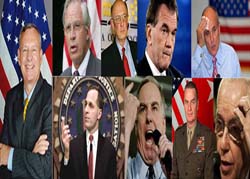
The MEK has enlisted some of the biggest names in U.S. politics and national security. In addition to Giuliani, Rendell and Jones, the group’s advocates have included former homeland security secretary Tom Ridge, former Vermont governor Howard Dean, former U.S. attorney general Michael Mukasey, former FBI director Louis Freeh, former Joint Chiefs chairman Hugh Shelton, former U.N. ambassadors John Bolton and Bill Richardson, and Mitchell Reiss, a former State Department official who has been among Republican president candidate Mitt Romney’s top foreign policy advisers since 2008.

Rendell, Giuliani and Mukasey were among 16 prominent former U.S. officials who flew to Paris for a pro-MEK rally last month. Also in Paris was Newt Gingrich, the former House speaker and Republican presidential candidate. In a video, Gingrich is seen bowing to the MEK’s co-founder. Afterward, Gingrich appealed for “decisive action” by the United States on the group’s behalf.

The MEK and its umbrella group, the National Council of Resistance of Iran, denied asking anyone to lobby for them

The dissidents “have not asked anyone in the United States to advocate for them, nor do they have any agents or lobbyists in that country,” said Shahin Gobadi, a spokesman. He said State Department officials had asked U.S. supporters to intervene to prevent a “humanitarian catastrophe” at the MEK’s Iraqi camp, and noted that more than 100 U.S. lawmakers have co-sponsored legislation to remove the MEK from the terrorist list.

Still, some of the MEK’s prominent surrogates have acknowledged accepting travel expenses from MEK-allied groups as well as speaking fees of $10,000 to $40,000 per engagement. Rendell has acknowledged accepting more than $150,000 in expenses from MEK supporters. Before he began speaking on their behalf, he says, he knew very little about the MEK.

The supporters, some of whom have acknowledged intervening on the MEK’s behalf with U.S. officials, say their motives are humanitarian. They say pro-Iranian elements in the Iraqi government have attacked the group’s followers since U.S. troops who had protected them left Iraq.

“A number of us are working with the State Department to facilitate the removal of the Iranian dissidents” from the MEK’s base in Iraq, Dean said in an e-mail response to a Post query. “Since this is an effort to facilitate U.S. government policy, it does not require any form of registration.”

None of the other participants responded to requests for comment.

Federal lobbying law defines a foreign “agent” as someone who acts “at the order, request, or under the direction or control, of a foreign principal, or of a person any of whose activities are directly or indirectly supervised, directed, controlled, financed, or subsidized in whole or in part by a foreign principal.” It covers activities that include acting as a publicity agency or political consultant or representing the interests of the foreign group “before any agency or official of the government of the United States.”

“The only defense would be if you can claim that you’re doing it on your own, unpaid,” said a retired senior U.S. official and expert on lobbying law, who spoke on the condition of anonymity to discuss hypothetical cases covered by the statute. “But if you’re getting money from the same group to make speeches, it’s pretty hard to make the case.”

Although the foreign agents act is often flouted in practice, “the fact that it’s a criminal statute shows how the government regards this kind of activity,” the former official said.

In addition to meeting with the MEK supporters, State Department officials have acknowledged that they have used them to relay messages directly to the MEK leadership to try to resolve what has become a dangerous standoff over the closing of Camp Ashraf, the former Iraqi army base northeast of Baghdad that has served as the group’s home in exile since 1986.

With the Iraq government vowing to close the camp by July 20, U.S. and U.N. officials are seeking to relocate its 3,300 residents to the grounds of what was once Camp Liberty, the former U.S. military base near Baghdad’s airport.

The controversy over lobbying is the latest wrinkle in an ongoing dispute over U.S. policy toward the MEK, whose name translates as “People’s Holy Warriors of Iran,” befitting its self-described status as the leading Iranian opposition group dedicated to overthrowing the country’s ruling mullahs.

Founded by Iranian students in the 1960s as a Marxist-Islamist movement, the group is accused of killing six Americans in terrorist attacks in the 1970s during its struggle to topple the U.S.-backed shah of Iran, Mohammad Reza Pahlavi. Some of its members participated in the takeover of the U.S. Embassy in Tehran in 1979 before the MEK broke with Iran’s new Islamic rulers and began attacking the regime with suicide bombings and assassinations. Many of the group’s leaders were captured, tried and executed.

MEK officials sought exile abroad, first in France and later in Iraq, where the group found common cause with Iraqi leader Saddam Hussein. The dictator provided the movement with a sanctuary — later dubbed Camp Ashraf — as well as weapons, tanks and other equipment. MEK troops fought against their countrymen during the eight-year Iran-Iraq war.

Connections to Iraq

MEK leaders officially renounced terrorism in 2001, but ties to the Iraqi dictator earned the group the hatred of Iranians and many Iraqis. In 2003, the U.S.-led invasion of Iraq left the group without its powerful sponsor and with few appealing prospects, unable to return to Iran and detested by the new Iraqi leadership. No other countries offered refuge to a group that, in addition to the terrorism stigma from the 1970s, had gained a reputation for cultlike behavior — MEK members at Camp Ashraf wear military clothing and adhere to a doctrine that requires mandatory divorce for married members as well as celibacy, enforced separation of the sexes and unquestioned allegiance to the MEK’s leadership.

“I see them as a cross between Hezbollah and the Branch Davidians,” said Karim Sadjadpour, an Iran expert with the Carnegie Endowment for International Peace. “It is legitimate to debate whether the MEK meets the Justice Department’s legal definition of a terrorist organization. But it is outright false to claim that they are a legitimate, democracy-minded opposition group with a wide base inside Iran.”

The group did possess two attributes that would eventually allow it to build a network of allies and friends. One was an extensive cash reserve, some of it donated by wealthy Iranians in the West, and the rest acquired from still-unknown sources, something MEK leaders decline to discuss. The other was a deep antipathy for the Iranian government, a view widely shared by many conservative Republicans as well as more hawkish Democrats.

The MEK’s appeal as a potential partner against Iran sharpened in 2002 when the group exposed the existence of a secret uranium-enrichment plant near the Iranian town of Natanz. Slowly, a small band of influential Americans began advocating direct U.S. support for the dissidents as a tool for undermining Iran’s government.

“What’s the answer? Regime change,” said Ridge, the former homeland security secretary, in a speech on behalf of the MEK in late May. “The heart of this effort, we all believe, is to recognize democratic opposition — it is the MEK.”

Rendell and other MEK supporters also have acknowledged that their advocacy has attracted the attention of federal prosecutors. Since the spring, Treasury Department officials have interviewed several of the group’s supporters to determine whether they violated U.S. law by providing support to an organization on the U.S. terrorist list. A Treasury spokesman, John Sullivan, said the department does not comment on “potential investigations.” Other U.S. officials familiar with the group said the inquiry remains essentially on hold while awaiting a formal decision on the MEK’s terrorist status.

“The MEK is a designated terrorist group,” Sullivan said. “Therefore, U.S. persons are generally prohibited from engaging in transactions with or providing services to this group.”

State Department view

Depending on events at Camp Ashraf, the MEK could soon lose its terrorist label. Clinton told Congress in May that the State Department would look favorably toward delisting the group if it complies with U.N. efforts to relocate its members in Iraq to new temporary quarters.

More than half the members have completed the move, but transfers of the remaining 1,200 have stalled amid complaints from the MEK about poor conditions and mistreatment by Iraqi officials. MEK leaders are balking at sending additional convoys to Camp Liberty, having apparently calculated that their Washington advocates can secure better terms for them.

In recent days, tensions between Iraqis and MEK officials have escalated, raising fears that the situation could turn violent if the exiles refuse to vacate Camp Ashraf by the July 20 deadline, U.S. officials say.

“The great tragedy is that people who say they want to help the MEK have instead emboldened their sense of entitled status, and that could get them into serious trouble,” said a senior State Department official involved in MEK policy discussions. The official spoke on the condition of anonymity because he was not authorized to publicly discuss the matter.

“If the supporters want to save lives, they could do the MEK a great service by getting them to focus on real issues and not stage extravagant provocations,” the official said.

Joby Warrick and Julie Tate,

July 7, 2012 0 comments
FacebookTwitterPinterestWhatsappTelegramSkypeEmail
USA

“Plainly wrong” to conclude US must remove MEK from terror list

American diplomats firmly pushed back Friday on reports suggesting that the U.S. must remove a controversial Iranian anti-regime group, the Mujaheddin-e-Khalq (MEK), from a U.S. list of US diplomats: “Plainly wrong” to conclude US must remove MEK from terror listdesignated terrorist organizations.

“MEK leaders appear to believe that the Secretary has no choice now but to delist them,” the State Department’s counter-terrorism coordinator Daniel Benjamin said in a call with reporters Friday. “That conclusion is quite plainly wrong.”

“In short, the court did not order the Secretary of State to revoke the MEK designation as a Foreign Terrorist Organization,” Benjamin continued. “The court has told the State Department that it must act by October 1, but it did not mandate a particular result. I think that’s very important to underscore. The Secretary thus retains the discretion to either maintain or revoke the designation in accordance with the law.

The State Department call was prompted by an impasse in efforts by the United States and United Nations to persuade members of the cultish group to leave their former paramilitary base in Iraq, Camp Ashraf.

To date, about 2,000 MEK members have been persuaded to leave Ashraf for the former U.S. Camp Liberty military base in Iraq, where they can be interviewed for possible relocation to third countries. But the last relocation convoy occurred in early May, and some 1,200-1,300 MEK members remain in Ashraf, and are apparently issuing new demands, emboldened by the perception the group’s terror designation may soon be revoked.

American officials have sought to encourage the relocation from Ashraf by indicating that cooperation in doing so will be a key factor in determining whether the group remains on the U.S. terror list. But a US court decision last month has interfered with that message.

In June, the US court of appeals ordered Secretary of State Hillary Clinton to issue a determination by October whether the MEK should be taken off the US terror list or its terror designation should be reissued.

Meantime, the Iraqi government is threatening to forcibly close the camp, and the United States is concerned about possible violence and a potential humanitarian disaster should relocation efforts continue to stall.

Despite the group’s terrorist designation, several prominent former senior American officials have taken large speaking fees to lobby for delisting the MEK. Among them, former FBI director Louis Freeh, former Pennsylvania governor Ed Rendell, former Vermont governor Howard Dean, former DHS chief Tom Ridge, former UN ambassador and top Mitt Romney foreign policy adviser John Bolton, former UN ambassador Bill Richardson, and former New York Mayor Rudi Giuliani. The Treasury Department issued subpoenas this past spring to determine who is paying for the massive lobbying effort on behalf of a designated terrorist group, and whether US criminal laws have been violated.

But American diplomats said Friday such lobbying will not impact the Secretary’s decision on the MEK’s designation.

“I do just want to underscore that when it comes to the designation itself, we have not met with any lobbyists or others,” Benjamin told reporters. “There was, in fact, one gentleman who came into my office under false pretenses from a foreign country to lobby for the MEK, and he was promptly thrown out.”

“Again, to underscore, we’re just looking at the merits of the particular case,” Benjamin added.

July 7, 2012 0 comments
FacebookTwitterPinterestWhatsappTelegramSkypeEmail
Mujahedin Khalq; A proxy force

Lobbying for terrorists: More on the MEK

Today’s Washington Post has another in a long series of deeply troubling press pieces about the terrorist group Mujahedin e Khalq (MEK) and those who have sold their principles for a few Lobbying for terrorists: More on the MEKthousand bucks to lobby for them. I wrote about the problem before, but count me even more gobsmacked by Joby Warrick’s fine WaPo piece. It’s one thing to take money for speeches from the MEK, something a bipartisan group of luminaries has done on repeated occasions; it’s completely another to join a series of calls and meetings with the State Department on the MEK — representing their interests — and pretend it’s anything other than what it is: Acting for a foreign agent.

Just a reminder for those out there who don’t know what the Foreign Agents Registration Act is: The law requires that anyone, regardless of compensation, register if they are acting at the behest of a foreign principal. Howard Dean, former presidential candidate, former head of the Democratic Party, former screamer, makes the stunning assertion to the Post that, “[s]ince this is an effort to facilitate U.S. government policy, it does not require any form of registration.” Um, Howard, um. The law doesn’t work that way. Or let’s put it another way: Since I don’t think things should be classified, I leaked millions of top secret documents to the public. Since I don’t think Obama should be president, I’m refusing to pay taxes. Since I think U.S. policy should support a terrorist group, I don’t need to register as a foreign agent when I work at their behest for cash. Oh yeah, that’s right.

Obama’s former National Security Adviser Jim Jones is among the MEK’s unregistered lobbyists, begging the question why he did nothing to liberate them from the onerous burden of a U.S. terrorist group designation when he was in office… Ditto former Attorney General Michael Mukasey. Answer? Because the MEK wasn’t paying them then.

This litany of whoring (is there any other word?) for foreign terrorists is appalling. And don’t soothe yourself with the notion that the MEK aren’t really terrorists or are about to be delisted by the State Department. Delisting is ridiculous, but also irrelevant. Foreign principals are foreign principals, and people who do their bidding are foreign agents. FARA is a criminal statute; let’s see what Justice does about enforcing it. For shame on these lobbyists for terrorists, each and every one.

Danielle Pletka ,aei-ideas.org

July 7, 2012 0 comments
FacebookTwitterPinterestWhatsappTelegramSkypeEmail
Mujahedin Khalq; A proxy force

Iranian Terrorist Group M.E.K. Pays Big to Make History Go Away

Come October 1, a federal appeals court decision will force the State Department to decide whether the exile-Iranian group Mujahadin-e Khalq, or M.E.K., belongs on the list of designated foreign terrorist organizations.

As recently as 2007, a State Department report warned that the M.E.K., retains "the capacity and will" to attack "Europe, the Middle East, the United States, Canada, and beyond."

The M.E.K., which calls for an overthrow of the Iranian government and is considered by many Iranians to be a cult, once fought for Saddam Hussein and in the 1970s was responsible for bombings, attempted plane hijackings, and political assassinations. It was listed as a foreign terrorist organization in 1997.Iranian Terrorist Group M.E.K. Pays Big to Make History Go Away

If the State Department does decide to delist M.E.K., whose name means "People’s Holy Warriors of Iran," it will be with the blessing of dozens of congressmen.

A congressional resolution that urges Secretary of State Hillary Clinton to remove M.E.K. from the State Department list of foreign terrorist groups was signed by 99 politicians, including Rep. Darrell Issa, a California Republican, Rep. Eleanor Holmes Norton, a Democrat from Washington, D.C., and Alabama Republican Sen. Spencer Bachus.

Those signatures may have been obtained with real money to grease the wheels. A U.S. News investigation found that three major lobbying firms were together paid hundreds of thousands of dollars by U.S.-based Iranian-American community groups with ties to the M.E.K. to drum up support for the resolution.

Victoria Toensing of DiGenova & Toensing, a lobbying shop famous for its involvement in the Bill Clinton-Monica Lewinsky scandal, was paid $110,000 in 2011 to lobby for the resolution. The firm Akin, Gump, Strauss, Hauer & Feld dedicated five lobbyists to getting signatures for the resolution, and was paid $100,000 in 2012 and $290,000 in 2011 to do so. Paul Marcone and Association similarly lobbied for the resolution, and received $5,000 in 2010 and $5,000 in 2011 for its efforts.

"It’s a worthy cause," said Toensing, who believes the M.E.K. has reformed from its violent past. "Have you ever seen a more bipartisan disciplined group as the one that supported this issue?"

(Akin, Gump, et al. declined to comment to U.S. News. Paul Marcone said despite its history, the M.E.K. "has every right to petition the government on resolutions.")
While dozens of congressmen have signed on to the delist resolution, those no longer holding office appear to be even more supportive of the group.

Last week, at a Paris rally for the M.E.K., Newt Gingrich was captured on camera bowing to the Iranian exile-group’s leader, Maryam Rajavi. (The M.E.K.’s political arm, the National Council of Resistance of Iran, has its headquarters in Paris).
Also in attendance were former Pennsylvania Gov. Ed Rendell, former New York City Mayor Rudy Giuliani, former State Department spokesman P.J. Crowley, and former Bush U.N. Ambassador John R. Bolton.

Video of the rally in Paris shows what appear to be tens of thousands of M.E.K. supporters waving flags and holding up pictures of Rajavi, who has called democracy "the spirit that guides our Resistance." Some assert the M.E.K. would prefer Iran to become a Marxist state, as it was founded by Marxist-Islamist Iranian students in the 1960s.

"The MEK are trying to portray themselves as a popular and democratic opposition to the current Iranian regime," said Karim Sadjadpour, an Iran analyst at the Carnegie Endowment for International Peace. "The reality is that they’re neither popular nor democratic."

A prominent Iranian journalist, who did not want to be named for fear of repercussions from the M.E.K., said that despite the group’s attempts to present itself as the main Iranian dissident group, the majority of the Iranian diaspora "does not want to get close" to it. A 2011 New York Times story said most Iranians and Iraqis see the M.E.K. as a "repressive cult."

The "cult" descriptor isn’t just popular opinion. A 2009 Rand study of the M.E.K. described the group as having "cultic practices" and "deceptive recruitment and public relations strategies."

Patrick Clawson, director of research at the Washington Institute for Near East Policy, which has been described as a pro-Israel group, describes the M.E.K. this way: "It’s a cult. There’s no other way to put it."

Clawson, who has spent time with M.E.K. members abroad and their supporters in the U.S., says politicians have been "misled" by "these charming individuals."

"They tell what seems at first glance to be a believable story," he said. "People in cults are charming sometimes. I mean, Scientologists convince movie stars."

There’s no doubt the M.E.K. knows how to charm. When reached by U.S. News & World Report, the spokesman for the National Council of Iran (the M.E.K.’s Paris-based political arm), Shahin Gobadi, spent an extraordinary amount of time answering questions, both over the phone and by E-mail.

"I have sent you a lot," he said, after an E-mail arrived containing 17 attachments. "But I am happy to send much more."

Gobadi repeatedly said that the M.E.K. was working for a democratic future for Iran, emphasizing freedom of speech, abolition of the death penalty, equality for women, and peaceful coexistence with the rest of the world.

"The designation of the M.E.K. as a foreign terrorist organization was … a goodwill gesture to the murderous regime in Iran as part of a policy of appeasing the mullahs," Gobadi said, skimming over the group’s violent past. "Various senior U.S. officials have acknowledged this reality."

Among these officials is former Democratic National Committee chairman Howard Dean, who once called for Rajavi to be recognized as Iran’s president.

As happened at the Paris rally last week, a number of politicians also deliver energetic speeches on behalf of the M.E.K.

Rendell, who has given at least eight supportive speeches, has made $150,000 for his efforts.

The Treasury Department is currently investigating Rendell along with several former senior government officials for giving M.E.K. speeches for money, as transactions with a terrorist group are against the law. Treasury spokesman John Sullivan said that the department "takes sanctions enforcements seriously," but would not give a timeline for when the investigation would be complete.
Rendell says his support for M.E.K. is humanitarian-based, as thousands of the group’s members currently live in exile in a refugee camp in Iraq.

The humanitarian situation is undoubtedly real—Camp Ashraf has been attacked several times since the U.S. transferred control back to the Iraqi government in 2009. In April of last year, Iraqi security forces reportedly stormed the camp and killed 31, wounding 320 more, though news reports vary widely. The M.E.K.’s various websites are heavily Camp Ashraf-focused.

"Ithink our reneging on protecting Camp Ashraf is nothing short of disgraceful," Rendell said, calling it.

Ask any politician who has supported the M.E.K., though, and they are unlikely to be able to tell you very much about the group or its history.

Both Rendell and Giuliani, who has spoken at M.E.K. events in Paris, Geneva, and New York, and who was in Paris twice last week to advise the group, said they knew little about the group before their paid speaking gigs began.

Giuliani said he first learned about the group from former FBI head Louis Freeh, who told him the M.E.K. were a group of revolutionaries, not terrorists. Then, Giuliani said, he "did research." "And every time I go to one of these meetings, I am more convinced," he said.

Former State Department spokesman Crowley, who has been paid to speak at at least four M.E.K. events, acknowledged that the exile group has in the past "on more than occasion been on the wrong side of history." But Crowley said he became increasingly "intrigued" with the group during his time at the State Department, whose location on C Street the M.E.K. regularly visits. He said he believes "their pursuit now is peaceful."

Sadjadpour, the Carnegie analyst, finds it remarkable that so many politicians have supported a group with so much baggage. "In some cases it’s greed, in some cases it’s cluelessness, in some cases it’s remarkably poor judgment, and often it’s all of the above," he said of the political support.

While Gobadi repeatedly told U.S. News that the group is peaceful, a number of news reports allege that the M.E.K. may have been involved in a string of nuclear scientist assassinations over the last several years, with monetary and other aid from the U.S. and Israeli governments.

"On the premise that the enemy of my enemy is my friend, funding, arming or training M.E.K. is an important strategic tool for Israel and the U.S.," Dilshood Achilov, assistant professor of Middle East politics at East Tennessee State University, told the International Business Times of the nuclear scientist assassinations.

Gobadi called the allegations "absolutely absurd" and "directly from the textbook of the mullahs’ Intelligence services."

But the New Yorker’s Seymour Hersh this April gave credence to possible ties between the M.E.K. and the U.S. government, publishing a short piece that said the U.S.’s Joint Special Operations Command had trained members of the M.E.K starting in 2005. According to Hersh’s sources, the training stopped sometime before President Obama took office. But "some American-supported covert operations continue in Iran," Hersch wrote, under the headline, the M.E.K. "Our men in Iran?"

Gobadi insists they aren’t anyone’s men. He says the M.E.K has "not received any funding or weapons from any foreign country and does not seek" it. "The Iranian crisis has an Iranian solution," he said.

Much of M.E.K.’s support, Gobadi says, comes from the Iranian diaspora. While he doesn’t name the group’s U.S. supporters, the Senate disclosure database reveals the Iranian American Community of North Texas and Iranian American Community of Northern California have been most active. Dozens of similar community groups came into existence after the U.S. government shut down a partner office of the M.E.K. in D.C. in 2003, but many have since disappeared. Requests for comments from both community groups were not returned, but it’s clear that they have had enormous fundraising and sway.

IACNT and IANCC paid the lobbying firms in Washington thousands of dollars to get signatures for the congressional resolution. They paid the speakers lobby thousands of dollars to get Rendell, Giuliani and Crowley, participants said.

And they funded a series of sleek ads that have aired on channels like Fox calling for a delisting of the M.E.K.

While it initially looked as though the M.E.K. would be delisted in October, new comments from the White House suggest the group won’t be.

In June, a senior administration official told reporters in a conference call that the M.E.K. may have "over-interpreted" recent events to its favor. "It appears that MEK leaders believe that the Secretary has no choice now but to delist them," the official said. "That is, quite plainly, wrong."

Gobadi said he can’t predict the outcome, but can only be hopeful the "unlawful designation" can come to an end.

Despite hundreds of thousands of dollars in effort, that may be impossible while doubts over the group remain.

US News reporter Seth Cline contributed to this report.

By Elizabeth Flock ,USNews.com

July 7, 2012 0 comments
FacebookTwitterPinterestWhatsappTelegramSkypeEmail
Mujahedin Khalq Organization's Propaganda System

MKO Is a Disgrace to the Media Warfare

Unethical manner of MKO characterizes it as an utter disgrace to media warfare

No doubt, of the most complex phenomenon in the modern world is manipulation of the media by terrorist groups because of serious inconsistency in word and action. Many of them manipulate a widespread network of the media and the sophisticated communication technology to dispense illusory senses of peace and freedom defined from their own point of view. Of course the ones developing a realistic understanding that any type of violent struggle is doomed to failure and have preferred a pro-democratic tactic of contention have mainly drawn their battle into the mass media and often participate in debates allowing the public to decide. In contrast, those in a pro-democratic disguise with the very same non-democratic infrastructures, based on their natural potentiality, misuse the media and modern means for censure, persuasion, distortion, brainwashing and mind-control activities against their insiders and sympathizers.

A group’s fitness to lead an opposition against any state is under question when it lacks the needed public legitimacy or fails to keep its close contact with the people for whom it claims to be on the rise. The most appropriate means in the today’s world is the media which turns into a problem itself when monopolized by a ruling government. Once Mojahedin Khalq Organization MKO/MEK, a group blacklisted on the State Department as FTO, claimed that the government-controlled media in Iran deprived it of dissemination of its political views. It still accuses Iranian regime of censuring the group in domestic media and disallowing a just analysis and justification of its legitimacy that stems from political and religious boundary delineation. It is nothing more than a fallacious claim since MKO has always had access to a rich, broad variety of private and non-private run media of its own. But the existing major problem is that the group never believes in dialogue but monologue.

Since conducting its antagonistic struggle under a pro-democratic disguise in European countries, MKO has heavily invested on the crucial role of the media to spread its play in the formation of public opinion and thought through talking in monologue. MKO has its own private media that broadcasts its own words and views on a variety of political, regional, religious and any intended objectives. Any focused debate is aimed to contribute to the corroboration of already advertised views. Of course, it does not mean that it has entirely cut interaction with other media but it is of a manipulative nature. When it plots to draw public attention to a particular event, draw supports, advertise certain stances congruent with its line of struggle and, in general, any venture to demonize its adversaries it falls in the context of taking advantage of the outside media.

But one thing is for certain that it escapes interview or open debate with other media, opposition or anybody that aims to challenge the organization and question its legitimacy. That is because any interview or debate raises another problem frequently encountered in considering its legitimacy. Thus, exploited beyond their main purpose, the outside media are practically secondary instruments to fulfill MKO’s ambitions. Besides their utilization to augment psychological warfare and propaganda blitz, these media are turned into the means of diffusing ideological teachings directly and indirectly.

Accuracy of news and reports released by MKO media is under question for those acquainted with MKO’s hypocrisy as it is skilled at seizing and creating opportunities to mislead the media and the public opinion. Concerning the created stalemate in Iraq for instance, one of its most effective tools to impress the public opinion is the systematic creation of hardship and suffering for the relocated insiders and making a martyr of them. Everyday problems and shortages of living in a temporary camp become serious and unsolvable problems of mankind needing a universal, unanimous decisiveness to solve.

While intentionally creating or precipitating a false crisis of food, water and medicine for the insiders, it then shifts the blame for the suffering of them from its own cultic and inhuman policies to the Iraqi Government that is doing its best, under the auspices of the UN representatives, for the reasonable and adequate wellbeing of the insiders. As recently, MKO blames by the Iraqi government for deaths of Ashraf and Liberty residents and directly relates them to lack of access to timely and effective medical treatment. No more explanation is provided, but those reading between the lines of this news released by MKO well recognize that they are needed victims to feed the group’s propaganda machine for any purpose but human. Besides, unethical manner of calumniating any opponent in the context of propaganda warfare characterizes MKO as an utter disgrace to media.

July 4, 2012 0 comments
FacebookTwitterPinterestWhatsappTelegramSkypeEmail
Newer Posts
Older Posts

Recent Posts

  • Ideology Cannot Prevail over Human Dignity

    July 29, 2026
  • Is Rudy Giuliani so naïve to support MEK terrorists?

    July 27, 2026
  • National Pride of Iranians: Reject the Rajavis and their Patrons

    July 22, 2026
  • Italian legislators fooled by MEK’s polished presentations

    July 18, 2026
  • The Rhetorical Style and Polemical Language of the MEK

    July 15, 2026
  • Facebook
  • Twitter
  • Instagram
  • Youtube

© 2003 - 2025 NEJAT Society . All Rights Reserved. NejatNGO.org


Back To Top
Nejat Society
  • Home
  • Articles
  • Media
    • Cartoons
    • NewsPics
    • Photo Gallery
    • Videos
  • Publications
    • Books
    • Nejat NewsLetter
    • Pars Brief
  • About Us
  • Contact us
  • Editions
    • عربي
    • فارسی
    • Shqip