Nejat Society
  • Home
  • Articles
  • Media
    • Cartoons
    • NewsPics
    • Photo Gallery
    • Videos
  • Publications
    • Books
    • Nejat NewsLetter
    • Pars Brief
  • About Us
  • Contact us
  • Editions
    • عربي
    • فارسی
    • Shqip
Nejat Society
Nejat Society
  • Home
  • Articles
  • Media
    • Cartoons
    • NewsPics
    • Photo Gallery
    • Videos
  • Publications
    • Books
    • Nejat NewsLetter
    • Pars Brief
  • About Us
  • Contact us
  • Editions
    • عربي
    • فارسی
    • Shqip
© 2003 - 2024 NEJAT Society. nejatngo.org
Mujahedin Khalq; A proxy force

Is Israel flirting with Iranian terrorists?

Israel’s image as a victim of terror is taken for granted by most Americans. Thus, the NBC report from February 9 of this year was all the more stunning. Obama administration officials leaked to Trita ParsiNBC that Israel had teamed up with a violent, cultish, US-terror listed Iranian organization called the Mujahedin-e Khalq (MEK) to assassinate Iranian scientists.

Citing US government sources, NBC reported that Israel financed, trained and armed the MEK to carry out the deadly attacks on Iranian nuclear scientists. That Israel had a role in the assassination of the scientists took few by surprise. That it collaborated with a fundamentally anti-Israeli, Marxist-Islamist terror organization to pull off the attacks was perhaps a bit more surprising. (That the Obama administration would divulge this information and embarrass its close ally Israel publicly was also unexpected.)
Is Israel flirting with Iranian terrorists?
The MEK’s history of violence and anti-Israeli activities is long and bloody. In the 1970s, it established deep ties with Yasser Arafat and both provided and received training from the PLO fighters. Much of the late Shah’s antipathy towards Arafat was rooted in the latters ties to the MEK and other opponents of the Pahlavi dynasty, publicly complaining “that some of the groups of the [Palestinian] resistance trained Iranian saboteurs to infiltrate our territory, kill our people and blow up various installations.”

Only days after the 1979 revolution toppled the Shah’s regime, Arafat showed up uninvited in Tehran, hoping that his investment in the Iranian opposition would translate into political, financial and military support to the PLO by the new Iranian regime.

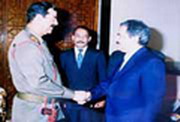
Massud Rajavi, the head of the MEK, greeted Arafat in Tehran with a Kalashnikov as a welcoming gift. When Saddam Hussein invaded Iran in 1980, Rajavi fled Iran for Iraq, where he enjoyed the protection of Saddam Hussein until 2003. A former MEK fighter told me that Arafat visited the MEK’s military camp in Iraq (Ashraf).

Israeli diplomats knew that whoever seized power in Iran in 1979 would be no lover of Israel—whether it was the Islamists who opposed Israel on religious and ideological grounds, or the leftists who viewed Israel as an outpost for American imperialism in the region. The MEK was unique since it fell in both categories.

Exactly when Israel’s ties with the MEK were established is unclear. But by the early 1990s, as I describe in my book, a relationship was forming, though its full nature and extent remains unknown.

At the time, Deputy Defense Minister Ephraim Sneh pushed Yitzhak Rabin to signal Tehran that Israel could also play the terrorist card. Sneh argued that whenever Iran used Islamic Jihad or Hamas to blow up a bus in Jerusalem, Israel should use the MEK to respond in kind in Tehran.

But cooler heads prevailed. Rabin refrained from entering into a public relationship with the organization. But the Labor government left the door to the MEK half open: it permitted the Iranian terrorist group to use two Israeli satellites to beam their TV broadcasts into Iran.

Even the MEK’s alleged revelation of the Iranian nuclear facilities at Natanz in 2002 was based on information leaked to the organization by Israel, according to Israeli intelligence expert Ronen Bergman. Indeed, a former US State Department official told me recently that while Israel does not publicly acknowledge its ties to the MEK, Israeli officials privately tell the US that the MEK is “useful.”

All of this has fueled suspicions in DC that the current multi-million dollar lobbying campaign by the MEK to get off of the State Department’s terror list is bankrolled by Israeli sources. Dozens of former US officials have received tens and thousands of dollars in speakers’ fees from the MEK or its surrogates to speak out on their behalf. These former officials have likely violated US laws on material support to terrorist organizations, and several of them have had their records subpoenaed by the US Treasury in an ongoing investigation.

Political one-night stands are not unusual in the Middle East. Even tactical collaboration with sworn enemies takes place. But associating Israel with a cultish Iranian terror group is damaging to Israel on several levels.

First, any attempt by Israel to hold the higher moral ground and point fingers at the regime in Tehran will be lost if Israel itself is entangled with violent terrorist groups that kill indiscriminatingly. This may have implications for other states’ willingness to collaborate against terrorist groups targeting Israel.

Second, if Israel teams up with an organization described by the US State Department as “fundamentally undemocratic” and “not a viable alternative to the current government of Iran,” the argument that peace in the region would be achieved if only the other states in the region were as democratic as Israel will become even more unconvincing.

And finally, this will likely undermine Israel’s ability to rebuild ties with the Iranian people down the road. The MEK has the dubious honor of being the only entity more disliked by the Iranian people.

It’s simply an association Israel should avoid.

Dailybeast.com

May 16, 2012 0 comments
FacebookTwitterPinterestWhatsappTelegramSkypeEmail
Mujahedin Khalq; A proxy force

Hillary’s Terrorists

Hillary Clinton is about to delist a dangerous terror group

On May 21, 1975, Col. Paul Shaffer, a military attaché to the US mission in Iran, kissed his wife Hillary Clinton is about to delist a dangerous terror groupand two children goodbye, and entered a waiting car with his colleague, Lt. Col. Jack Turner, whose wife was getting their three children ready for school. It was the last time the families of these two US servicemen would see them alive.

As the Iranian driver pulled into a side street to avoid traffic a car blocked their passage and another car rammed them from behind. Three gunmen appeared and fired at the two Americans pointblank, killing them instantly: the three escaped in a third car, leaving a leaflet on the blood-drenched seat. The leaflet denounced “US imperialism” and bore the imprint of the Mujahedin-e-Khalq (MEK), or “People’s Crusaders,” a Marxist-Islamist group led by Massoud and Maryam Rajavi.

All in all, the MEK killed 6 Americans in Iran: Lt. Col. Louis Lee Hawkins, an Army comptroller, cut down by gunman in front of his Tehran home, and William Cottrell, Donald Smith, and Robert Krongard, all employees of Rockwell International. They wounded Air Force Gen. Harold L. Price, and tried and failed to kidnap the US ambassador, Douglas MacArthur II. After the Iranian Revolution, the MEK supported the takeover of the US embassy in Tehran, opposed the release of the diplomats – calling a mass demonstration in protest – and demanded their execution.

Today, the MEK is campaigning to be taken off the US State Department’s list of terrorist organizations – and they’re on the brink of success. According to the Wall Street Journal:

“Senior U.S. officials said on Monday that Secretary of State Hillary Clinton has yet to make any final decision on the MeK’s status. But they said the State Department was looking favorably at delisting MeK if it continued cooperating by vacating a former paramilitary base inside Iraq, called Camp Ashraf, which the group had used to stage cross-border strikes into Iran.”

What the article fails to mention is that those “cross border strikes into Iran” took place during the 1980-88 Iran-Iraq war, when the MEK enjoyed the patronage of Saddam Hussein: MEK cadre fought on the Iraqi side during that conflict. They also were useful to Saddam in repressing internal enemies of the regime: after the 1991 Gulf war, MEK fighters were used by Saddam to crush uprisings in the south and in Iraqi Kurdistan. Maryam Rajavi told her followers: “Take the Kurds under your tanks, and save your bullets for the Iranian Revolutionary Guards.”

MEK has been described as a cult, most notably in a scary report by Human Rights Watch, a fascinating Al Jazeera video report, and in a remarkable piece by Elizabeth Rubin in the New York Times. Rubin relates the testimony of Salahaddin Mukhtadi, an Iranian historian living in exile, who says dissident MEK members “are locked up if they disagree with anything. And sometimes killed.” In the MEK cult, having particular friendships is strictly forbidden: sitting and talking together is considered a crime, especially when the subject is one’s past life before joining the cult. Wives are ordered to divorce their husbands, celibacy is mandatory, and families are broken up: nothing must come between the members and their devotion to the cause. Forced confessions and “criticism sessions” occur on a daily basis, in which participants are subjected to group abuse called “ideological cleansings.”

After the American invasion and occupation of Iraq, Massoud Rajavi ordered his followers to greet the Americans as liberators – and promptly went into hiding. He has not been seen since, but is said to retain his control over the cult, using his wife, Maryam – who has been proclaimed the self-styled “President” of Iran by the group –as a front. The US government took charge of the MEK facility, known as Camp Ashraf, and, although the Bush administration continued to characterize the group as a terrorist organization, President Bush cited Massoud’s cult as the source of “intelligence” on Iran’s alleged nuclear weapons program. Prominent neoconservatives began agitating for utilizing the MEK the way the Bush administration had used Ahmad Chalabi’s Iraqi National Congress, but efforts to openly put them on the CIA payroll stalled, along with the administration’s war plans. Somebody in the Bush administration must have figured out that funding and supporting a terrorist group that had killed Americans would not sit well while we were conducting an international “war on terrorism.”

However, it turns out the Bush administration secretly brought MEK cadre to the US for military training, including communications intercepts and other clandestine cloak-and-dagger stuff: the program supposedly ended just before the Obama administration took office. Apparently the MEK were turned over to the Mossad, who utilized them to carry out the assassination of Iranian nuclear scientists in Iran.

The MEK’s campaign to get their terrorist group legitimized has been characterized by large cash payments to prominent politicians and public figures in both parties: the list of MEK endorsers reads like a political Who’s Who of Washington bigwigs. The payments are ostensibly for speaking engagements at MEK rallies, but the size of these disbursements – ranging upward from $50,000 – indicates some good old-fashioned bribery.

There is an awful lot of MEK cash sloshing around the halls of Congress, and the cultists haven’t been shy about handing it out. Whether the Clinton Foundation or some Clinton-affiliated “charity” has partaken of the MEK’s largesse is presently unknown, but, as they say at the National Enquirer, “inquiring minds want to know.”

It’s fair to ask: where is all this unaccounted for cash coming from? While the Rajavi-ites use the familiar methods employed by cults to strip their members of all their assets – see the Al Jazeera video for a heart-rending account of how a major MEK spokesman ripped off his own elderly parents – it seems likely that, during their sojourn as Saddam Hussein’s favorite assassins, the MEK received compensation from the Iraqi dictator for slaughtering the Kurds and other regime opponents so efficiently and ruthlessly. Which means people like former Pennsylvania governor Ed Rendell, who has shilled for the MEK, and former Democratic party chairman Howard Dean, are recipients of Saddam’s gold.

Like so much of US foreign policy, the idea that the US would legitimize a crazed cult like the MEK sounds like the plot of a bad thriller. Yet it’s all about the timing: as the US-Iran nuclear talks loom, the prospect of our State Department in effect legalizing the MEK and its activities in the US is an open provocation that could possibly shut down the sensitive negotiations – and pave the way for war with Iran. No doubt hardliners within the Obama administration are using the MEK issue as a backdoor way to torpedo the Baghdad talks: whether they will succeed remains to be seen. As one State Department official told the Wall Street Journal: “To make that assertion on your own that the MeK will be removed is a realistic one. But in policy making you never know for sure what will happen.”

I have to add that the MEK, while claiming to have “renounced” terrorism, exists in an atmosphere seething with violence, and my own experience with them has borne this out. Whenever I have written about them I have invariably received emails from MEK supporters laden with explicit threats of violence. This is to be expected from members of a psycho cult, but in the case of the MEK it’s not like they’ve never killed any Americans before. Just ask the families of Paul Shaffer, Jack Turner, Louis Lee Hawkins, William Cottrell, Donald Smith, and Robert Krongard.

Antiwar.com

May 16, 2012 0 comments
FacebookTwitterPinterestWhatsappTelegramSkypeEmail
Mujahedin Khalq Organization's Propaganda System

Top US expert:NCRI report should be treated with great skepticism

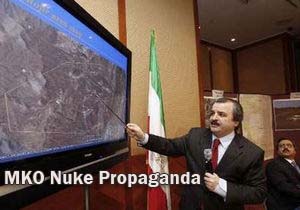
An exiled Iranian opposition group said on Saturday that Iran has some 60 scientists and engineers involved in a concerted and expanding program to develop nuclear weapons under defense ministry auspices.

However, diplomats say the National Council of Resistance of Iran has had a spotty record with allegations about Iran’s nuclear work since exposing a secret uranium enrichment plant at Natanz in 2002. A top U.S. nuclear expert said the NCRI report, like previous ones, should be treated with great skepticism.

Its latest report, whose details could not be verified, appeared timed to encourage a tougher line at talks with Iran the U.N. nuclear watchdog will have in Vienna on Monday and Tuesday and six world powers will hold in Baghdad on May 23.

But it clashed with the assessment of U.S. and Israeli intelligence officials that Iran has not decided whether to "weaponries" its enrichment program. Tehran says it is refining uranium solely for peaceful energy.

In the six-page report shown to Reuters, the NCRI cited sources in the Iranian government and military as saying some 60 scientists were pursuing bomb-relevant research in 11 agencies operating clandestinely under defense ministry control.

"Information … shows that the clerical regime has expanded the organization responsible for nuclear weapons development," the report said. "This finding reveals a complete and elaborate, and highly … secret research structure and a network for procurement of the required parts and equipment.

"So far, the identities of 60 directors and experts working in various parts of the New Defense Research Organization and 11 institutions and companies affiliated with it have been detailed," the report went on.

It featured diagrams said to lay out the disguised command structure and named scientists and engineers involved.

The NCRI, an umbrella bloc of five opposition groups in exile that seek an end to Shi’ite Muslim clerical rule in Iran, urged the International Atomic Energy Agency to launch a "robust probe" into Iran’s nuclear program and all personnel involved.

Iran says it is stockpiling enriched uranium for a future network of nuclear power plants. But the world’s No. 5 oil exporter has stonewalled an almost decade-old IAEA investigation into suspected military dimensions to its atomic activity.

World powers trying to rein in Iran’s nuclear activity via negotiations want to halt a spiral towards confrontation that has stoked fear of a new Middle East war, with Israel mooting last-resort air strikes on the nuclear sites of its arch-enemy.

But Western leaders have rejected Iranian calls for an end to U.N. sanctions against it as a precondition for any deal.

NO "SMOKING GUN"

In its last quarterly report on Iran issued in February, the IAEA cited generally credible information indicating Iran had carried out activities relevant to developing a nuclear explosive, but without evidence of actual weaponisation.

The NCRI is the political wing of the People’s Mujahideen Organization of Iran (PMOI), which the United States classifies the PMOI as a terrorist organization.

David Albright, head of an influential Washington-based think tank that tracks Iran’s nuclear work and has access to sensitive intelligence, said "we have to be extremely skeptical of whatever they (the NCRI) say.

"(They are) an activist group with a huge incentive to say there is a nuclear weapons program that is making great progress, " Albright said when asked about the report.

"We know this organization exists," he said, referring to the command structure cited by the NCRI. "We know the (NCRI) receives intelligence information from countries so sometimes it is good, but the trouble is, they fill in details …(without) evidence. You just don’t know whether it’s true or not."

Albright said the best available evidence was that Iran "doesn’t have a structured, coherent, active nuclear weapons program … Most of their effort is really focused on developing the capability to make nuclear explosive material…

"The real bottleneck in their program is the lack of any ability to make weapons-grade uranium quickly."

Refined uranium can be used to fuel nuclear power plants, which is Iran’s stated aim, or provide the core for a bomb if enriched to a much higher degree of fissile purity.

EU foreign policy chief Catherine Ashton referred without qualification to Iran’s "nuclear weapons program" on Friday. But her language went beyond that of Western security officials who are more plugged in to Iran’s activities, describing them as an attempt to advance towards a nuclear weapons capability.

In January, U.S. intelligence chief James Clapper said Iran was keeping the option open to develop a bomb but U.S. intelligence agencies did not know whether it would eventually decide to build one.

At the Vienna talks next week, the IAEA will once again try to get Iran to address suspicions about military aspects to its nuclear work. Atop the IAEA’s agenda will be gaining access to a military site that they fear Iran may be "sanitizing" to remove incriminating evidence of tests relevant to nuclear weapons.

The following week, the six big powers – the United States, Russia, China, Britain, France and Germany – will seek gestures from Iran that would evolve into guarantees that it is not after atomic bombs. These could include much more intrusive IAEA inspections and limits on Iranian capacity to refine uranium.

By Nicholas Vinocur and Fredrik Dahl , Editing by Mark Heinrich

May 15, 2012 0 comments
FacebookTwitterPinterestWhatsappTelegramSkypeEmail
Mujahedin Khalq; A proxy force

MEK to be delisted as terrorists in reward for engaging in terrorism

The Foreign Terrorism Organization list really doesn’t mean much if the way to get off it is by killing Iranian scientists at the behest of the US and Israel.MEK to be delisted as terrorists in reward for engaging in terrorism

The Obama administration is moving to remove an Iranian opposition group from the State Department’s terrorism list, say officials briefed on the talks, in an action that could further poison Washington’s relations with Tehran at a time of renewed diplomatic efforts to curtail Iran’s nuclear program.

MEK to be delisted as terrorists in reward for engaging in terrorismThe exile organization, the Mujahedin-e Khalq, or MeK, was originally named as a terrorist entity 15 years ago for its alleged role in assassinating U.S. citizens in the years before the 1979 Islamic revolution in Iran and for allying with Iraqi strongman Saddam Hussein against Tehran.

The MeK has engaged in an aggressive legal and lobbying campaign in Washington over the past two years to win its removal from the State Department’s list. The terrorism designation, which has been in place since 1997, freezes the MeK’s assets inside the U.S. and prevents the exile group from fundraising.

Oddly, the entire article makes no mention of allegations that MEK trained at a US Special Forces camp in the NV desert and/or killed a bunch of Iranian civilians with magnet bombs.

Though its last paragraph amounts to as much.

“If there’s a coalition against the mullahs, then we should fund that coalition, and the MeK should be a part of it,” said Rep. Dana Rohrabacher (R., Calif.). He cautioned that for now, he wasn’t advocating directly funding MeK. “The MeK has the resources to resist and fight the mullah dictatorship. They don’t need our money, they just need us to get out of the way and take the shackles off.”

Jim? I believe this is your department.

Though maybe it’s not all the dead scientists that made the difference here. Maybe it’s the art project that significantly resembles the INC’s finger painting projects leading up to the Iraq War. America. Big fans of primitive art.

We demand our terrorists to be able to both kill civilian scientists and draw crude pictures, you know.

Empty Wheel

May 15, 2012 0 comments
FacebookTwitterPinterestWhatsappTelegramSkypeEmail
Mujahedin Khalq; A proxy force

US mulls taking anti-Iran MKO off terrorism blacklist

The United States is considering the removal of the anti-Iranian Mujahedin-e Khalq Organization (MKO) from its terrorism watch list.
US mulls taking anti-Iran MKO off terrorism blacklist
Senior US officials say Secretary of State Hillary Clinton will make her final decision on the matter two months after the terrorist group leaves Camp New Iraq, formerly known as Camp Ashraf, some 120 kilometers (74 miles) west of the border with Iran.

MKO members are currently being relocated to Camp Liberty near the Baghdad International Airport under an agreement reached between the United Nations and Iraq last December.

The MKO is designated as a terrorist organization under US law, and has been described by State Department officials as a ‘repressive cult.’

The group fled to Iraq in 1986, where it enjoyed the support of Iraq’s executed dictator Saddam Hussein, and set up its Camp Ashraf near the Iranian border.

It is also known to have cooperated with Saddam in suppressing the 1991 uprisings in southern Iraq and carrying out the massacre of Iraqi Kurds.

MKO has carried out numerous acts of violence against Iranian civilians and government officials.
PressTV – May15,2012
http://www.presstv.ir/detail/2012/05/15/241266/us-mulls-delisting-mko-as-terror-group/

May 15, 2012 0 comments
FacebookTwitterPinterestWhatsappTelegramSkypeEmail
Mujahedin Khalq as an Opposition Group

ISIS rejects MEK claims on Iran pursuing nuclear weapons

The Institute for Science and International Security says a new report on Iran’s nuclear activities by the dissident National Resistance Council of Iran, a branch of the People’s Mojahedin Organization of Iran, should be regarded with skepticism.

Reuters reports that in a six-page report, the PMOI says that Iran is actively trying to build a nuclear bomb, having hired 60 engineers and scientists.

“We have to be extremely skeptical of whatever [the NRCI] says,” said David Albright, the head of ISIS. “[They are] an activist group with a huge incentive to say there is a nuclear weapons program that is making great progress.”

The PMOI is a dissident Iranian group that has been actively fighting against the Islamic Republic since it was established after the 1979 Iranian Revolution.

Albright added that available evidence shows that Iran “doesn’t have a structured, coherent, active nuclear weapons program.”

Iran has continuously maintained that it has no ambition to develop nuclear weapons and insists that its nuclear activities are all peaceful.

May 15, 2012 0 comments
FacebookTwitterPinterestWhatsappTelegramSkypeEmail
Mujahedin Khalq; A proxy force

The MEK and the USA: It’s Complicated

Since 1997, the Iranian opposition group known as the Mujahedeen-e Khalq (MEK) has been The MEK and the USA: It’s Complicateddesignated by the U.S. State Department as a terrorist organization. Yet prominent U.S. officials from Howard Dean to Rudy Giuliani have come out in support of the MEK, arguing that the group has turned its back on violence and should have its terrorist designation revoked. For this vocal body of American supporters, the MEK’s commitment to secular, democratic government could help turn the tide against Islamic rule in Iran.

The MEK and the USA: It’s ComplicatedThe issue, however, is muddied by MEK’s decidedly violent and even anti-American past. Originally an Islamic group, in the 1970s the MEK evolved into a Marxist organization dedicated to violent struggle against the U.S.-backed Shah of Iran. Responsible for at least six assassinations of American diplomats, the MEK enthusiastically supported the Iran Revolution in 1979, yet afterwards resisted the new Islamic rule and began a campaign of bombings, kidnappings, and assassinations targeting Iranian officials. The group fled to Iraq in 1986, allying with Saddam Hussein until the 2003 American invasion, after which it sought accommodation with U.S. forces.

Clearly, the MEK’s amenability to U.S. interests reflects only the group’s latest incarnation. Nonetheless, opponents of the MEK’s terrorist designation are willing to overlook prior transgressions if it means gaining a supposedly non-violent ally in the battle to undermine Iran.

There are several problems with this line of thinking, however. For one, withdrawing the MEK’s terror designation would undeniably exacerbate tensions with Iran. Though last month’s nuclear talks went relatively well, this situation could nosedive quickly with tacit American support for the MEK. Supreme Leader Ali Khamenei was himself a victim of an attempted assassination by the MEK in 1981. Iraq too is hostile towards the MEK, considering that for years the organization was supported by Saddam Hussein and may have participated in state repression.

It’s also not apparent that the MEK could achieve much in Iran, at least not as a legitimate political force. The MEK is widely despised by the Iranian people, including Iran’s reformist Green Movement, not least because of allegations that the MEK fought alongside Saddam in the Iran-Iraq War. It’s preposterous to think that an organization with so little public support could actually foster democratic government. American support for the MEK would only harm the encouragingly positive relations between the U.S. and the people of Iran.

Regardless of the political ramifications, the MEK may still actually qualify as a terrorist organization. The State Department states that the group still has the capability and intent to engage in terrorist acts. Indeed, there are allegations that the recent assassinations of Iranian nuclear scientists betray a Mossad-MEK alliance of sorts. Though some MEK members in Iraq have relinquished their weapons to American troops, the organization still has a global network of trained operatives and bomb-makers who have not reliably demonstrated a commitment to non-violence.

Though the United States and the Mujahedeen-e Khalq may share a common enemy, this is hardly a sufficient reason for the U.S. to remove the MEK’s terrorist designation. The Iranian people have tellingly disavowed the MEK, a group that incidentally has never been brought to justice for assassinating American citizens or its role in the Iran Hostage Crisis. Thus for both political and ethical reasons, it’s clear that the MEK should remain a designated terrorist organization.

by Sean Feely – Diplomacist

May 15, 2012 0 comments
FacebookTwitterPinterestWhatsappTelegramSkypeEmail
Mujahedin Khalq Organization's Propaganda System

MKO puts out propaganda report claiming Iranian secretly advancing NW

The National Council of Resistance of Iran (NCRI) – the political arm of the Mujahedin-e Khalq Organization (MEK or MKO) often known as the People’s Mujahedin of Iran (PMOI), a terrorist

Terrorist group puts out propaganda report claiming Iranian secretly advancing nuclear weapons program

organization trained by the United States and the Israeli Mossad to carry out assassinations and other covert operations in Iran – has put out another propaganda report dealing with the Iranian nuclear program.

In their latest report, which a top U.S. nuclear expert already said should be treated with great skepticism according to Haaretz, claims that there are 60 scientists and engineers currently playing a role in the alleged Iranian nuclear weapons program.

Of course, in reality, the United States Secretary of Defense Leon Panetta has confirmed that Iran is not pursuing nuclear weapons on multiple occasions. Similarly, the United States intelligence community does not have any evidence indicating that Iran is pursuing nuclear weapons.

Even the Israeli military chief Benny Gantz shares this position, making the claims from the NCRI highly suspicious at best.

The NCRI’s track record is far from one which would inspire confidence in the accuracy of their claims.

Since the revealed that uranium enrichment was occurring at the Natanz facility in 2002, they have essentially been unable to produce anything other than propaganda intended to push the international community into attacking Iran and/or ousting Iranian President Mahmoud Ahmadinejad.

Even Haaretz has to highlight that the latest report is filled with details which “could not be verified” and it indeed “appeared timed to encourage a tougher line at talks with Iran the UN nuclear watchdog will have in Vienna on Monday and Tuesday and six world powers will hold in Baghdad on May 23.”

The six page report was shown to Reuters and it cited sources allegedly in the Iranian government and military who claim that a massive team of around 60 individuals are actively pursuing research related to nuclear weapons across 11 agencies, all operating in secret under the control of the defense ministry.

One can make any manner of wild claims while citing supposed insider sources. As long as the details can’t be verified – and thus, cannot be falsified – they can never be challenged.

Unfortunately, some people seem to apply this knowledge selectively, in some cases choosing to give credence to claims made with no evidence while categorically dismissing such claims in other cases.

“Information […] shows that the clerical regime has expanded the organization responsible for nuclear weapons development,” said the report. “This finding reveals a complete and elaborate, and highly […] secret research structure and a network for procurement of the required parts and equipment.”

“So far, the identities of 60 directors and experts working in various parts of the New Defense Research Organization and 11 institutions and companies affiliated with it have been detailed,” the report added.

Now, this mind sound compelling, but the simple fact is: not a single one of these claims can be substantiated.

If I told you my high-level government contacts inside the Pentagon told me that all canines are actually hybrid robot-aliens sent to siphon the psychic energy of humans, would you believe me?

While that obviously sounds absurd to many people, there is just as much evidence to support claims such as these as there is to support the claims made by this terrorist group.

Interestingly, the document took a tactic right out of the U.S. government playbook – creating diagrams supposedly showing the hidden command structure, scientists and engineers involved in this alleged secret program.

These sound much like the completely fraudulent diagrams and drawings created in order to trick people into buying the justification for invading Iraq.

The NCRI has called on the United Nations nuclear watchdog agency the International Atomic Energy Agency (IAEA) to carry out a “robust probe” into the Iranian nuclear program and all involved.

While it is often claimed that Iran is blocking an IAEA investigation, this approach is ludicrous given that Israel refuses to allow any of their facilities to be inspected.

The antagonistic Israeli approach to the Iranian nuclear program is far from constructive and is blatantly hypocritical to the point of absurdity.

Hopefully the West can begin to use at least something resembling reason and logic in this situation, or else I fear we might be heading towards a confrontation the likes of which the world has never seen.

As always I hope, above all, that I am completely wrong and that these tensions quickly dissolve and the world can move forward into an era free of incredibly destructive nuclear weapons technology.

Did I forget anything or miss any errors? Would you like to make me aware of a story or subject to cover? Or perhaps you want to bring your writing to a wider audience? Feel free to contact me at admin@EndtheLie.com with your concerns, tips, questions, original writings, insults or just about anything that may strike your fancy.

By Madison Ruppert ,Editor of End the Lie

May 14, 2012 0 comments
FacebookTwitterPinterestWhatsappTelegramSkypeEmail
Mujahedin Khalq; A proxy force

MKO: Obama’s anti-Iran card in elections

"The US administration uses the MKO to create security challenges and problems in Iran, and this trend has continued since many years ago," says Dr. Foad Izadi, Professor at the UniversityDr. Foad Izadi, Professor at the University of Tehran and US affairs expert of Tehran and US affairs expert.

Iranian Diplomacy: The US has announced that it will take in a number of MKO members. What has this country’s position been toward this terrorist group from the inception of the group until today?

Foad Izadi: What we had seen was that the MKO had been in alliance with Saddam’s regime, and were financed by the regime in Iraq, and a base had even been created for them. Keeping this in mind, the US should have confronted them and, given that the MKO had also committed many crimes inside Iraq as well, put them to trial.

The MKO’s terrorist history inside and outside of Iran makes it totally clear that, according to the opinion of Americans and based on the US State Department’s terrorism list, it is definitely a terrorist group.

What happened after the invasion of Iraq was that unexpectedly the US not only did not confront the MKO, but it continued to financially support them just as Saddam had done, and thus smoothed the way for their terrorist acts.

Before the Iraq war, the Americans claimed that weapons of mass destruction could be found in Iraq and that this country supported terrorism. At that time, a reporter for NBC News asked Dick Cheney, George W. Bush’s Vice President, what terrorist groups Iraq supported. Cheney was reluctant to answer this question, but after the journalist insisted, which was in itself rather interesting, he finally said that the MKO was a terrorist group that Saddam supported. But after the invasion of Iraq, Dick Cheney was himself a sponsor of the MKO.

Therefore, the US government’s relations with the MKO continued and even during the period in which they were considered a terrorist group by the US, they had an office in Washington. They held conferences in Washington and many non-US citizens came to the US to attend these conferences, something that the US was completely aware of and supported because they issued visas for them. In reality, a terrorist group was easily able to get visas from the US and its members were able to enter the country. They also held meetings in Congress, and the MKO even held a ceremony for the Iranian New Year in the Capitol.

The issue of financial and arms support for the MKO did not stop with Iraq. As the American media reported, the US government trained members of the MKO in Nevada for anti-Iranian spying activities in the nuclear domain and in issues regarding the assassination of nuclear scientists, bugging and listening systems, and other ways to damage Iran. They used members of the MKO for spying and terrorist activities due to the fact that they spoke the Persian language and that they would not be recognized on the streets of Tehran because of their appearance.

This terrorist group is completely coordinated with a government that is the biggest supporter of terrorism. The recent news that the US will accept a number of MKO members is nothing new, because these individuals have been living in the US for many years now and have been active there, and this is a sign of the US’ double standard. Because, if the US claims that it combats terrorism, why does it support these people? This American policy confirms the US as a supporter of terrorism. In fact, from the US perspective, there are two types of terrorists; good terrorists who work in line with the interests of the US and its allies, and bad terrorists who work against US policies.

ID: Has the election atmosphere in the US influenced the decision to accept MKO members in the country?

FI: There is a presidential election this year and a competitive atmosphere between the Republicans and the Democrats inside the US, for both of which the issue of Iran is very important. The Obama administration intends to pursue more anti-Iran policies than its rivals. Usually, in election years, the two American parties compete with each other in support of the Zionists and Iran’s opponents. It should be said that, in the end, the issue of Iran is not the only issue of the election season, but an issue which has always been on the mind of politicians.

ID: Have relations between Iran and Iraq and Iran’s influence in this country been the cause for this US decision?

FI: If it was not for Iran’s influence in Iraq, the MKO would still have remained in this country. With all the US pressure on Iraq, they would not have been transferred. But, Iran’s influence in Iraq led to the upcoming deportation of the MKO from that country. Of course, crimes committed by this group might have helped in this cause, but it seems that this was not the only reason behind their deportation, for if this was the case, they should have left Iraq much earlier. Good relations between Iran and Iraq are the reason for this act. It should be noted that they have not completely left Camp Ashraf, and as long as American forces are present in Iraq, they will not permit all members of the MKO to be deported.

ID: Will accepting the MKO members create security problems for Iran?

FI: The US administration uses the MKO to create security challenges and problems in Iran, and this trend has continued since many years ago. It does not make any difference whether more numbers of MKO members are admitted to the US or not, for they have always enjoyed the support of the Americans. US support for the MKO has never weakened during previous years.

May 14, 2012 0 comments
FacebookTwitterPinterestWhatsappTelegramSkypeEmail
Mujahedin Khalq Organization as a terrorist group

MKO terrorists receive funds from Saudi Arabia, Israel

A Mujahedin-e Khalq Organization defector says the terrorist group receives funding from Saudi Maryam Sanjabi,MKO defectorArabia and Israel, emphasizing MKO’s role in the suppression and massacre of Iraqis under the former Baath regime.

Speaking in an exclusive interview with Ashraf News website in the Iraqi capital Baghdad on Saturday, Maryam Sanjabi said there is evidence about the relations and cooperation between the MKO and the Saudi kingdom.

She added that the group has used the tactic of establishing relations with Jordanian lawmakers in order to expand their activities in Jordan with the help of Riyadh.

She also called on the remaining MKO members in camp Liberty in Iraq to think rationally and take advantage of the Iraqi government and UN decisions about their re-settlement in another country.

MKO members have now a better chance of escaping in the wake of their transfer from Camp New Iraq, formerly known as Camp Ashraf, situated about 120 kilometers (74 miles) west of the border with Iran, to the Camp Liberty, the former MKO leadership council member said.

The group fled to Iraq in 1986, where it enjoyed the support of Iraq’s executed dictator Saddam Hussein, and set up its camp near the Iranian border.

The organization is known to have cooperated with Saddam in suppressing the 1991 uprisings in southern Iraq and carrying out the massacre of Iraqi Kurds. The group has also carried out numerous acts of violence against Iranian civilians and government officials.

May 14, 2012 0 comments
FacebookTwitterPinterestWhatsappTelegramSkypeEmail
Newer Posts
Older Posts

Recent Posts

  • A Comparative Analysis of Psychological Control Mechanisms in Jeffrey Epstein’s Cult and the MEK

    August 3, 2026
  • Operation Mersad: How Iran foiled Saddam’s final gambit 37 years ago

    August 1, 2026
  • Ideology Cannot Prevail over Human Dignity

    July 29, 2026
  • Is Rudy Giuliani so naïve to support MEK terrorists?

    July 27, 2026
  • National Pride of Iranians: Reject the Rajavis and their Patrons

    July 22, 2026
  • Facebook
  • Twitter
  • Instagram
  • Youtube

© 2003 - 2025 NEJAT Society . All Rights Reserved. NejatNGO.org


Back To Top
Nejat Society
  • Home
  • Articles
  • Media
    • Cartoons
    • NewsPics
    • Photo Gallery
    • Videos
  • Publications
    • Books
    • Nejat NewsLetter
    • Pars Brief
  • About Us
  • Contact us
  • Editions
    • عربي
    • فارسی
    • Shqip