Nejat Society
  • Home
  • Articles
  • Media
    • Cartoons
    • NewsPics
    • Photo Gallery
    • Videos
  • Publications
    • Books
    • Nejat NewsLetter
    • Pars Brief
  • About Us
  • Contact us
  • Editions
    • عربي
    • فارسی
    • Shqip
Nejat Society
Nejat Society
  • Home
  • Articles
  • Media
    • Cartoons
    • NewsPics
    • Photo Gallery
    • Videos
  • Publications
    • Books
    • Nejat NewsLetter
    • Pars Brief
  • About Us
  • Contact us
  • Editions
    • عربي
    • فارسی
    • Shqip
© 2003 - 2024 NEJAT Society. nejatngo.org
Mujahedin Khalq Organization's Propaganda System

Supporters of Iranian resistance group rally at State Department

Hundreds of supporters of the Iranian resistance group Mujahedin-e Khalq rallied in front of the U.S. State Department in Washington Friday, demanding the United States Supporters of Iranian resistance group rally at State Departmentremove the group from its list of foreign terrorist organizations. In a sophisticated display of its public relations ability, the demonstration featured scores of young supporters wearing matching yellow T-shirts and straw hats chanting slogans, live big-screen broadcasts of the speakers, appearances by well-know U.S. politicians and the release of white doves that flew up toward the State Department’s enormous navy-blue flag as a storm of yellow and blue confetti filled the air.

The protest took place as the State Department prepares to decide whether to remove the organization from its list of foreign terrorist organizations. The MEK denies that it supports terrorism.

The department placed the MEK on the list in 1997. The group initially supported the 1979 Iranian Revolution, but later turned against the ayatollahs and, until 2003, carried out bombings and killings of Iranian officials.

The State Department also cites eyewitness accounts and MEK documents that it says demonstrate that MEK members participated in and supported the 1979 takeover of the U.S. Embassy in Tehran and, in the 1970s, carried out terrorist attacks against U.S. interests in Iran as well as assassinations of Americans.

In the 1980s, because of the group’s anti-Iran actions, Iraq’s Saddam Hussein provided it with financial support and military training. During the Iran-Iraq War, the State Department says, Baghdad "armed the MEK with heavy military equipment and deployed thousands of MEK fighters in suicidal, mass wave attacks against Iranian forces."

The MEK surrendered its heavy arms to the U.S.-led coalition that invaded Iraq and, in 2003, said it was renouncing violence. Since then, roughly 3,400 M.E.K. members have been living at a refugee camp called Camp Ashraf on the Iran/Iraq border.

But the new Iraqi government, which is more sympathetic to the Iranian regime, wants to move the MEK out of Iraq. The camp has been violently attacked several times by Iraqi security forces. In one attack this spring, at least 30 of the camp’s residents died.

At Friday’s rally at the State Department, girls wearing yellow tiaras on their heads with the word "Ashraf" led the audience in cheers.

Onstage, former Pennsylvania Gov. Ed Rendell and former U.S. Rep. Patrick Kennedy addressed the crowd, urging support for its cause. The MEK, which is based in France, has spent millions of dollars to win backing in Washington.

The State Department, in its 2010 Country Reports on Terrorism, noted, "The MEK’s political arm, the National Council of Resistance of Iran, has a global support network with active lobbying and propaganda efforts in major Western capitals. NCRI also has a well-developed media communications strategy."

Some Iranians in the United States have been critical of the MEK. In a press release Friday, Trita Parsi, president of the National Iranian American Council, said delisting the group "would be disastrous for Iran’s nonviolent democratic opposition ."

Calling the MEK "a cult that abuses its own members," Parsi said it has "no support among the Iranian people." The MEK, he said, has been paying U.S. politicians to get it off the list of foreign terrorist organizations.

"If the MEK campaign is successful," he said, "it means that America’s national security is officially on sale to the highest bidder, and terror groups are free to set U.S. policies if the price is right."

By Jill Dougherty, CNN Foreign Correspondent

August 27, 2011 0 comments
FacebookTwitterPinterestWhatsappTelegramSkypeEmail
Mujahedin Khalq; A proxy force

Why are U.S. political and diplomatic figures endorsing a terror group?

In recent weeks, a number of national U.S. news outlets have documented a strange phenomenon. Dozens of retired U.S. government officials, spanning the liberal-to-conservative a number of national U.S. news outlets have documented a strange phenomenonpolitical spectrum and some paid tens of thousands of dollars in speaking fees, have joined a well-orchestrated lobbying campaign to remove a controversial Iranian exile group from the list of terrorist organizations maintained by the U.S. State Department.

Secretary of State Hillary Clinton is expected to make a decision on the group’s status within weeks. She should take a close look at the history of the Mujahedeen-e Khalq (MEK) before making a decision.

The MEK is a cult-like organization run by Iranian exiles Maryam Rajavi and her husband Massoud. Ms. Rajavi lives in Paris and leads the National Council of Resistance in Iran, a group that claims exile-government status. According to the FBI, it is a front group for the Mujahedeen-e Khalq.

Also known as the Warriors of God, MEK has a history of anti-American rhetoric and unsavory associations over the past four decades under the leadership of the Rajavis. It was initially aligned with the leaders of the Iranian Islamic revolution and later with Iraq’s dictator Saddam Hussein after the group was expelled from Iran. It is accused of dozens of assassinations and bombings, including one which killed six American advisers in Iran, and murdering Kurdish refugees in Iraq at Hussein’s behest. It is currently based at a camp in Iraq protected by the U.S. military but facing expulsion by the Iraqi government. A clash between Iraqi forces and camp members resulted in 34 deaths in April.

Despite the MEK’s ugly history, a power-packed roster of speakers has appeared at forums in the U.S. and Europe to endorse its drive to get off the terrorist list. Among the luminaries are former Vermont governor and Democratic presidential candidate Howard Dean, former New York Mayor Rudy Giuliani, retired Gen. Wesley Clark, former U.N. Ambassador John Bolton, former Energy Secretary and New Mexico Gov. Bill Richardson and former FBI director Louis Freeh. Some of the high-profile speakers admit they knew little about the group beyond their briefing by MEK advocates.

According to a study by the Rand Corporation in 2009, the MEK has deceptively retooled its image to that of a democratic, nonviolent organization dedicated to bringing down the Iranian government. As such, the group is cultivating prominent Americans looking for a plausible alternative to Iran’s current leadership.

The MEK doesn’t seem to fit that bill. The Rand study reported that up to 70 percent of the 3,500 people at MEK’s Iraqi camp were deceptively recruited and are held against their will. Even prodemocracy groups inside Iran have denounced the MEK as a totalitarian cult group dedicated to the Rajavis.

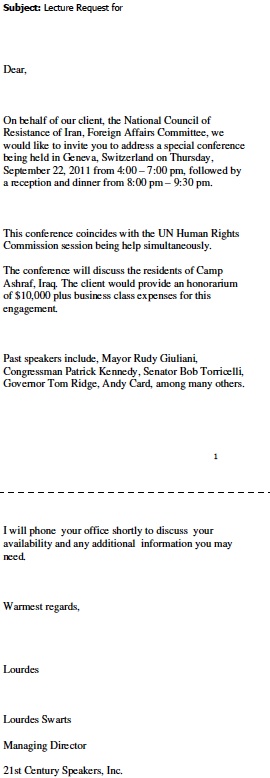
An investigation by the Christian Science Monitor reported that millions of dollars provided by MEK have paid those high-profile speakers’ fees and hotel costs for the events. Although U.S. law prohibits Americans from providing direct assistance to or taking payments from terrorist groups, the connection is disguised by running the funds through third parties, usually Iranian exile groups in the U.S.

Prominent Americans should not be accepting payments and supporting a group that has shed American blood in the past and has no viable support inside Iran. We urge Secretary Clinton to keep the MEK on the terrorist roster.

Chron.com

August 27, 2011 0 comments
FacebookTwitterPinterestWhatsappTelegramSkypeEmail
Mujahedin Khalq Organization's Propaganda System

MEK rally planned for Friday at State Department

Supporters of the Mujahedin-e-Khalq (MEK) movement are planning their largest-ever gathering in Washington on Friday in front of the State Department. MEK rally planned for Friday at State Department

"Join us in solidarity with the Iranian people, Camp Ashraf, and against the dictatorship ruling Iran," reads the flyer advertising the Aug. 26 rally and march at the 22nd and C Street entrance of the State Department’s Foggy Bottom headquarters. MEK supporters have been gathering there for months, imploring State Department employees and visitors to press Secretary of State Hillary Clinton to remove the MEK from State’s list of foreign terrorist organizations.

"Dear Hillary, My name is Shaghayegh. I am 14 and I live in Camp Ashraf, Iraq. I am afraid I am going to be murdered," begins an open letter from an MEK member to Clinton that has been printed in full-page ads in the Washington Post.

The State Department placed the MEK on its list of foreign terrorist organizations in 1999 for its involvement in bombings that killed six Americans, but is reviewing that status now.

The event is the latest and greatest example of the MEK’s multi-million dollar effort to build support among Washington’s political elite. The speakers at the event will include: Congressman John Lewis (D-GA), former Pennsylvania Gov. Ed Rendell, former FBI Director Louis Freeh, former Sen. Robert Torricelli, Rep. Patrick Kennedy, and former CIA Deputy Director of Clandestine Operations John Sano.

The MEK also lists among its supporters in Washington former National Security Advisor Gen. James Jones, former Vermont Gov. Howard Dean, former New York Mayor Rudolph Giuliani, former Joint Chiefs Chairman Gen. Richard Myers, former White House Chief of Staff Andy Card, Gen. Wesley Clark, former Rep. Lee Hamilton, former CIA Director Porter Goss, senior advisor to the Romney campaign Mitchell Reiss, Gen. Anthony Zinni, former Pennsylvania Gov. Tom Ridge, former Sen. Evan Bayh, and many others.

So what is the MEK? Well, that depends on who you ask. The group, which has an ideology based on the fusion of Islam and Marxism, was formed in Iran in 1965. It allied itself with Ayatollah Ruhollah Khomeini and fought against the Shah and his Western backers. After falling out of favor with Khomeini, the group was given shelter in Iraq by Saddam Hussein, who used them to conduct brutal cross-border raids during the Iraq-Iran war.

MEK leader Maryam Rajavi, who lives in Paris with her husband Massoud Rajavi, reportedly told her followers in 1991, "Take the Kurds under your tanks, and save your bullets for the Iranian Revolutionary Guards."

After the fall of Saddam, the United States helped broker an agreement whereby 3,400 MEK members were confined to a complex in Iraq called Camp Ashraf, which was protected by the U.S. military but then handed over to the Iraqi government in 2009. In an interview on Tuesday, Iraq’s ambassador Samir Sumaida’ie said that the MEK was dangerous and "nothing more than a cult."

In 2005, Human Rights Watch published a report accusing the MEK in Camp Ashraf of enforcing loyalty by subjecting "dissident members to torture and prolonged solitary confinement," and being responsible for "two cases of death under interrogation."

Elizabeth Rubin wrote about her 2003 trip to Camp Ashraf in the New York Times earlier this month. "Access to the Internet, phones and information about the outside world is prohibited. Posters of Ms. Rajavi and her smiling green eyes abound," she said. "Friendships and all emotional relationships are forbidden. From the time they are toddlers, boys and girls are not allowed to speak to each other. Each day at Camp Ashraf you had to report your dreams and thoughts. If a man was turned on by the scent of a woman or a whiff of perfume, he had to confess."

The MEK says it renounced violence in 2001 and professes to be leading the resistance to the Iranian regime. That claim, in addition to lucrative payments to former officials in both parties, has bought it a lot of attention and friends in Washington. But how can senior officials take money from a terrorist group?

"The MEK’s delisting campaign is funded by a fluid and enigmatic network of support groups based in the United States. According to an MEK leader, these groups are funded by money from around the world, which they deliberately shield from U.S. authorities," the Huffington Post reporter Christina Wilkie wrote. "These domestic groups book and pay for their VIP speakers through speaker agencies, which in turn pay the speakers directly and take a fee for arranging appearances. That way, the speakers themselves don’t technically accept money from the community groups."

An event organizer told The Cable that the MEK is expecting between 5,000 and 10,000 people at its rally at the State Department on Friday, which begins at 10 a.m.

Foreign Policy.com – By Josh Rogin

August 27, 2011 0 comments
FacebookTwitterPinterestWhatsappTelegramSkypeEmail
Mujahedin Khalq Organization's Propaganda System

Some participants in the rally had no knowledge about MKO

Several hundred supporters of the Iranian opposition Mujahedin-e Khalq Organization (MKO, aka MEK and People’s Mujahedin) gathered on August 26 in front of the State Department in Washington, D.C., to urge Secretary of State Hillary Clinton to remove the group from the United States’ list of foreign terrorist organizations.

The participants, who were wearing yellow vests with pictures of the leaders of the group, Maryam and Massoud Rajavi, chanted, "We want justice, we want peace, we want MEK off the list" and also "Iran, Rajavi, Rajavi, Iran."

The State Department is reviewing the status of the MKO, which it put on the list of terrorist organizations in 1999. The group, which has been described by former members as a Marxist/Islamist cult, is also designated as a terrorist organization by Iran.

The MKO, which was involved in a series of attacks in Iran in the 1980s, says it has renounced violence and is working for democracy in Iran. The group sided with Iraq during the bloody Iran-Iraq War in the 1980s, and more than 3,000 members are still based in Camp Ashraf in Iraq.

Today’s event included speeches by several former U.S. officials and congressmen, including former Representative Patrick Kennedy (Rhode Island-Republican) who said in Persian, " I am Iranian, I am an Ashrafi," referring to the camp in Iraq. He also warned Iraqi Prime Minister Nuri al-Maliki that he will be put on trial in the International Criminal Court for attacking Camp Ashraf.

Organizers said the event was broadcast live for Camp Ashraf members. Several rally participants told RFE/RL they have family members in Ashraf.

One of the organizers, who identified herself as Shirin, told RFE/RL the removal of MKO from the list of foreign terrorist organizations would allow MKO members in Ashraf to move to other countries.Shirin said the MKO’s removal from the list would allow those who are "hesitant" because of this status to join the opposition group.

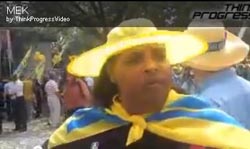
Rally participants also included a number of non-Iranian-Americans. Several of them told RFE/RL they had little or no knowledge about the MKO. "We’ve come for Iranian people," said one African-American.

When asked whether he and his female companion received money to attend the rally, the woman first said yes, but then retracted her statement at the man’s behest.

Another MKO supporter said describing the group as a cult is a label by intelligence agencies, which he said do not understand the nature of the group. In response to a question about the whereabouts of MKO leader Massoud Rajavi, who hasn’t been seen for years, he said his location should be kept secret for his personal safety.

Today’s rally was the latest event in a series the MKO has held in recent months in Washington to push for its delisting. Western media have reported that former U.S. officials have received substantial financial contributions to speak at MKO events and express support for the delisting of the group.[..]

Tehran-based political analyst Nejat Bahrami told RFE/RL earlier this month the delisting of the MKO would make average Iranians frustrated with the United States.

"The messages [U.S. President Barack] Obama has sent to the Iranian people on several occasions, including for Norouz, have been very encouraging," he said. "But I think [the delisting of the MKO] would neutralize those positive statements. And it might lead to frustration with U.S. policies and even hatred."

By Golnaz Esfandiari, Hossein Aryan

August 27, 2011 0 comments
FacebookTwitterPinterestWhatsappTelegramSkypeEmail
Iraq

Iraqi victims of MKO to collect signatures to expel the group

Chairman of the Committee for the defense of Iraqi victims of Mojahedin Khalq working to collect signatures to expel MKO (MEK, Rajavi cult) from Diyala, Iraq

The head of the Special Committee to defend the victims of the crimes of Mojahedin Khalq, Mr. Iraqi victims of MKO to collect signatures to expel the groupNafee-Issa, said the Committee is working to collect signatures for the expulsion of the Mojahedin from the province of Diyala, and from Iraq.

In a statement to All-Iraq News Agency on Tuesday, Mr. Nafee-Issa said that "the Committee is working to collect a large number of facts that show the crimes of this organization and what caused the killings of civilians in Iraq since 1986 till 2003."

He added that "organized crime continued after 2003 as a result of political interference in the affairs of Iraq by creating sectarian strife between Iraq’s people and in addition working to destabilise the security situation in the province of Diyala and the country in general."

Camp Ashraf, or as it is now known camp New Iraq, houses thousands of Iranian fighters of the MKO, an Iranian opposition faction, which based the headquarters for its Chairman at the camp nearly three decades ago.

All Iraq News, Translated by Iran Interlink

August 27, 2011 0 comments
FacebookTwitterPinterestWhatsappTelegramSkypeEmail
Mujahedin Khalq Organization's Propaganda System

Hundreds demonstrate in DC for Mojahedin Khalq

WASHINGTON — Hundreds of people are demonstrating in Washington to demand that an Iranian opposition group formerly allied with Saddam Hussein’s Iraq be removed from the U.S. list of terrorist organizations

Former Pennsylvania Gov. Ed Rendell and former Rhode Island Rep. Patrick Kennedy were among those speaking in support of the Mujahedin-e Khalq. The midday crowd filled a street outside the State Department for a rally with confetti and doves released into the air.

The U.S. declared the group a terrorist body in 1997. But a court last year ordered the State Department to reconsider the designation.

The MEK carried out a series of bombings and assassinations in Iran in the 1980s, and fought alongside Saddam’s forces in the Iran-Iraq war. The group says it renounced violence in 2001.

August 27, 2011 0 comments
FacebookTwitterPinterestWhatsappTelegramSkypeEmail
Mujahedin Khalq Organization as a terrorist group

Delisting MEK would be a disaster

Washington, DC – The Mujahadeen-e Khalq (MEK), a cult-like Iranian terrorist organization with a history of violence and no support among the Iranian people, has been paying U.S. politicians to help them get off the State Department’s terrorist list. They are rallying in front of the State Department today to take the group of the terror list. Today, NIAC President Trita Parsi released the following statement in regards to the MEK campaign:

“If the MEK campaign is successful, it means that America’s national security is officially on sale to the highest bidder, and terror groups are free to set U.S. policies if the price is right.

Delisting the MEK has little to do with humanitarian concern or support for a democratic Iran, and everything to do with putting the military option at the center of our Iran policy. The group’s biggest supporters in Washington have suggested using the MEK in a ‘tit for tat’ campaign of attacks against Iran that could quickly escalate into war.

Despite the MEK’s claims, delisting the group would be disastrous for Iran’s nonviolent democratic opposition [..]

The MEK operates as a cult that abuses its own members, and delisting it would only worsen humanitarian concerns in Camp Ashraf by empowering the group’s leadership. MEK leaders have exploited the suffering of the people in Ashraf and obstructed serious humanitarian proposals in order to advance their agenda of gaining U.S. support.

If the MEK leadership truly cares about the people in Camp Ashraf, they would not threaten to order them to commit mass-suicide to U.S. diplomats if the MEK isn’t delisted.

This group’s history of fraudulent claims casts serious doubt that we can simply take them at their word that they are no longer engaged in terrorism. They claim to have changed their ways, but the MEK refuses to acknowledge that their attacks that killed Iranian and American civilians are terrorism. This begs the question: how does the MEK expect us to believe it has changed its ways if the organization doesn’t even acknowledge it was a terrorist group in the first place?”

August 27, 2011 0 comments
FacebookTwitterPinterestWhatsappTelegramSkypeEmail
Mujahedin Khalq; A proxy force

Why Are Prominent Americans Lobbying for MKO Terrorists ?

It is not hard to imagine how Americans would react if they learned that Al Qaeda had hired top lobbyists to help promote its agenda in Congress. Or if they heard that influential active and retired government officials were being paid to attest to Hezbollah’s good character. They would be appalled.

But, amazingly, a group similar to Al Qaeda and Hezbollah is doing just that. It is the Mujahedin-e Khalq (MEK), an Iranian exile group that is on the Department of State’s list of Foreign Terrorist Organizations alongside other more prominent groups such Al Qaeda, Hezbollah, Hamas, and Al-Shabaab.

The MEK wants to be removed from the terrorist list because, by law, its presence there prevents it from directly promoting its agenda in Washington, and most importantly, from fundraising. So it has recruited some of officialdom’s biggest names to convince Secretary of State Hillary Clinton to "delist" MEK and free it from the current limitations on its activities. News reports predict that Clinton is seriously considering the move and will make a decision by month’s end.

According to the New York Times, among the "luminaries" promoting "delisting" are former New York mayor Rudolph Giuliani; former Vermont governor Howard Dean; former NATO commander Wesley K. Clark, President Obama’s former national security adviser Gen. James Jones; former F.B.I. director, Louis Freeh; former New Mexico governor Bill Richardson; former attorney general Michael B. Mukasey; and Lee H. Hamilton, the former congressman who was co-chairman of the 9/11 Commission. The Times report notes that the MEK endorsers are paid handsome sums (up to $100,000) for speaking out in its behalf.

The MEK’s hired guns say that it does not belong on the list because it long ago abandoned its violent ways. But its record is so long and so bloody that only the very credulous can believe that it turned a new leaf. And there is doubt whether the MEK is even a peaceful movement today. An FBI report from 2004 noted that the agency had reason to believe that the group was still "planning and executing acts of terrorism."

It is hard to keep up with the MEK, which changes its positions and alliances as often as a teenager changes baseball caps. That is, in part, because it is more like a cult than a political organization. (Even its supporters agree with that.) Its members are required to lay aside all personal desires and devote themselves completely to the MEK leader in a manner eerily similar to the Jim Jones Jonestown cult.

The Mujahedin-e Khalq started out supporting the Iranian revolution that drove out the Shah and replaced him with the Islamic Republic of Ayatollah Khomeini. That was in the 1970’s, a decade during which the MEK assassinated six U.S. military advisers and civilians in Iran and then participated in the seizure and hostage taking at the American embassy in 1979. It was among Ayatollah Khomeini’s most militant supporters and opposed any compromises with the United States which it called "the satanic force threatening the world…."

But it soon broke violently with the Ayatollah Khomeini regime and dedicated itself to overthrowing it. It relocated to, of all places, Iraq and allied itself with Iran’s then arch enemy, Saddam Hussein. Saddam gave the MEK a military base inside the country, from which to conduct its war against Iran and Saddam’s other enemies.
During the Iran-Iraq war, the Times notes, MEK "served as Mr. Hussein’s own private militia….For two decades he gave the group money, weapons, jeeps and military bases along the border with Iran." In 1991, the MEK helped Saddam crush the Shiite uprising in the south and eradicate the Kurds in the north. Reports of Iranian dead at the hands of the MEK range from several hundred to thousands.

Following the 2003 U.S. invasion of Iraq, American forces disarmed the MEK camp, although some 3,400 MEK members remain there today despite the natural determination of the current government to get a pro-Saddam encampment out of the country. (Most observers believe that a large percentage of the people at the camp are being held against their will, with no means to escape or place to escape to.)

And that brings us back to the current effort to "delist" the MEK. One of the ostensible reasons MEK’s advocates use is that "delisting" would allow innocent people in the camp to get out and seek refuge in other countries. But freeing the captives can be accomplished through the combined efforts of the U.S. military, the International Red Cross and the United Nations who can go in and separate out the hostages from the terrorists, who should be prosecuted. Delisting is irrelevant in that context.

So why the effort to delist? The MEK wants to be free to ensconce itself in Washington and other world capitals and play the role of a legitimate Iranian opposition, similar to what Ahmad Chalabi and his Iraqi National Congress did prior to the Iraq war. Also like the Chalabi group, the MEK seeks to align itself with American neoconservatives (many of whom already support it) and agitate for a U.S. invasion of their home country.

That analogy is an especially telling one because the MEK is despised in the nation it would like to "liberate." According to Ray Tayekh, a scholar at the Council on Foreign Relations, the MEK has absolutely no standing whatsoever to play a role in Iran, and not just because Iranians hate the organization for having joined Saddam’s war against the country.

At a House Foreign Affairs Committee hearing last month, he testified that the group’s "alliance with Saddam and its cult-like dispositions have alienated even the radical segments of intelligentsia that once found its ideological template attractive. … The Iranian populace is seeking ways of liberalizing its society and not embracing yet another ideological movement with totalitarian tendencies."

Given all this, it is amazing that any American would ally himself with the MEK. After all, what end does delisting serve other than to liberate a former terrorist group so that it might more effectively promote U.S. involvement in another Middle East war. That is, in fact, precisely why prominent neocons support delisting, just as they supported Chalabi.

"If the group is taken off the list, not as a result of an objective review, but by virtue of their lobbying prowess, several repercussions can be envisioned," Trita Parsi, president of the National Iranian American Council, a pro-democracy group, wrote earlier this year.

Some of these serious repercussions would be felt by the Iranian people. Because the group is despised by Iranians across the ideological, political and social spectrum, legitimizing it here might delegitimize the democracy movement there. [..]

It is likely that most of the people who lend their names to the MEK’s campaign have no idea what the group is and simply accepts money from it as an honorarium for making a speech, as if the MEK was like any other group that opposes the Iranian regime and supports U.S. policy goals. It isn’t. The MEK is indeed an enemy of the Iranian regime. But it is also our enemy. In other words, sometimes the enemy of our enemy is not our friend.

By MJ Rosenberg

August 25, 2011 0 comments
FacebookTwitterPinterestWhatsappTelegramSkypeEmail
Mujahedin Khalq Organization's Propaganda System

The two-sided demonstration of MKO terrorists

The yellow flags of well-funded Mujahedin Khalq’s supporters will be fluttered in front of the State Department on Friday August 26th following the calls the group has made for several weeks and the dollars it has spent for its usually artificially magnified demonstrations. The agenda is to call the DOS to delist MKO which has been on the list since its creation in 1997. The gathering will be surely accompanied by speakers whose pockets are filled with the MKO dollars. The coincidence is that it is the International Quds Day ; an annual event on the last Friday of Ramadan in which people rally to express solidarity with the Palestinian people and opposing Zionism .

If these efforts made by the MKO and propaganda campaign and its lobby in the US administration end with its being delisted, it will be a remarkable transformation; MKO was a terrorist Marxist cult with the blood of Americans on its hands, it turns into a friend, an ally for the US in its animosities against Iranian government, big change.

Elizabeth Rubin, a contributor to the New York Times Magazine who visited the MKO’s Camp Ashraf in 2003, believes that American supporters of the group are two groups.” in fact, an unlikely chorus of the group’s backers – some of whom have received speaking fees, others of whom are inspired by their conviction that the Iranian government must fall at any cost,” she writes in her new article.[1] as a person who has been eye witness of what is really going inside the MKO, Rubin describes her experiences of visiting an authoritarian cult closely, warning the US Secretary of State, Hillary Clinton.”Mrs. Clinton should ignore their P.R. campaign,”she states.[2]

Removing the MKO from the list will not make it a good, reliable friend. Reza Nasri of Iranian.com asserts that as a “radical” group, MKO’s “fanatical ideology, pugnacious discourse, undemocratic structure, leadership mission and agenda”, signify it as a terrorist designated organization. Nasri uses a very dramatic simily to explain the unchangeable nature of Mujahedin. He writes, “a mere change of designation is as absurd as removing a snake from the list of reptiles and expecting it to act as peaceful dove.”[3]

The message that delisting the MKO will send to the public is on the one hand, the fact that you can buy everything in the US. You are able to consider a group a friend or a freedom fighter or a pro-democratic movement rather a terrorist communist cult, just if you are well paid by the group. On the other hand, removing the MKO from the list opens the door for other terrorist group’s lobbying efforts in the US government. ”just imagine what sort of message such laxity could send to both the defenders and violators of international criminal law,” Reza Nasri concludes.

Another side of MKO demonstration
As I mentioned Friday is also the day of Quds annual rally – a day of protest against illegal occupation of Palestinian land and the city of Quds (Jerusalem) by Israel. As the new patron of Mujahedin Khalq the Israel lobby has employed the MKO agents to bring over 5000 people to a counter rally against the Quds rally, according to Iran-Interlink.

An insider of the National Council of Resistance has told Iran-Interlink that some operatives of the group have already arrived in Washington to prepare the ground for the arrival of the other thousands.[4] the MKO’s gathering on Friday will serve the needs of their new Zionist friends besides what it will bring to their own agenda.

The history never forgets that the Mujahedin Khalq Organization started its struggle as an anti-Zionist, anti-Imperialist movement. Its operatives received military training in PLO camps and Israelis interests, were among their first targets of assassination and bombing during the 1970’s.

You may feel dizzy. No surprise. The history of the MKO is overflowed with controversies.

By Mazda Parsi

References:

[1] Rubin, Elizabeth, nytimes , An Iranian Cult and Its American Friends, August 14, 2011
[2] ibid
[3] Nasri, Reza, iranian.com, Radical by Nature – The MEK will never become a moderate political force, August 20,2011
[4] Iran-Interlink, Growing International support for Palestinians prompts desperate measures from Israeli lobby – Mojahedin Khalq (MEK) mercenaries used to counter pro-Palestinian rally in America, August 18,2011

August 25, 2011 0 comments
FacebookTwitterPinterestWhatsappTelegramSkypeEmail
Mujahedin Khalq Organization as a terrorist group

The MEK will never become a moderate political force

Radical by Nature
The MEK will never become a moderate political force
The presumption that the MEK would transform itself into a “moderate” political group if delisted is flawed. The MEK did not become “radical” as a result of being “listed” as a terrorist organization in 1997. It was an extremist group way before that date. What fuels its radicalism and taste for terrorism is not how it is termed by the State Department or the nature of its relationship with the U.S, but its fanatical ideology, pugnacious discourse, undemocratic structure, leadership, mission and agenda. So unless the act of delisting provokes by itself a miraculous mutation in the group’s genetic fabric (something that proponents of delisting have to prove), there is absolutely no reason to believe that the MEK would or even could go against its own nature and fundamentally change its behavior solely because of a new legal status. Expecting an inherently violent and erratic organization to relinquish its raison d’être and become pragmatic because of a mere change of designation is as absurd as removing a snake from the list of “reptiles” and expecting it to act as peaceful dove.

Delisting the MEK would more likely allow it to advance its agenda with more freedom and with much more funding and act out its twisted vision with a credibility bestowed upon it by a U.S stamp of approval.

Of course, no one denies that an unconventional political group, a paramilitary or any other non-state actor could potentially moderate itself if it is engaged in a conventional political process. But the conversion from an eccentric actor to a rational one is not automatic. And not every group is capable of it. It requires a minimum of rationality and reasonableness amongst the group’s leadership. It takes some element of moderation – eventually represented by a faction within the group – that can be enhanced and boosted through engagement and recognition. But with the MEK, we’re talking about a senseless monolithic cult – with absolutely no voice or seeds of moderation inside – with a violent mentality and language that has not evolved one bit since 1980 (they still shout “death to Khomeini” in their rallies 22 years after the former leader’s demise). We’re talking about a cult that did not hesitate to go as far as instructing its own members to set themselves ablaze for the sheer purpose of attracting media attention when it wanted to coerce France to release Maryam Rajavi after she was detained by a French judge for a few days in Paris in 2003.

So, the subject of debate is not a normal political group that has at one point made few bad choices, then reformed and now deserves a second chance to integrate. But an inherently spiteful and unbridled cult in which members are still expected to show an excessively zealous and unquestioning commitment to their immovable leaders, where mind-altering practices (such as group chanting, collective rituals, denunciation sessions) are daily routine and where violence and coercion have been deeply engrained as very legitimate tools of achieving the end. Therefore, it is very unlikely that removing the MEK from the FTOs list would suddenly make its guru-style leaders change their ways (the only ways they know) or awaken the dormant forces of compromise and rationality within it so that it can act as a rational political actor.

Moreover, even if we accept the improbable assertion that delisting the MEK may somehow moderate its future behavior, it is still not a solid reason to do so. The State Department’s mission is not to close its eyes on the realities, history and current nature of an organization under review and to forgo all statutory criteria for designation in hope of taming or pacifying it. Its mission is to assess the current state of the organization and make a decision based on what it sees. A mere hypothetical prospect – or hope – of “moderating” the group in the future should not counterbalance all the actual and real facts supporting its designation as a FTO. If a group qualifies as a “terrorist organization” under U.S law based on its past actions, nature, ideology and material capacity to act violently then it should simply be called a “terrorist organization”. In other words, the process of designation is not about how we hope a particular group would act if delisted; but about what the group is or isn’t in its current form. Not calling a demonstrably dangerous organization what it so to induce it to change is not exactly a prudent or wise policy. Besides, it would send a terrible message to all other terrorist organizations about the United States’ resolve to fight terrorism.

Finally, among the State Department’s list of FTOs, the MEK is in one grim sense one of the few exceptions: The current leaders of the MEK, unlike the leaders of many other listed FTOs, are suspected with very probable cause of the highest and most serious crimes under international law – especially of war crimes and crimes against humanity. Whilst the members and/or leaders of many other FTOs – vicious and violent as they may be – are considered common criminals, outlawed rebels or simply “terrorists” liable for criminal prosecution under their respective domestic jurisdictions, the seriousness, nature and gravity of the crimes imputable to the MEK leadership is such that it makes them prone to prosecution in just any territory that they could be found. In other words, we’re not just talking about “terrorists” or “corrigible terrorists” that some proponents may, by a stretch of logic, even call “freedom fighters” but about alleged perpetrators of the most heinous and wanton crimes known to mankind. For this reason, it would be both irresponsible as a political act and disastrous as a legal precedent for U.S officials to take the risk of legalizing and legitimizing a group accused of the highest crimes, simply in hope of “moderating” its future behavior. Just imagine what sort of message such laxity could send to both the defenders and violators of international criminal law.

by Reza Nasri

August 24, 2011 0 comments
FacebookTwitterPinterestWhatsappTelegramSkypeEmail
Newer Posts
Older Posts

Recent Posts

  • A Comparative Analysis of Psychological Control Mechanisms in Jeffrey Epstein’s Cult and the MEK

    August 3, 2026
  • Operation Mersad: How Iran foiled Saddam’s final gambit 37 years ago

    August 1, 2026
  • Ideology Cannot Prevail over Human Dignity

    July 29, 2026
  • Is Rudy Giuliani so naïve to support MEK terrorists?

    July 27, 2026
  • National Pride of Iranians: Reject the Rajavis and their Patrons

    July 22, 2026
  • Facebook
  • Twitter
  • Instagram
  • Youtube

© 2003 - 2025 NEJAT Society . All Rights Reserved. NejatNGO.org


Back To Top
Nejat Society
  • Home
  • Articles
  • Media
    • Cartoons
    • NewsPics
    • Photo Gallery
    • Videos
  • Publications
    • Books
    • Nejat NewsLetter
    • Pars Brief
  • About Us
  • Contact us
  • Editions
    • عربي
    • فارسی
    • Shqip