Nejat Society
  • Home
  • Articles
  • Media
    • Cartoons
    • NewsPics
    • Photo Gallery
    • Videos
  • Publications
    • Books
    • Nejat NewsLetter
    • Pars Brief
  • About Us
  • Contact us
  • Editions
    • عربي
    • فارسی
    • Shqip
Nejat Society
Nejat Society
  • Home
  • Articles
  • Media
    • Cartoons
    • NewsPics
    • Photo Gallery
    • Videos
  • Publications
    • Books
    • Nejat NewsLetter
    • Pars Brief
  • About Us
  • Contact us
  • Editions
    • عربي
    • فارسی
    • Shqip
© 2003 - 2024 NEJAT Society. nejatngo.org
Iraqi Authorities' stance on the MEK

Zebari: Iraqi committee will decide for Mojahedin

The Camp Ashraf , home to more than 3,000 members of the Mujahedeen Khalgh Organization (MKO) has been under spotlight once more.

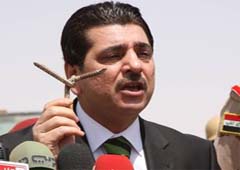
An Iraqi committee is to specify ways for terrorist MKO exit, said Iraqi Foreign Minister Hoshyar Zabari on Tuesday.

Zebari: Iraqi committee will decide for Mojahedin Khalq / US troops have to leave by end of the year

He made the remarks in a press briefing with Iranian counterpart Ali Akbar Salehi and said, "Iraqi regime’s stance for future of the group is clear. We have agreed that members of the group, now residing in Camp Ashraf, go to other countries. We have called for European parliaments and organizations to assist us and host some members of the group."

Zabari also said a committee is to be formed in Baghdad soon to determine ways for MKO members’ exit.

As to Iraq-US Security Pact, Zebari said, "the US troops need to leave Iraqi soil by the end of 2011."
Also Iranian Foreign Minister Ali Akbar Salehi said

First Vice President Mohammad Reza Rahimi is to visit Iraq on June 6 to join economic commission meeting.

The two sides also stressed expansion of mutual economic and political cooperation as well.
The MKO is listed as a terrorist group by much of the international community.

Founded in the 1960s, the group has masterminded many terrorist operations in Iran and Iraq.
The group is especially notorious in Iran for having sided with former Iraqi dictator Saddam Hussein during the 1980-1988 Iran-Iraq war.

The MKO has been in Iraq’s Diyala province since the 1980s.

June 22, 2011 0 comments
FacebookTwitterPinterestWhatsappTelegramSkypeEmail
Iraq

MKO must leave Iraq by end of 2011

The Iraqi foreign minister says members of the terrorist Mujahedin Khalq Organization (MKO) must leave Iraq, stressing that Baghdad’s stance on the issue is crystal clear.
The Iraqi foreign minister
“Camp Ashraf is to be shut down, and members of the [MKO] group have been given until the end of the current year (2011) to leave Iraqi soil,” Hoshyar Zebari said during a joint press conference with his Iranian counterpart Ali Akbar Salehi in Tehran on Tuesday, the Fars news agency reported.

He went on to say that Baghdad has proposed that a trilateral committee be established to discuss the situation of the terrorist organization.

Tehran and Baghdad also plan to hold talks with the Red Cross to discuss the future of the MKO members residing at the camp, he added.

Zebari also said the Iraqi government has suggested on several occasions that arrangements be made to facilitate the repatriation of the MKO members who want to return to Iran.

Elsewhere in his remarks, the visiting Iraqi official underscored that the US military’s presence in Iraq will not be extended unless Baghdad deems it necessary.

He stressed that the Iraqi people do not approve of the US military presence in their country, touching upon a security pact between Baghdad and Washington which requires that the withdrawal of American forces from Iraq by the end of 2011.

“The extension of US troops’ presence in Iraq is not an issue, unless the Iraqi government wants them to stay,” he said.

June 22, 2011 0 comments
FacebookTwitterPinterestWhatsappTelegramSkypeEmail
The MEK Expulsion from Iraq

Iraqis call for MKO expulsion

The Camp Ashraf , home to more than 3,000 members of the Mujahedeen Khalgh Organization (MKO) has been under spotlight once more.

In a conference in Tikrit in northwest of Baghdad, attended by a number of local officials, tribal leaders, the Iraqis called on the government to put pressure on the organization to leave the country as early as possible.

The participants called the presence of the MKO camp on Iraq soil unconstitutional stressing that the crimes against the Iraqi people by the MKO members are unforgettable.

Many here in this conference are of the opinion that Iraq will never see stability as long as MKO members are in the country.

The MKO is listed as a terrorist group by much of the international community.

Founded in the 1960s, the group has masterminded many terrorist operations in Iran and Iraq .

The group is especially notorious in Iran for having sided with former Iraqi dictator Saddam Hussein during the 1980-1988 Iran-Iraq war.

The MKO has been in Iraq’s Diyala province since the 1980s.

Erlier this year the MKO members attacked the Iraqi security forces who were attempted to enter the camp to open a new police station.

Tens of Iraqi security elements were injured in these clashes.

Wisam al-Bayati, Press TV, Tikrit

Download Iraqis call for MKO expulsion

June 21, 2011 0 comments
FacebookTwitterPinterestWhatsappTelegramSkypeEmail
Mujahedin Khalq Organization as a terrorist group

Exhibition to honor victims of MKO terrorists

Iran remembers the victims of terrorism.
Tehran is hosting a photo and poster exhibition to commemorate those killed in terrorist operations launched by the Iraq-based MKO.
The exhibition showcases the photos of a group of 12000 Iranians who have fallen victim to the terrorist nature of this group since the victory of the Islamic Revolution back in 1979.

This exhibition has been set up to show the true nature of the MKO and its supporters. In this exhibition we have also unveiled the links between the MKO and several other terrorist groups like Jondullah.
The Iraq-based MKO is listed as a terrorist group by much of the international community, but the US and a number of its European allies still throw weight behind the group.

Founded in the 1960s, the MKO has masterminded a slew of terrorist operations in Iran and Iraq, killing thousands of people and wounding many more.
The group is especially notorious in Iran because they took sides with former Iraqi dictator Saddam Hussein during the 1980-1988 Iraqi-imposed war on Iran.
Aside from ordinary people, the MKO has assassinated almost 200 revolutionary and important figures of the Islamic Republic of Iran including former Iranian President Mohammad-Ali Rajaei, Prime Minister Mohammad-Javad Bahonar, and Judiciary Chief Mohammad Husseini Beheshti. All were assassinated in 1981.

Saman Kojouri, Press TV, Tehran

Download Exhibition to honor victims of MKO terrorists

June 21, 2011 0 comments
FacebookTwitterPinterestWhatsappTelegramSkypeEmail
Iraq

Iraq – France relations strained over MKO terrorists event in Paris

The Iraqi government summoned the French ambassador to Baghdad to protest at Paris for hosting a conference of the Mojahedin-e Khalq Organization (MKO) where the terrorist group raised unfounded allegations against Baghdad.

Iraqi Gov’t Summons French Envoy over MKO Accusations

"To affect the international community and attract international support, the MKO has claimed that the Iraqi government has killed 35 members of the group and injured 350 others," the Iraqi government said on Monday.

"But, this is a sheer lie and Baghdad has not carried out such an action," the statement added.

The Iraqi people have announced their opposition to the presence of the MKO members in their country and have long staged protest rallies in front of the MKO’s main training camp in the Northern Diyala province to condemn the US-backed presence of the terrorist group in their country.

In a most recent case, a group of Iraqi people gathered outside Camp Ashraf in May, and called for the expulsion of the terrorist group from the country’s soil.

The Baghdad government has assured the Iraqi people that it is determined to expel the MKO from Iraq by the end of 2011.

The family members and relatives of the members of the MKO have also gathered outside the terrorist group’s main training camp in Iraq for more than a year now.

The MKO ringleaders have already adopted numerous measures to confront those relatives who have camped outside the Camp of New Iraq (formerly known as Camp Ashraf) in Iraq’s Northern province of Diyala.

The MKO ringleaders have not allowed a visit between the group’s members and their families.

After MKO ringleaders saw the number of defectors were increasing, they resorted to harsher measures and tried to haunt down fugitives in violation of their agreement with the Baghdad government which bans any activity or trafficking of the group members beyond the camp boundaries.

And after the Baghdad government failed to persuade the terrorist group to respect the agreement terms, it ordered the Iraqi Army to tighten control on the camp to prevent any illegal trafficking or infiltration, but the MKO attacked the Iraqi guards and killed and wounded many of them.

An Iraqi commander who was present on the scene of clashes in early April revealed later that the MKO sparked the armed conflict with the Iraqi security forces responsible for guarding the camp in a move to kill its dissident members during the clashes.

According to a report published by the website of the Habilian association in mid April – a human rights group formed of the family members and relatives of the Iranian victims of terrorism – the Iraqi commander, who was speaking on the condition of anonymity, said that the move by the MKO was not unprecedented since the group had previously forced its dissident members to start armed clashes with the Iraqi forces.

"The MKO’s foremost front was formed of the dissident members of the group during the recent clash. They were forced to be there and be killed," the Iraqi commander reiterated.

But, in an astonishing move which substantiated the West’s double-standard policies on human rights and terrorism, EU foreign policy chief Catherine Ashton called on Iraq to ignore the illegal activities of the MKO, including its armed clashes with the Iraqi soldiers.

The European Union has lately changed approach towards the terrorist MKO in a move to pressurize Iran to stop its progress in the civilian nuclear technology.

Some ranking members of the MKO who have had a role in the assassination of a large number of Iranian citizens and officials are currently living in France.

Before an overture by the EU, the MKO was on the European Union’s list of terrorist organizations subject to an EU-wide assets freeze. Yet, the MKO puppet leader, Maryam Rajavi, who has residency in France, regularly visited Brussels and despite the ban enjoyed full freedom in Europe.

The MKO is behind a slew of assassinations and bombings inside Iran, a number of EU parliamentarians said in a recent letter in which they slammed a British court decision to remove the MKO from the British terror list. The EU officials also added that the group has no public support within Iran because of their role in helping Saddam Hussein in the Iraqi imposed war on Iran (1980-1988).

Many of the MKO members abandoned the terrorist organization while most of those still remaining in the camp are said to be willing to quit but are under pressure and torture not to do so.

June 21, 2011 0 comments
FacebookTwitterPinterestWhatsappTelegramSkypeEmail
Iran

Iran holds an exhibition to honor victims of MKO terrorists

Iran remembers the victims of terrorism.
Tehran is hosting a photo and poster exhibition to commemorate those killed in terrorist operations launched by the Iraq-based MKO.

VIEW THE VIDEO FILE

The exhibition showcases the photos of a group of 12000 Iranians who have fallen victim to the terrorist nature of this group since the victory of the Islamic Revolution back in 1979.

This exhibition has been set up to show the true nature of the MKO and its supporters. In this exhibition we have also unveiled the links between the MKO and several other terrorist groups like Jondullah.

The Iraq-based MKO is listed as a terrorist group by much of the international community, but the US and a number of its European allies still throw weight behind the group.

Founded in the 1960s, the MKO has masterminded a slew of terrorist operations in Iran and Iraq, killing thousands of people and wounding many more.

The group is especially notorious in Iran because they took sides with former Iraqi dictator Saddam Hussein during the 1980-1988 Iraqi-imposed war on Iran.

Aside from ordinary people, the MKO has assassinated almost 200 revolutionary and important figures of the Islamic Republic of Iran including former Iranian President Mohammad-Ali Rajaei, Prime Minister Mohammad-Javad Bahonar, and Judiciary Chief Mohammad Husseini Beheshti. All were assassinated in 1981.

Saman Kojouri, Tehran

June 20, 2011 0 comments
FacebookTwitterPinterestWhatsappTelegramSkypeEmail
The MEK Expulsion from Iraq

MKO crimes against the Iraqi people unforgettable

The Camp Ashraf , home to more than 3,000 members of the Mujahedeen Khalgh Organization (MKO) has been under spotlight once more.

Iraqis call for MKO expulsion
 

In a conference in Tikrit in northwest of Baghdad, attended by a number of local officials, tribal leaders, the Iraqis called on the government to put pressure on the organization to leave the country as early as possible.

 
VIEW THE VIDEO FILE

The participants called the presence of the MKO camp on Iraq soil unconstitutional stressing that the crimes against the Iraqi people by the MKO members are unforgettable.

Many here in this conference are of the opinion that Iraq will never see stability as long as MKO members are in the country.

The MKO is listed as a terrorist group by much of the international community.

Founded in the 1960s, the group has masterminded many terrorist operations in Iran and Iraq .
The group is especially notorious in Iran for having sided with former Iraqi dictator Saddam Hussein during the 1980-1988 Iran-Iraq war.

The MKO has been in Iraq’s Diyala province since the 1980s.

Erlier this year the MKO members attacked the Iraqi security forces who were attempted to enter the camp to open a new police station.

Tens of Iraqi security elements were injured in these clashes.

Wisam al-Bayati, Tikrit

June 20, 2011 0 comments
FacebookTwitterPinterestWhatsappTelegramSkypeEmail
Mujahedin Khalq; A proxy force

Lobbying for MKO terrorists

Daniella Pletka of the Enterprise Blog wrote an article on MKO’s lobby in the United States and its lobbying efforts to get support for its removal from FTO list of US Department of State. Her illuminating post on MKO terrorists’ lobby in her country, as usual encountered with a deluge of Ad hominem attacks by MKO agents.

In her post Ms. Pletka offers evidences on MKO cult-like nature and dictatorial system:

The Hill reported on Sunday that the U.S.-designated terrorist group the Mujahedin e Khalq (aka the People’s Mujahedin of Iran, aka the National Council of Resistance) has acquired lobbying help from Democratic powerhouse Akin Gump to support its removal from the State Department’s Foreign Terrorist Organization list.
To be fair to Akin Gump, plenty of GOPers have taken up cudgels for the MEK, though the direct cash payoff to them is less clear.
The MEK has for years lobbied aggressively via a myriad of front groups to be taken off the terrorism list. Shrewd lobbyists, they have moved well beyond their street corner and airports campaign (“support Iran’s starving children”) to “grassroots” organizations and hired guns. And I get why they don’t want to be on the terrorism list; it comes with a spate of sanctions and restrictions that are odious to most groups no matter their intentions. But what of their partisans? Do they know the MEK? If not, check out Michael Rubin’s piece on the MEK or this FBI report from 2004, the list of murdered Americans, the money laundering, the cult-like behavior, the … terrorism. Is it all a lie? Has the MEK seen the light? Or is this a way of trying to oust the foul regime in Tehran?

She ends the post by posing some controversial questions:
And here’s another question: Where’s the FBI and the Justice Department? A terrorist group is lobbying in the United States. It’s paying top political fixers to make its case. It’s paying speaking fees to former government officials. Where’s the money from? How’s it being transferred? And would it be okay for Hezbollah to do this? Al Qaeda?

Following the fallacious attacks by sympathizers of the cult of Rajavi, Danielle Pletka posts another piece to respond on June 16. She confirms her arguments by addressing the commenters individually:

Yesterday, I wrote a post on the Mojahedin E Khalq, a U.S. designated terrorist group that has, through supporters, hired a big Dem lobbying firm to help them get off the State Department’s terrorism list. And as expected, I got a deluge of comments to the post. Here are some highlights: Apparently, according to commenter CNGS, some “intelligent folks” get that the MEK, a “group with a shinning [sic] record of close t[o] a half century of struggle against the Sheik and the Shah, having irrigated the tree of liberty with the blood of more than 120,000 martyrs,” is the best alternative to the mullahs now ruling Iran. After all, according to AH, the “MEK was put on terrorist list because of some lobbyist in Washington.”
… as for the lobbying that got the MEK on the list, all I can say is that they should have been on the list years before. Killing Americans in terrorist attacks merits a listing. Read the FBI report. I linked to it yesterday, here it is again. READ IT.

Then there were some other comments, in Alexgeorge1’s vein: He thinks that we “neocons better answer for the debacle you created in Iraq, handing that country to the terrorist mullahs of Iran on a silver platter.” Apparently, I also do wrong to reference my colleague Michael Rubin, whom Shahab accuses of writing “yellow journalism at best.” A few just helpfully offered “shame” on me.

Some comments in response; take them in the vein of helpful hints to the policy and etiquette impaired:

—Calling me names isn’t going to win me (or anyone) over to your cause.

—Organizations that used to be headquartered in Baghdad taking money from Saddam Hussein should probably shy away from the topic of Iraq. It might appear you miss dear old Saddam.

—Suggestions that the MEK was put on the terrorism list to appease Iran are well placed, but that doesn’t mean they shouldn’t be on the terrorism list.

—Just because well-known people have taken up the cudgels for the MEK doesn’t whitewash the stain of American blood nor address the question of the group’s own record of Islamism, cult-like behavior, murder, terrorism, or money-laundering. I note that no one denied those points in my original piece.

June 19, 2011 0 comments
FacebookTwitterPinterestWhatsappTelegramSkypeEmail
Iraqi Authorities' stance on the MEK

Government Spokesman: Iraq is not an American colony

“Insulting Statements” Strain US-Iraqi Relations
BAGHDAD – The Iraqi government’s demand that a US congressional team leave Baghdad after a congressman made “insulting statements” has once again strained sensitive relations between the two nations.

Dana Rohrabacher, a Republican congressman from California, angered Iraqi politicians and the citizens by suggesting that Iraq should repay the US millions of dollars when the country’s economy prospers.

Rohrabacher made the widely reported comments in a press conference in Baghdad last week after he and five other members of the congressional delegation met with Prime Minister Nuri al-Maliki. The delegation reportedly told Maliki that a US congressional committee is investigating violence between Iraqi forces and members of the Iranian dissident group Mojahedi-e-Khalq Organization that killed 34 people and injured 200 at Camp Ashraf north of Baghdad.

Following the comments, the Iraqi government told the US Embassy that the delegation was no longer welcome in Iraq, government spokesman Ali al-Dabagh said.

“This is the stance of a sovereign state towards the unacceptable attitude of those congressmen,” he said.

“Iraq is not an American colony where such insulting statements can be made against [Iraq’s] own interests,” Dabagh maintained.

Dabagh also said the delegates and the prime minister did not discuss Baghdad repaying the US government for the aid it has provided since ousting Saddam Hussein’s regime in 2003.
“In fact we should be the ones to demand compensation for all the damage and losses our people suffered as a result of their occupation,” he said.

Dabagh acknowledged that the delegation’s views did not reflect the US government’s position, and that the statements may have been made because of next year’s US election campaign.
An Iraqi government spokesman also said Iraqi government had rejected a request by the congressional team to visit Camp Ashraf.

“This is about sovereignty and we cannot allow just anyone to roam our country freely as they wish,” said the Iraqi government spokesman.

Mojahedin-e-Khalq is a dissident Iranian group whose members moved to Iraq in the 1980s and sided with the Iraq in its eight-year war with neighboring Iran. Since the fall of Saddam Hussein’s regime in 2003, the group has come under attack from the Iraqi army and militia groups believed to be funded by Iran.

Human rights organizations have called for investigating the April Camp Ashraf incident, the details of which are still unclear. Iraqi forces are accused of killing Iranian dissidents after storming the camp, while the Iraqi government claims the rebel group’s guards fired on residents.

The Iranian authorities want the Iraqi government to close down the camp and hand members of the Mojahedin-e-Khalq, which is banned in Iran and is also branded a terrorist group by the United States. Dabagh said the Iraqi government will try to find a country where members of the group can safely relocate.

Before heading to Baghdad, the congressional team was met by the Kurdistan region president Massoud Barzani. A source from president’s office said Barzani had thanked the United States for toppling the former regime.

Mohammed A Salih, Rudaw

June 18, 2011 0 comments
FacebookTwitterPinterestWhatsappTelegramSkypeEmail
Mujahedin Khalq; A proxy force

Blind support for MEK terrorists damages American diplomacy

There is something fundamentally wrong about the way the United States views the rest of the world and interacts with it. I would cite two incidents from the past week: In a Tuesday press Blind support for Mojahedin Khalq terrorists damages American diplomacyconference at the White House with German Chancellor Angela Merkel, President Obama fielded a series of questions on the US economy’s impending “double dip recession” and other domestic issues, leaving Merkel standing by and looking completely useless. I have never quite understood why the American President somehow believes that a press conference to introduce a visiting head of state is an appropriate forum for questions totally unrelated to the bilateral relationship or the visitor. It smacks of an arrogance that is completely unrestrained by either common sense or civility.

On Friday Congressman Dana Rohrabacher of California led a delegation from the House Foreign Affairs Committee in a meeting with Iraqi Prime Minister Nouri al Maliki. During an hour and 40 minute meeting, Rohrabacher informed al Maliki that his committee is investigating the killing by Iraqi troops of 35 Iranian dissidents in April. Rohrabacher called it a likely crime against humanity. Rohrabacher also asked Iraq to repay some of the costs of the 2003 US invasion and the subsequent occupation. An Iraqi government spokesman responded that Iraq would pay not “a cent” and the Foreign Ministry then demanded that the delegation leave Iraq. The Iranians in question are members of the Mujaheddin e Khalq (MEK), an Iranian terrorist group that found shelter in Saddam Hussein’s Iraq. It has been listed as a terrorist organization by the US government for the past ten years and has been implicated in the killing of Americans.

It seems that Rohrabacher and some fellow wingnuts to include Ileana Ros Lehtinen, the committee chairman, have a soft spot in their hearts for MEK because it is an enemy of the regime in Tehran. They have tried a number of times to get it delisted as a terrorist organization. Not coincidentally, the congressmen who are fond of MEK are also passionate supporters of Israel. My enemy’s enemy…

The point is that Rohrabacher and Obama fail to be guided by the Bobby Burns dictum to see ourselves as others see us. What Iraqis, whose country was invaded and in large part destroyed by the US, see is an arrogant and ignorant moron wrapped in congressional hubris who has done grave damage to them and is now asking that they should pay for it and even be indicted for war crimes when so many American crimes went unpunished. Germans watching the Obama-Merkel performance will understand that the US President was speaking to a media crowd that is so poorly informed and self-absorbed that they could not even come up with any decent questions for a respected and important visitor.

Philip Giraldi, American Conservative

June 18, 2011 0 comments
FacebookTwitterPinterestWhatsappTelegramSkypeEmail
Newer Posts
Older Posts

Recent Posts

  • A Child behind the Ideological Bars of Massoud and Maryam Rajavi

    August 8, 2026
  • A Comparative Analysis of Psychological Control Mechanisms in Jeffrey Epstein’s Cult and the MEK

    August 3, 2026
  • Operation Mersad: How Iran foiled Saddam’s final gambit 37 years ago

    August 1, 2026
  • Ideology Cannot Prevail over Human Dignity

    July 29, 2026
  • Is Rudy Giuliani so naïve to support MEK terrorists?

    July 27, 2026
  • Facebook
  • Twitter
  • Instagram
  • Youtube

© 2003 - 2025 NEJAT Society . All Rights Reserved. NejatNGO.org


Back To Top
Nejat Society
  • Home
  • Articles
  • Media
    • Cartoons
    • NewsPics
    • Photo Gallery
    • Videos
  • Publications
    • Books
    • Nejat NewsLetter
    • Pars Brief
  • About Us
  • Contact us
  • Editions
    • عربي
    • فارسی
    • Shqip