Nejat Society
  • Home
  • Articles
  • Media
    • Cartoons
    • NewsPics
    • Photo Gallery
    • Videos
  • Publications
    • Books
    • Nejat NewsLetter
    • Pars Brief
  • About Us
  • Contact us
  • Editions
    • عربي
    • فارسی
    • Shqip
Nejat Society
Nejat Society
  • Home
  • Articles
  • Media
    • Cartoons
    • NewsPics
    • Photo Gallery
    • Videos
  • Publications
    • Books
    • Nejat NewsLetter
    • Pars Brief
  • About Us
  • Contact us
  • Editions
    • عربي
    • فارسی
    • Shqip
© 2003 - 2024 NEJAT Society. nejatngo.org
MEK trial in Iran
Mujahedin Khalq; A proxy force

Iranian court uncovers MEK role in coordinated attacks with Israel during recent war

During ongoing legal proceedings against the Mojahedin-e Khalq Organization (MEK), Tehran’s Criminal Court heard new evidence linking the terrorist group to Israeli attacks during the recent 12-day war—including the targeting of a civilian hospital.

At the 36th public session of the trial, held Tuesday, at Branch 11 of Tehran Province’s Criminal Court One, presiding Judge Hojjatoleslam Amir-Reza Dehqani announced that MEK operatives had coordinated with Israeli intelligence by gathering data on traffic flow near Kermanshah’s Farabi Hospital and passing it on to the regime in Tel Aviv. The intelligence was used to carry out a deadly strike on the hospital.

Judge Dehqani opened the hearing by condemning Israel’s actions and praising the Iranian Armed Forces for defending national sovereignty in the face of foreign-sponsored terrorism. He also expressed condolences to the families of those killed in the recent war, declaring:
“We are witnessing a new phase of hegemonic aggression aimed at destabilizing independent nations by assassinating their intellectual and scientific leaders. These acts are designed to uphold an unjust global order maintained by arrogant powers.”
Daughter of martyred scientist demands justice

Zohreh Abbasi Davani, daughter of late nuclear scientist Dr. Fereydoun Abbasi Davani—killed in the recent Israeli-led assault—testified in court, calling for accountability in a prior 2010 assassination attempt on her father.
“The second attack claimed my father’s life, re-injured my mother, and killed a neighbor. Twenty-eight families were displaced. My father was not a military figure—he was a university professor devoted to the country’s scientific progress.”

Following her statement, Judge Dehqani revealed that new documents and testimony submitted by the second defendant showed active cooperation between MEK members and Israeli operatives, particularly in identifying and targeting Iranian nuclear scientists. He said the evidence would be reviewed in full and, if warranted, referred back to the Prosecutor’s Office.
Widow of another assassinated scientist: MEK targeted Iran’s scientific core

The widow of Dr. Masoud Ali-Mohammadi, another prominent Iranian nuclear physicist assassinated in a separate incident, also testified.

“Ten days before his death, my husband showed me emails and satellite images of nuclear sites sent by the MEK. When he refused to engage, they killed him.”

She added: “The MEK has betrayed the Iranian people since the Revolution. My husband’s killing wasn’t just a personal loss—it was an attack on the nation’s scientific backbone. It risks setting back Iran’s intellectual development for generations.”
Concluding her testimony, she formally pressed charges: “I demand that those within the MEK responsible for these crimes be held accountable.

Justice must be done

August 16, 2025 0 comments
FacebookTwitterPinterestWhatsappTelegramSkypeEmail
Nejat Newsletter no.127
Nejat Publications

Nejat Newsletter No.127

INSIDE THIS ISSUE
1. The NYTimes: the MEK has almost zero popularity in Iran
The NY Times reporter sees the MEK’s siding with Saddam Hus sein during the Iran-Iraq war as the dark spot in the MEK’s past, the act that many Iranians considered treason.

2. Regime change in Iran? MEK starts lobbying in the US, here’s what it aims for
The Iranian opposition in exile has begun lob bying in the US to gain the support of Presi dent Donald Trump. And to accomplish this, a lobbying company close to the Republicans, called “Special Guests Publicity”, has been engaged, which has connections to Trump’s inner circle.

3. Endless MEK’s anger towards New York Times. Why?
After the Israeli attacks on Iran, given the prospect of the so-called regime change in Iran, journalists are exploring the landscape of Iranian opposition groups. Dozens of news me dia have published articles analyzing the viable alternatives to the Iranian government. The majority of these investigative reports conclude that there is a lack of a unified and credible opposition for Iran.

4. Why the MEK is Not Considered a Viable Alternative
A significant factor is the MEK’s past associa tion with Saddam Hussein during the Iran-Iraq War, which has deeply damaged its reputation within Iran. The group’s alliance with Iraq, which included military opera tions against Iranian forces, is viewed by many Iranians as an act of treason, destroying the MEK’s standing in its homeland. This association is a major reason for the MEK’s unpopularity inside Iran,

5. Why is the MEK considered a destructive cult?
The Mujahedin-e Khalq (MEK), also known as the People’s Mojahedin Organization of Iran (PMOI) or the National Council of Resistance of Iran (NCRI) (which is widely considered an alias for the MEK), is considered a destructive cult due to a com bination of factors, including its charismatic and absolute leadership…

6. The MEK children who speak out
The experiences of children of the Mujahedin-e Khalq have attracted a lot of attention in recent years, to the point that one of the most frequently repeated facts about human rights viola tions in the MEK deals with the issue of children.

7. About Nejat Society

To view the pdf file click here

August 13, 2025 0 comments
FacebookTwitterPinterestWhatsappTelegramSkypeEmail
Women in the MEK: Trapped, tortured, and silenced
The cult of Rajavi

Female ex-member speaks of sexual and psychological abuse in the MEK

Cult leaders use a wide range of deceptive tactics to exert sexual and psychological control over their female followers. They often exploit women’s vulnerabilities and create an environment of dependency and fear. These methods are insidious and gradually destroy members’ psychological and intellectual independence and self-awareness.

In a recent article titled “The Complex Intersection of Sex and Cults,” American researcher Stephanie Elias argues that cult leaders often use sex as a tool for power and control, presenting themselves as divine or clairvoyant figures with whom sexual contact is essential for spiritual or personal growth. This manipulative tactic is often framed as part of a broader mission, whether that mission is to bring followers closer to “enlightenment” or fulfill some divine purpose. The leader becomes the ultimate arbiter of sexual relations within the group, determining who sleeps with whom, when, and why.
Documents and accounts from women who defected the Mujahedin-e Khalq (MEK) indicate that Massoud Rajavi, as the leader of the cult, also used sexual exploitation of women as a means of exerting power and control and creating dependency.

By focusing on sexual relations within the group structure, as Stephanie Elias writes, cults create an environment in which members come to believe that their emotional, physical, and spiritual well-being is tied to following the leader’s rules. Members may become conditioned to believe that abstaining from sex with the leader will lead to spiritual or personal failure. This creates a dependency on sexual “privileges” granted or withheld by the leader.

Sima, Another Witness to Rajavi’s Sexual Corruption

Batoul Soltani was the first woman to speak out after fleeing Rajavi’s destructive cult about Massoud Rajavi’s mass marriages with women of the leadership council, the “Liberation Dance” sessions, and the sexual relations of these women with Massoud Rajavi. Batoul Soltani’s horrific but courageous revelations were only repeated in quotes from other male defectors, such as Siamak Naderi, Iraj Mesdaghi, and Mohammad Reza Torabi, who they likely heard in private conversations with other former female members of the MEK.

Until the publication of the famous Intercept article in 2020, in which two journalists named Murtaza Hussain and Matthew Cole interviewed six former members of the MEK, no other female former member of the cult had spoken out openly about Massoud Rajavi’s sexual abuse of women and the practice of sterilization. Sima is the second female ex-member of the MEK to speak out in this investigative report about Massoud Rajavi’s sexual corruption.

In the Intercept article, “Defectors Tell of Torture, Forced Sterilization in Iran’s Militant Sect,” published on March 22, 2020, the authors state that their report contains the following: “Interviews with six defectors, including several who held senior positions, provide the most detailed account yet of life inside the MEK.”

Reza Sadeghi, Batoul Soltani, Issa Azadeh, Ghorbanali Hosseinnejad, and “Sima” were the five who allowed the Intercept to record their experiences in the MEK. Sima is the only person whose real name is not given in the Intercept report for ethical reasons, and is introduced as follows:

Another female member of the High Council at Camp Ashraf, whom The Intercept agreed to identify only as Sima, said she joined the MEK in the 1980s and left it in 2014. Unlike other former members, Sima asked that her real name not be used because she feared retaliation from current MEK members. She now lives in hiding in a European country and agreed to meet privately in a place where other local supporters of the group were unlikely to see her.

Sima explains her fear of the MEK to The Intercept: “You must know the organization and the psychological warfare that they start against you. They assassinate your personality and you will lose your closest friends; even your family wouldn’t trust you. This is the reason that these people are scared.”

According to the Intercept, Sima’s background in activism is that she joined the MEK in Iran after becoming disillusioned with other leftist movements that seemed hesitant to confront the Shah or the Islamic Republic. But unlike other interviewees, she said she never felt fully committed to the MEK ideology, and it was very difficult for her to find a way back to her old life after being caught up in the organization.

She moved to Camp Ashraf in Iraq after marrying another MEK member, where she realized she had nowhere else to go. At that time, caught up in Rajavi’s cult, the world outside of Rajavi’s control seemed both unreal and frightening.

Like other members of the MEK, Sima underwent years of military training at Camp Ashraf to prepare for what she saw as an imminent attack on Iran and the installation of Rajavi as the country’s leader. They carefully studied maps of possible attack routes and received weapons and intelligence training. Sima was also aware of the large amounts of money flowing to the MEK from Saddam Hussein’s intelligence services.

She was among those who managed the group’s finances in the years leading up to the 2003 US invasion of Iraq. “I was managing the money for the hundred people in my section,” Sima said. “We received sacks full of Iraqi dinars every month.”, Sima told The Intercept.

Over the years, she began to clash with the group. In response, they monitored her and forced her to attend grueling self-criticism sessions that she described as psychologically challenging. Around 2000, Sima was nearing breaking point. She and another woman plotted an escape from Camp Ashraf. They mapped out their escape in meticulous detail, but the other woman betrayed her to the leaders of the MEK. Sima was not only punished, but also severely ostracized and subjected to psychological torture.

For most of the next 14 years, Sima was confined to a section of Camp Ashraf, unable to move freely. Like Batoul Soltani, Sima spoke of an intense form of psychosexual manipulation by Rajavi, which she said had become an integral tool in controlling the female cadres. Sima recounted that years earlier, in 1998, “Rajavi gave every woman in the organization a pendant and told us that we were all dependent on him and no other man.” She was eventually forced to divorce her husband and, like Batoul Soltani, eventually was coerced to sleep with Rajavi.

The Sterilization Project

The Intercept reports on a more shocking directive that Rajavi gave to the organization’s female members, based on testimonies of Sima and Batoul Soltani. “I see some obstacles which have prevented us from reaching our goals and achieving victory,” Rajavi told members of the group, Soltani recalled. “That obstacle is hope for the future. We want to eliminate any kind of hope for the future from your mind. You are either with us or not!”
Sterilization was a tool to capture the full mental focus of women. “They said that this organ of the body, the womb, has made women want to be mothers someday and return to domestic life,” Soltani told the Intercept. “And so, meetings with women began, to get them to go in groups of 20 or 30 to have a hysterectomy.”

The women were to be examines at the MEK hospital in Camp Ashraf. The procedures were to be performed by a female MEK member trained as a physician, with the assistance of a local Iraqi doctor. At first, Soltani resisted. But eventually, “the pressure was so great that it broke my resistance and I too, should make an appointment. In other words, they gave so many and varied arguments for me to go to the hospital that I had no choice.”

Rajavi later asked at a meeting, referring to what he called “women who have abandoned the last vestiges of their sexual world and have undergone surgery,” “How many women have reached the peak?” The doctor replied that there had been 50. Soltani eventually left the MEK in 2006, before the operation could be performed on her.

And here’s Sima’s story in the sterilization project: After much insistence from the MEK leaders, Sima finally agreed to have her ovaries surgically removed in 2011. “When you’re brainwashed, you do anything. You would do any military operation, you would go and have sexual relations with your leader, you would sell information and intelligence. We were under constant control by the leader,” she told The Intercept.

Sima in the Free World

When Sima finally left the MEK, she said, “I felt like a lost person.” The United Nations arranged a meeting between her and her brother, whom she had not seen for 30 years. At first, Sima was reluctant to hug or kiss her brother, because she had become so alienated from her closest relative. Her brother taught her how to shop and use money. Sima said she told her brother, “I haven’t seen anything like this in about 30 years. I have completely forgotten what real life is like outside the MEK.”
“They destroyed my life,” she says quietly.
According to The Intercept, when she first spoke out against the group, current members requested a meeting. They offered her several thousand euros not to criticize the group, which Sima says she declined. “I told them, ‘You cannot return what I lost, my family, my husband. You cannot return that.’”

Mazda Parsi

August 11, 2025 0 comments
FacebookTwitterPinterestWhatsappTelegramSkypeEmail
The Italian parliament building (illustrative photo)
Mujahedin Khalq Organization as a terrorist group

Families of Iranian victims of terrorism protest Italian support for MKO

The families of Iranian victims of terrorism have issued an open letter to Italy’s judiciary and top lawmakers, condemning the reception given to the ringleader of the Mojahedin-e Khalq Organization (MKO) during her visit to Rome on July 30.

The letter, sent by the Habilian Association, which represented over 23,000 victims of terrorism, denounced the support shown by several Italian politicians and parliamentarians for the MKO, a group with a long history of violence and currently on trial in Tehran for acts of terrorism.

The letter outlined the MKO’s record, including its collaboration with former Iraqi dictator Saddam Hussein during the Iran–Iraq War and its involvement in attacks on Iranian and Iraqi civilians, which resulted in thousands of deaths.

Although the MKO was removed from the EU’s terrorism list in 2009, the letter said the group remained implicated in money laundering, internal human rights violations, and continued acts of sabotage in Iran through its so-called “rebellious units.”

The letter stated that the MKO’s former ringleader, Massoud Rajavi, had repeatedly incited armed violence against both military and civilian targets in Iran.

The families expressed deep concern over the actions of Italian officials, including the deputy speaker of parliament reportedly presenting an award to an MKO member and plans to host the group’s ringleader at the Italian parliament.

According to the letter, these events, which also included exhibitions and political propaganda, violated Italy’s anti-terrorism laws and the EU’s legal framework, both of which criminalized support for terrorist organizations, including promotion and provision of resources.

The letter argued that such actions not only contradicted Italy’s international obligations but also threatened public safety and risked damaging the historically friendly relations between Iran and Italy.

The Foreign Ministry summoned the ambassador over the Italian parliament’s decision to host the ringleader of the MKO terrorist cult.
“These actions called into question Italy’s commitment to fighting terrorism,” the letter stated, “and could negatively impact the psychological security of Italian citizens by enabling a group that openly promoted violence and sabotage.”

The families claimed that at least 12 MKO-affiliated front organizations operated in Italy and urged a thorough investigation into their activities.

The letter demanded that Italian authorities enforce anti-terrorism laws by investigating politicians who supported the MKO, banning its members from entering Italy, and prohibiting all forms of propaganda events associated with the group.

It urged the Italian parliament to provide a platform for the victims’ families to share their firsthand accounts of the MKO’s atrocities, equal to the space afforded to the group’s representatives.

“Italy, as a key member of the European Union, had the opportunity to demonstrate its commitment to combating terrorism and to prevent actions that promoted violence and instability, even when those actions targeted countries other than Italy,” the letter concluded, calling for immediate measures to halt unlawful support for the MKO.

The MKO has carried out numerous terrorist attacks against Iranian civilians and government officials since the 1979 Islamic Revolution.

A top Iranian criminal court has held dozens of hearings into the group’s crimes and is expected to continue its trial sessions.

August 9, 2025 0 comments
FacebookTwitterPinterestWhatsappTelegramSkypeEmail
Butterfly Gallery, an exhibition run by Nejat Society Albania
The cult of Rajavi

Butterfly Gallery, an exhibition run by Nejat Society Albania

In light and warmth of art and sound and thoughts, Nejat Society Albania organized the “Butterfly” exhibition – a gallery of photographs and caricatures that speak aloud. Placed carefully in every corner of the hall, these artistic works narrate the history and the life of Mujahedin-e Khalq (MEK).

The “Butterfly,” the symbol of freedom and transformation, was not chosen by chance. Like the butterfly emerging from its cocoon, many of the former MEK members have emerged from the darkness of manipulation and isolation, to finally find light and free air in Albania.

Through the images on display, viewers travel through painful realities: faces without smiles, eyes that speak of hopelessness, gloomy environments and constant checks. But at the same time, the gallery also offers glimpses of rebirth – people who today walk freely, who smile with their families, who say their names and identities out loud. They are former members of the MEK.

The cartoons, with their sharp pen and subtle irony, strike at the closed system of the MEK. They reveal the absurdity of life under command, where free thought was forbidden, and love for family was considered treason. One particularly poignant cartoon shows a member of the organization trying to embrace the shadow of his mother behind an iron curtain. It is a metaphor for the lost years, for the longing that was never heard, and for the fundamental right to love.

This gallery is not just an art exhibition. It is an act of remembrance. It is a voice for those who have been silenced for years. It is an invitation to reflection for all of us – to understand how precious freedom is and how quickly it can be taken away when we lose the right to choose our own lives.

On behalf of the Nejat Society Albania and in solidarity with all those who have suffered under the MEK’s oppression, this gallery remains a window of hope and courage. Because every butterfly that rises above the earth is a soul that has regained freedom.

Etleva Sulollari

Butterfly Gallery, an exhibition run by Nejat Society Albania

Butterfly Gallery, an exhibition run by Nejat Society Albania

Butterfly Gallery, an exhibition run by Nejat Society Albania

Butterfly Gallery, an exhibition run by Nejat Society Albania

Butterfly Gallery, an exhibition run by Nejat Society Albania

Butterfly Gallery, an exhibition run by Nejat Society Albania

Butterfly Gallery, an exhibition run by Nejat Society Albania

Butterfly Gallery, an exhibition run by Nejat Society Albania

Butterfly Gallery, an exhibition run by Nejat Society Albania

Butterfly Gallery, an exhibition run by Nejat Society Albania

Butterfly Gallery, an exhibition run by Nejat Society Albania

Butterfly Gallery, an exhibition run by Nejat Society Albania


August 4, 2025 0 comments
FacebookTwitterPinterestWhatsappTelegramSkypeEmail
Rudy Giuliani paid advocacy for Maryam Rajavi
Mujahedin Khalq Organization's Propaganda System

How much did Maryam Rajavi pay you?

Rudy Giuliani says he is “honored” to do interviews all day about Maryam Rajavi

Maryam Rajavi the leader of the Mujahedin-e Khalq (MEK) hosted former New York mayor Rudy Giuliani together with some other retired politicians in Rome, Italy. It seems that Rome gathering was an opportunity for former America’s Mayor to be “Honored to do interviews all day today about Maryam Rajavi and her ten point plan to have a free and democratic Iran”, as he stated on his X account. However, X users slammed him with a crucial question: How much did Maryam Rajavi pay him?

The exact amount Rudy Giuliani is currently paid by the MEK for speaking at or attending their rallies is not publicly disclosed in recent information. However, past reports and legal filings provide insight into his compensation from the group.

Giuliani has been a prominent advocate for the MEK for over a decade, participating in their events and giving speeches. While the precise current figures are not available, past estimates and statements shed light on his financial arrangements with the group. For instance, it has been reported by the Guardian in 2018, that speakers at MEK events have received between $30,000 to $50,000 per speech.

According to the report by Saeed Kamali Dehghan of the Guardian, John Bolton, another high-profile American politician who has spoken at MEK rallies, is estimated to have received upwards of $180,000 for multiple events, with a financial disclosure showing he was paid $40,000 for one speech in a particular year.

Rudy Giuliani says he is “honored” to do interviews all day about Maryam Rajavi

Rudy Giuliani says he is “honored” to do interviews all day about Maryam Rajavi

Giuliani himself has acknowledged receiving payment for his appearances. In a 2011 interview, Michael Mukasey, Giuliani’s former law partner and fellow MEK advocate, stated he was paid his standard speaking fee of $15,000 to $20,000 for talks at MEK-related events. While Giuliani would not elaborate on how much the group pays him for his appearances, he has defended his advocacy by stating that many other prominent U.S. politicians and military figures also participate in such activities. This was revealed in an investigative report on NBC News in October, 2019.

The financial arrangements between the MEK and its American political supporters, including Giuliani, have drawn scrutiny, particularly concerning compliance with the Foreign Agents Registration Act (FARA). FARA requires American citizens to disclose lobbying or public relations work on behalf of foreign entities to the Justice Department, regardless of whether they are compensated.

According to NBC News, Michael Mukasey, for example, registered as a foreign agent lobbying pro bono for the MEK’s political arm in 2017, though he stated he was not compensated for his advocacy but would be reimbursed for expenses. The report of NBC stated that Giuliani, however, has maintained that he has no reason to register under FARA because he does not plan to speak to U.S. government officials about the MEK.

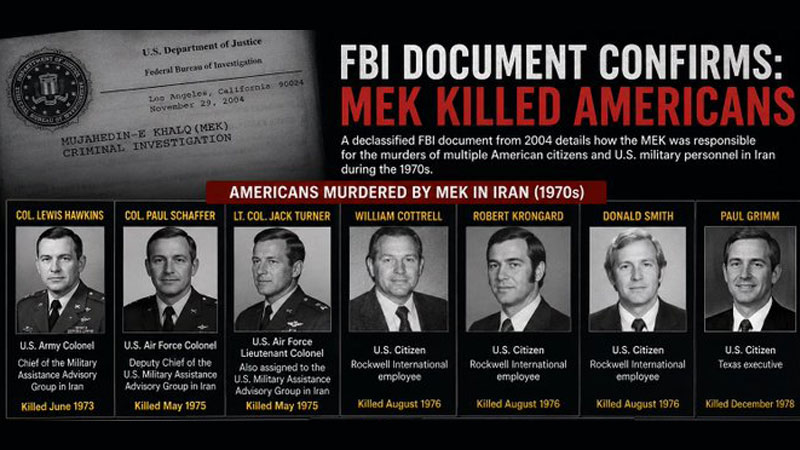
The MEK, a cult-like terrorist group with a complex history, was designated a foreign terrorist organization by the U.S. State Department until 2012. Despite its delisting, the group has attracted a network of American politicians who have been paid to advocate on its behalf. Critics, such as Daniel Benjamin, a former State Department counterterrorism coordinator, who was interviewed by NBC News have found it “distasteful” that these individuals “were shilling for this group even if it was delisted,” citing the group’s past actions, including the killing of Americans.

Moreover, the source of the MEK’s funding for these payments has also been a subject of speculation.

Mazda Parsi

Sources:
1. Kamali Dehghan, Saeed, Who is the Iranian group targeted by bombers and beloved of Trump allies?, The Guardian, July 2nd, 2018.
2. Julia Ainsley, Andrew W. Lehren and Rich Schapiro, Giuliani’s work for Iranian group with bloody past could lead to more legal woes, NBC News, October 17th, 2019.

August 3, 2025 0 comments
FacebookTwitterPinterestWhatsappTelegramSkypeEmail
Masoumeh Chaheh sister
Human Rights Abuse in the MEK

The West’s ‘democratic alternative’ tortured my sister to madness

Masoumeh Chaheh was 24 when she showed up at her family’s door in southern Tehran – bruised, scratched, and dishevelled. She couldn’t form coherent sentences about where she had been the past few years. “We were all shocked. We kept asking her what had happened, but she couldn’t explain anything. She just screamed, cried, and zoned out,” said Leila, Masoumeh’s younger sister, one of the first to find her in that state. “We didn’t know what to do. She kept running away, and eventually, we lost contact with her again.”

After fleeing home, Masoumeh was picked up by police while wandering Tehran’s streets. She eventually ended up in a psychiatric facility, where her family was notified of her whereabouts. “When she was still home, she used to mumble an anthem. We later found out it belonged to the Mojahedin-e-Khalq (MEK).”

The MEK is a terrorist organization that has operated mostly from outside Iran. Currently based in Albania (and previously in Iraq), the group is responsible for killing over 24,000 Iranians – including at least six people, one of them an infant, in a recent MEK-linked terrorist attack in southeastern Iran. Media outlets affiliated with the MEK characterized the terror attack as an “armed rebellion by the youth” and praised the terrorists for their brutal crime.

The MEK was listed as a terrorist organization in the U.S. and Europe for years, until its removal in the early-to-mid 2010s. The West has long used the group for espionage and attacks inside Iran. Most recently, during the Iran-Israel war, Western media and politicians attempted to rebrand the MEK, hailing it as a “reformed,” female-led faction and even floating it as a potential alternative to Iran’s government. One New York Times report wrote that the MEK now advocates for a “secular republic, gender equality, and a non-nuclear Iran.”

But for the MEK’s victims – like Masoumeh – no PR campaign can erase their suffering. Like many others, she didn’t join voluntarily, and leaving cost her everything: her sanity, and ultimately, her life.

“Masoumeh started taking care of us at just 8 years old, after our mother died. Our father was a construction worker and was usually away at work,” Leila explained. “She always put us first and dreamed of a better life for her siblings. She cooked for us, cleaned after us, and took us outside to play.” The family had seven children – two sisters, four brothers, and an older half-sister, Fatemeh, whose ties to the MEK would destroy Masoumeh’s future.

Fatemeh had been an MEK member but left before Saddam Hussein’s fall, when the group began to bar defections from its Iraqi camps. She moved to Finland and tried to bring over two financially struggling siblings – Masoumeh and her brother, Hamidreza –through an MEK contact she thought could be trusted. “They were supposed to go to Turkey first, then Finland,” Leila said. Instead, in 2001, the MEK member took them to the Ashraf Camp in Iraq.

The family lost contact immediately. Hamidreza resurfaced 14 years later, escaping during the MEK’s chaotic relocation to Albania. Masoumeh reached out sooner by randomly visiting them after four years – but her ordeal had been far worse.

“After being taken to Iraq, they were separated at Ashraf Camp. Both resisted at first, but Hamidreza bided his time. Masoumeh kept fighting back – so the group decided to ‘get rid of her,’” Leila said.

As previously documented by the Tehran Times, the MEK routinely sent defiant members to the infamous Abu Ghraib prison, which was well-known for the systematic torture of inmates. Masoumeh endured months of beatings, isolation, and psychological torment before Iraqi guards dumped her near Iran’s border. She then walked for days – starving, traumatized – only to face more violence from roadside thugs. By the time she reached Tehran, her mind was shattered.

“The person who came back wasn’t my sister,” Leila said. “She’d slip into catatonic states. When she did regain awareness, the memories made her try to kill herself – over and over.”

The final escape

For the next 20 years, Masoumeh cycled through psychiatric facilities, where she tried to take her life multiple times. Her last attempt, taking place in February of 2025, was successful. That day, Leila visited Masoumeh in the psychiatric hospital and then took her to a restaurant in Chaloos, a scenic route north of Tehran.

“Masoumeh used to love nature. So, I took her to a nice location to spend a few hours together. But as we sat at our table, she started recalling her past, so I tried distracting her. I looked away for seconds… and she was gone.”

Triggered by flashbacks of Abu Ghraib, Masoumeh had jumped into a nearby river. Her body was later found wedged against a tree trunk. “That was the end the MEK gave her – decades of torture, physical and mental, until she couldn’t take it anymore,” Leila said as tears began to rush down her face.

Masoumeh’s story is not unique. Before the West attempts to promote a terrorist outfit as a “democratic group”, similar to how it rebranded the Hayat Tahrir al-Sham (HTS) terrorists in Syria, it must reckon with dozens like her. Future Tehran Times reports will ensure they are not forgotten.

By Sheida Sabzehvari

August 3, 2025 0 comments
FacebookTwitterPinterestWhatsappTelegramSkypeEmail
MEK members' at camp ashraf
The cult of Rajavi

Why is the MEK considered a destructive cult?

The Mujahedin-e Khalq (MEK), also known as the People’s Mojahedin Organization of Iran (PMOI) or the National Council of Resistance of Iran (NCRI) (which is widely considered an alias for the MEK), is considered a destructive cult due to a combination of factors, including its charismatic and absolute leadership, enforced isolation and control over members’ lives, history of violence and shifting ideologies, and allegations of human rights abuses within the group [1] [2] [3].

The group was founded in the 1960s with a blend of Islamic and Marxist ideologies, initially opposing the Shah of Iran [1] [4]. After the 1979 Islamic Revolution, the MEK clashed with Ayatollah Khomeini’s new regime, leading to a period of assassinations and bombings against Iranian officials [1] [2]. In the 1980s, the MEK relocated to Iraq and allied with Saddam Hussein during the Iran-Iraq War, fighting against Iran [1] [4]. This alliance is a significant reason for its widespread unpopularity within Iran, as many Iranians view their collaboration with an enemy during wartime as unforgivable [1] [4].

Several former high-ranking members and human rights organizations have described the MEK as a cult. Masoud Banisadr, a former MEK representative to the UN and US, who left the group in 1996, now dedicates his work to understanding cults and terrorism, explicitly labeling the MEK a “destructive cult” [2] [3]. He highlights the presence of a charismatic leader (Masoud Rajavi, and later Maryam Rajavi), a black-and-white worldview, enforced isolation from family, and mind manipulation as key characteristics [2]. Banisadr recounts how members were encouraged to hate their family members if they were perceived as enemies and how he himself had to go into hiding after leaving the group [2].

Human Rights Watch and a 2007 US State Department report have documented allegations of severe mistreatment of MEK members, including forced divorces, lengthy solitary confinements, severe beatings, and torture for those attempting to leave the group [1] [4]. Banisadr himself was forced to divorce his wife, a common practice within the MEK where celibacy was enforced for all members except the Rajavi leadership [2] [3]. This control over personal relationships and the suppression of individuality are hallmarks of cultic behavior [2].

The MEK’s internal structure is far from democratic, despite its public portrayal as a democratic alternative to the Iranian government [1]. Critics argue that the group uses human rights concerns to obscure its past and present practices [1]. The group’s influence in Western political circles is often attributed to its significant financial contributions to speakers at its events, with estimates ranging from $30,000 to $50,000 per speech [1]. Despite its efforts to rebrand itself as a democratic force, analysts and former members assert that the MEK has little to no visible support inside Iran [1] [4].

Sources:
[1] Kamali Dehghan, Saeed, Who is the Iranian group targeted by bombers and beloved of Trump allies?, The Guardian, July 2, 2018.
[2] Adam Forrest, A Former MEK Member Talks About the Extremist Iranian ‘Cult’, VICE, September 2, 2014.
[3] Potter, Richard, The Cult in the Shadow War: An Interview with a former member of Mojahedin-e-Khalq, Mondoweiss, November 26, 2013.
[4] Lo, Joe, UK MPs attended rally for Iranian group whose leader is still banned by London, Middle East Eye, January 30, 2018.

Mazda Parsi

July 28, 2025 0 comments
FacebookTwitterPinterestWhatsappTelegramSkypeEmail
Massoud Rajavi
Massoud Rajavi

Rajavi’s complex mix of miscalculation for Eternal Light

Massoud Rajavi’s decision to launch the “Forough Javidan” (Eternal Light) operation in 1988, which resulted in significant casualties for his forces, was driven by a complex mix of strategic miscalculation, political ambition, and a profound misunderstanding of the prevailing conditions. The operation, also known as Mersad by Iran, was a large-scale military offensive by the Mujahedin-e Khalq (MEK) from Iraq into Iran, aiming to capture Tehran and overthrow the Iranian government in three days.

Rajavi’s miscalculations

One primary reason for Rajavi’s decision was his belief that the Iranian government was on the verge of collapse and that the Iranian public would rise up to support the MEK’s advance. This assessment was a critical misjudgment.
The Iran-Iraq War had severely weakened Iran, and the country had just accepted UN Resolution 598, signaling a willingness to end the conflict. Rajavi interpreted this as a sign of the Iranian government’s weakness and desperation, believing that a final push would lead to its downfall. He underestimated the Iranian people’s hatred against the MEK and their loyalty to the Islamic Republic, despite the war’s hardships. The MEK had been largely isolated from the realities inside Iran, operating from Iraq under Saddam Hussein’s patronage, which may have contributed to this skewed perception. Also, the Iranian nation despised the MEK because it had allied with the invader, Saddam Hussein.

Rajavi’s deep-rooted animosity against Iran

The MEK had been engaged in a pitiless war with the Islamic Republic of Iran since 1981, including from Iraq during the Iran-Iraq War. Rajavi, having sided with Saddam Hussein against his Iranian country-fellow, was seen as a traitor by many Iranians. This intense ideological conflict and desire for revenge likely fueled his determination to launch a decisive attack.
Another significant factor was the MEK’s reliance on Saddam Hussein’s support and their integration into the Iraqi military strategy. Saddam armed the MEK with Iranian weapons captured from Iranian troops and provided them with a base in Iraq. Massoud Rajavi, had close cooperation with Saddam Hussein, who entrusted them with the assassination of figures like Lieutenant General Sayyad Shirazi, who had inflicted heavy losses on Saddam’s army during the Iran-Iraq war. Saddam’s strategic objectives, which included creating a buffer zone and destabilizing Iran, aligned with the Rajavi’s ambitions, leading to a joint offensive. The MEK, with Iraqi air power cover, aimed to advance rapidly towards Kermanshah and ultimately Tehran.

Rajavi’s cult-like dictatorship

The MEK’s internal structure and leadership style also played a role. The organization was characterized by a “guru-like-leadership” where Rajavi held “divine power” and brainwashed members, controlling even their personal matters. This cult-like environment fostered unquestioning loyalty and may have suppressed dissenting opinions regarding the feasibility of the operation. Members were reportedly enslaved to the leadership’s decisions, making them willing to sacrifice their lives for the cause.

Bad timing for Rajavi

Finally, the timing of the operation, shortly after Iran accepted UN Resolution 598, was critical. Rajavi likely saw this as a window of opportunity, believing that Iran’s military was disorganized. However, Iran’s acceptance of the ceasefire allowed it to re-focus its military efforts on the MEK, leading to a swift and decisive counter-attack known as Operation Mersad. The Iranian military, including the Revolutionary Guard and the Army, unified their efforts and launched a coordinated response, utilizing paratroopers and air power to demolish the MEK forces. The MEK’s expectation of a popular uprising in Iran never materialized, and they were met with strong resistance from the Iranian military and civilians.

In summary, Massoud Rajavi’s decision to launch the Forough Javidan operation was a catastrophic miscalculation rooted in an overestimation of the MEK’s support within Iran, an underestimation of the Iranian government’s resilience, deep-rooted animosity towards Iran, and a strategic alignment with Saddam Hussein that ultimately backfired. He lost over one thousand of his forces including men, women and even child soldiers like Maryam Gheitani and Zohair Zakeri.

Mazda Parsi

July 26, 2025 0 comments
FacebookTwitterPinterestWhatsappTelegramSkypeEmail
Maryam Rajavi
Maryam Rajavi

Why is Maryam Rajavi’s “Third Option” dismissed?

The “Third Option” as articulated by Maryam Rajavi, the leader of Mujahedin-e Khalq, is a strategic approach to regime change in Iran that rejects both foreign military intervention and appeasement of the current clerical regime. While the so-called third option should seem reasonable and democratic for the opponents of the Iranian government, it has not been embraced by them.

It depends on who’s proposing third option

The MEK’s background and nature are not compatible with the principals of third option. The apparent principals of third option are the followings:

1. No Foreign War: The strategy avoids any form of foreign military involvement in Iran
2. No Appeasement: It rejects negotiations and any diplomatic approach toward the Iranian government.
3. Regime Change by the Iranian People and Resistance: The core tenet is that regime change should be achieved through the efforts of the Iranian people and their organized resistance

The first principal is unheard of in the MEK’s background. The MEK was the only group that chose armed struggle is its fight against the Iranian newly established government in 1980s. It sided with Iraqi dictator in the first foreign war against Iran. It acted like the private army of Saddam Hussein in intelligence and military operations against Iranians.

After the fall of Saddam Hussein, the MEK was disarmed by the US military. Since then, it has been cooperating with the US and Israeli intelligence services and military in order to destabilize the government in Tehran.

Maryam Rajavi rejects diplomatic solutions because negotiation and diplomacy has never been a part of MEK’s strategy. The group has always been violently suppressing its opponents, critics and even its own dissident members. The only diplomatic effort made by the MEK has been through its hefty multi-million-dollar lobbying campaign in western parliaments.

The most controversial principle of third option is the last one: Regime change by the Iranian people and resistance. Maryam Rajavi has consistently emphasized that the Iranian people possess the essential elements for change.

The “organized resistance” that Rajavi refers to is allegedly the MEK’s network of supporters, activists, and members, both inside and outside Iran, who are committed to overthrowing the current regime. Where are these people?

It was just a few weeks ago that the New York Times reported that the MEK has almost zero support inside Iran.

The MEK dreams of mobilizing such a network to create a broad-based movement capable of challenging the Iranian government’s authority. However, the reality of the Iranian political scene indicated the opposite. Iranians of any political hate the MEK. Even if they want regime change, they do not trust Maryam Rajavi.

Democratic values and Third Option

According to Maryam Rajavi’s claims, the Third Option is presented as a democratic alternative to war and appeasement, with the goal of establishing a free, secular, and non-nuclear Iran. Its framework often highlights the MEK’s commitment to democratic values, human rights, and a secular government in Iran. This is intended to appeal to a broad range of Iranians and garner international support for the movement.

The success of third option highly depends on the ability of the MEK to effectively mobilize and organize the Iranian population. The strategy has been the subject of considerable debate and scrutiny, with critics questioning the MEK’s past actions and its ability to represent the diverse interests of the Iranian people.

The contradiction between Maryam Rajavi’s advocacy for democratic values for Iranians and the fact that MEK has a history of violence, cult-like practices, and internal authoritarianism, is the crucial topic raised by the experts. This contradiction is a complex issue with significant implications for the MEK’s credibility and its claims to represent the Iranian people.

The MEK’s internal structure and leadership have always been subject to scrutiny. Critics have described the group as a cult, citing its strict hierarchical structure, personality cult around Massoud Rajavi (Maryam Rajavi’s husband), and thought control and isolation of members. Defectors have reported instances of forced confessions, restrictions on contact with the outside world, forced celibacy and the suppression of dissent. These practices are seen as antithetical to democratic values, which emphasize individual freedom, critical thinking, and open dialogue.

Maryam Rajavi’s leadership role in the MEK raises questions about her commitment to democratic principles. The MEK’s internal structure and past actions contradict the values she publicly espouses, and so it undermines her credibility as a champion of democracy for Iran. The MEK’s history of violence and its cult-like practices have created a significant challenge for Maryam Rajavi to reconcile her advocacy for democratic values with the reality of the organization she leads.

The core of the contradiction lies in the disparity between the MEK’s stated goals of establishing a democratic Iran and the means it has employed to achieve those goals, as well as its internal organizational structure. The use of violence, the suppression of dissent, and the cult-like practices within the MEK are seen as incompatible with the democratic values that Maryam Rajavi claims to uphold. This contradiction raises questions about the MEK’s true intentions and its ability to govern democratically if it were to come to power in Iran.

Mazda Parsi

July 21, 2025 0 comments
FacebookTwitterPinterestWhatsappTelegramSkypeEmail
Newer Posts
Older Posts

Recent Posts

  • Farman Shafabin, MEK member who committed suicide

    December 3, 2025
  • Nejat Newsletter No.131

    December 3, 2025
  • Israeli Hayom: The case for redesignating the MEK, Learning from history

    November 29, 2025
  • Propaganda and Cyber Operations of the Mujahedin-e-Khalq (MEK) Terrorist Group

    November 23, 2025
  • Mujahedin-e Khalq| resistance or violence

    November 18, 2025
  • Facebook
  • Twitter
  • Instagram
  • Youtube

© 2003 - 2025 NEJAT Society . All Rights Reserved. NejatNGO.org


Back To Top
Nejat Society
  • Home
  • Articles
  • Media
    • Cartoons
    • NewsPics
    • Photo Gallery
    • Videos
  • Publications
    • Books
    • Nejat NewsLetter
    • Pars Brief
  • About Us
  • Contact us
  • Editions
    • عربي
    • فارسی
    • Shqip