Nejat Society
  • Home
  • Articles
  • Media
    • Cartoons
    • NewsPics
    • Photo Gallery
    • Videos
  • Publications
    • Books
    • Nejat NewsLetter
    • Pars Brief
  • About Us
  • Contact us
  • Editions
    • عربي
    • فارسی
    • Shqip
Nejat Society
Nejat Society
  • Home
  • Articles
  • Media
    • Cartoons
    • NewsPics
    • Photo Gallery
    • Videos
  • Publications
    • Books
    • Nejat NewsLetter
    • Pars Brief
  • About Us
  • Contact us
  • Editions
    • عربي
    • فارسی
    • Shqip
© 2003 - 2024 NEJAT Society. nejatngo.org
The MEK Expulsion from Iraq

Mass escape, an alternative option before MKO

The fate of MKO and Ashraf residents in Iraq appears to have been sealed and the members are waiting their relocation to another temporary camp that can put them under the strict control of the Iraqi forces until they will have been sent out of the country completely. Unpredictable as a dangerous terrorist cult, the question is whether the dismantlement of MKO in Iraq and eviction of its stronghold will be an unchallenged task to accomplish? According to the assertions of Mrs. Soltani, a ranking detached member of MKO, the Ashraf residents have Rajavi’s order of committing a mass suicide as a protest to any imposed decision that may happen to be a challenge against the entity of the organization and its forcible displacement. However, it might be the last solution but not necessarily the first as it may cost a lot and at the present Rajavi prefers to expend as little as possible and not to venture the forces that can be used as human shield at any time. Although a working cult tactic of having revenge and imposing demands on the Iraqi Government, as they have already practiced it in France, Rajavi seems determined to preserve them for their potentialities to perform other big tasks.

It is not the first time Rajavi is getting mired in a grave situation to save the forces. Concentrated in a variety of camps and benefitting the benevolence and patronage of Saddam, Rajavi’s solution to weather the consequences of the coalition force’s invasion and decrease the casualties was to disperse the concentrated members throughout the Iraqi soil to reorganize them when the right time came. The process stopped, however, just when it was to start since the both side made a bargain and came to an agreement and the forces were concentrated in a single camp, Ashraf. It was much better to take a shelter under the protective umbrella of the US forces to guarantee the preservation of its forces and it actually worked and lasted at least for a few years. But where and under whose protection could they take shelter if the forces had to disperse?

No better option could they find than to seek and find refuge in the strongholds and areas under the control of the advocates of Saddam and dissidents to the newly established Iraqi Government. The remnants of the loyalists to Saddam and Baath Party could better than anybody protect and shelter them, trusting them as Saddam had before, and take advantages of their various military and information potentialities. Who knows, it could become much harder for the new government to confront and tackle with the insurgent and dissident parties and groups, less experienced in activities that required organizational aptitudes. Experts in masterminding violent and terrorist plots, MKO’s collaboration with rebellious dissidents could lead the country to a worse chaotic situation and harder-to-control internal disorder.

Failing to arrive at any agreement with the present government to prolong its stay in Iraq and within its walled Ashraf stronghold, MKO can only rely on Saddamists and remnants of Baath Party that predominate in Takrit region. They have an open arm for MKO since it objected Saddam’s execution that was a green light of loyalty and its readiness to be at the service of his loyalists. Always opportunists, MKO has never cut ties with dissidents as it had anticipated a day when it needed friends in high places. MKO has two alternatives before it; just wait to be relocated to Baghdad and to be transplanted to an isolated prison camp or implement the same plan it suspended after establishing rapport with the US forces. The Iraqi forces must be cautious about the unexpected.

A purely hypothetical question at the first look, the escape and dispersion of Ashraf residents is an option on the table of the organization; it may be a hard job to control the stealthy escape operation and to block their escape routes although not impossible. For Rajavi, tying the destiny of its organization to that of al-Qaeda and Baath dissidents is less challenging than easily assenting to an uncertain destiny of relocation. Early concerns over the presence of the terrorist MKO in Iraq somehow abated when it was disarmed and reduced the danger of its terrorist collaboration with the Iraqi dissidents and insurgents regardless of how costly it was for the new government. But to permit an easy scattering and escape of these trained members to fight on the side of the dissidents would bring more violence in the disturbed Iraq and will be much more costly to tackle with them. MKO is unpredictable and the Iraqi Government has to be cautious and serious as well as considering all controlling and security measures in the process of the members’ relocation.

January 9, 2010 0 comments
FacebookTwitterPinterestWhatsappTelegramSkypeEmail
Iraqi Authorities' stance on the MEK

Iraq firm in expelling the MKO

A member of the Iraqi parliament insisted that Iraq is firm in its decision to expel the anti-Iran terrorist group, the Mujahedin-e Khalq Organization (MKO) from the country.

Muhammad Al-Hamidawi called the terrorist cult’s presence in Iraq “illegal”, adding that “the conditions for asylum seeking as well as the terms of Geneva Conventions do not apply to the members of the cult”. He said the Iraqi government “is firm and serious in expelling the MKO,” Habilian Association (families of Iranian terror victims) news website quoted Mehr News Agency as reporting.

“The MKO entered Iraq during Saddam Hussein’s rule just due to its enmity towards Iran. Now we should destroy this cult, a way of which is their relocation from Camp Ashraf,” said the member of Al-Fadhilah Islamic Party in the Iraqi parliament.

“The MKO’s presence in Iraq has made so many problems to our nation due to usurping their lands, but also it is illegal according to the Iraqi Constitution,” Hamidawi insisted.

He confirmed there were pressures on the Iraqi government not to expel the terrorist cult, insisting Iraq “is determined to expel the MKO”, since the cult has had “several interventions in Iraq’s internal affairs both now and under Saddam’s rule and has been in contact with some of those who are well known for their opposition to the current Iraqi political situation”.

January 9, 2010 0 comments
FacebookTwitterPinterestWhatsappTelegramSkypeEmail
Mujahedin Khalq; A proxy force

UK blamed for provoking violence in Iran

Alleged supporters of the Iranian opposition have asked the British government to stop the Mojahedin Khalq Organization (MKO) terrorists from provoking violence in Iran.
 
Head of the Middle East Strategy Consultants in the UK, Massoud Khodabandeh, called on British Prime Minister Gordon Brown to stop the MKO from fomenting violence by sending supportive messages to Iran’s opposition movement.

"We would expect that you act immediately to prevent the incitement to violence by the terrorist [MKO] from inside the UK," Khodabandeh, a former MKO member, wrote in a letter to Brown.
"In doing so you would remove from Iranian hard-liners their main excuse for crushing the people’s legitimate protests to bring about change in their own country."

Iran has blamed Britain, the US, the Zionist regime and the MKO of masterminding and supporting the riots that erupted after the presidential election in June 2009.

Tehran has also strongly condemned the interference of foreign countries in its internal affairs after the US and Britain praised the group of people who held anti-government protests on the Shia Muslim religious event of Ashura when people commemorate the 7th century martyrdom of Prophet Muhammad’s (PBUH) grandson, Imam Hussein (PBUH).

Police used tear gas to disperse the protesters who damaged public property, set trashcans on fire, and clashed with security forces.

In his letter to the British prime minister, Khodabandeh said that Britain’s tacit support of the MKO would endanger the government and its interests, UPI reported.

"Britain, following Washington’s lead, has put herself in a position where she is seen to support terrorism," he wrote. "This is not in our interests."

January 9, 2010 0 comments
FacebookTwitterPinterestWhatsappTelegramSkypeEmail
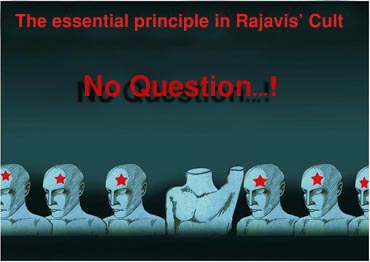
The cult of Rajavi

MKO Indoctrinates Members

MKO Indoctrinates MembersMKO Indoctrinates Members

January 6, 2010 0 comments
FacebookTwitterPinterestWhatsappTelegramSkypeEmail
Mujahedin Khalq as an Opposition Group

Iran blames PMOI for Mousavi death

The dissident People’s Mujahedin of Iran is responsible for the assassination of the nephew of Iranian opposition leader Mir Hossein Mousavi, officials said.

Demonstrations in Iran on the Shiite holy day of Ashura turned violent as supporters of the opposition movement clashed with security forces and set fire to a local police station.

Iran puts the official death toll from the weekend unrest at eight, while opposition Web sites claim as many as 12 died in the weekend demonstrations.

Among the dead was Ali Mousavi, the nephew of opposition leader and former Prime Minister Mousavi. Early reports said Mousavi was assassinated during a drive-by shooting in Tehran; government authorities denied involvement in the attack.

Iranian Intelligence Minister Haidar Moslehi said investigators now believe members of the PMOI were behind the assassination, Iran’s semiofficial Fars News Agency reports.

"We have no doubt that (the PMOI) has been involved in this issue," he said.

The PMOI is under fire to leave its base in Iraq’s Diyala province. The group earned a terrorist designation for its violent action against the clerical regime in Iran. It now claims it is acting peacefully to advocate regime change in Tehran.

Tehran blames the PMOI, the United States and Britain for the political unrest in the country.

January 6, 2010 0 comments
FacebookTwitterPinterestWhatsappTelegramSkypeEmail
Mujahedin Khalq; A proxy force

The West must cut its terror ties

The world has been put on notice that Yemen is a worrying center of activities by terrorists. The question is, how many other countries can be added to that list? The Daily Star is publishing an open letter to British Prime Minister Gordon Brown, by Massoud Khodabandeh, a UK-based The West must cut its terror tiesconsultant who demands that the Mojahedin-e Khalq organization be brought under control. The group, which is termed “terrorist” by the United States, is allowed to operate freely in Germany, France and the United Kingdom, and its satellite programs are inciting violence on the streets of Iran.

Meanwhile, the Iranian authorities are claiming that some of those arrested in the demonstrations and clashes are Mojahedin-e Khalq members, purportedly acting with the connivance of Western intelligence agencies.

Whatever the exact degree of Western involvement with the Mojahedin-e Khalq, the group remains a candidate for partnership with Western governments, who preach about fighting terror.

The Mojahedin-e Khalq might be a footnote in the wider struggle, but it’s the nail that punctures the great powers’ approach to Iran. Why harbor the group if it’s terrorist? If the West can’t agree on who’s a terrorist, how do they expect an agreement with the Muslim world?

The partisans of the Mojahedin-e Khalq aren’t just reporting the news from London; they’re inciting and agitating, and acting as a fifth column (whatever their actual size). They help ensure that the dispute between factions in Iran takes a course that leaves behind any possibility of reasonable settlement.

People in this region mentally note that the West, in some way or form, enables the efforts and activities of the Mojahedin-e Khalq while demanding action on terror. Today, Hillary Clinton is warning us about Yemen; can we be absolutely sure that such shadowy foreign policy tools aren’t being used there too?

Similar credibility damage has come from Blackwater in Iraq, and the larger Private Military Contractor phenomenon. Many Iraqis have suffered the exactions of these mercenaries; last week, a group of Blackwater employees found out that they wouldn’t have to stand trial for murder. People hear the stories of Blackwater, and the Mojahedin-e Khalq, and all of the Obama administration’s rhetoric of fighting extremists and violence goes out the window.

Even worse, people assume that the West actually seeks a clash with the Muslim world, by allowing these harmful elements to survive or flourish.

If the West wants to go forward with new sanctions on Iran, and seeks regional and international support, it simply must clean up its act. It can’t allow these terrorists and non-state actors to wreck the chances for making a real fight against the economic underdevelopment and political illegitimacy that plagues us, and that incubates the terror that Washington is so worried about.

The Daily Star

January 6, 2010 0 comments
FacebookTwitterPinterestWhatsappTelegramSkypeEmail
The MEK to launch Armed Struggle

The New Year and the new promise of MKO leader

The assertion by Iranian authorities to have arrested a number of MKO members during the Ashura riots in Tehran is an indication that the organization is so fickle in its pro-democratic claims concerning a democratic change in Iran. Regardless of what the Iranian regime’s authorities refer to as the engagement of foreign hands in the recent anti-government riots, for certain the agents that carried the operations have been those who have long announced war and armed struggle against the regime and have proved to be serious in their strategy and can never make any change to turn to peaceful and democratic ways.

It is a tactic to temporally renounce violence and terrorism to achieve certain organizational goals as MKO could easily dupe the Europeans, as it can also be regarded a bilateral cooperation and a mutually arrived agreement, to be removed from the terrorist list of the EU. The evidence mainly focused on was MKO’s claim that it had stopped its terrorist plots against the Iranian regime since 2001. At least in a number of post-election violent riots in Iran that left many casualties and deaths the organization has claimed to have played a role and the announced arrest of its members asserts their claim. Just following the bloody Ashura clashes, Maryam Rajavi told AFP in Paris that her followers were already cooperating with more recent protest movements on the streets of Tehran and called on opposition leaders to do the same.

The Iranian people have known the violent nature of MKO from the long past and know that it has a direct, or claim to have, role in aggressive and violent anti-government moves and unrests; it is either engaged in or glorifies terrorism. For sure, the world is watching and hearing. The Rajavis statements only make it much more difficult for them to be accepted by any country, none yet, as the Iraqi Government is decisive to expel them. Some believe the organization has started a new round of suicide attempt as it did in the Operation Eternal Light and attacked Iranian borders to try its chance to overthrow the regime. Of course, at the time it had the abundant military and logistical backing of Saddam when it received the heaviest military strike.

Now, again, Mrs. Rajavi has predicted that the government of Iran would fall within 12 months if foreign powers remain neutral. And of course they never intend to act directly but through all media and propaganda potentialities that foils any sense of impartiality. And the New Year has just started. Does it mean that the advocates, members and sympathizers, most in their mid and old ages, have to wait another year, as they have in the past thirty years? And of course, most of them know nothing will come out since the organization has not changed its policy of devotion to use of violence that is instead pushing the organization further onto the eagle of a precipice. Besides, the Iraqi Government does not seem to have any intention of setting another 12 months deadline to reprieve relocation of Ashraf.

January 5, 2010 0 comments
FacebookTwitterPinterestWhatsappTelegramSkypeEmail
Habilian Foundation

Iraqi Kurd scholars meet Habilian SG

A number of Iraq’s Kurdistan senior Islamic scholars met the Secretary General of Habilian Association (families of Iranian terror victims) in Mashhad.

Seyyed Mohammad Javad Hasheminejad welcomed the group, headed by Sheikh Hussein Khushnawati, to “the Iran’s spiritual capital city”, hoping “a good cooperation” between Iran and Iraq, Habilian Association (families of Iranian terror victims) news website reported.

“Iran’s enemies enjoyed utmost use of terrorist groups”

“The enemies used terrorist groups widely to break the Iranian nation’s unity. The US used the anti-Iran terrorist group, the Mujahedin-e Khalq Organization (MKO), in the midst of Iran-Iraq war against our country. The cult assassinated several Iranian senior officials as well ordinary people. The enemies also created terrorist groups in the name of backing Iraq’s Kurdistan,” the Secretary General of Habilian Association said.

“US wants MKO stay in Iraq”

“The MKO is much hated both in Iran and Iraq, since it has committed many crimes against the two nations. However, the US wants the MKO stay in Iraq. The cult is currently planning to intervene in Iraq’s forthcoming parliamentary elections. The MKO, as well as other terrorist groups does not like a secure Iraq,” Hasheminejad added.

“More relationships are welcomed”

“Your association is named after Habil (Abel), the son of Adam, which shows your humane views. By the way, Abel was not willing to do any harm to his evil brother,” Jamal Muhammad, Imam of Halabja Mosque said. “Opposite to you is Qabil (Cane) or the MKO, who fought with Saddam Hussein against you and also destroyed many Kurd villages. We want you to continue holding such meetings,” he insisted.

“I am also willing to continue this. The more security in Iraq, the more friendship between the two countries,” Hasheminejad said.
“MKO assisted Saddam in removing Iran-Iraq shared heritage”

“We have many things in common, but the MKO aided Saddam in removing our shred heritage. We hope to meet you soon in Iraq’s Kurdistan,” said Seyyed Muzaffar Pirkhezri, a university lecturer and chief of Pirkhezri Seyyeds.

“Part of Saddam’s savage crimes in Iraq was committed by the help of the MKO. The cult committed many crimes in Kifri and Tuz Khurmatu and we should say that it many MKO crimes are committed in Iraq’s Kurdistan,” Hasheminejad commented.

“Habilian, the first and only anti-terrorism organization in Iran”

Issa Barzanchi, another member of the Iraqi group, asked Mr Hasheminejad if Habilian Association is registered in international organizations.

“We are the first and only anti-terrorism official organization in Iran and we could manage to collect a full list of Iranian terror victims. We have given the Iraqi officials confidential documents we have gained against the MKO. However, we are not willing to register the Association in international organizations, since they only back those who repeat their words. There have been many talks between me and Western officials, including those in Geneva. They said they didn’t know the MKO, though they supported the cult to be removed from terrorist organizations lists,” Hasheminejad answered.

January 5, 2010 0 comments
FacebookTwitterPinterestWhatsappTelegramSkypeEmail
Mujahedin Khalq; A proxy force

Mojahedin Khalq used again to disseminate false information

U.S. Intelligence Found Iran Nuke Document Was Forged

 WASHINGTON, 28 Dec (IPS) – U.S. intelligence has concluded that the document published recently by the Times of London, which purportedly describes an Iranian plan to do experiments on what the newspaper described as a "neutron initiator" for an atomic weapon, is a fabrication, according to a former Central Intelligence Agency official.
Philip Giraldi, who was a CIA counterterrorism official from 1976 to 1992, told IPS that intelligence sources say that the United States had nothing to do with forging the document, and that Israel is the primary suspect. The sources do not rule out a British role in the fabrication, however.

The Times of London story published Dec. 14 did not identify the source of the document. But it quoted "an Asian intelligence source" – a term some news media have used for Israeli intelligence officials – as confirming that his government believes Iran was working on a neutron initiator as recently as 2007.

The story of the purported Iranian document prompted a new round of expressions of U.S. and European support for tougher sanctions against Iran and reminders of Israel’s threats to attack Iranian nuclear programme targets if diplomacy fails.

U.S. news media reporting has left the impression that U.S. intelligence analysts have not made up their mind about the document’s authenticity, although it has been widely reported that they have now had a full year to assess the issue.

Giraldi’s intelligence sources did not reveal all the reasons that led analysts to conclude that the purported Iran document had been fabricated by a foreign intelligence agency. But their suspicions of fraud were prompted in part by the source of the story, according to Giraldi.

"The Rupert Murdoch chain has been used extensively to publish false intelligence from the Israelis and occasionally from the British government," Giraldi said.
The Times is part of a Murdoch publishing empire that includes the Sunday Times, Fox News and the New York Post. All Murdoch-owned news media report on Iran with an aggressively pro-Israeli slant.

The document itself also had a number of red flags suggesting possible or likely fraud.

The subject of the two-page document which the Times published in English translation would be highly classified under any state’s security system. Yet there is no confidentiality marking on the document, as can be seen from the photograph of the Farsi-language original published by the Times.

The absence of security markings has been cited by the Iranian ambassador to the International Atomic Energy Agency, Ali Asghar Soltanieh, as evidence that the "alleged studies" documents, which were supposedly purloined from an alleged Iranian nuclear weapons-related programme early in this decade, are forgeries.

The document also lacks any information identifying either the issuing office or the intended recipients. The document refers cryptically to "the Centre", "the Institute", "the Committee", and the "neutron group".

The document’s extreme vagueness about the institutions does not appear to match the concreteness of the plans, which call for hiring eight individuals for different tasks for very specific numbers of hours for a four-year time frame.

Including security markings and such identifying information in a document increases the likelihood of errors that would give the fraud away.

The absence of any date on the document also conflicts with the specificity of much of the information. The Times reported that unidentified "foreign intelligence agencies" had dated the document to early 2007, but gave no reason for that judgment.

An obvious motive for suggesting the early 2007 date is that it would discredit the U.S. intelligence community’s November 2007 National Intelligence Estimate, which concluded that Iran had discontinued unidentified work on nuclear weapons and had not resumed it as of the time of the estimate.

Discrediting the NIE has been a major objective of the Israeli government for the past two years, and the British and French governments have supported the Israeli effort.
The biggest reason for suspecting that the document is a fraud is its obvious effort to suggest past Iranian experiments related to a neutron initiator. After proposing experiments on detecting pulsed neutrons, the document refers to "locations where such experiments used to be conducted".

That reference plays to the widespread assumption, which has been embraced by the International Atomic Energy Agency, that Iran had carried out experiments with Polonium-210 in the late 1980s, indicating an interest in neutron initiators. The IAEA referred in reports from 2004 through 2007 to its belief that the experiment with Polonium-210 had potential relevance to making "a neutron initiator in some designs of nuclear weapons".

The National Council of Resistance of Iran (NCRI), the political arm of the terrorist organisation Mujahedeen-e Khalq, claimed in February 2005 that Iran’s research with Polonium-210 was continuing and that it was now close to producing a neutron initiator for a nuclear weapon.

Sanger and Broad were so convinced that the Polonium-210 experiments proved Iran’s interest in a neutron initiator that they referred in their story on the leaked document to both the IAEA reports on the experiments in the late 1980s and the claim by NCRI of continuing Iranian work on such a nuclear trigger.

What Sanger and Broad failed to report, however, is that the IAEA has acknowledged that it was mistaken in its earlier assessment that the Polonium-210 experiments were related to a neutron initiator.

After seeing the complete documentation on the original project, including complete copies of the reactor logbook for the entire period, the IAEA concluded in its Feb. 22, 2008 report that Iran’s explanations that the Polonium-210 project was fundamental research with the eventual aim of possible application to radio isotope batteries was "consistent with the Agency’s findings and with other information available to it".

The IAEA report said the issue of Polonium-210 – and thus the earlier suspicion of an Iranian interest in using it as a neutron initiator for a nuclear weapon – was now considered "no longer outstanding".

New York Times reporters David Sanger and William J. Broad reported U.S. intelligence officials as saying the intelligence analysts "have yet to authenticate the document". Sanger and Broad explained the failure to do so, however, as a result of excessive caution left over from the CIA’s having failed to brand as a fabrication the document purporting to show an Iraqi effort to buy uranium in Niger.

The Washington Post’s Joby Warrick dismissed the possibility that the document might be found to be fraudulent. "There is no way to establish the authenticity or original source of the document…," wrote Warrick.

But the line that the intelligence community had authenticated it evidently reflected the Barack Obama administration’s desire to avoid undercutting a story that supports its efforts to get Russian and Chinese support for tougher sanctions against Iran.

This is not the first time that Giraldi has been tipped off by his intelligence sources on forged documents. Giraldi identified the individual or office responsible for creating the two most notorious forged documents in recent U.S. intelligence history.

In 2005, Giraldi identified Michael Ledeen, the extreme right-wing former consultant to the National Security Council and the Pentagon, as an author of the fabricated letter purporting to show Iraqi interest in purchasing uranium from Niger. That letter was used by the George W. Bush administration to bolster its false case that Saddam Hussein had an active nuclear weapons programme.

Giraldi also identified officials in the "Office of Special Plans" who worked under Undersecretary of Defense for Policy Douglas Feith as having forged a letter purportedly written by Hussein’s intelligence director, Tahir Jalail Habbush al-Tikriti, to Hussein himself referring to an Iraqi intelligence operation to arrange for an unidentified shipment from Niger.

By Gareth Porter

*Gareth Porter is an investigative historian and journalist specialising in U.S. national security policy. The paperback edition of his latest book, "Perils of Dominance: Imbalance of Power and the Road to War in Vietnam", was published in 2006.

January 4, 2010 0 comments
FacebookTwitterPinterestWhatsappTelegramSkypeEmail
Iraq

Iraqis Set to Reclaim Usurped Lands from MKO

Iraqi citizens in the city of Khalis in Diyala province filed lawsuits to regain ownership of their lands usurped by the anti-Iran terrorist group, the Mojahedin-e Khalq Organization (MKO), during the rule of the former Iraqi dictator Saddam Hussein.
Iraqi citizens in the city of Khalis in Diyala province filed lawsuits to regain ownership of their lands usurped by MKO
"A number of Iraqi citizens have filed lawsuits against the MKO at the local courts in the city of Khalis demanding reparation for the usurpation and occupation of 1500 hectares of their farming lands by the grouplet during the recent years," Deputy Governor-General of Diyala Odai al-Khadran said.

Describing the terrorist group as a major threat to Iraq’s security, he reiterated that many Iraqi people and the government are seeking an expulsion of the group from the Diyala province and from the country.

He also said that none of the Iraqi citizens dared to file a lawsuit against the MKO in Saddam Hussein’s era as the terrorist group acted as the regime’s arm for repression.

The MKO has been in Iraq’s Diyala province since the 1980s. The Iraqi government and parliament have announced that they would not tolerate the group anymore and that they are seeking to expel the group from the country in the near future.

The anti-Iran terror group has been blacklisted as a terrorist organization by many international entities and countries.

The MKO is behind a slew of assassinations and bombings inside Iran, a number of EU parliamentarians said in a recent letter in which they slammed a British court decision to remove the MKO from the British terror list. The EU officials also added that the group has no public support within Iran because of their role in helping Saddam Hussein in the Iraqi imposed war on Iran (1980-1988).

Many of the MKO members abandoned the terrorist organization while most of those still remaining in the camp are said to be willing to quit but are under pressure and torture not to do so.

A May 2005 Human Rights Watch report accused the MKO of running prison camps in Iraq and committing human rights violations.

According to the Human Rights Watch report, the outlawed group puts defectors under torture and jail terms.

The group started assassination of the citizens and officials after the Islamic Revolution in Iran in a bid to take control of the newly established Islamic Republic. It killed several of Iran’s new leaders in the early years after the Revolution, including the then President Mohammad Ali Rajayee, Prime Minister Mohammad Javad Bahonar and Judiciary Chief Mohammad Hossein Beheshti who were killed in bomb attacks by MKO members in 1981.

The group fled to Iraq in 1986, where it was protected by Saddam Hussein and where it helped the Iraqi dictator suppress Shiite and Kurd uprisings in the country.

The terrorist group joined Saddam’s army during the Iraqi imposed war on Iran (1980-1988) and helped Saddam and killed thousands of Iranian civilians and soldiers during the US-backed Iraqi imposed war on Iran.

The MKO was put on the US terror list in 1997 by the then President, Bill Clinton, but since the 2003 US invasion of Iraq, the group has been strongly backed by the Washington Neocons, who also argue for the MKO to be taken off the US terror list.

January 4, 2010 0 comments
FacebookTwitterPinterestWhatsappTelegramSkypeEmail
Newer Posts
Older Posts

Recent Posts

  • Rebranding, too Difficult for the MEK

    December 27, 2025
  • The black box of the torture camps of the MEK

    December 24, 2025
  • Pregnancy was taboo in the MEK

    December 22, 2025
  • MEPs who lack awareness about the MEK’s nature

    December 20, 2025
  • Why did Massoud Rajavi enforce divorces in the MEK?

    December 15, 2025
  • Facebook
  • Twitter
  • Instagram
  • Youtube

© 2003 - 2025 NEJAT Society . All Rights Reserved. NejatNGO.org


Back To Top
Nejat Society
  • Home
  • Articles
  • Media
    • Cartoons
    • NewsPics
    • Photo Gallery
    • Videos
  • Publications
    • Books
    • Nejat NewsLetter
    • Pars Brief
  • About Us
  • Contact us
  • Editions
    • عربي
    • فارسی
    • Shqip