Nejat Society
  • Home
  • Articles
  • Media
    • Cartoons
    • NewsPics
    • Photo Gallery
    • Videos
  • Publications
    • Books
    • Nejat NewsLetter
    • Pars Brief
  • About Us
  • Contact us
  • Editions
    • عربي
    • فارسی
    • Shqip
Nejat Society
Nejat Society
  • Home
  • Articles
  • Media
    • Cartoons
    • NewsPics
    • Photo Gallery
    • Videos
  • Publications
    • Books
    • Nejat NewsLetter
    • Pars Brief
  • About Us
  • Contact us
  • Editions
    • عربي
    • فارسی
    • Shqip
© 2003 - 2024 NEJAT Society. nejatngo.org
Mujahedin Khalq Organization members' families

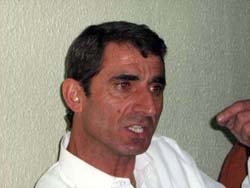
Alireza Ahmad Khah’s family appeal against MKO leaders

Alireza Ahmad Khah, a resident of Camp Ashraf was killed.

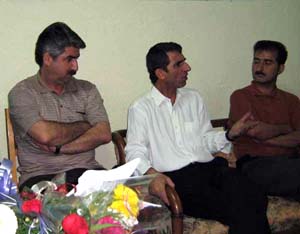
Immediately after the publication of the news of MKO residents’ clashes with Iraqi forces, families who are members of Nejat Office in Gilan including Ahmad Khalh family came over. They welcomed the act of Iraqi government to take complete control of Camp Ashraf, appealing the Iraqi government and all Human Right bodies for the release of captured residents of Ashraf from the bars of Rajavis’ cult.

They are also looking forward for the fate of their beloved ones who might face a bright future, by visiting their families far from the deadly atmosphere of Camp Ashraf.

Ali Reza Ahmad Khah was among those Ashraf residents who were killed in clashes which were intensified due to MKO leaders’ stimulations. His family was seriously concerned about his health. They regularly came to Nejat Society office to get news of health of their beloved son.

He was another victim of Rajavi’s ambitions.

It is worth to know that MKO itself anticipated contacting Ahmad khalh family to inform them of the death of their son! Of course not for informing them but for abusing his blood to make a new show off in front of world witnesses but Ahmad Khah family who suffered years of being uninformed of their beloved son, insulted the caller that “ why you never called us to give the news of his health in all those past twenty years?!”

Now we see you as responsible for the death of our beloved one. You must be tried before all international courts.

The following is Ahmad Khah family’s appeal for justice:

August 25, 2009 0 comments
FacebookTwitterPinterestWhatsappTelegramSkypeEmail
Former members of the MEK

Massoud asked arrogantly:”Does anyone claim to have a husband other than me?”

Memoirs of Ms. Batoul Soltani – Part 22

The members of the Leadership Council were convinced to marry the leader with the reasoningMassoud asked arrogantly: "Does anyone claim to have a husband other than me?" and logics that Maryam and Massoud gave them. They may simply be convinced due to the way Maryam viewed them. She had already spoken to the members in a humiliating manner in order to make sure that they would be persuaded that “ideological marriages are superior to normal marriages”!

This reasoning recalls Surdell’s dialectic that says:” to escape from humbleness, the individuals have to shelter before the one who humiliates them. Therefore, the relationship between leaders and members was managed in a way that the justifications were easily accepted. I would like to note some justifications Maryam and Massoud made to convince us.

Maryam accused us of having a reactionary mind that motivated us to feel a distance between Massoud and ourselvesIn order to convince us to marry him, Massoud Rajavi said in a meeting: “if the peak of sexual marriage is 10, then the peak of ideological marriage will be one thousand. Imagine that you are in a hall with a very high ceiling, if you are under a table, the top side of the table will be the peak of an ordinary marriage which signifies a wife-husband relationship, but the ceiling of the hall will be the peak of an ideological ideal relationship. Your mind is filled with old thoughts; you think that I am stranger to you, so you are not comfortable with me. Now that we want to remove this obstacle and we want to remove the quotation marks from the women, we use this scheme.” According to the leaders of MKO, “Women in quotation marks” (cult jargon) signifies women who have grown up in an ordinary society with normal regulations ruling it. They meant the traditional weak women.

Maryam Rajavi tried to degrade the traditional women who “are always owned by their husband.” She insisted that we were still in that situation and we didn’t pass over those old thoughts.

Naturally, we tried to remove that humiliating view from ourselves. The leaders looked dawn on us so we accepted everything they said. They always tried to make us doubt our individuality. If we were not able to present a case about one of our minor colleagues, Maryam would punish us. She accused us of distancing ourselves from Massoud. Then she concluded that the problem comes from our thinking. I could never convince myself to accept their justification from the bottom of my heart.

Maryam accused us of having a reactionary mind that motivated us to feel a distance between Massoud and ourselves. Then she concluded that in order to remove this distance, we should marry him. She made us believe that we never had the right to have another husband. Then in the meeting Massoud asked us arrogantly: "Does anyone claim to have a husband other than me?"

Then he added “if anyone feels she belongs to her ex-husband for the least part, she should get out of the room.”

In fact, with his reasoning, Massoud convinced the members that he sacrificed himself to release the women from the old, traditional, reactionary thoughts that always exploited women in the history.

In MEK, the leaders try to make you believe that Massoud Rajavi is the only one who is always ready for change and revolution; the only one who scarifies himself to solve others’ contradictions; he is the only one who accepts every responsibility. Therefore he is not an ordinary man! This is what the organization makes us to believe.

August 25, 2009 0 comments
FacebookTwitterPinterestWhatsappTelegramSkypeEmail
Terrorist groups and the MEK

Pro-Baath Group Opposes Calls for MKO Expulsion

Pro-Baath Group Opposes Majority Calls for MKO  Expulsion 

 An Iraqi group with records of cooperation with Iraq’s former Baath regime announced that it supports presence of the anti-Iran terror group, the Mojahedin-e Khalq Organization (MKO) inside Iraq.

The Iraqi Habilian website reported that the group, Islamic al-Sadr Society, which formed in Lebanon’s southern city of Tyre in 2002 announced in a statement that it supports MKO’s stay inside Iraq.

Iraq’s security forces took control of the MKO’s training base at Camp Ashraf – about 60km (37 miles) north of Baghdad – last month and detained dozens of the members of the terrorist group.
The Iraqi authorities also changed the name of the military center from Camp Ashraf to the Camp of New Iraq and underlined expulsion of the group’s members from Iraq.

The society which is not more than a 5 roomed building had first become a gathering center for former Iraqi dictator Saddam Hussein’s opposition figures and refugees inside Lebanon, the website said.

Yet, former Iraqi opposition figures say that later the group recruited Iraqis and gathered information about anti-Baath Iraqis via detailed questionnaires.

Habilian reported that "Valid Mayahi" an opponent of Saddam regime was assassinated at the center of the suspicious group. After Mayahi’s death, 100 application forms and questionnaires with data and information about identification of anti-Saddam figures disappeared and were later transferred to the Baath regime’s intelligence apparatus.

The report also noted that the group’s formation was aimed at identification of anti-government figures and transferring their list to the Intelligence ministry.

August 24, 2009 0 comments
FacebookTwitterPinterestWhatsappTelegramSkypeEmail
Former members of the MEK

Weekly sessions, a process to secure obedience to Rajavi

An interview with Batool Soltani on MKO self-immolations – Part twelve

Sahar Family Foundation: Ms, Soltani, you pointed out something interesting concerning the Weekly sessions, a process to secure obedience to Rajavimechanism of suicide operations and self-immolations, that is, how easily one can carry out these organizationally inculcated operations just by making a liaison with a point out of one’s own self. That is, one overruns his individuality and will for a greater cause crystallized in another person called leader. The logic, regardless of its justifiably luring virtue, does not end here because any thought and attitude can easily justify itself through such a logic. That is true about many adherents of cults who do anything for the guru, preaching right or wrong notwithstanding. Following such logic, any group can claim to be rightfully on the right path and it has nothing to do at all with the nature of the source of liaison. There were people on the side of Yazid (a reference to a historical event when the army of Yazid massacred all forces on the side of Imam Hussein, the third Shi’it imam) who had accepted the leadership of Yazid and fought against Imam Hussein with a gesture of goodwill and for the sake of God. Is it right to say that liaison with a source of leadership justifies a truth? If so, there are many antitheses to discuss. Was there any opportunity to discuss these discrepancies and what were Rajavi’s responses?

Batool Soltani: Indeed there were many controversies and, of course, Rajavi insisted that the members of the Leadership Council take their time to solve any ambiguity and raised question. But his answer to these ambiguities was that first it had to be discovered why people had joined the side of the wrong. He insisted on recognition of what had motivated them to join. There was no question if they had joined for worldly and ambitious causes but it was different if they were fighting on the wrong front for the cause of truth. Then it turned to be a matter of the ideologically polluted system of the opposite front. He mainly focused on the polluted ideology of the followers of the opposite front. He gave example of the operation Eternal Light saying that we would call our killed forces martyrs as did the Islamic Republic and strongly contradicted its claims to be on the right path; he believed that the IR had deceived and misled who had come to confront the rightful Mojahedin’s forces. The IR forces had not erred in attaching themselves to the IR leadership but it was the wrong ideology that had misled them.

SFF: Then it was not totally a matter of ambitions since they too fought for ideological causes and had attached themselves to someone out of their own self.

BS: That is why he would say they had ideologically been misled and anybody following Khomein’s ideology failed to be accounted as our forces who could never be ideologically affiliated with the regime. None of the either sides could possibly agree on the oriented ideology of the opponent, but there were those who walked a middle path and dodged seeing their interests in danger. He would call them compromisers who never walked in a fixed front and changed their position whenever sensed danger from any side. Thos who shunned, for example, committing suicide or self-immolation when it was necessary belonged to this very same group. They are people of ambitions and opportunists who are enslaved by their whims and avarice and infiltrate into both sides to fill their pack and have nothing to do at all with the ideology and the leadership. In fact, he believed, they were attached to nobody but themselves while the real forces adherent to either ideology resisted to the end and never changed their positions.

Those who stood on Rajavi’s side were known to be the true believers of a right ideology while the others on the opposite front were perverted and aberrant. He would adduced the Quran as his proof for his theory and would say the Quran classifies people into four groups; the righteous, the martyrs, the faithful and the prophets. Nothing was to be told about the last group that was an exception. One way to recognize the sincere who assented to commit suicide operations was to see his frequent attendances of weekly hold sessions of ablution and confession*. It was the recognized boundary between the true ideological believers and the opportunists. It was Rajavi’s instructions preached in the meetings of the members of the Leadership Council and insisted that those who refused and dodged to attend weekly sessions of cleansing and confession would certainly stop midway in the path of struggle while others, who attended sessions, continued to the end.

These instructions were all included in the especial book prepared by himself for the members of the Leadership Council who had to attend weekly sessions as well to prove their sincerity. He would call the weekly ablutions a ‘great crusade’ through which one could unite his within with without and dared to outpour all counter-values that hindered when the time came to sacrifice to defend the leader and his interests. These were the faithful who had even outstripped the martyrs, that is what he believed in. There were sympathizers who came to take part in the demonstrations and would donate sums of money to help but never risked their life in practical struggle. They were the righteous but still lagged far behind the martyrs. Unlike them, the faithful risked their life anywhere in the world just to defend and safeguard the interests of the leadership by setting themselves on fire. They outshined the martyrs.

Now, what was the touchstone to distinguish them? They could be recognized in the frequency of taking part in the weekly sessions of ablution and who cleaned their selves by pouring out what was passing within them; their personal penchants, lust, insincere tendencies, and whatever hindered them to be unified with Rajavi. The ones that merged with Rajavi made no attempt to conceal anything from him and if they had to, it was a matter of submission to his order. Nothing could come between them and the leader and they had fused into one. No doubt, such devoted people never disappointed their leader when the time came to commit suicide and set themselves on fire. Thus, this is an answer to existing contradiction within Rajavi’s system. But I can give more details to resolve these contradictions. I think Rajavi followed a model that he had theorized in its most extreme form.

At times in inter-organizational relations and meetings, Rajavi would decry the idea of being touched by Khomeini. He meant that we should not do things to be afraid of being condemned of following the models and ideological guidelines of Ayatollah Khomeini. But then it changed. Rajavi resolved that his relation with the members and sympathizers had to be set on such pattern that was further explained in a speech by Mehdi Abrishamchi. What he said in general was that the organization should have no reluctance in abandoning fears of condemnation and following a pattern in its struggle to topple the regime. The best pattern at hand he recommended to adhere to and practice within the organization was Ayatollah Khomein’s relation with his followers, mainly founded on people’s compliance with him. Of course, they disregarded his charismatic influence on his followers that goes far beyond ordinary logic or self-interest and since Rajavi failed to understand and explain such devotional relationship, he tried to interpret it within the terms like detachment from the self and attaching to a source without; that is, the members have to be completely devoted to their leader and prepared to do anything he commands- even kill others, or themselves.

The more the time passed, the more he was obsessed with plans to become a magnet to draw devoted members and insisted to exactly, even if forcibly, accomplish the pattern he was holding onto. He was merging the principle of guidance with its authoritative aspects and opportunism to create a holy man of himself called the ideological leader. He dissolved all those assemblies and bodies whose role was to supervise the leadership and became the egocentric leader and center of all decision makings and identical to nobody in the modern world; a morally, ideologically and politically infallible leader who was even exceeding the pattern he had chosen. Thus, he became a leader from whom even the ideology drew its legitimacy.

To be continued

*. According to a recently published official report by RAND, the MeK holds daily, weekly, and monthly “sessions” that involve forced public confessions aimed at expelling deviant thoughts and behaviors that are believed to undermine group coherence. MeK members are required to keep daily records of their thoughts and nighttime dreams, particularly sexual thoughts and desires (which are, of course, forbidden), as well as observations about their fellow members. They must submit their journals to their supervisors. During large meetings, members often are forced to read their reports aloud and to make self-critical statements. MeK members are often required to admit to sexual thoughts.

August 24, 2009 0 comments
FacebookTwitterPinterestWhatsappTelegramSkypeEmail
Missions of Nejat Society

Nejat Society Gilan Branch appeal to human rights bodies

Following the arrival of Iraqi police to Camp Ashraf and its aftermath which ended with casualties among Ashraf residents, families of Nejat Society tried to contact Nejat Office in Rasht expressing their concern over the health of their beloved children; however they welcomed the act of Iraqi authorities.

The families are well informed of Iraqi humanitarian act to help their beloved ones release from the bars of Rajavi’s Cult, recognizing Iraqi right to control their own territory including Camp Ashraf. Thus, in current crucial situation of Ashraf residents they ask ICRC High Commission for Refugees and all Human Rights bodies especially those of Iraqi nation to help their captured children get rid of the manipulative system of MKO Cult.

The families seriously fear that MKO leaders victimizing the rank and file members of the organization in order that they can save their own lives.

Therefore they urge Iraqi government to arrest authorities of MKO and try them for their criminal acts and treasons against their own members in Ashraf and the crimes they committed against Iraqi and Iranian civilians. In addition, they asked for facilities for the return of dissatisfied members of the cult to Iran.

August 23, 2009 0 comments
FacebookTwitterPinterestWhatsappTelegramSkypeEmail
MEK Camp Ashraf

The Continuing Story of Camp Ashraf

According to multiple news sources and Iranian exiles with contacts in the People’s Mujahedin of Iran (PMOI) camp in Iraq known as Camp Ashraf, the camp was attacked by Iraqi forces on July 28 and 28, 2009.The MKO camp was attacked by Iraqi forces on July 28 and 28, 2009
 
At least eleven camp residents were killed. Also, according to these same sources, the attack was witnessed by US forces who sat by and did nothing, despite pleas from wounded Iranians. It is believed that the reason for the attack was a promise made by the al-Maliki government in Baghdad to Tehran that they would close the camp down. Iraqi officials have denied this, saying simply that they wished to establish a police post there. Meanwhile, the camp residents have asked for US protection.

The PMOI and the National Council of Resistance in Iran (NCRI) are the modern day representatives of an Iranian resistance group that goes back to the days of the Shah. Their beginnings are in the student movement that rose up against the Shah and US imperialism, ultimately throwing the Shah out of the country. The group itself has undergone several ideological changes since its inception and is currently best typified as a secular organization opposed to the social conservatism of the theocratic government in Tehran. To go beyond this general description requires considerably more space than is available here.

Unfortunately for the PMOI, it was categorized as a terrorist organization by the Bill Clinton administration. It continues to carry this designation in the US, although the designation was removed by the European Union earlier in 2009. On top of this label, which has certainly isolated the NCRI and PMOI from potential support among certain elements of the US power structure, the PMOI and NCRI have found their friendliest allies in the US amongst the pro-Zionist wing of the neoconservative movement. Although one can conceive of this support as simply a cynical move by the neocons to gain Iranian intelligence available to the NCRI in their never-ending drumbeat towards an attack on Iran, the other side of the coin is that the NCRI and PMOI have curried this favor. This fact alone has made it next to impossible for the members of these groups to get any positive press or support from the US left and antiwar movement. Indeed, this coziness was enough to convince this writer to view these organizations with considerable caution, despite professing guarded support for them in the past. After all, in the US, it does matter who one shares their political bed with.

This attack and its aftermath is not about the PMOI’s all too apparent coziness with elements of the neoconservative establishment in the United States. It is about a human rights violation by Washington’s client government in Iraq. This is also not the recent elections in Iran and whether or not they were fair. It is about a group of dissidents who appear to be somewhat isolated from their natural constituency while also being surrounded by well-armed US and Iraqi military with instructions to keep them penned where they are.

It is wrong that the members of the PMOI were attacked by forces of the Maliki government in Baghdad on July 28 and 29, 2009 while US forces looked on. It is the right thing to expose this action and to ask that it not be repeated. The attack exists as a human rights violation in a country that is a vast ocean of human rights violations, many of them the result of the US invasion. It should be condemned. Yet, for some reason, the PMOI is asking one of the greatest human rights violators in Iraq and elsewhere around the world–the US government–to protect them.

Ron Jacobs is the author of The Way The Wind Blew: A History of the Weather Underground. His most recent novel Short Order Frame Up is published by Mainstay Press. He can be reached at: rjacobs3625@charter.net. Read other articles by Ron, or visit Ron’s website.

Andres Kargar replies to the article:
While I agree that the Iraqi attack on Mujahedin was a violation of the human rights of the residents of the camp, I should also state a few other facts that are missing from this article.
Firstly, the decision of the leadership of the Mujahedin to remain in Iraq was made in order to continue their activities to destabilize the Islamic Republic regime in Iran.
Today, the political orientation of the Mujahedin Organization is no longer what it used to be when they employed a mix of religion and Marxism to struggle against the dictatorial regime of the Shah. They have remained in Iraq to serve the interests of Israel and the United States. Prior to that, they were serving as the propaganda tool of Iraq’s Saddam Hussein against Iran. That was the mistake that eroded any degree of support they might have enjoyed among Iranians.
Many of the residents of camp Ashraf are there against their will. There are many teams of husbands and wives in that camp who have been kept totally separated from one another, since men and women there live in totally separate quarters.
Eager to disband the threat of Mujahedin, the Iranian regime has offered asylum to those members who desert their posts and turn themselves in. Some who have managed to get away have sought and been granted asylum in Iran.
And finally, many (but perhaps not the majority) of those in Camp Ashraf are also citizens of the United States or one of the European countries. If they wanted to and were allowed, they could be repatriated to those countries.
 by Ron Jacobs

August 23, 2009 0 comments
FacebookTwitterPinterestWhatsappTelegramSkypeEmail
MEK Camp Ashraf

A clash at Camp Ashraf left 11 MEK members Camp Ashraf dead

In a letter to a British parliamentarian last month, a senior State Department official insisted that the United States was “doing its utmost” to ensure that Iraq’s government would treat 3,400 Iranian exiles living at Camp Ashraf in eastern Iraq “humanely.” Two weeks later, a clash The Iraqi government claims the exiles threw stones and Molotov cocktails when Iraqi forces entered the camp, ostensibly to establish a police post. The exiles have video showing Iraqi forces beating peoplebetween the exiles and Iraqi police left 11 Iranians dead, and 36 were taken into custody by Iraqi forces.

Americans troops had guarded the camp since 2003, but recently handed over responsibility to Iraqi forces. Baghdad promised that the exiles would be protected.

There is no authoritative version of events, but it does not look as if that promise is being kept. The Iraqi government claims the exiles threw stones and Molotov cocktails when Iraqi forces entered the camp, ostensibly to establish a police post. The exiles have video showing Iraqi forces beating people with clubs and charging them with vehicles. The administration’s response has been weak. Officials say they will press Iraq to fulfill its promises but can only do so much now that Iraq is in charge.

The camp’s residents are members of the People’s Mujahedeen of Iran (MEK), which is committed to overthrowing Tehran’s government. Saddam Hussein welcomed them to Iraq during the Iraq-Iran war and they have lived at the camp ever since.

Iraq’s Shiite-dominated government now has good relations with Iran and little enthusiasm for the MEK. The Americans are at best ambivalent. The group, which some consider a cult, is on the American terrorism list for attacks against the United States (in the distant past) and more recently against Iran. In 2004, the United States — seeking to stabilize Iraq — recognized the camp’s residents as “protected persons” under the Fourth Geneva Convention, after they signed statements renouncing terrorism and gave up their weapons.

Residents say that Washington has now betrayed that commitment. They have a legitimate complaint. But the MEK has also made no effort to reduce tensions with the Iraqis.

The United States should not retake control of Camp Ashraf. But it must warn Prime Minister Nuri Kamal al-Maliki that it will more closely monitor how the exiles are treated. Iraq’s government must formally charge those arrested, give them a fair trial and take steps to avoid a repeat of last month’s bloodshed. If Iraq is determined to close the camp, Washington, Baghdad and the United Nations should develop a process.

Residents are barred from resettling in many third countries because of the group’s terrorist designation. Finding a solution will not be easy, but none of the exiles should be forcibly returned to Iran.

August 23, 2009 0 comments
FacebookTwitterPinterestWhatsappTelegramSkypeEmail
Former members of the MEK

Rajavi’s leadership, the criterion to legitimize the ideology

Sahar Family Foundation: We continue with the question, in all aspects of the discussed suicide operations, what were the ideological foundations and historical backgrounds that theorized and justified application of such operations? Were there any reliable historical facts to refer to or Rajavi relied only on his own inferences to justify such deeds? As Rajavi usually theorizes anything before putting it into action, it has to be necessarily true in this case as well. I believe these are key issues, hardly discussed in detail, to help develop a better understanding of such reprehensibly ideological mannerism. So I think you can better disclose untold aspects since you have been so close to the nucleus of decision makings.

Batool Soltani: Naturally, as they stated, anything was founded on and done according to a series of presented justifications. That is to say, any resolution had to be justifiably fitted in an ideological apparatus to be practically conceivable. I myself believe that we cannot possibly develop an understanding of the mechanisms that are products of an egocentric will, and in many cases self-instigated, unless we can well analyze fundamental principles. Concerning your question, I will give some details of what I have observed in the different levels and in the level of the Leadership Council in particular.

Regardless of many subjects already discussed, once in 2002 we had a long discourse on the subject you broached. I have to point out that there was a especial book of the Leadership Council wherein you could find the questions, duties and responsibilities of the members of the Leadership Council. Particularly, an article exclusively concerned the subject. Of course, the book was only circulating among the members of the Leadership Council and none of the lower ranks were permitted to touch it. It was exclusively edited for the members of the Leadership Council and would be also referred to as “the Book of Guidance”. The book contained extended degrees of responsibilities as well as the limitations and whatever was considered to be an act of sin. In one of the meetings of the Leadership Council it was enthusiastically debated about the mentioned subject and the historical backgrounds of the suicide operation. In his speech Rajavi underlined that the act of suicide in itself was a big sin and homicide in Islamic teachings. He would say if according to Quran suicide was known to be a big sin then, why we were stressing on suicide and related operations as a working approach. Of course, it was before the widespread self-immolations of June 17.

He would continue focusing on the point that while it was a big sin then, why we took advantage of it for organizational interests and to defend Ashraf. In answer to his own raised question some stood to justify that the suicides were ideologically rooted and done for organizational and revolutionary interests that eventually benefitted masses. He taunted them all about whatever they thought to be serious remarks. He explained that it was all beyond our understanding since we lacked the sound political-ideological capacity needed to reach the accurate answer. The rationalized answer to his own posed question was that in all the wars and battles to which the prophets and imams dispatched their disciples to and also the armed struggle the organization was engaged in some people were inevitably killed. Then, was there any difference between the former warriors called martyrs and the latter combatants killed in the course of suicide operations? Both of the groups he explained to be of help to their leaders to carry out their responsibilities to affect their societies and the revolution they led. He meant that there was no difference between the two groups since both were killed in a battlefront to which they had been dispatched by the order of leaders who intended to accomplish the same cause.

Giving further explanations, he focused on Ahmed Rezai’s suicide act as a sacred feat beyond any regular suicide operation saying his act was sacred and distinguished because he, as the suicide-man, had reached a point where he had detached from his own self and had attached himself to a source without. Any act in any form, being suicide, self-immolation or else, done when the suicide detaches himself from his within and relies on a pivot without not only distances himself from any territory of sin but also transcends himself to a status even above the martyrs. He would interpret that the Quran regards suicide an act of sin because the perpetrator does it in the sphere of observing only his own self and as a result of failing to satiate his own personal will and whim. Then, it would be considered no sin if committed far from selfish tendencies and for a sacred causes to achieve some social and historical ends.

The Quran condemns suicide when motivated by individual urges and the suicide sees no obligation to follow the orders of a leader who intends to alleviate social problems and solve social controversies. It is no more a sin as it relies on and is guided by a pivotal element without who controls deflection when attached to. In fact, Rajavi was commenting on the application of one of the articles of his forced ideological revolution referred to as article F, Fardiyat (individual). The article in particular asserts the relation between the individuals and the leader meaning that it is the leader who legitimizes anything said or done by the individuals. He is the pivot on whom the individuals have to relay and attach themselves for interpretation of anything that happens to be practical and the criterion to assess the accuracy and soundness of thoughts.
SFF: What did Rajavi actually mean, attachment to leadership or ideology? Since it is the ideology, however, that crystallizes the values than the leader whose main role is to interpret and foster them. What did he really mean?

BS: He exactly intended attachment to leadership himself. There were controversies at the beginning on the ideological aspect and some would say that suicide draw its legitimacy from the ideology while Rajavi had a different opinion stressing on the leader as the matrix to which the individual had to secure a liaison. Although it may generally be considered the very same ideology, Rajavi believes that it is the leader who is the spirit without whom anything lacks legitimacy. It is main cause of his strife with the Islamic Republic regime. Attachment to ideology in his opinion is a general perception that actualizes by attaching to the leadership. Then, the matrix one attaches himself to far from his own self is the leader rather than the ideology since from the very beginning the leader has crystallized the ideology itself. As a matter of fact, both are regarded identical with the priority of the former over the latter to justify suicide tantamount to a de facto recognition of a sacred act wherever and whenever the leader wills. Looking it from the angle of Rajavi’s interpretation, the leader is the criterion and the grounds to judge what is lawful, permissible, prohibited and ideologically acceptable. That is where one’s suicide turns to be a big and unforgivable sin if it is unauthorized by the leader regardless of him being directly or indirectly attached.

SFF: What do you mean by directly or indirectly?

BS: By directly I mean a reaction against any direct attempt on the leader’s life when an individual risks his life to save the leader. Any reaction to protect the interests of the leader anywhere on the earth by risking one’s life is an indication of indirect attachment, a responsibility the individuals claim to defend the leadership, his security and interests. In both cases, whether the leader is exposed to direct attempts of assassination or indirect character assassination, one has to protect and defend the leadership and sacrifice himself. To actualize his justifications, he did not even shrink from identifying himself with the prophets and imams. He would say the one who sacrificed himself to protect the Prophet against the harms of the adversaries was identical with the same faithful follower who committed suicide or self-immolation away in the distance to defend his status and interests. Again the criterion was the leadership and his unlimited protection directly or indirectly.
I believe that Rajavi intended to completely remove the doubts formed in the minds of the members of the Leadership Council that suicide was in no way an act of sin and even sacred and glorified if it was committed under the command of the leadership in any form. The suicide who sacrificed himself for the cause of the leadership and his interests anywhere in the world would be rewarded far beyond that of a martyr who had been killed under the command of the Prophet or the leader of the organization.

SFF: At the first look, it seems that the priority is first to guarantee maintenance of the leadership’s interests and then survival of the organization. Can it be the basis for all justifications?

BS: Of course, in one aspect that is to guarantee the interests of both leadership and the organization. But there is one important point to notice, that is, the two are intermingled and inseparable with the priority of the former. The organizational interests can never be discussed separately unless accredited to the leader just as it is with the ideology that draws its legitimacy from the leadership.

To be continued
Translated by Mojahedin.ws

August 22, 2009 0 comments
FacebookTwitterPinterestWhatsappTelegramSkypeEmail
Mujahedin Khalq; A proxy force

MEK: The Peril of Paradox in American Middle East Policy

One thing is abundantly clear about American policy in the Middle East–it is based on a series of paradoxical, internally contradictory goals and alliances which typically end in tragic results for friend and foe alike.

Nowhere is this conundrum clearer than in the present U. S. quandary over the Mujahedin-e-Khalq (MEK), or People’s Holy Wvarriors, as chronicled by Ed Blanche, Beirut correspondent for The Middle East, in that publication’s June 2009 issue.

As Blanche capably summarizes what is known of the MEK, the organization was formed in Iran in 1965 by leftist students, subsequently adopting a “bizarre ideology that embraced by Islam and Marxism.” The ideology soon became linked to urban revolutionary guerrilla violence. In the final years of Pahlavi Iran, the MEK conducted a series of attacks and assassinations on American military and diplomatic personnel, as it sought the overthrow of Shah Mohammed Reza Pahlavi.

The MEK joined forces with Khomeini’s revolutionaries in this ultimately successful effort, only to be expelled by the IRI regime itself in Tehran once its usefulness had expired after the Shah’s departure. The MEK began to conduct guerrilla operations against the Islamic Regime as they had against the monarchy previously, with considerable success. But the IRI applied a level of retaliatory force the “Islamic-Marxists” could not endure. They fled to France, and later joined forces with Saddam Hussein against Iran in the 1980-1988 war between the Gulf rivals.

The shifting paradoxes would continue, as the MEK established a headquarters at Camp Ashraf in Iraq, largely under American and Israeli protection. The one-time adversaries of both Persian monarchy and its American military and intelligence allies, had now become a tool of the United States and the Europeans against the Islamic theocratic regime they helped to usher in 3 decades ago.

And the ultimate paradoxes are these: First, Mr. Bush’s Operation Iraqi Freedom has resulted in the installation of a central government in Baghdad largely sympathetic to the IRI regime in Tehran, and with identical animosity to the MEK’s presence within its borders.

Second, while Ed Blanche notes that it “was the MEK that disclosed the existence of Iran’s nuclear program in August 2002, stunning the U. S. intelligence and military establishments,” he fails to note credible information provided by Barry O’Connell and IPS’s Gareth Porter that the MEK’s role in “disclosing the existence of Iran’s nuclear program,” has been to serve as a clandestine conduit of information on the subject supplied by the Israeli intelligence community.

Hello, Mossad, meet your new allies in the “Islamic-Marxist” network worldwide.

There you have it. The Mujahedin-e-Khalq (MEK), or People’s Holy Warriors, is an “Islamic-Marxist” terror organization, which assisted in implementing the Islamic Revolution in Iran in 1979; was subsequently involved in guerrilla warfare operations against the very Iranian Islamic Regime they helped to bring to power; fought on the side of Saddam Hussein for 8 years in the Iran-Iraq war between 1980-1988; and now, according to Barry O’Connell and Gareth Porter, is working with Jewish neo-conservatives and Israeli intelligence in planting false “intelligence” on Iran’s nuclear program with the American National Security State and Western news media, itching for a confrontation between Tehran and Tel Aviv—even as it now possesses an adversarial role with the very regime in Baghdad installed by Mr. Bush’s War. Confused?

You should be. The global international establishment can’t figure out what its position on the MEK is supposed to be, either. Hence, according to Blanche, Saudi Arabia’s General Intelligence Directorate is trying to find the organization a new place to live; the U. S. State Department continues to maintain a place for the MEK on its terrorism blacklist, as does the European Union; American and Jewish neo-conservatives in the defense and intelligence communities of the United States advocate an alliance with the MEK against Tehran; even as Britain’s Court of Appeal ruled in May of 2008 that the MEK “should not be deemed a terrorist organization.”

Oh, yes. One other thing. Even as Israeli intelligence and the Pentagon pursue an anti-Tehran alliance with the MEK, Tehran, according to Blanche, offered the United States in December of 2003 several senior Al Qaeda operatives in exchange for MEK commanders under U. S. control at Camp Ashraf. The U. S. could have had Saif Al Adel and Mahfouz Ould Walid (Abu Hafs the Mauritanian), even as it avenged the deaths of murdered American personnel from the days of Pahlavi Iran in the 1970s.

Why was there no deal?

Better ask the Mossad, Richard Perle, Paul Wolfowitz, Kenneth R. Timmerman, and the Project for the New American Century crowd.

Isn’t paradox wonderful?

August 22, 2009 0 comments
FacebookTwitterPinterestWhatsappTelegramSkypeEmail
Iran

Iran Calls on Iraq to Extradite Interpol-Wanted MKO Members

Iranian Foreign Minister Manouchehr Mottaki urged Iraqi officials to extradite to Iran those criminal members of the terrorist Mojahedin-e Khalq Organization (MKO) wanted by the Interpol.

Speaking in a meeting with Iraqi Ambassador to Tehran Majid Sheikh, Mottaki referred to the friendly relations between Tehran and Baghdad and reiterated that such relations show that the terrorist camp (Camp Ashraf) should not be present in the Iraqi soil.

Iraqi security forces took control of the training base of the MKO at Camp Ashraf – about 60km (37 miles) north of Baghdad – last month and detained dozens of the members of the terrorist group.
The Iraqi authority also changed the name of the military center from Camp Ashraf to the Camp of New Iraq.

The MKO has been in Iraq’s Diyala province since the 1980s. The Iraqi government and parliament has announced that it would not tolerate the group anymore and is seeking to expel the group from the country in the near future.

The anti-Iran terror group has been blacklisted as a terrorist organization by many international entities and countries.

The MKO is behind a slew of assassinations and bombings inside Iran, a number of EU parliamentarians said in a recent letter in which they slammed a British court decision to remove the MKO from the British terror list. The EU officials also added that the group has no public support within Iran because of their role in helping Saddam Hussein in the Iraqi imposed war on Iran (1980-1988).
Many of the MKO members abandoned the terrorist organization while most of those still remaining in the camp are said to be willing to quit but are under pressure and torture not to do so.
A May 2005 Human Rights Watch report accused the MKO of running prison camps in Iraq and committing human rights violations.
According to the Human Rights Watch report, the outlawed group puts defectors under torture and jail terms.
The group started assassination of the citizens and officials after the revolution in a bid to take control of the newly established Islamic Republic. It killed several of Iran’s new leaders in the early years after the revolution, including the then President, Mohammad Ali Rajayee, Prime Minister, Mohammad Javad Bahonar and the Judiciary Chief, Mohammad Hossein Beheshti who were killed in bomb attacks by MKO members in 1981.
The group fled to Iraq in 1986, where it was protected by Saddam Hussein and where it helped the Iraqi dictator suppress Shiite and Kurd uprisings in the country.
The terrorist group joined Saddam’s army during the Iraqi imposed war on Iran (1980-1988) and helped Saddam and killed thousands of Iranian civilians and soldiers during the US-backed Iraqi imposed war on Iran.
The MKO was put on the US terror list in 1997 by the then President, Bill Clinton, but since the 2003 US invasion of Iraq, the group has been strongly backed by the Washington Neocons, who also argue for the MKO to be taken off the US terror list.
Fars News, August 19, 2009
http://english.farsnews.com/newstext.php?nn=8805270758

August 20, 2009 0 comments
FacebookTwitterPinterestWhatsappTelegramSkypeEmail
Newer Posts
Older Posts

Recent Posts

  • The black box of the torture camps of the MEK

    December 24, 2025
  • Pregnancy was taboo in the MEK

    December 22, 2025
  • MEPs who lack awareness about the MEK’s nature

    December 20, 2025
  • Why did Massoud Rajavi enforce divorces in the MEK?

    December 15, 2025
  • Massoud Rajavi and widespread sexual abuse of female members

    December 10, 2025
  • Facebook
  • Twitter
  • Instagram
  • Youtube

© 2003 - 2025 NEJAT Society . All Rights Reserved. NejatNGO.org


Back To Top
Nejat Society
  • Home
  • Articles
  • Media
    • Cartoons
    • NewsPics
    • Photo Gallery
    • Videos
  • Publications
    • Books
    • Nejat NewsLetter
    • Pars Brief
  • About Us
  • Contact us
  • Editions
    • عربي
    • فارسی
    • Shqip