Nejat Society
  • Home
  • Articles
  • Media
    • Cartoons
    • NewsPics
    • Photo Gallery
    • Videos
  • Publications
    • Books
    • Nejat NewsLetter
    • Pars Brief
  • About Us
  • Contact us
  • Editions
    • عربي
    • فارسی
    • Shqip
Nejat Society
Nejat Society
  • Home
  • Articles
  • Media
    • Cartoons
    • NewsPics
    • Photo Gallery
    • Videos
  • Publications
    • Books
    • Nejat NewsLetter
    • Pars Brief
  • About Us
  • Contact us
  • Editions
    • عربي
    • فارسی
    • Shqip
© 2003 - 2024 NEJAT Society. nejatngo.org
Mujahedin Khalq 's Function

Mujahedin and manipulation of religion

There are arguments that Mojahedin from the very beginning have put emphasis on having adopted a fundamentally religious ideology. It cannot be denied since at the time when the MKO and manipulation of religionorganization started its activities, it was mainly due to the specific social, political and religious conditions of the society rather than sincere faith in religion that made the organization to make such claims. In fact, the early Mojahedin were very anxious to create an ideology that justifiably approved armed struggle according to Islamic decrees.

In fact, Ideology is a tool best utilized by Mojahedin leadership for the fulfillment of his political and cultic objectives and through which he has so far lured a remarkable amount of sympathizers. It has played a crucial role in the development of the organization up to now and has served a variety of historical, social, and political purposes. Mojahedin had well perceived that the emotional essence of religion rose out of spontaneous mass agitations and the collective passions these generated. It could draw masses into the streets, arm them with the smallest weapons to highest effectiveness, and could instigate a revolution as it could distract an already started one.

Basically having adopted an eclectic Islamic-Marxist ideology, the ideology of the organization, through its history and in any phase, depended much on the main objectives it pursued and functioned as a pretext for the fulfillment of its objectives. On the one hand, they looked at it instrumentally with regard to political and social conditions of the society; on the other hand, some others have extracted the necessity of struggle from religious doctrines. However, religion has been considered mainly as a means to achieve political goals.

The first ostensive move in this respect is the occurrence of the ideological schism of the organization into Islamic and Marxist wings due to the fact that some members came to believe that religion in itself was not capable to solve all social and political challenges of the society. Therefore, it was deemed necessary to replace the eclectic ideology of the organization with a clearly unveiled one that well defined their position in the path of the struggle they followed. Although the former wing claimed to have remained loyal to Islamic principles, it was nothing but a mere sham.

As Torab Haqshenas, an ex-Mojahedin member in states when giving details on dualistic views of Mojahedin on the form of religion and ideology they had to adhere to, “Mojahedin tried to confirm the fundamental concepts of their ideology by means of religion that was intermingled with the [Iranian] dominant and conventional culture. Therefore, they had to be cautious about whatever could be regarded as anti-religion and they justified whatever they told according to Quran. For example, if members theorized that working was of great value, they had to present evidences from the Quran.”

The following events, especially after the beginning of the Islamic regime in Iran, brought to surface what the organization had long masqueraded as Islamic ideology. As it was expelled from Iran and it had no more any hope of winning the Iranian people’s support, it had to search for the ways to preserve the remnant of its body to survive. Now the ideology had to be abused as an instrument to advance certain non-collective interests and to secure authoritarian hegemony of Rajavi. Considering the course of events after the beginning of ideological revolution within MKO well clarifies the organization’s real intention and how Rajavi in all these years had misused ideology and religion in order to justify his egocentrically made decisions.

His so-called ideological marriage with Maryam Azodanlu, considered to be a turning point in the history of the organization, was an evident example of misusing religion for his selfish, egocentric ends. Although Rajavi made justifications for this revolutionary move with a focus on religious values, nobody doubted that Rajavi was heretically misusing off course. In the amazement of the majority of the members neither Maryam Azodanlu’s divorce from her husband, Mehdi Abrishamchi, nor her immediate remarriage with Rajavi corresponded with Islamic conventions.

Rajavi exploited religion and the ideology that was intended to help advance a struggle for a certain cause; he abused it for the establishment of a most anti-social phenomenon that somehow makes people have a jaundiced view of religion that is a cult. He accredited himself a god-like and prophetic status whose mission was, and still is, to guide not only his followers but the world. The mere claim of being a cult’s maharishi with a developed eclectic ideology is enough to jeopardize the security and well-being of any society. The problem is even greater with MKO and the Rajavis at the lead; they have developed traits and characteristics of a notorious terrorist organization synthesized with that of a dangerous cult.

June 10, 2009 0 comments
FacebookTwitterPinterestWhatsappTelegramSkypeEmail
Former members of the MEK

A phenomenon called the “Leadership Council”

Memoirs of Ms. Batoul Soltani – Part 14
I would like to discuss a phenomenon called the “Leadership Council” from its different aspects. After the foundation of his so called leadership Council, Rajavi found it useful.Then the organization launched a propaganda campaign for their new establishment called the “Leadership Council”
In fact, this body had several benefits for him. It’s most important advantage was that anything Rajavi wanted to be done was accomplished as soon as possible.

“If this operation had to be done before the formation of the Leadership Council, I would have had too much challenge to convince Mr. Hassan Nezam to prepare a unit for the operation, but now when I explain a plan for Ms. Roqayeh Abbasi or Ms. Mahvash sepehri, I don’t have to challenge them. I just tell them to do the plan and they go and operate it." Rajavi alleged in a meeting after an armed operation.

Rajavi didn’t care if Hassan Nezam or Abbas Davari have the knowledge and skills to carry out the task. Their qualifications are much higher than the women who have just taken their positions in the organization and have no idea about the necessities of an operation. In fact, he didn’t care what the result would be; he just wanted them to say “Yes”. He also said:”The main part of the operation is performed in my office”. Therefore, after a while,”No” became a forbidden word in MKO.

Masud Rajavi said: ”if an official says “Yes, it is possible” and goes to operate it ,it will be sufficient for me”. He also asked the leadership Council to make their men work so hard that “they become so thin” saying that:”I don’t want those who say “No, it is impossible”. The problem was that he couldn’t accept “No” as an answer.

Then the organization launched a propaganda campaign for their new establishment called the “Leadership Council” claiming that such a founding was the only one in the whole world and even a single man member could not be found in it, and this was a privilege for women and Masud Rajavi’s ideological revolution. They called it a masterpiece in the human history that their Leadership Council consisted of just women. This was a new pastime for the members in the Camp. They talked about their new phenomenon that was an innovation in the entire world. The pastime aspect of the leadership Council was used as a tool just inside MKO and not outside of it.

The other argument was about the male members who once had their own hegemony and now they had to allegedly divorce their positions and submit them to female members. Rajavi told the men that they should liberate themselves from individuality by divorcing their hegemony and giving it out to the women and they shouldn’t think of being the superior sex anymore. By these interpretations, Rajavi tried to deceive them to leave their positions. Thus every man who wrote reports confessing that he didn’t want to submit his hegemony to women was considered as a superior member by Rajavi. In his opinion such a person was more advanced within the organization and never had an untold story. Therefore, a new pastime occupation was made for male members.

After some time, Rajavi added new groups to his Leadership Council and began to specialize some of them. He made those people design the projects for specialization. So a group of people were busy with a new game! On the other side passion of promotion was flaming among female members. They were motivated to grow to go to the higher ranks but when they reached the higher levels there were contradictions before them and they had to allegedly solve their contradictions.

Every individual in any level of the organizational pyramid had to solve the contradictions around his responsibility. They have to write their Facts (how they encounter the phenomenon) so they are always busy working.

I remember when Maryam and Masud declared the most recent number of the Leadership Council’s members. They claimed that they wanted all women in MKO to be the members of the leadership Council. When I escaped the organization the number was over six hundred who had been tricked to become the members of the Leadership Council. Of course these people had a crucial contradiction: there are not enough responsibilities to assign all these people to. They sent a group of them to Europe along with Maryam. A group of them were specialized for certain duties. A number remained without any responsibility.

Therefore, even in the Leadership Council there was an irony calling the Council being shallow or formal. Some people were just tricked by Rajavi. They only attended weekly meetings to discuss the challenges in the leadership Council. He assigned Maryam Rajavi to solve the problems but she didn’t succeed. Then Faeze Mohabatkar was assumed as the official to provide hospitality and comfort for members of the council. It was too difficult to provide personal car, office, desk … for all of these numerous members. This caused the most pressure on the organization. To remove the trouble they defined “the member of Leadership Council” as a dog who barks for his owner”. During the special meetings in layers of leadership council, they manipulated the members under too much pressure to convince them to accept their definition of leadership council.
Translated by Nejat Society

June 9, 2009 0 comments
FacebookTwitterPinterestWhatsappTelegramSkypeEmail
Mujahedin Khalq Organization as a terrorist group

MKO thirst for alliance with other terrorist groups

In an interview in relation with recent confessions of the gang leader of Jundollah terrorist group about cooperating with MKO Secretary General of Habilian Association said: Terrorist groups such as People’s Mujahedeen and Jundollah follow the same approach and some western countries like United States and Britain are never expected to put a stop to the criminal activities of such groups because the sponsorship of terrorism would be carried out by the same two countries.

Calling the Iraqi government and people’s desire for the expulsion of MKO from their country as logic Hashemi Nejad also said: Today MKO collaboration with many other terrorist groups is absolutely certain for the Iraqi government and the Iraqi people know it very well that the presence of this band inside the country is the basis of insecurity and unrest in Iraq, therefore the Iraqi government’s determination to expel this terrorist organization according to the Iraqi constitution is quite understandable.

In response to a question about the possibility of Jundollah presence on the western borders because of their cooperation with the MKO Secretary General of Habilian Association said: Masterminding such a mobility is beyond the abilities of MKO which is now in a very crucial status, besides groups like PJAK in western Iran and Jundollah in the east are directly backed by the United States and Israel and MKO is only a tool for the implementation of America’s plans.

Hashemi Nejad reiterated once again the critical situation of the People’s Mujahedeen and said: After the fall of Saddam, Mujahedeen have lost their major supporter and now seek to postpone the closure of camp Ashraf at any rate and their cooperation with Jundollah is in an attempt to describe the situation crucial so as to draw a part of the attention of Iran and Iraq to other things.

This expert in the affairs of the People’s Mujahedeen continued: The course of action of the terrorist MKO and Jundollah is almost the same and they have many things in common and today the cooperation between them reveals that their difference is merely about the names; yet they have undertaken the same approach.
Rejecting the existence of democracy in MKO cult Hashemi Nejad said: there’s no place for the group to portray itself a democratic organization because terrorism is in its theory structure struggle for creating discord and riot is in its nature.

In response to a question about the possibility of MKO return to the terror list of European Union due to their cooperation with Jundollah son of Ayatollah Hashemi Nejad also said: MKO rearrival at the European Union list of terrorist groups does not change anything and will make no difference in the EU attitude towards the rebel group, therefore there is no need for trying to enlist them again; because such lists are only symbolic and would do nothing to reduce their miseries.

Underlining that MKO supporters are countries and individuals who are never after the actual meaning of Human Rights Hashemi Nejad went on and said: Thos who claim MKO has renounced terrorism are the same ones who remained silent at the time this terrorist cult openly carried out terrorist operations across Europe.

At the end Hashemi Nejad stated: MKO has recently staged clandestine efforts for the release of Abu Omar al-Baghdadi, top MKO leader in Iraq, which indicates the high point of terrorism in this cult.

June 8, 2009 0 comments
FacebookTwitterPinterestWhatsappTelegramSkypeEmail
Mujahedin Khalq; A proxy force

MKO Terror campaign supported by US

In an article entitled The American-Backed Terror Campaign in Iran circulated by Pakistan Daily, it goes into details of why the suicide bombing in Iranian border city of Zahedan, with a casualty of 140 dead and injured, has attracted the least global attention. It explains that for years Iran has endured a series of terrorist actions, but it is no mystery why the attack attracted so little attention in the Western press. Jundullah, the group responsible for the blast, is aligned philosophically if not operationally, with al Qaeda and has openly boasted of killing hundreds of people in its campaigns. As Chris Hedges notes, it "has a habit of beheading Iranians it captures, including a recent group of 16 Iranian police officials, and filming and distributing the executions."

But of the significance is that Jundullah is one of the several armed insurgent groups inside Iran being supported by the United States as Andrew Cockburn reported last year. In an adopted policy by the Bush Administration, he signed a secret finding authorizing a covert offensive against the Iranian regime that, according to those familiar with its contents, "unprecedented in its scope."

Bush’s secret directive covers actions across a huge geographic area – from Lebanon to Afghanistan – but is also far more sweeping in the type of actions permitted under its guidelines – up to and including the assassination of targeted officials. This widened scope clears the way, for example, for full support for the military arm of Mujahedin-e Khalq, the cultish Iranian opposition group, despite its enduring position on the State Department’s list of terrorist groups. Similarly, covert funds can now flow without restriction to Jundullah.
daily.pk – June 7, 2009

The full article

Campaign in Iran Convergence and Continuity: The American-Backed Terror Campaign in Iran
On Thursday, a suicide bomber walked into a mosque, detonated his explosives and killed and wounded almost 140 people. In the wreckage and confusion afterward, a final death count has not yet been established, but the latest available information puts it at 23.

It is unlikely that you heard about this terrorist attack — because it took place in Iran. For years, Iran has endured a series of terrorist actions — suicide bombings, kidnappings, beheadings, open assaults by fanatical gunmen, sabotage, and "targeted assassinations" of government officials, scientists and others. Multitudes have been slaughtered in these operations, whose ferocity and frequency are surpassed only by the atrocities that have been unleashed in the four countries that have been on the forefront of America’s Terror War: Iraq, Afghanistan, Pakistan and Somalia. One shudders to think what Washington’s response would be to such a sustained campaign on American soil.

Of course, it is no mystery why the attack on the mosque in Zahedan — a city situated at the strategic point where the borders of Iran, Pakistan and Afghanistan converge — attracted so little attention in the Western press. Every day, we are schooled relentlessly by our political and media classes to regard the Iranians — heirs to one of the world’s oldest and most sophisticated civilizations — as demons and subhumans, whose lives are of little account. This can be seen in the long-running debate over an attack on Iran, which focuses almost entirely on the advantages or disadvantages such an assault would pose for American and Israeli interests — and not at all on the thousands of human beings living in Iran who would be killed in the operation.

But There is another reason why the terrorist attack in Zahedan has not been greeted with commiserations from the White House or excited coverage from our government-spoonfed media: because it is highly likely that the United States played a role in fomenting the attack, either by direct or by collateral hand.

As AFP notes, Zahedan is the capital of Sistan-Baluchestan province, with "a large ethnic Sunni Baluch minority," which is often at odds with the Shiite-dominated central government. The region — which is also a prime conduit for arms and drug trafficking across the volatile borders — has been roiled for years by the militant Sunni extremist group, Jundullah (Soldiers of God). This group, aligned philosophically if not operationally with al Qaeda, has openly boasted of killing hundreds of people in its campaigns, and, as Chris Hedges notes, "has a habit of beheading Iranians it captures, including a recent group of 16 Iranian police officials, and filming and distributing the executions."

You would think that such violent, frenzied zealots — fellow travellers of Osama bin Laden! — would be taken up by our Terror Warriors as poster boys for the evils of "Islamofascism." But as we noted here a few months ago, "bombings and beheadings and deathporn videos are not inherently evil; they can also be a force for good — as long as they put to the service of America’s ever-noble, ever-lofty foreign policy ideals."

For Jundullah is one of the several armed insurgent groups inside Iran being supported by the United States. As Andrew Cockburn reported last year:

Six weeks ago, President Bush signed a secret finding authorizing a covert offensive against the Iranian regime that, according to those familiar with its contents, "unprecedented in its scope."

Bush’s secret directive covers actions across a huge geographic area – from Lebanon to Afghanistan – but is also far more sweeping in the type of actions permitted under its guidelines – up to and including the assassination of targeted officials. This widened scope clears the way, for example, for full support for the military arm of Mujahedin-e Khalq, the cultish Iranian opposition group, despite its enduring position on the State Department’s list of terrorist groups.

Similarly, covert funds can now flow without restriction to Jundullah, or "army of god," the militant Sunni group in Iranian Baluchistan – just across the Afghan border — whose leader was featured not long ago on Dan Rather Reports cutting his brother-in-law’s throat.

Other elements that will benefit from U.S. largesse and advice include Iranian Kurdish nationalists, as well the Ahwazi Arabs of south west Iran. Further afield, operations against Iran’s Hezbollah allies in Lebanon will be stepped up, along with efforts to destabilize the Syrian regime.

Thus the attack this week in Zahedan is an integral part of a wide-ranging campaign of American-supported terrorism inside Iran — even if the "darksiders" in the U.S. security organs had no direct involvement or knowledge of this particular attack. When you are in the business of fomenting terror (see here and here), there’s no need for micro-management. You co-opt the armed extremists who best serve your political agenda of the moment; you slip them guns, money, intelligence, guidance — and then you turn them loose on the local populace.

We have seen this over and over; in Iraq, for example, where American death squads — such as the ones led by Stanley McChrystal, recently appointed by Barack Obama to work his "dirty war" magic in Afghanistan — joined with mostly Shiite militias to carry out massive "ethnic cleansing" campaigns and individual assassinations. We saw it years ago, in the American-led construction of an international army of mostly Sunni extremists raised to hot-foot the Soviets in Afghanistan — then turned loose upon the world. And of course this lineage of terror-breeding as an instrument of American foreign policy goes back for many decades. with one of the earliest, most spectacular successes being the use of religious extremists to help bring down the secular republic in Iran in 1953.

And as we noted here last year:

Bush’s directive represents an intensification of the drive for open war with Iran, but it is not a new development; rather, it is a major "surge" in a state terror campaign the Administration has been waging against Iran (among others) for years. As I wrote as along ago as August 2004, the Bushists have openly sought, and received, big budgets and bipartisan support for terrorist groups and extremist militias all over the world. Here’s an excerpt from that 2004 report:

If you would know the hell that awaits us – and not far off – there’s no need to consult ancient prophecies, or the intricate coils of hidden conspiracies, or the tortured arcana of high-credentialed experts. You need only read the public words, sworn before God, of top public officials, the great lords of state, the defenders of civilization, as they explain – clearly, openly, with confidence and pride – their plans to foment terror, rape, war and repression across the face of the earth.

Last month, in little-noticed testimony before Congress, the Bush Regime unveiled its plans to raise a host of warlord armies in the most volatile areas in the world, Agence France-Presse reports. Bush wants $500 million in seed money to arm and train non-governmental "local militias" – i.e., bands of lawless freebooters – to serve as Washington’s proxy killers in the so-called "arc of crisis" that just happens to stretch across the oil-bearing lands and strategic pipeline routes of Africa, the Middle East, Central Asia and South America.

Flanked by a gaggle of military brass, Pentagon deputy honcho Paul Wolfowitz told a rapt panel of Congressional rubber-stamps that Bush wants big bucks to run "counter-insurgency" and "counter-terrorist" operations in "ungoverned areas" of the world – and in the hinterlands of nations providing "sanctuary" for terrorists. Making copious citations from Bush’s 2002 "National Security Strategy" of unprovoked aggressive war against "potential" enemies, Howlin’ Wolf proposed expanding the definition of "terrorist sanctuary" to any nation that allows clerics and other rabble-rousers to offer even verbal encouragement to America’s designated enemies du jour….

There’s nothing really new in Bush’s murder-by-proxy scheme, of course; America has a long, bipartisan tradition of paying local thugs to do Washington’s bloodwork. For example, late last month, Guatemala was forced to pay $420 million in extortion to veterans of the U.S.-backed "paramilitaries" who helped Ronald Reagan’s favorite dictator, right-wing Christian coupster Efrain Rios Montt, kill 100,000 innocent people during his reign, the BBC reports. The paramilitaries, whose well-documented war crimes include rape, murder and torture, had threatened to shut down the country if they weren’t given some belated booty for their yeoman service in the Reagan-Bush cause.

But Wolfowitz did reveal one original twist in Bush’s plan: targeting the Homeland itself as a "terrorist sanctuary." In addition to loosing his own personal Janjaweed on global hotspots, Bush is also seeking new powers to prevent anyone he designates a "terrorist" from "abusing the freedom of democratic societies" or "exploiting the technologies of communication" – i.e., defending themselves in court or logging on to the Internet. As AFP notes, Wolfowitz tactfully refrained from detailing just how the Regime intends to curb the dangerous use of American freedom, but he did allow that "difficult decisions" would be required.

[Perhaps some of those measures to prevent people from "exploiting the technologies of communication" to spread discontent with the Imperium are being formalized right now in the new Administration’s plans for a "cyberspace command," where "the armed forces will conduct both offensive and defensive computer warfare," as the NY Times reports. And since "cyberwar" — like the Terror War — "knows no borders" (as the usual anonymous "senior intelligence official" told the Times), the Obama White House is now busying trying to figure out just how you can aim its cyberwar offensives at the Homeland itself. After all, said the official, "how do you fight them if you can’t act both inside and outside the United States?” How indeed? Better start training your carrier pigeons for any private messages you might want to send.]

II.
In any case, whatever its provenance, the attack on the Zahedan mosque serves a confluence of interests. For it comes not only at a strategic location but also at a strategic time: just two weeks before the Iranian presidential election, with the hardline incumbent, Mahmoud Ahmadinejad, facing a strong challenge from two reformist candidates.

Of course, the very last thing that the militarists in Washington and Israel want to see is the election of a moderate in Iran. They want — and need — Ahmadinejad, or someone just like him, so they can keep stoking the fires for war. A moderate president, more open to genuine negotiations, and much cooler in rhetoric than the loose-lipped Ahmadinejad, would be yet another blow to their long-term plans. Because the ultimate aim — the only aim, really — of the militarists’ policy toward Iran is regime change. They don’t care about "national security" or the "threat" from Iran’s non-existent nuclear arsenal; they know that there is no threat whatsoever that Iran will attack Israel — or even more ludicrously, the United States — even if Tehran did have nukes. They don’t care about the suffering of the Iranian people under a draconian, repressive and corrupt regime. They are not worried about Iran’s "sponsorship of terrorism," for, as we’ve seen, the militarists thrive on — when they are not actively fomenting — the fear and anguish caused by terrorism. This fear is the grease that drives the ever-expanding war machine and ‘justifies’ its own ever-increasing draconian powers and corruption.

No, in the end, the sole aim of the militarist policy is to overthrow Iran’s current political system and replace it with a regime that will bow to the hegemony of the United States and its regional deputy, Israel. There is no essential difference in aim or method between today’s policy and that of 1953. (Except that the regional deputy in those days was Britain, not Israel.) What they want is compliance, access to resources and another strategic stronghold in the heart of the oil lands — precisely what they wanted, and got, with the installation of the Shah and his corruption-ridden police state more than a half-century ago.

They play the long game, our militarists. For example, they agitated openly — and plotted covertly — for the invasion of Iraq for almost 10 years before they finally got their way. They have worked for 30 years now to restore a client regime in Iran, and today, with the relentless bipartisan demonizing of the Iranians — and the "mushroom cloud" fearmongering over a non-existent nuclear weapons program — they are as close as they have ever been to their goal. To lose a fear-raising (and fundraising!) asset like Ahmadinejad now would be a bitter disappointment.

And what better way for an incumbent president to stand tall before the voters than to rally the nation around him in the face of a horrible terrorist attack? A mosque full of Shiite worshippers, blown to pieces, with photos showing the blood of the innocent martyrs splattered on the ruined walls? This serves the interests of all the major players in the great geopolitical game: the Iranian hardliners, the American and Israeli militarists, the Jundullah extremists. Of course, it doesn’t serve the interests of the murdered dead, or the Iranian people — or the American people, for that matter. But this too is nothing new. As we noted here in 2007, in a piece about an earlier escalation of state terror by the American government:

There are really no words to describe how morally depraved and monumentally stupid this policy is. It is of course not all that surprising that it springs from a family whose political fortunes are founded, at least in part, from the financial fortunes it reaped from helping build the Nazi military-industrial complex; a family that continued trading with the Nazis even after Americans were in battle against Hitler’s forces. The Bushes and their outriders have always been attuned to the kind of brutal realpolitik that is willing — at times eager — to see American blood shed in order to advance their elitist agenda. (Which they have of course internalized as being identical with the "national interest.")

But as we’ve also noted many times, this political "philosophy" is by no means unique to the Bush Family faction. It is resolutely bipartisan, and deeply embedded in the mindset of the American Establishment. The Bushes are nothing but second-rate camp followers, empty shells and non-entities, originating nothing, ignorant and cynical in equal measure, their only unusual trait being how open they are in their scorn for the worthless rabble and the bullshit Constitution that the crypto-Commies like Madison and Jefferson foisted on the proper rulers of the country. Otherwise, they simply regurgitate the unprocessed prejudices, unexamined assumptions and vulgar ambitions of the clique that spawned them.

Of course, at times the idiot George W. Bush and the criminally ignorant crew that surrounds him have brought the inherent lawlessness, greed, brutality and incompetence of the American elite to what seem like new heights — although even the sick-making murder of the Iraq campaign has still not approached the genocidal fury of, say, the bipartisan bombing of Indochina, and the millions of dead that the "best and the brightest" left behind there. Nor have Bush’s domestic repression and flagrant abuse of authority — as bad as they are — yet approached the toxic and all-pervasive level of the "Red Scares" launched by Democratic icons Woodrow Wilson and Harry Truman. (Joe McCarthy merely took the ball that Truman put into play and ran with it.) But sufficient unto the day is the trouble thereof; the crimes of the Bush Administration are not any less heinous — and the people they have murdered are not any less dead — just because these crimes are not some aberration of the idiot and his crew but are instead continuations and at times accelerations of long-standing Establishment thinking and policy.

But with each passing decade, the technological tools of repression and militarism grow more overpowering and far-reaching. With each passing decade, the pernicious after-effects and blowback from past depredations build up and compound, breeding new evils. With each passing decade, the societal rot engendered by the rapacity of the elite spreads deeper, eating away at the foundation of the Republic and the fabric of our communities, and weakening or destroying the social and institutional counterbalances to unchecked greed and ambition.

Thus in one sense it doesn’t matter if the Bush Faction is any more or less criminal and destructive than other administrations. The world in which they are blundering around killing people is far more unstable and dangerous than before, because it is filled with the compounded evil and folly of previous times.

Of course, that was written a long time ago, back in those dark days when Bush Family factotum Robert Gates was still running the Pentagon and operators of death squads and torture shops like Stanley McChrystal were given high commands; back when the government was going to court to protect warantless spying on Americans and seeking to strip all rights from Terror War captives held indefinitely at the arbitrary will of the president, and devising "legal" justifications for these exercises of authoritarian power; back when the Pentagon and CIA were expanding their operations in Pakistan and intensifying the civilian-shredding air war in Afghanistan; back when we had militarist leaders who considered the mass-murdering war crime in Iraq to be "an extraordinary achievement;" back when cynical and hypocritical presidents would travel to harsh dictatorships in the Middle East to deliver "major speeches" on America’s great commitment to freedom and democracy in Muslim lands; and back when the president and his secretary of state routinely ignored all contrary evidence to insist that the Iranians were developing a nuclear arsenal that would soon threaten the whole world with destruction, while U.S. covert agencies were funding and fueling the death and suffering of Iranian civilians in terrorist operations.

Thank god everything is different now, in our glorious new era of Progressive Continuity. Too bad those people in Zahedan can’t tell the difference. Chris Floyd

Daily.pk

June 8, 2009 0 comments
FacebookTwitterPinterestWhatsappTelegramSkypeEmail
Mujahedin Khalq; A proxy force

James Longley on his ‘MEK and US Relations’

An Interview with filmmaker James Longley – about his Special Report ‘MEK and US Relations’ 

We were honored when filmmaker James Longley offered LinkTV an exclusive window to bring An Interview with filmmaker James Longley - about his Special Report'MEK and US Relations'you his special report about The MEK (AKA the Mujahadeen-e-Khalq). James’s award-winning film ‘Iraq in Fragments’ made a profound impression on me so I was fascinated to see his Special report about this little-known organization and very proud to be able to bring it to you. You can watch the premiere of the report streamed here on LinkTV.org and it will also be airing on the channel on 25th September at 9pm Pacific/12 Eastern, and October 30 at 4pm Pacific/7pm Eastern.

According to the Council on Foreign Relations, ‘The U.S. State Department lists the Mujahadeen-e-Khalq as a terrorist organization for its association with Saddam Hussein’s Iraqi regime until the dictator’s ouster by the U.S.-led invasion in 2003.’ It also states that ‘the MEK was blamed for Western targets in the 1970s and for supporting the 1979 American embassy takeover in Tehran. Over the last two decades, however, the group’s continued presence on the U.S. terrorist group list primarily involves its activities directed from Iraqi territory against Iran. After the 2003 U.S.-led invasion, the MEK was disarmed and confined by American forces to the grounds of a former Iraqi military base. Still, the 2007 State Department report says that MEK maintains “the capacity and will” to attack “Europe, the Middle East, the United States, Canada, and beyond.”
We talked to James earlier today about his film:

Why did you make the film?

First of all, I don’t really look at this project as a “film” per se — this is more like a special report, made exclusively for TV broadcast and Internet. I made the decision to put this report together because I think the subject matter is important; it has a strong impact on US-Iran relations although it’s a subject of which few in the United States are aware.
Are these former MEK members who gave interviews in any danger?

I was able to make contact with the former members of the MEK through an NGO in Tehran called the Nejat Society, which is an officially-sanctioned organization that helps the families of MEK members currently in Iraq and also provides support to former MEK members who have returned to Iran. Though I am sure the MEK itself might pose a danger to former members who speak about their experiences inside that organization, it’s important to recognize that I made these interviews with the blessing of an official organization in Iran, and not in secret. None of the participants in my report expressed any fear about giving interviews, since the Iranian government is already fully aware of their identities and history.

From what I can gather, it is now the position of the Iranian government to allow former MEK members to return to Iran without charging them with any crime, except for those who were in leadership positions inside the MEK or personally carried out terrorist acts – and there are relatively few of these people. In this way, the Iranian government hopes to dissolve the organization by allowing most people to leave it easily, and making it more feasible to shut down the main MEK Ashraf base in Iraq.
How did you come across the characters?

I contacted most of the former MEK members through the Nejat Society in Tehran. The journalists and historians I interviewed because of their published work on the MEK. People like Hans von Sponeck, who had been working for the UN in Iraq in the 1990s, I was able to interview just by chance. I was also able to interview the FBI agent in charge of investigating the MEK in the United States during the 1980s, though it took a long time to arrange this interview. I also contacted pro-MEK organizations such as the Iran Policy Committee, but after initially agreeing to an interview they eventually refused to go on the record. I also contacted Ali Reza Jafarzadeh – the former spokesperson for the MEK who now works for Fox News – to request an interview, but he never responded.

What are the characters in the film up to now?

Arash Sametipour, the main character in the report, finished his prison sentence and has been married for several years, living in Tehran where he works in a private company that teaches English to Iranians. Ronak, who was held against her will by the MEK in Ashraf base from the age of 14, is now in her early twenties and lives with her mother in the Kurdish area of Iran. Babak Amin, who carried out a number of terrorist operations in Iran including firing an RPG at the Ministry of Defense building, served a prison sentence and is now pursuing an engineering degree in Tehran. Yavar, the former MEK member who killed a young security guard in Esfahan after the 1979 revolution, served a long prison sentence and was saved from the death penalty by clemency granted by the guard’s mother, according to the Iranian legal system which allows family members of murder victims to pardon the murderer. Yavar adopted two young girls orphaned during the Iran-Iraq war and raised them as his own.

Have the MEK acted on any recent threats to the Iranian government?

During the 1980s and 90s the MEK carried out a number of terrorist operations against Iran, and even launched a land invasion in 1988, at the end of the Iran-Iraq War. However, since the 2003 US invasion of Iraq, the MEK has been largely disarmed and is no longer in a position to carry out large operations against Iran. Instead, they have been lobbying the US government to take military action against Iran, hoping to inspire a “regime change” that would allow themselves to come to power.

Has the U.S. government’s policy changed at all concerning the MEK?

My understanding is that there are deep divisions of opinion inside the US government regarding the MEK. On the one hand, the State Department, CIA and FBI all seem to regard the MEK and its lobbying efforts with a great deal of skepticism, because they understand the history and nature of the organization. After all, the MEK remains on the State Department list of designated foreign terrorist organizations, and they continue to be investigated by the FBI up to the present day. However, it is also clear that the MEK has managed to gain some favor both inside the White House and the Pentagon. Because of this overt and less-overt support, the MEK – a terrorist organization, according to the US government – is able to continue operating a base in Iraq under US military protection, and is able to continue fund-raising and lobbying efforts in the United States. So the MEK has come to represent a kind of hypocrisy on the part of the US government, because of their inconsistent enforcement of US anti-terrorism laws when it comes to the MEK.

Is the MEK an Islamic fundamentalist group like the Taliban?

No. The MEK can not really be compared to the Taliban – they are very different. Prior to the 1979 Islamic Revolution in Iran, the MEK was a pro-revolutionary group that used many methods, including bombings and assassinations, to advance their goals. They espoused a philosophy which they called “Revolutionary Islam” which combined Marxist ideology with Islam. After the revolution when the the MEK was forced into exile, they became a personality cult under the leadership of Massoud and Mariam Rajavi, the husband and wife duo that has led the MEK since the 1980s. At that point, the actual political ideology of the group became secondary to the personality cult of the Rajavis.

Why isn’t the MEK well known in the United States, especially in the press?

Though the MEK has maintained an organized presence in the US since the 1980s and been under almost constant investigation by the FBI, they are not well known in this country since most of their activity has been focused inside their base in Iraq and their operations into Iran. The face they have presented in the United States is one of a democratic opposition group fighting for human rights in Iran, and they have been able to sell this image successfully among many members of Congress. The MEK has received some occasional press attention, but I think they are generally ignored because their story is quite complex and requires a great deal of explanation and background to tell properly, and US journalism tends to shy away from stories that cannot be told in sound-bites.

Why is it important for our viewers to see your film now?

Right now the US is faced with two vastly divergent paths that it can follow in terms of policy toward Iran. We can either go down the road of diplomacy and negotiations with Iran, or continue to build up a policy of sanctions and threats, and possibly war. The MEK is very much bound up in this choice, since if we choose to go down the diplomatic road with Iran then clear decisions have to be made to end all support for the MEK, whose main goal is the overthrow of the Iranian government, and to continue tacit support for the MEK clearly worsens relations with Iran and makes diplomatic efforts more difficult. To take a clear position to end US support for the MEK would ameliorate US-Iran relations and make negotiations on other issues far easier.

From an interview with James Longely, September 23rd, 2008. LinkTV.

For additional information on the subject of the film, the MEK, go to: http://en.wikipedia.org/wiki/PMOI
Also, James has put up additional video and audio about the group here: http://www.daylightfactory.com/MEK/

James Longley Biography

James Longley was born in Oregon in 1972. He studied Film and Russian at the University of Rochester and Wesleyan University in the United States, and the All-Russian Institute of Cinematography (VGIK) in Moscow. His student documentary, Portrait of Boy with Dog, about a boy in a Moscow orphanage, received the Student Academy Award in 1994 by the Academy of Motion Picture Arts and Sciences.

After working as a film projectionist in Washington State, an English teacher in Siberia, a newspaper copy editor in Moscow, and a web designer in New York City, James traveled to Palestine in 2001 to make his first feature documentary, Gaza Strip. The film, which takes an intimate look at the lives and views of ordinary Palestinians in Israeli-occupied Gaza, screened to critical acclaim in film festivals and U.S. theaters.

In 2002, James traveled to Iraq to begin pre-production work on his second documentary feature, Iraq in Fragments, which was completed in January 2006 and premiered at the Sundance Film Festival, where it was awarded prizes for Best Documentary Directing, Best Documentary Editing, and Best Documentary Cinematography – the first time in Sundance history a documentary has received three jury awards. Iraq in Fragments went on to win the Nestor Almendros Award at the Human Rights Watch Film Festival, the Nesnady + Schwartz Documentary Film Competition at the Cleveland Intl Film Festival, the FIPRESCI International Critics Award at Thessaloniki, and the Grand Jury Award at the Full Frame Documentary Film Festival, and was nominated for an Academy Award in 2007.

James Longley’s short film, Sari’s Mother, premiered at the 2006 Toronto International Film Festival, and was nominated for an Academy Award in 2008.

James is currently working on projects in Iran.
Posted September 24, 2008 by Lorraine Hess with contributions from Deepak Unnikrishnan

June 7, 2009 0 comments
FacebookTwitterPinterestWhatsappTelegramSkypeEmail
Former members of the MEK

Why did Rajavi create his so-called Leadership Council?

Initially I should point out a key point: Rajavi’s goals and wishes are the only things which matter Imagine Rajavi as a spider that everything in the organization forms around himto the MKO cultic relations. Imagine Rajavi as a spider that everything in the organization forms around him, just like a spider’s web.
 
Looking at MKO’s background shows us that after the fall of Shah, the organization’s process was alienated by Rajavi’s personal desires. I mean, gathering every single supporter and member together, step by step, and then performing every single operation, one by one, followed by Rajavi’s demands.

Therefore when you say that MKO is a cult of personality around Masud Rajvi, although you need to discuss it in a separate session, it is not baseless or illogical.
Before he formed the Leadership Council, the problem was that the group’s affairs were not running in the way he wanted. Masud Rajavi liked his plans to be accomplished exactly as he intended to and exactly at the definite time he had planned for. But he didn’t hold proper members, bodies and systems to operate his plans. In his primary steps, when he assigned

Maryam Rajavi as a co-leader and married her, he thought he could solve the problem. Having such a viewpoint he declared Maryam as the highest responsible in MKO and himself as the ideological leader. But he found out that affairs were not meeting his objectives.

For instance, suppose that Masud Rajavi wanted a special operating team to go to Iran in a specific time in order to attempt against an Iranian authority. Following his order, Maryam Rajavi used to carry out the order, but in the operational process, those who realized the situation logically, I mean the brothers who held responsibilities including Mehdi Abrishamchi, Abbass Davari and Mehdi Baraiee ,knew that there were a lot of difficulties and problems in reality. Rajavi’s goals were stuck in a cult-de-sack. He was sure that with the existing tools and facilities his ambitions wouldn’t be accomplished.

Therefore he declared his decision on removing all high ranking male members and replacing them with some of the so-called reliable women who could fulfill his demands. He thought that the problem is that men don’t listen to him as much as women do. He thought that women would carry out his plans much better.

In fact he had enough reasons for his decision which was made due to his outmost charlatanism. His thinking was perfect since the women in MKO who had never held any key and high ranking positions and had always been considered as the second-degree members, would listen to the orders and would try their best to offer finest services to Masud Rajavi. The case of replacements was also a new phase that amused the members for some time. Rajavi used to make a new program adding an article to the ideological revolution time to time, in order to stop members thinking of anything other than the organization.

This time the new program was that the men should give up their hegemony to the women. It means that following their divorce, they had to submit their leadership roles to the women.
Rajavi had posed his ridiculous idea among high ranking members like Mohammad Ali Tohidi, Jabber Zade and Abrishamchi who had agreed with him saying: ”now that we have Maryam as a criterion, if we give the authority to women, they will be so successful.” Therefore, they selected 24 members as the primary Leadership Council among those women who were the most devoted, the most dissolved …

Then they announced these women as the leaders of the organization. However, a lot of fuss was made asking why even a single man is not among the members of the leadership council. Mr. Rajavi reacted to the protests saying that just because he has decided so. But there were still protestations to the values and criteria that gave the women – who had recently been in the lower ranks of the group – the authority of commanding a brigade or a unit.

But, by using manipulations, Rajavi stated that this was the product of Maryam’s revolution and she wanted to give women the opportunity to grow. He said that he wanted to give the whole organization to these women, implying that he would do it doubtlessly. Thus, the poor women of the Leadership council had to be at Rajavi’s disposal for 24 hours a day, seven days a week, so as he could work on them. Masud Rajavi went on working on the leadership members and also married them all (according to the theory of the Ideological Revolution, a Mojahed female can never marry a Mojahed male but all Mojahed women should marry Masud Rajavi. In other words Mojahed men should divorce their wives with the intention of giving them to Masud so that he could marry them. Everyone in MKO should consider Rajavi as the husband of all women).

Accepting this rule is compulsory for membership in MKO. The women of the Leadership Council were working hard to accomplish Rajavi’s desires. They forced the minor members under their rule to execute Rajavi’s plans in every possible way. I remember some undeniable facts on this case and I will discuss them in an appropriate time. I will deal with the Rajavi’s illogical demands and the fact that he didn’t care how much time they had or how the members’ health condition was. He only cared about his plans. His desires had to be met at any cost. The members of the Leadership council just received the orders and then they came to the camp and ordered their forces to do them immediately. They didn’t care if the person is in the hospital or hadn’t slept for hours. They asked the members to work hard until their orders are fulfilled.
Translated by Nejat Society

June 6, 2009 0 comments
FacebookTwitterPinterestWhatsappTelegramSkypeEmail
Mujahedin Khalq; A proxy force

Iran nuclear leaks ‘linked to Israel’

[Comment by Editor: The MKO is currently mired in a desperate attempt to prevent the dismantlement of its military base, Camp Ashraf in Iraq. Israel’s open challenges to Iran’s nuclear programme are a strong indication that the MKO is no longer useful as a proxy for Israel’sIran nuclear leaks'linked to Israel' intelligence services.]

Excerpt:
The anonymous Israeli intelligence officials claim, cited in the committee report, that the”blueprints”in the”alleged studies”collection matched documents his agency had gotten from its own source seems to confirm the analyst’s finding that Israeli intelligence assembled the documents.

German officials have said that the Mujahedin E Khalq (MEK), the Iranian resistance organization, brought the laptop documents collection to the attention of US intelligence, as reported by IPS in February 2008. Israeli ties with the political arm of the MEK, the National Committee of Resistance in Iran (NCRI), go back to the early 1990s and include assistance to the organization in broadcasting into Iran from Paris.

The NCRI publicly revealed the existence of the Natanz uranium-enrichment facility in August 2002. However, that and other intelligence apparently came from Israeli intelligence. The Israeli co-authors of The Nuclear Sphinx of Tehran, Yossi Melman and Meir Javeanfar, revealed that”Western”intelligence was”laundered”to hide its actual provenance by providing it to Iranian opposition groups, especially NCRI, in order to get it to the IAEA.

They cite US, British and Israeli officials as sources for the revelation.
New Yorker writer Connie Bruck wrote in a March 2006 article that an Israeli diplomat confirmed to her that Israel had found the MEK”useful”but declined to elaborate.

Read the full article:

WASHINGTON – A report on Iran’s nuclear program issued by the United States Senate Foreign Relations Committee last month generated news stories publicizing an incendiary charge that US intelligence is underestimating Iran’s progress in designing a”nuclear warhead”before the halt in nuclear weapons-related research in 2003.
That false and misleading charge from an intelligence official of a foreign country, who was not identified but was clearly Israeli, reinforces two of Israel’s key themes on Iran – that the 2007 US National Intelligence Estimate (NIE) on Iran is wrong, and that Tehran is poised to build nuclear weapons as soon as possible.
But it also provides new evidence that Israeli intelligence was the source of the collection of intelligence documents which have been used to accuse Iran of hiding nuclear weapons research.

The committee report, dated May 4, cited unnamed”foreign analysts”as claiming intelligence that Iran ended its nuclear weapons-related work in 2003 because it had mastered the design and tested components of a nuclear weapon and thus didn’t need to work on it further until it had produced enough sufficient material.
That conclusion, which implies that Iran has already decided to build nuclear weapons, contradicts both the 2007 NIE on Iran, and current intelligence analysis. The NIE concluded that Iran had ended nuclear weapons-related work in 2003 because of increased international scrutiny, and that it was”less determined to develop nuclear weapons than we have been judging since 2005″.

The report included what appears to be a spectacular revelation from”a senior allied intelligence official”that a collection of intelligence documents supposedly obtained by US intelligence in 2004 from an Iranian laptop computer included”blueprints for a nuclear warhead”.
It quotes the unnamed official as saying that the blueprints”precisely matched”similar blueprints the official’s own agency”had obtained from other sources inside Iran”.
No US or International Atomic Energy Agency (IAEA) official have ever claimed that the so-called laptop documents included designs for a”nuclear warhead”. The detailed list in a May 26, 2008, IAEA report of the contents of what have been called the”alleged studies”- intelligence documents on alleged Iranian nuclear weapons work – made no mention of any such blueprints.

In using the phrase”blueprints for a nuclear warhead”, the unnamed official was evidently seeking to conflate blueprints for the re-entry vehicle of the Iranian Shehab missile, which were among the alleged Iranian documents, with blueprints for nuclear weapons.
When New York Times reporters William J Broad and David E Sanger used the term”nuclear warhead”to refer to a re-entry vehicle in a November 13, 2005, story on the intelligence documents on the Iranian nuclear program, it brought sharp criticism from David Albright, the president of the Institute for Science and International Security.
“This distinction is not minor,”Albright observed,”and Broad should understand the differences between the two objects, particularly when the information does not contain any words such as nuclear or nuclear warhead.”

The Senate report does not identify the country for which the analyst in question works, and the Senate Foreign Relations Committee staff refused to respond to questions about the report from Inter Press Service (IPS), including the reason why the report concealed the identity of the country for which the unidentified”senior allied intelligence official”works.
Reached later in May, the author of the report, Douglas Frantz, said he was under strict instructions not to speak with the news media.
After a briefing on the report for selected news media immediately after its release, however, the Associated Press reported May 6 that interviews were conducted in Israel. Frantz was apparently forbidden by Israeli officials from revealing their national affiliation as a condition for the interviews.

Frantz, a former journalist for the Los Angeles Times, had extensive contacts with high-ranking Israeli military, intelligence and Foreign Ministry officials before joining the Senate Foreign Relations Committee staff. He and co-author Catherine Collins conducted interviews with those Israeli officials for The Nuclear Jihadist, published in 2007. The interviews were all conducted under rules prohibiting disclosure of their identities, according to the book.

The unnamed Israeli intelligence officer’s statement that the”blueprints for a nuclear warhead”- meaning specifications for a missile re-entry vehicle – were identical to”designs his agency had obtained from other sources in Iran”suggests that the documents collection which the IAEA has called”alleged studies”actually originated in Israel.
A US-based nuclear weapons analyst who has followed the”alleged studies”intelligence documents closely says he understands that the documents obtained by US intelligence in 2004 were not originally stored on the laptop on which they were located when they were brought in by an unidentified Iranian source, as US officials have claimed to US journalists.

The analyst, who insists on not being identified, says the documents were collected by an intelligence network and then assembled on a single laptop.
The anonymous Israeli intelligence official’s claim, cited in the committee report, that the”blueprints”in the”alleged studies”collection matched documents his agency had gotten from its own source seems to confirm the analyst’s finding that Israeli intelligence assembled the documents.

German officials have said that the Mujahedin E Khalq (MEK), the Iranian resistance organization, brought the laptop documents collection to the attention of US intelligence, as reported by IPS in February 2008. Israeli ties with the political arm of the MEK, the National Committee of Resistance in Iran (NCRI), go back to the early 1990s and include assistance to the organization in broadcasting into Iran from Paris.

The NCRI publicly revealed the existence of the Natanz uranium-enrichment facility in August 2002. However, that and other intelligence apparently came from Israeli intelligence. The Israeli co-authors of The Nuclear Sphinx of Tehran, Yossi Melman and Meir Javeanfar, revealed that”Western”intelligence was”laundered”to hide its actual provenance by providing it to Iranian opposition groups, especially NCRI, in order to get it to the IAEA.

They cite US, British and Israeli officials as sources for the revelation.
New Yorker writer Connie Bruck wrote in a March 2006 article that an Israeli diplomat confirmed to her that Israel had found the MEK”useful”but declined to elaborate.
Israeli intelligence is also known to have been actively seeking to use alleged Iranian documents to prove that Iran had an active nuclear weapons program just at the time the intelligence documents which eventually surfaced in 2004 would have been put together.

The most revealing glimpse of Israeli use of such documents to influence international opinion on Iran’s nuclear program comes from the book by Frantz and Collins. They report that Israel’s international intelligence agency Mossad created a special unit in the summer of 2003 to carry out a campaign to provide secret briefings on the Iranian nuclear program, which sometimes included”documents from inside Iran and elsewhere”.

The”alleged studies”collection of documents has never been verified as genuine by either the IAEA or by intelligence analysts. The Senate report said senior United Nations officials and foreign intelligence officials who had seen”many of the documents”in the collection of alleged Iranian military documents had told committee staff”it is impossible to rule out an elaborate intelligence ruse”.

Gareth Porter is an investigative historian and journalist specializing in US national security policy. The paperback edition of his latest book, Perils of Dominance: Imbalance of Power and the Road to War in Vietnam, was published in 2006.
(Inter Press Service)

By Gareth Porter

June 6, 2009 0 comments
FacebookTwitterPinterestWhatsappTelegramSkypeEmail
Iraq

MKO leaders feared by Iraqi Police

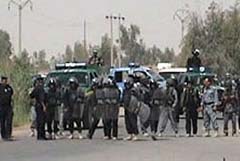
Following the arrival and settlement of Iraqi police in Camp Ashraf in order to investigate the cases of residents of Ashraf, the leaders of Rajavis’ Cult have launched a large-scale propaganda collecting signatures of supporters of former Iraqi dictator, Saddam Hussein to protest against the legitimate approach of Iraqi government.

The move by Iraqi police which indicates the declining process of MKO presence in Iraqi territory ,has terrified the cult leaders who have always prevented the Ashraf residents from free access to outside world and visiting their families . Now that the Iraqi police is settled in Camp Ashraf (a part of its territory which has been occupied by MKO), the residents of Ashraf will find the opportunity to voice their requests and to call for help against manipulative pressures caused by leaders.

Although, the presence of police in a society, assures the security and peace, Rajavis’ cult leaders are awfully terrified. The residents of Camp Ashraf arrived in Iraq with Iranian IDs and passports or they entered from a third country and stayed in Iraq as the guests of Saddam Hussein. Therefore, it is the absolute right of Iraqi legitimate government to investigate the case of the terrorists who had been sheltered by former Baathist dictator of Iraq.

The cult leaders fear from being executed and tried for their inhumane approaches against their own members and the atrocities they committed against innocent Iraqi civilians. They allow themselves to imprison Iranian youth behind the bars of their cult and to stop them visiting their parents, educating, traveling and having fun but they cannot stand the Iraqi police listening to residents and voicing their calls before the international community.
By Mazda Parsi

June 3, 2009 0 comments
FacebookTwitterPinterestWhatsappTelegramSkypeEmail
Former members of the MEK

Red Cross repatriates 260 Iran rebels;MKO from Iraq

BAGHDAD (AFP) — The International Committee of the Red Cross has helped with the voluntaryThe International Committee of the Red Cross has helped with the voluntary repatriation of 260 members of MEK repatriation of 260 members of Iran’s main armed opposition, the People’s Mujahedeen, over five years, the ICRC said on Monday.

ICRC spokeswoman Dibeh Fakhr told reporters the 260 had been repatriated between the US-led invasion of Iraq in 2003 and April 2008, after having asked to return to Iran. Two more Mujahedeen members have since also returned home.

“The committee has helped 260 members of the Mujahedeen Khalq (People’s Mujahedeen) to return to Iran, and we actually managed to take them back to their country,”she said.

The Mujahedeen, which seeks to overthrow Iran’s Islamic regime, is branded a terrorist organisation by the United States, while the European Union only removed it from its blacklist earlier this year.

It was founded in 1965 in opposition to the shah, but was sidelined by the rival clerical regime which took power in the 1979 Islamic revolution.

The group’s largest base in exile is in Ashraf, north of Baghdad. It was set up in the 1980s when Saddam Hussein was in power and at war with Iran as a base to operate against the Iranian government.

It is home to 3,500 Mujahedeen supporters and their families.

“Our role is purely humanitarian, and we have visited them to check their situation in the (Ashraf) camp,”the ICRC spokeswoman said.”During the visit, some of them expressed their desire to return to Iran.”

Since April 2008, the ICRC helped two more members of the Mujahedeen return to Iran around a week ago, said Patrick Yusef, who heads the ICRC in Iraq’s central provinces.

In March, Iraq’s National Security Advisor Muwafaq al-Rubaie said the Mujahedeen members who were based in the Ashraf camp should leave, describing them as”foreign terrorists”.

But the Mujahedeen said a forcible transfer would be illegal and that its supporters in the camp would never leave.

June 3, 2009 0 comments
FacebookTwitterPinterestWhatsappTelegramSkypeEmail
The MEK and Jundullah

Jundullah admits MKO connection

The head of the Jundullah gang, Abdulmalik Rigi, has admitted receiving assistance from the terrorist group Mojahedin Khalq Organization (MKO).

The al-Qaeda-affiliated Jundullah is a sectarian Sunni organization that occasionally launches terrorist attacks against Shias in the southeastern Iranian province of Baluchestan from across the border in Pakistan.

Jundullah admits MKO connection
The PMOI’s Maryam Rajavi (L) and Jundullah’s Abdulmalik Rigi (R)

Their latest outrage was a suicide bombing in a Shia mosque in Zahedan, the provincial capital. Last Thursday’s bombing killed 25 worshippers and injured more than a hundred.

There have been persistent intelligence reports of collaborations between the MKO and Jundullah in the past. But, in a significant admission, Rigi told a US-based satellite TV station, monitored by the ISNA news agency on June 2,”They (MKO) have had good intelligence collaborations with us and have provided us with much information about the activities of the Iranian regime.”

Rigi, who was described as a man who”used to fight with the Taliban and is part drug smuggler, part Taliban, part Sunni activist,”by Alexis Debat, a senior fellow on counterterrorism at the Nixon Center and an ABC News consultant who recently met with Pakistani officials and tribal members, told the station,”They (MKO) inform us about the regime’s activities in our areas of operations and let us know of the regime’s forces in these districts and send us most of the intelligence of our interest by email and messages.”

Rigi, who like his fellow al-Qaeda fanatics, has a penchant for videotaped decapitation of hostages, boasted in the interview,”We have treaties of friendship with all groups who act against Iran, and, among these, the MKO can do some things for us and we too can transit their members. But, I guess that they have certain limitations and are in countries where they cannot carry out their intended actions the way they want.”

This was an apparent reference to the presence of MKO co-leader Maryam Rajavi in France, where the group has recently been taken off the terrorist list on the pretext of having forsworn violence.

Rigi’s revelations undermine the MKO’s claimed transformation.

The MKO, which killed thousands of people in their campaign of terrorism in Iran, mainly in the 1980s, later were sheltered and armed by former Iraqi dictator Saddam Hussein. They are led by the husband-and-wife team of Massoud and Maryam Rajavi. While the whereabouts of Massoud are not clear following the US invasion of Iraq, Maryam is based in France and openly solicits for support and funds from certain European politicians.

The MKO is listed as a terrorist organization by Iran, Iraq, Canada, and the US, but was recently removed from the list in the European Union.

June 3, 2009 0 comments
FacebookTwitterPinterestWhatsappTelegramSkypeEmail
Newer Posts
Older Posts

Recent Posts

  • The black box of the torture camps of the MEK

    December 24, 2025
  • Pregnancy was taboo in the MEK

    December 22, 2025
  • MEPs who lack awareness about the MEK’s nature

    December 20, 2025
  • Why did Massoud Rajavi enforce divorces in the MEK?

    December 15, 2025
  • Massoud Rajavi and widespread sexual abuse of female members

    December 10, 2025
  • Facebook
  • Twitter
  • Instagram
  • Youtube

© 2003 - 2025 NEJAT Society . All Rights Reserved. NejatNGO.org


Back To Top
Nejat Society
  • Home
  • Articles
  • Media
    • Cartoons
    • NewsPics
    • Photo Gallery
    • Videos
  • Publications
    • Books
    • Nejat NewsLetter
    • Pars Brief
  • About Us
  • Contact us
  • Editions
    • عربي
    • فارسی
    • Shqip