Mr Gholam-Reza Sadeghi a former member of the Mojahedin-e Khalq Organisation (MKO) who was in Ashraf Camp from 1997 until 2006 and stayed about 8 months in the camp controlled by the US Forces called TIPF had previously filed a lawsuit against the MKO in the French judicial system. He has complained the MKO for forcing him to stay in Iraq against his will, imposing psychological and physical pressure on him, and beating him so that his thumb was broken in two places. In this regard his French lawyer who is proceeding the case in the French court had asked him in a meeting to provide him his medical record registered in the American hospital in TIPF which proves that he was tortured when he left the Ashraf camp. Therefore Mr Reza Sadeghi travelled to Iraq and approached the camp to gain that medical record. There happened some events relating to his presence which has been described by him to the Sahar Family Foundation as below:
“. . . I approached the TIPF adjacent to the Ashraf Camp to gain my medical record from the American hospital. While I was waiting in the taxi some MKO guards in Ashraf camp in Iraq recognised me and started photographing me that I took no notice of them. Then as I learned later they informed the Iraqi police based outside Ashrf camp that an Afghan national wearing a blast belt is standing outside the America base and he is aiming to do a terrorist action. Thus some Iraqi police personnel took this warning serious and harassed me with arms and arrested me. The police took away all my belongings and started to take me towards their base. While passing the American check point I started to call them and when they saw us they asked the Iraqi police to take me to them. Meanwhile the MKO persons were busy taking photos. They left the place when the Americans warned them to stop it and asked them to go away.
The personnel in the American check point asked the Iraqi police about the case and they explained that the MKO guard has informed them that an Afghan terrorist wearing a blast belt is busy photographing the US Army facilities and is aiming to carry out a terrorist action, and then we took action to arrest him. I fully introduced myself to the US Forces officer based outside Ashraf camp and explained the reason I was there and told them that I do not posses any weapons or ammunition and I do not have a camera or any other device which might worry them. I told them that I had only approached the TIPF to gain my medical record which indicates that I was tortured when I entered there.
The American officer in charge recorded my particulars and after full investigation and taking orders from his superiors realised that they have been deceived by the MKO persons and I have been subject to a conspiracy where the Iraqi police was made to get involved. He asked the Iraqi police personnel to release me and after I finished my job to escort me back to my taxi that was still waiting for me, and do not let the MKO people bother me anymore or harm me. Meanwhile the American colonel talked to me on the line and assured me that there would be no problem for me and he expressed his wishes that I would make a safe return back to Baghdad.
The Iraqi police personnel took me to their base afterward and asked for my pardon. The higher rank officer said repeatedly after kind hospitality that the Ashraf camp persons misinformed us and we thought that a terrorist activity is in progress against the US Forces. This of course resulted to causing such discomfort for you. He pointed out that neither they nor the American forces have any problem with me or any former MKO member. He also expressed that the MKO is causing a lot of trouble in their province and they are really fed up with these sorts of acts as well as their presence in the area. They asked me to stay with them over the night and be escorted to Khalis in the morning and arrange for my return to Baghdad since it was getting dark and the roads were not safe. I did not accept their offer and decided to return after I finished my business there with the taxi which was waiting for me.
It is worth mentioning that Bizhan Qahremani a member of the MKO intelligence and also Farhang and three other individuals were involved in this case and although they managed to waste my time a little but they once again exposed their nature for the Iraqi police as well as the American forces. The Iraqi police assured me that from now on he would brief his forces not to react immediately on misinformation received form the MKO. He said that such mistakes would not happen again and we would not be trapped within their conspiracy any more. He emphasised that now they are sure the MKO has deliberately misguided them and he is happy that his forces did not harm me when they were provoked by the MKO. . .”
Contact (Iraq):
saharfamily@yahoo.com
Tel: +964 – 7808481650 (Arabic and Farsi)
Contact (outside Iraq):
Sahar
BM 2632
London
WC1N 3XX
U.K.
Tel: +44 – 2076935044 (English only)
————
Sahar Foundation, Baghdad, April 03, 2008
 the mullahs in Tehran. But the camp, which the organization established in Saddam’s Iraq, is beset by reports of dissidents escaping the gulag. The Iraqi government wants to get rid of the former fighters, but find this avenue blocked.
 MKO by their TV and Radio programs. I became their full-time sympathizer from 1999 to 2001 in Tehran and my activities contained social and advertising for the organization. I leaved Iran to Iraq from Turkey for joining to MKO on July 18-2001. I stayed in Turkey for around one month and then after explanation process by the organization’s people in charge, I got moved to Iraq first to Basra port and then to Baghdad. After staying in Baghdad for half day I was moved to Ashraf camp.
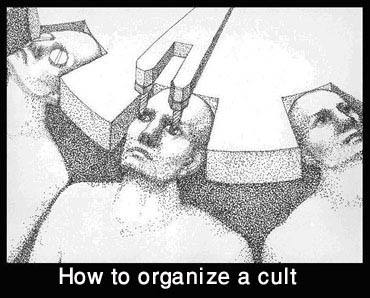 As part of the intense influence and change process in many cults, people take on a new social identity, which may or may not be obvious to an outsider. When groups refer to this new identity, they speak of members who are transformed, reborn, enlightened, empowered, rebirthed, or cleared. The group’ approved behavior is reinforced and reinterpreted as demonstrating the emergence of "the new person." Members are expected to display this new identity. 1 The new personality totally split from the outside world is manipulated for a variety of group tasks based on the objectives of the group and cult that consider the outsiders as the enemies who have to be confronted: The conflicts a mass movement seek and incites serve not only to down its enemies but also to strip its followers of their distinct individuality and render them more soluble in the collective medium. 2 As Hoffer asserts, a cultist personality is formed to be submissive to the inner-cultic relations that have priority to outwardly demonstrated ambitions and goals. The members undergoing overall identity change easily consent to any means of changing behaviour and conduct. Thus, cults can successfully accomplish their goal of binding new members to the group. Considering the stages people will go through as their attitudes are changed by the group environment and the thought reform processes, Singer points to psychologist Edgar Schein’s second stages of three: During this second stage, you sense that the solutions offered by the group provide a path to follow. You feel that anxiety, uncertainty, and self-doubt can be reduced by adopting the concepts put forth by the group or leader. Additionally, you observe the behavior of the longer, term members, and you begin to emulate their ways. As social psychology experiments and observations have found for decades, once a person makes an open commitment before others to an idea, his or her subsequent behavior generally supports and reinforces the stated commitment. That is, if you say in front of others that you are making a commitment to be "pure," then you will feel pressured to follow what others define as the path of purity. 3 There are also the eight psychological themes that psychiatrist Robert Lifton has identified as central to totalistic environments and cults invoke these themes for the purpose of promoting behavioral and attitudinal changes in the members. The third theme, demand for purity, depicts two opposite world of black and white; the cult being an absolutely white and clean world versus the black and evil world of outside. Of course, the members with a new personality have no other choice but to think and act according to cult’s ideology and drawn strategy: An us-versus-them orientation is promoted by the all-or-nothing belief system of the group: we are right; they (outsiders, nonmembers) are wrong, evil, unenlightened, and so forth. Each idea or act is good or bad, pure or evil. Recruits gradually take in, or internalize, the critical, shaming essence of the cult environment, which builds up lots of guilt and shame. Most groups put forth that there is only one way to think, respond, or act in any given situation. There is no in between, and members are expected to judge themselves and others by this all-or-nothing standard. 4 The process of producing identity within MKO follows the same mechanism in the cults and its orientation began with the start of the internal ideological revolution. All the members undergoing the revolution process admitted their identity change, that there does exist a long distance between their organizational and personal identities. It was instilled into them that their identity would be prompted based on the extent of adherence to the ideological system of the group and denial of any personal identity. In a text written by a member of MKO in self-denial we read: Personality, egocentrism, self-reliance and individualism are all souvenirs of the bourgeoisie’s worthless humanism that distanced me from the organization as far as its degree of its impact on me. It was like a chaff that barred me to drink the pure, life-giving instructions of the organization and was leaving me alone in a desolate waste-land with no way out. I was enslaved by dominant ambiguities within me. When I failed to overcome the ongoing struggle inside me, I was even more vulnerable to the outside misfortunes and could not even face them. 5 The member’s confession well depicts his identity destabilization and what psychologists call an identity crisis. He looks back at his own world and values to find out that he has been wrong in the past. This process makes him uncertain about what is right, what to do, and which choices to make and of course, as he admits, only the cult-like instructions of the organization can lead him to what is inspired to be the right path. Consequently, he takes on a new organizational identity which he considers a change for the better. In the process, he, as the member of a cult, detaches from his most dear ideas and attachments which he discovers to have been nothing beyond a barren waste-land for the identity reborn, a utopia in the horizon he fails to dismiss easily. Masoud Banisadr, another separated member of MKO, in his memoir relates of the time when sat tearing whatever attached him to the past under the commands of the organization: This time I attacked my old photographs from my own childhood till marriage and up to then, my parents photographs as I wanted to deny all of them, my father who was perhaps responsible for my bourgeois tendencies and my mother who was responsible of my own ‘mild’ and ‘gentle’ behaviour known as liberal ones. Anna seeing me taking all those photographs and albums, with anger, was quietly crying, then when I attacked our marriage Album she start crying louder, and asked me to stop it. She said those are not just yours . . . but I was not listening to her and took everything and put them in a rubbish bag. 6 Quoting Lifton’s forth theme, through a cult’s instructions, members are told whatever connects them to their former lives is wrong and has to be avoided, a fact well affirmed by MKO’s ex-members: Through the confession process and by instruction in the group’s teachings, members learn that everything about their former lives, including friends, family, and nonmembers, is wrong and to be avoided. Outsiders will put you at risk of not attaining the purported goal: they will lessen your psychological awareness, hinder the group’s political advancement, obstruct your path toward ultimate knowledge, or allow you to become stuck in your past life and incorrect thinking. 7 That is why MKO refer to members’ solubility in the organizational identity as a “reborn” or “identity salvation”. The organization, being transformed into a cult, pursues the same cult mechanism of altering the members’ personal identity to produce a new identity. References: 1. Margaret Thaler Singer; Cults in Our Midst, JOSSEY-BASS, 2003, p. 78. 2. Eric Hoffer; The true believer, Harper &. Row, Publishers, New York, 1966, p. 112. 3. Margaret Thaler Singer; Cults in Our Midst, JOSSEY-BASS, 2003, p. 76. 4. Ibid, 71. 5. Mojahed, no. 252; Abdol-ali Maasoumi’s letter to the ideological revolution. 6. Masoud Banisadr; Memoirs of an Iranian Rebel. 7. Margaret Thaler Singer; Cults in Our Midst, JOSSEY-BASS, 2003, p. 72.
 for censure, persuasion, distortion, brainwashing and mind-control activities against their insiders and sympathizers. Cults show diverse and double reactions in their dealing with the media that draw substantial public attention to accomplish a variety of objectives. Besides, the media in any form play a key role in the formation of public opinion and thought, life-style, and even the depiction of a nation’s destiny. For sure so important, versatile phenomena of the modernity never escape the attention of the cults. In the same way that the media can give warning against the threat and the evil nature of the cults, they can also be at their service, depending on the amount of revenue and how influentially they can master them, to instil noxious ideas into a society. However, since the media can hardly be an exclusive medium for the cults and in many occasions it is too expensive a means for propagation with the least expected outcome, and sometimes inflicts irreparable damages, the cults prefer not to invest much trust in the media. The case is sometimes different with the political cults. If we consider deliberate isolation tactic as one of the cults’ most common mechanisms of control and enforced dependency, then the social persuasion is the identical definition of the mechanism. The recruits are encouraged to disrupt their common lifestyle and leave whatever they are attached to behind to adapt themselves to the cult’s milieu in isolation. In this process, what is considered to be a threat in neutralizing the effects of the social persuasion will be the media which the cults favour to avoid. That is mostly because cults’ prompt of black-and-white thinking fails to be functional and productive in the media which has to be repelled. However, cults are not so powerful as the governments that can have total control over the media for social persuasion and people’s mind-control if they will. Quoting Orwell reasoning the effectiveness of the media coming under the complete control of the governments, Singer states: Orwell reasoned that if a government could control all media and interpersonal communication while simultaneously forcing citizens to speak in a politically controlled jargon, it could blunt independent thinking. If thought could be controlled, then rebellious actions against a regime could be pre- vented. 1 Milieu control, that is total control of members’ communication in the cults, is a mechanism to keep members from communicating anything other than what the cults approve and often involves discouraging members from contacting relatives or friends outside the cult and from reading, watching and listening to anything unapproved by the cult or the organization. Consequently, the effectiveness of the media in illuminating facts about the cults and active organizations is actually neutralized and the insiders are told not to believe and trust in anything they see or hear reported by the media that has to be accounted as an agent in the enemy’s front. In this way, the cults’ leaders blindfold members about historical facts: Milieu control also often involves discouraging members from contacting relatives or friends outside the group and from reading anything not approved by the organization. They are sometimes told not to believe anything they see or hear reported by the media. One left-wing political cult, for example, maintains that the Berlin Wall is still standing and that the "bourgeois capitalist" press war people to think otherwise in order to discredit communism. 2 As a result, cults’ hostile position against the media decreases the influence of the media on the members to a zero degree. Furthermore, cults exploit a variety of approaches and legal levers in the war against the media. Sometimes they use violent tactics such as threatening, intimidation and harassment to frighten away the critics, reporters, journalists and authors and to compel them cease anti-cult productions and programs: A metropolitan newspaper’s desk editor was harassed after he ran a piece critical of a local cult. He and his family had to move out of their home after receiving seventy-two hours of continuous phone calls from cult members. 3 As mentioned earlier, if possible, cults will set up complex networks of public relations and radio-TV stations to make a direct channel of communication and contact with the sympathizers rather than letting them refer to public media for information. Such a biased medium works as sufficient to hold the followers hooked onto the cult. As Singer explains: Cults have found many ways to restrict and control public information about them. Some groups have brochures, handouts for the press, and written overviews and endorsements of the group, often prepared by sophisticated public relations firms. In essence, these materials imply that "you need go no further. Here is who we are. Here is all you need to know to understand us perfectly. Take this material and use it. Everything is fine." The implication is that the material is objectively represented and relatively comprehensive. 4 As a leftist cult, Mojahedin-e Khalq Organization (MKO) has adopted various tactics to muzzle and beat the media. It will be discussed in the following article. References: 1. Margaret Thaler Singer; Cults in Our Midst, JOSSEY-BASS, 2003, introduction. 2. Ibid, p. 70. 3. Ibid, p. 224. 4. Ibid, p. 226.
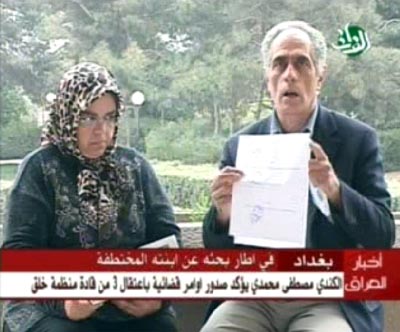 warrant for three leaders of his terrorist organization: Abbas Davari ,Sediqeh Husseini, the responsible of the so-called National Liberation Army. Somaye has been stolen and she asked me and her brother to try to return her home and country but the terrorist Mujahedin-e-Khalq Organization forces her to say:”I don’t want to return.”