Nejat Society
  • Home
  • Articles
  • Media
    • Cartoons
    • NewsPics
    • Photo Gallery
    • Videos
  • Publications
    • Books
    • Nejat NewsLetter
    • Pars Brief
  • About Us
  • Contact us
  • Editions
    • عربي
    • فارسی
    • Shqip
Nejat Society
Nejat Society
  • Home
  • Articles
  • Media
    • Cartoons
    • NewsPics
    • Photo Gallery
    • Videos
  • Publications
    • Books
    • Nejat NewsLetter
    • Pars Brief
  • About Us
  • Contact us
  • Editions
    • عربي
    • فارسی
    • Shqip
© 2003 - 2024 NEJAT Society. nejatngo.org
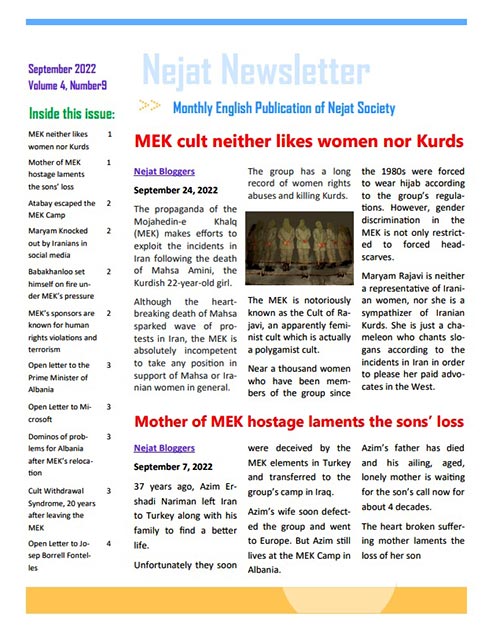
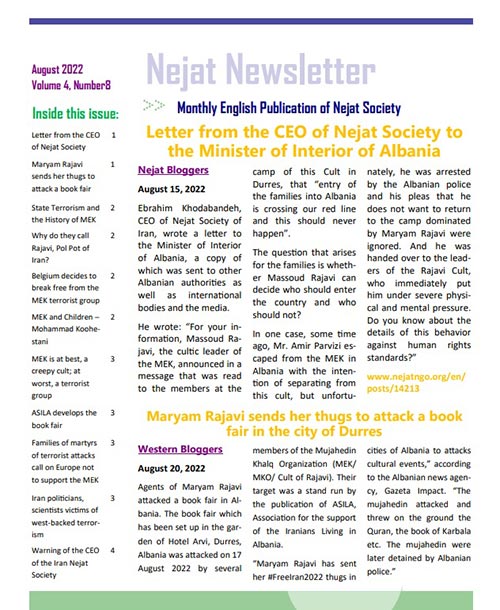
Nejat Society Newsletter no.93
Nejat Publications

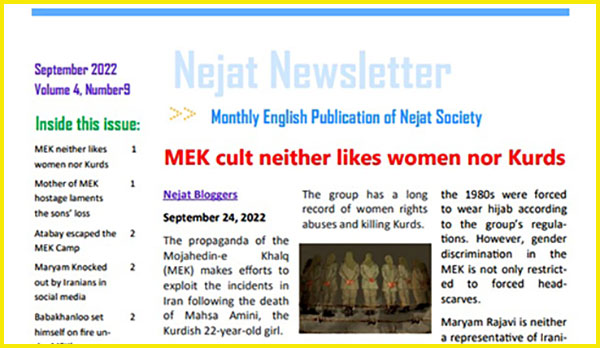
Nejat Newsletter No. 94

Inside this issue:

– Mahmoud Dehghan escaped the MEK
Mahmoud Dehghan, a hostage of the Mujahedin Khalq Organization could manage to escape the group’s camp. He left the bars of the cult-like system of Rajavi’s group located in Manez, in north of the Albanian capital…

– Goli’s Prison Break, an account of escaping Camp Ashraf
Goli, was a member of the Mujahedin Khalq Organization for 23 years. In the spring of 2011, after he lost 36 of his comrades in the operation..

– Mohammad Gamoosh was hanged in the MEK
Born in 1968, Mohammad Gamoosh was from Zanjan, Iran. He was a soldier in the Iran-Iraq war serving in division 46 Orumieh. He was taken as a war prisoner in a joint operation launched by Iraqi and MEK forces against Iranians in Hajomran region. Mohammad Gamoosh had just finished his army service and had planned to get back home but the tide turned. . .

– Ray Torabi’s message on the occasion of his 40th birthday
When I was 17, after 8 years of separation from my parents, I finally met my biological mother.
Unfortunately, the condition of our meeting was that I had to leave Canada and go to Iraq to meet her, where she was a member of an Iranian opposition organization (MEK-turned out to be a religious cult) . .

– Yusof Laskani return home
Yusof Laskani was released from the MEK in 2016, after 17 years of imprisonment in the cult-like system of the group. He enjoyed his life in the free world in Albania and Germany for

– Hamzeh Rahimi was tortured then disappeared
Hamzeh Rahimi a member of Mojahedin-e Khalq was killed under torture when he was imprisoned in the group’s Camp Ashraf. He was an officer of the Iranian army taken as a Ms. Mohabbati: help me visit my daughter …

– Darvishi witnessed Parviz Ahmadi’s killing under torture
Ardeshir Darvishi, 63, was a sympathizer of the Mujahedin Khalq Organization while he was an army officer of the Iranian army. He left the army in 1991 and joined the group in Camp Ashraf, Iraq, The MEK

– Ex-member: We were remote controlled MEK former member: Rajavi is an Iranian Bin-Laden
Ali Qashqaei spent five years (1995-1998) in the organization’s camps in Iraq: “I was in a difficult financial situation. I thought the organization could help me to get out of it. I was also attracted by the
leaders’ message.

– They May Day, a standard to bring the MEK leaders to trial
Under the impression that she was joining a movement to free the Iranian people, Zahra Mirbagheri found herself in the deserts of Iraq, running carrying heavy pack bags full of rocks. “Viva Rajavi”, she heard herself chanting in the headquarters of the Mujahedin Khalq Organization.

To view the pdf file click here

June 6, 2022 0 comments
FacebookTwitterPinterestWhatsappTelegramSkypeEmail
Massoud Rajavi
Massoud Rajavi

Documents to Expose Rajavi’s Violence against Dissident Members

A recently published document from inside the Mujahedin-e Khalq proves that Massoud Rajavi has used the most horrific tactics to suppress dissident members. Former child soldiers of the MEK revealed the cover and some pages of a pamphlet that demonstrates how critics against the MEK’s strategy will end with imprisonment, torture, elimination and even murder of the criticizing person.

The pamphlet which is titled “Organizational Ideological Argument” is actually the abstract of thousands of manipulation sessions run by Massoud and Maryam Rajavi in Camp Bagherzadeh, Iraq in 2001. The heart-breaking memoir of these sessions are always part of the difficult experiences of every former member of MEK. All of the confirm the content of the recently published document. According to the contents of this booklet, the MEK leaders forbid any kind of dissent and criticism in their cult-like organization.

The pamphlet which is titled “Organizational Ideological Argument

Organizational Ideological Argument

The pamphlet which is titled “Organizational Ideological Argument

The pamphlet which is titled “Organizational Ideological Argument

guidelines to push the dissident members to the hands of the Iranian Government or the Saddam Hussein’s Intelligence Service

Zhina and Amir, the two former child soldiers of the MEK published two pages of the document that contains a dozen of guidelines to push the dissident members to the hands of the Iranian Government or the Saddam Hussein’s Intelligence Service (Estekhbarat). The document which is dated September 2001, clearly argues that defection is forbidden:

“There is no such a person as defector. A defector who wants to leave the organization to enjoy a normal life should confess in front of the cameras. His place is not in the organization; he will be sent to Iran without cyanide capsule and arm.” This way, the MEK leaders plan to threaten their dissident members that they will certainly be arrested and executed by Iranian government and the group actually pushes them to this dark fate.
According to the document, no dissident member is allowed to go to Europe to take refuge. Instead, he or she will be handed to the then Iraqi government that was called by the MEK as the landlord.

“If we do not smuggle the defector into Iran, we will hand him to the landlord who will deal with him in accordance with their laws. Explanation: unlike European countries, Iraqi government does not deal with individuals and does not grant refuge. Iraq deals with the organization as a whole. It has accepted members based on the organization’s credit. Therefore, people who are attached with the organization are not questioned and do not have to fill out forms while arriving or leaving the country. Consequently, once the organization does not admit the responsibility of an individual, he will be treated as an illegal person.”

The content of this document is nothing new for former members of the MEK. We have already seen the testimonies of numerous defectors of the group who were victims of such a horrific punishment by the Cult of Rajavi. However, this booklet can be considered as a legal document to prove the inhumane attitude of the MEK leaders towards their own members in order to bring them to justice in a fair international trial.

June 2, 2022 0 comments
FacebookTwitterPinterestWhatsappTelegramSkypeEmail
Torture in the MEK Cult
Former members of the MEK

I come from the land of pain and suffering – Part six

This number, however, reached 80 by the winter of 2003[1380]. These people were sold at different periods to the Iraqis in groups of three and four. The Red Cross visited Abu-Quraib Prison twice during my one-year stay there. Prior to each visit, the prison authorities would visibly and violently torture some of the prisoners in front of others in order to instill fear in everyone’s heart. They would separate those of us former MKO members and would threaten us so as to discourage us from speaking to the Red Cross officials. The Red Cross inspectors were surrounded by two groups at all-time preventing us from getting close to them. Following cooperation between the intelligence and security forces of MKO, Islamic Republic of Iran and Iraqi regime, an agreement was reached among them involving the exchange of 50 former MKO members with 650 Iraqi prisoners of war. [..]

In an event, towards the end of January 2002 [Dey 1380], Abu-Seyf visited Abu-Quraib Prison speaking to me and four other former MKO members. When I confronted him with his false promises and lies, he once more swear that we would be exchanged in the near future. I voiced my protest and said that, under no circumstances, I wish to go back to Iran. I said that I wanted to join my daughter in Denmark. He told me that at the time of exchange, I would be able to tell the Red Cross that I didn’t wish to be returned to Iran. At that time he said, the Red Cross would transfer you to the City of Al-Ramadi first and later sent you to Denmark. The long time prisoners at Abu-Quraib also confirmed that the Red Cross was present during the prisoners of war exchange between Iran and Iraq in 1998 and 1999. They said those who didn’t wish to go to Iran were placed under UN protection.

Mohammd Hussein Sobhani

Mohammd Hussein Sobhani

After two years of being at virtually no contact, Iraqi regime and the Islamic Republic of Iran held meetings on political and security issues in January 2002 [Dey 1380] news of which received widespread coverage in both countries marked a turning point in relations between them. Towards the end of January 2002 [ Dey 1380] ,Iraqi TV announced that 650 prisoners of war were going to be exchanged with 50 Iranian prisoners the following week. They also announced that the Red Cross would be present at the exchange. Our hopes were raised considerably when we heard that the Red Cross was going to be present at the exchange. We, however, didn’t know that the 50 prisoners were former MKO members [dissidents].

On either 18 or 19 January 2002 [28 or 29 of Dey 1380], a voice on the prison loudspeakers asked the prisoners who had been kept in the so-called “protective custody” to gather in the yard. The warden read 50 names who were Mr. Rajavi’s prisoners kept in “protective custody”. My name was among them. The warden asked who wished to return to Iran and who did not? He separated those who wished to be returned to Iran from those who did not. Around 23 or 24 people said that they did not wish to go back to Iran. The warden threatened them telling the prisoners that they had to go back to Iran otherwise they would remain in Abu-Quraib forever. He then began to intimate us by shouting and beating us. A number of the prisoners changed their minds until the number of those not wishing to return to Iran was reduced to 12. A number of my friends, who were former MKO members, and I coordinated our efforts and asked to see the Red Cross and UN officials. The warden spoke to each one of us separately trying first through conciliatory and sympathetic approach, to convince us to go back to Iran. And when that failed, he threatened and ordered us to write a letter stating that we would wish to spend the rest of our lives in Abu-Quraib Prison. He asked me first to write the letter. I refused and told him that I neither wanted to go to Iran nor did I wish to remain in Abu-Quraib Prison in Iraq. I said that I wanted to speak to the UN and the Red Cross. The warden threatened me again telling me that I should write what he dictated to me. I still refused and wrote what I wanted to say. The other 12 people did the same thing, more or less. Finally through the coordinated efforts among MKO representative, Mehdi Abrishamchi and Abbas Davari [in charge of National Resistance Council’s labor committee] and Abu-Seyf, the decision was made to video tape all the prisoners, in which they were supped to express their desire to return to Iran. A number of people, fearing that their names might be taken out of the prisoner exchange list, agreed to be videotaped.

To be continued

June 1, 2022 0 comments
FacebookTwitterPinterestWhatsappTelegramSkypeEmail
Mahmoud Dehghan
Former members of the MEK

Mahmoud Dehghan escape the MEK’s camp in Albania

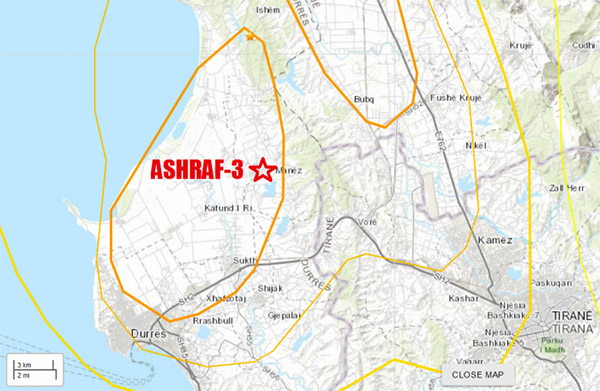
Mahmoud Dehghan, a hostage of the Mujahedin Khalq Organization could manage to escape the group’s camp. He left the bars of the cult-like system of Rajavi’s group located in Manez, in north of the Albanian capital.

Mahmoud Dehghan was a soldier of the Iranian army when he was taken as a hostage in a joint operation by Saddam Hussein’s and Rajavi’s forces in the border area of Mehran. The MEK agents took him to their notorious Camp Ashraf. He was then relocated in Albania together with the group. Thus, his mental and physical imprisonment behind the bars of the Cult of Rajavi lasted for 34 years.

Mahmoud Dehghan

Mahmoud Dehghan

Mahmoud succeeded to escape the cult after more that three decades. During the long years of separation, his family took several actions calling for release of their beloved Mahmoud. They sent open letters to the international and Albanian authorities, published text and video messages to ask Mahmoud to contact them. Today, they can enjoy contacting and visiting Mahmoud in the free world.

May 30, 2022 0 comments
FacebookTwitterPinterestWhatsappTelegramSkypeEmail
hanged
The cult of Rajavi

Mohammad Gamoosh was hanged in the MEK Camp Ashraf

Born in 1968, Mohammad Gamoosh was from Zanjan, Iran. He was a soldier in the Iran-Iraq war serving in division 46 Orumieh. He was taken as a war prisoner in a joint operation launched by Iraqi and MEK forces against Iranians in Hajomran region. Mohammad Gamoosh had just finished his army service and had planned to get back home but the tide turned.

The MEK forces transferred Mohammad and other POWs to Debes prison near Kirkuk, Iraq. From the first moment Mohammad tried to convince the MEK agents that his army service had finished and his parents had awaited his return but he was totally ignored. Instead, Sadat Darbandi (called Kak Adel), the notorious MEK’s commander humiliated and threatened him. Mohammad did not stop complaining. He was known among POWs for his dissent against MEK commanders.

Eventually, in a cold morning of the winter of 1987, his body was found hanged behind the prison building. A number of members of the Mujahedin Khalq saw Mohammad Gamoosh’s body hanged.

The MEK agents did not allow anyone to ask a question about Mohammad’s fate. A group of 20 to 30 MEK agents came to take his body, suppressing other prisoners violently. They put his body in a jeep, took him out of Debes prison and buried him immediately.

May 29, 2022 0 comments
FacebookTwitterPinterestWhatsappTelegramSkypeEmail
Mohammad Reza Torabi
The cult of Rajavi

Ray Torabi’s message on the occasion of his 40th birthday

Ray (Mohammad Reza) Torabi, former child soldier of the Mojahedin-e Khalq shared a post on his Facebook account on the occasion of his 40th birthday:

Mohammad Reza Torabi

Mohammad Reza Torabi

“When I was 17, after 8 years of separation from my parents, I finally met my biological mother. Unfortunately, the condition of our meeting was that I had to leave Canada and go to Iraq to meet her, where she was a member of an Iranian opposition organization (turned out to be a religious cult). She told me that my father had passed away some years before as a result of a heart attack, which he suffered in his sleep. He was 39 at the time of his death.
I ended up staying in this organization for many years, and oh the stories…
But in all those years, I always believed that I, like my father, would one day die of a heart problem while in my bed. Although I was literally in the middle of war with so many life-threatening situations, nothing scared me quite like the idea of dying in my bed before even turning 40.
I wouldn’t be lying if I said that I thought about it hundreds of times over the years.
But the years went by and as is the rule of life, the truth surfaced and I realized that my biological mother had lied to me regarding the facts surrounding my father’s death and that he didn’t die of a heart attack and that he was murdered by the same organization he sacrificed his life for. That’s a story for another day.
But I turned 40 today. A year older than my father. And although life hasn’t been so kind to me, I’m grateful for every day of it. With all its ups and downs, sweet and bitter moments, pains and sufferings and the challenges that turned me into the resilient, humble, compassionate, forgiving, kind… Human that I am.”

Mohammad Reza Torabi

Mohammad Reza Torabi in his youth

Mohammad Reza, nicknamed Ray, is a former child soldier of the MEK who left the group four years ago after 18 years of enduring the cult-like system of Massoud and Maryam Rajavi. He did not know that his father was a victim of torture in that very organization until he left the group. Ray Torabi is one of the several former child soldiers of the MEK who are speaking out against the group’s brainwashing structure. In response to Ray’s questions about the death of his father, the MEK propaganda made his biological mother and his aunt write against him labeling him as agent of the Iranian government. However, Ray did not give up and continued speaking out about his experience of involvement with the Cult of Rajavi.

Amir Vafa Yaghmaee

Amir Vafa Yaghmaee

His Facebook post on the occasion of his birthday was warmly welcomed by his audience. He was widely encouraged by former members of the MEK and his current friends to bravely share his stories. Amir Yaghmai, another former child soldier of Rajavi’s army addressed Ray by writing:
You are one of the most humble guys I’ve met. Our background could have turned us into strange personalities with the lack of social adaptation. Fortunately, most of us made it quite well and we became good souls.

Amir Nematollahi

Amir Nematollahi

Among the numerous comments on Ray’s post, the one from Amir Nematollahi, former operative agent of the MEK is also remarkable:
Life has thrown its fair share of obstacles in your way from a young age, before our paths even crossed, and I have only been able to witness the strength you carry for a short amount of time. But in those three years, you have managed to inspire more than any quote, self-help book, or words of wisdom could ever do, because you get out of bed every morning, face life and all of its challenges head on, while still managing to keep your head up, and live life to the fullest. I am truly grateful to know you and your life story inspired me in many ways stay strong and I assure you that your father would have been so proud of what you become and who you are…by the way happy birthday.

May 28, 2022 0 comments
FacebookTwitterPinterestWhatsappTelegramSkypeEmail
Torture in the MEK Cult
Former members of the MEK

I come from the land of pain and suffering – Part five

I was physically and psychologically tortured by Ebrahim Zakeri and others for at least seven to eight hours. I was subjected to the most terrifying and violent torture. A number of them began hitting me on the shin with their army boots. They would tie my hands behind my back, pick me up and slap me around. Sometimes, they would put their mouth next to my ears and would scream loudly. It was torturous and nerve-racking. They feared that I had somehow been able to telephone my family and BBC radio. Therefore they were trying to break me down and force me to sign the letter, so in case the news of my imprisonment were to be broadcast, they would be able to manufacture a document explaining their actions.

Prior to my treatment at the hands of these people, I had spent the night before wondering in the streets of Baghdad and had not slept for 48 hours. This fact intensified the awful effect of the torture. I was subsequently blindfolded and handcuffed again and transferred to another solitary confinement cell where I remained until Dec. 1999-Jan 2000 [Dey 1379].

Mohammd Hussein Sobhani

Mohammd Hussein Sobhani

They sold me (blindfolded and handcuffed again) to Iraqi intelligence and security Organization (Mukhaberat) on 16 January 2000[ 26 Dey] of the same year (later I discovered that three other longtime members of the organization had separately received the same kind of treatment as I. I, however, would not reveal their identities for safety reasons, but I am prepared to give their names to amnesty International, UN High Commission on Human Rights and legal agencies). Other members of the organization and I spent 35 days in Iraqi torture chambers and at Intelligence and Security Organization’s (Mukhaberat) central jail. As long as I was at Rajavi’s jail, I was kept in solitary confinement which placed great deal of emotional and psychological pressure on me.

However, the overcrowded jails at Iraqi Intelligence and Security were unbearable. They put 12 prisoners in a cell three meters by three meters. The prisoners had to sleep on top of each other. Toilet and sink filled one third of the room. The walls of the cell were the color of blood. The half-dark cell was lit only by a dim moonlight. This was in stark contrast to Rajavi’s solitary confinement jail, where four years I had to sleep with the light on every night. And anytime I was awaken by onslaught of mosquitoes, suffocating heat or unbearable psychological pressure, I was not able to go back to sleep. The bright lamps would worsen the throbbing headache that I had to frequently endure.

After two or three weeks, Abu-Seyf came to visit me at Ashraf Base. I protested my imprisonment and demanded to be turned over to UN so I could join my daughter in Denmark. In the past, he, on many occasions because of my post in the HE, had seen me with Mr. Rajavi and Mrs. Maryam Qajar-Azdanlou. Abu-Seyf tried to console me. He tried to portray Iraq as an innocent party to all that had aspired by differentiating between MKO and Iraqi policies. He placed the blame for my years in Rajavi’s solitary confinement on MKO. He expressed his sorrow at my years of imprisonment and torture and my inability to see my daughter promising to transfer me to a new location where UN officials in Baghdad would visit me. He said that I would be able to ask the UN officials to transfer me to Denmark where I could join my daughter.

I along with another three long-time members of the organization were transferred to Abu-Quraib prison on 20 February 2001[1st Esfand 1379] date as received. To my amazement I discovered that 30 to 40 former members of the organization who had been sold to Iraqi government were housed at that prison.

To be continued

May 26, 2022 0 comments
FacebookTwitterPinterestWhatsappTelegramSkypeEmail
Zahra Mirbagheri
Former members of the MEK

Zahra Mirbagheri’s Prison Break, an account of escaping Camp Ashraf

Zahra Mirbagheri, former member of the Mujahedin Khalq escaped the group’s headquarters in Iraq, Camp Ashraf, in 2013. She finally made it after three unsuccessful attempts. Although she was under an extensive control by her commanders and peers, she was determined to leave the MEK’s oppressive atmosphere. “Zahra! You must not get back to Rajavi’s hell!”, she told herself at the moment she started running away.

January 29th, 2013 was a landmark day in Zahra’s life. She was not only barred from the outside world by the barbed wire fences, but also, she was constantly surrounded by the MEK commanders and watched by one or two of her peers because she had previously tried to flee the group three times. “I was under severe mental and physical pressure because I resisted their lies, oppressions and brainwashing system,” she writes in her story. “I was banned from visiting my brother and sisters who were in the group too. A woman was supposed to watch me all the time and to report on what I was doing all day long.”

Zahra Mirbagheri

Zahra Mirbagheri showing the pendant that Rajavi gave to the women of the organization telling them that they were all connected to him and to no other man

Zahra was sick. Her ear was infected and she had pain in her neck and back. “After three failures in escaping and because of taking too much antibiotics I had become so weak,” she recounts. “I had a herniated cervical disk due to a blow to my neck but I was forbidden to have a doctor’s appointment.”

However, Zahra had made her decision. “I had promised myself to fight the authorities and to escape the Cult of Rajavi. I was determined to survive to reveal Rajavi’s inhumane and evil dogma,” she writes. On January 28th, the group held a meeting in which medical commander of the camp was supposed to justify the participants. Zahra was shocked to see there so many of her comrades who were not sick. The next day, when they went to the Iraqi hospital, she realized that those ones had been ordered to watch the sick members to prevent their likely escape.
The night before going to the medical center, Zahra prepared her military uniform. The next morning, she was dressed up. She was ordered to go to the eating place. Zohreh Qaemi (the then commander of Ashraf) came to the hall to speak once more. Zahra tried to pretend that every thing was normal — after her last unsuccessful attempt to escape, Zohreh Qaemi had conveyed the message of Maryam Rajavi to her, “We have decided that you will die!”.

Zahra and few of other sick members were taken to Iraqi hospital by the western side of Camp Ashraf. She was constantly watched by two female guards who were members of the MEK’s Elite Council. Families of the group’s members were calling on their loved ones who were isolated in the camp from other side of the camp fences. Zahra was ordered to pull her scarf on her face while crossing in front of the families.
“When we arrived in the hospital, I began to look around to find a way out,” she recalls. “I noticed some of the high-ranking commanders of the security unit of the MEK and I found out that I would have difficulties but again I promised my self not to give up.”

In the waiting room, Zahra found a kitchen, she looked for windows. All windows had been screened. The exit door was also closed and blocked with a big table. Zahra looked around to find a new escape route. “As I was looking around, my commander shouted at me, ‘what are you doing?’,” she recounts. “She ordered me to sit down next to her. I was not feeling well but I was really motivated to escape. So, I kept cool and sat down.”
Finally, she was examined by ENT specialist in the consulting room. The interpreter was also a member of the MEK. “The MEK had arranged everything to control members,” Zahra writes. “Nobody was allowed to stay alone with the doctors.” The specialist prescribed antibiotics for her ears so they had to go to the drugstore to take the medicines. In the drugstore, Zahra was still accompanied by her commander.

The next chance was the orthopedic specialist who was supposed to examine Zahra’s neck. Zahra recounts her escape adventure:

“Together with a few women, I was standing in front of the door of the doctor’s room. Ther was a long corridor. We were standing in the middle of it. I noticed another door behind myself. I did not know to where it opens. I looked at the commanders and security guards of the group who were walking through the corridor watching us. I recalled Massoud Rajavi’s words in his last speech, ‘It is better for a hundred of you to be killed than for one to flee’. My heart was pounding. I looked at those brainwashed women around me. ‘Do you have a doctor’s appointment too?’ I asked one of the. ‘It’s none of your business,’ she replied. I smiled and said, ‘No matter, just asked’. Just then, the woman told the others, ‘Let’s go!’.

“It was a landmark moment. I made my decision immediately after the women turned their back to me. I opened the door behind me and rushed though a hall that was for male patients. I turned left and opened another door to a hall that looked to be an eating place. The hall was empty. There was a widow at the end of it. It was covered by a flyscreen. I took out the cutter I had put under my clothes and cut the screen. Fortunately, the window had no glass. I got up to get out of the window and I was lucky that there was a staircase under the window at the foot of the wall. I stepped out and quickly rushed to my left. I reached a metal wall. I squeezed through a 20-centimeter gap in the wall. Again, I began to run. An Iraq soldier was praying before my eyes. He walked to me as soon as he saw me and took me to the commander’s office.

“When I entered the room, their walkie talkie was making too much noise about the escape of a female Mujahed. I could not contain my happiness. On my God! My dream came true. I could manage to escape.”

May 25, 2022 0 comments
FacebookTwitterPinterestWhatsappTelegramSkypeEmail
Batoul Soltani
Former members of the MEK

Soltani’s prison break, an account of escaping Camp Ashraf

Batul Soltani, former member of the Elite Council of the Mujahedin-e Khalq escaped Camp Ashraf in 2007. She was a long-time member of the group who had been forced by Massoud Rajavi to divorce her husband and to leave her children. She was so brainwashed in the Cult of Rajavi that she was not able to refuse the order of Maryam Rajavi to sleep with Massoud Rajavi. However, once she realized that her commanders were dishonest, she left the group. The story of her escape from Camp Ashraf is really dramatic.

batul soltani and her child

Batul Soltani and her child

Following the so-called ideological revolution that coerced members to divorce their spouses, and after the smuggling of their children out of Iraq, Batul and other rank and file of the group, were kept busy doing difficult physical tasks around their military camp. “I became the commander of a unit of tanks in 1993,” Batul recounts. “I was so busy running eleven tank, each tank three forces. I had no time thinking of myself. I could sleep one or two hours a day.”

Batul Soltani

Batul Soltani at the MEk’s Camp Ashraf

Batul was gradually elevated in the cult’s hierarchy. She was charged with the security unit and then she was smuggled to Britain to learn using computers and ultimately, she was selected to become a member of Rajavi’s Elite Council. As a member of Rajavi’s close female forces she was coerced to attend Salvation Dance and then to Massoud Rajavi’s bed. Batul Soltani was the first female defector of the MEK who revealed Rajavi’s polygamy cult.
“In 2006, as a member of the Elite Council, I had become the topic of the meetings; I was under the focus of the superior rank,” Batul writes. “I was constantly asked why I looked depressed. Even Massoud Rajavi contacted me several times to understand what was wrong with me but I could not tell them about my anxieties. I had missed my children and my husband. Besides, I had a lot of unanswered questions about the group. I felt like losing my whole life for nothing.”

Batoul Soltani

Batool Sultani, photographed in Paris in January 2020.
Photo: Matthew Cassell for The Intercept

What took place on that special day made her determined to leave the MEK. She had been ordered to fix Mozhgan Parsai’s computer network. She entered the network and she discovered a letter. “I ran into a report about myself that Mozhgan Parsai had prepared to send to Maryam Rajavi. All at once, my whole world came crashing down around me. She had written that the Elite Council was in trouble, that I was distracted by thinking about my kids and that I was morally corrupted. I was astonished to read those words.”

The very day, she packed her bag and made her decision to escape the group. Unaccompanied trafficking was prohibited in Camp Ashraf.

“Even if you wanted to go planting in the garden, you had to be accompanied by a peer as your responsible. They said that these rules were for guaranteeing the security of the group but I swear to God that it was because they did not trust anyone inside the organization.”

Thus, Batul found a way to pretend that she was not alone in her jeep: “I put the pack bag on the driver’s side seat,” she recounts her heroic escape. “I put a helmet on that and I tied a scarf around the helmet. When I reached the checkpoint, I told the guard that my comrade was asleep so I could cross the check point.”
It was late at night. The female guard knew that Batul Soltani was one of the commanders of the group so she did not scrutinize anymore. She drove toward the fences around the camp. “I left the car somewhere around the garrison and I escaped that prison”, she writes.

She cut the barbed wires crawled from under them. The guards in the watchtower did not notice her. She walked to the American camp that was settled by the side of Camp Ashraf for escapees from the Cult of Rajavi. And, she found herself free. She told the American authorities that she would not get back to the Mujahedin-e Khalq anymore.

May 23, 2022 0 comments
FacebookTwitterPinterestWhatsappTelegramSkypeEmail
Yusof Laskani
Former members of the MEK

Yusof Laskani return home after years of custody in the MEK

Yusof Laskani was released from the MEK in 2016, after 17 years of imprisonment in the cult-like system of the group. He enjoyed his life in the free world in Albania and Germany for five years and finally, last week, he returned Iran to join his family in his home town.

Yusof Laskani, now 50 years old, from a village in Sistan and Baluchestan province was recruited by the MEK when he was 27. Nejat Society congratulates him and his family on his return hoping them a happy and prosperous life, looking forward to seeing the release of all hostages of the Cult of Rajavi, Mojahedin-e Khalq.

Yusof LaskaniYusof Laskani

Yusof Laskani

Yusof Laskani

May 22, 2022 0 comments
FacebookTwitterPinterestWhatsappTelegramSkypeEmail
Newer Posts
Older Posts

Recent Posts

  • Rebranding, too Difficult for the MEK

    December 27, 2025
  • The black box of the torture camps of the MEK

    December 24, 2025
  • Pregnancy was taboo in the MEK

    December 22, 2025
  • MEPs who lack awareness about the MEK’s nature

    December 20, 2025
  • Why did Massoud Rajavi enforce divorces in the MEK?

    December 15, 2025
  • Facebook
  • Twitter
  • Instagram
  • Youtube

© 2003 - 2025 NEJAT Society . All Rights Reserved. NejatNGO.org


Back To Top
Nejat Society
  • Home
  • Articles
  • Media
    • Cartoons
    • NewsPics
    • Photo Gallery
    • Videos
  • Publications
    • Books
    • Nejat NewsLetter
    • Pars Brief
  • About Us
  • Contact us
  • Editions
    • عربي
    • فارسی
    • Shqip