Nejat Society
  • Home
  • Articles
  • Media
    • Cartoons
    • NewsPics
    • Photo Gallery
    • Videos
  • Publications
    • Books
    • Nejat NewsLetter
    • Pars Brief
  • About Us
  • Contact us
  • Editions
    • عربي
    • فارسی
    • Shqip
Nejat Society
Nejat Society
  • Home
  • Articles
  • Media
    • Cartoons
    • NewsPics
    • Photo Gallery
    • Videos
  • Publications
    • Books
    • Nejat NewsLetter
    • Pars Brief
  • About Us
  • Contact us
  • Editions
    • عربي
    • فارسی
    • Shqip
© 2003 - 2024 NEJAT Society. nejatngo.org
USA

The danger of Bush’s anti-Iran fatwa

The president’s decision to use force against Iranian "agents" inside Iraq could snare innocent pilgrims, and raises the risk of open warfare.

Jan. 30, 2007 | George W. Bush last week announced that American troops in Iraq were henceforth authorized to "kill or capture" any Iranian intelligence agents they discovered in Iraq. The announcement came on the heels of his pledge in the State of the Union address to bring another aircraft carrier into the Persian Gulf, a move that clearly targeted Iran. A prominent Iranian parliamentarian responded to Bush’s threat by saying, "Such an order is a clear terrorist act and against all internationally acknowledged norms." Iraq’s deputy prime minister, meanwhile, put a pox on both Iran and the U.S. for conducting their geopolitical battle on Iraqi soil.

The danger of Bush’s approach may be realized in short order. Tuesday, Jan. 30, marks the 10th day of Muharram, and is the Islamic holy day known as Ashura. Iraq is the Shiite holy land, the site of the passion and martyrdom of revered figures such as Ali, the son-in-law of the Prophet Mohammed, and al-Husayn, the Prophet’s grandson. Thousands of Iranians come on pilgrimage to the Shiite shrine cities of Najaf and Karbala in Iraq every year, and the flow of pilgrims peaks at Ashura, which commemorates the martyrdom of al-Husayn. Ashura is an especially important holiday to Shiites, drawing up to 1 million pilgrims to Karbala, 60 miles southwest of Baghdad. In 2004 Sunni insurgents exploited the presence of so many Shiite pilgrims by setting off massive explosions that killed more than 100 people.

Given Bush’s new directive, how will U.S. troops distinguish between innocent Iranian devotees and spies? What if U.S. troops kill pilgrims in a mistaken belief that they are covert operatives? Leaving aside whether U.S. law authorizes such a broad, vague use of deadly force against foreign nationals, which is unclear, Shiite religious sensibilities would be inflamed in both Iraq and Iran, furthering the potential for a widening conflict.

Or maybe the spark for a wider conflict is just what the increasingly desperate President Bush seeks. His fixation on Iranian activities in Iraq cannot be explained by his cover story, which is that Tehran is supplying weapons to forces that kill U.S. troops. To date, no hard evidence that the Iranian government is sending high-powered weaponry into Iraq has been made public, and no credible proof may be forthcoming. In general, one should take such claims with a large grain of salt, much like the skepticism with which one should greet the official U.S. story about the firefight in Najaf on the weekend that supposedly claimed the lives of 250 insurgents.

To begin with, some 99 percent of all attacks on U.S. troops occur in Sunni Arab areas and are carried out by Baathist or Sunni fundamentalist (Salafi) guerrilla groups. Most of the outside help these groups get comes from the Sunni Arab public in countries allied with the United States, notably Saudi Arabia and other Gulf monarchies. Washington has yet to denounce Saudi aid to the Sunni insurgents who are killing U.S. troops.

Meanwhile, the most virulent terror network in Iraq, which styles itself "al-Qaida in Mesopotamia," has openly announced that its policy is to kill as many Shiites as possible. That the ayatollahs of Shiite Iran are passing sophisticated weapons to these, their sworn enemies, is not plausible.

If Iran is providing materiel to anyone, it is to U.S. allies. Tehran may be helping the Supreme Council for Islamic Revolution in Iraq and its Badr Corps paramilitary, but the U.S. is not fighting that group. By sale or barter, some weaponry originally given to the Badr Corps might be finding its way to other groups, such as the Mahdi Army of nationalist Shiite cleric Muqtada al-Sadr, that do sometimes come into conflict with the U.S. That problem, however, must be a relatively small one, and cannot explain Bush’s hyperbolic rhetoric about Iran.

Some of the reports of "thousands" of Iranian agents in Iraq come from the Mojahedin-e Khalq terrorist group, which is made up of Iranian expatriates who display a cultlike devotion to their leader, Maryam Rajavi. An enemy of Tehran, responsible for numerous bombings inside Iranian borders, the MEK was given a terrorist base, "Camp Ashraf," in eastern Iraq by Saddam Hussein. When the U.S. invaded Iraq, some Pentagon figures wanted to use the MEK against Tehran in the same way Saddam had, and the MEK fighters have not been expelled from the country. They now supply disinformation about Iran to the U.S. in order to foment conflict, much as Ahmad Chalabi lied in order to sell the Americans on invading Iraq.

That the U.S. is in search of a rationale for a wider conflict is supported by the fact that it has arrested Iranian officials inside Iraq on two occasions in the past six weeks. In December, U.S. troops raided the compound of Shiite cleric Abdul Aziz al-Hakim, the leader of the largest bloc in parliament, made up of fundamentalist Shiites, and discovered several visiting Iranians there. Some were briefly detained and then allowed to leave the country. Two others were delivered to Iraqi government custody and accused of being high-ranking intelligence officers of the Quds Force unit of the Iranian Revolutionary Guard Force. Baghdad at length let them go, as well.

Al-Hakim, as well as Iraqi President and Kurdish leader Jalal Talabani, indignantly insisted that they had invited the Iranians to the country, protests that seem strange if the Iranian visitors were harming Iraqi interests. Press reports on the documents the U.S. captured in the raid were contradictory. American newspapers said that they indicated Iranian arms smuggling and included plans for ethnic cleansing of Sunnis in Baghdad. British intelligence officials told the BBC, in contrast, that the documents did not mention arms but indicated that the Iranians had come to consult about the cabinet shuffle planned by Prime Minister Nouri al-Maliki, head of the fundamentalist Shiite al-Dawa party, the largest bloc in the legislature.

The U.S. then launched a raid in the far northern Kurdish city of Irbil on an incipient Iranian consulate, there by the invitation of the Kurdistan Regional Government. Troops captured five Iranians, which the U.S. accused of being intelligence operatives. Again, the Iraqi Kurdish officials expressed annoyance and affirmed that the paperwork had been submitted for the establishment of the consulate.

There are very few U.S. troops in the northern Kurdish regions, and the Iraqi Kurds are close allies of the United States. How Iranian activities in Irbil could possibly pose a threat to American troops is completely mysterious. Why Washington would order arrests of persons designated as guests by Iraqi government officials is also obscure.

Maybe what is really going on is that the Bush administration finds itself competing with Iran for influence with erstwhile allies in Iraq and losing. Abdul Aziz al-Hakim was feted at the White House on Dec. 4 of last year and said he wanted U.S. troops to remain in the country. His contacts with Iranian officials, whether intelligence operatives or not, pose no military threat to the U.S., since he is a Bush ally. They might, however, pose a political threat insofar as al-Hakim’s Supreme Council for Islamic Revolution in Iraq can act with more independence from Washington if it receives aid from Tehran. At the invitation of the Iraqi government, Iran has now offered to expand its economic presence in Iraq.

As Washington grows weaker in Iraq, it is concerned that Iran not pick up the pieces and establish hegemony over its smaller neighbor. The Bush administration may also be casting about for some issue that will galvanize the American public and give it a pretext to expand its presence in Iraq despite how badly the war has gone. Any leaders of a failing war effort are always tempted by a strategy of escalation. Announcing open hunting season on all Iranian visitors to Iraq is like playing Frisbee with nitroglycerin. Bush has gone looking for trouble and is likely to find it.

By Juan Cole, January 30, 2007

http://www.salon.com/opinion/feature/2007/01/30/iran_ashura/?source=rss

February 3, 2007 0 comments
FacebookTwitterPinterestWhatsappTelegramSkypeEmail
Iraq

MKO’s Role in Saddam Massacres Should be Exposed

The court of former Iraqi regime’s crimes, now being held without the presence of Saddam Hussein, exposes important issues one of which is the decision of former Iraqi dictator to exterminate the Kurds with all possible means.

In the court, it was revealed that the order for massacring the Kurds by chemical weapons was issued personally by Saddam Hussein and suggested by Ali Hassan Al-Majid and consequently criminal officials of former regime committed the crimes in Halabja.

Meanwhile, what are very important are Chemical Ali’s comments on using the MKO for pursuing and targeting the Kurds (even inside Iran).

Earlier also, with the exposure of Rajavi’s secret talks with then the head of Iraqi Intelligence Service lieutenant general Taher, in which MKO forces’ participation in killing the Kurds was praised on behalf of Saddam, the role of the group in massacring the Kurds had been revealed.

In addition to the issue of MKO’s role in killing the Kurds- which has been proved with a lot of documents- what’s new in Chemical Ali’s comments and reveals new facts on MKO-Saddam ties, is the reality that this group acted as a private army for Saddam Hussein and that Iraqi officials considered the roles of the MKO when planning.

In this regard, Chemical Ali clarifies that MKO forces were tasked with pursuing and targeting the Kurds inside Iran.

The new government of Iraq and those in charge of holding the court should expose more of documents on cooperation between the MKO and Saddam Hussein in order to illuminate the public opinion and prevent distortion of historical facts by the leaders of the group.

By clarifying the dimensions of such crimes the efforts of MKO leaders to seek refuge in Iraq will fail and the main reasons of their presence in the country will be determined.

February 3, 2007 0 comments
FacebookTwitterPinterestWhatsappTelegramSkypeEmail
Missions of Nejat Society

Fear in MKO’s Camp

According to reports, following the comments of Iraqi Government Spokesman on the expulsion of terrorist MKO from Iraq, the MKO leaders and members have sunk in deep fear and a critical situation rules their camp.

Despite pressures from pro-Baathist supporters of MKO and obstacles by occupiers, Iraqi officials acted decisively and announced the issue of MKO expulsion from Iraq. They have notified Iranian officials of their will.

Following the announcements by the spokesman of Iraqi government Mr. Ali Al-Dabbagh, terrorist gang of Rajavi has gathered its supporters to force the Iraqi government to accept its refugee status in Iraq.

Also, in order to boost the morale of its desperate members and in order to remind them of a promise that the US will use them along with its policies, they quoted a coalition commander in Iraq saying: "The comments of Ali Al-Dabbagh don’t reflect the positions of the US and we don’t agree with these comments. The position of the US on the rights of Camp Ashraf residents has not changed and Iraqi officials have been repeatedly notified of such position and the US forces are responsible for their protection."

Meanwhile, the officials of foreign ministries of the US and Britain have repeatedly stressed that the issue of MKO’s expulsion or its refugee status is something that should be decided by Iraqi government and that the US and Britain don’t interfere in such issues.

Irandidban – 2007/01/31

February 3, 2007 0 comments
FacebookTwitterPinterestWhatsappTelegramSkypeEmail
Former members of the MEK

People’s Mujahedin;Another Iranian Fanatism

After the Islamic revolution of Ayatollah Khomeiny Mujahedin Khalq Organization fled to Iraq. On the pretext of fighting for Democracy, they made a bizarre world controlled by the hatred for Islamic Republic. A narrative by the defectors of MKO.

While his arrest, Babak Amin couldn’t swallow his cyanide capsule. The Iranian police surprised him by catching his neck from behind so that he couldn’t swallow the capsule and a hand went into his mouth to get out the deadly poison while he was walking around Vanak Square in Tehran. The unit is specially trained for this kind of operation: catching the MKO members. However a medical team, who accompanied the police in such an operation, owns the necessary antitoxin. Therefore four of his comrades who succeeded to swallow the cyanide were also rescued.

Babak Amin was arrested in January 2001. He had arrived from Iraq and had operated some mortar attacks against security centers which were the last attempts of MKO, present all over the Europe, in Iran.

Horror and Science “Fiction

While his attempts, Babak Amin didn’t succeed to kill anyone which caused him be safe from death penalty. He was sentenced to a ten-year imprisonment of which he has passed five years and now he is enjoying the conditional freedom. This 40-year old defector who is studying Informatics at Tehran University narrates his 20-year experience of living in MKO as a commandant. A terrifying story which mixes horror and science fiction. Therefore one find a world, governed by an insane Utopia that, with hatred to Islamic Republic, inverse the values. An example of this inversion can be seen in their military branch (National Liberation Army) by the domination of women over men. The male fighters with some exceptions include the sub-officers or simple soldiers who have to wash the dished or do the laundry.

Al this doesn’t prevent the strict isolation which manages the Iraqi headquarters of MKO extremely. Definitely the restaurants are separated. There are distinctive gas stations for the men and women do not encounter – "if one has to talk to his female commandant ,four or five other people must also be present " Babak Says " only the men are allowed to swim in the pool but on the condition that they are totally dressed.

Babak entered the MKO in 1983 while living in Vienne. The Organization was formed in 1965 and played an active role in fighting against Shah who executed all the historical leader of MKO except Masud Rajavi. Professing an Islam without ayatollahs mixed with Marxism, MKO refused to submit to regime which cost them to be evaluated as apostate and insurgent by Imam Khomeini. Regarding the Western "Useful Idiots" MKO has a rusty message in which the promise of establishing democracy in Iran is included.

But what made Babak to step inside the Organization, he explains with a voice without passion;" were the photos of political prisoners tortured by Islamic regime shown to him”

With five other people, Babak set out for Iraq where MKO who was allied with Saddam Hussein fighting against Iran, had settled its bases.

Babak and 300 Iranian students who had come from all over the world received an intensive military training at Camp Jalil in Iraqi Kurdistan. The objective is to form the groups made of two or three fighters who then had to infiltrate into Iran border; then it was the time for a long time residency in Camp Ashraf, the central headquarter located at 60 kilometers from Baqdad. Ashraf itself is another world, a world outside the world that Babak found out. "A society completely closed in itself. Receiving letters or phone calls are forbidden, you don’t have the right to leave the base except for medical reasons or sometimes shopping."

The absolute control of thoughts

1989,the imprisonment became harder since the previous year was the final year of Iran-Iraq war and in the aftermath of the cease-fire MKO defeated in its vast invasion to Iran through Iraqi borders. The invasion was named "Eternal Light"; Mujahedin succeeded to enter Iran borders but they were forced to retreat with heavy damages and the promise made by Masud Rajavi and his wife Maryam ( who lives in Ouver-Sur-d’Oise, Paris) based on the uprising of the Iranian people, failed to occur.

"They told us: you didn’t fight hard, so you defeated"

The absolute control of thoughts started; marriage became forbidden and divorce obligatory even if the spouse lived in Iran. The rings should have gotten out of fingers. In your mind, you must forget the existence of women. Everyday, there were meetings in which we had to explain to our commandant, anything passed in our minds beginning with sexual things. All this was noted in a report which was used against you in case of necessity especially when you were willing to leave the MKO. This caused you to think that everyone is a sensualist. You weren’t anything anymore, even deep in your mind." The rare amusement included watching films of war." They were censured, of course, but after watching them, you also had to say anything you felt."

Behrouz Soltani, also aged 40 years, says the same thing and adds: "so as, when I arrived Iran, I had strange sexual thoughts even about my sister." He became a member of MKO due to Iran- Iraq war. He was old member of Basij who was captured by Iraqi forces in Basra in 1982. He was only 15. "In POW camp, they asked me if I want to be liberated I said yes, then they took me to Camp Ashraf. There they proposed to me to join Rajavi or spend eight years at Abu Qoraib prison (the terrifying prison of Saddam Hussein).In spring 2001, among Mujahedin Behrouz became a supply soldier of Iraqi Army especially against Kurds. Soltani is not pleased for what he did in Iran borders:" we killed a lot of Kurds, the officials told us that they were Iranians but because of their clothes, we could see that they were definitely lying".

I witnessed that our tanks passed over the dead bodies just for fun. We arrested the Kurdish families who with white flags came to Iraq and delivered them, men women and children, to Iraqi Intelligence Service." he continues:"It is normal to kill the armed combatant but not the innocent civilians. We just couldn’t say anything. To understand it, you should go interior the organization. Any individual, even in the prison, owns an identify but we were nothing, the Iraqis called us " Rajavi’s men". Personally, I hoped they would kill me so that I shouldn’t be obliged to attend the nightly inquiry meetings. In that condition there was no pity for no one. They don’t let you love anyone."

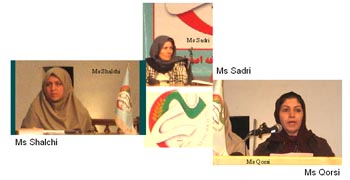
Hura Shalchi, 35, joined MKO when she was 24.Mujahedin forced her to divorce and separated her from her four”year old daughter. Hura succeeded in her first mission but while the second mission when she had to commit a mortar attack against a revolution guard’s base in Tehran, she was arrested." While returning to Iraq, the person who was supposed to guide her through the border handed her to police." He did this under the order of MKO leaders. I found out that they don’t want the ones who go for mission get back any more since they fear that anything is told about Iran’s today condition because there were no similarity between what we had seen and what they had told us." Hura who was sentenced to life imprisonment, only spent one and a half years in the prison and now she is free under the juridical control.

"When she was arrested, one of her comrades recalls, our chiefs made us believe that she has been killed and all Ashraf Campers celebrated her martyrdom." They prefer viewing her as a martyr because they can also exploit her blood." Behrouz Soltani adds.

Under American Protection

Today, Camp Ashraf incorporates 3000 men and women who are under the control of Mojgan Parsaiee. The difference from Saddam Hussein’s era is that now the camp is under the protection of Americans who have disarmed the group and defend it against the Shiite pro-Iranian groups. However the Department of State has listed MKO as a FTO, Pentagon is applying a flexible policy toward the organization, and making profit of their information on Iran doesn’t hesitate to use them against Islamic Regime. However, the Americans haven’t prevented the individuals coming out of the camp and going to Iran what Naser,49,did recently. He was a member of MKO for twenty years." Due to my political activities, he says, I passed four years in Iranian prison. When I came out, there was no place for me in the society. Therefore I joined them. With them, I wanted to liberate my people."

Once he was out of Ashraf, he passed three months at American Camp Tiff." The Americans knew everything about us. In that camp we were like refugees, but they treated us brutally. They don’t respect you except if you serve them. If we protested, they would beat us." He affirms.

For a long time, only membership of MKO could make you be executed, and thousand of fighters paid the price by their lives. Today, Regime has completely changed its policy and if a crime hasn’t been committed, they are welcomed by regime. They are even allowed to have a small association where they employ themselves in order to extract those who are still in Iraq. Today they learned about the suicide of Yasser Akbari Nasab, one of their friends at Camp Ashraf. The Organization is not any more the phantom that was in 1989’s for Iran. "If the Mujahedin leave Iraq, they will be finished for ever." says Babak. Waiting for that time, the organization stays rich and influential in Europe. It has also received an important victory in front of European justice that annulled the freezing of MKO’s funds estimated to be several million Euros, which were blocked since 2002. The defectors, who victimized their youth in MKO, didn’t join the Islamic regime though. Since then we detest any politic." says Hura Shalchi.

Liberation-France – Jean-Pierre Perrin – January 3rd, 2007

February 3, 2007 0 comments
FacebookTwitterPinterestWhatsappTelegramSkypeEmail
Nejat Publications

Nejat NewsLetter-ISSUE NO.8

February1, 2007   Nejat News Letter :

  • Download Nejat NewsLetter-ISSUE NO.8

    February 1, 2007 0 comments
    FacebookTwitterPinterestWhatsappTelegramSkypeEmail
  • Ann SingletonFormer members of the MEK

    My years of slavery with the terrorists

    Anne Singleton grew up in an unremarkable Yorkshire family, but by her early 20s she was a member of a terrorist organisation recruiting suicide bombers in Iraq. Billy Briggs reports.

    IN 1992, Anne Singleton was in the Iraqi desert being trained to fire a Kalashnikov rifle by the People’s Mujahedin of Iran. It was a year after the first Gulf War and Anne was a member of an organisation intent on overthrowing the Iranian government by force.

    "I was in the desert wearing a military uniform and I had no passport and no money," she says. "I had never felt so free in my life. But the irony was that I was in a state of modern slavery. I was mentally chained to the Mujahedin."

    Sitting in her Leeds home 15 years later, the 48-year-old wants to make her past public in the hope it acts as a stark warning that recruitment to an organisation proscribed as a terrorist movement by the European Union, America and Canada, is something that could happen to anyone.

    In the present climate, with radical terrorist cells and cults active in the UK, Anne is campaigning to raise awareness of how extremist groups manipulate people.

    Her life now, living in a three-bedroom semi as a computer programmer and being a mother to a six-year-old-son, could not be further removed from a previous existence where she prepared for war and accepted the deaths of innocent people as a justifiable means to an end.

    "I thought I was a saviour of the world and would have done anything for the Mujahedin. I worshipped those people," says Anne, whose involvement with fanatical extremists began when she moved from Yorkshire to study English at Manchester University.

    Her boyfriend at that time, an Iranian called Ali, was interested in the Mujahedin, and Anne became intrigued by the movement’s opposition to the regime of the Ayatollah Khomeini after the 1979 revolution.

    "Manchester Uni was very political and I went along to Mujahedin meetings," she says. "In truth, I could not even understand what the leader was saying in the videos but I was utterly transfixed."

    The Mujahedin was formed in 1965 to free Iran from "capitalism, imperialism, reactionary Islamic forces and despotism" and by the early 1970s, it had embarked on an armed struggle and later sought refuge in Iraq, fighting with Saddam Hussein against the Iranian government.

    Anne’s indoctrination, conversion and submission to the organisation was something that happened gradually over a period of about 10 years, the subtle influence of Anne’s Mujahedin peers eventually leading her away from her job, friends and family.

    She views the Mujahedin now as a cult and says their methods of psychological manipulation are tried and tested and used by many other groups around the world, even similar to some tactics employed by salesmen to sell timeshares.

    "It takes a long time and they are very clever and use peer pressure," she says. "They implement subliminal messages. They use mind control techniques. They got me to submit to a higher order, their leader.

    "They got me to make financial commitments. I used to ask all my friends and family to donate money to various causes that were all blatant lies.

    "They replace your family, your relationships and get you to reject all your old values."

    In 1985, Massoud Rajavi became the Mujahedin leader, transforming the movement, Anne says, from a being a political group into a cult.

    He married a woman called Maryam, whose role was to encourage women to break away from male control, and Anne began spending all of her spare time looking after members’ children, cooking, listening to their poetry and revolutionary music.

    "I thought they were people of a higher order," says Anne, who was utterly convinced she was part of a noble, armed struggle. She even had posters of martyrs, suicide bombers and women with guns adorning her walls.

    In 1989, Anne split with Ali, who wanted nothing more to do with the movement, and she moved to London to become more involved in Mujahedin activities.

    During this period, she got involved with activists at a safe house in Finchley and, when the UN Human Rights Rapporteur visited Iran in l990, they all went on hunger strike to apply pressure on him to question the Iranian government about the nation’s Mujahedin prisoners.

    "I was as high as a kite on hunger strike and I felt superhuman as if I had transcended normal humanity," she says. "Shortly afterwards I walked out on my job and went full-time with the movement.

    "I didn’t question anything. I was shown a film of a female suicide bomber blowing up an ayatollah in Iran. It was horrific, and very shocking, at first, but I was shown the film many times, and each time I was less distressed. Eventually, I didn’t bat an eyelid,"

    By this time Anne barely saw her parents and she had ditched all her friends. She had even publicly burned the diaries she had kept since childhood, as a symbolic rejection of her past.

    "If the leader had said ‘kill yourself’, I would have killed myself," she says.

    In l992, Anne was asked to go to Iraq for some military training. As a member of an armed struggle, she knew this might be required and did not resist, even relinquishing her passport to the Mujahedin when she arrived in the desert.

    "You have no human rights, no nationality, you are simply a Mujahed," she says.

    "I loved the camp and it felt liberating to obey orders, because you lose all responsibility for yourself. I felt like a child and thought if I put all my trust in their hands, I would be okay," Anne says.

    But in 1993 Anne started to have doubts about the movement after all members were told that marriage was banned and all couples must get divorced. At this time she met her current husband Massoud, another disillusioned member, and in 1996 they made the decision to leave.

    With the Mujahedin in constant contact, initially it was extremely difficult for them to adapt back into society and it took three years to make a complete break and fully recover from their ordeal.

    "We are both Muslims, but after we left, we would even go out and get drunk just to be ‘normal’," she says. "Being able to think for yourself again was amazing, and we were like little kids doing things like going to the supermarket and choosing our own food."

    In 1999, Anne and Massoud discovered literature from the Cult Information Centre and discovered that the psychological coercion techniques used by the Mujahedin were methods all recognised and listed, and together, they now campaign to warn others that anyone is vulnerable to these groups

    "Look at the young men in West Yorkshire who are being targeted by the terrorist organisations," she says.

    "People across the UK must be asking what is wrong with the people in West Yorkshire. There is nothing wrong with the people here, it is just that the extremists are out there recruiting in the locality, using the same tried and tested methods used by the Mujahedin and the many other disparate cults and movements active around the world.

    "Psychological manipulation can happen to anyone, any time. If you’re lucky, you end up with a timeshare.

    "If you’re unlucky you end up blowing yourself and innocent people up on the Tube."

    Yorkshire post, January 31 2007

    http://www.yorkshiretoday.co.uk/ViewArticle2.aspx?SectionID=105&ArticleID=2009152

    February 1, 2007 0 comments
    FacebookTwitterPinterestWhatsappTelegramSkypeEmail
    USA

    US using opposition group to track Iranian influence networks in Iraq

    Camp Ashraf which is occupied by the Iraq-based Iranian opposition group the Mujahedine Khalq Organisation (MKO) is sited more than 260km north of Baghdad.

    This group resettled in Iraq in 1987 during the rule of Saddam Hussain. After Saddam was ousted in 2003, the US army gave protection to this camp which remains today.

    The Iraqi coalition government headed by Shiite Ebrahim Al Jaafari and Nouri Al Maliki decided to expel MKO members from Iraq and close Camp Ashraf. However, none of these decisions have been implemented.

    In this camp and in other Iraqi cities, there are between 4,000 and 5,000 MKO members and their families, with identities issued by the United Nations and the Coalition Provisional Authority (CPA) to facilitate their mobility inside Iraq.

    Jalal Al Din Al Sagheer, a prominent figure in the Shiite coalition, has accused MKO members of supporting terrorist groups affiliated to the former regime.

    Prohibits

    He told Gulf News: "There is an Iraqi constitution which prohibits using the Iraqi territory to launch a series of cross-border attacks against neighbouring countries and we are committed to this position."

    Leaders of Camp Ashraf move with heavy US forces’ protection inside Baghdad and other Iraqi cities. During visits of Iraqi officials to Tehran and their Iranian counterparts to Baghdad, the MKO group file was at the top of bilateral talks. It was said that Iran wants a settlement with Iraqis to end the MKO file in return for full security cooperation that guarantees stopping the infiltration of terrorist elements into Iraq from the Iranian borders.

    Lubaid Abbawi, the undersecretary of the Iraqi Ministry of Foreign Affairs, told Gulf News: "The MKO file must move fully to the responsibility of the Iraqi government and must not be a political agenda used by different politicians or parties."

    In the light of American-Iranian conflict in Iraq and in the region it is unlikely that the American forces will submit Camp Ashraf to Al Maliki.

    According to some leaks from Baghdad, Americans have begun to form special groups comprising MKO members to assist them to track Iranian intelligence networks in Iraqi cities, as well as to provide the US intelligence with a huge amount of information from inside Iran, especially with the escalation of the Iranian nuclear file. These measures came just after the launch of the new US strategy set by President George W Bush, which included reducing the Iranian influence in Iraq.

    A MKO report published recently in Germany referred by name to more than 31,000 Iraqi agents working for the Iranian intelligence. This indicates that the next phase will witness greater convergence between the MKO and the American forces in Iraq.

    Hadi Al Ameri, leader of the Badr Organisation of the Shiite Supreme Council, has accused the MKO of training terrorist elements and working to destabilise Iraq. Al Ameri affirmed the coming period will witness the exile of this Iranian opposition group from Iraqi territories.

    The Al Maliki government works to exclude Iraq from any Iranian-American influence conflict and to ensure Iraq does not turn into an arena for settling accounts between the two countries.

    The MKO group in Iraq has established political relations with prominent Shiite religious leaders who oppose the political process, the Mahmoud Al Hasani group in Karbala and the Jawad Al Khalisi group in Kadhimiya city, Baghdad.

    Basil Adas, gulfnews – January 31, 2007

    February 1, 2007 0 comments
    FacebookTwitterPinterestWhatsappTelegramSkypeEmail
    Ali Reza Jafarzade

    “Building a Case for War”with Iran: Jafarzadeh and the Downing Street Dossier Redux

    Is it possible we are stupid enough to fall for it again?

    "US officials in Baghdad and Washington are expected to unveil a secret intelligence ‘dossier’ this week detailing evidence of Iran’s alleged complicity in attacks on American troops in Iraq. The move, uncomfortably echoing Downing Street’s dossier debacle in the run-up to the 2003 Iraq invasion, is one more sign that the Bush administration is building a case for war," reports the Guardian.

    Not to worry, declares Nicholas Burns, the senior diplomat in charge of Iran policy and, hardly coincidentally, a member of the Council on Foreign Relations and the Order of St. John, the latter run by the ruling houses of Europe, headed until his death by the former SS official, Prince Bernhard of the Netherlands.

    The neocons are "not looking for a fight" with Iran (indeed, they don’t want to fight the Iranians, simply shock and awe them into submission) and instead are eager to "push back," never mind there is no defensible reason to do so. "Primarily that means Tehran’s perceived meddling in Iraq, where its influence with the Shia-led government and Shia majority population appears to be increasing as Washington’s weakens," the Guardian would have us believe.

     Once again, we are subjected to the discredited accusation "Iranians are smuggling into Iraq sophisticated explosive devices, mortars, and detailed plans to wipe out Sunni Arab neighborhoods," never mind that Pentagon has done a mighty fine job of accomplishing the latter without the help of Iran.

    "But as was also the case in the days before Saddam Hussein fell, powerful external forces, ranging from exiled Iranian opposition groups to leading Israeli politicians, appear intent on stoking the fire”and winding up the White House," an unabashedly fair assessment, although it would help if the Guardian told us the rest of the story, namely the so-called "case" against Saddam Hussein consisted of a transparent passel of lies, fabrications, and fairy tales.

    "The al-Quds Force of Iran’s Islamic Revolutionary Guards is stepping up terrorism and encouraging sectarian violence in Iraq," Alireza Jafarzadeh”a US-based Iranian dissident who is linked to the Marxist cult Mujahedin-e-Khalq (MeK), officially listed by the State Department as a terrorist group”told the Moonie, er Washington Times earlier this month. In essence, Jafarzadeh is but another Ahmed Chalabi, pedaling lies and exaggerations, the vile stuff of neocon pretext.

    In the not too distant past, Jafarzadeh was happy to proffer scary stories about ayatollahs with nukes. Now, however, as a neocon team player, he has adopted the Iran meddling in Iraq theme, apparently the emerging rationale conjured up as a flimsy excuse to be used in the upcoming effort to shock and awe Iranian school children and grandmothers.

    "There is a sharp surge in Iran’s sponsorship of terrorism and sectarian violence in the past few months," Jafarzadeh told a conference organized by the Iran Policy Committee, an organization connected at the hip to the American Enterprise Institute, a criminal operation where Bush’s get his psychopathic "minds."

    According to Right Web, the "two leading figures at IPC are Raymond Tanter, who cofounded the organization in January 2006, and Clare Lopez, IPC’s executive director. IPC members have close ties with the U.S. military, intelligence community, and high-tech military contractors," death merchants who stand to profit handsomely from any attack launched against Iran. It is hardly a surprise that Clare Lopez, an operations officer with the CIA for two decades, is an adjunct scholar at the Washington Institute for Near East Policy, the AIPAC and Zionist created think tank.

    "Israel is also pushing the intelligence case while upping the ante, claiming to have knowledge that Tehran is within a year or two of acquiring basic nuclear weapons-making capability," explains the Guardian, trotting out what should by now be a threadbare and thoroughly discredited lie. "In a BBC interview last week former prime minister Binyamin Netanyahu compared President Mahmoud Ahmadinejad’s regime to Hitler’s Nazis. Speaking in Davos the deputy prime minister, Shimon Peres, demanded immediate regime change or failing that, military intervention."

    Finally, the New York Times, responsible for eagerly disseminating war propaganda in the lead-up to the invasion and occupation of Iraq, tells us "Bush and his aides [read: criminal neocons] calibrate how directly to confront Iran, they are discovering that both their words and their strategy are haunted by the echoes of four years ago”when their warnings of terrorist activity and nuclear ambitions were clearly a prelude to war. To many in Washington, especially Mr. Bush’s Democratic critics, the new approach to Iran has all the hallmarks of an administration once again spoiling for a fight."

    Of course, there will be no "fight," at least not in a traditional military sense, but rather a cowardly air bombardment, designed not only to take out Iran’s fictional nuclear weapons labs but also decimate the country’s civilian infrastructure, producing in essence a repeat of the situation in Iraq.

    Although the perfidious neocons and their Fox News apologists and enablers tell us repeatedly they look forward to taking out Iran’s supposed nuke capability”and, in the process, deposing the ayattollahs for the sake of the poor besieged Iranian people”last year Seymour Hersh revealed the "U.S. Air Force proposals for an air attack to destroy Iran’s nuclear capacity [include] the option of intense bombing of civilian infrastructure targets inside Iran," as should be expected, as the attack Iran plan is simply another step in the Zionist and neocon agenda engineered to decimate Muslim and Arab society and culture.

    by Kurt Nimmo – Global Research – January 30, 2007

    February 1, 2007 0 comments
    FacebookTwitterPinterestWhatsappTelegramSkypeEmail
    Mujahedin Khalq Organization as a terrorist group

    New Document on MKO’s Involvement in Kurds’ Massacre

    On Jan. 23, 2007, CNN Arabic reported from Baghdad on the details of the 35th session of Anfal Court, which clearly points to the fact that Ali Hassan Al-Majid ordered MKO members to pursue and target Kurds inside Iran.

    The report is as follows:

    "35th session of Anfal Court was held in Iraq and it’s the second session without the presence of former Iraqi president Saddam Hussein, hanged on December 30.

    In the previous session, prosecutor provided the court with audio tapes of talks between Saddam and Hassan Al-Majid, in which the orders were issued on using chemical weapons against the Kurds.

    In the 35th session, new documents were presented on the accusations and the roles of former Iraqi president’s allies in attacking the Kurds in 1988 were identified.

    What follows is part of the details of the session quoted by Iraqi TV:

    – Prosecutor provided the court with a new audio tape in which Ali Hassan Al-majid talks about chemical weapons against the Kurds and promises to impose more restrictions on them, including the ban on speaking Kurdish.

    – Another audio tape revealed that Hassan Al-Majid was planning a new scenario, including chemical attacks on the Kurds, gathering them in specified locations and then targeting them with chemical weapons.

    – Prosecutor states that in a part of the tape, Al-Majid asks for pursuing the Kurds by special teams and also targeting them inside Iran by Mojahedin-e Khalq. The tape was not played.

    CNN Arabic, 23 January 2007

    February 1, 2007 0 comments
    FacebookTwitterPinterestWhatsappTelegramSkypeEmail
    Mujahedin Khalq 's Function

    Iraqi politicians are working for Iran

    Seizing the opportunity to escalate the created tension between Iran and the US, MKO has opened a new front of misinformation. Talking to Asharq Al-Awsat, MKO spokesperson in Britain, Dawlat Nawruzi, stated that many high-ranking Iraqi Government officials and Iraqi politicians are working for Iran. She said they are among a "list of 132,000 agents who work for Iran inside Iraq." She further claimed that "MKO has obtained precise information about the names of the agents, their titles and financial allowances they receive from the Iranian Government."

    Disclosing Mojahedin’s intelligence activities inside Iraq since the invasion of the US, she said: "For the past four years, the organization has been continuously publishing its information about thousands of Iranian agents in Iraq, and the operations that these agents have been carrying out. However, nobody paid attention to this information, and we were not given the opportunity to disclose the details."

    For sure, the Iraqi nation and authorities hardly tolerate such allegations by a terrorist group enjoying the support of American forces in their own country when it claims that "We have said that some Iraqi officials have received millions of dollars from Iran to carry out operations against the Iraqi people".

    mojahedin.ws –  31/01/2007

    February 1, 2007 0 comments
    FacebookTwitterPinterestWhatsappTelegramSkypeEmail
    Newer Posts
    Older Posts

    Recent Posts

    • Rebranding, too Difficult for the MEK

      December 27, 2025
    • The black box of the torture camps of the MEK

      December 24, 2025
    • Pregnancy was taboo in the MEK

      December 22, 2025
    • MEPs who lack awareness about the MEK’s nature

      December 20, 2025
    • Why did Massoud Rajavi enforce divorces in the MEK?

      December 15, 2025
    • Facebook
    • Twitter
    • Instagram
    • Youtube

    © 2003 - 2025 NEJAT Society . All Rights Reserved. NejatNGO.org


    Back To Top
    Nejat Society
    • Home
    • Articles
    • Media
      • Cartoons
      • NewsPics
      • Photo Gallery
      • Videos
    • Publications
      • Books
      • Nejat NewsLetter
      • Pars Brief
    • About Us
    • Contact us
    • Editions
      • عربي
      • فارسی
      • Shqip