Nejat Society
  • Home
  • Articles
  • Media
    • Cartoons
    • NewsPics
    • Photo Gallery
    • Videos
  • Publications
    • Books
    • Nejat NewsLetter
    • Pars Brief
  • About Us
  • Contact us
  • Editions
    • عربي
    • فارسی
    • Shqip
Nejat Society
Nejat Society
  • Home
  • Articles
  • Media
    • Cartoons
    • NewsPics
    • Photo Gallery
    • Videos
  • Publications
    • Books
    • Nejat NewsLetter
    • Pars Brief
  • About Us
  • Contact us
  • Editions
    • عربي
    • فارسی
    • Shqip
© 2003 - 2024 NEJAT Society. nejatngo.org
Torture in the MEK Cult
The cult of Rajavi

I come from the land of pain and suffering – Part two

I was subjected to the most horrendous physical and psychological torture during my stay in solitary confinement. I was verbally abused; physically assaulted; psychologically tortured, starved, deprived of warm water in winter, denied air condition during the 50 degree centigrade summer days in Baghdad. My cell was infested with cockroaches and mosquitoes. I was subjected to general and localized torture for at least 13 times.

Sometimes in the middle of 1374{year beginning on 21 March 1995}, following my loud protests (complaining about the abhorrent prison condition and the fact that I was being prevented from seeing my wife and daughter), they moved me again from my cell in the middle of the night while the streets at Ashraf Base were deserted. They had feared that other inmates might recognize my voice. They tied my hands and blindfolded me. I was transferred to another secret jail on the same base. However, after nine months, I was transferred back to the original cell. They didn’t allow me to speak to my wife for four and half years. They finally letme to speak to my wife sometimes in Ordibehesht – Khordad 1375 [April-May 1996].

Mohammd Hussein Sobhani

Mohammd Hussein Sobhani

This was meant to break me and bring me down to my knees. Rajavi allowed me to speak to my wife for only 10 minutes. In a letter, Mr. Rajavi, had asked me to forget the past and assured me that the regime [Islamic Republic of Iran] was about to be toppled!! I was kept in solitary confinement until Esfand 1376 [March 1996] when I received another letter from Mr. Rajavi. During this period, I was not allowed to call my daughter or even write to her. They did not even give me the letters or photographs she had sent me.

I received another letter from Mr. Rajavi in Esfand 1376 [March 1996]. Subsequently, I was taken to a meeting attended by Mahvash Sepehri,Mehdi Abrishamchi, Fahimeh Arvani,Mahbubeh Jamshidi,seyed Mohamamd Seyyed-al-Mohaddesin, Mohammad ali Tohidi and Mohammad Ali Jaberzadeh. I asked them to let me see my daughter. They agreed on the condition that I should stay anther three years at a so-called suitable place but in solitary confinement (prisoners called it Rajavi’s Hostel) they said that I would be allowed to visit my daughter in Denmark afterwards. I accepted but insisted that I must be allowed to either call my daughter or stay in touch with her through letters. However, right before transferring me from my solitary confinement at Ashraf to another jail in Badie, which by all accounts was a better facility, they asked me to sign a letter stating that I was willing going to spend three years at the so-called Rajavi’s military hostel. I refused at first which prompted them to delay my transfer for two weeks. However, at the end I signed the letter in hope of being able to speak to my daughter and exchange letters with her.

April 28, 2022 0 comments
FacebookTwitterPinterestWhatsappTelegramSkypeEmail
MEK terrorists in Albania
Mujahedin Khalq Organization as a terrorist group

Th MEK; Virus of Corruption, Terrorism in Albania

It has been more than five and a half years since the terrorist Mujahedin-e Khalq Organization (a.k.a. MEK, MKO, and PMOI) has relocated to Albania, a small country in southeastern Europe. A process, which took nearly three and a half years, indicates how difficult and complicated the expulsion of fewer than 3,000 members from Iraq to a third country was.

The MEK’s expulsion from Iraq and their acceptance by a third country had been a knotty problem for the Iraqi central government because of their criminal and anti-human rights record, which has been corroborated by numerous international reports, including the European Union.

Eventually, Albania, a small Balkan country, accepted the MEK members after signing an agreement with the United States. Many believe that Albania’s acceptance was because of the United States’ hegemony over Albania and its $20 million aid to the Albanian government, which had been revealed by John Kerry during his meeting with the Albanian Prime Minister in Albania.

Camp Ashraf 3 in Albania

Camp Ashraf 3 in Albania

However, Albanian officials, being aware of the sensitivity of their decision, insisted that their terrorist guests made pledges not to engage in any political activity and they had been accepted solely for humanitarian reasons. But the fact is that none of these claims of the Albanian authorities came true. The politicians of the Democratic Party who signed the agreement to accept the MEK members in 2013 did not adhere to the claim. And the Socialist Party and Prime Minister Edi Rama offered the strongest support to the terrorist group. The incumbent Albanian Socialist Party had previously accused the Democratic Party of taking huge bribes from the United States in exchange for accepting MEK members on Albanian soil. Strangely enough, the political leaders of both parties are now giving widespread support to the MEK. Members of the MEK were initially housed in buildings in the Albanian capital of Tirana. Gradually, they moved to a more remote site in Durrës County, western Albania, and constructed a highly fortified camp on 34 hectares of farmland when the country was struggling with unfavorable economic conditions.

Albanian officials have suspiciously stepped up their support for the cult of MEK. Forgetting his legal status, Albanian President Ilir Meta attends the MEK camp in Tirana to meet with the leader of the terrorists. Prime Minister Edi Rama spends a significant portion of his time at the UN General Assembly in support of the MEK. Albanian lawmakers have frequently visited the MEK camp and given speeches in their support. In November 2018, former Albanian MP Namik Kopliku said that his country’s politicians were united in welcoming the MEK. Given the serious disagreements between the Albanian political parties, the MEK’s drawing support from Albanian politicians should be seriously investigated as Albania’s political corruption has always been a hindrance to its EU membership. Popular narratives of MEK’s cutting fat checks for some Iraqi and US officials during the last years shed light on the reasons for the Albanian support and speeches in favor of the MEK.

It is the dubious support of the Albanian authorities for the MEK that has led to the group’s freedom of action in the country, a situation that contradicts the initial commitments of the Albanian authorities. The MEK cult, according to the Independent’s 2018 report, has built a state within a state in Albania that implements its own laws. For example, for a large sum of money, it has set up a powerful telecommunication tower overlooking Tirana. “The organization appears to have strong connections to senior Albanian officials.,” the report said. “Pandeli Majko, a minister in the current Albanian government of Prime Minister Edi Rama, Fatmir Mediu, a former defense minister, and Elona Gjebrea, a former deputy interior minister, were with Giuliani in his visit to Tirana earlier this year for Persian New Year festivities hosted by the MEK.” The MEK’s influence among the corrupt Albanian politicians has been so overwhelming that, according to the Independent, even the Albanian police are not allowed to enter their camp. The Albanian Interior Ministry has no control over the compound, which has become a secret underground organization.

At the peak of the coronavirus pandemic and the infection of a significant number of the MEK members which led to the death of a number of them, the Albanian Ministry of Health was not allowed to enter the camp to check the health protocols. In addition, at the heart of the energy crisis which has plagued the country, causing power outages in various parts of the country including Durres, it has been surprising and at the same time irritating for the locals to see the MEK’s camp lit by innumerable lamps.

Undoubtedly, the Albanian government’s different approach to the MEK has seriously raised suspicions of collusion and secret agreements of Albanian officials with this terrorist cult and perhaps its sponsors. In 2020, El País disclosed the MEK’s $1 million support for Spain’s far-right Vox party during its founding in 2013 and the payment of monthly salaries to the party leaders, as well as the payment of 80% of its campaign expenses in the 2014 European Parliament elections. It shows that the group’s tendency to attract foreign support and strengthen its lobby knows few bounds. It becomes highly dangerous if the support is drawn from officials of a small country faced with economic chaos like Albania whose politicians are involved in rife corruption.

Albania performed poorly in the Corruption Perceptions Index 2020 and ranked 104. Housing the MEK with numerous cases of money laundering and corruption is a threat to Albania and would endanger its efforts to join the European Union. The MEK spends huge sums of money to support the political authorities who support them the most. The political leaders, in return, will do their best to attract the attention of this terrorist group. It will be the Albanian people who will suffer from the presence of this terrorist group in Albania and will touch its effects, in the long run.

by Reza Alghorabi – Quds Online – Translated by Habilian Association

April 27, 2022 0 comments
FacebookTwitterPinterestWhatsappTelegramSkypeEmail
Saeed and Mohammad Akhavan Hashemi—MEK children Saeed and his twin brother Mohammad were only three years old in 1988 when their mother was killed in Forough Javidan, the messy military operation that the Mujahedin Khalq launched from Iraq against Iran after the ceasefire was signed between Iraq and Iran. A year later, the twins were smuggled out of Iraq together with seven hundred children of Mujahed parents who were separated from their parents under the direct order of Massoud Rajavi who saw the children an obstacle to the struggle. Saeed and Mohammad were smuggled through Europe to Canada. As well as other MEK children, the agents of MEK in Canada handed the twins to families who were mostly sympathizers of the group. They were grown up in Canada until their teen years. When they got sixteen, the organization needed the child soldiers to extend its millitary force. Thus, Saeed and Mohammad were persuaded to get back to Iraq to join the group’s military arm, the so-called National Liberation Army (NLA). They were first moved to the US where they were settled in the MEK’s base for a few months. They were indoctrinated to join the army to revenge the blood of their mother. In the US, Saeed was intrigued to take part in the anti-Iran protests run by the MEK. After a few months of indoctrination in the headquarters of the NCR in Washington, when they were 17 years old, the twins were coerced to sign the membership forms of the NLA and eventually they were smuggled back to Iraq. They were given military uniforms and arms as child soldiers of the MEK’s army. In the MEK’s headquarters in Iraq, Saeed and Mohammad like other child soldiers of the MEK were not able to go to school or university. Instead, they received military trainings. In 2003, after the US invasion to Iraq, the MEK was disarmed by the US army and NLA was practically dismantled. Iraqi dictator Saddam Hussein, main sponsor of the MEK had been collapsed and the newly established Iraqi government did not want the MEK in its territory but the MEK leaders considered themselves the owners of Camp Ashraf, the land that Saddam Hussein had confiscated from Iraq farmers and had donated to Massoud Rajavi. In order to move the MEK out of Iraq, the group was temporarily relocated in Camp Liberty near Baghdad. The twins were separated. Mohammad was transferred to Camp liberty and Saeed was ordered to stay in Camp Ashraf. Although the brothers did not use to live together in Camp Ashraf –as none of family members are allowed to live together in the MEK—the last two weeks they spent more time together. “We used to talk to each other every night for the last two weeks,” Mohammad says. “The last day we said goodbye to each other. We exchanged our watches as memento.” This was their last visit. Saeed was shot dead by Iraqi Intifada Youth who raided camp Ashraf on September 1st 2013. He was only 28 when he became the victim of Massoud Rajavi’s ambitions in Iraq. The whereabouts of Mohammad Akhavan is not clear. He might be still under the brainwashing system of the Cult of Rajavi i9n Albania to revenge the blood of his mother and brother, who both were victimized by the cult’s system or he might have left the MEK after the group was relocated in Albania, just like many other former child soldiers of the group.
The cult of Rajavi

MEK and Children – Saeed and Mohammad Akhavan Hashemi

Saeed and his twin brother Mohammad were only three years old in 1988 when their mother was killed in Forough Javidan, the messy military operation that the Mujahedin Khalq launched from Iraq against Iran after the ceasefire was signed between Iraq and Iran.

A year later, the twins were smuggled out of Iraq together with seven hundred children of Mujahed parents who were separated from their parents under the direct order of Massoud Rajavi who saw the children an obstacle to the struggle. Saeed and Mohammad were smuggled through Europe to Canada.

Saeed and his twin brother Mohammad

Saeed and his twin brother Mohammad were only three years old in 1988 when their mother was killed in Forough Javidan

As well as other MEK children, the agents of MEK in Canada handed the twins to families who were mostly sympathizers of the group. They were grown up in Canada until their teen years.
When they got sixteen, the organization needed the child soldiers to extend its millitary force. Thus, Saeed and Mohammad were persuaded to get back to Iraq to join the group’s military arm, the so-called National Liberation Army (NLA).

They were first moved to the US where they were settled in the MEK’s base for a few months. They were indoctrinated to join the army to revenge the blood of their mother. In the US, Saeed was intrigued to take part in the anti-Iran protests run by the MEK.

After a few months of indoctrination in the headquarters of the NCR in Washington, when they were 17 years old, the twins were coerced to sign the membership forms of the NLA and eventually they were smuggled back to Iraq. They were given military uniforms and arms as child soldiers of the MEK’s army.
In the MEK’s headquarters in Iraq, Saeed and Mohammad like other child soldiers of the MEK were not able to go to school or university. Instead, they received military trainings.

In 2003, after the US invasion to Iraq, the MEK was disarmed by the US army and NLA was practically dismantled. Iraqi dictator Saddam Hussein, main sponsor of the MEK had been collapsed and the newly established Iraqi government did not want the MEK in its territory but the MEK leaders considered themselves the owners of Camp Ashraf, the land that Saddam Hussein had confiscated from Iraq farmers and had donated to Massoud Rajavi.

In order to move the MEK out of Iraq, the group was temporarily relocated in Camp Liberty near Baghdad. The twins were separated. Mohammad was transferred to Camp liberty and Saeed was ordered to stay in Camp Ashraf.

Saeed and his twin brother Mohammad

Saeed and his twin brother Mohammad

Although the brothers did not use to live together in Camp Ashraf – as none of family members are allowed to live together in the MEK—the last two weeks they spent more time together. “We used to talk to each other every night for the last two weeks,” Mohammad says. “The last day we said goodbye to each other. We exchanged our watches as memento.” This was their last visit.

Saeed was shot dead by Iraqi Intifada Youth who raided camp Ashraf on September 1st 2013. He was only 28 when he became the victim of Massoud Rajavi’s ambitions in Iraq. The whereabouts of Mohammad Akhavan is not clear. He might be still under the brainwashing system of the Cult of Rajavi in Albania to revenge the blood of his mother and brother, who both were victimized by the cult’s system or he might have left the MEK after the group was relocated in Albania, just like many other former child soldiers of the group.

April 26, 2022 0 comments
FacebookTwitterPinterestWhatsappTelegramSkypeEmail
Leila Kiukan
Mujahedin Khalq Organization members' families

My father is a prisoner of the MEK Cult

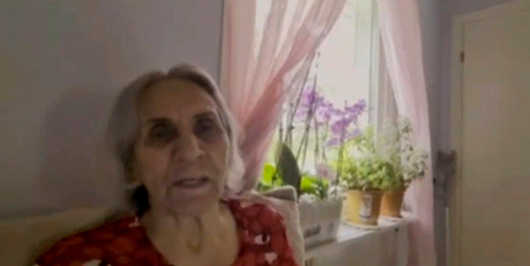
Leila was only two years old when her father left Iran. ”My father and I have never heard each other’s voice”, she says. Leila has no memory of her father.

Leila’s father; Rahim Kiukan who as a supporter of the MEK was brainwashed by the instincts of the MEK cult left his family in 1981 and joined the group in Iraq. The family have had no news of him since then.
A 10 cm family photo, is the only memory, Leila has of his father.

A court session has been held in Tehran in March 2021, to look into the complaints filed a by a group of the MEK ex-memebrs, who have managed to leave the group after several years of being under torture and oppression by the cult leaders. Leila participated the court session as a victim of the group. Here is part of the interview with Ms. Kiukan:

https://dlb.nejatngo.org/Media/Interview/Kiukan-Leila-2.mp4

to download the video file click here

April 25, 2022 0 comments
FacebookTwitterPinterestWhatsappTelegramSkypeEmail
Torture in the MEK Cult
The cult of Rajavi

I come from the land of pain and suffering – Part one

My name is Mohammad Hosein Sobhani. I am a former official and member of the Mojahedin Khalq Organization central committee. My name and title appeared in the special Autumn issue of 1370{ year beginning on 21 March 1977} and became professionally involved with that organization on 22 Bahman 1357{11 February 1978}. At the beginning, I was working in MKO’s administrative and student departments until with my wife, Afsaneh Taherian, were dispatched to Iranian Kordestan. Prior to my transfer, I was in command of a resistance unit. After the opposition forces pulled back from the liberated territories in Iranian Kordestan, I continued my work at MKO bases in Iraq. I worked in the communication department of Radio Mojahed until 1364{year beginning on 21 March 1985} when I assumed my role as a unit commander at the training school for urban guerrilla warfare. And later I was out in charge of a department at the intelligence headquarters. I, subsequently, became the security commander at Ashraf Base and later became one of the commanders in charge of AM {security} and HE{protection}.

Mohammd Hussein Sobhani

Mohammd Hussein Sobhani

Starting in 1371 {year beginning on 21 March 1992}, I began expressing my views about MKO’s strategy regarding its armed struggle and the organization’s presence in Iraq.
Subsequently I had two meetings with Massoud Rajavi,each lasting six to seven hours, during which he tried to change my views. I also met Maryam Azdanlu and Fahimeh Arvani a number of times during which I pushed my views forward, stood my grounds and expressed reservations about various issues. Finally at the start of Shahrivar 1371{August 1992}, Mr. Rajavi ordered a meeting attended by Ebrahim Zakeri and Seyyed Mohamamd al-Mohaddesin and a number of high ranking officials.
I saw behind Rajavi’s false façade for the first time. During this meeting those people who until yesterday were calling me brother were now using their hands, fists and gutter language as well as profanity trying to dissuade me from questioning the strategy of the organization. I , however, stood my ground and did not bend. After that, Ebrahim Zakeri who had presided over the meeting ended the session. Following that meeting, report of which was forwarded to Rajavi, I was put in Bengal { a small container} at Badie Base for 24 hours. The next day, before the start of the daily routine at the base, I was secretly moved by two Land cruisers and a group headed by Ebrahim Zakeri and Soheyla Sadeg ( at the time in charge of the organization’s jail and personnel headquarters). I was transferred to a new jail and put in solitary confinement located on street No 400 at Ashraf Base (at the center of Khales, 50 km north of Baghdad).

To be continued

April 21, 2022 0 comments
FacebookTwitterPinterestWhatsappTelegramSkypeEmail
Sister of Davood Heidarian
Mujahedin Khalq Organization members' families

Heidarian family asks to visit their beloved Davoud at the MEK Camp in Albania

Davoud Heidarian captured by the Iraqi forces during Iran-Iraq War in 1080. As a POW, Davoud then was transferred to the MEK Camp Ashraf in Iraq on the contrary to the international war laws. The family have had no contact with him since then.

https://dla.nejatngo.org/Media/Nejat/Alborz/Heidariyan-Davoud-Sis-202204.mp4


Ms. Masoumeh Heidarian; sister of Davoud on behalf of the family asks the Albanian authorities to facilitate their travel and meeting with their beloved Davoud.
She says: I have not seen my brother for 41 years and have had no contact with him.

April 20, 2022 0 comments
FacebookTwitterPinterestWhatsappTelegramSkypeEmail
Ali Biglari
Former members of the MEK

Victim of the Cult of Rajavi: I was brainwashed

As a passionate teenager, Ali Biglari fled home to go to the front of Iran-Iraq war. He dreamed of defending his homeland against the aggressive enemy. However, he soon was taken as a war prisoner by Iraqi forces.
The recruiters of the Mujahedin Khalq  succeeded to convince him to join their group after three years of imprisonment in Rumadi Camp, Iraq.

Ali Biglari

Ali Biglari

Once he entered the MEK’s headquarters in Iraq, Camp Ashraf, he found out that he had stepped in the wrong path but the brainwashing system of the Cult of Rajavi continued to keep him for many years.
Ali Biglari could finally manage to return home in 2003, after 14 years of imprisonment and mental and physical torture in the MEK’s cult-like structure. “The bitterness of freedom” is a recently-published book based on Ali’s life experience as a victim of the Cult of Rajavi.

Ali Biglari

Javad Kamvar; Writer of the book: bitterness of freedom, and Ali Biglari

“The title of the book implies that the central character of the book was freed from Iraqi prison but immediately after he was imprisoned in the MEK’s prison,” Javad Kamvar, the author of the book says. “He regretted but there was no way back. He could not accept the ideology of the MEK so he was under too much organizational pressure that led him to commit suicide. He survived but the MEK leaders handed him to Iraqi notorious prison, Abu Ghuraib.”

Ali Biglari never became an official member of the MEK’s army but he was coerced to stay in the group. “I had no idea that Camp Ashraf was a camp surrounded with barbed wires,” he says. “I thought it was a city in which I would have a normal life but as I arrived in Ashraf, the exit was shut for me for 14 years. I was brainwashed there.”

April 18, 2022 0 comments
FacebookTwitterPinterestWhatsappTelegramSkypeEmail
Marziyeh Babakhani
The cult of Rajavi

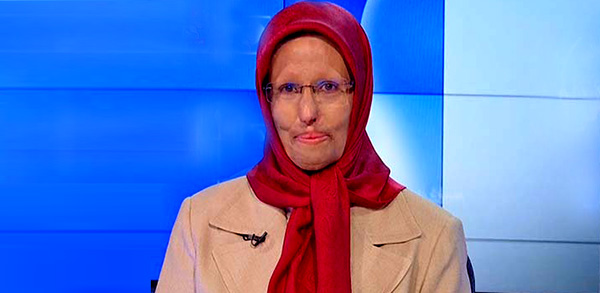
Marzieh Babakhani set herself on fire to protest the arrest of Maryam Rajavi

“I do not regret what I did on June 17th 2003”, Marzieh Babakhani said in a conference held by the Mujahedin Khalq (MKO/ MEK/ PMOI/ Cult of Rajvai) in Paris in 2014. This was not her first time to speak in an MEK-run event. She is often considered as the symbol of a devotee to Maryam Rajavi by the group’s propaganda.
Marzieh Babakhani joined the MEK when she was a young girl. She was soon elevated in the hierarchy of Massoud Rajavi’s cult of personality. When Maryam Rajavi was arrested by the French Police on June 17th, 2003, in Paris, Marzieh was 40 and a member of Maryam’s security team.

Marziyeh Babakhani

Marziyeh Babakhani

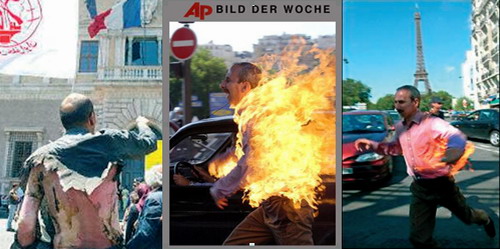
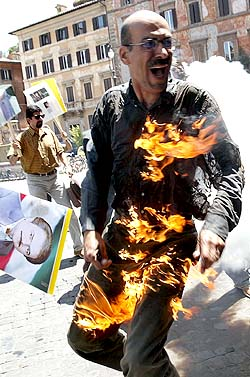
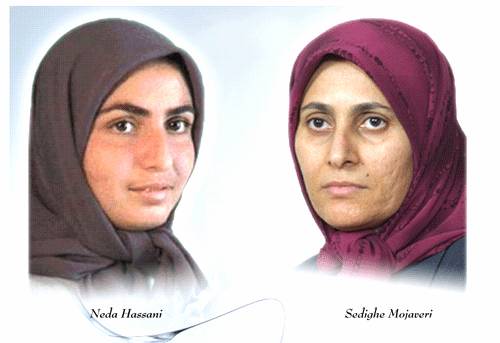
Marzieh was one of the ten MEK members who set themselves on fire to protest the arrest of the third wife of their disappeared leader, Massoud Rajavi. Two MEK female members, Neda Hassani and Sedigheh Mojaveri were killed in fire.

“I set myself on fire not to kill myself but for the freedom of my people,” Marzieh said. “Dear Maryam, you have several times told me that you disagreed what I did but as a human being I chose and I decided to do it because I think the Police raid on June 17th was a raid to terminate a legitimate resistance.”

In contrary to Marzieh’s claims, the MEK was not a legitimate entity. It was on the list of terrorist organizations of the European Union at the time and Maryam Rajavi had been arrested under terrorism charges. About nine million dollars were discovered by the French Police in Maryam Rajavi’s headquarters in Auver Sur d’Oise
There are a lot of evidences to prove that the Mujaheds who self-immolated after the arrest of Maryam Rajavi were coerced by the group to do so. “According to an organizational ruling issued by Massoud Rajavi, members of the MEK had been asked to set themselves on fire in France and other European countries,” Javad Firouzmand, a defector of the MEK writes. “This way, the group wanted to put pressure on France to release Maryam Rajavi.”
In an organized act, ten members of the MEK set themselves ablaze before the eyes of the citizens in France, Switzerland, Britain and Canada. Marzieh Babakhani set herself on fire in the morning of June 19th in front of the building of French intelligence and security department (DST).

MEK members self immoation

photo: The raid of the MEK’s Paris compound in 2003, which prompted acts of self-immolation by some of its members.

On the proper day, the French newspaper, Le Parisien, stated that the spokesperson of the foreign committee of the National Council of Resistance (NCR) had called cellphones of some of its journalists to announce the name of the self-immolator. The same newspaper also reported, “After the fire was extinguished, one of the Mujaheds offered a journalist better and nicer photos of the self-immolation ceremony!”

MEK members self-immolation

Marzieh Babakhani is a victim of a manipulative system that coerced its members to commit what it wants. The French author, Nathalie Goulet states evidences of on such a system in her book:
“In October 2007, two Iranians Mahmoud Alami (55) and Hossein Amini Gholipour (51) were charged in a court in Paris, for encouraging Sedigheh Mojaveri to set herself on fire on June 18th 2003. The two men were members of the MEK who had been arrested in a protest run by the group in front of the DST headquarters. The two men were filmed while they were buying a gallon of petrol in a gas station. They eventually handed the gallon to Sedigheh Mojaveri.” (Goulet, Nathalie, “PMOI: How a political cult transformed to a democratic party”, page 32)
About Marzieh Babakhani, the case seems to be the same. Moreover, Marzieh was security guard for protecting Maryam Rajavi. She was always by the side of Maryam carrying a colt to protect her. Alef Abbasi, an MEK defector says, “After the arrest of Maryam Rajavi, Marzieh was under too much pressure by the group. ‘Sister Maryam is in Jail and you are still beathing,’ she was constantly told. She was continuously asked by the Cult of Rajavi: ‘What should have you done to prevent the arrest of Sister Maryam?’ “

She finally had no way out except to “decide” to pour petrol on her body and light the fire in order to stop the arrest of Sister Maryam or at least to stop the organizational pressure on herself.

The self-immolations committed by MEK members in Western capitals, are those of the darkest points in the history of the group. In western academic and political circles, self-immolations are regularly referred to in order to authenticate that the MEK has cult-like characteristics. Therefore, the MEK propaganda has to call on Marzieh Babakhani and other survivors of June 2003 to show up and declare that they tried to kill themselves with their own free will. However, every one agrees that free will is unheard of in destructive cults such as PMOI.

By Mazda Parsi

April 16, 2022 0 comments
FacebookTwitterPinterestWhatsappTelegramSkypeEmail
Alireza Taherlou
The cult of Rajavi

Alireza Taherloo; burned alive under the order of Massoud Rajavi

Alireza Taherloo joined the Mujahedin Khalq Organization (MKO/ MEK/ PMOI/ Cult of Rajavi) after the Iranian 1979 revolution. He used to work in the political phase of the group. In 1982, a year after the MEK launched a bloody armed struggle against the newly established government of Iran, Alireza was arrested by the Iranian security forces.

He was freed in 1992 after he served his ten-year-long sentence. “He was looking for a job after he was released,” Alireza’s sister told Nejat Society. “Because of his criminal record, it was too difficult for him to find a job so he traveled to Turkey to find a good job.”

Alireza Taherloo

Alireza Taherloo

In Turkey, Alireza was once more recruited by the MEK’s active recruiters there. “He was no more interested in working with the MEK but they deceived him and took him to Iraq,” his sister said.
Alireza arrived in Camp Ashraf, Iraq, in 1993 but only one year later, he was jailed in Camp Ashraf under the accusation of being the agent of the Iranian government. At the time, a large number of MEK members had been accused of such allegations. They were imprisoned, violently interrogated and tortured by their own commanders in Ashraf.

Nasir Heidari who was one of the suspected members of the group recalls: “They took Alireza Taherloo to our cell. He had been terribly tortured. His mental and physical conditions were not normal. We all had to sign a paper to confess that we had come to Ashraf to kill Massoud Rajavi otherwise tortures would be continued.”
After months of imprisonment and torture, Alireza was released but he was not mentally balanced. He was kept in isolation because he usually opposed commanders’ orders.

On April 8th, 2011, when Massoud Rajavi ordered his disarmed members to attack Iraqi forces who were supposed to build a station in Camp Ashraf, Alireza was coerced to commit suicide.

Alireza Taherloo

Alireza Taherloo

Khodabakhsh Miri, MEK defector who witnessed the deadly clashes in the morning of April 8th, testifies about Alireza Taherloo’s killing: ‘’He was in a car sitting next to his commander, Kianoush Salahpour. The car stopped. Alireza was listening to the commander. He took off the car and went towards Iraqi forces and set himself on fire.” Alireza burned alive before the eyes of Iraqi forces and his commander.

On April 8th, 2011, Massoud Rajavi ordered his members to scarify themselves to stop Iraqi forces from entering Camp Ashraf. Thirty-six members of the MEK were killed and hundreds were injured in the clashes between the MEK’s rank and file and Iraqi army. Iraqi police were supposed to return the lands in north of Camp Ashraf to their original owners, Iraqi farmers of the region. The lands have been confiscated from the farmers and donated to Massoud Rajavi by Iraqi’s former dictator, Saddam Hussein.

April 13, 2022 0 comments
FacebookTwitterPinterestWhatsappTelegramSkypeEmail
Musa Jaberifar
The cult of Rajavi

The worst experience of being an MEK member

“I saw my mother and brother over the fences of Ashraf but I did not bat an eyelid”, Musa Jaberifar, MEK defector said.
Defectors of the Mujahedin Khalq Organization have so many times testified about the many examples of human rights violations committed by leaders of the group against their own members. The cases of violations include intimidation, humiliation, peer pressure, solitary confinement, physical and mental torture and even death.
However, the experience of Musa Jaberifar and many other MEK members might be considered as one of the worst memoirs of members of destructive cults like the Cult of Rajavi. These unpleasant experiences belong to those who found the chance to see their families on the other side of the walls of Camp Ashraf in Iraq but they were not allowed to meet them. Families used to picket in front of the gates of Ashraf in Iraq calling on their beloved children who were taken as hostages behind the bars of the cult.

Musa Jaberifar

Musa Jaberifar

Musa Jaberifar who has recently declared his total defection form the MEK writes this memoir as evidence for the inhuman experience he endured in his 13 years of membership in the MEK’s manipulative system:
“When we were in Ashraf, one day I was on guard post in one of the sides of Ashraf prison, I noticed my mother and brother who had come to visit me, behind the barbed wires around Ashraf. They were not allowed to enter Ashraf and I was not told that my family were there. I saw them accidently but as I was so frightened of the authorities and their humiliating sessions to oppress members, I did not bat an eyelid.”

Musa ignored his mother and brother while he had not seen them for years and he had definitely missed them. He had left them to immigrate to Greece but he turned out to be imprisoned in the MEK’s headquarters in Iraq. Nevertheless, ignoring his mother and brother was not enough for the cult authorities. His commander summoned him. He continues:

“After finishing my job, the authorities took me to the unit’s commander, a woman named Sheida. She said, ‘I called on you to tell me about your problems. We can talk about it and solve it.’ But I was afraid and already knew that if I said anything they would use it against me in their humiliating sessions. They might even label me with further accusations. So, I said, ‘No. I have no problem and every thing is OK.’ They did not say anything about my family’s coming to Ashraf.”

This was a brief account of the suppressive atmosphere ruling the Cult of Rajvai. There are a lot of similar experiences exposed in the testimonies of defectors of the cult.

Gholam Ali Mirzaei

Gholam Ali Mirzaei

Gholam Mirzai was forced to speak in the MEK’s TV cannel to announce his hatred against his family who had come to Camp Ashraf to visit him. Years later, he could manage to leave the group and join his family in Iran after 40 years of separation.

Sasani Families

Ms. Akafian – Ali sasani’s mother

Mohammad Ali Sasani is still in the MEK. His mother Mahnaz Akafian recalls how MEK members were forced to shout at their parents because they had come to Ashraf to visit them. At the time, she realized that his son did not come to visit him because he did not want to be rude to them.
This is the truth of People’s Mujahedin of Iran. It is a destructive cult that coerces members to ignore, insult and accuse their own parents only because they miss their children.

By Mazda Parsi

April 12, 2022 0 comments
FacebookTwitterPinterestWhatsappTelegramSkypeEmail
Newer Posts
Older Posts

Recent Posts

  • Nejat Society Albania’s Conference on June 20th

    June 22, 2026
  • Maryam Rajavi’s Stance, Peace or Survival Tactic?

    June 22, 2026
  • France’s foreign ministry denies asking for ban of MEK’s rally

    June 20, 2026
  • The MEK did not allow them to visit their father

    June 20, 2026
  • June 17th, 2003, a Counterproductive Event for the MEK

    June 17, 2026
  • Facebook
  • Twitter
  • Instagram
  • Youtube

© 2003 - 2025 NEJAT Society . All Rights Reserved. NejatNGO.org


Back To Top
Nejat Society
  • Home
  • Articles
  • Media
    • Cartoons
    • NewsPics
    • Photo Gallery
    • Videos
  • Publications
    • Books
    • Nejat NewsLetter
    • Pars Brief
  • About Us
  • Contact us
  • Editions
    • عربي
    • فارسی
    • Shqip