Nejat Society
  • Home
  • Articles
  • Media
    • Cartoons
    • NewsPics
    • Photo Gallery
    • Videos
  • Publications
    • Books
    • Nejat NewsLetter
    • Pars Brief
  • About Us
  • Contact us
  • Editions
    • عربي
    • فارسی
    • Shqip
Nejat Society
Nejat Society
  • Home
  • Articles
  • Media
    • Cartoons
    • NewsPics
    • Photo Gallery
    • Videos
  • Publications
    • Books
    • Nejat NewsLetter
    • Pars Brief
  • About Us
  • Contact us
  • Editions
    • عربي
    • فارسی
    • Shqip
© 2003 - 2024 NEJAT Society. nejatngo.org
Missions of Nejat Society

Families organize petition

The petition of family members of Nejat Society in Azerbaijan province to the international communities

In a meeting held [with the assistance of Nejat Society] in Eastern Azerbaijan province on September 28, two defectors of MKO joined their families. In the event, a number of MKO members’ families signed a petition addressing Red Cross office in Tehran, Iraq and Switzerland embassies in Tehran and asked for direct meeting with their loved ones held in MKO’s camp Ashraf in Iraq.

The content of the petition is as follows:

“In the name of God

From:

Nejat Society in the Eastern Azerbaijan Province

To:

Red Cross office in Tehran

[US interests section at the] Swiss embassy in Tehran

Iraq embassy in Tehran

We, signatories of this petition, as the families of a number of people held by the organization of Mojahedin-e khalq in Camp Ashraf in Iraq ask the respected officials to manage our direct meeting with our loved ones in Iraq to become certain of their mental and physical status and get them back to the family.

Families signing the petition:

1. Nasser Fakhri

2. Mir Mohsen Mortazavi

3. Ali Joodat

4. Dariush and Mahboobeh Dabbagh Tabrizi

5. Salman Dolat Panah

6. Ali Akbar Azimi

7. Hassanali Pour Mohammed Rouhi

8. Mehdi Sojoodi

9. Abolfazl Sheikh Beglou

10. Abdullah Nikbakht Tabrizi

11. Kheirallah Mohammed Alian

12. Nasser Javanshir

13. Hassan Rahnamai Ana Khatoon

14. Majid Ashk Khooni

15. Ramin and Majid Hassan Pour

16. Jalal Fakhimzadeh

17. Bakhshali Alizadeh

18. Habibeh Onsorian

19. Mohammed Reza Sedigh Aghbolagh

20. Mohammed Ali Baghbanbashi

21. Ali Asghar Karami

22. Suleiman Kheiri

23. Javad Abdi Nemat Abad

24. Karim Nalbandian (Ashrafi Vala)

25. Ali Hamed Ranji

26. Zekr Ali Zibayee

27. Kheirallah Mohammedian

28. Mir Sadegh Hejazi
November 8, 2005 0 comments
FacebookTwitterPinterestWhatsappTelegramSkypeEmail
Mujahedin Khalq; A proxy force

Friends in high places

Western governments classify the People’s Mojahedin as a terrorist group, but it can still boast allies in the US and UK. Dan De Luce charts its history

Western governments describe the People’s Mojahedin as a terrorist organisation, yet the group has allies in the House of Commons and the US Congress.

When one of its leaders was arrested by French police last month, her followers went on hunger strike. Several set themselves alight in front of television cameras, with two later dying.

French security officials claim that the People’s Mojahedin was planning to stage terrorist attacks throughout Europe, but the group says that it advocates secular democracy and women’s rights in Iran.

So who are the People’s Mojahedin, and where did the group come from?

Its origins lie in the 60s, when opponents of the Shah’s regime in Iran looked to socialist ideals and new readings of Islamic texts for inspiration in their campaign against the US-backed monarchy.

Outraged by the Shah’s brutal suppression of dissent, the People’s Mojahedin, or Mojahedin Khalq Organisation (MKO), chose to take up arms.

Bombings and assassinations, including several attacks that claimed the lives of US military officers and contractors, took a serious toll and provoked further repression by the regime.

The MKO’s blend of Marxism and Islam influenced other opposition figures, and made its mark on the clerics who came to rule Iran after the fall of the Shah. However, divisions among the MKO’s ranks became apparent, with some electing to part from an increasingly radical leadership.

As the only armed and organised opposition group during the final years of the Shah’s rule, many historians say that the People’s Mojahedin played an important role in his eventual overthrow in 1979.

During the chaotic days after the Shah had fled amid mass protests, the MKO seized the state television headquarters and other government buildings.

As Ayatollah Ruhollah Khomeini and his allies asserted control in what later became known as the "Islamic revolution", the MKO attracted a large following among students, who admired its record of fierce opposition to the Shah’s regime.

Yet the group soon found itself marginalised as Islamic conservatives sought to defeat left-wingers. When the ayatollah demanded that the group disarm, it refused. Violent conflict eventually erupted between the Islamic clerical leadership and the MKO, which had done so much to weaken the Shah.

MKO members resumed the terror tactics practised during the Shah’s era, assassinating senior figures and then speeding away on high-powered motorbikes.

Its underground war against the government reached a peak in June 1981, when a series of bombs exploded in Tehran’s city centre during a major political meeting. The bombing killed 72 people, including chief justice Mohammad Beheshti, a senior figure close to the ayatollah, government ministers, numerous MPs and civil servants.

A month later, the president, Mohammad-Ali Rajei, and the prime minister, Javad Bahonar were killed in a bombing attack.

The government waged a determined campaign against the People’s Mojahedin, using Militant Revolutionary guards and arresting and executing numerous MKO suspects.

In recent years, some journalists have questioned whether all those arrested were proven MKO agents, or whether they were merely rounded up in a sweeping move against all opposition.

Lethal attacks on the clerical leadership failed to bolster the MKO’s position, and civilian casualties cost it support among ordinary Iranians.

"I remember my parents told us we couldn’t go outside because they were afraid of more bombings by the MKO," Mustafa, a computer engineer, recalled.

With western governments backing Iraq in its war against Iran, the MKO decided to link its future with the Iraqi president, Saddam Hussein. The group acted as infiltrators and a source of military intelligence for Baghdad, and Saddam later used the MKO to help crush Kurdish and Shia opponents.

By siding with a regime bombing Iranian cities and killing hundreds of thousands of young Iranians, the MKO became despised in Iran and lost what support it still retained.

"The one thing in which there is common agreement among all political parties here, reformist or conservative, is that the MKO is a black organisation," Amir Mohebian, a conservative academic, said in an interview.

The 1980-88 Iran-Iraq war ended in stalemate, forcing the MKO into permanent exile and subservience to Saddam’s repressive rule. A group that had been born in opposition to one dictatorship became dependent on another.

The recent collapse of Saddam’s government has rendered the MKO homeless. The US bombed MKO bases during its attack on the Iraqi regime, but was slow to negotiate the group’s surrender. Diplomats say that the US coveted intelligence about Iran held by the MKO.

More and more, analysts believe, the MKO may have become a pawn in a bigger contest between Washington and Iran. The George Bush administration sees the MKO as a possible lever in its campaign to restrict Iran’s nuclear programme and force the extradition of al-Qaida suspects in the country.

Although it has staged occasional hit and run raids along the Iran-Iraq border, including mortar attacks, it is the MKO’s skilful public relations effort that has kept it alive outside Iran.

Through its political wing, the National Council for Resistance, articulate spokesmen, fluent in foreign languages, explain the group’s goals in clear terms, delivering user-friendly material to the media. Outsiders already hostile towards Iran’s theocracy respond well to the group’s message.

The MKO’s ability to gain allies in parliaments, and publicity, infuriates Iran, which accuses Washington and other governments of adopting a hypocritical stance in their declared war on terrorism.

The MKO also has managed to raise serious sums of money from exiles and supporters. French police seized some $8m (£4.5m) during a recent raid on the MKO headquarters.

Former members have told horror stories about life inside the organisation, which, they say, resembles a cult. They have accused their former masters of punishing disobedience with torture, or even murder, and allege that the leadership separated some children from their parents.

Ervand Abrahamian, a history professor at Baruch College, in the US, has written a comprehensive history of the MKO. He says that the group has been sustained less by ideology than by a cult of personality surrounding its leader, Massoud Rajavi, and his wife, Maryam.

"If Massoud Rajavi got up tomorrow and said that the world was flat, his members would accept it," he told the New York Times.

Spokesmen for the MKO deny allegations of brainwashing, insisting that the organisation is the target of propaganda by the Iranian government, which it has labelled a "clerical dictatorship".

Whether the People’s Mojahedin is a fanatical cult set on violence or the democratic organisation described by its leaders, its days of influence in Iran faded long ago.

Deprived of a base for its armed resistance, unpopular in its homeland and targeted for investigation by French authorities, it appears to be in terminal decline.

Dan De Luce 

November 8, 2005 0 comments
FacebookTwitterPinterestWhatsappTelegramSkypeEmail
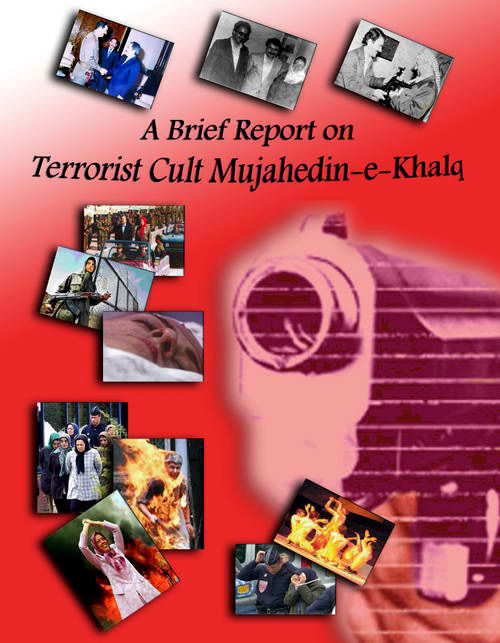
A brief report on MKO
Mujahedin Khalq Organization as a terrorist group

A BRIEF REPORT ON TERRORIST CULT MEK

Table of contents

A brief report on MKO


  1. Background After revolution
  2. After revolution
  • Cooperation with Islamic Revolution,
  • Confrontation with the Islamic Republic of Iran

3· Cooperation with Saddam

4· Relation with Western Countries

5· Financial Sources of Mujahedin

Download A BRIEF REPORT ON TERRORIST CULT MEK

November 6, 2005 0 comments
FacebookTwitterPinterestWhatsappTelegramSkypeEmail
Nejat Publications

Pars Brief – Issue No.19

1.    13 MKO defectors repatriated

2.    Call for the Expulsion of a Controversial Iranian Rebel Group

3.    Saddam Hussein’s Links with International Terrorism

4.    MKO remains on EU terrorist list

5.    BBC Woman’s Hour interview with Anne Singleton

6.    Iranian Dissidents Square Off in DC

 
Download Pars Brief – Issue No.19

November 5, 2005 0 comments
FacebookTwitterPinterestWhatsappTelegramSkypeEmail
Iraq

What Multi-National Forces Say about PMOI?

Multinational forces in Iraq has an electronic journal in which they reflect latest news and events on Iraq, especially those related to these forces. In Vol.1 No.2, under the title “Detainee Operations Update” we read about the MKO:

“MeK members repatriate to Iran

CAMP ASHRAF, Iraq – With assistance from the International Committee of the Red Cross and the Ministry of Human Rights, ten former members of the Iranian Mujahedeen-e Khalq Organization based at Camp Ashraf returned home this month.

These former members requested to be repatriated back to Iran upon arrival at the Coalition controlled facility. Since late 2004, over 300 former members of the organization have returned home to Iran through the amnesty program provided by the Iranian Regime.”

October 31, 2005 0 comments
FacebookTwitterPinterestWhatsappTelegramSkypeEmail
Mujahedin Khalq Organization as a terrorist group

Iranian Dissidents Square Off in DC


A news conference conducted by self-described Iranian dissidents descended into chaos on Monday as audience members and two journalists accused the speakers of spreading disinformation and being agents of Iranian intelligence.

As supporters of the rival dissident groups vied for media attention, one group accused the other of being imposters. An hour and a half into the National Press Club event in Washington, D.C., organizers halted it and Capitol police were called in to keep order.

Monday’s news conference, titled "Saddam and Terrorism," was sponsored by the Iran Peyvand Association and was supposed to focus on Iraq as it was. Speakers argued that after fleeing Iran, the Mujahedin-e Khalq Organization (MEK) operated out of Iraq as a terrorist group. For that reason, its leader, Massoud Rajavi, should be brought to justice just as Saddam Hussein was, the Iran Peyvand Association insisted.

The MEK was expelled from Iran after the 1979 Islamic Revolution. Starting in the late 1980s, its main support came from Saddam Hussein’s Iraqi regime. While it conducted terrorist attacks against the interests of the religious regime in Iran, it also mobilized to suppress the 1991 Shiite and Kurdish uprisings against Saddam, a point the presenters emphasized.

According to U.S. government terrorist group profiles, the MEK advocates the overthrow of the Iranian regime and its replacement with the group’s own leadership. Currently, over 3,000 MEK members live in Camp Ashraf, north of Baghdad, where they remain under the Geneva Convention’s "protected person" status.

A press release for Monday’s event promised that attendees would see a documentary film exposing the MEK’s role in the suppression of the 1991 Iraqi uprising and "video evidence, secretly filmed by Saddam’s own security services," showing the "financial, spying and terrorist relationship between the Mojahedin-e Khalq Organization and Saddam’s regime."

Anti-war activist Carol Moore warned that if the U.S. attacked Iran, the result could be world-wide nuclear war.

A flier distributed by the organizers echoed the "catastrophic" repercussions of an American attack and argued that Iranian officials could deploy "millions of troops and enter Iraq," as well as attack Israel’s nuclear sites and cities, American bases and troops in Iraq and U.S. ships at sea.

"They could cut off much of the world’s oil, which comes through the Straight of Hormuz," read the flier, which was produced by StopTheWarNow.net, DawnDC.net and UnitedForPeace.org.

Karim Haqi, introduced as a former member of the MEK, followed Moore’s speech. After a video was shown, he addressed the meeting in Farsi while Marukh Haji translated.

Shortly into Haqi’s speech, audience members began interrupting, including one unidentified young woman who said she spoke Farsi and complained the translation being given to the audience was erroneous.

Another woman who refused to be identified except to say she was an immigration attorney, stood up and complained that the U.S. Department of Homeland Security had allowed a former "terrorist" into the country.

A man who described himself as a "freelance journalist" asked Haqi whether it was true, as alleged, that he had worked with Iranian intelligence. He was escorted from the meeting by organizers. But the charge was echoed in questions by a British-Israeli journalist.

Haqi later denied any such ties to Iranian Intelligence, and through translator Marukh Haji, added that he and his supporters had spent years in Iranian prisons and were the "first ones" the government attacked.

"We put all our hopes in [the MEK]" said Haqi. "They betrayed us.

Two individuals carrying materials from the Committee Against Ahmadinejad (Iran’s new president) repeatedly interrupted Haqi and his translator. Later, members of the group gave reporters copies of a document accusing the organizers of Monday’s news conference of being in the employ of Iranian intelligence.

By Sherrie Gossett and Monisha Bansal

October 31, 2005 0 comments
FacebookTwitterPinterestWhatsappTelegramSkypeEmail
Mujahedin Khalq Organization as a terrorist group

Iran opposition group seeks US legitimacy

Even by the standards of Washington politics it was an unusual spectacle – the veiled leader of a Middle East group banned in the US as a terrorist organisation delivering a speech by live video-link to applauding members of Congress inside the Capitol itself.

But since the organisation is dedicated to the overthrow of Iran’s theocracy, the People’s Mujahideen Organisation and its political co-leader, Maryam Rajavi, are given leeway in the US as they campaign to have the "terrorist" tag removed and to become eligible for US funding of Iranian opposition groups.

In suit and matching headscarf, Mrs Rajavi spoke from France. She thanked six congressmen by name for their support, praised President George W. Bush and called for an end to western "appeasement" of the "engine of Islamic fundamentalism".

The audience – a mix of Iranian-Americans, politicians and staffers filling a conference room in the Capitol last Thursday – gave her a standing ovation. Sheila Jackson Lee, a Democrat congresswoman from Texas, spoke warmly of "sister Maryam".

Known by its acronyms MKO and MEK, the group led by Mrs Rajavi and her husband Massoud, was outlawed by the US for its killing of Americans before the 1979 Iranian revolution; alleged collaboration with Saddam Hussein’s genocidal campaigns against Iraqi Kurds; and attacks on civilians inside Iran.

The MKO denies the charges of terrorism, saying it was banned by then-president Bill Clinton in an attempt to engage the Iranian government.

Despite its attraction to the US – and particularly to some Pentagon planners – as an armed force inside Iraq ready in opposition, analysts in Washington doubt the group will regain legitimacy.

Nonetheless, its lobbying reflects the ferment inside the Bush administration as it grapples with producing a coherent policy towards Iran, working out – in the words of one European diplomat – whether to "engage, isolate or disrupt".

Stephen Hadley, national security adviser, commissioned 10 briefing papers exploring various options. A National Security Council meeting was cancelled this month after one of the papers, which proposed expanding diplomatic contacts with Iran, was leaked to the Wall Street Journal. Some officials suspect that someone senior wanted to sabotage the idea.

Diplomats and two US officials said the latest review was prompted by the conclusion reached by Condoleezza Rice, secretary of state, and others that an effective sanctions option did not exist, and that they had been misled by the predictions of neoconservatives who saw the Iranian regime ripe for overthrow by a restless populace.

Recent statements by Ms Rice point to an effort to broaden diplomatic contacts with Iran.

Diplomats also say there is a new effort to find a settlement, negotiated through European allies, to the standoff over Iran’s nuclear programme. But officials say any such pragmatic tendencies would be tempered by the conviction that the Bush administration should do nothing that would be seen to confer legitimacy on the regime while actively supporting the democratic aspirations of Iranians.

Iranian-American sympathisers of the MKO, who are active donors to US politicians, remain hopeful their group will be de-listed

By Guy Dinmore in Washington

October 31, 2005 0 comments
FacebookTwitterPinterestWhatsappTelegramSkypeEmail
The MEK Expulsion from Iraq

Clean Iraq from Terrorist MKO

We used to live in a restricted society in which there was only one voice and maybe that is the reason why we now see everything upside down.

Today, we feel the freedom in Iraq and no one can deny this, except those who have never wanted to accept the truth or those who act maliciously. You can vote and express your ideas freely and whenever you want; what’s it if it’s not freedom? You can get a passport and travel freely in this situation. You can sleep in your own car without being arrested for what’s called “violation of security and social order”. I can well remember a day when I was traveling with my friend on the road of Basra and my friend was rebuked only for sleeping on his seat. The officer acted like Saddam. He took my friend out of the bust and arrested him but he was lucky and later freed, otherwise no one knows what would have happened to him. All this was for being asleep when the car stopped at checkpoint. Do we now fear from being asleep?

I know the meaning of freedom and I know that its definition is wider than what I said; I was just giving an example. Today, we can speak freely in front of employees, teachers and other people of this society. We can criticize ministers and some people even insult them.

We now enjoy freedom and we should preserve it. But freedom is not anarchy; it’s order and fidelity. We should be faithful to Iraq and its people.

On the other hand, the government should also know that freedom is not the same as anarchy and disorder. Free and democratic countries have practical plans and regulations they act according to which. Iraq should not bear big threats and dangers under the name of freedom.

The issue of the settlement of armed paramilitary groups in Iraq is also important. Some paramilitary groups in Iraq have been disarmed but other international terrorist organizations still possess weapons and everyone, familiar with politics, understands how dangerous it is for Iraq.

There’s no doubt that these terrorist groups are linked to each other and there are secret ties and cooperation between terrorist MKO, Al-Qaeda and Zarqawi and other remnants of ousted Saddam regime.

We are all aware of strong ties between Mojahedin-e khalq and Saddam Hussein. Some people try to clean this from the minds of Iraqis. They even hold meetings to do this, which has undesirable consequences.

Cleansing Iraqis soil from paramilitary groups, such as MKO, Zarqawi and Al-Qaeda, is as important as destroying weapons. Freedom and democracy and recognizing the rights for political asylum is not the same as welcoming terrorist groups.

Abbas Sarhan – Al Naba Website

October 31, 2005 0 comments
FacebookTwitterPinterestWhatsappTelegramSkypeEmail
The MEK; Baath Party Accomplice

Saddam Hussein’s Links with International Terrorism

Group to Hold Press Conference on Saddam Hussein’s Links with International Terrorism,

To: Assignment Desk, Daybook Editor

Contact: Mahrukh Haji of Pars-Iran, 613-829-9598 or 613-261-2550 (cell)

News Advisory:

WHAT: Press conference on Saddam Hussein’s links with international terrorism

WHEN: Monday, Oct. 24 at 12 p.m.

WHERE: National Press Club (First Amendment Lounge), 529 14th Street NW, Washington DC

—

The following is a statement released by Pars-Iran:

The trial of Saddam Hussein is scheduled to start this week.

We demand that his closest ally, Massoud Rajavi, whose hands have been dirtied by many of Saddam’s crimes, also be brought to justice.

The toppled regime of Saddam Hussein actively supported international terrorism, and the Mojahedin-e Khalq Organisation, led by Massoud Rajavi, was at the top of the list of these terrorist organisations.

— The Mojahedin as part of Saddam’s military played a decisive role in the suppression of the internal uprisings in Iraq in 1991, and are responsible for the massacre of many Iraqi Shiites and Kurds who opposed Saddam. The best documented of these being the massacre of the Kurds in their uprising in March 1991.

— The Mojahedin acting as ‘Saddam’s Private Army’ have actively participated in the war which Saddam Hussein waged against Iran between 1980 and 1988, engaging themselves in intelligence gathering for the Iraqi army as well as participating in joint operations with them.

— Each and every military and terrorist operation carried out by the Mojahedin in Iran has been ordered directly by Saddam Hussein and his intelligence and secret services in Iraq.

On Monday, October 24, a press conference will be held in Washington, DC. The program includes:

— A documentary film exposing the Mojahedin’s role in the suppression of the uprising of the Iraqi people in 1991.

— Video evidence, secretly filmed by Saddam’s own security services, showing the financial and spying relationship between the Mojahedin-e Khalq Organisation and Saddam’s regime.

— A three member panel (TBA) will speak on this issue.

— Former members will be available to answer questions on the MEK.

October 24, 2005 0 comments
FacebookTwitterPinterestWhatsappTelegramSkypeEmail
European Union

MKO remains on EU terrorist list

The European Union published Tuesday an updated list of persons and groups that the 25-member European bloc designates as terrorists.

The Iranian Mujahedin-e-Khalq Organization (MKO), which was put on the EU’s terrorist list in 2002, remains on the new blacklist.

However, the MKO’s political front, the so-called National Council for Resistance of Iran (NCRI), which has its headquarters near Paris, is excluded from the list.

The MKO has been lobbying with some members of the European Parliament to have its name removed from the EU’s terrorist list.

The Communist Party of the Philippines was added to the new list, which contains the name of 45 individuals and 46 organizations.

The EU started the list following the Sept 11 attacks in the US as part of its efforts to fight terrorism.

EU governments are obliged to freeze assets of people and groups on the list, according to EU rules.

October 24, 2005 0 comments
FacebookTwitterPinterestWhatsappTelegramSkypeEmail
Newer Posts
Older Posts

Recent Posts

  • Why the MEK Failed to Become a National Movement

    August 26, 2026
  • From Studying in America to Death in a Village in Albania

    August 22, 2026
  • The Psychological Impact of MEK Ideology on Members

    August 17, 2026
  • A study on the financial mechanism of the Mujahedin-e Khalq

    August 10, 2026
  • A Child behind the Ideological Bars of Massoud and Maryam Rajavi

    August 8, 2026
  • Facebook
  • Twitter
  • Instagram
  • Youtube

© 2003 - 2025 NEJAT Society . All Rights Reserved. NejatNGO.org


Back To Top
Nejat Society
  • Home
  • Articles
  • Media
    • Cartoons
    • NewsPics
    • Photo Gallery
    • Videos
  • Publications
    • Books
    • Nejat NewsLetter
    • Pars Brief
  • About Us
  • Contact us
  • Editions
    • عربي
    • فارسی
    • Shqip