
Amir Yaghmai, a former child soldier of the Mujahedin-e Khalq (MEK), never lived with his parents. He was born in Paris when his parents were living in the organization’s headquarters and would send him to the group’s kindergarten. Then, in Camp Ashraf, Iraq, Amir was kept in a boarding house with other children and only saw his parents on weekends. After being separated from his Mujahedin parents with nearly a thousand other children in 1991 and smuggled to Europe, he experienced the life of an orphan in Sweden. At the age of 14, when he was sent back to Iraq as a child soldier, his mother saw him only as a comrade-in-arms and scolded him severely when Amir wanted to leave the organization at the age of 19.
Amir Yaghmai rebuilt his life after leaving the MEK, but his childhood trauma never left him. Although he wrote his memoirs of his entangled life with the Cult of Rajavi in recent years and published them on social media, he still occasionally posts photos, notes. His notes from his experience in the MEK on his personal account on X, are not only interesting but also instructive. The following photos and notes are from Amir, who is in his forties, who shares his childhood experience in a terrorist cult with his audience in a profound way:

Amir Yaghmai in the MEK’s kindergarten
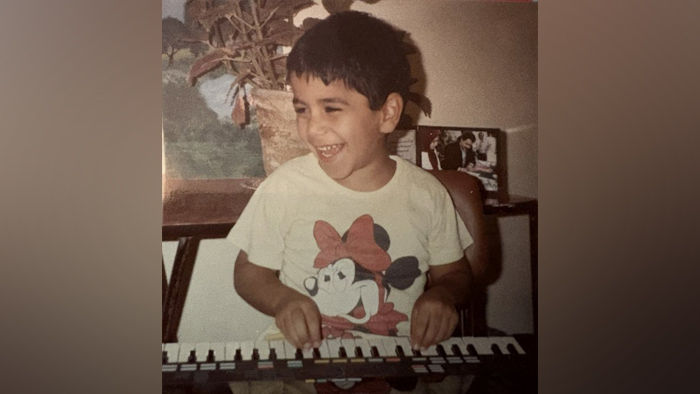
In ordinary families, family photos are usually framed and placed on the wall or on the shelves; but in the environment where we grew up, that is, in the MEK bases, almost the only images that were allowed to be in front of our eyes were the images of the leaders of the organization: Massoud and Maryam Rajavi.
In this photo, I am playing with a toy instrument in one of the MEK bases in Paris. Behind me is a framed image of the wedding ceremony of Massoud and Maryam Rajavi in Paris.
Even in the simple and childish moments of our lives, the presence of the organization’s leadership was constant; as if an image of family and personal life was not supposed to form in our minds, instead it had to be replaced with the image of “leadership”.
Children in the MEK’s kindergarten
Collective work was considered a value in the MEK; to the point that even we three- or four-year-old children in kindergarten were not exempt from it. They would give us a piece of cloth or a handkerchief and ask us to clean the radiators.
In this picture, I am the child standing in front, wearing a blue shirt and putting my hand over my mouth; as if I had already gotten sick of these forced tasks imposed on children.
This picture was taken around 1986, in one of the MEK kindergartens in Paris.
Photos of Maryam and Massoud Rajavi in the MEK’s kindergarten
Photos of Maryam and Massoud Rajavi on the wall in the MEK’s kindergarten
Around 1984, in the kindergarten of the MEK in Paris. I am the same child in the red dress and holding a balloon.
What attracts attention most in this photo is the atmosphere of the children’s playroom. On the walls, instead of cartoons, children’s characters, or paintings that would be appropriate for a child’s world, there are numerous photos of Massoud and Maryam Rajavi.
In one of the photos on the left, Massoud Rajavi is seen caressing the face of a child. From the very first years of life, we were taught that Massoud Rajavi was our ideological “father.” We grew up in an environment where the face and image of the leader of the organization were an inseparable part of everyday life and even the children’s playroom.
Today, when I look at this photo, the question that comes to mind most of all is why a kindergarten should be decorated with pictures of the leaders of a political organization instead of creating a world full of colors, stories, and children’s characters. This photo is not just an old photo for me; It is a document of an environment in which our childhood was tied to the ideology of the organization from the very beginning.
Mazda Parsi