
In cults, children are either seen as an inconvenience or used as means for growing the cult. In both situations, children are seen as objects who are victims of the destructive system that rules the cult. Cults, by nature, break down parental and familial bonds. In the cult-like extremist terrorist organization such as the Mujahedin-e Khalq (MEK) abusing childrens’ rights has led to their recruitment in the group’s military arm, the so-called Liberation army. Child soldiers who had first considered as inconvenience by the leader Massoud Rajavi. Once they were grown up, they were seen as means for growing the group.
Social psychologist Alexandra Stein, Ph.D., specializes in cult phenomena and teaches courses at several universities in London. Her article, “Mothers in Cults: The Influence of Cults on the Relationship of Mothers to Their Children,” examines the impact of the cult experience on the mother-child bond. Dr. Stein notes that this bond is controlled in multiple ways:
mothers are often discouraged from having a special bond with the child;
mothers may spend very little or no time with their children because of the demands of the cult;
the child is physically taken from the parents; and
mothers’ behavior toward their children is carefully monitored.
Stein writes: “Doing ‘the right thing’ (for God, the Revolution, one’s personal growth, whatever) becomes synonymous with obeying the leader. To go against the leader’s directive is to go against God himself. The mother becomes psychologically trapped: she wants to be a good person, but the definition of goodness resides entirely in the cult’s domain.
In 1991 around one thousand children of Mujahed couples were separated from their parents and smuggled to Europe and North America under the order of Massoud Rajavi. More than 3 hundred of the smuggled children were later, at the ages of 14 to 19, sent back to Iraq to receive military trainings at the MEK camps.
Amir Yaghmai is one of these former child soldiers who managed to leave the MEK fighting the group leaders as well as his own leader.
He wrote and published his memoirs of being born in a Mujahed family, grown up at camp Ashraf until his 5 year-old age, smuggled to Sweden, recruited as a child soldier at the age of fourteen.
His mother is still in the MEK’s cult-like structure. She resides in the group’s headquarters in Albania. She denies that Amir is her son because as Dr. Stein expresses, she is psychologically trapped; She wants to be a good person by the definition of goodness that Massoud and Rajavi define for MEK members.
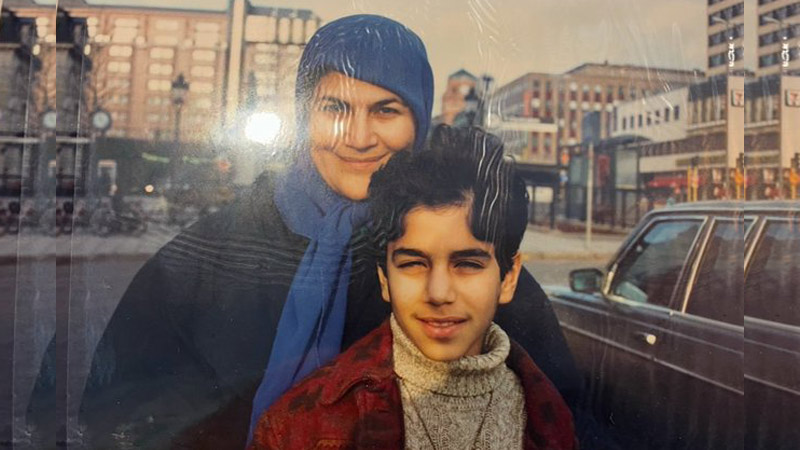
At his forties, Amir Yaghmai is a father of two girls but he is still impressed by the behaviors of his brainwashed mother trying to shed light on the nature of the MEK as a destructive terrorist cult. Here is a short memoir Amir has recently published on his X account sharing a photo of him and his mother:
- I am around 10 years old.
My mother is in Sweden – on behalf of the organization.
For a few days she lives in their office.
On the last day we meet in Guldfynd in the center of Kista.
She asks what I wish for.
I choose a bronze Thor’s hammer.
She buys it for me.
I think it is a farewell between mother and son.
At the last moment, just before she says goodbye, she says:
“Amir, I didn’t come here to see you.
I am here on behalf of the organization.”
The world stops.
Everything goes in slow motion.
I remember every sensory impression –
how my breath evaporates in the chilly air,
exactly where I am standing on the uphill slope,
and above all how my heart breaks.
I wanted to feel needed.
After several years of absence, I thought she came for me.
But instead I was told that I was worth less than the organization.
A feeling that was confirmed over and over again during my upbringing.
Mazda Parsi
