
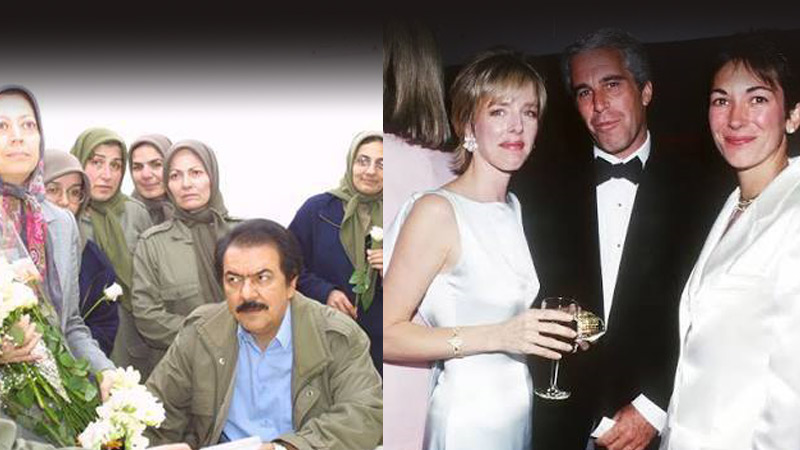
A study of cult phenomena in contemporary history shows that cult leaders, regardless of their geographical, political, or social contexts, use very similar behavioral and psychological patterns to dominate their members, especially women. A comparison of the documents related to the organization of Jeffrey Epstein, the American capitalist, with the cult-like structure of the People’s Mojahedin Organization (MKO/ MEK) led by Massoud Rajavi reveals striking similarities in the areas of coercive control, the collapse of self-confidence, the isolation of victims, and the implementation of humiliating rituals. In what follows, various dimensions of these structural and behavioral similarities are analyzed.
Common patterns in the recruitment and deception process
One of the most important common aspects of the structure of the Epstein cult and the Rajavi cult is the use of sophisticated techniques of deception and psychological preparation to ensnare victims. In Jeffrey Epstein’s organization, victims were mainly recruited from among young girls with tempting promises of careers in the modeling industry, while in the MEK, recruitment was often carried out with promises of fighting for freedom, social justice or asylum in Europe and a better job and life to overcome personal crises. In both cases, the cult leaders initially introduce themselves as “saviors” or powerful supporters who can create a bright future for the individual. Over time, this process leads to the creation of intense emotional and financial dependence, such that the individual has no way of returning or making independent decisions.
Anya is the pseudonym of one of the women who was one of Jeffrey Epstein’s victims. In a recent interview with the BBC, she confirmed the statements of other female victims of Epstein: “I am still trying to come to terms with the fact that I was abused for years.” According to her, although she was apparently free, in reality she was trapped in restrictions and dependencies that acted like invisible chains, and she only realized this after Epstein’s death.
The female victims of Massoud Rajavi, however, did not and do not even enjoy apparent freedom. They have been imprisoned for years in closed camps of the organization in Iraq or Albania, but with Rajavi’s special values, such as the “denial of individuality and gender”, not only do they not realize their captivity, but they see themselves on the path to “perfection” and “salvation of the people.”
The victims who managed to escape the physical and mental bars of the MEK, after leaving the organizational context, managed to break away from the invisible chains and, like Batoul Soltani, Nasrin Ebrahimi, Fereshteh Hedayati, Zhina Hossein Nejad, and many others, speak of what happened to them in Rajavi’s cult of personality.
Destruction of individual autonomy
In the clinical psychology literature of cults, the destruction of individual autonomy and the right to choose is the main foundation of the dominance of cult leaders. In Epstein’s cult, victims such as “Anya” have testified that Epstein deprived them of the ability to think independently by constantly humiliating them, criticizing their physical appearance, and controlling their relationships and finances. Similarly, in Rajavi’s cult, Massoud Rajavi used meetings called “ideological revolution,” “bait,” “weekly bath,” and “current operations” and intense mental control to destroy the personal, emotional, and family attachments of members. Forced divorces, forced celibacy, separating children from parents, and imposing ideas in which the individual does not have the slightest right or will for his or her personal life are evaluated precisely in this context; a strategy whose ultimate goal is to turn people into unwilling tools serving the interests of the cult leader.
Creating all-encompassing dependency and tools of economic and social control
The victim’s attachment to the system is the main obstacle to their escape or protest. In Epstein’s organization, women lacked independent bank accounts, health insurance, or financial support, and Epstein trapped them in invisible chains with the phrase “I am your health insurance.” In Rajavi’s cult, the complete severance of members’ connections with the outside world, family, and society, as well as strict control over all their basic necessities, placed them in a position where they could not imagine any refuge outside the organization. The use of fabricated debts or embarrassing documents in Epstein’s cult to silence victims is very similar to the creation of a sense of permanent guilt and organizational accountability in the MEK. The self-criticism meetings held daily in Camp Ashraf and Ashraf 3 under the title of “Current Operation” function to create a sense of permanent shame and indebtedness to “Brother Massoud” and “Sister Maryam.”
Humiliating rituals and physical control (Salvation dance and naked dance)
One of the most obvious points of commonality between these two organizations is the use of collective and humiliating rituals to break self-respect and ensure non-disclosure. Published testimonies from Epstein’s victims, including Anya, mention cases in which women were forced to strip and dance in front of Epstein’s camera and eyes so that, as he said, “they would never be able to act against him”; because having this visual evidence turned the fear of humiliation into a tool for silence.
This method is exactly reminiscent of the phenomenon known as the “Salvation Dance” in the leadership council of the MEK, which was carried out under the management of Maryam Rajavi and under the orders of Massoud Rajavi. There, too, under the guise of fabricated ideological concepts, women members of the Leadership Council were forced to take actions that violated their privacy and human dignity and fatally cemented their emotional and organizational ties to Massoud Rajavi. In both systems, the purpose of these forced rituals is to create a point of no return for the victim, so that she feels that she has no way to protest or leave because of her participation in a humiliating and dirty act.
Finally, examining the structure of these two organizations shows that the apparent differences between an unhealthy network of financial and sexual corruption (Epstein) and an extremist political organization (Rajavi) do not prevent their deep and substantial similarities in the use of mind control tools, the exploitation of people, and especially the victimization of women.
Mazda Parsi
