Nejat Society
  • Home
  • Articles
  • Media
    • Cartoons
    • NewsPics
    • Photo Gallery
    • Videos
  • Publications
    • Books
    • Nejat NewsLetter
    • Pars Brief
  • About Us
  • Contact us
  • Editions
    • عربي
    • فارسی
    • Shqip
Nejat Society
Nejat Society
  • Home
  • Articles
  • Media
    • Cartoons
    • NewsPics
    • Photo Gallery
    • Videos
  • Publications
    • Books
    • Nejat NewsLetter
    • Pars Brief
  • About Us
  • Contact us
  • Editions
    • عربي
    • فارسی
    • Shqip
© 2003 - 2024 NEJAT Society. nejatngo.org
Mujahedin Khalq; A proxy force

Iran War Drums Beat Harder

Despite the Bush administration’s insistence that, at least for now, it remains committed to using diplomatic means to halt Iran’s alleged nuclear weapons program, war drums against the Islamic Republic appear to be beating more loudly here.

Secretary of State Condoleezza Rice assured Europeans on her trip this past week that Washington does indeed support the efforts of France, Britain, and Germany (EU-3) to reach a diplomatic settlement on the issue. However, she also made it clear that Washington has no interest in joining them at the negotiating table or extending much in the way of carrots.

And her consistent refusal to reiterate former Deputy Secretary of State Richard Armitage’s flat assertion in December that Washington does not seek "regime change" in Tehran has added to the impression that the administration is set firmly on a path toward confrontation.

Whether the administration is pursuing a "good cop/bad cop" strategy  in which Washington’s role is to brandish the sticks and the EU-3 the carrots  remains unclear, but the voices in favor of an "engagement" policy are being drowned out by crescendo of calls to adopt "regime change" as U.S. policy.

The latest such urging was released here Thursday by the Iran Policy Committee (IPC), a group headed by a former National Security Council staffer Ray Tanter, several retired senior military officers, and a former ambassador to Saudi Arabia.

The 30-page document, "U.S. Policy Options for Iran" by former Central Intelligence Agency (CIA) officer Clare Lopez, appears to reflect the views of the administration’s most radical hawks among the Pentagon’s civilian leadership and in the office of Vice President Dick Cheney.

It was Cheney who launched the latest bout of saber-rattling when he told a radio interviewer last month that Tehran was "right at the top of the list" of the world’s trouble spots and that Israel may strike at suspected Iranian nuclear sites even before the U.S.

The study echoes many of the same themes  mainly support for the Iranian exiled and internal opposition against the government  as another policy paper released by the mainly neoconservative Committee on the Present Danger (CPD) in December, but it is also much harsher.

Both papers favored military strikes against suspected nuclear and other weapons facilities if that was the only way to prevent Tehran from acquiring nuclear weapons, and endorsed "regime change" as U.S. policy.

But the CPD paper, which had the influential backing of former Secretary of State George Shultz, called for a "peaceful" strategy that involved elements of both engagement and nonviolent subversion similar to that pursued by Washington in Poland and elsewhere in Central Europe, particularly during the 1980s.

The latest report does grant a role for "carrots" in achieving a delay in Iran’s nuclear ambitions and even in regime change, although the IPC’s members expressed greater skepticism that the EU-3 talks will be effective or even desirable.

"Negotiations will not work," said Maj. Gen. (ret.) Paul Vallely, chairman of the military committee of the neoconservative Center for Security Policy, who described the Iranian regime as a "house of cards."

Instead, the IPC’s main emphasis is on more aggressive actions to bring about the desired goals, including military strikes and active efforts to destabilize the government, in major part through the support and deployment of what it calls "indisputably the largest and most organized Iranian opposition group," the Mujahedin e-Khalq (MEK)  an idea that many Iran specialists here believe is likely to prove exceptionally counterproductive.

"[A]s an additional step [in a strategy of destabilization]," the paper states, "the United States might encourage the new Iraqi government to extend formal recognition to the MEK, based in Ashraf [Iraq], as a legitimate political organization. Such a recognition would send yet another signal from neighboring Iraq that the noose is tightening around Iran’s unelected rulers."

The MEK fought on Iraq’s side during the Iran-Iraq war and has been listed as a "terrorist group" by the State Department since 1997 as a result of its assassination of U.S. officials during the Shah’s reign and of Iranian officials after the Revolution.

However, it has long been supported by the Pentagon civilians and Cheney’s office, and their backers in Congress and the press as a possible asset against Iran despite its official "terrorist" status.

Indeed, there have been persistent reports, most recently from a former CIA officer, Philip Giraldi, in the current edition of the American Conservative magazine, that U.S. Special Forces have been directing members of the group in carrying out reconnaissance and intelligence collection in Iran from bases in Afghanistan and Balochistan, Pakistan, since last summer as part of an effort to identify possible targets for military strikes.

After bombing MEK bases in the opening days of the Iraq invasion in March 2003, the U.S. military worked out a cease-fire agreement that resulted in the group’s surrender of its heavy weapons and the concentration of about 4,000 of their members, some of whom have since repatriated voluntarily to Iran, at their base at Ashraf.

The State Department, which was then engaged in quiet talks with Iran about dispersing the group in exchange for Tehran’s handing over prominent al-Qaeda members in its custody, clashed repeatedly with the Pentagon over the MEK’s treatment.

After State was forced by the White House to break off its dialogue with Tehran following al Qaeda attacks in Saudi Arabia, allegedly ordered from somewhere on Iranian territory, the administration determined that MEK members in Iraq should be given Geneva Convention protections.

The IPC now wants the State Department to take the MEK off the terrorist list, a position backed by several dozen members of Congress who have been actively courted by the group and believe that a confrontation with Iran is inevitable.

"Removing the terrorist designation from the MEK could serve as the most tangible signal to the Iranian regime, as well as to the Iranian people, that a new option is now on the table," according to the report.

"Removal might also have the effect of supporting President Bush’s assertion [in his State of the Union address] that America stands with the people of Iran in their struggle to liberate themselves."

But most Iran specialists, both inside and outside the government, who agree that the regime is deeply unpopular, also insist that Washington’s endorsement of the MEK will actually bolster the regime in Tehran.

When they invaded Iran from Iraq in the last year of the Iran-Iraq war, according to Sick, who teaches at Columbia University, they had expected to march straight to Tehran gathering support all along the way.

"But they never got beyond a little border town before running into stiff resistance. It was a very ugly incident. They had a chance to show what they can do, and the bottom line was nothing very much. I’ve seen nothing since then to change my estimate," he said.

by Jim Lobe 
June 28, 2005 0 comments
FacebookTwitterPinterestWhatsappTelegramSkypeEmail
Former members of the MEK

TEARS OF JOY

At a ceremony last week, an Iranian mother hugged her son, one of 31 returning combatants who had spent time at a military camp in Iraq.

Anti-Iran militants return home

More than 250 young Iranians, from a group committed to toppling Iran’s leaders, are back in Tehran.

TEHRAN, IRAN “ Clutching flowers, chewing fingernails, and nervously holding their faces in their hands, 31 Iranian families awaited a reunion they thought would never come. They were reuniting with sons who had joined anti-Iran militants, officially tagged "terrorists" by both the US and Iran.

The journey of one of those sons, Hamid Khalkali, is typical: He went to Turkey five years ago for work, but ended up at a military training camp in Saddam Hussein’s Iraq. He was recruited by the Mujahideen-e Khalq, the "People’s Holy Warriors," or MKO, Iran’s largest opposition group, which aims to overthrow the government. It was supported for two decades by Mr. Hussein.

But now Mr. Khalkali is being officially welcomed home. He’s one of more than 250 former combatants who have returned home since December – among the first to test Iran’s offer of amnesty. Even as hawks in Washington debate tapping the group to help engineer regime change in Iran, a growing disillusionment within the MKO, coupled with a new Shiite- dominated government in Iraq that has little sympathy for it, has thinned the ranks of this once-feared militant group.

Collapsed in her son’s arms

Hamid’s mother, Mahin Amouie, thought her son was dead. But her grief turned to cautious joy last week when the telephone rang. Giving little information, the caller said: "We want to give you good news – come and get your son."

Until Ms. Amouie arrived at a small amphitheater in Tehran, bearing flowers and talking to other disbelieving families, she says she had no idea that Hamid had joined the MKO. Climbing onto the stage when her name was called, her emotional dam burst when Hamid strode into view. Tears streaming, Amouie collapsed into her son’s arms, a scene repeated again and again.

"Oh Lord, I sacrifice myself for you!" Amouie sobbed to Hamid, crushing the armful of flowers as she wrapped herself tight around his neck. "Where have you been? Where have you been?"

While some hawks in Washington wanting to enlist their services, the MKO is designated a "terrorist" group by the US State Department, with some 3,500 members still in Iraq. Hussein used the group as foot-soldiers in his war against Iran in the 1980s and later to help put down anti-regime uprisings in Iraq. Quoting US government sources, Newsweek last month reported that the Bush administration is "seeking to cull useful [MKO] members as operatives for use against Tehran," to be trained as spies and sent back to Iran to gather intelligence. Currently, remaining members are under what the US calls "protective custody" at Camp Ashraf, north of Baghdad.

Some 232 crossed from Iraq in two groups earlier this month, under the auspices of the International Committee of the Red Cross. "For us, it’s a humanitarian file. We do it for the families," says Loukas Petridis, a Red Cross spokesman in Tehran. "The message the Iranian authorities want to pass to Camp Ashraf is that more than 250 people have come back, and are free – and so far, that is how it has been." The Red Cross first received guarantees of safe treatment from Iran before agreeing to help.

With Marxist roots, Mao-style political indoctrination, and self-criticism sessions that prompt former members to brand the MKO a cult, the group’s history includes killing several Americans in the 1970s, supporting the 1979 Islamic Revolution, and seizing of the US Embassy. Losing out in the post-revolution power struggle, the MKO turned against the regime and launched a string of bomb attacks that killed hundreds in the early 1980s. Iran’s supreme leader, Ayatollah Ali Khamenei, survived an MKO attack in 1981 that paralyzed one arm.

For years the MKO leadership has warned members that they faced certain death or imprisonment if they returned to Iran.

Reporting from inside Camp Ashraf last weekend, The Los Angeles Times said the MKO dismisses the defectors as "quitters," and that those remaining "show no interest" in going back.

Most of those now repatriating to Iran have been with the MKO just a few years, and say they were "deceived" with promises of cash and a job when recruited in Turkey.

"It is 100 percent stress, but after four years I want to see my family," says Binyamin Espandani, a young former militant as he waits to join his family. "I went there for an objective – I wanted my country to stay independent…. But after the US came, the mujahideen were asking Americans for help to topple the government of my country."

Warnings for the families

A semiofficial agency that helps former militants reintegrate addressed the waiting families. "Maybe you expect your sons to [be unchanged from] five years ago, but it won’t be the same – some were told [by the MKO] to cut themselves off from you," said Shahin Rabiee, of Anjoman Nejat, or "Rescue Association."

But there were warnings, too, for families that signed a form stating that they received their son "safe and sound," and were now "responsible for him."

"They are not completely innocent. They could have escaped [from Iraq] easily during the American attack; they had weapons in their hands," psychologist Dr. Sami Ani told them. "So we have to accept that your children were doing something against the security of the country. But they are forgiven…. They … were brainwashed."

The happiness of homecoming set aside all other concerns. Former militant Hamid Sahapour held his mother’s hand and stroked her face while his brother Davoud tearfully leaned on him from the right. "I can’t express my joy – there are no words," says Mr. Sahapour. "Before the Americans came, if I said I wanted to leave, they would have sent 20 people to beat me."

This time Hamid’s mother, Delaram Vatanha, vows never to let him out of her grasp: "I will not let him go again."

Christian Science Monitor

June 26, 2005 0 comments
FacebookTwitterPinterestWhatsappTelegramSkypeEmail
Mujahedin Khalq Organization as a terrorist group

Humanitarian ruse at L.A. airport raised funds for terrorists

SJ Mercury on Arrests

Humanitarian ruse at L.A. airport raised funds for terrorists, FBI says

SEVEN ARRESTED IN GROUP OPPOSING IRAN GOVERNMENT

BY CHERYL DEVALL

Mercury News Los Angeles Bureau

LOS ANGELES — They stopped travelers in the airport with a humanitarian plea: Help these suffering Iranian children.

But the fundraisers, whose appeals generated at least $1 million, were actually raising cash for an Iranian terrorist organization, the Federal Bureau of Investigation said Wednesday.

FBI investigators said they had arrested seven members of the Mujahedin-e Khalq, a group dedicated to overthrowing the Iranian government. The organization is included on the U.S. State Department’s list of designated terrorist organizations. In recent years, its National Liberation Army has taken credit for armed raids on Iran from bases in neighboring Iraq.

But as they stopped people at Los Angeles International Airport with heart-rending photos of orphaned children, members of the group identified themselves as the Committee for Human Rights in Iran, the FBI said.

And their main fundraising targets, the FBI said, were Asian travelers in the international terminal.

The fundraisers, dressed in business attire and carrying binders filled with photos of alleged atrocities against Iranian children, asked for donations of up to $500.

“Their belief was that Asian travelers would be more likely to make donations than people of other ethnic backgrounds,” said FBI spokesman Matthew McLaughlin.

The Committee for Human Rights in Iran was making $5,000 to $10,000 a day from these airport solicitations, according to FBI affidavits filed with a federal magistrate. The group also aggressively solicited members of Los Angeles’ large Iranian-American community, FBI representatives said.

“This money was used to buy arms, such as mortars and rocket-propelled grenades,” said James DeSarno of the FBI’s Los Angeles office.

“There is no evidence in our investigation that anyone who was solicited was knowledgeable of where the funds were going.”

The Mujahedin-e Khalq has opposed Iranian governments from that of the late Shah Reza Pahlavi to the present regime of the Ayatollah Khamenei. It has been involved, the FBI said, in several actions against American targets, including the 1979 U.S. embassy takeover in Tehran and a 1992 occupation of the Iranian mission to the United Nations in New York.

Germany’s federal criminal police tipped off U.S. law enforcement to the organization’s alleged money laundering in 1997, according to the affidavit.

“None of the money they raised went to humanitarian purposes,” FBI spokesman McLaughlin said.

But so far, the FBI has not been able to connect the money raised in this country to specific terrorist acts. They have traced $1 million to two accounts in Turkish banks. Of that, $400,000 was sent to a used auto parts store in Dubai, United Arab Emirates.

Beyond that, the money trail “may be rather difficult to discern, given the cultural and geographical barriers we’d have to overcome,” McLaughlin said.

He added that the investigation is continuing beyond the arrests of seven people believed to be leaders of the Mujahedin-e Khalq in Los Angeles.

The arrests were made Tuesday in locations throughout the city’s West side; the group’s alleged ringleader, Tahmineh Tahamtan, was picked up at a Starbucks coffee shop.

The Committee for Human Rights in Iran had the appropriate permits to solicit funds in public places. Those permits required proof of state and federal tax-exempt status, said Tammy Catania, a spokeswoman for the Los Angeles Police Commission, which issues the permits. Those permits do not require police background checks, Catania said.


It is not clear why the solicitors singled out Asian tourists. Officials at several tour companies catering to Asians said Tuesday they’d never heard complaints about airport fundraisers.

Neither had the Japanese consulate in Los Angeles. Spokesman Yasushi Fujii, who spent eight years in Iran, could only speculate that perhaps “Iran had a kind of sympathy for the Japanese because they fought a war with America.”

The Mujahedin-e Khalq, which mixes Islam with socialism, has never had a large following in the United States, said Salam Al-Marayati, director of the Muslim Public Affairs Council, a lobbying organization with offices in Los Angeles and Washington, D.C.

The group splintered from the Islamic opposition to the Shah in the late 1970s, he said. “It’s always puzzled people as to exactly what their ideology is.”

The group has been raising money in airports for about 20 years, said Al-Marayati, who said he has been approached by the fundraisers more than once while at domestic terminals in Washington and Los Angeles. Before the group’s appearance on the State Department terrorist list, the solicitors identified themselves as representatives of Mujahedin-e Khalq, not as the Committee for Human Rights in Iran, he said.

“They have these notebooks of pictures and you don’t know where the pictures are from. They just tell you these are pictures of dying children,” he said. “I oppose giving people money based on pictures.”

Because he’s of Iraqi descent, he said, the solicitors thought he might be sympathetic to them. But when he asked where the money would go, they offered no answer, Al-Marayati said.

Whether their fundraising benefited terrorist activities, he added, “will be up to the courts to decide.”

June 26, 2005 0 comments
FacebookTwitterPinterestWhatsappTelegramSkypeEmail
Mujahedin Khalq; A proxy force

THE DISINTEGRATION OF MEK IN POST-SADDAM IRAQ

As the landmark Iraqi elections loom closer, the fate of a controversial and often misunderstood Iranian opposition group hangs in the balance. The formerly armed Mojahedin-e Khalq Organization (MKO) has been based in Iraq for twenty years with regime change as its exclusive cause. Not only was it a long term irritant for Iran, launching waves of terrorist attacks from across the border, it also waged a remarkably intensive “ albeit unsophisticated “ anti-Iranian propaganda campaign from major Western capitals. It was a tempting prospect for hawks in the U.S. administration, therefore, to use the MKO“ officially classified a terrorist organization by the U.S. and EU governments “ as a tool against Iran, particularly for those with regime change at the forefront of their agenda. But on the eve of the Iraqi elections, the MKO seems to be more of a liability for the U.S. than ever.

Shortly after the fall of the former Iraqi regime of Saddam Hussein, the organization’s value was such that Iran offered to exchange some top al-Qaeda operatives for the MKO. But whether the U.S. administration had over-estimated the MKO’s value and wanted more, or whether there were covert plans to use the group rather than be rid of it, the offer was refused. In the immediate aftermath of the Iraq war in 2003, U.S. forces displayed a puzzlingly ambiguous attitude toward the MKO; first negotiating a ceasefire and subsequently disarming it, but then protecting the group against Iraqi revenge attacks. Even when the Iraqi Interim Governing Council (IGC) voted for the MKO’s expulsion in December 2003, the U.S. failed to comply, further fuelling Iranian suspicions over U.S. motives. [1]

Outside Iraq, the MKO’s political wing, the National Council of Resistance (NCR), found common ground with U.S. advocates for regime change in Iran. The NCR exposed intelligence on Iran’s nuclear program during last autumn’s negotiations between Iran and the EU, and supported U.S. moves to take the issue to the UN Security Council. The NCR stopped short of asking the U.S. to bomb Iran, instead claiming it could perform the task of regime change if given the right support. That would entail maintaining the MKO as an armed force in Iraq and, as a prerequisite, removing both the MKO and the NCR names from the U.S. terrorist list. While this hopelessly unrealistic approach could have been tried even six months ago, it is difficult to see how it could be implemented following an election in Iraq.

While Iran lined up with the United States to push for the January 30 elections to go ahead, the MKO struck a defiant tone, effectively adopting the same rhetoric as the neo-Baathists, Salafi Islamists and other insurgent forces that are desperate to derail the election process. But despite its vociferous criticism of the elections, the MKO has no power or mandate to influence the outcome of the electoral process. Implausibly, the organization claims a constituency of support among Iraqi Sunni Arab tribal leaders (especially in Diyala Province) which contrasts strangely with its inability to show any meaningful support inside Iran. The emergence of democratic institutions in post-war Iraq will severely undermine the MKO, as it will lend popular legitimacy to calls for their immediate expulsion. In short, the United States will not be able to ignore the wishes of the new elected government as it ignored the wishes of the unelected IGC back in December 2003.

Either the MKO will have to be expelled as already requested, or its members will face trial and punishment as cohorts of Saddam Hussein. In any case, the organization’s potential value as a U.S. bargaining chip in complex negotiations with Iran will be effectively ended by the elections. [2 ]                                                 

In any event, the notion of sending MKO members inside Iran as secret operatives tasked with undertaking espionage and sabotage operations was always a non-starter. This proposal entirely overlooks the actual state of the organization itself. The average age of the members is over 48 years, with a significant number over 50 years old. And these are people whose bodies have been ravaged by the conditions of constant military training, sleep deprivation and inadequate nutrition. Most have not set foot in Iran for nearly 24 years and would have difficulty now navigating around their own neighborhoods, let alone an unknown nuclear facility. More than this, the psychological state of the members following years of isolation and psychological coercion would not allow them to act independently or intelligently outside their immediate organizational environment “ let alone in hostile territory. In short, the U.S. covert operation would need local Iranians not burnt-out ex-patriots. In addition, the MKO has become so heavily infiltrated, and not just by the Iranians, that it is hard to see how such a plan could be even formulated without Iran becoming forewarned of it.

MKO: Still Terrorists?

In many ways, MKO behavior in the West points to quite another deal being struck with the U.S. and other Western governments. Conditions for its continued existence in any form appear to be that the MKO ditch its ideological leader, Massoud Rajavi; that it changes the strategy of armed struggle for exclusively propaganda work; and that it changes its name so that the MKO stays on the terrorist lists but members continue to work as the NCR.

The significance of these demands is that they cut right to the heart of the MKO’s existence as a coherent force. For years, Massoud Rajavi has remained invisible while his wife, Maryam, was presented as the acceptable public face of the MKO. This barely disguised deception has enabled the organization to present itself as a democratic force, despite its well known pseudo-communist origins and the cult-like characteristics it has acquired since 1985. This massive inconsistency in the MKO’s public profile and its internal dynamics, at times produce dramatic and disturbing events. For instance when Maryam Rajavi was arrested in Paris in 2003 on terrorism charges, the MKO had no other recourse but to orchestrate a series of self-immolations by members in order to terrorize the French government into releasing her.

Moreover the MKO has been deeply committed to "armed struggle" since its emergence in the 1960’s. Therefore, relinquishing the "principle" of armed struggle would seriously unsettle the organization and most likely lead to the emergence of splinter groups. Western governments need to take this into account before they consider removing the MKO from their terrorist lists.

While the U.S. has been aware of the problems presented by the MKO, it has only lately begun to address them seriously. The designation of protected status under the Fourth Geneva Convention in July 2004 constituted the first practical step the U.S. has taken to deal with the group. This allows the International Committee of the Red Cross (ICRC) to process individual members and remove them from Iraq without lifting the terrorist status of the whole organization – a kind of controlled dissolution.

Almost as though they had anticipated the outcome from the start, the Iranians had, since the summer of 2003, been offering amnesty to "repentant" MKO who wanted to return to Iran. This was hugely controversial inside Iran. While the vast majority of Iranians are either ignorant or indifferent toward the exiled group, supporters of the Islamic Republic are highly sensitive to the violence inflicted by the organization on their leaders and fellow supporters, particularly in the period 1981-1984 when the MKO’s armed struggle was at its peak. In spite of this, Iranian officials pushed ahead with the offer, and since December 2004, the ICRC has voluntarily repatriated 41 individuals who have been de-briefed and then re-united with their families. No prosecutions are planned, although it is understood that repatriated members should not take part in political activity. However, the officially repatriated members constitute only a tiny number of MKO members that have returned to Iran since May 2003. According to reliable sources, more than 300 members have fled Ashraf and returned to Iran in the past 19 months. In almost all cases these members surrendered to the Iranian customs authorities on the Iran-Iraq border, who subsequently handed them over to the Ministry of Intelligence. The former members were transferred to Tehran and debriefed for two days by Iranian intelligence officers in specially designed reception centers in the Marmar and Esteghlal Hotels, before being released to their families.

But more interesting than this has been the information given by returning members about conditions in the Ashraf camp in Diyala. While U.S. forces control the camp perimeter, they have allowed the MKO to maintain its internal command structure, leaving the members under conditions of psychological coercion. It is widely believed that around 1,000 disaffected MKO members approached the U.S. army and requested to be separated from the organization, and are now apparently being held in a separate part of the camp. [3] These developments seem to suggest that the longer the MKO remain ensconced in Ashraf, the more likely it is that the organization disintegrates in the face of overwhelming internal and external pressures.

Conclusion

The downfall of Saddam Hussein effectively spelled the end for the Mojahedin-e-Khalq’s presence in Iraq armed or otherwise. While the U.S. could have made the best out of the situation by swapping MKO leaders for senior al-Qaeda members in Iranian custody, for a variety of complex reasons this "near-deal" was never implemented. The only real issue on the ground is how and when to remove the MKO from its Ashraf base. The Iraqi elections are likely to accelerate this process and thus remove a major obstacle in improving ties between Iran and the new Iraqi regime.

Whether Western governments subsequently remove the MKO from the terrorist list remains to be seen. But before any de-designation takes place, western policy makers should bear in mind that the MKO irrespective of its massive decline in recent years  is still a highly sensitive issue for the Islamic Republic. Therefore de-designation runs the risk of complicating wider counter-terrorism efforts in the region  not least Iran’s support for Hezbollah and Palestinian Islamic groups.

Massoud Khodabandeh is a former member of the Mojahedin-e-Khalq, and mainly served in the organization’s intelligence/security department. Khodabandeh left the Mojahedin in 1996 and currently lives in the north of England, where he works as a security consultant.


Notes:

Iraqi Television, November 5, 2003

Mehr News Agency, September 2, 2004

Nejat Association, May 17, 2004. The Nejat Association based in Tehran  brings together families of MKO members currently based in the Ashraf camp in Iraq. The Association has been lobbying the ICRC and the Iranian government for the repatriation of MKO members to Iran.

TERRORISM MONITOR

June 26, 2005 0 comments
FacebookTwitterPinterestWhatsappTelegramSkypeEmail
Former members of the MEK

The Abu Ghraib prison that I know

As I passed through the gates of the notorious Abu Ghraib prison, I could not believe that this was really me, standing at the edge of where the world finishes.

Abu Ghraib prison, a name that sent shivers down the back of any Iraqi, was in front of me and I, with over twenty one years history of serving the Mojahedin organization, had to start a new existence in this prison and wait for the leadership of the organization, especially Maryam, the sensual wife of Massoud Rajavi, to decide in what way they will eliminate me.

Looking back I clearly remember that even while I was entering the prison I had not understood or recognized the true nature of this barbaric couple. I did not know exactly how they had been surviving on the consumption of the blood of the children of my country.

It is reminiscent of the ancient story of Zahak whose shoulders were kissed by the devil whereupon two voracious snakes grew, one on each shoulder. Then the devil, posing as a doctor, came to his bedside and told him ‘if you feed these snakes a human brain each every day for some time, they will die’. So year in, year out without end, Zahak killed the children of the people of Iran and fed the brains to the snakes on his shoulders. And now this same story is being repeated by Rajavi and his wife who, for getting a grip on power – and what a dirty way of achieving power – are killing the best children of this country. They are selling them in bunches to the likes of Aghid Hashem and Naghib Mohammed [two agents of Saddam’s Secret Services]. I clearly remember my last day in Ashraf camp when they were going to hand me over to the Security Services of Saddam. On that day, a well known dirty and corrupted woman called Mahvash Sepehri together with Batool Rajaie and Javad Khorasan from the so called officials of the organization, along with some of the well known torturers of the organization including Farhad Olfat, came to me and asked me to put my head down and by accepting the rank of deputy of section, go back to my work. After a year of imprisonment and torture in solitary confinement I had only one answer and that was to spit on the floor at their feet.

After a few days in Abu Ghraib prison, I discovered what ‘Falgheh’ meant. But I had no idea that I would become famous in Abu Ghraib together with Abass Yazdani as a ‘loyalist’ of the Falgheh. The Falgheh was a specially made machine for torturing the prisoners. Every Iranian prisoner and in particular every ex member of the Mojahedin had to be tied to this equipment. The so called ‘deposits’ of Rajavi, were informed by our torturers, that we had to feel the machine in such a way that we would understand more deeply Rajavi’s sacrifices, and we would witness with our whole being that our Mojahed leader is paying the highest price by accepting the torture of his ex members.

It did not take long for me to experience this machine. In one of those hot Iraqi afternoons my name was suddenly shouted out by one of the prison guards. I reported to him and without a word he started to beat me with a big wooden club. My head was broken and blood poured from several places on my body. He did not stop and a few moments later two other guards joined him. Nothing was said. Only severe beating. I was loosing my strength very quickly and then I don’t know what happened.

There was some unfamiliar sound and then I was up. At first I thought that I must be dreaming, but the pain was so real that I forgot what I was thinking about. I was covered in blood.

My jaw was dislocated. Lying me on the floor they started again and I could feel their boots kicking every part of my body while I was screaming.

In that situation the one thing I did not know was that I would be spending the next three months living in a toilet.

The guards made me stand on my legs. Only at that time was I informed that I was accused of trying to escape the prison and that there were others who had allegedly been trying to help me and that I would not tell their names! They were beating me up to tell them the names of people who did not exist.

It was clear that the real reason for my torture was that I had been trying to give hope to the other prisoners and had been trying to convince them that one day they would be freed and so we should not give in to the demands of the torturers to go back to Rajavi.

They had found out about this. The laughable accusation of trying to escape was something they would routinely use to cover whatever real purpose they had to beat people up.

Naturally there were people who were unable to put up resistance and under torture would start saying anybody’s name in the vain hope that they would reduce the torture. I would not co-operate in this charade and would not give any names. I could not even bring myself to give the names of the people that I knew had been the cause of my situation.

That was why I had to be tortured to the end. Every torturer and every prisoner knew that these were false allegations but again, everybody knew also that the system of torture and beating had to continue.

My name had come up and in the end they moved me to ‘Mahjaz’. This was a toilet with no water where they would not give you clothes, food or anything else. There was no light in it either. For three months in the worst heat of Iraq I had only 3 glasses of water per day for all my needs. I had no food for the first four days and then I received one piece of bread per day. I had to sleep by the side of the same toilet bowl which had been used over and over and had never been cleaned. The concrete floor was not big enough to stretch out my legs while lying down to sleep.

Living in this condition for three months was barely possible, but every day too after counting the prisoners, the guards would come and in groups of three to five would beat me up and haul me off to the prison yard. There in front of others, they would tie me to the ‘Falgheh’ and beat me on my feet with a very thick wooden club and I would scream and shout. After a while, it became a routine. Every morning I had to run into the yard with a guard beating me on my back. I had to lie down in the middle of the yard so that the chosen prisoners of the day could tie my feet onto the ‘Falgheh’ and keep them up so that the guards could beat my severely injured feet with their special clubs. Seeing me under torture had become a normal thing even for my friends. It was just another routine among hundreds of other scenes in Abu Ghraib. But it was very different for me. For me it was constant torture and constant fear of the next torture session. Many times I could see that while I was under torture the other prisoners were talking to each other and laughing. I could not blame them as I could remember that before me, it had been the turn of Abass Yazdani, and I used to go and watch even though I did not want to. And now it was my turn.

On one of these regular torture days, my foot broke and I passed out. When I came round I saw that they had bandaged my foot. They had not touched my other wounds. But breaking my foot and losing my nails meant the torture was stopped for some time. I spent about three years in Abu Ghraib prison on the direct order of Massoud Rajavi, during which for only three months was I exempted from torture.

All these barbaric activities were taking place because Rajavi had decided that he no longer wants to have any ex members.

Today Rajavi is serving the Americans in rebuilding the Secret Services of Iraq. He is also serving shoulder to shoulder with the new torturers in Abu Ghraib prison. Both Saddam and Bush know that Rajavi, who does not have any mother country, would do any dirty work to please his masters and that is why his sell by date can always be renewed. He resembles an infamous torturer during Iran’s Safavid Empire [1501 – 1722].

This man remained in his position after the attack by Ashraf Afghan and went on to serve in Nader Shah’s court. One day on his way to work he saw the head of Nader Shah on a spike. He approached the people whom he was to kill that day – the ones who killed Nader Shah the night before – and asked them to give him fresh orders for the new victims to be beheaded. He stayed in his job even after the death of Nader Shah.

Similarly, Massoud Rajavi will always have some customers up to the last day of his life. That is, of course, unless someone does not bring him to justice sooner.


Akbar Akbari Sharbaf 

Date: 2004/09/05


June 25, 2005 0 comments
FacebookTwitterPinterestWhatsappTelegramSkypeEmail
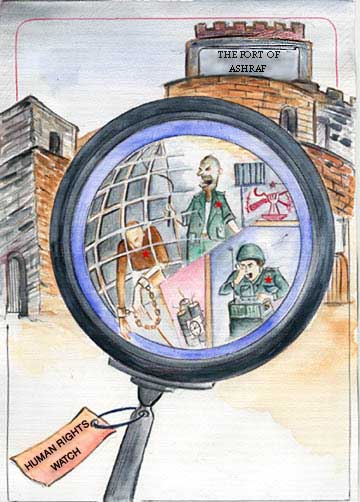
Human Rights Abuse in the MEK

HRW Report

Human Rights Watch Report on the terrorist cult of Mujahedin-e-Khalq    

HRW Report

June 25, 2005 0 comments
FacebookTwitterPinterestWhatsappTelegramSkypeEmail
S.Mahmud Husseini

Memories of Sayed Mahmud Hosseini

Dear friends in “Nejat society” My name is Sayed Mahmud Hosseini. I was born in Neyshabuor and I live inMemories of Sayed Mahmud Husseini Mashhad now. Because of the life difficulties, I was forced to stop my studies up to the first grade of guidance school and go to work instead.

In 2002, when I finished my military service, I went to Turkey legally to find a job. Before leaving Iran. One of my friends named Mojtaba introduced me to an acquaintance of his. He worked at Platon Hotel in Istanboul. Mojtaba gave his address to me and told me that he can find a job for me.

But when I reached Istanboul and looked for him, he had gone to Greece.

After a few days of going about, I  couldn’t find any work since I didn’t know the language, on the other hand I didn’t have enough money, so disappointed and helpless I decided to return home.

One morning, at 11 o’clock I went to the bus station. The first bus to Iran was supposed to leave at 2 pm. So during these hours while I was wondering around the station desperately I ran into a man called Saeed. He invited me to walk with him, and glad to see an Iranian, I narrated my adventures for him.

Saeed abused my misery and offered me a job.

He told me:you can work in Mujahedin Khalq Organization, you will learn more English, music, make money and any time you would like to leave the organization you can, on the whole you are your own master. Saeed was an evil in a man’s cover who tried to attract me to do terrorist activities hypocritically and I didn’t know that I was a victim. I was always dreaming of finding a job and sending money to my two sisters and my old mother.

But it is to be regretted that it was just a dream. I and many others were caught in the net that Saeed made.

I accepted his promises, he took me to Ankara and introduced me to Ali Ankara ( he was Turkish), a member of MKO.

We were three, Ashkan who had come from Cypres, Reza who had come from Tehran and me. After being introduced to Ali, he took us to Taaj Hotel and after three hours sent us to Baqdad via Syria by train.

Arrival In Iraq

While arriving Iraq, I was watching the poor houses and the unpleasant condition of life regretfully and my dark fate, waiting for me passed my mind. Therefore we decided to return from the beginning but every time, with their evil propaganda, they tried to convince us to go on.

Having arrived in Baqdad. They took us to a place called Ashraf. At the door of Ashraf we became penitent and decided to come back, even we took some steps backwards and refused to enter Camp Ashraf which was a military camp, since we were not interested in military activities, our motive was finding a work, but the members of the terrorist group prevented us to go and said:” you decided to come yourselves but you can’t go by yourselves and forced us to enter the Camp with their weapons.

Disagreeable and Hypocritical treatment.  

On the first day, they kept us behind the entrance of the building of the camp. We were frightened of so many weapons and military devices, so promised to eachother to leave the camp tomorrow morning, but they didn’t let us.

We were thinking of a dark destiny. Night came; they took us to the building and settled us in rooms. What they had told us was very different from what we saw.

I complained, broke the window and the T.V of the room to provide them an excuse to make us free. The same night, they took me near Aydeen and mokhtar, who were the responsibles of the arrivals, to investigate. Aydeen shouted at me violently and called me spy, regimes agent and enemy. He told me :” I keep you here for tow years and  force you to labour and send to Iraqi prison to stay there for eight years and it is not obvious how they would deal with you he always threatened  me and tortured me mentally so that they could make me obedient.

But their bad treatment led me to make my decision to save myself. They even didn’t permit me to call my old mother for fourteen months.

 Brain washing

A month passed and because I continued to show the signs of opposition and my willingness to leave, they arranged meetings for me where they said:” we struggle for the people not for ourselves. We don’t want any thing for ourselves.” With their deceitful slogans and their vain promises and actually by force they could transfer us to the reception. I had stepped in a path that I did not like at all. I was a villager who had been grown up in the villages around Neyshabour and I had had no information about the nature of the organization. I had always dealed with farms, spades and picks not guns and tanks and terror. Having arrived at reception, I began to disobey. They took me to meetings to accomplish their process of brainwashing. They threatened and despised me regularly and kept on frightening me from the Islamic Republic regime, but always I answered:” I want nothing but my freedom. Therefore they shouted at me angrily and asked me:” whose policy do you lead?  You are the evil agent of regime. They forced us to attend revolutioal meetings, weekly ablutions and Amaliat-e- Jari (ei: Current Operation in which the members had to confess all their thoughts including sexual dreams, thoughts or relations ) but regularly we tried to get out of the meeting using different excuses.

Forced Meetings

Here I bring you some examples of the meetings that the members were obliged to attend:

One day, while I was on food strike and I didn’t talk to any body, I saw some commanders had lifted a man named Farhad and were taking him to Current Operation by force; I intervened and quarreled with them. So one of them told me that I had to go too and left him go and caught me. I fought them and this battle led me to an injury to my right arm. I broke the window to defend myself with the glass.

Sohrab was an other person who avoided attending the meetings but because of too much pressure he committed suicide. He ate 60 sedative pills and he got toxicity. He was taken to hospital immediately and then they threw him in a room for a long time.

Another one who had become sick psychologically because of too much mental pressure and avoided to attend the meetings, immolated himself, consequently his right hand burned. His name was Mohammad Bandi and he was from Abadan but resided in Isfahan. He also lives in Isfahan now. He fled from the camp when the American forces seized there.

Majeed was from Kermanshah. While the period of dispersion he wanted to flee but the officials killed him. Since this man was the topic of the meetings and always they used bad language against him, he didn’t have a normal mental condition.

June 11, 2005 0 comments
FacebookTwitterPinterestWhatsappTelegramSkypeEmail
Nejat Publications

Pars Brief – Issue No.15

1.       Exiled Armed Group Abuses Dissident Member

2.       Mojahedin in Oil-for-Food scandal

3.       Iran Wants the Return of Mojahedin

4.       MKO in Canadian Blacklist

5.       Neocons’ Pet Iranian Revolutionaries Accused of Torture

 
Download Pars Brief – Issue No.15

June 9, 2005 0 comments
FacebookTwitterPinterestWhatsappTelegramSkypeEmail
Missions of Nejat Society

Nejat Society meeting in Kermanshah

Nejat Society meeting in Kermanshah  Nejat Society meeting in Kermansha
Nejat Society meeting in Kermansha

June 6, 2005 0 comments
FacebookTwitterPinterestWhatsappTelegramSkypeEmail
Nejat Publications

Pars Brief – Issue No.14

1.       Mujahedin-e Khalq Organization (MEK)

2.       “Iran: The Nuclear Threat”—Fox News Channel War Lies 

3.       Ad surprise

4.       "The Third Way"

5.       MEK Member Arrested on Money Laundering

 
Download Pars Brief – Issue No.14

May 14, 2005 0 comments
FacebookTwitterPinterestWhatsappTelegramSkypeEmail
Newer Posts
Older Posts

Recent Posts

  • Why Neither Pahlavi nor the MEK Can Claim to Represent Iran?

    October 31, 2026
  • Tactical Links Between the MEK and Separatist Groups in Iran

    October 26, 2026
  • Echoes in an Empty Room: MEK Propaganda, Western Media Silence, and the Cuneo Case

    October 24, 2026
  • Various Aspects of Massoud Rajavi’s Disappearance

    October 20, 2026
  • MEK agents near schools in Tirana, Albania

    October 17, 2026
  • Facebook
  • Twitter
  • Instagram
  • Youtube

© 2003 - 2025 NEJAT Society . All Rights Reserved. NejatNGO.org


Back To Top
Nejat Society
  • Home
  • Articles
  • Media
    • Cartoons
    • NewsPics
    • Photo Gallery
    • Videos
  • Publications
    • Books
    • Nejat NewsLetter
    • Pars Brief
  • About Us
  • Contact us
  • Editions
    • عربي
    • فارسی
    • Shqip