[Note by Iran-Interlink The context for the following article is that at the time of the alleged missile attack on Camp Ashraf, another group of families had arrived at gates of Camp Ashraf trying to get visiting rights with their relatives who are trapped inside Camp Ashraf under US army ‘protection’.
A similar incident took place in February this year. A group of families travelled to Camp Ashraf and asked to meet with relatives without MEK minders being present. None were granted this right. At the same time the MKO said a water pump supplying the camp had been blown up by one of the visitors. When they discovered the person was not even in the same country at that time, they quickly changed tack and said Iran’s Qods Force had blown up the water pump. External investigation found no evidence of this.]
The lying warmongers at The Associated Press, the New York Times, and Fox News are at it again, and blatantly as ever.
False Flag at Camp Ashraf
The latest chapter in self-destructive neocon hypocrisy has the neocons’ favorite U.S.-designated terrorist group—the Mujahideen e-Khalq (MeK), a.k.a., National Council of Resistance of Iran (NCRI), a.k.a., PMOI—propagating another elaborate pretext for further aggression against Iran, using a one-two punch of a staged attack combined with a fraudulent spin on Iran’s nuclear program.
Mek spokesperson Alireza Jafarzadeh’s latest piece at Fox is another third-person account from a first person’s perspective. [1]
Though he refers to the MeK/PMOI/NCRI (same group, different divisions: e.g., agitprop, militia, covert-ops), he doesn’t bother acknowledging his association with the organization. And when he writes, "according to reports from Iraq," he is referring to the MeK, as in the opening paragraph:
According to reports from Iraq, in a sinister plot hatched at Tehran’s Baghdad embassy by Qods Force commander-turned-ambassador Hassan Kazemi Qomi, Tehran’s proxies launched a missile attack against Ashraf city, the residence of the main Iranian opposition movement, the People’s Mojahedin (PMOI/MEK).
Looks serious, eh? Serious enough that you’d figure Jafarzadeh would provide full attribution to those "reports from Iraq." But he doesn’t.
Perhaps he was referring to the Thomson Reuters "Factbox" report on the incident, dated May 27, 2008, which states:
ASHRAF – Gunmen fired missiles at camp Ashraf, on the Iranian border, which houses Iranian refugees and the exiled opposition People’s Mujahideen Organisation of Iran (PMOI). A PMOI spokesman said they hit the camp, but U.S. military officials in the area said they missed. No one was hurt. [2]
That’s the only major news wire report on the alleged incident thus far. Only a few bloggers and pundits who support the MeK have "covered" the incident; all their spiels appear to be from the same script, and as such, none of them cite a credible source for the charges against Tehran and the Iranian Embassy in Iraq.
The only sources cited by Reuters are the PMOI (MeK) and "U.S. military officials." Those officials have released no further statements and there is nothing from Tehran. The only sources are Jafarzadeh’s organization (Mek/NCRI/PMOI) and its keepers ("U.S. officials"). Keep in mind that no one was injured and that the "U.S. military officials" from the Reuters report said that no projectile hit the camp. So, how do we know that it was "a sinister plot hatched at Tehran’s Baghdad embassy"?
The MeK ("reports from Iraq") said so; that’s how.
But just for argument’s sake, let’s assume the incident actually occurred at all. Would the elite Iranian Revolutionary Guard (IRGC), or even an Iranian-employed militant group, fire several guided missiles at such a huge target and not land one hit within the perimeter? And are we really supposed to believe that the alleged culprits (Iranian government officials) would leave a signature on an invitation for the U.S. and its proxies to officially bomb and invade their country?
But Jafarzadeh and his fellow cult members are a step ahead: they have rock-solid evidence! "The Iranian-made missiles were engraved with the Persian date of manufacture ’24-5-1384,’ which corresponds to August 15, 2005," says the career quisling.
But when you watch the video provided by MeK agents on YouTube, you might think someone went to the supply room or local hardware depot, picked up an engraving gun, and etched the numerals and characters onto the exploded shell. Since Jafarzadeh is obviously making things up, for all we know, the shell was planted or was fired by the MeK. Most likely, the entire incident was staged.
Either way, no authoritative evidence has been offered to support the charge against Tehran and the Iranian Embassy in Iraq. Mr. Jafarzadeh is tooting his own trumpet, as usual.
The IAEA-MeK-Neocon Report
Just in time to keep the reader from thus putting two and two together, Jafarzadeh switches quickly to the subject of Iran’s nuclear program and the latest pertinent report from the U.N.’s International Atomic Energy Agency (IAEA). As usual, it’s the typical drum-beating based on conjecture, phantom evidence, and straight-faced lies. A couple of fantasy sequences stand out, e.g., another first-to-third-person episode:
The agency’s frustration with Tehran’s stonewalling and evasiveness, only thinly disguised in the report, centers on a set of 18 documents based on intelligence provided by different sources, which strongly point to a robust and ongoing nuclear weapons program.
Again, Jafarzadeh refers to his own organization without mentioning his involvement. He, like the IAEA and its report, conceals MeK’s role as one of the "different sources" mentioned as the origin of the "18 documents." The other "different sources" include Israeli and U.S. entities. [3]
Fox’s favorite U.S.-designated terrorist spokesperson continues:
The nine-page report . . . said that "Iran has not provided the Agency with all the information, access to documents and access to individuals necessary to support Iran’s statements" that its activities are purely peaceful in intent.
Which on the surface seems troubling, until you actually read the agency’s report and find out Mr. Jafarzadeh is a conniver. As it turns out, the IAEA and its "intelligence" sources (MeK & Co.)—not Iran—are guilty of not providing substantial information, documents, and so forth. [4]
—The Agency received much of this information only in electronic form and was not authorised to provide copies to Iran. (para. 16)
— Although the Agency had been shown the documents that led it to these conclusions, it was not in possession of the documents and was therefore unfortunately unable to make them available to Iran. (para. 21)
— It should be noted that the Agency currently has no information – apart from the uranium metal document – on the actual design or manufacture by Iran of nuclear material components of a nuclear weapon or of certain other key components, such as initiators, or on related nuclear physics studies. (para. 24)
So, how can Iran be expected to provide information to refute the charges if the evidence allegedly supporting the charges isn’t made available to Iran? Total fraud. Next, the liar cites a lie by the New York Times:
[T]he agency bluntly accused it of a “willful lack of cooperation, particularly in answering allegations that its nuclear program may be intended more for military use than for energy generation,” according to the New York Times.
This falsehood was easily exposed by reading the IAEA report, wherein you’ll not only find the words "willful lack of cooperation" absent from the text, but you’ll also find statements quite to the contrary.
— All nuclear material at FEP, as well as all installed cascades, remain under Agency containment and surveillance. (para. 2)
— All nuclear material at PFEP, as well as the cascade area, remains under Agency containment and surveillance. (para. 4)
— The Agency was, however, able to ensure that all necessary safeguards measures, including containment and surveillance, were in place before UF6 was fed into the newly installed centrifuges. (para. 11)
— Iran provided its response to these questions on 23 May 2008, which is being assessed by the Agency. (para. 15)
— The Agency has been able to continue to verify the non-diversion of declared nuclear material in Iran. (para. 26)
— Iran has agreed to address the alleged studies. However, it maintains that all the allegations are baseless and that the data have been fabricated. (para. 27)
— Iran’s responses to the Agency’s letter of 9 May 2008 were not received until 23 May 2008 and could not yet be assessed by the Agency. . . . It should be emphasised, however, that the Agency has not detected the actual use of nuclear material in connection with the alleged studies. (para. 28)
For a more detailed and eloquent breakdown of this particular aggression against the American and Iranian peoples by the Times, see "NY Times again misrepresents IAEA report on Iran," by Cyrus Safdari. The same fraudulent assertions made by the Times are found in the balance of Jafarzadeh’s fantasy piece, and Safdari smashes them all. [5]
The MeK has a history dotted with elaborate, trumped-up agitprop and deadly military attacks on U.S. and Iranian targets. They have used both tools of their trade as the means to their desired end: regime-change in Tehran via psychological warfare (propaganda) and armed insurrection. So far, since 1979 Islamic Revolution (which they were a part of, but for the wrong reasons), they have been able to secure for themselves, at best, a safe haven in Iraq, as well as material and political support from mostly French and U.S. entities. All they lack to be ultimately successful is the full military support of a powerful state like, say, the United States.
So far, they have the lying corporate media on their side, along with dozens of treasonous politicians and pundits selling their phony image as, for instance, "the largest democratic opposition group in Iran." They pull out all the stops, trying to win the hearts and minds of the already-thoroughly-dumbed-down U.S. corporate media audience, using somewhat elaborate agitprop—like this latest one-two punch of a staged attack and contrived nuclear threats—as a catalyzing pretext.
But don’t be fooled. Those "18 documents"—as well as all outstanding issues referenced by the IAEA’s reports on Iran’s nuclear program—are attributable to the Mek/NCRI/PMOI and Israeli and U.S. neocon-Likudniks who can’t wait to commit another genocide upon innocent millions of Arabs and Persians. Even the sanctions pushed through the U.N. Security Council pertaining to Iran’s uranium enrichment program were based on "intelligence" from the same entities. None of the charges of a clandestine weapons program have been proved to be true; yet, through diplomatic coercion in the U.N., the U.S. delegation has been able to get the sanctions passed, based on the same trumped-up "intelligence." [6]
Armageddon Pushers (AP)
The Associated Press is the most offensive propaganda organ of all when it comes to building the neocons’ case for murdering Arabs and Muslims. As the world’s largest source of "news" AP is expected to report the alleged news in a tepid (fair and balanced) way. This is what they claim anyway, but unfortunately their news "coverage" reads more like an editorial.
AP is throwing its very own one-two combination of trumped-up Iranian military threats and misinterpretations of the IAEA report. Together, the two fear-inducing frauds make a formidable tool for shaping public opinion in favor of illicit aggression. The following excerpts are from a May 31 report titled "UN nuclear agency report puts Iran on defensive." [7]
AP injects basically the same falsehoods and conjecture found in the Times and Jafarzadeh frauds; but instead of offering zero sources for their opinions-disguised-as-facts, AP’s editors simply make up sources:
A senior U.N. official – who demanded anonymity because he was not authorized to comment on the report – told the AP . . .
A diplomat accredited to the IAEA who demanded anonymity for divulging confidential information . . .
The "anonymous/confidential sensitivity" technique is a cornerstone of yellow journalism at AP. But too much of that will lead the reader to start questioning, so AP simply quotes some obscure officials with diplomatic credentials to pacify the readers and prevent the ugly truth from breaking out:
Simon Smith, the chief British delegate to the IAEA, said the language reflected deep "frustration at the lack of cooperation" by Iran.
Pierre Goldschmidt, Heinonen’s predecessor at the IAEA, says . . .
Notice AP only partially quotes the source—another cornerstone in the AP m.o.—which is done so as to be able to lie with great flexibility and subtlety:
Olli Heinonen – the IAEA’s deputy director general in charge of the agency’s Iran file – said Iran’s possession of nuclear warhead diagrams was "alarming."
Iran never was in possession of those diagrams: ownership of them was merely asserted by the "intelligence" cited in the report as "alleged studies." Iran denied the charges. Furthermore, not only did Iranian officials not have those diagrams: neither did the IAEA! From paragraph 21 of the IAEA report:
Concerning the documents purporting to show administrative interconnections between the alleged green salt project and a project to modify the Shahab-3 missile to carry a nuclear warhead, Iran stated that, since some of the documents were not shown to it by the Agency, it could not make an assessment of them. Although the Agency had been shown the documents that led it to these conclusions, it was not in possession of the documents and was therefore unfortunately unable to make them available to Iran.
Not inclined to settle for a psychological fleecing, AP editors throw up a middle-finger to their readers and hurl a long-discredited, warmongering, neocon psychopath’s excretion at them: former U.S. ambassador [sic] to the U.N., John Bolton, is partially quoted by AP as a credible source on matters of conflict resolution. HA!!!
But AP editors don’t want to scare their readers away, so they begin to shift to an almost-anti-war voice of reason from that trusty no-name diplomat:
But "it’s never too late," Goldschmidt said. . . . "I think the Americans should talk to the Iranians directly, bilaterally, multilaterally secretly and (initially) without any preconditions … (and) at the highest level," he said.
Ah! He agrees with about 99% of Americans! His point of view must be marginalized immediately! Send in the "realists"!
Still, Iran may have less reason now than a year ago to compromise, now that its technicians appear to have eliminated most bugs keeping them from full-scale enrichment expansion.
"In the past, Iran has experienced significant problems" with breakdowns and other technical mishaps keeping it from running its enriching centrifuges smoothly, said David Albright, a former IAEA nuclear inspector. But the newest IAEA findings show "that Iran is overcoming these problems," he added.
That is true according to the IAEA, but how the AP editor knows that it means Iran has "less reason to compromise" is a mystery. Lucky for AP, being in bed with the warmongers means not having to bother with objectivity and reasoning. I mean, why bother when there’s all this fun war-fomenting to be done?
But starting last year, the IAEA began focusing on probing for evidence of activities that point more directly to a possible clandestine weapons program.
Based on its own information and intelligence from the U.S. and other board members, it has asked – in vain – for substantive explanations for what seem to be draft plans to refit missiles with nuclear warheads; explosives tests that could be used for a nuclear detonation; military and civilian nuclear links and a drawing showing how to mold uranium metal into the shape of warheads.
Iran remains defiant.
As shown above, that is a total fraud.
And what is a so-called fair and balanced news agency to gain from using obviously gratuitous phrases like "— in vain —" (the em dashes are intended accents in news reports; agencies typically keep them to a bare minimum, as necessary for emphasis when commas are not effective) and "Iran remains defiant" without attributing them to a source? In other words, why does AP editorialize within a so-called news report? News editors edit: they don’t editorialize unless the piece they are editing is their own editorial and is designated as such.
AP nears the conclusion (thank heavens) of the report with that anonymous "diplomat" telling us that "some of Tehran’s most important allies" are turning their backs on Iran. This is done to make it seem like, yeah, we ("the world’s only superpower") should be pimping and exacting naked aggression against this third-world nation for the financial gain of our war-profiteering leaders and their corporate cronies!
A diplomat accredited to the IAEA who demanded anonymity for divulging confidential information, told the AP on Friday that China was not opposing a U.S-backed push to introduce a resolution critical of Iran at an IAEA board meeting starting next Monday.
China – along with Russia – has traditionally opposed strong U.N. action against Iran’s nuclear program and insisted on watering down the three sets of Security Council sanctions now in place against Iran.
Any such resolution would be symbolic, meaning the U.S. and others seeking curbs on Iran’s nuclear activities would have to turn to other options. And those are limited.
Gee, what does that mean? Does it mean that a fraud about the potential for U.S. military aggression on Iran comes next, so as to provide a phony cover for the neocons? Well, duh!
President Bush’s administration is unlikely to opt for a military strike as it counts down to its final days in office.
That leaves Goldschmidt’s options of tougher sanctions and improved incentives – including a direct U.S. overture to the Tehran leadership – as the most realistic possibility.
What a hoot. Gosh. Why don’t the U.S. and Iranian delegates seek counsel from AP more often? They seem to know all the answers with very little information to work from.
AP’s Very Own Two-Punch
The worst offense involving the media build-up to war on Iran is how AP and corporate media continue to tell flat-out lies about the weak president of Iran, Mahmoud Ahmadinejad—falsely implying that his tough rhetoric will translate into tough military action, and perpetuating mistranslations and myths which make it easier for media to falsely portray him as hell-bent on suicide and Armageddon.
From another AP report dated June 2 and titled "Ahmadinejad says Israel to disappear" comes the second half of AP’s one-two warmongering campaign this past week. [8]
It opens:
Iranian President Mahmoud Ahmadinejad, known for vitriolic anti-Israeli rhetoric, has again predicted the demise of Israel, according to Iran’s IRNA news agency.
Is the term vitriolic necessary in a news report? Are two or more adjectives in a row ever necessary in a tepid presentation of a subject?
Of course! After all, AP’s job is to zero everything out at Israeli government interests. Who says this is not a tepid, fair and balanced account? You must be an anti-Semite!
Ahmadinejad latest comment on the eventual disappearance of the Jewish state came Monday at a ceremony honoring the late founder of the Islamic Republic of Iran, Ayatollah Ruhollah Khomeini.
Accusing Israel of decades of aggression, he said the country "has reached the end of its function and will soon disappear off the geographical domain," IRNA reported.
Total fabrication. Here’s the full quote from IRNA via Thomson Reuters:
"You should know that the criminal and terrorist Zionist regime which has 60 years of plundering, aggression and crimes in its file has reached the end of its work and will soon disappear off the geographical scene," he said. [9]
Oh, but AP is not finished lying with the use of creative quoting techniques and sheer disinfo. No truth till the mushroom cloud, goddammit!
Ahmadinejad has repeatedly called for Israel’s destruction. Threatening exchanges between Iran and Israel have intensified since 2005, when Ahmadinejad said in a speech that Israel will one day be "wiped off the map." The Iranian leader has also described the Holocaust as a "myth."
Ah yes. The infamous mistranslation that has been perpetuated in AP’s reportage for over 2½ years despite AP’s being made aware of the fact that it is a dangerous mistranslation. [10]
The "Holocaust/myth" fraud is just as old as the "wiped off the map" fraud and has been just as handily smashed. [11]
AP and corporate media keep those lies going in order to keep the war drums beating and public opinion less informed and more bent on aggressive war. Speak of the devil:
Israel has repeatedly condemned Ahmadinejad’s statements but warned that the country is a serious threat because of its efforts to develop a nuclear program and long-range missiles.
After coming to power in the 1979 Islamic Revolution, Khomeini cut relation with Israel and called it an illegitimate entity.
Right about now, we should be giving our fellow Israel-worshipers a group hug and assuring each other that the world-dominating third-world threat of a figurehead president will somehow be stopped by some conscientious group of good men in charge of thousands of harmless little nuclear weapons and indomitable sanctioning power in the U.N.
Oh! Woe is us!
In the build-up to war on Iraq, so-called Iraqi dissidents conspired with corporate media and neocons to frame Saddam Hussein for WMD possession and manufacture. Pre-invasion WMD inspections turned up nothing on Saddam’s regime; the so-called evidence (contrived by none other than the so-called Iraqi dissident group and its neocon handlers) turned out to be either forged or non-existent; yet, with few exceptions, corporate mass media collaborated with the neocons in lying to the world and sending U.S. men and women into an undeclared aggressive war to die and kill.
The more that things change, the more they smell the same.
Perhaps it is corporate media that should be "wiped off the map."
Notes:
[1] http://www.foxnews.com/story/0,2933,359163,00.html
[2] http://uk.reuters.com/article/worldNews/idUKANW75775320080527
[3] http://www.campaigniran.org/casmii/index.php?q=node/4205
[4] http://www.campaigniran.org/casmii/index.php?q=node/5072 (my emphasis)
[5] http://www.iranaffairs.com via http://www.campaigniran.org/casmii/index.php?q=node/5084
[6] http://www.countercurrents.org/ulrich051207.htm
[7] http://apnews.myway.com//article/20080531/D910G4Q80.html (my emphasis)
[8] http://apnews.myway.com/article/20080602/D9127EJ00.html
[9] http://www.reuters.com/article/worldNews/idUSL0261250620080603 (my emphasis)
[10] http://www.mohammadmossadegh.com/news/rumor-of-the-century/ &
http://www.mohammadmossadegh.com/news/caught-red-handed/
[11] http://www.informationclearinghouse.info/article12790.htm
Media With Conscience
 fact, the process of brainwashing in a cult can be carried out within a structure of an absolute charismatic authority. Besides, in facing the outsiders, the built courage within the insiders originates out of the charismatic impact of the guru before whom they cringe and bow. Thus, first the recruits have to be convinced to put all trust in the leader before anything else and as Singer analyses:
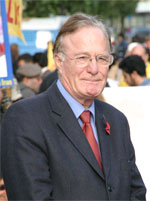 Lord Colbert does not do his title justice; to paraphrase Samuel Butler, a degenerate nobleman is like a turnip. There is nothing good of him but that which is under ground. Else how can he explain throwing in his lot with terrorists who are in the employ of Israel?”Israel is said to have had a relationship with the M.E.K at least since the late nineties, and to have supplied a satellite signal for N.C.RI. broadcasts from Paris into Iran” [ii]. Their servitude to the Israelis was after they had committed treason, murder, and terrorism while under the tutelage of Saddam Hossein – the man that the Americans and the British considered a threat to world peace, and whose demise and the invasion of Iraq has now caused a threat to world peace.
 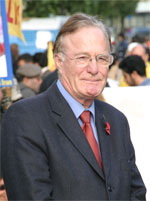 Lord Colbert does not do his title justice
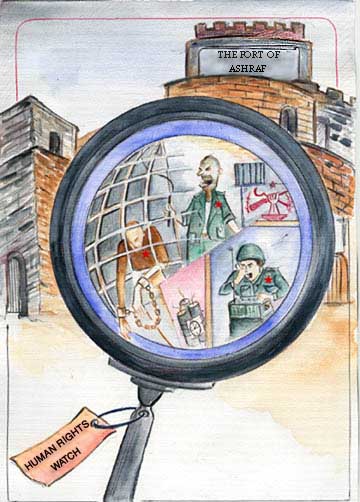 Considering itself an alternative, MKO, in spite of chanting slogans, hardly believes in and adheres to the principles of human rights. Reportedly, the organization is notoriously known to be abusing its insiders through a various instances of human rights violations. Reported by Human Rights Watch, “abuses carried out by MKO leaders against dissident members ranged from prolonged incommunicado and solitary confinement to beatings, verbal and psychological abuse, coerced confessions, threats of execution, and torture that in two cases led to death”. 1