The “all-or-nothing” way of thinking is one of the very destructive thinking patterns that a person can have. This thinking pattern is also called “black and white thinking”. Thinking in black and white arranges the world into extremes: good and bad, yes and no.
It’s like seeing only in black and white and ignoring the shades of gray in between. This thinking pattern leads the person to absolutism. Absolutism refers to ideas, phrases and words that denote totality, either in magnitude or probability. Absolutist thoughts are unqualified by nuance and overlook the complexity of a given subject.
Those who are not with us are against us!
For absolutists, there is nothing more than two possible positions. They do not admit that a person or group can have a neutral stance or could disagree in part with their position without entirely opposing them. In the cults of personality such as the Mujahedin Khalq (MEK, MKO, PMOI, Cult of Rajavi), the absolute leader is the main person to coerce members into such a thinking pattern.
In the MEK, any voice of dissent is forbidden and eventually will be silenced by any means. Based on interviews that he made with former members of the MEK, Aron Merat wrote in the Guardian that “MEK commanders systematically abused members to silence dissent and prevent defections – using torture, solitary confinement, the confiscation of assets and the segregation of families to maintain control over members”.
Members of the MEK often undergo sever punishment as soon as they express their willingness to leave the group. As the former high ranking member of the group Saeed Shahsavandi told the BBC inside the MEK’s ruling system “people do not leave the group, but they are expelled from the group”. According to Shahsavandi, the organization do not tolerate any criticism. “Criticism and polyphonic ideas are not tolerated, so the dissident member is considered as traitor,” he says. “In such organizations, relationships are based on zero or one hundred, black or white, you are either a servant or a traitor.”
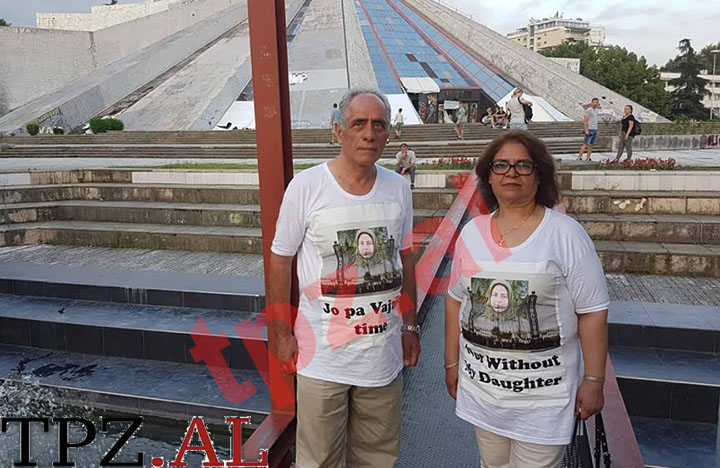
Absolutism of the MEK leaders explains why families of the MEK members are called mercenaries of the Iranian government just because they ask the international human rights bodies to aid them contact their children who are kept like hostages in the MEK.
As absolute powers of their ruling system, dictators suffer such personal disorder. Lack of balanced thinking make the MEK leaders fail to bring together the dichotomy of both positive and negative qualities of a phenomenon. Like other totalitarian leaders such as Stalin or Hitler, Massoud Rajavi is considered as a narcissistic personality. Narcissism is one of the popular causes of the all or nothing way of thinking.
A Narcissist devalues people, considers them worthless and thinks highly of them. Therefore his mind gradually adopts the all or nothing thinking. The narcissist thinks that things are either perfect or imperfect. Massoud Rajavi calls members as “unique gems” or “freedom fighters” as far as they obey his absolute power. As soon as a member decides to leave the group, he is labeled a “traitor” or “agent of the Iranian Intelligence”.
The duality of black and white thinking prevent the MEK leaders from realizing the truth because in reality most things can be approached from multiple perspectives. The fictional black and white world that the Rajavis have built inside their cult has a very destructive effect on the members’ lives. They are hardly ever capable of leaving the group in a normal process. There is an urgent need of human rights bodies to aid the release of the group members from the bars of the Cult of Rajavi.
Mazda Parsi
Articles
The following is an interview I conducted via email with Osli Jazexhi, an Albanian-based, Canadian-Albanian historian who specializes in the history of Islam, nationalism and religious reformation in Southeastern Europe. His interest covers nationalism, radicalism, religious and ethnic identities in the Balkans. The interview was conducted between December 17 and 19.

How popular is MEK in Albania?
MEK is a terrorist cult that resides in Albania, and which struggles to overthrow the government of a country that has done nothing wrong against Albania. As a result, the majority of the Albanians have no sympathy for this organization whose job is to wage war and terrorism against a foreign country. What MEK does is criminal and punishable according to the Albanian Penal Code and the Constitution of Albania.
MEK was brought to Albania by deception. Albanian politicians like Pandeli Majko, Fatmir Mediu, Sali Berisha etc., asked the Americans to host them in Albania without asking the Albanian people first. This is like as if German politicians were to take into Germany the ISIS army and command, and host them in their country without asking their citizens first.
The first members of MEK came to Albania in 2013. However, the bulk of them were brought in 2016, when the then US Secretary of State John Kerry announced their massive landing in Tirana. The coming of MEK created big fears in the country where many media, security analysts, journalists and the public opinion condemned the deception through which MEK was brought. From 2016 to 2018 the media in Albania has written and produced many debates against the MEK and ISIS fighters. Even the office responsible for fighting extremism classified them as an extremist organization in January 2018. The weird nature of MEK which operates as a messianic jihadi cult, whose members are mujahedeens, live isolated from the world, refuse civilian life and make continuous calls for jihad against Iran, and create fear among the peace-loving Albanians in the same way ISIS does for many people in the world. For this reason in the past years many journalists and activists have criticized the government of Prime Minister Edi Rama by blaming it for turning Albania into a safe heaven for terrorists.
In the past three years MEK has gained notoriety in Albania for its attacks against journalists, the media and any person who questions their activities. MEK defectors and their revelations have appalled the Albanians who hate the Stalinist past of their country, when they were indoctrinated and isolated like MEK does at present with its members.
When MEK first came to Albania they were housed in Tirana. Many of their members, who for many years had been kept in isolation in Iraq, started to defect en masse. Some were caught by the border police for trying to smuggle themselves into Western Europe. The stories that defectors presented to the Albanian public, which showed the brainwashing and radicalizing tactics of MEK against their members, shocked the Albanians. 2016 and 2018 have been critical for MEK, since it faced many defections and scandals from many family members of MEK jihadis who came to Albania trying to rescue their relatives from the organization. To stop this, the MEK leadership took the following steps:
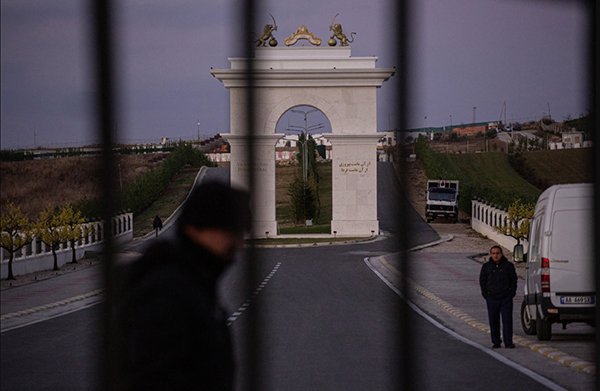
1. They removed their members from Tirana and housed them in the paramilitary camp of Manza known as Ashraf 3, where they are kept locked in and not allowed to walk out of the camp.
2. They asked American and British politicians to intervene in Albania and ask the Albanian authorities to not allow any family member of MEK jihadis to come to Albania and meet their relatives. Their family members were branded as agents of Iran and the Albanian government was ordered to stop their entry in the country.
3. They spread fake news in Albania and Europe by claiming that Iran is sending terrorists to kill them and for this reason forced the Albanian government to keep them in total isolation from the outside world and discourage the media from investigating them.
4. They have asked from all the local media to never interview and investigate them, not to reveal their names and activities, by claiming that if interviewed the media will send out facts which will be used by Iran to kill them. While they succeeded in silencing the Albanian media, they failed with the Western media who have exposed them a lot.
5. They secured the shameful collaboration of the UNHCR office in Albania and Albanian government agencies through which any MEK member who escaped from the jihadi camp and wanted to de-radicalize himself was to be punished by the UNHCR and the Albanian authorities by having his / her social assistance cut, their political asylum rejected, and left without working and traveling documents. In few words, if the mojahedens abandon the jihadi organization, they were to be starved to death.
6. They co-opted some Albanian media like News 24 TV and Vizion + and paid their journalists to support their cause and propagate the fake MEK claims that Iran is a terrorist state which wants to kill them. The owners of News 24 and Vizion + did not allow any debate in their TV stations about what MEK does, how it spreads fake news and attacks their opponents without facts. Journalists like Sokol Balla who covered their events, even produced a documentary showing the jihadis as freedom fighters.
7. They demanded the Albanian authorities to close all Shia religious institutions of the country connected to Iran, block their bank accounts and expel all the Iranians from Albania. The Albanian authorities complied. A Quran foundation, a private High School and Rumi philosophical foundation that were cooperating with religious institutions and universities in Iran were all closed down. Hundreds of Albanians lost their jobs, students lost their education, many Iranians were deported back to Iran and many research projects and book publications were canceled. The Bektashi Community of Albania and other Sufi Tariqas who historically had very close relations with Iran have all been forced to severe their ties with Iran and not invite Shia religious scholars in the country anymore.
How much in the public are Maryam Rajavi and Massoud Rajavi? Do they have much support in Albania?
Massoud Rajavi, the founder of MEK is nowhere to be seen. People who study MEK believe that he is dead, probably because of an injury that the Americans inflicted on him in Iraq when MEK was on the side of Saddam Hussein and was considered a terrorist organization by the United States.
Maryam Rajavi the widow of Massoud, who leads the cult-organization, does not make public appearances. She never comes out in streets and few Albanians know where she hides. It is believed that most of the time she stays with her cult commanders who run the everyday life of the mojahedins and their subversive activities against Iran and probably Iraq.
Maryam Rajavi works mainly behind the curtains. Time after time she releases pictures of meetings with Albanian politicians, where she asks for favors and pushes them to stop the media from reporting on human rights violations that MEK does against her members. The story that MEK and Maryam Rajavi conveys to those Albanian media who have agreed to spread their fake stories is that MEK is ‘the democratic opposition of Iran’, that people in Iran live in a dictatorship and are being killed by the ‘regime’ and they are all waiting for Maryam Rajavi to go and save them from the Mullahs. MEK tries to play the victim in Albania and the West by spreading fake news against Iran and claiming that Iran is ready to conduct a major terrorist attack and kill the ‘democracy loving’ mojahedins. On the other hand, as the Albanian Deputy Minister of Interior Besfort Lamallari have accepted in a TV show, MEK, contrary to Albanian laws, runs its own secret service agency in Albania and serves as a major tool to direct Albanian policies towards Iran. In a few words, MEK has taken over Albanian foreign affairs in regard to Iran in the country, and apart from its foreign fight against Iran, conducts espionage activities inside Albania against Albanian and foreign citizens.
Even thought they spend a lot of money to counter their negative image, the Albanian public opinion and almost all the journalists and security analysts do consider MEK, at least privately, a violent terrorist organization which is hosted in Albania because the Americans have ordered it to be.
MEK has been trying hard to buy a number of Albanian politicians and NGO activists on their side by inviting them to their events in Albania and in France, and connecting them with American and European politicians. They spend a lot of money even with peasants who live in the vicinity of their village of Manza in order to recruit them on their side. There are reports that MEK is teaching its jihadi ideology to young children in the village of Manza; however, the Albanian government has done nothing to stop this dangerous indoctrination.
Nevertheless, the Albanian public opinion including the politicians do not take MEK seriously for what they do and say. MEK’s desire to do jihad and establish a utopian Rajavi cult-like regime in Iran does not make any sense for the Albanians who for 50 years lived under a MEK-like Stalinist regime of Enver Hoxha. No Albanian would ever want to live even for a day in the paramilitary camp of MEK or under the totalitarian ‘Utopia’ of Maryam Rajavi. I do not believe that any Albanian will be cheated to join the jihad of MEK against Iran as many did when they joined DAESH in Syria.
The only use that Albanian politicians have with MEK is the connections that MEK has with high neo-con politicians in the United States. Since the US Embassy has the absolute say about many things that happen in our country, having good connections with MEK for the corrupt Albanian politicians means that they will have access to the Americans and probably save themselves from being sent to jail for their crimes. For this reason, many Albanian politicians, including our president, participate in MEK meetings.
One Albanian deputy who used to seat in Albania’s Security Council in 2018 told me that ‘We know that MEK is a terrorist organization. But the Americans brought them here, and they and our British friends told us to keep them, and we are keeping them because we are told so.’
Is MEK growing in numbers and influence, or diminishing? Why do you think that is?
When the Obama administration brought MEK to Albania, the idea was that they will build an asylum where MEK terrorists will retire and die by escaping justice for their past crimes against Iran and Iraq. MEK was brought to Albania, probably as part of the Iran Nuclear Deal. Iran and Iraq did not want them in their region and the Americans had to do something in order to save them from justice. As a result of their past terrorism, no country wanted to host them. Even the Americans did not want them in the United States.
The only country which accepted them was Albania. Albania was a good choice since our country is run by criminal groups and does not have a functioning legal system like the United Kingdom, Italy or many countries in the West have. By being a lawless country with very weak legal institutions, a corrupt leadership and where the US Embassy has the final say on everything, the Americans made the right decision to bring them to Albania. The other option for MEK would have been the Guantanamo Bay. Many American senators who have visited Albania during the past years have told Prime Minister Edi Rama to protect MEK at any cost and do not allow them to be charged for the murder and crimes they have committed in the past. If MEK was to be located in the United States, United Kingdom, France or Italy, many of its members would have gone to court by now.
After coming to Albania, many MEK members have changed their names and ID-s. Last year, when a Canadian family of Mostafa Mohammady wanted to save their daughter, Sommayeh Mohammady, who is being held in the MEK camp – Mostafa revealed to the media that many MEK commanders who appeared in the media parading his daughter in Iraq had other names. Mostafa and other defectors have revealed that some of the commanders who are today in Albania, in the past have committed crimes and even killed people. This fact has shocked the journalists and the public, but no investigation has been opened by the office of the general prosecutor. The only court case that is ongoing at present against MEK in Albania is the case of Gjergji Thanasi, an Albanian journalist who has been accused for being an Iranian spy by commander Behzad Safari. Thanasi has sued Behzad Safari for slander, libel and defamation and is asking compensation for the damage that MEK fake accusations have made against him.
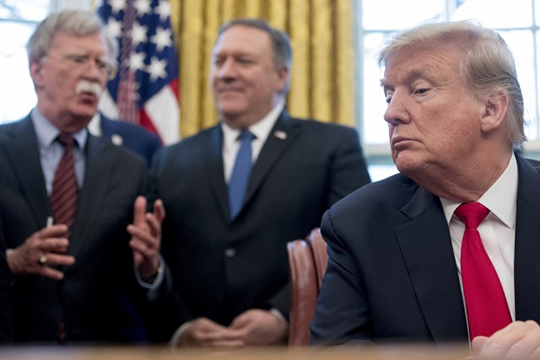
While during the days of Obama administration MEK kept a low profile, their influence and profile has changed during the beginning of the Trump administration. John Bolton, the National Security Adviser to president Trump, has been instrumental on radicalizing and promoting them as ‘the democratic opposition of Iran’ and promoting them as the ISIS or Free Syrian Army version of a future war against Iran – which would bring regime change in Tehran. In the last three years MEK has transformed its profile in Albania – from an asylum seeking organization who begged Albania to host and ‘save them from Iran and Iraq’ into a militant organization which together with the US administration has pushed Albania to undertake hostile actions against Iran; like the expulsion of the Iranian Ambassador in December 2018. In the past two years MEK and Maryam Rajavi have aggressively demanded from the Albanian government to cut all ties with Iran, expel Iranian diplomats, and has been involved in a huge campaign of spreading fake news against Iran.
The Edi Rama government, who at first was surprised by their demands and was hesitant to please them, in the past year has been forced to give them support on the fake news that they spread and in their attacks against MEK defectors.
However, after the sacking of John Bolton and the investigations that have started against President Trump and Rudy Giuliani in the US, MEK seems to have gone mute. In the past months they have been less aggressive in the Albanian media, and have launched only sporadic attacks against some foreign media outlets like the BBC, Der Spiegel or Albanian journalists like me and Gjergji Thanasi who have reported on their weird activities and organization.
MEK is very vicious against the media. Unlike ISIS or the Taliban who kill the journalists, MEK who cannot do such killings; in Albania, the attacks against them are through character assassination by accusing them of being agents of Iran and working for the Mullahs. This is how they have attacked the BBC, Channel 4, the Guardian, Al Jazeera and many journalists who dare to speak and investigate them. When they attack the media, they do not use their names. They post their attacks in anonymous websites who cannot be traced where they are located. As a result, journalists like me have difficulty to sue them in courts. But the case is different with Gjergji Thanasi, who was attacked by Behzad Safari, a notorious commander of MEK who has to justify his lies in court.
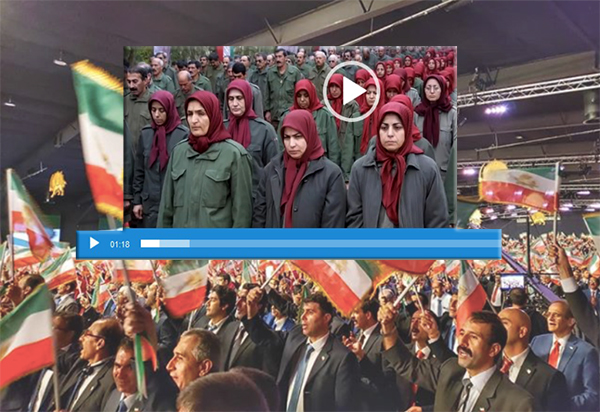
The hate that MEK has against the media is partly because Maryam Rajavi and her commanders live in a totalitarian utopia. They brainwash their soldiers with fake hopes about the imminent victory of their utopian regime change in Iran. Albanian politicians like Pandeli Majko have also fallen pray to MEK radicalization. Two years ago, Majko believed that before 2019 he and Maryam Rajavi would eat ice cream in Tehran after overthrowing the democratically-elected government of Iran. However, while the people of Iran hate MEK and their regime change has never materialized, MEK hates the media and perceives them as its greatest enemy. MEK behaves like the Communist Party of China. Their camps are not much different from the Xinjiang Concentration Camps where Uyghur Muslims are brainwashed to believe that chairman Xi Jinping is the leader of the great Chinese revolution. Like the CCP, which hates the media and have placed Xinjiang in a total lockdown, MEK does the same. Journalists are not allowed to enter in their camps to investigate their members, and the only time when ‘friendly’ journalists and guests are invited they are allowed to film MEK jihadis singing and praising Maryam Rajavi. Exactly what CCP does with its imprisoned Uyghurs in the concentration camps, who when presented to the media are told to sing and dance.
However, after the sacking of John Bolton and Donald Trump’s declaration of retreat from Syria and his abandonment of the Kurds, the MEK leadership seems to be having a very hard psychological time in Albania. Some defectors have told me that MEK fears that Trump will abandoned them like he did the Kurds and this will mean the end of MEK. The Saudi money which is believed to be funding MEK’s existence will cease, and without money its members who now stay in the Manza camp or Ashraf 3 will escape and defect en mass towards Western Europe. Maryam Rajavi will be forced to close her 50-year old jihadi organization and Albania and Europe will have to deal with MEK at the same way as they are dealing with the returning ISIS fighters. Albania will be in the position of Turkey with its 3 million Syrian refugees, while the Americans will discharge the MEK problem to Europe as they are doing with ISIS returnees at present.
How strong is the international support for MEK in your estimation?
MEK had a lot of support when John McCain was alive and John Bolton was advising the White House. MEK was perceived as the Iranian version of ISIS and Free Syrian Army by American neo-cons. However, with the death of McCain and dismissal of Bolton and troubles for Rudy Giuliani, MEK seems to have lost some very important supporters in the United States. MEK is not a military asset for the United States against Iran. They are a bunch of old terrorists, many suffering severe illnesses, who no longer have tanks and cannons like they had under Saddam Hussein. From Albania they cannot easily conduct terrorist attacks against Iran like they were doing from Iraq. The best that they can do in the great regional war between Iran and the Axis of Resistance on one side and Israel and the United States on the other, is to spread lies and disinformation against Iran or to stage false flag attacks in Europe.
MEK has been quite successful on that. Many ‘terrorist’ attacks that the media attributed to Iran in 2018, have in fact been faked by MEK and its members. To date not a single Iranian or Iranian-linked individual or organization has been found guilty in Europe during the past years, even though MEK and Israeli media keep on repeating that Iran is about to mass-terrorize the Europeans.
MEK is being used by Israel and certain elements of the American deep state to serve as a poisoning tool in the relations between Iran and Europe.
Their organization, which is believed to have around 3000 members, needs a huge budget to run. Each MEK member used to take around 500 EURO / month to survive in Albania from UNHCR. The minimum budget that MEK takes to sustain its members and camp is around 1.5 million EURO per month. It is believed that this budget comes from Saudi Arabia. In a year they need at list 18 million Euros, without counting here the money that they spend for building their facilities and hosting periodic events where they invite retired and second-class politicians from the West who get free hotel, food, airplane tickets and some stipends for their attendance.
Coming back to your question how strong is MEK’s international support I could say that they have the support of some countries that are hostile to Iran, like the United States, Israel and Saudi Arabia. But no European government loves them, and the European Union despises them since they perceive them as a security threat. The Italians, the Greeks, the Macedonians, the Turks, the Russians etc., all observe MEK with great concern.
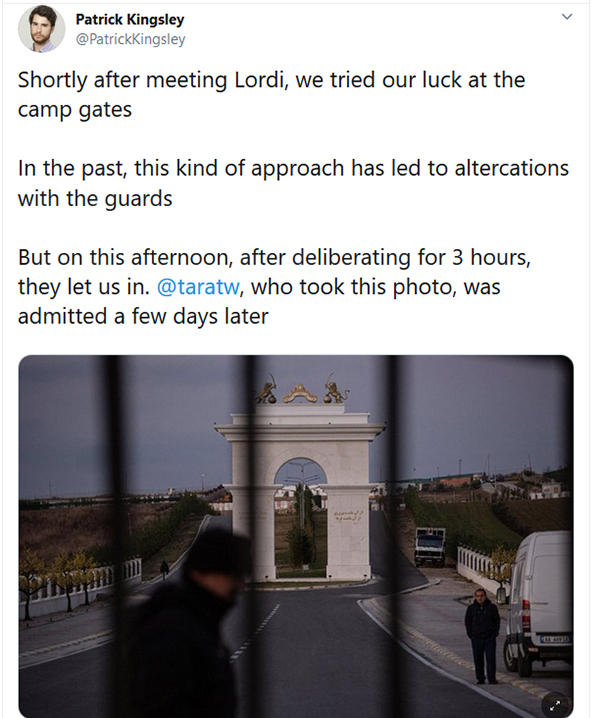
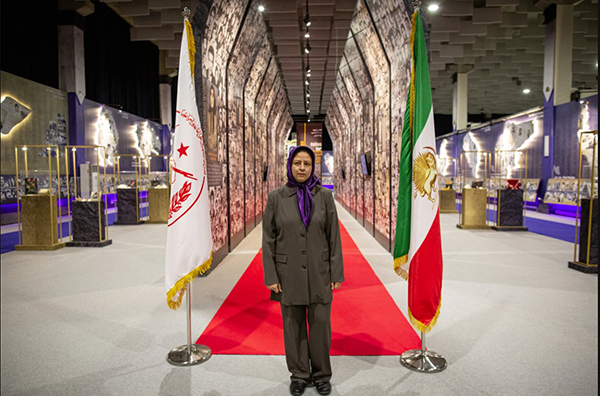
MEK tries very hard to create the impression that it has mass international support. In its periodic conferences it invites retired Europeans and Americans, students, workers etc. who, in exchange for their free holiday trip to Albania, are required to go into their gatherings and spend a few hours in photographic meetings that Maryam Rajavi does with them. MEK stages shows in its camp like the CCP does in its concentration camps in Xinjiang with foreign journalists and diplomats. China invites foreigners who receive first-class treatment and in return are expected to lie about Xinjiang and not to investigate what is going on with the Muslim detainees. MEK’s invitees do the same. They do not interrogate MEK members who do not want to do jihad and want to escape from the camp. The invitees in most of the cases are happy to sell to the world a fake story by declaring that MEK is not a terrorist cult which wants to do jihad against Iran, but it is the ‘Iranian opposition’ who ‘wants to bring democracy to Iran’. However, some brave journalist like the brave Alice Taylor who have visited the MEK camp, have revealed to the world how MEK tries to fake its image and use the paid journalists for this fake make up.
When MEK came to Albania, their presence was rejected overwhelmingly by many civil society groups, the media and the public. There were many calls for their immediate expulsion from the country. However, in the past two years MEK, with the support of many American and Western politicians, has been able to buy many individuals and silence the media criticism on them. They do this by blackmailing the media who report on them, by character assassination of journalists, or when they cannot silence the media they try to buy them by offering money. Many journalists are paid when they go to MEK camp and produce fake stories on them. MEK never accepts open debates about what they do. They do not know how to act in an open society.
Since MEK is seen as an organization which the United States supports, no politician or religious personality in Albania dares to talk about them in public. Many journalists who have opposed them in the past have been told not to do so anymore. Many media have chosen to ignore them since they know that by speaking against MEK they put themselves into trouble, and as MEK commanders say to many journalists – they will ruin their career.
Do you think MEK is a well-organized group, or is it in disarray?
MEK has three types of members. Some who are fully indoctrinated and follow the ideology of Maryam Rajavi blindly and believe that she is some kind of Holy Person who will establish an utopian Marxist – Rajavist regime in Iran. Some who know that her totalitarian ideology is non-sense, but keep quiet because they know that if they leave the cult, now that they are too old they will not be able to survive and will die in poverty. The third type of their members, who are mainly youths, hate the organization and wait for their moment to escape and live in freedom. MEK does anything in its power to keep its members isolated and scared from the outside world. The majority of its members, especially the youth, are not allowed contact with their families, the media and the outside world since this will give them the connections to escape into freedom.
MEK runs as a paramilitary organization. It has a well-organized command structure, while the rest of its members are treated as simple jihadi soldiers. Some MEK defectors who live in Tirana have told me that there is an open mutiny among the soldiers and when foreign delegations visit the camp, many members are kept locked indoors and are not allowed to attend the mass events. They want to abandon the camp where they live isolated like in prison. MEK members undergo psychological brainwashing very much like the Uyghurs in China’s concentration camps. Camp members are forced to undergo indoctrination classes every day. They do not have access to telephones, the internet and are not allowed to communicate with their families. They are kept under constant supervision, radicalized with ideas of violent jihad and monitored by surveillance cameras. Defectors have told me that Maryam Rajavi rules over them with fear. She and her command scare the mojahedins by claiming that if they leave the camp they will die of hunger or Iran will kill them with its agents.
For as long as MEK receives a budget of millions of dollars and is protected and allowed to isolate its members and abuse their human rights, it will manage to survive for a few more years as an anti-Iran warmongering organization and center of espionage. If Washington or Tel Aviv would need, some of its still-able members will be also used to commit terrorist attacks in the Middle East and Europe. However, if the organization will be left without money, Maryam Rajavi will not be able to pay ‘international supporters’ like Bolton and Giuliani for her cause and its members who will be hungry will riot and abandon the cult like many of their comrades have done in the past.
If Iran reaches a new comprehensive and long-lasting deal with the United States, MEK will very likely lose its sponsors and the organization will either be sent back to Iran or it will dismantle by itself. But even if these things do not happen, in the coming 10 to 20 years the organization will cease to exist since many of its members will be dead by that time and Maryam Rajavi, if she is still alive, will not have the chance to abduct and brainwash new jihadis against Iran.
Robert Fantina, Counter Punch
At the mass that took place at St. Paul’s Catholic Cathedral in Tirana for Christmas, besides many corrupt personalities, thieves and criminals who went on to pardon sins and appear on television as good men, there were also representatives of the former terrorist Iranian Mojahedin-e Khalq organisation (MEK).
Present at the Christmas Mass was the head of the Iranian Jihadis, Maryam Rajavi. Behind Maryam Rajavi, in the photo published by an Albanian newspaper, is her first husband Mehdi Abrishamchi, who because her second husband, Massoud Rajavi, is now dead, is apparently replacing the former.
On the left of Maryam Rajavi is the feared Communist spy, Djana Culi, who is notorious in Albania for sending the brothers Blloshmi and Genc Leke to the gallows, and who is now a fiery supporter of the MEK jihad against Iran. On the right of the hijab wearing Maryam is Elona Gjhebrea, former Deputy Minister of the Interior, who is also controversial for her acquaintance with the Habilaj clan drug gang.
Attendance by the former terrorists, former communist spies and friends of drug traffickers has been welcomed by Monsignor George Frendo. In a repetition of the biblical tragedy of Pontius Pilate and the hypocritical religious leaders who condemned Jesus Christ to the cross, Monsieur George Frendo was happy with the presence of former terrorists, spies, criminals, etc. who attended the Christmas Mass. Their presence turned the Mass into a biblical tragedy.
Knowing that Maryam Rajavi presents herself to members of her cult as the messenger of Imam Mahdi who will save Iran from Islam and the Imams, the Christmas Eve Mass in Tirana resembled messianic dust. Maryam the ‘saint’ was celebrating the day of the birth of the saint Jesus Christ in the presence of many sins and sinners.
If Christ was in the grave, the night would have been a freakshow of horror!
Hallelujah!
Gazeta Impakt, Tirana, Translated by Iran Interlink
The Mujahedin-e Khalq keeps about two thousands members inside its cult-like structure in Camp Ashraf 3 in Albania despite the departure of a large number of its members during the two past decades. Each and every of the remaining male and female members of the MEK has a story of their family life. Most of the old members were married and had children when they joined the group. Though, they left family behind when Massoud Rajavi ordered them to divorce their spouses and to send their children out of the group. So there are a lot of heartbreaking stories of families whose destiny was involved in the ambitions of the leaders of the MEK. The stories of certain fathers and daughters have been already published on Nejat Society website. It is time to review the painful stories of some fathers and sons in the MEK.

The most iconic and prominent father and son in the MEK are Massoud Rajavi and his son Mohammad. Mohammad was an infant in the safe house where his mother Ashraf was killed in an armed clash between the MEK agents and the Iranian forces in Tehran. He was then taken to Iraq and then to Europe where he grew up and again back to Iraq. He left Iraq together with other members of the group. In Albania left the group and went to Norway where he goes to university under the supervision of the MEK commanders.
According to the testimonies of former member, Mohammad was a critic of his father’s approach in the group. Some former members even revealed that he had tried to escape the group several times but he did not succeed as far as the group was located in Iraq. As soon as the group was settled in Albania, Mohammad moved to the free world although he is not free from the group’s control.
Nonetheless, not everyone was as lucky as mohammad Rajavi. Majid Hanifsnejad is another example of the sons of the MEK’s high ranking members. Ahmad, Majid’s father is the brother of Mohammad Hanifnejad one of the early founders of the group. Former members confirm that Ahmad is one of the cruelest interrogators of the MEK. He has tortured a lot of his comrades inside the group just because they asked to leave the group. Majid was studying in a college in Europe when his father ordered him to get back to Iraq. He is brought to the group’s propaganda media from time to time to show that he is still dedicated to the cause of the group that his uncle founded.
The experience of Yasser Ezzati tells a lot more about the painful stories of fathers and sons in the MEK. Yasser Ezati was ten-years-old when he was taken away from his parents – together with hundreds of other Mujahedin children. Some went to live with members in the West, and some in children’s homes very similar to an orphanage. Yasser went to both: he spent three years with three different families in Canada, and afterwards stayed in three different children’s homes in Germany. As a child Yasser Ezati often stood in the shopping center of Cologne with the pictures of victims in Iran, collecting money for the MEK. Many members in Europe worked like this, until the governments discovered that the funds did not go to aid organizations, but to buy weapons. [source: Misled Martyrs, Judith Neurink]
The former members of the group state that his father, Hassan, is known to be a torturer in the MEK. ”He even beat me several times after I declared defection,” he said. “Whenever I missed my parents my father would receive me by beating and kicking me.”
“I have not forgotten my past yet because an important part of my life, my childhood, my adolescence were lost for the misguided goal of the MKO”, he told Nejat Society. Finally, Yasser Ezzati could manage to escape the MEK a decade ago.
Like many other children of MEK members, Amir Vafa Yaghmaei was a citizen of Sweden. He was able to leave Ashraf after 2 years with help of Swedish government. His father, Esmaeil Vafa Yaghmaei was so loyal to Mr. Rajavi at NCRI that he ignored several requests by his own son, who was 16 when sent to Iraq, and refused to help him. Amir was abused inside Ashraf and also in US Camp, TIPF, for almost 2 years. However, both Esmaeil and Amir defected the MEK. Unlike the three other cases, Amir was under the coercive indoctrinations of her mother in Camp Ashraf. He cannot forgive his mom for what he underwent under the pressure of the MEK’s cult-like system.
Nejat Society
A very essential question in any discussion and argument about the Mujahedin Khalq Organization (the MKO, MEK, PMOI, Cult of Rajavi) has always been about its financial resources. Based on various investigative reports, interviews, testimonies and documents, the question can have a variety of answers based on the timing.
For most, the simplest answer is Saddam Hussein. The answer is quite acceptable. The financial and logistical support that former Iraqi dictator granted to MEK was nothing secret. The group was actually Saddam’s private army during the Iran-Iraq war and the suppression of Iraqi people’s uprisings after the war.
After the fall of Saddam Hussein a video revealed MEK agents receiving boxes of dollars from Iraqi intelligence officers. However, this does not seem to be enough to run a cult of a few thousand rank and files, bribing Western politicians with big sums of speaking fees and funding western far right parties to win the election.
Investigating former members’ testimonies and arguments made by experts, you will reach to a common answer that includes Saudi Arabia as the main sponsor of MEK. Massoud Khodabendeh, a former high-ranking MEK official confirmed long-held suspicions that Saudi Arabia has been financing the MEK since Saddam’s era. In an interview with Jordanian news outlet Al-Bawaba in December 2018, he asserted that he oversaw the transfer of hundreds of millions of dollars’ worth of materials including gold and Rolex watches. [1]
Massoud Khodabandeh explained that 3 tons of solid gold, a minimum of four suitcases of customized Rolex watches and fabric that had been used to cover the Muslim holy site of Kaaba in Mecca were among the commodities shipped from Saudi Arabia to MEK operatives in Baghdad. From there, the valuables would be sold on the black market in Jordan’s capital, Amman, to Saudi-aligned merchants. [2]
This was confirmed by the well-known historian Ervand IAbrahamian, a professor at the City University of New York and author of the definitive academic work on the group’s history, “The Iranian Mojahedin”.”The money definitely comes from Saudis,”he told Aron Merat of the Guardian.”There is no one else who could be subsidising them with this level of finance.”[3]
Mark Dankoff, radio broadcaster, journalist and former Senate candidate also revealed the MEK’s notorious alliance with the enemies of Iran in an interview with Tasnim news agency.”The New York Times has extensively covered the Neo-Conservative, Zionist politicians who have been on the MEK payroll, and who helped remove them from the American State Department list of Officially Designated Terrorist Organizations,”he said.”The money of the MEK is traceable to Saudi Arabia, and Israeli players in this New Great Game.”[4]
Not surprisingly, the MEK enjoys operational support by the side of the most operative enemy of Islamic Republic in the region, Israel. Connie Brock of The New Yorker writes,”Israel had a relationship with the M.E.K at least since the late nineties, and had supplied a satellite signal for N.C.R.I. broadcasts from Paris into Iran. An Israeli diplomat said:”The M.E.K is useful,”but did not elaborate.”According to the same report, the Israelis provided the MEK with unsubstantiated intelligence on Iran’s nuclear program. [5]
Luisa Hommerich of Spiegel Online, wrote,”Security experts believe that the U.S., Saudi Arabia and Israel also provide the group with financial support, but there is no proof for that supposition.”[6]
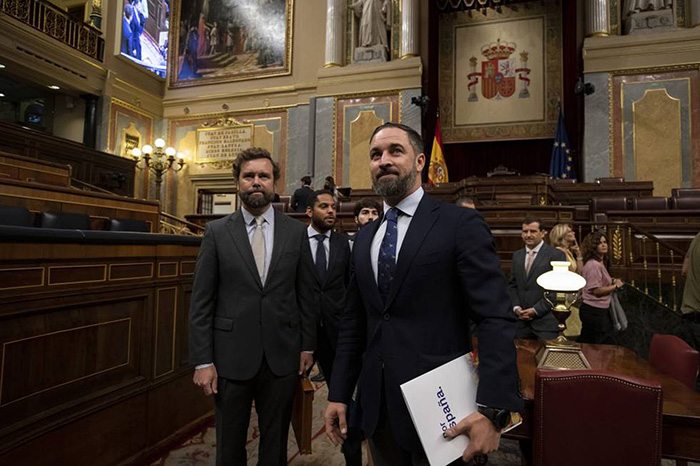
Given that we ignore all the above-mentioned evidences and accept that there may be no proof, the reason is clear: money laundering is taking place in a complicated network coordinated by the sponsors and the MEK agents all over the world. In April 2019, the Spanish Newspaper, El Pais reported that the Spain’s far-right Vox received funds from mujahedin Khalq.
Documents leaked to El Pais revealed that between its founding in December 2013 and the European Parliament elections in May 2014, Vox received almost a million euros from the MEK’s front group, the National Council of Resistance of Iran (NCRI). It was not as though the financial relationship between Vox and the NCRI began gradually, but right when Vox was founded. Joaquín Gil, a journalist with El Pais, explained:”From the day it was founded in December 2013—the same day that it registered as a political party with the Spanish Ministry of Interior—Vox started to receive Iranian funds”. These funds came from different countries including the United States, Germany, Switzerland, Canada, and Italy in amounts ranging from 60 to 35,000 euros, totaling almost 972,000 euros, from December 2013 to April 2014, right before the 2014 elections. According to Gill, Alejo Vidal-Quadras Roca, former EP president and MEK’s longtime advocate, who was a leading member of Vox,”asked his friends at NCRI … to instruct its followers to make a series of money transfers.”[7]
Actually, for the adversaries of Iranians, traitors are potentially the most reliable people to invest on. Their treasonous attitude finds no boundaries. They are always ready to sell themselves to anyone who pays them.
Mazda Parsi
Refrences:
[1] Joplin, Ty, Inside the MEK: The Secluded Group Scheduled to Overthrow the Iranian Regime, Abawaba, July 31st, 2018.
[2] ibid
[3] Merrat, Aron,Terrorists, cultists – or champions of Iranian democracy? The wild wild story of the MEK, The Guardian, November 9th, 2018.
[4] Tasnim, US Favors ‘Regime Change’ Not Diplomacy with Iran: Ex-US Senate Candidate, December 4th, 2019.
[5] Sepahpour-Ulrich, Soraya, Washington’s Infatuation with Iran’s Mujahedin-e Khalq (M.E.K) Terrorist Organization, Global Research, June 30th, 2019.
[6] Hommerich, Luisa, The Cult-Like Group Fighting Iran, Speigel Online, Februray 18th, 2019.
[7] Jannessari, Sohail, & Loucaides, Darren, Spain’s Vox Party Hates Muslims—Except the Ones Who Fund It, April 27th, 2019.
Police said cell planned attacks on exiled Iranian opposition group. Others wonder if Albania is being drawn into US and Israeli fight with Iran
MEK defectors raise doubts over alleged Iranian ‘terror cell’ in Albania
Albanian police recently announced that they had discovered a terror ring, run by the Iranian Revolutionary Guards, which had planned attacks on an exiled Iranian opposition group living in Albania.
“A terrorist cell of the foreign operations unit of Iranian Quds was discovered lately by Albanian intelligence institutions,” Police Director General Ardi Veliu said at a press conference in late October.
The goal of the ring, Veliu said, was to strike the Mojahedin-e Khalq (MEK), an exiled Iranian opposition group which has been based in Albania for the past three years.
Names of group members were also released, including Alireza Naghashzadeh, whom Veliu identified as the cell’s operations chief and a member of the Quds Force, the arm of the revolutionary guards which conducts foreign operations.
The ring, he added, had been identified by sources inside it.
But no arrests have been made and Albania has yet to request international arrest warrants for the alleged attackers, leaving local journalists and Iranian dissidents with lingering doubts.
‘If it was true, why hasn’t Interpol arrested them?’
– Hassan Heyrani, former MEK member
Gjergj Erebara, a journalist with the Balkan Investigative Reporting Network, said the press conference – which he attended – was unusual, to say the least.
“Albanian police gave no proof to substantiate its claims. They said they have discovered the “terrorist cell”, but they didn’t make any arrests,” Erebara said.
Hassan Heyrani, a former high-ranking MEK member who defected from the group in 2017, said he believes the story that the police presented is fabricated.
“If it was true, why hasn’t Interpol arrested them? Albania is a very poor country where corruption is rife, police can be bought,” he said.
MEE repeatedly asked the Albanian police for further details about the alleged ring, but a spokesperson declined to comment. The Iranian Embassy in Tirana refused to comment.
Without further detail, some observers say they have been left wondering if the announcement is a sign that the Balkan country is being drawn further into America’s – and Israel’s – fight to overthrow the Iranian government.
From Iran to Albania
Established in 1965 as an Islamist-socialist movement, the MEK rose up against the rule of the Shah of Iran during the 1979 Islamic Revolution, but soon ran afoul of new leader Ayatollah Ruhollah Khomeini.
Facing a deadly crackdown, the MEK launched attacks on government officials and security forces and eventually was forced to flee the country, first to France and then eventually to Iraq.
MEK defectors raise doubts over alleged Iranian ‘terror cell’ in Albania
Massoud Rajavi, who led the MEK until he disappeared in 2003, and his wife Maryam, who now leads the group, seen in Paris in 1985 (AFP)
The group, whose activities have been described as cultish, with a goal of overthrowing the Iranian government using violence and indoctrination, was designated for more than a decade by both the US and the UK as a terrorist organisation.
But in recent years, and as both countries delisted the group, the MEK has become a favourite of anti-Iran hawks in the US and Europe who see it as a weapon against the government in Tehran.
Between 2014 and 2016, at the bequest of the US, at least 2,700 MEK members were resettled in Albania after the group came under attack at Camp Ashraf, the Iraqi refugee camp where they had been living since the mid-1980s.
These days, the group lives in a fortified camp in the country’s northwest, heavily protected by Albanian authorities.
Covert playground
Analysts say the group’s presence in Albania has raised alarm bells in Tehran and there have been reports that prominent members of the group have been under surveillance globally.
Ruslan Trad, an independent researcher focused on Iranian influence in the Balkans and co-founder of De Re Militari, said he believes Albania is now “a subject of espionage games” between Israel, Iran and the US.
Trad said Iran’s presence in Albania must be understood in the context of Tehran’s activities over the past two decades in the Balkans where it has been quietly establishing a foothold, triggering the concerns of western governments that the conflict with Iran had arrived in their backyard.
A 2012 attack killing five Israeli tourists, a bus driver and the bomber outside the airport in the Bulgarian city of Burgas, which Bulgarian intelligence eventually attributed to Hezbollah, was seen by many analysts as part of the covert war between Iran and Israel. Hezbollah denied its involvement.
Since then, however, Trad said he believes the Balkans have become an attractive location for Hezbollah, according to locally based Hezbollah members and sympathisers he has interviewed.
“Hezbollah is using Kosovo and Macedonia as a logistic centre and transit path, and Bulgaria as a hub,” he explained. He believes Hezbollah is heavily linked to Balkan mafia circles.
In turn, the activity has seen the Israelis step up their own operations in the Balkans, he said: “The Albanian authorities are probably cooperating with them.”
US-Albanian ties
Heyrani, the former MEK member who defected, said he believes the main reason Albania has been so supportive of the MEK is a result of the close relations between Albania and the US.
“Albania is under American control and also MEK is supported by the American Israel Public Affairs Committee (AIPAC),” he said, referring to the appearance of MEK members in an AIPAC-funded TV commercial against the Iran nuclear deal in 2015.
Under Donald Trump’s administration, hawkish support for the MEK has continued, including from now-former security advisor John Bolton and Secretary of State Mike Pompeo.
Bolton praised Albanian President Edi Rama at the end of last year for expelling the Iranian ambassador in Tirana in direct relation to an alleged terror plot targeting MEK members.
Trump wrote a letter acknowledging Albania’s “steadfast efforts to stand up to Iran and to counter its destabilising activities and efforts to silence dissidents around the globe”.
The continued support and safety measures that the Albanian government provides the MEK – now with the added questions about the alleged terror cell – has led many dissidents who have left the group to be concerned about their futures.
MEE spoke to several MEK defectors, several on condition of anonymity, who said they were distressed about what would come next for them, given the government’s stance.
“We just want a normal life, to get married and have a family. We have no citizenship, no passports, no land rights. We came here on humanitarian grounds, but we are treated like criminals,” Heyrani said. “I have no choice but to live here. I can’t go back to Iran. They do not accept us.”
Heyrani said that recently his image was splashed on Albanian television where he was described as an enemy of the state.
“They have no evidence, just like the alleged terror plot,” he said. “But here in Albania that is not important.”
Suddaf Chaudry, Middle East Eye
Inside Giuliani’s dual roles: Power-broker-for-hire and shadow foreign policy adviser
The president’s personal attorney Rudolph W. Giuliani was on the phone in late 2018, pressing administration officials about his latest agenda item.
a man and a woman standing in front of a building: President-elect Donald Trump talks with Rudolph W. Giuliani after a meeting at Trump National Golf Club Bedminster in New Jersey on Nov. 20, 2016.© Jabin Botsford/The Washington Post President-elect Donald Trump talks with Rudolph W. Giuliani after a meeting at Trump National Golf Club Bedminster in New Jersey on Nov. 20, 2016.
President Trump had nominated a career Foreign Service officer to become the U.S. ambassador to Qatar, a key post in a Middle Eastern country with tricky regional relationships, an important U.S. military installation and vast oil reserves.
Giuliani, who has said he had held a cybersecurity contract with Qatar in 2017 and early 2018, proposed replacing her with someone he said would be a better fit — Scott W. Taylor, a Trump-supporting former congressman from Virginia defeated in his reelection bid in November 2018, according to people familiar with his outreach.
Giuliani’s previously unreported attempts to shape the pick for the U.S. envoy to Qatar is part of an unorthodox foreign policy portfolio he has carved out for himself while also working as a power-broker-for-hire with direct access to the president and top administration officials.
Subscribe to the Post Most newsletter: Today’s most popular stories on The Washington Post
The dual roles he has embraced is part of what longtime colleagues say has been a transformation of the once-iconic New York mayor into a multimillionaire consultant to powerful figures overseas.
In the three years since Trump took office, Giuliani has expanded his lucrative foreign consulting and legal practice, taking on clients that span the globe, from Turkey to Venezuela to Romania to Ukraine.
Along the way, he also has used his singular perch to try to influence U.S. policy and criminal investigations — at times pushing the interests of foreign figures who could benefit him financially.
In 2017, Giuliani tried to get Trump and top Cabinet members to make moves sought by Turkey while working as a lawyer for a gold trader from that country with ties to top government officials. This spring, he successfully helped oust U.S. ambassador to Ukraine Marie Yovanovitch, a top target of a Ukrainian prosecutor who he considered representing in a six-figure contract. In September, he urged Justice Department officials not to pursue a case against a wealthy Venezuelan energy executive who had hired him as a private attorney.
Giuliani has said he separates his private business from the work he does for the president for free. He has said the kind of services he provides his foreign clients does not require registering with the U.S. government as a foreign lobbyist.
But since the start of the administration, his actions have caused persistent alarm among Trump’s advisers, who worry that it is often not clear who Giuliani is representing — the president, his private clients or his own foreign policy views — in his meetings at the White House and in foreign cities, according to people familiar with the concerns who spoke on the condition of anonymity to describe internal discussions.
Those worries have become acute since Giuliani emerged as a central figure in the Ukraine pressure campaign that is the subject of the House impeachment inquiry — and the arrests of two of his associates, Lev Parnas and Igor Fruman, who assisted him in that effort.
Federal prosecutors in New York are scrutinizing Giuliani’s business ties to the men and his consulting business as part of a broad probe, according to people familiar with the investigation.
In several conversations in recent months, Attorney General William P. Barr has counseled Trump in general terms that Giuliani has become a liability and a problem for the administration, according to multiple people familiar with the conversations. In one discussion, the attorney general warned the president that he was not being well-served by his lawyer, one person with knowledge of the episode said.
The Justice Department and the White House declined to comment. Giuliani did not respond to multiple calls and messages seeking his comment. His lawyer declined to comment.
Giuliani has assured the president that he is not in legal trouble, according to White House aides. And Trump has so far resisted entreaties to distance himself from the former New York mayor, telling others that he appreciates Giuliani’s combative media appearances on his behalf, according to White House officials and Trump advisers.
“He’s a good man and he’s an honorable guy and he’s a great crime fighter, corruption fighter,” the president said in an interview with Bill O’Reilly last month.
Last week, even as the House began drafting articles of impeachment, Giuliani kept up his work abroad on the president’s behalf, swooping into Kyiv to meet with Ukrainian prosecutors who he claims have damaging information about Democrats.
But the federal probe — being run out of the U.S. attorney’s office in Manhattan that Giuliani once led — appears to be delving into his foreign entanglements.
In recent weeks, prosecutors subpoenaed a consulting firm founded by former FBI director Louis Freeh, which hired Giuliani to write an August 2018 letter to Romanian officials calling for an amnesty for people prosecuted for corruption, a policy change that would have benefited a Freeh client, according to people familiar with the move. The subpoena has not been previously reported.
Freeh’s firm declined to comment, as did a spokesman for the U.S. attorney’s office in Manhattan.
This examination of Giuliani’s activities is based on interviews with more than 25 of his associates, current and former administration officials and other people familiar with his work, many of whom spoke on the condition of anonymity because of the ongoing criminal investigation.
In recent interviews, Giuliani told The Washington Post that questions about his foreign clients are “diversions by Democrats hoping to shoot the messenger” and an effort to distract from information he is uncovering about the president’s political opponents, such as former vice president Joe Biden.
“The Swamp Media is going back 20 years to find anything I could have done which they can paint as ‘wrong,’ ” he wrote in a tweet this fall.
Embracing a new lifestyle
Giuliani first came to prominence as the mob-fighting U.S. attorney in Manhattan in the 1980s, a position that helped propel him into the New York mayor’s office in 1994. His calm, take-charge leadership during the Sept. 11, 2001, terrorist attacks brought him international acclaim.
George Pataki, Rudy Giuliani are posing for a picture: Then-New York Gov. George Pataki, left, Giuliani, center, and then-Sen. Hillary Rodham Clinton tour the site of the World Trade Center disaster in New York on Sept. 12, 2001.© Robert F. Bukaty/AP Then-New York Gov. George Pataki, left, Giuliani, center, and then-Sen. Hillary Rodham Clinton tour the site of the World Trade Center disaster in New York on Sept. 12, 2001.
After leaving office, he parlayed that fame into a new role as a paid speaker around the world. The money that suddenly began flowing his way was a revelation, according to people who knew him.
One longtime friend recalled that during his travels for speeches abroad, Giuliani learned he could get paid $1 million or more as a consultant to foreign interests. He was stunned — and enticed, said the friend, who spoke on the condition of anonymity to describe private conversations.
Soon, Giuliani began living a much more affluent lifestyle, enjoying a house in the Hamptons, premium cigars, fine scotch, first-class travel and a luxury residence in New York. In 2003, he married his third wife, Judith Nathan, in an elaborate ceremony on the lawn of Gracie Mansion attended by 400 guests, including Trump. (The two are now in the midst of a bitter divorce.)
By the time Giuliani ran for president in 2008 — a bid that started strong but fizzled — his financial disclosure showed he had made $9.2 million for speeches alone between 2006 and mid-2007, many from domestic companies but also from foreign sponsors and think tanks. He made additional millions through his consulting company and his law firm, Bracewell & Giuliani, the disclosure showed.
But Giuliani’s failed presidential bid left the onetime hero “cast off into the political wilderness again,” said Andrew Kirtzman, a journalist who covered his political rise and wrote a 2001 biography of the former mayor.
He redoubled his efforts to make money, friends and associates noted.
“His values seemed to change,” Kirtzman said. “He was the least materialistic figure I’d ever covered back in his prosecutorial and mayoral days. His interest was always in power, not money. Then he became a man who was very interested in money.”
In the process, the former prosecutor began to drift away from colleagues he had known for decades, some of whom now express bewilderment at his transformation.
“There was a time when he wouldn’t take dirty money or questionable money or money of dubious origin,” said Ken Frydman, who served as the press secretary for Giuliani’s 1993 mayoral campaign, noting Giuliani was known then for vetting donors especially aggressively. “Today, it seems he’ll take money from anyone.”
Like Trump, Giuliani has always had a stubborn refusal to admit mistakes, Frydman said.
“Don’t back down. Don’t apologize,” Frydman said of Giuliani’s philosophy. But he said there is an “an intensity” to Giuliani now that goes beyond what he remembers: “He’s turned on the afterburners. He’s Rudy on steroids.”
Giuliani was soon moving in the same social circles as Trump, whom he had known for years in New York, emerging as one of the developer’s most vocal surrogates in the 2016 campaign.
Rudy Giuliani et al. sitting in front of a crowd: Giuliani arrives a Trump campaign stop in Aston, Pa., on Sept. 13, 2016.© Matt McClain/The Washington Post Giuliani arrives a Trump campaign stop in Aston, Pa., on Sept. 13, 2016.
After Trump’s surprise victory, Giuliani made clear he wanted to be named secretary of state, according to current and former administration officials. But a team of lawyers vetting potential administration appointees raised red flags about possible conflicts of interest arising from his work overseas, according to the officials.
A few weeks after Trump’s election, Giuliani announced that he had taken himself out of the running for the job. On Fox News, he said he planned to pursue his private legal and consulting business “with even more enthusiasm” than before Trump’s election.
Expanding foreign practice
The former New York mayor had robust work overseas before Trump took office. His companies, Giuliani Partners and Giuliani Security & Safety, provided security and emergency management consulting to governments in Peru, Chile, Argentina and Ukraine, among others. He gave paid speeches around the world, including to Mujahideen-e-Khalq, or MEK, an Iranian resistance group operating in exile that was listed as a terrorist group by the State Department as recently as 2012.
Rudy Giuliani et al. standing on a stage in front of a crowd: Giuliani attends a March 2018 ceremony in Albania marking the Iranian new year.© Siavosh Hosseini/Alamy Giuliani attends a March 2018 ceremony in Albania marking the Iranian new year.
But Trump’s election provided Giuliani with a substantially bigger platform — and newfound access to the top levels of U.S. decision-making.
He became a mainstay at the Trump International Hotel down the street from the White House, where he has spent long evenings meeting friends and potential business partners. When he needs to privately discuss deals, he convenes meetings at some of his favorite cigar bars, including Shelly’s Back Room in Washington and New York’s Grand Havana Room, according to people familiar with the sessions.
Giuliani has bragged to other Trump allies that he has made millions of dollars since the president took office, according to people familiar with his comments.
He also has regularly boasted about his access to Trump and the closeness of their friendship, said a senior U.S. official who interacted with Giuliani.
In one meeting with a prominent Ukrainian political figure in early 2018, Giuliani was explicit that hiring him would provide a route to the president, according to a person in attendance.
“It was just so clear what he was peddling. He was pushing for business, and his pitch was, ‘I’m close to the White House, I’m close to Trump. If you want to get in there, I’m your guy,’ ” the person said. In that case, the Ukrainian did not hire Giuliani.
Giuliani used his access to Trump in 2017 to push for two controversial issues sought by Turkish President Recep Tayyip Erdogan, as The Post has previously reported.
Early that year, he was hired by the legal team of a Turkish-Iranian gold trader, Reza Zarrab, who was charged in New York with violating U.S. sanctions against Iran. The matter was of keen interest to Erdogan, who said Zarrab was a political “hostage” of American law enforcement. Giuliani met with the Turkish president on a visit to Istanbul in February 2017 to discuss a possible “state-to-state resolution in this case,” according to court filings in the Zarrab case.
In the fall of 2017, Giuliani attended an Oval Office meeting where Trump urged then-Secretary of State Rex Tillerson to consult with Giuliani and craft a diplomatic deal that would involve dropping charges against Giuliani’s client in exchange for concessions from Turkey, such as the release of an American pastor in Turkish custody.
People familiar with the incident have said Tillerson was shocked at what he viewed as an inappropriate request to intervene in a criminal matter. Tillerson has declined to comment.
Giuliani told The Post he sought a prisoner exchange but declined to comment on any private discussions on the topic. He said he did not need to register as a foreign agent for his Turkish advocacy because his only goal was to assist the legal case of his client, Zarrab. Defense attorneys are not required to register as foreign lobbyists when they assist clients in criminal or civil matters.
In late 2017, Zarrab pleaded guilty to orchestrating a multibillion-dollar conspiracy to evade U.S. sanctions against Iran by disguising money transfers so they would appear to be legitimate gold trades. He testified in federal court that the scheme was approved by Erdogan. Turkish officials denied any wrongdoing.
That year, Giuliani also persistently pushed Trump on another top concern of the Turkish president: extraditing exiled Turkish cleric Fethullah Gulen back to his home country to face prosecution. State Department and National Security Council officials have argued against such a move, but Trump appeared receptive to the idea, pressing his advisers about Gulen’s status, as The Post previously reported.
Giuliani declined to discuss whether he advocated for Gulen’s extradition, writing in a text message earlier this year: “can’t comment on it that would be complete attorney client privilege but sounds wacky.”
“I don’t represent foreign government in front of the U.S. government,” he told The Post earlier this year. “I’ve never registered to lobby.”
But inside the White House, officials were so disturbed by how he was promoting Turkey’s causes with Trump that then-Chief of Staff Reince Priebus pulled Giuliani aside in the West Wing in 2017 and warned him against lobbying for the country, officials said.
New proximity to president
Rudy Giuliani standing in front of a wedding cake: Giuliani and Maria Ryan arrive for a State Dinner with Australian Prime Minister Scott Morrison and President Trump at the White House on Sept. 20.© Patrick Semansky/AP Giuliani and Maria Ryan arrive for a State Dinner with Australian Prime Minister Scott Morrison and President Trump at the White House on Sept. 20.
In April 2018, Giuliani formally joined Trump’s legal team to help him deal with special counsel Robert S. Mueller III’s investigation, a position that required him to talk frequently with the president.
White House aides fear Giuliani has used his role as the president’s lawyer to promote the interests of private clients, fretting that they do not know who he represents, officials said. His conversations with Trump are protected by attorney-client privilege, meaning even Trump’s closest aides are not briefed on what they discuss.
Priebus’s successor, John F. Kelly, tried to limit Giuliani’s reach, scheduling his meetings with Trump at the White House residence, so he would not interact with other White House staff, former administration officials said. Kelly also told others he did not want to be part of calls or meetings with Giuliani, the people said.
Giuliani has insisted that he keeps his role as the president’s lawyer separate from the work he does for foreign interests.
“I’ve never lobbied him on anything,” Giuliani told The Post earlier this year, referring to Trump.
But he has continued to take on foreign clients, and, behind the scenes, his advocacy on foreign policy issues has not ceased, according to people familiar with his activities.
In the months after Giuliani joined Trump’s legal team, he began discussions with a group interested in influencing U.S. policy in Venezuela.
In the summer of 2018, over cigars and whiskey at New York’s Grand Havana Room, Giuliani met with Parnas and two American business executives with investments in the country seeking his advice on how to open a back channel of communication between Trump and Venezuela’s socialist leader, Nicolás Maduro, according to people familiar with the gathering.
As part of the previously unreported talks, Giuliani agreed to help find a way to negotiate with Maduro and a diplomatic solution to the political chaos and economic collapse overtaking the country, they said.
Weeks later, he told the group that he had met with John Bolton, the president’s national security adviser, to discuss the idea.
harles Cooper, an attorney for Bolton, declined to comment.
Bolton’s distaste for Giuliani’s foreign policy freelancing has emerged during the impeachment inquiry. Former national security official Fiona Hill testified that Bolton warned her not to interact with the president’s lawyer, calling him “a hand grenade that is going to blow everybody up.”
After a contested election in January, Bolton urged Trump to formally recognize legislative leader Juan Guaidó as the country’s leader instead. Maduro has refused to abdicate and the United States imposed stiffer sanctions in response.
By this summer, Giuliani had picked up an important Venezuelan client: energy executive Alejandro Betancourt López, who hired Giuliani to help him contend with a Justice Department investigation of alleged money laundering and bribery, according to people familiar with the situation.
Giuliani stayed at Betancourt’s historic estate outside Madrid in August, when he met with a top aide to Ukrainian President Volodymyr Zelensky and urged him to open investigations into the 2016 election and Biden’s son Hunter’s work for a Ukrainian gas company , as The Post previously reported.
On Aug. 13, days after returning from Madrid, Giuliani was back at Grand Havana Room, meeting with another potential client: the National Bank of Ukraine, which had taken over a bank once owned by Ukrainian businessman Ihor Kolomoisky, according to a person familiar with the meeting.
He suggested that lawyers with the law firm Quinn Emanuel, which represents the Ukrainian state-owned bank, hire him to wage a public campaign against Kolomoisky, with whom the bank is engaged in a complicated legal battle. Kolomoisky is also considered a political supporter of Zelensky.
Giuliani told Bloomberg, which first reported the meeting, that he was approached by the lawyers for the bank to see whether he could help them with a civil suit. He said the timing was not right.
“Since representing Trump I have considered and turned down all deals in Ukraine, even those not presenting a conflict,” Giuliani tweeted last week.
A spokesman for Quinn Emanuel declined to comment.
Interest in Qatar
Giuliani’s interest in U.S. foreign policy has often tracked with countries where he has had a financial interest.
That was the case with his efforts to shape the pick for ambassador to Qatar, where he did security consulting work in 2017 and 2018 related to a hacking incident, Giuliani told The Post earlier this year.
He declined to describe the specific work he did but said his contract concluded before he was named Trump’s attorney in April 2018. He said that he did not register as a foreign lobbyist because he never lobbied U.S. officials on behalf of Qatar.
The Qatari Embassy in Washington declined to comment.
In November 2018, Trump nominated Mary Catherine Phee to fill the post of ambassador to Qatar, a key diplomatic job that had been vacant since June 2017. Phee had served as a career diplomat since 1991, including a stint as ambassador to Sudan.
She is known as “an old school, talented diplomat” whose “strong point is the nitty-gritty of bilateral relations,” according to a former senior administration official involved in Middle East policy.
Scott Taylor, who wrote a 2015 book called “Trust Betrayed: Barack Obama, Hillary Clinton, and the Selling Out of America’s National Security,” had experience in the region and with energy policy. He served as a security contractor for Hunt Oil in Yemen from 2008 to 2010, Taylor told the Virginian-Pilot before his 2016 election. While in Congress, Taylor worked to build ties with Qatar, visiting the country in 2017 and speaking at a Qatari event in Washington in 2018.
Giuliani offered to promote Taylor as candidate for the post and help guide him through the process, according to a person familiar with his outreach.
During a night at a cigar bar in Friendship Heights in December and a lunch meeting the following day at the Trump hotel, Giuliani described a plan to promote Taylor for the job, the person said.
During the conversations, Giuliani told Taylor that he had done work in Qatar, but it was unclear why he was interested in shaping the ambassador pick.
In subsequent calls to administration officials, Giuliani argued that Taylor would be a better choice than Phee because he would be more supportive of Trump’s agenda, according to multiple people familiar with the conversations.
As the process progressed, Giuliani also told Taylor he had discussed the idea with the president, who had seemed enthusiastic, one person said.
When asked about his advocacy for Taylor in a November interview, Giuliani laughed and ended the call.
Reached by phone, Taylor — who this summer launched a campaign to unseat Sen. Mark R. Warner (D) — declined to comment on Giuliani’s effort to get him the appointment, saying only, “I had a lot of advocates on that.”
The State Department declined to comment.
Phee’s nomination expired when Congress adjourned last year and Trump has not renominated her. He also did not name Taylor, leaving the key job vacant.
Foreign work under scrutiny
a group of people standing in the rain holding an umbrella: Lev Parnas arrives at federal court in New York on Dec. 2.© Seth Wenig/AP Lev Parnas arrives at federal court in New York on Dec. 2.
The scope of the ongoing investigation by federal prosecutors in Manhattan is unclear, but the recent subpoena to Freeh’s firm indicates that investigators appear to be drilling into Giuliani’s work abroad.
In August 2018, Giuliani sent a letter to the Romanian president, expressing his concern that “excesses” by the nation’s anti-corruption agency were resulting in the prosecution of innocent people. Giuliani called for an amnesty for people convicted under the system.
Giuliani told The Post at the time that he was hired to send the letter by Freeh’s firm. He declined to say on whose behalf Freeh’s firm was working or how much he was paid.
But Freeh has said he was hired in July 2016 to conduct a review of the conviction of Gabriel “Puiu” Popoviciu, a Romanian real estate executive sentenced to seven years in prison for fraud.
Popoviciu originally hired Freeh at the recommendation of Hunter Biden, who had been retained by the Romanian, an attorney for the former vice president’s son, George R. Mesires, confirmed. The New York Times first reported Hunter Biden’s role. A Biden campaign official said Hunter Biden never discussed his Romania work with his father, who actively supported anti-corruption initiatives in the country.
Giuliani’s letter to the Romanian president, written on the letterhead of his firm Giuliani Partners, did not mention his relationship to Trump. But it caused an immediate stir in Bucharest, where news organizations highlighted Giuliani’s role as the president’s attorney and questioned whether the letter indicated a shift in U.S. support for the anti-corruption agency.
The State Department tried to distance itself from him. “Rudy Giuliani does not speak for the U.S. government on foreign policy,” an official told The Post at the time.
Giuliani has repeatedly dismissed questions about the propriety of his foreign work.
“5 different organizations are looking at 8 different cases trying to find something wrong. why if I’m not part of a Left Wung [sic] Witchunt for nailing Biden,” he wrote in a recent text message.
But people familiar with the current investigation have said federal prosecutors are exploring a wide range of potential crimes — including wire fraud and failure to register as a foreign agent — as they examine Giuliani’s relationship with his two associates, Parnas and Fruman.
The two men were charged in October with campaign finance violations. The allegations do not implicate Giuliani and both have pleaded not guilty.
Parnas and Fruman were key intermediaries who helped connect Giuliani early this year with Ukrainian officials such as Ukraine’s then-top prosecutor, Yuri Lutsenko, who was offering damaging information about Trump’s political opponents, Giuliani and Parnas have said.
Giuliani’s efforts in Ukraine soon merged with official U.S. policy. He pushed White House and State Department officials to issue a visa to a former Ukrainian prosecutor who was blocked from traveling to the United States because of corruption allegations, according to testimony from U.S. officials during the impeachment hearings.
And he lobbied Secretary of State Mike Pompeo to dismiss the U.S. ambassador, speaking with Pompeo twice by phone and then sending him a packet of material advocating her removal, documents show.
Denisse Oller wearing glasses and looking at the camera: Marie Yovanovitch, former U.S. ambassador to Ukraine, testifies before the House Intelligence Committee last Friday. Yovanovitch “exuded tremendous strength and integrity,” in the opinion of one Georgetown student.© Jonathan Ernst/Reuters Marie Yovanovitch, former U.S. ambassador to Ukraine, testifies before the House Intelligence Committee last Friday. Yovanovitch “exuded tremendous strength and integrity,” in the opinion of one Georgetown student.
Yovanovitch was removed from her post in May, the same month Trump directed top U.S. officials working on Ukraine policy to coordinate with his private attorney. By July, Trump was personally involved in the effort, pressing Zelensky by phone to work with Giuliani to open the investigations.
Giuliani has insisted he was not paid for the work he did for Trump. But he has acknowledged that in January he considered representing Lutsenko and the Ukrainian Ministry of Justice, writing a draft contract to formalize the deal in which he would have been paid $500,000.
He told the Wall Street Journal that he quickly decided against the arrangement, fearing it could pose a conflict with his representation of the president.
Last week, Giuliani traveled to Budapest, where he met with Lutsenko, then traveled to Kyiv, where he met with two members of Ukraine’s parliament who have called for a joint U.S.-Ukrainian parliamentary investigation into the gas company that hired Hunter Biden.
During the trip, Giuliani indicated he was speaking for the United States, writing on Twitter that until Ukraine investigates the “criminal conduct” of Biden, it “will be a major obstacle to the U.S. assisting Ukraine with its anti-corruption efforts.”
The president appeared pleased with his efforts, telling reporters Saturday that Giuliani was going to “make a report” to the attorney general and Congress.
“He says he has a lot of good information,” Trump said, adding: “I hear he has found plenty.”
josh.dawsey@washpost.com
rosalind.helderman@washpost.com
tom.hamburger@washpost.com
devlin.barrett@washpost.com
Anne Gearan, Alice Crites and John Hudson contributed to this report.
Josh Dawsey, Rosalind Helderman, Tom Hamburger, Devlin Barrett
Cults make the news when there is a large number of deaths of their victims. Terrorism is also in the news when there is violence or catastrophe, such as numerous acts of terror all over the world by alQaeda, ISIS and other terrorist groups. Not all cults are dangerous but there is a risk and likelihood of violence from cult members. As their name implies, terrorists intentionally use violence to achieve their goals, but cult members are always potentially expected to turn into terrorists.

The same person can be identified as a”cult member”or”terrorist”in one society and at the same time welcomed as a”freedom fighter”or”hero”in her or his own group. In case of members of the Mujahedin Khalq Organization (the MKO/ MEK/ PMOI/the Cult of Rajavi),”terrorist”can simply fit the group based on its evident undisputed background of violent acts although it not listed as a terrorist organization by western states.
The group leaders claim that they are”freedom fighters for people”which is the equivalent of the term”Mujahedin_e Khalq”. However, the group is considered as a cult by experts and based on many evidences. Leaders of the Cult of Rajavi have used manipulative techniques to run their cult.
Herd mentality is a behavior pattern in human beings that helps leaders to program the crowd. Once the crowd is programmed, cult leaders indoctrinate them. Members of the MEK have been enduring the state of being programmed for over 40 years –at least since Massoud Rajavi became the leader of the group.
In the late 1979, following the Iranian revolution and the MEK’s breakdown with the newly established Iranian government, the MEK formed its militia. The semi military MEK members included ambitious youth who were recruited by the MEK agents; they were excited and influenced by their leaders and peers to commit certain acts of violence. They were terribly influenced by the leaders of the MEK. The consequence was the loss of thousands of innocent civilians, the arrest and the execution of a large number of the group members by the Iranian government.
This was how herd mentality functioned. When a crowd is led under herd mentality, it adopts some characteristics:
*They lose fear of the consequences so they commit any violent act that they are ordered or indoctrinated to do even if their victims are children and women. The documents on MEK’s homicide or suicide attacks against civilians is the proof.
*They lose moral responsibility; they are no more sensitive to violation of moral, religious or social norms. They are told to boycott their family, to divorce their spouses, to leave their children, to insult them all and they are coerced to accept.
*They enjoy a feeling of invincibility. Thus they are courageous enough to act unethically, immorally and violently. They are ready to set themselves on fire for the release of their leader Maryam Rajavi.
*The act of the crowd is contagious. This is empowered by peer pressure in the cults. In the Cult of Rajavi peer pressure is a tool to keep members under control. Self-criticism sessions are regularly held inside Camp Ashraf 3 in which members have to confess their thoughts in front of their peers and eventually get verbal and physical abused by them.
*The crowd interests are preferred over personal interests. This turns out to be a jargon in the cults that every cult member should follow. In the MEK, the consequences of such a jargon have been a range of human rights abuses including forced labor, sleep deprivation, mandatory celibacy, separation of children from parents and etc.
Even irrational acts become contagious. Self-immolations of a dozen of MEK members in June 2003 to protest the arrest of Maryam Rajavi by the French Police is an example of irrational acts. Agitated by the group’s propaganda and manipulative meetings, certain members were not able to decide over their lives. Herd mentality and eventually cult-like indoctrinations made them choose that catastrophic death.
*Human herding is usually led by a Demagogue. In case of the MEK, Maryam Rajavi tries her best to play the part of a demagogue. Despite the huge violation of human rights that are taking place in her establishment, she always vows for democracy, women rights and freedom in Iran. Although she hardly ever enjoys Iranians’ public support, her claims can be taken as serious by the isolated members inside the cult or at least she wishes to influence them.
Being in a cult, under the rule of a Demagogue, individuals enter a hypnotic-like state mesmerized by the leader. So the leader can influence the crowd. Glorified as”unique gems”who are”freedom fighters”for the Iranian Khalq (people), the MEK member became more and more suggestible. They started to turn Rajavi’s thoughts to acts. This has had a lot of disastrous outcomes in the MEK. To mention one, you can refer to the marriage of Massoud Rajavi with a large number of female members of the group’s Elite Council.
In human societies, herding often involves people using the actions of others as a guide to sensible behavior, instead of independently seeking out high-quality information about the likely outcomes of these actions. It seems that destructive cults such as the MEK go much further misusing this behavior pattern in human beings. The outcome has been numerous acts of violence against the Iranian civilians, Iraqi Kurds and even their own members.
Those who could manage to leave the MEK, before their departure they definitely could take some time and look at what they were following for decades, who they were following and why. They might be surprised by what they found. That was the time they could make a decision by their own. However, most of these people were not lucky enough to find a way to escape the group.
The human rights bodies including the UNHCR must take proper action to help those MEK members who are under the rule of Rajavi’s cult of personality. The threat of a cult herding some thousand rank and file should not be neglected.
Mazda Parsi
Russian And American Geopolitical Scheming And The Destabilization Of Europe
The Spanish government has been recently investigating the activities of Denis Sergeev, a Russian spy and intelligence agent, and his alleged involvement in the rebellious Catalonian election of 2017 in which Catalans voted to secede from Madrid. They say that Sergeev is a member of “Unit 29155” which consists mainly of veterans of Russia’s bloodiest wars, including in Afghanistan, Chechnya and Ukraine.
One retired G.R.U. officer with knowledge of Unit 29155 who spoke anonymously said that the unit was efficient in preparing for “diversionary” missions, “in groups or individually — bombings, murders, anything.” “They were serious guys who served there,” explained the retired officer. “They were officers who worked undercover and as international agents.”
Sergeev went by the alias, Sergey Fedotov and according to the Passenger Name Record (PNR) database, which is used by airlines to document all of their travelers, he took two trips to Spain. In the first trip, Sergeev was in Madrid on November 5, 2016 and stayed there for six days before returning to Moscow through Zurich. Sergeev’s second trip was on September 29, 2017, only two days before the Catalan separatist referendum which occurred on October 1st. This time he stayed in Spain until October 9th and then returned to Moscow through Geneva. There is no known documentation about further trips. This information has been discovered in the investigation opened by High Court Judge Manuel García-Castellón and which is currently sealed but has been revealed by El Pais. The inquiry into Sergeev’s activities is being conducted by the National Police force’s General Information Office.
Vzglyad has a dark history. It was founded by Russian troll and politician, Konstantin Rykov who also went by his internet pseudonym, “Jason Foris.” His snide, trolling and attention grabbing ways earned him millions as an internet entrepreneur and even got him elected into the Russian Parliament. Rykov spent years on the internet as a troll, and would eventually land himself in a position to help put Russia in the battlefield of the trolling world online. Rykov created accounts on Russian social media sites like Vkontakte (VK), Live Journal, and Odnoklassniki, where he accrued large followings by sharing pictures of scantily clad women, telling crude jokes and spreading a satiric, nihilistic brand of humor. He eventually got a position with Russia’s state-owned Channel 1 as the head of its internet department. 2005 would be the year that Rykov would create the online publication, Vzglyad, which would eventually become a mouthpiece for the Kremlin. In fact, President Vladimir Putin’s former deputy chief of staff, Vladislav Surkov, had direct ties to Vzglyad’s editorial department and determined what they published.
Alexander Shmelev, who served as Vzglyad’s editor-in-chief in 2007 and 2008, recounted the type of control the Russian government had on the paper’s articles:
“There were weekly meetings at the presidential administration … Sometimes, there were situations when we published something, and Surkov’s assistant who was in charge of the media, Alexey Chesnakov, called and said, ‘No, please, replace this article,’ or, ‘Please, publish something about this issue.’”
Shmelev, exasperated over how much control the state had over the publication, left Vzgylad. In 2008, when Russia invaded Georgia, the general consensus in online media was that Russia was the aggressor and the antagonist. This pushed Russia to shift its gears from just being focused on television and newspapers to the internet. Russia had to adapt to the world of internet propaganda. Shmelev explained:
“It was discussed that we lost the information war — that on the internet, everyone around the world believes that Russia suddenly attacked Georgia, and the topic of Georgia attacking South Ossetia is never mentioned and that we came to protect it … We need to change this somehow, we need to learn to be proactive, we need to learn to work not only in the Russian segment of the internet but in the internet in general.”
Through Vladislav Surkov, Putin’s administration began signaling to Konstantin Rykov that they were interested in his skills as a troll. As we read from Molly Schwartz:
“In 2007, Surkov organized private fundraisers for Rykov’s ventures. Rykov was elected to the Russian Parliament in 2008 as a member of the United Russia party, the same party as Putin. Rykov was only 28-years-old.
In return, Rykov developed tactics to help the Kremlin boost support for its image online. Shmelev says that he attracted a new community of supporters for the government by advertising pro-Kremlin articles on sites like Mail.ru, porn websites and humor websites. Rykov showed the Kremlin how to spread competing narratives on social media to deflect attention away from reporting that was critical of their activities.”
Rykov’s Vzglyad site became, and still is a, a means to spreading propaganda and information that Russia wants inculcated online, nationalist and anti-European Union sentiment.
On September 8th of 2017, Vzglyad published another article stating: “Catalan politicians are already discussing what they’ll do after proclaiming independence. One of them told Vzglyad that Catalonia will seek recognition for Abkhazia and South Ossetia,” two regions that Russia recognized as autonomous and independent from Georgia in 2008. This one politician was J. Enric Folch Vila of the obscure Catalan separatist party, Solidaritat Catalana. In September of 2016, Folch attended a conference in Moscow funded by the Russian government and organized by the Russian Anti-Globalization Movement (MAR). “We were invited by the Anti-Globalization Movement of Russia, because the reason for the meeting was to meet other nations without a State or that seek to achieve independence. Basically, the objective was to contact other nations or countries that are in these processes, and make a change of impressions,” explained Folch. According to the president of the Anti-Globalization Movement, Alexander Ivanov, about 30% of the group’s general budget come from the Russian government. They have also received separatists from Northern Ireland, Scotland, Italy, Catalonia, and the Basque country. One thing that is fascinating about this group is how its name “anti-globalism” echoes the rhetoric of those on the Alt-Right, that is, that they are against “globalism,” which simply means, amongst other things, that they are against immigration and want to create a fixation on national pride and tribalism.
This tribalism can be seen in Folch who has called for open rebellion against Madrid and says that the days of reasoning with Spain are over, exlaiming : “We will follow our own law, our own institutions, our own Catalan Republic”.
In 2017, Pravda, the official newspaper for the Communist Party of the Russian Federation, put out an article that said: “if Catalans hold the referendum and unilaterally declare independence, there will be a precedent for the EU similar to Crimea.” This article was shared by two Twitter accounts owned by Pravda, @pravda.ru and @pravdaonline, both of which have over a quarter of a million followers. Another Twitter account that advances the pro-Russian view, while at the same time disseminating propaganda for European nationalist parties (like the AfD), is Voice of Europe , which has over a quarter of a million followers. This page has retweeted posts sympathetic to the Catalan cause and with sensational titles like: “Spain BOILS: EU REFUSES to act for Catalonia despite Spain ‘violating basic human rights,’” or “Spain in CRISIS: Troops sent in as 40,000 protest over ‘WAR’ on Catalan independence vote.”
The Spanish Twitter account for RT (the most popular media voice for the Russian government), RT en Espanol which has over three million followers, and its Facebook page (currently over seven million followers) has posted stories with titles like “Catalonia: the dictator Francisco Franco has returned victoriously.” This last line on Franco implies that Spain, because she has suppressed the Catalan separatist movement, is like her past “dictator,” Francisco Franco.
The agenda of these media publications is to rile up the separatist side to vote in favor for their cause. Spain’s Defence Minister Maria Dolores de Cospedal, said back in 2017:
“What we know today is that much of this came from Russian territory … These are groups that, public and private, are trying to influence the situation and create instability in Europe”
When Spain’s Foreign Minister, Alfonso Dastis, was asked if he is emphatically sure of Russian meddling, he responded: “Yes, we have proof.” According to Dastis, a Spanish investigation confirmed a plethora of fake accounts on social media expressing support for Catalan separatism. These accounts were traced back to Russia and another 30% of them to Venezuela.
It makes sense as to why Russia would have an interest in Catalan nationalism, just like it makes sense that they would have an interest in nationalist parties like the AfD in Germany. By splitting up Spain, several things happen: firstly, it would destroy the European Union as we know it today, and secondly it would give the pretext to Germany to reinstate herself as the military ruler of Europe.
Germany is currently the economic controller of her continent, but she is still under American eyes when it comes to military defense. If Catalonia splits from Spain, it would trigger a continental emergency that Germany would then use to justify a return to militarism in the name of ‘European unity.’ Lets remember that Nazi Germany’s warpath did not begin in Poland nor Czechoslovakia, but in Spain, when the Spanish Civil War broke out after Franco and soldiers loyal to him overthrew the Left-wing government of Manuel Azana. Hitler used the conflict as an excuse to send in the German military to fight off the Left-wing forces that were combating the nationalists who would be on the side of Franco.
Hitler and Mussolini sent over 90,000 troops into Spain to back the Spanish nationalists (Ganser, NATO’s Secret Armies, ch. 8, p. 104) During the Spanish Civil War, the Soviet Union supplied the Spanish Left-wing fighters with weapons and training. It was a proxy war between Germany and Russia for power and influence over Europe. Hitler helped Franco’s regime, not because he really sympathized with Catholics who were being butchered by the anarchists and Republicans (Hitler butchered millions of Catholic Poles), rather he did so because he wanted to expand Germany’s geopolitical leverage, hence why Franco sent the Spanish military’s Blue Division to the Russian front to fight alongside the Wehrmacht (Ibid). Stalin backed the Popular Front government which was a coalition of Left-wing parties such as the Spanish Communist Party and the PSOE (Partido Socialista Obrero Español or the Spanish Socialist Workers’ Party). What is very interesting is that the PSOE, through Spain’s Prime Minister Pedro Sanchez, is the very party that today authorized the removal of Franco’s remains from the Valley of the Fallen mausoleum, an action which has angered the Right-wing but has pleased the Left. As we read from Time Magazine:
“While few defend the human rights abuses under Franco’s regime, many have argued that moving his remains serves little purpose and that his family should decide where he rests. “Sanchez has spent a year playing with [Franco’s bones] to try to divide us into reds and blues, but at this point this no longer matters to many Spaniards,” Alberto Rivera, leader of the centre-right Citizens, tweeted after the ruling.
Santiago Abascal, the leader of Spain’s far-right party Vox, which in 2018 became the first far-right political force to win seats in national elections since Franco’s death, attacked the exhumation as “profaning tombs and digging up hatreds”.”
While the Left in Spain is becoming more aggressive, with Catalonian Leftists working for separatism and the Socialists removing Franco’s remains, the Right-wing in Spain is also rising, and this is indicated in the fact that Vox — a nationalist and Right-wing party — went from being an obscure party to one that has 52 seats in the parliament (out of 350 seats), the first time a Ring-wing party won more than one seat since Spain returned to democracy in the 1970s. With the intensification of the Right-Left rift in Spain, its as if a strategy of tension is being done to cause all of this.
Vox in fact received a substantial amount of cash from the People’s Mujahideen of Iran (the MEK) which, until recently, was classified as a terrorist organization but nonetheless has been getting American backing thanks to people like Rudy Giuliani, John Bolton and Newt Gingrich.
With such high level Republicans backing the MEK, it is fitting to quote Dina Esfandiary who wrote that the Trump administration “provides a platform to groups like the Mujahideen-e Khalq, an exiled Iranian resistance group once listed as a foreign terrorist organization by the U.S. government”.
In April of 2019, documents leaked to El Pais revealed that between its founding in December 2013 and the European Parliament elections in May 2014, Vox received almost a million euros from the MEK’s front group, the National Council of Resistance of Iran (NCRI). It was not as though the financial relationship between Vox and the NCRI began gradually, but right when Vox was founded. Joaquín Gil, a journalist with El Pais, explained: “From the day it was founded in December 2013—the same day that it registered as a political party with the Spanish Ministry of Interior—Vox started to receive Iranian funds”. These funds came from different countries including the United States, Germany, Switzerland, Canada, and Italy in amounts ranging from 60 to 35,000 euros, totaling almost 972,000 euros, from December 2013 to April 2014, right before the 2014 elections. According to Gill, Alejo Vidal-Quadras Roca, who was a leading member of Vox, “asked his friends at NCRI … to instruct its followers to make a series of money transfers.”
Vidal-Quadras has confirmed that the NCRI organized the international fundraising campaign for Vox and the group was willing to discuss the matter with Spanish journalists. “We knew that it was a new party, but not a far-right one,” a spokesperson for the NCRI told El País. In fact, Vidal-Quadras admitted that the NCRI organized the international fundraising campaign for Vox. “We knew that it was a new party, but not a far-right one,” a spokesperson for the NCRI told El País. Its difficult to believe the NCRI when it was obvious from the beginning that Vox had nationalist beliefs. The main question is: what interest does an Iranian lobbyist group have with Spanish nationalists? The NCRI is backed by influential American political agents like Giuliani and Bolton. Thus it would not be shocking if it is indeed the US government backing Vox through a third party, and that the support for Vox and Catalonian nationalists by international players like Russia and the US is simply a strategy of tension to get the whole of Europe to implode.
Is it possible that the removal of Franco’s remains is really part of a strategy of tension to get the Right and Left to eventually implode in violent war within Spain? It would not be surprising, given the fact that the Soviet Union backed the Left during the Spanish Civil War. It would not be to our shock if the US is also backing the Catalan cause, since even back in 1947, the OSS (the CIA’s precursor) armed Catalonian nationalists to overthrow Franco in what is known as Operation Banana.
It was a failed operation nonetheless, since not everyone in Washington or London agreed to topple Franco and some saw him as an asset. So the militants were arrested and the coup failed. Franco solidified his relationship with the US in 1953 after he made a deal with the Americans to allow missiles, soldiers and airplanes and Signals Intelligence (SIGINT) antennas in Spain. The United States backed the Spanish nationalists since the Franco regime was a true bulwark against Communism.
US intelligence collaborated with Spanish intelligence to combat Soviet influence; this was part of NATO’s Gladio operation. Andre Moyan, a leading Belgian counter-intelligence agent during the Cold War, said in an interview with the Communist newspaper, Drapeau Rouge, that Spain had played “a key role in the recruitment of Gladio agents” and that his first contacts with the Spanish Gladio network occurred in October of 1948 when “a cell of the network operated in Las Palmas” on the Spanish Canary Islands. Spain had become a center for Italian Right-wing radicals bent on overthrowing Italy’s government. For example, the Right-wing extremist, Marco Pozzan, a member of the terrorist organization, Ordine Nuovo, which was behind the massacre in the Piazza Fontana (in which 17 people were murdered) in 1969, revealed to judge Felice Casson in 1984 that there was a plethora of Italian fascists operating in Spain during the final years of Franco’s rule.
After Prince Valerio Borghese organized a failed neo-fascist coup against the Italian government on December 7th of 1970, 100 of the plotters fled to Spain. Borghese, as well as Carlo Ciuttini and Mario Ricce, regrouped in Spain under the command of the known neo-fascist terrorist, Stefano Della Chiaie. While in Spain, Chiaie was hired by the former Nazi, Otto Skorzeny (who was hired by the Spanish government as a security consultant) to target any enemies of Franco, especially anti-fascists. (Ganser, NATO’s Secret Armies, ch. 8, pp. 105-108)
If the United States was backing nationalists during the Cold War, and since the Cold War has never really ended, it would not be shocking that the US is still backing nationalists in Spain. NATO supported stay-behinds or Right-wing paramilitaries in Europe during the Gladio operation, and we know for a fact that the vice-president of Vox, Victor Gonzalez, has been involved in paramilitary training. In fact, we know this from our own personal conversion that we had with Gonzalez back in 2015.
We were in Madrid for a conference and Mr. Gonzalez, impressed by the subjects we delved in, sat by us to have a conversation on politics and religion. In the middle of the conversation, Gonzalez told us that he was a part of a secretive Catholic order that was involved in paramilitary training. He even said that he was jumping off of planes as part of the training. As he explained, this training was being done to prepare for a war with Muslims since, as he told us, “If we don’t fight them outside of Europe, then we will fight them in the streets.” He did not tell me the name of the order and when I requested an interview with him to discuss the paramilitary group he explained that he would first need permission from his superior. Weeks later we contacted Mr. Gonzalez and requested an interview to discuss his political ideology and paramilitary activity, but he declined. The fact that the vice-president of the biggest nationalist party in Spain has been, admittedly, involved in paramilitary training, should at least make us suspicious. Vox has been financed by the US-backed Iranian lobby, and its vice-president has been involved in paramilitary training. We wrote Gonzalez for this article but he declined to write us back. The apparatus has the trappings of a Gladio operation.
Russian outlets have been advancing the propaganda for Catalonian nationalism while backing other nationalisms like that of the German AfD, while at the same time the US government under the Trump administration has been pushing Germany to stop being independent on the US for its defense. Both of these actions are extremely dangerous. Russia wants to split the European Union, and if this occurs it will accelerate Germany to pursue militarist aims, since the a fragmented EU will be a national security disaster and will give Germany the opportunity to claim that allies no longer care about Europe and that European countries should follow Germany as the continent’s defender. In addition, with the US pushing for Germany to not be dependent on the US for defense spending, the Germans are taking this as a green light for German military independence. A Germany bent on military independence, alongside a fragmented Europe, will only spell disaster, and that is a revival of German military power. Russian trolling for anti-EU sentiment, and the US’ pushing for Germany to pay for her own defense, are ingredients for the recipe of Europe’s implosion.
By Walid & Theodore Shoebat
December 6, 2019
US Favors ‘Regime Change’ Not Diplomacy with Iran: Ex-US Senate Candidate
Mark Dankof, a former US Senate candidate, said the US administration is interested in “regime change” not diplomacy with respect to Iran.
“They are obviously interested in ‘regime change,’ not diplomacy, with the interests of Israel, Saudi Arabia, the Central Banks, Oil-Gas Consortiums, and Armament Manufacturers being paramount,” Dankof told Tasnim.
Mark Dankof is a broadcaster for The Ugly Truth Podcast. Born in Wiesbaden, Germany, the son of a United States Air Force Colonel, he graduated from Valparaiso University in 1977 and from Chicago’s Trinity Evangelical Divinity School in 1983. In recent years, he has pursued post-graduate work in systematic theology and theological German at Westminster Theological Seminary in Philadelphia. Formerly the 36th District Chairman of the Republican Party in King County/Seattle and later an elected delegate to Texas State Republican Conventions in 1994 and 1996, he entered the United States Senate race in Delaware in 2000 as the nominated candidate of the Constitution Party against Democratic candidate Thomas Carper and Republican incumbent William Roth.
Following is the full text of the interview.
Tasnim: In an interview with BBC Persian on Nov. 21, the US special representative for Iran, Brian Hook, said Washington is “very pleased” with protests over a fuel price hike in Iran, adding that the maximum pressure against Iran will continue. US President Donald Trump and Secretary of State Mike Pompeo also took to Twitter to express support for the protesters. Open support for rioters has just reinvigorated the Islamic Republic’s official narrative that the real goal the United States pursues through maximum pressure is not to bring Iran to the negotiating table but to cause “regime change” in the country. What do you think? What is behind this kind of US policy?
Dankof: It is clear that “regime change” in Iran is the goal of the Neo-Conservative, Zionist foreign policy of the Trump Administration. As I stated in an interview on the Republic Broadcasting Network this afternoon, and on UK EuroFolkRadio yesterday morning, the situation in Iran must be understood not only in light of what the CIA and British intelligence did in Tehran with Operation Ajax in 1953, but in contemporary terms in the 4 decades since the overthrow of Shah Mohammed Reza Pahlavi in 1979 with ongoing American and Israeli subversion in various cities and provinces of Iran, along with the current American Empire machinations in Ukraine, Libya, Syria, Iraq, Bolivia, Venezuela, and now Hong Kong among others. Pompeo’s recent announcement giving Israel the green light to steal the West Bank along with solidifying their theft of East Jerusalem (al-Quds) must also be added to this demonic mix and overview. Jewish settlement in Hebron (al-Khalil) alone has now tripled, as but one example of the ramifications. The American backed horrors in Gaza and Yemen amplify a very blood-soaked picture.
Tasnim: Reports by Iranian intelligence services say that the US and its allies in the region meddled to stoke recent unrest in Iran. They say clues have been found proving that they intervened to create the turmoil. Bahman Reyhani, a military commander in Kermanshah, said “the rioters belonged to anti-revolutionary groups and America’s intelligence services”. What are your thoughts on this?
Dankof: All of the published reports over time indicate that the Saudi-backed terror groups are involved in (Sistan and) Balouchestan Province terrorist operations coming across the Pakistani-Iranian border. In Khuzestan Province, where unofficial reports indicate Iran has discovered a new potential deposit of oil in southwestern Iran, both groups and the nefarious Muhajedeen-e-Khalq (MEK-MKO) are apparently involved in the ignition of violent incidents. The MEK is clearly involved in the troubles in Tehran, and in Golestan Province and Iranian Azerbaijan.
The MEK headquarters in Tirana, Albania, has been regularly entertaining leading American Neo-Conservatives and Zionists in public photo-ops. The New York Times has extensively covered the Neo-Conservative, Zionist politicians who have been on the MEK payroll, and who helped remove them from the American State Department list of Officially Designated Terrorist Organizations. The money of the MEK is traceable to Saudi Arabia, and Israeli players in this New Great Game. It is fascinating to note the absolute silence over the recent Albanian earthquake and the report of the Balkans Post and Iran Interlink that the MEK headquarters there was devastated. I’m fishing for more information on this report, and what the damage and casualties there might mean to this key asset in the American-Israeli-Saudi war on Iran.
As far as Kermanshah, (military commander) Bahman Reyhani’s initial report may later lead to more information publicly on these “anti-revolutionary” groups, in terms of specific identification of the organizations involved. Dr. Philip Giraldi has already confirmed to your agency (Tasnim) that American, Israeli, and Saudi fingerprints are all over these operations. I concur.
Tasnim: Last Wednesday, the director-general of the anti-espionage department of the Iranian Intelligence Ministry said a number of elements that were seeking to collect information on the riots and transfer it to foreign countries were identified and arrested before they could carry out their mission. “These elements that had received CIA-funded training in various countries to gather information under the guise of citizen-journalists had been monitored for quite a long time,” the official said. How much do you think the CIA, Mossad and Saudi spy agency were involved in the riots?
Dankof: As I have already indicated, I believe it to be logically indisputable that the CIA, Mossad, and Saudi are involved in funding these subversives and provocateurs, and providing legends and covers for those operationally active in these incidents. The use of “citizen-journalists” and fake NGO “human-rights” activist profiles is a regular feature of these “spontaneous” uprisings and “color revolutions.” One presumes the interrogations of those apprehended yielded all kinds of additional information and evidence for Iranian intelligence and the internal security apparatus.
Tasnim: Iranian officials have repeatedly said that US sanctions against Tehran have dealt a blow to the prospects of talks between Washington and Tehran. It seems that Trump administration has closed the door to diplomacy. Do you share the opinion that the White House is not interested in diplomacy when it comes to Iran?
Dankof: They are obviously interested in “regime change,” not diplomacy, with the interests of Israel, Saudi Arabia, the Central Banks, Oil-Gas Consortiums, and Armament Manufacturers being paramount. Trump unilaterally and illegitimately abrogated the multilateral JCPOA, P5+1 nuclear treaty being adhered to by Iran. The Treasury and State Department have instituted economic sanctions on Iran that are a literal declaration of war on Iran by other means. This has led to predictable political unrest in Iran, exacerbated by the wartime gasoline rationing designed by the Iranian government to bring national consumption of gasoline down from 110 million liters to 70 million annually. Once the economic distress led to more publicly expressed political dissatisfaction and unrest, American, Israeli, and Saudi intelligence began unleashing the MEK/MKO terrorists and subversives within the country, with an assist from the Saudi Wahhabist groups, depending on the region and location involved. It is as simple as that.
But it may get worse. The economic sanctions and deployment of terrorists and provocateurs in cities and provinces must be seen as the last stage in “regime change” endeavors short of an overt military attack on Iran.
The endgame may well be a False Flag event somewhere, falsely and deliberately attributed to Iran, that would provide the cover for such an attack. This is how evil and ruthless these people are.