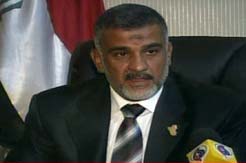
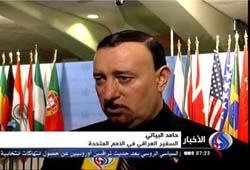
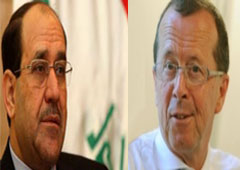
On Wednesday, 21/03/2012 Martin Kobler, the UN Special Representative for Iraq and Head of the United Nation Assistance Mission for Iraq (UNAMI), reported to the meeting of the Foreign Affairs Committee on the work of the UNHCR and UNAMI in Iraq and the current situation of the Iranian Mojahedin-e Khalq (MEK) in Camp Ashraf and Camp Liberty.
As part of his description of the problems of resettlement of the Ashraf residents Kobler said that it demanded a cooperative attitude from the residents.
The infrastructure at Camp Liberty was indeed improved, but the basic services are guaranteed. The capacity of the camp was for use by 4000 – 5000 U.S. soldiers and UN staff. This has been sufficient and would offer ample space.
The medical care at Camp Ashraf, although confined to two doctors and six nurses, but also including use of hospitals outside of Liberty, is guaranteed. The establishment of a clinic inside the camp had, however, until recently been refused by the residents, said Kobler.
In addition, there are ultra-modern kitchen facilities in accordance with U.S. standards, but these were rejected by the occupants.
The U.S. special envoy for Camp Ashraf, Daniel Fried, said that the information that the United States has of the situation in Camp Ashraf and Liberty is consistent with Kobler’s descriptions. The conditions at Camp Liberty are not nearly as bad as described by the MEK.
Kobler appealed to the MEK, to refrain from propaganda and complained that the constant, unnecessary rhetorical attacks by the MEK and its supporters are hindering the UN and the Iraqis in their work.
Fried said the key to success is not discussions about the conditions at Camp Liberty, but the progress of the work of the UNHCR.
In a conversation with Mr Kobler following the meeting, we had the opportunity to inform him of our "Back to the Family" initiative and asked him to work to ensure that in individual discussions with the UNHCR the Ashraf residents are made aware as soon as possible that contact with their family members is available.
News
GOP presidential candidate Mitt Romney’s foreign policy team claimed last month that they’ve been working hard at brining the former Massachusetts governor up to speed on global affairs.
But his ignorance about what has become a lightening rod issue among the foreign policy community raises questions about their work.
As of December, as shown in a YouTube video that has eluded widespread attention, Mitt Romney claimed to not know anything about the Mojahedeen-e Khalq (MEK), a controversial, exiled Iranian group listed by the State Department as a “foreign terrorist organization.” Asked during a campaign appearance about the group, Romney said he’d never heard of the group and asked what they were. Told of the MEK’s status, Romney asked indignantly, “Why would you think that I support a — you said it’s a terrorist group?”
As the questioner informed Romney, one of Romney’s foreign policy advisers — former Ambassador Mitchell Reiss — has been active in the very public, well-financed campaign to get the MEK off the terror list. Romney then replied:
I’ll take a look at the issue. I’m not familiar with that particular group, or that effort on the part of any of my team.
It might seem like a small and obscure issue, but the MEK has attracted much attention, including paid speeches by top American politicians and former officials here and in Europe, and multiple full-page newspaper adverts. Another Romney backer, former U.N. Ambassador John Bolton, has advocated forcefully on behalf of the MEK. More recently, NBC News did a long report on the group’s ties to terror activity in Iran. And the Treasury Department recently announced that it is investigating payments to prominent former American government officials to speak in support of the MEK.
Beyond the public attention, the Romney campaign has been engaged in the MEK issue well before his professed ignorance in December. Romney may not have been aware of it, but Reiss’s advocacy for the MEK was used by neoconservatives in the Romney camp to marginalize Reiss.
In a November GOP debate, Romney spoke of using Iranian “insurgent” groups. (The MEK is by far the best organized militant group opposed to the Islamic Republic.) The remark prompted the conservative Daily Caller website to make a number of inquiries to the campaign that went unanswered, and wrote that the campaign wouldn’t “clarify whether he was referring to the MEK, and what his position is on the organization.”
Now that three months have passed, Romney should make clear his grasp of MEK issues — which involve not only matters of Iran and Iraq policy, but also issues of terrorism — and stake out a position on the group. (HT: Matt Duss)
By Ali Gharib
Iraqi officials say they have unearthed three mass graves inside the Camp New Iraq, which once hosted members of the terrorist Mujahedin-e Khalq Organization (MKO) in eastern Diyala
province.
Odai al-Khadran, mayor of Khalis, a town about 75 kilometers (47 miles) north of the Iraqi capital Baghdad, said on Friday that the grisly find was recently discovered in the notorious camp, Mehr News Agency reported.
Khadran highlighted that the Iraqi government plans to evacuate the third batch of MKO terrorists from Camp New Iraq, formerly known as Camp Ashraf and located about 120 kilometers (74 miles) west of the border with Iran, within the next few days.
On March 9, Iraqi officials transferred the second batch of nearly 400 members of MKO terrorist outfit to Camp Liberty [TTL] – a former US military base near Baghdad International Airport.
On February 18, the initial group of 400 MKO members was moved to Camp Liberty[Temporary Transit Location].
The relocation of the terrorist MKO group is part of an agreement reached between the United Nations and the Iraqi government in December 2011.
The MKO fled to Iraq in 1986, where it enjoyed the support of Iraq’s executed dictator Saddam Hussein, and set up its camp near the Iranian border.
The group is also known to have cooperated with Saddam in suppressing the 1991 uprisings in southern Iraq and the massacre of Iraqi Kurds. The group has carried out numerous acts of violence against Iranian civilians and government officials.
Iran has repeatedly called on the Iraqi government to expel the group, but the US has attempted to block the expulsion by mounting pressure on the Iraqi government.
Uday Khairallah called 1991 uprisings “Iraq’s Arab spring” which were suppressed by Baathist party and Mujahedin-e Khalq terrorist group.
According to a report published by Habilian database on Wednesday, Iraq’s Ambassador to Algeria said that his country is no longer willing to tolerate MKO on its soil, adding that the main reason of that is “their cooperation with Baathist forces to repress 1991 Iraqi Intifada.”
The 1991 revolts in the Kurdish north and the Shia south were a series of anti-Saddam rebellions in southern and northern Iraq crushed by Saddam’s private army (MKO) and Baathist forces.
“International organizations in Iraq have pledged to resolve the crisis,” Khairallah added.
“Since a major part of the land (of Ashraf) belongs to a number of Iraqi people, the government is resolved to completely recapture it.”
The Iraqi Ambassador noted that after US withdrawal, Iraq exerted control over Camp Ashraf and the UN also decided to relocate them with the permission of Iraqi government.
Wednesday, 14 March 2012 Habilian
The People’s Mujahedin of Iran, aka MEK, has long been designated as a terrorist group by the State Department. However, it was removed from the EU’s terrorist list in 2009, and there’s considerable controversy over whether MEK should continue to receive that designation from the United States. Today the group claims to be nonviolent and to represent a "parliament-in-exile" opposed to the current Iranian regime.
Nonetheless, it does in fact remain an officially designated terrorist organization in the United States, and providing material support for a designated terrorist group is illegal. As Glenn Greenwald points out today:
In June, 2010, the U.S. Supreme Court issued its 6-3 ruling in the case of Holder v. Humanitarian Law. In that case, the Court upheld the Obama DOJ’s very broad interpretation of the statute that criminalizes the providing of “material support” to groups formally designated by the State Department as Terrorist organizations. The five-judge conservative bloc (along with Justice Stevens) held that pure political speech could be permissibly criminalized as “material support for Terrorism” consistent with the First Amendment if the “advocacy [is] performed in coordination with, or at the direction of, a foreign terrorist organization” (emphasis added). In other words, pure political advocacy in support of a designated Terrorist group could be prosecuted as a felony—punishable with 15 years in prison—if the advocacy is coordinated with that group.
You may think this was a bad ruling. But a ruling it is, and it’s the law of the land. And yet, a large cast of worthies, including Rudy Giuliani, Howard Dean, Michael Mukasey, Ed Rendell, Andy Card, Lee Hamilton, Tom Ridge, Bill Richardson, Wesley Clark, Michael Hayden, John Bolton, Louis Freeh, and Fran Townsend have actively lobbied for MEK and have apparently done it in coordination with MEK’s leadership.
So shouldn’t this be against the law? Glenn, in particular, calls out Townsend, former Homeland Security Advisor under George Bush, who was a vocal supporter of the Humanitarian Law ruling. She actively supports MEK, yet appears to be under no threat of prosecution from the Obama Justice Department. Glenn again:
An NBC News report from Richard Engel and Robert Windrem in February claimed that it was MEK which perpetrated the string of assassinations of Iranian nuclear scientists, and that the Terrorist group “is financed, trained and armed by Israel’s secret service” (MEK denied the report).
….Even the dissenters in Humanitarian Law argued that the First Amendment would allow “material support” prosecution “when the defendant knows or intends that those activities will assist the organization’s unlawful terrorist actions.” A reasonable argument could certainly be advanced that, in light of these recent reports about MEK’s Terrorism, one who takes money from the group and then advocates for its removal from the Terrorist list “knows or intends that those activities will assist the organization’s unlawful terrorist actions”: a prosecutable offense even under the dissent’s far more limited view of the statute.
Discuss! Is support for MEK allowed because (a) their patrons are VIPs, not random Muslim schmoes, (b) MEK’s allegedly lethal activities are aimed at Iran, which everyone thinks is wink-wink-nudge-nudge just fine, or (c) because there’s some legitimate legal issue that distinguishes what Townsend and Rendell are doing from other cases of material support that have been prosecuted in recent years? I’d be genuinely curious to hear the other side of this argument.
By Kevin Drum , Mother Jones
A nationwide campaign has started in Iraq to collect one million signatures from Iraqi nationals to call for the trial of the members of the anti-Iran terrorist Mojahedin-e Khalq Organization (MKO, also known as the MEK and PMOI) and accelerate their expulsion from Iraq. 
According to a report published by the Habilian Association, a human rights group formed of the families of 17,000 Iranian terror victims, the Association of Justice to Defend Iraqi Victims of MKO declared that the first stage of the signature gathering campaign in Diyala province has finished with a total of 40000 signatures.
Secretary-General of the Association of Justice Dr. Nafie Isa told Habilian that the result of the process in other provinces will be announced and made public in the coming days.
Owing to the people’s significant participation, the executive committees of the campaign in other provinces have announced the need for more signature forms.
Hitherto, many university professors and school teachers, young people, university students, tribal elders, politicians, artists, women, and civil society activists in Diyala province have signed the campaign.
The MKO has been in Iraq’s Diyala province since the 1980s.
The MKO is blacklisted by much of the international community, including the United States.
Before an overture by the EU, the MKO was on the European Union’s list of terrorist organizations subject to an EU-wide assets freeze. Yet Maryam Rajavi, who has residency in France, regularly visited Brussels and despite the ban enjoyed full freedom in Europe.
The MKO is behind a slew of assassinations and bombings inside Iran, a number of EU parliamentarians said in a recent letter in which they slammed a British court decision to remove the MKO from the British terror list. The EU officials also added that the group has no public support within Iran because of their role in helping Saddam Hussein in the Iraqi imposed war on Iran (1980-1988).
Many of the MKO members abandoned the terrorist organization while most of those still remaining in the camp are said to be willing to quit but are under pressure and torture not to do so.
A May 2005 Human Rights Watch report accused the MKO of running prison camps in Iraq and committing human rights violations.
According to the Human Rights Watch report, the outlawed group puts defectors under torture and jail terms.
The group started assassination of the citizens and officials after the revolution in a bid to take control of the newly established Islamic Republic. It killed several of Iran’s new leaders in the early years after the revolution, including the then President, Mohammad Ali Rajayee, Prime Minister, Mohammad Javad Bahonar and the Judiciary Chief, Mohammad Hossein Beheshti who were killed in bomb attacks by MKO members in 1981.
The group fled to Iraq in 1986, where it was protected by Saddam Hussein and where it helped the Iraqi dictator suppress Shiite and Kurd uprisings in the country.
The terrorist group joined Saddam’s army during the Iraqi imposed war on Iran (1980-1988) and helped Saddam and killed thousands of Iranian civilians and soldiers during the US-backed Iraqi imposed war on Iran.
Since the 2003 US invasion of Iraq, the group, which now adheres to a pro-free-market philosophy, has been strongly backed by neo-conservatives in the United States, who also argue for the MKO to be taken off the US terror list.
Death of MKO members grants the group an opportunity to make further excuses
According to released news by MKO’s media, a member of the group, Nour Mohammad
Biranvand, died of hepatic failure in the New Iraq Camp (Camp Ashraf). Confirming the report, an Iraqi Security source told AlIraqinews (AIN) that “The element died for heart failure.” The group claims that he was long suffering the disease and inaccessibility to specialist hospital and doctors was the cause of his death.
The death of any resident within Ashraf or TTL before anything is the result of the group’s procrastination to relocate and it grants the terrorist group an opportunity to make further excuses and to condemn the Iraqi Government. Besides putting the blame of any death on the Iraqi Government at the present, any death means a gained victory for MKO rather than a human soul perished long away from his/her family.
The Iraqi Government has never denied the residents access to medical services in Iraq. However, as a closed cult, MKO insists to send accompanying observers along with any patients that is to be taken out of the camp to any medical center, an outright violation of a country’s codes. A cult is never expected to care the least for its entrapped members as it is the case with MKO. The responsibility is on the Iraqi Government to expedite the members’ relocation to TTL, where they will get a step nearer to the free world.
On last Thursday, Diyala Operations Command announced the transferring of the second group of the MKO elements which involved 400 elements to TTL. Although MKO played for the time, at last it had to submit to move the second group. It is not clear how long the group intends to prolong its stay in Ashraf, but one thing is crystal clear; there remain less than two months to hit the deadline for complete closure of Ashraf and its departure from Iraq.
Iraqi Vice President Khudayr al-Khuzaie has reiterated the resolve of Baghdad in its decision to expel the Mujahedin-e Khalq Organization (MKO) terrorist group, describing its members as
‘persona non grata’.
We insist on the expulsion of the terrorist group from Iraq, al-Khuzaie said, adding that the MKO members are not considered guests, but “persona non-grata”.
The Iranian terrorists, who fled to Iraq in the mid-1980s after conducting many terrorist operations against the country’s officials as well as ordinary citizens, also committed numerous crimes against the Iraqi people and helped executed Iraqi dictator Saddam Hussein to suppress several uprisings in the country.
Al-Khuzaie also referred to the cooperation between Iraq and the United Nations with respect to the MKO’s expulsion from Iraq, adding that Iran has expressed its willingness to receive those members of the terrorist group that are willing to abandon terrorist activities and return to Iran.
Earlier in September, the Iraqi government and the United Nations reached a deal, under which they agreed to relocate 3,400 MKO members living in Camp Ashraf, near Baghdad, until their refugee status is determined.
Nearly 750 members of the MKO expressed preference to return to Iran. The Islamic Republic had announced that it would pardon all the residents of Camp Ashraf except less than 100 individuals that have criminal records in the country.
The MKO is listed as a terrorist organization by much of the international community and is responsible for numerous acts of terror and violence against Iranian civilians and government officials.
Iran has repeatedly called on the Iraqi government to expel the group, but the US has blocked the expulsion by mounting pressure on the Iraqi government.
The residents of Diyala province in Iraq condemned the crimes committed by the anti-Iran
terrorist Mojahedin-e Khalq Organization (MKO, also known as the MEK and PMOI) against the Iranian and Iraqi nations, and underlined the necessity for the rapid expulsion of the terrorist group from Iraq.
Several people from Diyala province have sent an email to Habilian declaring their displeasure over the MKO terrorist group’s presence on their territory.
According to a report published by the Habilian Association, a human rights group formed of the families of 17,000 Iranian terror victims, the email contains images of large signboards installed along the roads of Diyala province opposing the presence of Mujahedin-e Khalq terrorist group inside their country.
The message reads, "On behalf of the residents of Diyala, we confirm Iraqi government’s decision to expel Monafeqin-e Khalq (as they are called in Iraq). We urge the government to clean our holy land from their presence.
A group of professors, scholars and tribal sheikhs and the residents of Baqubah, Iraq."
The MKO, whose main stronghold is in Iraq, is blacklisted by much of the international community, including the United States.
Before an overture by the EU, the MKO was on the European Union’s list of terrorist organizations subject to an EU-wide assets freeze. Yet Maryam Rajavi, who has residency in France, regularly visited Brussels and despite the ban enjoyed full freedom in Europe.
The MKO is behind a slew of assassinations and bombings inside Iran, a number of EU parliamentarians said in a recent letter in which they slammed a British court decision to remove the MKO from the British terror list. The EU officials also added that the group has no public support within Iran because of their role in helping Saddam Hussein in the Iraqi imposed war on Iran (1980-1988).
Many of the MKO members abandoned the terrorist organization while most of those still remaining in the camp are said to be willing to quit but are under pressure and torture not to do so.
A May 2005 Human Rights Watch report accused the MKO of running prison camps in Iraq and committing human rights violations.
According to the Human Rights Watch report, the outlawed group puts defectors under torture and jail terms.
The group started assassination of the citizens and officials after the revolution in a bid to take control of the newly established Islamic Republic. It killed several of Iran’s new leaders in the early years after the revolution, including the then President, Mohammad Ali Rajayee, Prime Minister, Mohammad Javad Bahonar and the Judiciary Chief, Mohammad Hossein Beheshti who were killed in bomb attacks by MKO members in 1981.
The group fled to Iraq in 1986, where it was protected by Saddam Hussein and where it helped the Iraqi dictator suppress Shiite and Kurd uprisings in the country.
The terrorist group joined Saddam’s army during the Iraqi imposed war on Iran (1980-1988) and helped Saddam and killed thousands of Iranian civilians and soldiers during the US-backed Iraqi imposed war on Iran.
Since the 2003 US invasion of Iraq, the group, which now adheres to a pro-free-market philosophy, has been strongly backed by neo-conservatives in the United States, who also argue for the MKO to be taken off the US terror list.
The MKO has been in Iraq’s Diyala province since the 1980s.
Iraqi security forces took control of the training base of the MKO at Camp Ashraf – about 60km (37 miles) North of Baghdad – in 2009 and detained dozens of the members of the terrorist group.
The Iraqi authority also changed the name of the military center from Camp Ashraf to the Camp of New Iraq.
When former Gov. Bill Richardson left office he told New Mexicans he was looking forward to
visiting baseball parks across the United States.
Instead, the former pitcher has been traveling around the world earning speaking fees.
Eyewitness News has learned some of Richardson’s fees were paid by an Iranian dissident group listed on the U.S. State Department’s list of known terrorist groups.

In addition to paying the former governor, the Mojahedin-e Khalq, also named MEK, has been spending millions to have Richardson and other diplomats, politicians and even former U.S. military generals use their influence to help them get de-listed.
In December 2011, Richardson, the former U.N. Ambassador, told the National Resistance Council in Paris, France that there is increasing international and bipartisan support for the group.
KOB found the video from Richardson’s speech in Paris on YouTube.
At least 33 high-ranking former U.S. officials have given speeches to MEK-friendly audiences since December of last year as part of more than 22 events in Washington, Brussels, London, Paris and Berlin.
While not every speaker accepted payment, MEK-affiliated groups have spent millions of dollars on speaking fees, according to interviews with the former officials, organizers.
Richardon is represented by the Washington Speakers’ Bureau and reportedly earns between $25,000 and $50,000 a speech.
Following the U.S. invasion of Iraq in 2003, the MEK agreed to give up its weapons arsenal in exchange for protection from the U.S. military.
But following a review in 2007, the U.S. State Department maintained the organization’s classification as a Foreign Terrorist Organization when it ruled the group still possessed the "capacity and will" to commit terrorist acts.
Exiled in Iraq, members of the MEK are suspected of assassinating nuclear scientists working for Iran’s nuclear development program.
Earlier this month, Secretary of State Hillary Clinton indicated she has not made a decision to de-list MEK.
She said they must voluntarily relocate from their current camp to another location inside of Iraq first.
By: Peter St. Cyr, KOB Eyewitness News 4