Nejat Society
  • Home
  • Articles
  • Media
    • Cartoons
    • NewsPics
    • Photo Gallery
    • Videos
  • Publications
    • Books
    • Nejat NewsLetter
    • Pars Brief
  • About Us
  • Contact us
  • Editions
    • عربي
    • فارسی
    • Shqip
Nejat Society
Nejat Society
  • Home
  • Articles
  • Media
    • Cartoons
    • NewsPics
    • Photo Gallery
    • Videos
  • Publications
    • Books
    • Nejat NewsLetter
    • Pars Brief
  • About Us
  • Contact us
  • Editions
    • عربي
    • فارسی
    • Shqip
© 2003 - 2024 NEJAT Society. nejatngo.org
blank
Mujahedin Khalq; A proxy force

Speaking at MEK Cult-held conference!

Stephen Harper speaks at conference held at ‘cult’ Iranian dissident group’s Albanian compound

For a second straight year, former prime minister Stephen Harper spoke at a conference organized by the MEK, a controversial Iranian dissident group that his government once labelled a terrorist organization and has been described as a cult.

Stephen Harper

Harper, who has been a vocal critic of the Iranian regime during and after his time as prime minister, gave a speech at the Free Iran conference on July 13. This year’s gathering was held at the MEK’s newly-built headquarters located in rural Albania.
“I am delighted to be here, because there are a few causes in this world today more important, at this moment, than what you are pursuing: the right of the people of Iran to change their government and their right to do it through freedom and the power of the ballot box,” he said, to applause from the audience.
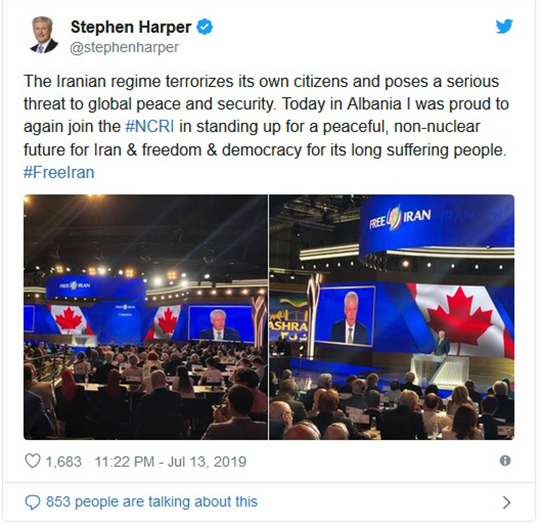
The conference was organized by the Paris-based National Council of Resistance of Iran (NCRI), a group founded by the MEK, which aims to topple the current theocratic regime in power since the Iranian revolution. The council calls itself “an inclusive and pluralistic parliament-in-exile.”
According to the Guardian, the MEK’s new headquarters is located in a rural fenced-off hillside compound outside Albania’s capital of Tirana. It’s where more than 2,000 of its members live.
The well-funded and well-organized MEK, also known as the People’s Mojahedin Organization of Iran, has received the backing of numerous high-profile politicians in the West.
For example, U.S. President Donald Trump’s personal attorney, Rudy Giuliani, spoke at the conference and called for the overthrow of the clerical regime. Former Democratic senator Joe Lieberman and British Tory MP Matthew Offord also participated.
Members of Trump’s inner circle, including his national security adviser John Bolton, have also spoken in favour of the group and its mission.
Harper’s former foreign affairs minister John Baird was also a speaker at the event. Former B.C. Conservative MP Paul Forseth also spoke.
Conservative figures calling for a regime change have increasingly offered support in recent years, but Liberals, such as Irwin Cotler, David Kilgour and Judy Sgro, have also publicly supported MEK.

While the 50-year history of the organization is long and complicated, the MEK has been criticized more recently as a cult.

According to a 2009 RAND Corporation analysis, the MEK turned toward cultlike practices after its leadership relocated to Paris in the mid 1980s. It included engaging in “near-religious devotion” to the married Massoud and Maryam Rajavi.

Its members were said to engage in “public self-deprecation sessions, mandatory divorce, celibacy, enforced separation from family and friends, and gender segregation” — allegations reinforced by independent reporting over the years.

Massoud disappeared during the 2003 U.S. invasion of Iraq, where the MEK was based for years with the support of Saddam Hussein, but Maryam Rajavi has continued to represent the MEK.
Rajavi is now the “president-elect” of the NCRI. According to the council’s website, she will hold the position for “the provisional period for transfer of power to the people.”
In his speech, Harper endorses Rajavi’s 10-point plan for a post-clerical Iran, calling it “the future the world wants.”
The plan includes universal suffrage, political freedom, ending the death penalty, secular governance, equality, an independent judiciary, upholding human rights, installing a capitalist economy, promoting regional peace and establishing a non-nuclear Iran.
Thomas Juneau, a Middle East expert at the University of Ottawa, said while the group bills itself as a “viable democratic opposition to the Islamic Republic,” that’s far from the truth.

“It is a violent, thuggish, corrupt cult,” he said. “It’s also a movement that has absolutely no support inside Iran.”

“For Canadian politicians, serving or retired, to endorse the MEK and by attending the event … that should not be acceptable.”
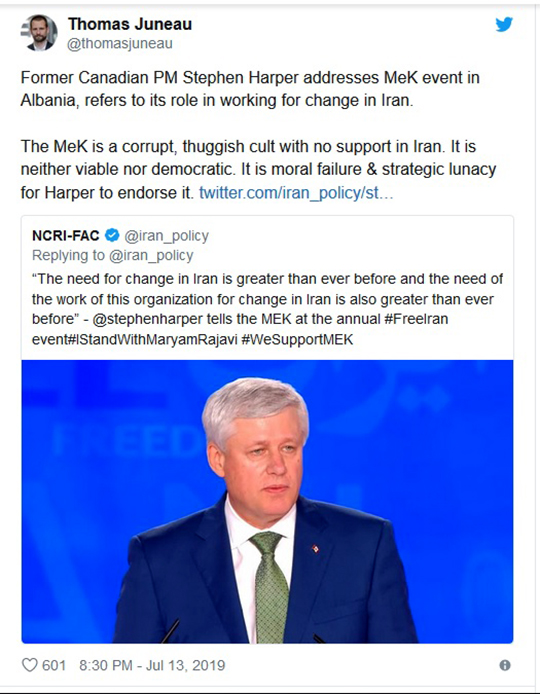
Juneau, who took to Twitter over the weekend to criticize Harper, said supporting an “undemocratic” leader like Rajavi does a “disservice” to the actual cause of democracy in Iran.
Harper was criticized last year for speaking at an MEK-sponsored conference in Paris.
Juneau also noted independent reporting has shown the MEK runs a “slick propaganda machine” and handsomely pays speakers to support their cause.

The Guardian recently spoke to men in Tirana who had fled the MEK compound over the last two years, where they said life inside the camp was of a “cultlike atmosphere” in which mobile phones and contact with relatives, and between men and women, were prohibited.
Members were also required to spend days sitting at computers flooding the internet with messages in support of the MEK.
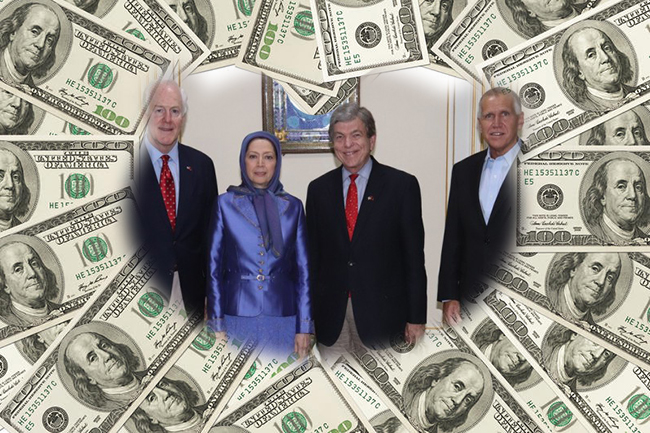
Iran’s Mohajedeen e Khalq: MEK Money Sure Can’t Buy Love But it can buy a lot of politicians

Questions from iPolitics sent to Harper’s office on Monday via his website, including whether he was paid by the MEK to speak at the event, were not met with a response.
Until 2012, the U.S. and Canada designated the MEK as a terrorist entity. The group was once an armed faction, carrying out assassinations of Iran regime figures, but now supports propping up a secular government via non-violent means.
For much of his speech, Harper called for countries to take a harder line on the ayatollah’s regime.
“The right policy, the only realistic policy is to impose sanctions, boycott, designate institutions as terrorist organizations and do what my government did in Canada: close down the regime’s embassies around the world,” he said.
“Weakness and appeasement will not avoid a military confrontation with this regime.”

Juneau said he believes political figures such as Harper know of MEK’s reputation but want to be seen as taking a hard line on the Iran regime through a controversial, but well-organized group.

“It’s opportunism in the most cynical way possible.”
ipolitics.ca
July 20, 2019 0 comments
FacebookTwitterPinterestWhatsappTelegramSkypeEmail
blank
Mujahedin Khalq; A proxy force

How Iranian MEK went from US terror list to halls of Congress

Described by critics as ‘a cult’, Iranian opposition group is now lauded by top US officials as alternative to Iran’s government
As soon as Maryam Rajavi, her face beaming across a giant screen, finished speaking, the sky above hundreds of her supporters in the United States filled with red, white and green confetti – the colours of the Iranian flag.
Dressed in a glossy, dark blue suit and matching scarf tied loosely around her neck – a modest way to wear the hijab that went out of style decades ago in the Middle East – Rajavi had just accused the Iranian government of”terrorism and belligerence”.
“Iran Maryam, Maryam Iran,”the protesters chanted back, holding up posters of Rajavi in a show of admiration bordering on religious devotion to the leader of the Iranian Mujahideen-e Khalq, commonly referred to as MEK or PMOI.
Dressed in yellow, the MEK supporters were lively but disciplined, standing in military formations as they stared up at the screen outside the US State Department building in Washington.
They waved pre-Islamic Revolution Iranian flags, which feature a golden lion bandishing a sword instead of the name of God in Arabic script that adorns the country’s emblem today.

Critics have described the Iranian opposition group as a”totalitarian cult”, voicing concerns about its growing clout in the halls of power in the US capital. Only seven short years ago, the US State Department listed the MEK as a terrorist organisation – and the group’s sordid reputation is something Rajavi and her followers are acutely aware of.

At the 21 June demonstration, Rajavi even acknowledged it, accusing the MEK’s detractors of siding with the Iranian government and carrying out a”disgraceful demonisation campaign”against the group. That effort, she said in Farsi in the video, which was accompanied by English subtitles,”seeks to perpetuate the narrative that the people of Iran are better off with the theocratic rule of the mullahs”.
In her brief speech via video feed, Rajavi also thanked her”friends”in the US. Today, they include representatives, senators, ex-generals, former ambassadors and current policymakers of all political stripes.
In fact, two of Donald Trump’s right-hand men have been on the MEK’s payroll: National Security Adviser John Bolton and the president’s personal lawyer, Rudy Giuliani, have both charged hefty fees to speak at MEK rallies in the past few years.

For their part, the MEK protesters, standing in front of the same building that labelled their organisation a terrorist group in 1997, were making demands of the US government:”US, US, take action; mullahs must get more sanctions,”they shouted.”#Free Iran”was spelled out in golden balloons in the crowd.

Beyond Giuliani and Bolton, lawmakers from both major American political parties have lauded the MEK as a pro-democracy movement despite its checkered past.
“It’s just ridiculous that they’ve been able to get the influence that they have had in the US,” said Barbara Slavin, director of the Future of Iran Initiative at the Atlantic Council, a Washington-based think-tank.

“I think that’s primarily due to the money … that they pay lobbyists to press their case,”she told MEE.”They’ve had some very influential people like John Bolton and Rudy Giuliani who have taken their side.”

Giuliani showed up at an MEK podium again this month, headlining a conference in Albania, where the dissidents are now based. The former New York City mayor described the group as a”government-in-exile”, saying it is a ready-to-go alternative to lead the country if the Iranian government falls.
“We don’t have to say, ‘What could be worse?’ We know that there is something much better,”said Giuliani, who has publicly entertained and backed the prospect of regime change in Tehran.
He went on to joke that Rajavi has more support than he does in the US Congress – and judging by the group’s influence among powerbrokers in Washington, he may be right.

Bipartisan support
Over the years, Senior House Democrats Eliot Engel and Brad Sherman, Republican Congressman Tom McClintock, GOP Senator John Cornyn, Senate Democrats Gary Peters and Jeanne Shaheen, and late Senator John McCain have all attended events linked to the MEK and spoken in its favour.
At the rally in Washington last month, both Democratic and Republican politicians praised the group’s struggle against the Iranian government. Since being removed from Washington’s list of foreign terrorist organisations in 2012, the MEK has taken advantage of its ability to operate legally in the country – and a growing hostility towards Iran – to court policymakers.
“Bashing Iran is good politics in certain circles… If there is a possible financial incentive as well, it becomes easy for a lot of lawmakers to sign up,”said Ryan Costello, policy director at the National Iranian American Council (NIAC), a Washington-based advocacy group.
Last month, key legislators and former officials delivered messages of support at the MEK gathering in Washington, including Senator Bob Menendez, the top Democrat on the Committee on Foreign Relations.
“Thank you for continuing to highlight the plight of Iranians under an oppressive, brutal regime,”Menendez said in a written statement that was read out during the demonstration.”I share your vision for a better future for Iran and all Iranians.”
The rally came less than 24 hours after Trump ordered, then cancelled, military strikes against Iran amid escalating tensions between the two countries. The New York Times reported at the time that Bolton was one of the top White House officials encouraging military action.
Bolton, a regular speaker at MEK gatherings, shares the group’s view that the Iranian regime cannot be reformed and instead must be toppled. At a MEK conference in Paris in 2017, a few months before he joined the Trump administration, Bolton told the crowd they would be celebrating the fall of the Iranian government before 2019.
“I have said for over 10 years since coming to these events that the declared policy of the United States of America should be the overthrow of the mullahs’ regime in Tehran,”he said at the time.

Several speakers at last month’s rally also stressed that the MEK is the right replacement for the government in Tehran.”We need a new regime, and that regime is you, the MEK,”Bill Richardson, a former governor of New Mexico and US ambassador to the UN from 1997 to 1998, told the crowd.
The Organization of Iranian American Communities (OIAC), a US-based, MEK-linked advocacy group, did not return MEE’s multiple requests for an interview about its lobbying efforts in the US.

Asked if the MEK has enough legitimacy to be an alternative to the Iranian government, as some of the group’s backers have said, Slavin told MEE:”No, not at all.”

But she added that not all the lawmakers who speak at MEK events are necessarily aware of the group’s history or supportive of the organisation itself. “They figure out, this group is opposed to the Iranian regime,”Slavin said. “They don’t look at the fine print; they don’t examine the history of the group.”

MEK history
The MEK started in Iran in 1965 as an ideologically driven, socialist and Islamist movement opposed to the dictatorial rule of Shah Mohammad Reza Pahlavi. It joined the ranks of the Islamic Revolution in 1979 but ran afoul of the uprising’s leader Ruhollah Khomeini shortly after Pahlavi’s fall.
After facing a deadly crackdown by Iran’s new authorities, the MEK embarked on a series of attacks on government officials and security forces. The group’s members, led by Maryam Rajavi’s husband, Massoud Rajavi, went into exile and eventually settled in Iraq in 1986. There, they sided with Saddam Hussein in his war against their home country.
The Iran-Iraq war raged from 1980 to 1988, as hundreds of thousands of people were killed and Iraqi forces openly used chemical weapons in battle. In a late stage of the war, MEK militants were at the forefront, leading a major incursion into Iranian territory, which was repelled by the country’s military in 1988.
After the war, the MEK remained in Iraq, and according to some of its critics, including NIAC, the group helped Iraqi forces brutally put down Kurdish and Shia uprisings in the early 1990s – accusations that the MEK rejects.

‘They don’t have a following in Iran; in fact, they are widely detested for siding with the regime of Saddam Hussein during the Iran-Iraq war’
– Barbara Slavin, Atlantic Council

During the 2003 US-led invasion of Iraq that toppled Hussein, American forces bombed MEK bases in the country before reaching a ceasefire agreement with the group. Massoud Rajavi disappeared that year, and his whereabouts remain unknown, putting Maryam alone in charge of the organisation.
Starting in 2009, the Iraqi government became more openly hostile to the MEK amid growing Iranian influence in Baghdad. As a result, the US led efforts to get the group’s members out of Iraq and shutter their main base at Camp Ashraf outside the capital, where the group’s members were confined after the invasion.
Once out of Iraq, the MEK began to resettle in Albania in 2013. A year earlier, former US Secretary of State Hillary Clinton removed the group from the State Department’s terrorist blacklist – 15 years after it was originally added – allowing its members to work openly in the US.
During the debate about legalising the MEK in the US, New York Magazine contributor Elizabeth Rubin presciently warned that the group may use its new status to get Washington into war with Tehran.

“If the group is taken off the terrorist list, it will be able to freely lobby the American government under the guise of an Iranian democracy movement,”she wrote in 2011, comparing it to the influence Iraqi exiles exerted on the US decision to invade Iraq.

“Recent history has shown that the United States often ends up misguidedly supporting not only the wrong exile groups in the Middle East, but the least relevant ones.”

Blacklisting and popularity
But not everyone views the MEK in a negative light, as anti-Iran hawks have questioned why the group ended up on the US’s terrorist blacklist in the first place.
Raymond Tanter, a political science professor who served on the White House’s National Security Council in the early 1980s, said he studied the history of the group and is convinced it is on the”right side of justice”.
In a recent interview with MEE, Tanter said former President Bill Clinton placed the Iranian dissidents on the list of foreign terrorist organisations in 1997 to appease Tehran.”They were there because the Clinton administration wanted to do a favour for some of the so-called ‘moderates’ who had been elected in Iran,”he said.
“[Supreme leader Ali] Khamenei was making sounds as [if] he was willing to negotiate, but those sounds became very, very hollow and nothing came of that.”Tanter said he avoids using the term MEK because of its affiliation with the State Department’s blacklist, preferring to go with PMOI, which stands for the People’s Mujahideen of Iran.
Rudy Giuliani

Rudy Giuliani called the MEK a ‘government-in-exile’ on 13 July at an event in Albania

Tanter told MEE that bipartisan support for the group stems mostly from the organising efforts of the OIAC advocacy group. He said the OIAC is composed of Iranian Americans from across the US, including many white-collar professionals.
Still, support in the halls of Congress does not necessarily translate into tangible influence on the ground. MEK’s critics say the group has no representation inside Iran itself, where the people loathe the movement because of its militant history.

“They don’t have a following in Iran; in fact, they are widely detested for siding with the regime of Saddam Hussein during the Iran-Iraq war,”Slavin said.”They have no constituency in the country.”

‘Attention paid is an indicator of the significance of the PMOI and the larger NCRI have in Iran’
– Raymond Tanter, political science professor
With a lack of independent reporting in Iran and the underground nature of MEK activities there, it is difficult to ascertain what level of support the group has among Iranians.
Tanter, however, said the MEK’s popularity can be measured by the Iranian government’s stated concern about it. Citing recent research by his students at Georgetown University, Tanter said the Iranian government incessantly mentions the MEK.”Attention paid is an indicator of the significance of the PMOI and the larger NCRI have in Iran,”he said.
Slavin dismissed that argument, however, saying the Iranian government shows concern about the MEK because it views the group as a proxy for Saudi Arabia and Israel. “The MEK has committed acts of terrorism in Iran; let’s be real about this,” Slavin told MEE.

Militant past
Seven years ago, NBC News cited two US officials as saying that Israeli-trained MEK operatives were behind the assassination of five Iranian nuclear scientists between 2007 and 2012. The group denied the report at the time, calling it a”sheer lie”.
Still, the MEK has been accused of being responsible for a string of attacks throughout its history.
In 2006, a US State Department report said the MEK carried out a series of deadly attacks in Iran, blaming the movement for a 1981 bombing in Tehran that claimed the lives of dozens of top Iranian officials, including Chief Justice Mohammad Beheshti. The group also openly conducted violent raids on Iranian embassies across the world in 1992.
Moreover, in the pre-revolution era in Iran, the MEK was behind”bombings and shootings directed against American military personnel stationed in Iran”, former US State Department official Daniel Benjamin wrote in a Politico column in 2016.
But that militant past is behind the MEK now, said Kazem Kazerounian, an engineering professor at the University of Connecticut who spoke at the pro-MEK rally in Washington in June. Kazerounian called the movement an”organised, legitimate resistance to the tyranny of the Iranian regime”.
“Currently, they’re not violent; they’re not a military organisation,”he told MEE. Kazerounian said members of the group are the”key organisers”of peaceful protests inside Iran, and added that the MEK’s ongoing struggle against the Iranian government gives it credibility.
“In the lack of possibility of having a democratic election – which actually we would like to get as soon as this regime falls – resistance is the basis of legitimacy of the [MEK-dominated] National Council of Resistance of Iran,”Kazerounian said.
Yet for a group that advocates gender equality and says it is the main pro-democracy Iranian faction, the MEK does little to hide its ties to the ultraconservative, autocratic government of Saudi Arabia.
MEK rallies often feature pro-Saudi speakers and sometimes even Saudi officials. For instance, Turki al-Faisal, a Saudi prince, former intelligence chief and key diplomat, addressed MEK rallies in Paris in 2016 and 2017, prompting accusations from Tehran that Riyadh supports terrorism.
Salman al-Ansari, president of the Saudi American Public Relations Affairs Committee, a pro-Riyadh lobby group in Washington, also spoke at the MEK conference in Albania on 13 July. He was repeatedly interrupted by cheers from MEK supporters as he bashed Iran in both Arabic and Farsi.
“I tell you clearly, as a Saudi citizen who loves and adores his country and an Arab proud of his Arabism and a Muslim honoured by his religion… we are all Ashrafi,”he said, paying tribute to the MEK’s base in Albania, known as Camp Ashraf-3.

Cult of Rajavi
The Saudis are not the only foreign officials to attend MEK events.
Former Canadian Prime Minister Stephen Harper spoke at the group’s conference this month in Albania, where he was joined by dozens of legislators and ex-ministers from around the world, including former US Senator and Democratic vice-presidential candidate Joe Lieberman and parliament members from across the Middle East.
Most of the speakers denounced Iran and sang the praises of Maryam Rajavi and the MEK.
But Rajavi was not always so revered in Western capitals. In 2003, she was briefly detained in Paris along with dozens of MEK members on terrorism charges. A decade later, she released a 10-point plan for the MEK in which she pledged support for free elections, gender equality, abolishing the death penalty and ending Iran’s nuclear programme.
Still, one provision of the manifesto seemed to address lingering concerns among the MEK’s Western backers about the group’s communist ideology – vowing to respect private property and a free-market economy.

The 2006 State department report says the MEK mixes”Marxism, feminism, nationalism and Islam”.

Indeed, the group’s original logo showcases communist symbols, including a sickle and red star, below a verse from the Quran that praises those who struggle – the mujahideen.
The group’s leftist beliefs may appear to make it a strange bedfellow of right-wing hawks such as Bolton and Harper. But Tanter, the political science professor, said he has spoken to many MEK members and found them to be to the”right of”US Senator Bernie Sanders, who describes himself as a Democratic socialist.
Ideology aside, rights groups have decried the MEK’s treatment of its own members. The movement requires complete devotion to the Rajavis and the organisation, and a 2005 Human Rights Watch report accused the group of asking its followers to divorce their spouses to be fully dedicated to the MEK.

HRW also said the group has committed violations“ranging from detention and persecution of ordinary members wishing to leave the organisation, to lengthy solitary confinements, severe beatings, and torture of dissident members”.

In 2009, Rand Corporation, a California-based think-tank, said the MEK started demanding “near-religious devotion to the Rajavis”from its members in the 1980s. In addition, the MEK forced its followers to remain celibate and cut ties to friends and relatives, the Rand report said.

And to make up for a drop in popularity tied to its alliance with Iraq’s Hussein, the group started recruiting Iranian economic migrants in the Middle East under false pretences – promising jobs and visas to Western countries, the report found.

Despite these reports about its activities, the MEK remains shrouded in secrecy – and its complex ideological foundation is hard to fully understand, Slavin said.
Put simply, she said:”It’s a cult.”
By Ali Harb, Middleeasteye.net

Ali Harb is a writer based in Washington, DC. He reports on US foreign policy, Arab-American issues, civil rights and politics.

July 18, 2019 0 comments
FacebookTwitterPinterestWhatsappTelegramSkypeEmail
MEK rally with rented audiences
Mujahedin Khalq; A proxy force

Avoided by most Iranians, the MEK is not an alternative to the Iran Gov.

US State Department: The MEK cannot stand for leadership in the Islamic Republic

Mojahedin-e Khalq (MEK): there is more behind the demand for respect for human rights in Iran

In Ashraf-3 – this is the name of the new Iranian Resistance Headquarters in Albania – Rudy Giuliani, Councilor for Information Security of the White House, has supported the MEK as a “valid alternative to the regime of terror which has oppressed the”Iran”and called Maryam Tajavi”the only true representative of the Iranian people”.
About 50 kilometers from Tirana, Ashraf-3 resembles a heavily guarded small town, with parks, conference rooms, restaurants and swimming pools. It is”the new epicenter of the Iranian resistance, which shows its power as the world loses patience with Iran”, comments Ali Safavi, a member of the National Council of Resistance of Iran (NCRI). The conference, entitled”120 years of struggle of the Iranian people for freedom”, held on 12 and 13 July, was attended by thousands of MEK members and around 300 politicians from all over the world. Among others, Ingrid Betancourt, former Colombian senator and presidential candidate, Michèle Alliot-Marie, a former French minister, defined by Forbes in 2006 as the 57th most powerful woman in the world, Joe Lieberman, a former US senator and first American Jewish candidate Vice President, former Clinton energy secretary, Bill Richardson, Matthew Offord, Conservative Member of the Parliament of the United Kingdom, Sid Ahmed Ghozali, former Algerian Prime Minister, former French Foreign Minister Bernard Kouchner, former Prime Minister Canadian Stephen Harper. Italy was represented by Roberto Rampi, senator of the Democratic Party, Giuseppina Occhionero, elected deputy in the ranks of LEU, Antonio Tasso, M5S deputy. Explicit objective of the assembly: to ask the international community to put an end to the pacification policy with Iran.

The Mojahedin-e Khalq (MEK) in fact claim to have the support of the majority of Iranians but this time it is the American Herald Tribune that denies the organization. According to a poll commissioned in 2018 by the Public Affairs Alliance of Iranian Americans (PAIA) only 6% of Iranians residing in the United States support the MEK as a legitimate alternative to the current government in Iran. The figure reflects the analysis of the previous year, which reports a weak 7% on sympathies for Maryam Rajavi, leader of the MEK.

As previously written , the Mujaheddin e-Khalq were born in 1963, in Iran, with the aim of opposing Western influence in the country and as bitter opponents of the Shah regime. In 1979 the Mek participated in the[Ayatollah] Khomeini-led revolution, but the ideology that characterized it at the time was a singular cross between Marxism, feminism and Islam. As such it is completely incompatible with that of the Shia ayatollahs. Thus the Mek was forced to disperse, while its headquarters moved to Paris in 1981. In this time the MEK”changed skin”, as well as ideologues and financiers and, five years later, reappeared in Iraq, precisely in Camp Ashraf, north of Baghdad. There he distinguished himself as an autonomous armed formation – a few thousand well-trained fighters, with families in tow – who supported Saddam Hussein against Iran and actively appeared in numerous episodes of the repression of Iraqi Kurds. The MEK strangely survived the fall of Saddam Hussein and, in 2003, was transferred, by the American winners, literally”arms and baggage”, to another large military camp that will take, not surprisingly, the name of Camp Liberty. From that outpost, numerous terrorist attacks and diversion and boycott actions against Iran are raging. Formally”disarmed”by the US military, included in the list of international terrorist organizations, the MEK continued to carry out an intense war and propaganda campaign against Tehran. Always under the guidance of the Paris Headquarters and always left free to act by the American, Israeli and French secret services.

The ambiguity of its location does not prevent it – indeed it helps it – from cashing in on the more or less explicit support of Western political exponents, such as the former mayor of New York, Rudolph Giuliani, and John Bolton, former US representative at the Nations United and current National Security Advisor.

Even former European commissioner Emma Bonino faces some of the MEK’s”humanitarian”initiatives. In the New York Times , a list of supporters appeared in 2012, including several members of the American Congress, but also R. James Woolsey and Porter J. Goss, former directors of the CIA, Louis J. Freeh, former director of the FBI, Tom Ridge, former secretary of Homeland Security under President George W. Bush, former Attorney General Michael B. Mukasey, and former Obama National Security Advisor, General James L. Jones.
However, as early as 1994, the US State Department emphasized that the MEK could not stand for leadership in the Islamic Republic:

“Avoided by most Iranians and fundamentally undemocratic, the organization of the Mojahedin-e Khalq is not an alternative practicable to the current Iranian government”.

Earlier, in 1992, the then Deputy Secretary of State, Robert Pelletreau, wrote

:”The Mojahedin-e Khalq Organization does not represent a significant political force among the Iranians, partly because of its close ties with the Iraqi government”.

The United States included the MEK in the list of foreign terrorist organizations in 1997 for”occasional use of terrorist violence”. In 2012, at the culmination of a bipartisan, aggressive and well-funded lobbying campaign, the then Secretary of State, Hillary Clinton, cleared the MEK, removing it from the”black list”, despite the organization being considered a terrorist not only by Iran and Iraq, but also from the European Union, Great Britain and Canada *.
No effect came from the letter , published in the Financial Times in 2011, of 37 experts from the Islamic Republic. These, underlining the absence of”political base and true support”of the organization within Iran, warned the State Department to exclude the MEK from the black list. Among the signatories of the letter, Gary Sick, who served on the staff of the National Security Council at the time of Presidents Ford, Carter and Reagan, and who on that occasion described the MEK’s support in Iran as”very, very limited”. While Michael Rubin, the Pentagon’s Middle East consultant from 2002 to 2004, wrote in The National Interest that

“much of the Iranian population, regardless of its political vision, shares a deep hatred of the MEK”.

John Limbert, former deputy secretary of state for Iran, adds that

the majority of the Iranian people”are not fooled by the democratic demands of the MEK because they know its murderous history”.

While politicians in the West, according to Politico , would be very sensitive to the scent of money that the MEK would distribute generously (over $ 20,000 to attend an event), even in Europe. So much so that, following in the wake of the sweet effluvium, El País would have discovered that the Vox party would be born thanks to MEK funding, which between 2013 and 2014 would have touched a million euros.

However, whatever the origin of the money of which the MEK seems to abound, at the top of international politics, perhaps, what was claimed by Trita Parsi, president of the National Iranian American Council (NIAC), does not go unnoticed:

“Unlike other opposition groups Iranian, the MEK can organize military operations. Its members are experts in sabotage, murder and terrorism. These are not qualities that lend themselves to any”democratization”project, but they are extremely useful when the strategic objective is to provoke a change of regime (through the invasion or political destabilization)”.

—-
* According to research conducted by Ivan Kesić – a freelance writer for The Iranian – and reported by global Research, the MEK would be a terrorist organization that would conduct attacks against numerous Western targets, both in Europe, North America and elsewhere. In the early 1970s, MEK members killed several US soldiers and civilians working on defense projects in Tehran. In 1972 the MEK would also attempt to assassinate the president of the United States, Richard Nixon. At the same time, the MEK’s agents were also responsible for attacks against structures of Pan-Am Airlines, Pan-American Oil and Shell Oil.
Furlan Margherita
Margherita Furlan, independent journalist, co-founder of pandoratv.it. Committed to unmasking the lies and propaganda of the mainstream media, she deals with domestic and foreign politics, with an eye to the Middle East. He collaborates with numerous online newspapers, including Saker Italia.

By Furlan Margherita, revoluzione.unoeditori.com, Translated by Nejat Society

July 17, 2019 0 comments
FacebookTwitterPinterestWhatsappTelegramSkypeEmail
MKO members in Albania - Camp Ashraf 3
Mujahedin Khalq Organization's Propaganda System

Trump allies’ visit throws light on secretive Iranian opposition group

MEK operates out of compound in rural Albania and has been described as having cult-like attributes

The gates to the Mujahedin-e-Khalq (MEK) compound, situated on a gently inclined hillside in rural Albania, are usually firmly closed, guarded by two sculpted lions atop stone pedestals and a large team of Albanian security guards. Unannounced visitors are not welcome at the fenced-off, secretive site, where more than 2,000 MEK members live.

The history of the MEK, or the People’s Mujahedin of Iran, is long and complicated.

Critics and many of those who have left the group in recent years describe it as a shadowy outfit with little support inside Iran and many cult-like attributes, condemned to die out at the obscure base in Albania because of its enforced celibacy rules.

But for its backers, which include many politicians and, notably, members of Donald Trump’s inner circle, the MEK are tireless fighters for a free and democratic Iran who could potentially become the country’s next government.
This was highlighted over the weekend when the group held a gathering of international backers attended by, among others, Trump’s personal lawyer, Rudy Giuliani. Other visitors included the former Democratic senator Joe Lieberman and the British Conservative MP Matthew Offord.

Giuliani described the MEK as a “government in exile” and suggested it was also a government in waiting after potential regime change in Iran. “It gives us confidence that if we make those efforts to overthrow that horrible regime, sooner rather than later, we will not only save lives but will be able to entrust the transition of Iran to a very responsible group of people,” he said to cheers from the assembled audience.

Giuliani has been a regular visitor to MEK events for several years, as has the US national security adviser, John Bolton. While they have been predicting an MEK government in Tehran for years, the fact that these officials now have positions in the Trump administration, combined with the increasingly fraught geopolitical situation around Iran, makes their support for the MEK matter more than ever.

Originally a Marxist-Islamist group that played a leading role in the 1979 Iranian revolution, the MEK ended up exiled and fighting against the Iranian regime from a base in Saddam Hussein’s Iraq. In the process, the MEK lost a lot of support inside Iran.
The group was only removed from the US terror list in 2012 and the Obama administration later helped negotiate its relocation to Albania as the situation in post-Saddam Iraq became perilous. There, in the countryside, it has constructed a vast compound where men and women lead segregated existences.

Last month, the Guardian spoke with about a dozen men in Tirana who had fled the MEK compound over the past two years.

With no passports or other documents, they remain in limbo, unable either to work or to leave the country. The picture they painted of life inside the compound was of a cult-like atmosphere in which mobile phones and contact with relatives were banned, all interactions between men and women were prohibited, and days were spent sitting at computers firing out tweets and other online messages in support of the MEK.

Each evening, the men had to gather in small groups with their commanders for “ideological training” as well as a confessional about any sexual thoughts they might have had that day.

“For example, you would have to say: ‘I saw a girl on television and I got an erection,’ or ‘This morning I masturbated,’” said Hassan Heyrani, one of the defectors. He said there was no specific punishment for such admissions except scolding and embarrassment. “If you admit to it too often they will get angry and say: ‘How do you want to create freedom for the Iranian people if you have an erection every day?’”

An investigation by the Intercept recently found that an anti-regime Iranian activist, who had written extensive media columns about Iran, appeared, in fact, to be an invented persona created by MEK trolls.

When leading political figures came to visit, the rank-and-file MEK members were told to do everything to make sure their high-level guests felt appreciated. Heyrani remembered a visit by John McCain in 2017, who was greeted by a chanting crowd of MEK members. “We had to cheer and clap. One of the commanders told us: ‘You speak English. Please tell him he is the best of democracy,’” he said.

For the MEK leadership, the election of Trump in 2016 was a godsend. Those who have left the camp since recalled that in the run-up to the election the group often prayed for a Trump victory and the defeat of Hillary Clinton.

One person who left the compound in 2018 said:

“Everything changed when Obama left and Trump came to power. The leaders came from France to talk to us. They said you must wait a few months and suffer the conditions here and then soon we’ll be in power.”

The MEK did not respond to several requests for comment sent to a Paris-based spokesman, nor to a request left with the security guards outside its compound in Albania.

By Shaun Walker in Tirana,
Shaun Walker is the Guardian’s central and eastern Europe correspondent. Previously, he spent more than a decade in Moscow and is the author of The Long Hangover: Putin’s New Russia and the Ghosts of the Past

July 16, 2019 0 comments
FacebookTwitterPinterestWhatsappTelegramSkypeEmail
blank
Mujahedin Khalq; A proxy force

Has Giuliani undergone MEK’s brainwashing techniques?

Giuliani’s Cuckoo Praise for the MEK
Josh Kovensky reports on this year’s annual MEK gathering at their strange compound in Albania:

President Trump’s personal attorney Rudy Giuliani has joined buckraking forces with former Senator Joe Lieberman (D-CT), speaking at an event in Albania for a bizarre, cultish Iranian group that fashions itself as a government-in-exile for the Islamic Republic.
Mujahedin-e Khalq (MEK) — once designated as a foreign terrorist group — hosted the conference at a compound that MEK operates in Albania.

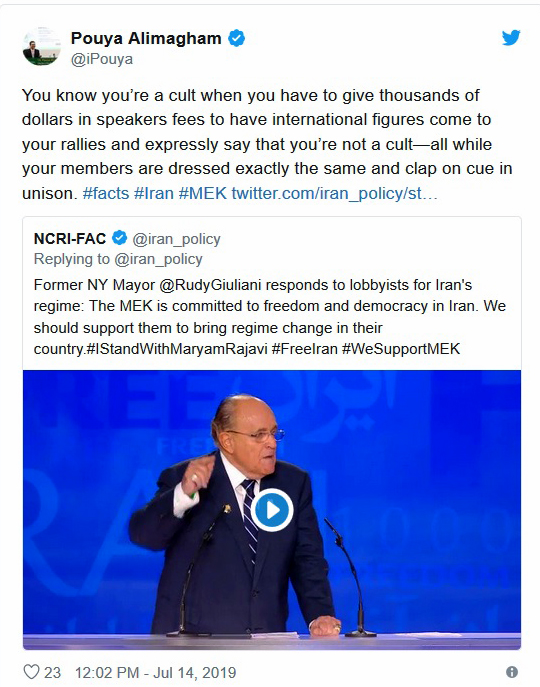
Giuliani delivers pretty much the same speech every time he attends an MEK event, but this year he added the flourish of condemning people that referred to the totalitarian cult as a cult: “These are people that are dedicated to freedom, and if you think that’s a cult, there’s something wrong with you! There’s something missing in your soul!” Then the camera looks out at the crowd of identically-dressed cult members obediently applauding Giuliani’s rote recitation of the cult’s talking points. The video is priceless, as Pouya Alimagham points out here:

Pouya Alimagham

You know you’re a cult when you have to give thousands of dollars in speakers fees to have international figures come to your rallies and expressly say that you’re not a cult—all while your members are dressed exactly the same and clap on cue in unison. #facts #Iran #MEK https://t.co/EzpYJy7y6n
— Pouya Alimagham (@iPouya) July 14, 2019

When Giuliani affirms that the MEK’s agenda “looks just like our Bill of Rights,” you begin to wonder if he has undergone some of the group’s brainwashing techniques. He goes on to praise them as “miracle workers” because of the speed with which they built their creepy compound. The idea that a group that subjects its own members to physical and psychological abuse stands for “human rights” is laughable, and it is a measure of how divorced from reality Giuliani’s speech is that he would make such a claim. “This is a decent organization, this is a good organization,” the president’s lawyer asserts because this is what he has been paid to say. “This is a group we can support,” Giuliani says near the end. It speaks volumes about the horrible judgment and poor ethics of Giuliani and his fellow MEK cheerleaders that they are willing to take money from this group and say these things publicly about them.
The MEK’s paid American boosters are a disgrace, but their participation in these propaganda spectacles is useful in confirming that we can automatically dismiss anything these people have to say about Iran or Iran policy. No one that takes money from a deranged cult hated by Iranians has any business talking about Iran’s political future, and anyone that chooses to echo MEK propaganda has absolutely no credibility on any issue related to Iran. MEK boosters clearly know nothing about Iran and its people, and they definitely don’t care about what the Iranian people think or want. The “decent” and “good” organization that Giuliani praises fought for Saddam Hussein against their own country, it has killed Americans and Iranians in terrorist attacks, and it holds its own members captive and subjects them to brutal and dehumanizing treatment. The fact that he and others advocate for them to have any role in Iran’s government shows their utter contempt for the Iranian people.

The shameless cheerleading for a totalitarian cult might not seem so important, but we should remember that one of the cult’s biggest fans, John Bolton, is now National Security Advisor in charge of making Iran policy. The insane claims that Giuliani and others were making in Albania this weekend aren’t just confined to a bunch of has-beens on the take. Bolton has said many of the same things on many occasions, and I suspect he is fanatical enough in his desire for regime change that he would consider the MEK to be a legitimate ally.

July 15, 2019 0 comments
FacebookTwitterPinterestWhatsappTelegramSkypeEmail
blank
Mujahedin Khalq Organization's Propaganda System

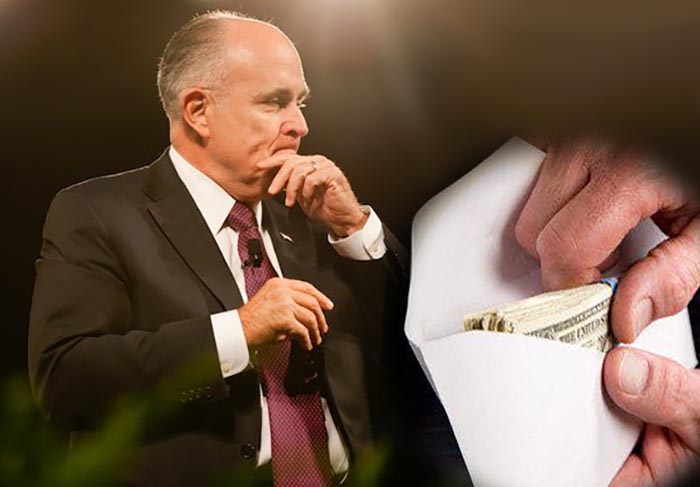
Pockets stuffed with terrorist cash to be MEK’s Guys

Trump Consiglieres Giuliani and Bolton Paid Big Bucks by MEK Terrorist Group

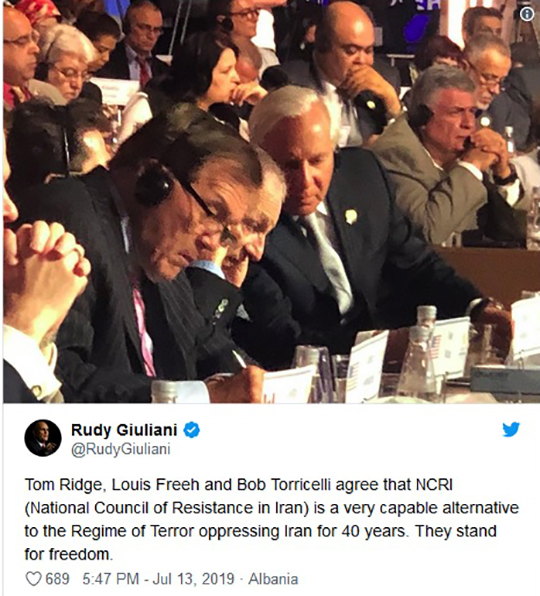
Trump’s attorney, Rudy Giuliani, his pockets stuffed with terrorist cash, tweeted on Saturday that MEK is a viable alternative to the rule of the mullahs in Iran.

Rudy, of course, didn’t bother to point out that NCRI is a front organization for MEK, short for Mojahedin-e Khalq, the terrorist organization that wants, with the help of the neocons, to rule Iran.
According to research conducted by Ivan Kesić, a freelance writer for The Iranian, MEK is a terrorist organization on par with the Islamic State.
Kesić writes that

“based on the facts and figures, due to the terrorist attacks committed by the Mujahedin-e Khalq more than 16,000 people have been killed in Iran alone, not counting their atrocities against Iranian and Iraqi civilians during the Iran-Iraq war and the 1991 uprisings in Iraq. Their tactics included bomb attacks, targeted assassinations, aircraft hijackings, and so on. Only from 26 August 1981 to December 1982, the MEK conducted 336 terrorist attacks against targets in Iran.”

Americans were not immune from violence, according to Kesić:

Mujahedin-e Khalq has also conducted attacks against numerous Western targets, both in Europe, North America and elsewhere. In the early 1970s, MEK members killed several US soldiers and civilians working on defense projects in Tehran. Such victims included US Army Lt. Col. Lewis L. Hawkins who was assassinated in June 1973, US Army officers Col. Paul Shaffer and Lt. Col. Jack Turner killed in May 1975, an Iranian employee at the US Embassy in Tehran two months later, and US civilian contractors Robert R. Krongrad, William C. Cottrell Jr. and Donald G. Smith assassinated by four gunmen in August 1976. Furthermore, in May 1972 US Air Force General Harold L. Price was seriously wounded in attempted assassination. Several hours later, the MEK had a plan to assassinate US President Richard Nixon and they blasted a bomb at mausoleum where Nixon was scheduled to attend a ceremony just 45 minutes after the explosion. In November 1970, a failed attempt was made to kidnap the US Ambassador to Iran, Douglas MacArthur II. MEK gunmen ambushed MacArthur’s limousine while he and his wife were en route their house. Shots were fired at the vehicle and a hatchet was hurled through the rear window, however, MacArthur remained unharmed. During the same period, MEK operatives also committed bombing of facilities of Pan-Am Airlines, Pan-American Oil, Shell Oil, and of gates of British Embassy.

Even Wikipedia, the establishment’s online encyclopedia of spin and historical omission, admits NCRI is a front for MEK.

The organization has appearance of a broad-based coalition; however many analysts consider NCRI and the People’s Mujahedin of Iran (MEK) to be synonymous, taking the former to be an umbrella organization or alias for the latter, and recognize NCRI as an only “nominally independent” political wing or front for MEK. Both organizations are considered to be led by Massoud Rajavi and his wife Maryam Rajavi.

Not surprisingly, one of the most ardent Zionists to ever sit in Congress, Joe Lieberman, supports NCRI-cum-MEK and likely feeds at same MEK trough as Giuliani.
None other than establishment propaganda paragon Politico reported the former New York mayor’s affection for MEK cash.
According to a financial disclosure reported on by The New York Times, Giuliani has been speechifying at hyperspeed for years, collecting $11.4 million for 124 appearances in just one year—and that was before signing up for the MeK gravy train around 2011. Perhaps he just didn’t have time to consider the character of his paymaster.

Liberman

The euphonious sounding “2019 Free Iran conference” will be held this weekend at the MEK compound in Albania. The terrorist organization has produced a video announcing the arrival of the wined-and-dined, many undoubtedly on the payroll.
The NCRI née MEK proudly announced the following participants:

Former New York Mayor Rudy Giuliani, former United States Senator Joe Lieberman, Foreign French Foreign Ministers Michèle Alliot-Marie and Bernard Kouchner, former Canadian Prime Minister Stephen Harper, former Canadian Foreign Minister John Baird, former US Senator Robert Torricelli and hundreds of other international lawmakers, official and dignitaries attend the Iranian opposition’s 2019 Free Iran conference in ‘Ashraf 3’, the headquarters of the People’s Mojahedin Organization of Iran (MEK or PMOI) in Albania. Iranian opposition leader Maryam Rajavi is the event’s keynote speaker.

The chief neocon warmonger and Trump national security adviser, John Bolton, was not included on the above list.

“There have been quite a few former officials, politicians, and retired military officers that have been cheerleading for the MEK over the last few years, but Bolton is one of their oldest and most consistent American supporters,”

writes Daniel Larison.
Bolton, like Giuliani, is slimy with MEK blood money.

By Kurt Nimmo

Kurt Nimmo is a journalist and the author of two books, “Another Day in The Empire: Life in Neoconservative America”, 2006 and “Donald Trump and the War on Islam”, 2016. His articles are usually published on the Global Research and his blog. Kurt Nimmo has blogged on political issues since 2002. In 2008, he worked as lead editor and writer at Infowars, and is currently a content producer for Newsbud.

July 14, 2019 0 comments
FacebookTwitterPinterestWhatsappTelegramSkypeEmail
blank
Mujahedin Khalq Organization's Propaganda System

Teaming up for MEK Cult conference in Albania

Rudy Giuliani, Joe Lieberman Team Up For Albania MEK Conference

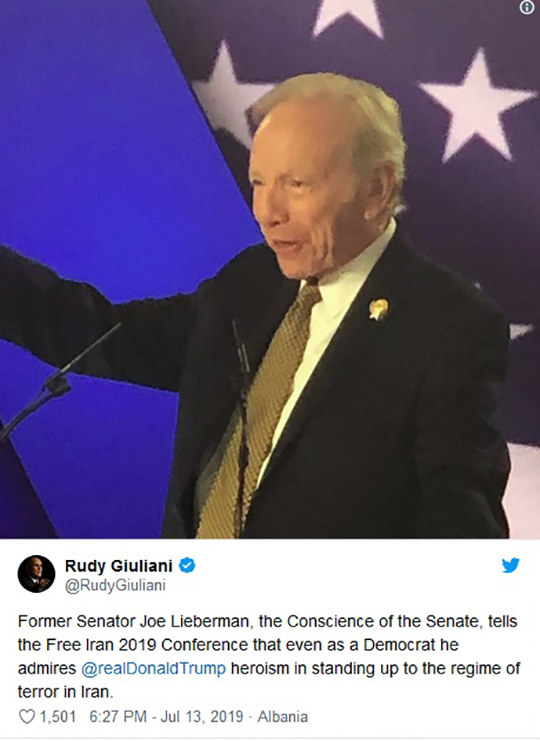
President Trump’s personal attorney Rudy Giuliani has joined buckraking forces with former Senator Joe Lieberman (D-CT), speaking at an event in Albania for a bizarre, cultish Iranian group that fashions itself as a government-in-exile for the Islamic Republic.

Mujahedin-e Khalq (MEK) — once designated as a foreign terrorist group — hosted the conference at a compound that MEK operates in Albania.
In addition to Giuliani and Lieberman, former Colombian Senator and longtime FARC hostage Ingrid Betancourt appeared at the event, along with former Marine Corps Commandant James Conway.
Billed as “The 120 Year Struggle Of The Iranian People For Freedom,” the conference appears to focus in part on extolling the virtues of MEK leader Maryam Rajavi.

Rajavi styles herself as the “leader of the Iranian resistance,” but has faced criticism for alleged brainwashing by the group.

In a video posted to Twitter, Giuliani says that “an alternative exists to the theocracy in Iran. It’s our responsibility to support it.”

In March, the Trump Administration reportedly shifted its position to no longer rule out MEK as a potential replacement for Iran’s current government.

Giuliani seems to have gone straight to the conference from a Thursday evening call-in appearance on Sean Hannity.
Giuliani also spoke at an anti-Iran rally in Warsaw in February, saying that he was representing MEK, and not Trump. He did some work for Trump on the sidelines of the event, however, meeting with a Ukrainian prosecutor who was claiming to have dirt on presidential candidate Joe Biden.
At Friday’s conference, Lieberman echoed Giuliani’s statements.
“When I’m here I feel that I’m representing the spirit of my great friend, the late Senator John McCain, who was warned by the establishment to stay away from this organization, but he spent time learning about it,” Lieberman said. “He came to Ashraf 3, believing in this organization and its cause.”
This isn’t Giuliani’s first time in Albania. In May 2018, he traveled to the southern European country for another MEK event. The relationship has gone on for years.
By Josh Kovensky,talkingpointsmemo

July 13, 2019 0 comments
FacebookTwitterPinterestWhatsappTelegramSkypeEmail
blank
Mujahedin Khalq; A proxy force

MEK lack of empathy for innocent Iranians killed by US

FBI Surveillance Of Iranians After The Downing Of Flight 655

This month marks 31 years since the U.S. Navy ship, the USS Vincennes, shot down Iran Air flight 655, killing 290 Iranian civilians, including 66 children. The downing of the airliner on July 3, 1988 remains one of the deadliest flight disasters of all time. Although Americans have largely forgotten the tragedy, Iran commemorates its anniversary each year, and the incident still hangs over U.S.-Iran relations.

One aspect of the Iran Air flight 655 story that has been completely unknown until now is the FBI’s actions immediately after the incident.
According to formerly secret documents obtained through the Freedom of Information Act, in the days immediately following the downing of an Iran Air flight 655, the FBI conducted an effort it labeled “Winter Campaign,” which included surveillance of Iranians and Iranian groups in the United States, and extended to Muslims abroad.
The FBI documents dated beginning July 4, 1988—just one day after the flight was shot down—describe “Winter Campaign” as an effort to collect information to prevent any retaliation from Iran for the downing of flight 655. However, the FBI documents repeatedly call for surveillance of Iranians and Iranian groups engaging in constitutionally protected activities like attending protests and belonging to political and religious organizations.
Large portions of the documents are redacted, but there is enough detail to get a strong sense of the surveillance operation the FBI conducted in the weeks following the downing of flight 655.
In a July 5, 1988 communication sent to all FBI field offices and legal attaches abroad, the FBI director’s office instructs FBI offices in major U.S. cities to begin “physical surveillance, spot checks, etc.” of Iranian groups and individuals. “These measures will remain in effect until notified by FBIHQ,” the communication reads.
The U.S. cities specifically named in the document for monitoring are Boston, Indianapolis, Los Angeles, Newark, New York, and the Washington D.C. area. Unfortunately, the lines describing the type of measures the FBI offices were instructed to take in these cities is redacted.
Protests in the city of San Diego were also deemed by the FBI to be a particular concern, given that the USS Vincennes—the U.S. Navy vessel that shot down the airliner—was based out of San Diego.
A July 28, 1988 communication from the FBI office in San Diego asks all FBI offices to monitor any Iranian activists traveling to San Diego, as well as any plans for protests in San Diego.
The communication also states:
San Diego [San Diego FBI office] continues to monitor the activities of key Pro-Khomeini Iranians and will provide the Bureau and recipients with timely updates as to investigative results, asset reporting, and assessments in regard to this matter.
This same July 28 communication from the FBI’s San Diego field office also indicates that the FBI was keeping tabs on the International Muslim Student Association/Persian Speaking Group (MSA/PSG). The FBI described the group’s weekly meeting as both a religious meeting and a political forum for PLO-Khomeini Shites Moslems who are predominantly the members/supporters of the local Anjoman Islamie (AI) Chapter.

Surveillance of Muslims Abroad
The FBI documents indicate that the FBI’s “Winter Campaign” also extended to Muslims abroad.
A communication sent from the FBI legal attaché in Barbados to the FBI director’s office on July 19, 1988, describes the surveillance of Muslims on the Caribbean island of Curacao on July 3, 1988, just one day after the downing of flight 655.
The communication reads:
On the day following the incident in the Persian Gulf, the local Muslims held a meeting, after their hour of prayer, during this meeting the incident was discussed and heavily criticized.
The FBI legal attaché in Barbados was also monitoring the statements and travel of the public relations representative of Iran in Barbados, noting that he traveled to Venezuela to give his condolences to the Iranian consul.
Mujahedin-E-Khalq and Monarchist Groups
In addition to monitoring other Iranian groups, the FBI was interested in gathering the opinions of American-based Iranian opposition groups to the downing of Iran Air flight 655.

The San Diego branch of the Iranian opposition group, Mujahedin-E-Khalq (MEK), which was formerly listed by the U.S. State Department as a terror organization, is quoted in the document as “applauding” the U.S. Navy’s downing of the Iranian airliner.

The July 28 San Diego FBI field office communication states:

The San Diego MEK chapter does not blame the U.S. but rather applauds the event as it serves to “bloody the nose of Iran” and cause greater disharmony between the U.S. and Iran. Either case is seen by them to benefit the MEK cause.

The San Diego branch of the MEK also believed conspiracie theories that the downing of the airliner was an Iranian propaganda operation.
The San Diego MEK appears to generally believe that bodies recovered from the crash sight were planted either aboard the jet before a suicide mission or were planted at the scene by design.

The FBI documents indicate that the group believed that Iranian search-and-rescue units were “fully equipped and in position to arrive on the scene ahead of any other party to control the scene and maximize the propaganda value.”

The section of the documents on the MEK is particularly interesting because the group is still very active, and John Bolton, President Trump’s national security advisor, has given paid speeches at MEK gatherings where he pledged to overthrow Iran’s government.
The documents also mention other Iranian dissident groups based in the United States. An FBI asset in the pro-monarchy (pro-Shah) element of the Iranian community in the United States is quoted as saying the monarchist community didn’t blame the United States for downing the airliner.
It would not appear that the Pro-Monarchy (Pro-Palavi) segment of the local Iranian community blames the U.S. for its action or fosters any ill will due to the tragedy.
Trita Parsi, co-founder of the Quincy Institute, reacted to the opinions expressed by the MEK and monarchist groups in the FBI documents, telling Lobe Log:

The fact that the MEK, and to a lesser extent the Monarchists, at the time were absolving Washington of responsibility and even claimed the tragedy was a publicity stunt by Tehran, only goes to show how marginalized these groups are and how tremendously disconnected they are from mainstream opinion among Iranians. Their lack of empathy for innocent Iranians killed shows why they have had such difficulty getting traction among Iranians, in spite of the immense unpopularity of the current government.

One-Year Anniversary of Flight 655
On the one-year anniversary of the downing of the flight, July 3, 1989, a communication from the FBI Director’s office went out to all FBI field offices and legal attaches abroad instructing all FBI offices conducting “technical surveillances” of Iranian groups or individuals to remain alert.
The FBI communication instructed all field officers to:
Report any information pertaining to organized efforts or planned activity by Iranian groups or individuals to protest or demonstrate against the United States in connection with the anniversary of the incident.
FBI field offices with Iranian assets were also asked to canvass their assets for “any information pertinent to the anniversary date” and report any “unusual activity with the Iranian community.”
The July 3 communication also details that the FBI headquarters learned of a yet-to-be-aired CBS TV report on the downing of Iran Air flight 655, which was to be broadcast on the anniversary of the incident.
The FBI communication states, “the mere topic could increase the threat potential in the U.S.”

Current Tensions
The FBI documents revealed here are of historic importance. However, they are particularly interesting given the renewed tension between the United States and Iran since President Trump took office in 2017.
The downing of flight 655 came at the tail end of the Iran-Iraq war, and by 1988, the United States was directly involved in assisting Saddam Hussein’s war effort against Iran. During this period, oil tankers were regularly being attacked in the waters off Iran’s coast, and there was an increasing risk of a direct U.S.-Iran military confrontation. There are some concerning similarities between then and now, and the United States has even voiced concerns tensions with Iran could once again pose a threat to civilian air traffic.
The United States appears to be playing a less-than-helpful role in preventing a future incident like flight 655. On July 3, 2019, the anniversary of the downing of flight 655, observers noted that a U.S. surveillance aircraft off the coast of Iran had changed its transponder number and was impersonating an Iranian aircraft. It’s possible this was done to confuse Iranian air defenses, putting civilian aircraft in the area at risk. Immediately after the downing of flight 655, the United States claimed that the Iranian airliner had a transponder signaling it was an Iranian military aircraft, but this turned out to be untrue.

Discrimination and Harassment of Iranian-Americans Today
It is not yet known if the FBI under Trump has instituted anything like “Winter Campaign” to target Iranians and Iranian groups with increased surveillance. However, the Trump administration’s harsh anti-Iran attitudes have certainly extended beyond rhetoric and into government-directed policies, which are harming Iranian-Americans.
The Trump administration’s most obvious act of institutional discrimination against Iranians is the travel ban, which targets Iranians more than any other group. “Sixty percent of the people affected by the travel ban are Iranians,” Toossi of NIAC said. “Now our families and our loved ones can’t come to see us, there’s countless cases of people’s spouses from Iran who aren’t allowed to come here.”
The Trump administration has also been behind a harassment campaign that operated under the name “The Iran Disinformation Project,” which received money from the State Department to launch social media attacks on Iranians, journalists, human rights groups, and even an Iranian-American running for public office.
“The goal of Iran Disinfo was to craft a narrative that anyone who is critical of Trump’s Iran policy is illegitimate or connected to Iranian regime and try to push the narrative that Iranian-Americans support Trump’s harsh policy towards Iran,” said Toossi.
Toossi stated that NIAC has received reports of Iranian-Americans and Iranians with valid visas facing trouble entering the United States at airports. Just this week, an Iranian volleyball team was detained at Chicago’s O’Hare airport for four hours when they arrived to participate in a Nation’s League Tournament.
Trump’s anti-Iran rhetoric and policies have also fueled other forms of discrimination against Iranian-Americans. According to a survey conducted by the Public Affairs Alliance of Iranian Americans, Iranian-Americans have seen an increase in discrimination since 2016, and more than three-quarters of Iranian-Americans surveyed express fear that they will be discriminated against in the future.
Leila Austin, executive director for the Public Affairs Alliance of Iranian Americans, told Lobe Log,
PAAIA has been receiving more phone calls from individuals across the country who have experienced discrimination due to their ethnicity. We’ve heard from people about workplace discrimination, property discrimination, and even police discrimination.
U.S. banks and technology companies have also been treating Iranian-Americans unfairly by shutting down their accounts. Toossi said, “There are many cases of Iranian Americans banks accounts being closed down, citing vague sanctions reasons when there is no legitimate sanction reason.”

The messaging app Slack and the money-transferring app Venmo have closed accounts and blocked transactions that mention the word “Iran,” according to Toossi. “It’s really ridiculous and we’ve had to write letters to these companies,” Toossi continued.
As has been the case since Iran’s revolution in 1979, Iranians and Iranian-Americans suffer most at times of heightened tension between the United States and Iran.
“The overall climate of anti-Iran hysteria is really impacting Iranian-Americans in their day-to-day life here in the United States. Whether it’s the fear of war or any of the Trump administration’s other very hostile, aggressive policies towards Iran, many people in the community have become afraid of even speaking out,” Toossi said.
Paul Gottinger is an independent journalist based in Chicago and Istanbul.

July 13, 2019 0 comments
FacebookTwitterPinterestWhatsappTelegramSkypeEmail
Maryam Rajavi
Mujahedin Khalq Organization's Propaganda System

Filings Reveal MEK’s Foreign Influence Operation to Push for Regime Change

Documents reveal that MEK, an Iranian dissident organization labeled a terrorist group as recently as 2012, has been ramping up its influence network in Washington D.C. in recent months.

Tensions between the United States and Iran are rising to a fever pitch following the downing of an American drone Wednesday by Iran’s Revolutionary Guard over the Strait of Hormuz. It comes less than a week after an attack on two tankers purportedly conducted by Iran.
Iran has declared that although it does not want conflict, it is “ready for war.” Hawkish voices in the U.S. have called for aggressive action as top military leaders review plans for a possible confrontation.

What is the MEK?
As both nations move closer to the brink of war, the National Council of Resistance of Iran, a little-known advocacy group determined to install itself as the new government of Iran, continues to build a powerful influence network in Washington and beyond.
Recent documents in accordance with the Foreign Agents Registration Act reveal that the council, the political arm of opposition group Mujahedeen Khalq or MEK, has been hosting opulent events at the National Press Club and elsewhere, publicizing itself through national and international media, and meeting with dozens of current and former government officials, all with the end goal of toppling the current Iranian government and rising to power in its place.
OpenSecrets previously reported on the MEK’s deep ties to National Security Advisor John Bolton and other voices currently agitating for war against Iran. The new documents reveal the extent to which the dissident group is using media and its vast array of prominent supporters to push the national discourse toward confrontation.
The council of resistance either submitted or was quoted in 51 media pieces between December 2018 and May 2019, according to FARA filings. These pieces were concentrated in right-leaning media outlets such as Fox News, The Washington Times, The Washington Examiner and NewsMax.
Throughout their appearances, the organization stood firm behind dubious claims that Iran is currently carrying out assassinations in Europe and the U.S., an assertion widely rejected by experts. The rhetoric, based on Dutch intelligence reports that two Iranian dissidents were murdered by Tehran in 2015 and 2017, portrays the threat as dire and immediate, including calling for all Iranian embassies in Europe to be shut down in May.

MEK’s War Chest of Advocates
The group also continued to meet with a number of major former government officials, including James Jones, who served as Barack Obama’s national security advisor from 2009 to 2010, and Tom Ridge, the first Secretary of Homeland Security.

The council has been building a war chest of prominent advocates to justify its mission to the public and to national and international political communities, including Bolton, former New York City Mayor Rudy Giulliani, former Speaker of the House Newt Gingrich, former Attorney General Michael Mukasey and former U.N. Ambassador Bill Richardson.
Some of these individuals were investigated by the Treasury Department in 2012 for accepting significant speaking fees from the MEK, which was, at the time, still designated by the federal government as a terrorist organization. The investigation ultimately dissipated after the group was de-listed as a terrorist organization later that same year following a multi-million dollar lobbying blitz.
The group continues to organize public protests, rallies and speeches claiming to represent the Iranian people, even though the group is reportedly “widely despised” within Iran and has been exiled from the country for decades. The group spoke with several U.S. senators on Nowruz (Persian New Year) in March and received the backing of two sitting senators, John Boozman (R-Ark.) and Jeanne Shaheen (D-N.H.).
Standing between two Iranian flags emblazoned with the MEK’s golden lion insignia, Boozman told the group, “We are committed to helping you in any way that we can.”
Boozman and Shaheen aren’t the only members of Congress to have publicly backed the MEK Sen. Tom Cotton (R-Ark.), who has repeatedly called for launching a first strike on Iran, spoke at a 2015 meeting of the Organization of Iranian American Communities, an advocacy group closely aligned with the MEK.
Two other senators, Thom Tillis (R-N.C.) and Roy Blunt (R-Mo.), flew to Albania in 2017 to meet with the MEK’s leader Maryam Rajavi and wish her group “success in their struggle for democracy and human rights in Iran.”
Supporters of the MEK claim that Rajavi will usher in a secular democratic state in the place of the current theocratic regime. They champion her stated commitment to free-market capitalism and promises to modernize the nation.

History of the MEK
The council was founded in the early 1980s as the political front of the MEK, which itself was started by self-described Marxist Iranian students in 1965. Initially fighting with other opposition groups to take down the Shah in the 1979 Iranian Revolution, the group soon came into conflict with the new Ayatollah Khomeini’s government, with members of the MEK eventually killing the Iranian president and prime minister in 1981.
They later fought alongside Saddam Hussein’s Iraq in the 1980 Iran-Iraq war and into the 1990s and early 2000s against Iraqi Shiites, Kurds and Americans. They have been blamed for the deaths of thousands of Iraqi soldiers and at least six American citizens.
The group plans to demonstrate in front of State Department headquarters in D.C. on Friday in a protest dubbed “March 4 Regime Change by Iranians” by social media supporters and closely-aligned groups, including OIAC. OIAC has been spending to amplify the march with more than $300 going to Facebook ads in the days leading up to the event and multiple tweets promoting the demonstration on Twitter, but the amount of that spending is unknown since OIAC is not on the list of issue advertisers tracked by Twitter’s Ads Transparency Center.

By Reid Champlin, opensecrets

July 10, 2019 0 comments
FacebookTwitterPinterestWhatsappTelegramSkypeEmail
blank
Mujahedin Khalq; A proxy force

US intelligence service closely cooperating with MKO terrorists

Iran’s ambassador to the United Nations has described the Islamic Republic as a victim of terrorism and extra-national organized crime, stating that the anti-Iran terrorist group Mujahedin-e Khalq Organization (MKO), supported by some regional and European countries, is working closely with the US intelligence service in a bid to descend Iran into chaos.
“Even though terrorists and organized criminals differ in their motives and methods, they are similar to one another concerning the repercussions of their acts, which are total disruption and comprehensive destruction,” Majid Takht-e Ravanchi said at a UN Security Council meeting entitled “Threats to international peace and security: Linkage between international terrorism and organized crime” in New York on Tuesday evening.
He added that Iran has been a victim of terrorists and international organized criminals, and has been a pioneer in the fight against them.
Majid Takht-e Ravanchi highlighted that 17,161 Iranian citizens, including late president Mohammad Ali Rajaei, former prime minister Mohammad Javad Bahonar, late Head of Supreme Judicial Council Ayatollah Mohammad Beheshti, late Deputy Chief of the Iranian Armed Forces General Staff Ali Sayyad Shirazi, 27 legislators as well as four nuclear scientists have been killed by terrorists.
“The MKO terrorist group, which bears responsibility for the death of more than 12,000 Iranian civilians, is currently being sponsored by a number of regional counties and several states in Europe. (The United States of) America has provided its members refuge after removed the group from its list of designated terrorist organizations. The US intelligence service is working closely with them in order to hatch conspiracies of destruction in Iran,” the Iranian diplomat pointed out.
The MKO is listed as a terrorist organization by much of the international community. Its members fled Iran in 1986 for Iraq, where they received support from then dictator Saddam Hussein.
The notorious outfit has carried out numerous attacks against Iranian civilians and government officials for several decades.
In 2012, the US State Department removed the MKO from its list of designated terrorist organizations under intense lobbying by groups associated to Saudi Arabia and other regimes adversarial to Iran.
A few years ago, MKO members were relocated from their Camp Ashraf in Iraq’s Diyala Province to Camp Hurriyet (Camp Liberty), a former US military base in Baghdad, and were later sent to Albania.
Those members, who have managed to escape, have revealed MKO’s scandalous means of access to money, almost exclusively coming from Saudi Arabia.
Takht-e Ravanchi then pointed to Iran’s cooperation with Iraq and Syria in its fight against Daesh Takfiri terrorists, emphasizing that Iran’s military presence in both countries is based on requests by their legal governments.
The Iranian UN ambassador also made a reference to his country’s leading role in fighting drug trafficking, saying that more than 39 percent of world narcotics in 2017 were discovered by Iran.
“Over the past 40 years, Iran has lost 3,815 members of the law enforcement forces during anti-drug operations. More than 12,000 people have been injured as well,” he said.
Takht-e Ravanchi finally called on the international community to support Iran in the fight against illegal drugs without any preconditions, discrimination and political considerations.

July 10, 2019 0 comments
FacebookTwitterPinterestWhatsappTelegramSkypeEmail
Newer Posts
Older Posts

Recent Posts

  • The black box of the torture camps of the MEK

    December 24, 2025
  • Pregnancy was taboo in the MEK

    December 22, 2025
  • MEPs who lack awareness about the MEK’s nature

    December 20, 2025
  • Why did Massoud Rajavi enforce divorces in the MEK?

    December 15, 2025
  • Massoud Rajavi and widespread sexual abuse of female members

    December 10, 2025
  • Facebook
  • Twitter
  • Instagram
  • Youtube

© 2003 - 2025 NEJAT Society . All Rights Reserved. NejatNGO.org


Back To Top
Nejat Society
  • Home
  • Articles
  • Media
    • Cartoons
    • NewsPics
    • Photo Gallery
    • Videos
  • Publications
    • Books
    • Nejat NewsLetter
    • Pars Brief
  • About Us
  • Contact us
  • Editions
    • عربي
    • فارسی
    • Shqip