Nejat Society
  • Home
  • Articles
  • Media
    • Cartoons
    • NewsPics
    • Photo Gallery
    • Videos
  • Publications
    • Books
    • Nejat NewsLetter
    • Pars Brief
  • About Us
  • Contact us
  • Editions
    • عربي
    • فارسی
    • Shqip
Nejat Society
Nejat Society
  • Home
  • Articles
  • Media
    • Cartoons
    • NewsPics
    • Photo Gallery
    • Videos
  • Publications
    • Books
    • Nejat NewsLetter
    • Pars Brief
  • About Us
  • Contact us
  • Editions
    • عربي
    • فارسی
    • Shqip
© 2003 - 2024 NEJAT Society. nejatngo.org
mek US terrorists - our men in Iran
Mujahedin Khalq; A proxy force

US military secretly trained MEK Terrorists

The Exceptionally American Historical Amnesia Behind Pompeo’s Claim of ‘40 Years of Unprovoked Iranian Aggression’

From a CIA coup and supporting the Shah’s brutality to enabling chemical attacks, shooting down a civilian airliner and training terrorists,‘aggression’ between the US and Iran is overwhelmingly one-sided

Someone attacked two oil tankers in the Gulf of Oman last week. The Trump administration wants the world to believe that Iran is the culprit. Yet there is no serious evidence that Tehran was behind the attacks on the Norwegian and Japanese ships. Not only is there no proof of Iranian involvement, such an attack by Iran makes no sense at all. Japan and Iran are friends. Just last month, Japanese Prime Minister Shinzo Abe — who was visiting Tehran during the tanker incident — affirmed this friendship in the presence of Donald Trump during the US president’s recent state visit to Japan. Most importantly of all, the crew and owner of the Japanese tanker attacked in the gulf vehemently reject the US claim that the vessel was damaged by a mine, asserting instead that a “flying object” struck the ship.

Still, Secretary of State Mike Pompeo blamed Iran for what he called a “blatant assault” on the tankers. Pompeo also said that the attacks “should be understood in the context of 40 years of unprovoked aggression” against the US and other “freedom-loving nations” by Iran. There is no such history. Iran hasn’t started a war since the mid-19th century, when it was still the Persian Empire. The true context which must be understood is one of a century of US and Western exploitation of Iranian people and resources, and decades of US threats and aggression against Iran that once reportedly included a plan to stage a false flag attack very similar to last week’s tanker incident.

Destroying Democracy

Many Americans suffer a collective historical amnesia that renders a true and complete understanding of the causes, conduct and consequences of their nation’s perpetual conflicts all but impossible. This explains why most Americans trace the origins of US-Iran enmity to the 1979 hostage crisis, when Islamists occupied the US Embassy in Tehran for 444 days and Iran was transformed from close ally to arch-enemy practically overnight. US leaders and media portrayed those young revolutionaries as wild-eyed Muslim fanatics consumed by irrational hatred of the United States. Their legitimate grievances, chief among these the repression and brutality of the US-backed regime they dethroned, were ignored.

Pompeo’s preposterous claim that the US wants to “restore democracy” to Iran begs the question of when Iranians ever enjoyed democracy in the first place. The closest they ever came was in the early 1950s, when the reformist prime minister Dr. Mohammad Mossadegh set out to end British and American exploitation of Iranian oil resources by nationalizing the assets of companies including the Anglo-Iranian Oil Company, which despite its equitable-looking hyphenation was really a British-owned near-monopoly known today as BP. Iran’s monarchy, led by Mohammad Reza Shah Pahlavi, had sold out his country to foreign capitalists to the extent that one State Department official wrote in 1942 that the US would “soon be in the position of actually running Iran.”

Emboldened, perhaps, by President Harry S. Truman’s hollow promise to “assist free people to work out their own destinies in their own way,” Iranians rallied behind Mossadegh as he fought to take what was rightfully Iran’s back from foreign predators. In addition to nationalization, he expelled foreign technicians from oil refineries and even broke off diplomatic relations with Britain. Mossadegh’s was the most popular and democratic government Iranians had ever known. Time magazine, in naming him its “Man of the Year” for 1951, called him “the Iranian George Washington.”

The British were nearly as infuriated by Mossadegh as they had been by the original George Washington, and London enlisted its former colony to hatch a plan to depose the Iranian leader. Truman demurred but his successor, Dwight D. Eisenhower, was game. Secretary of State John Foster Dulles and his brother, Central Intelligence Agency Director Allen Dulles, had both previously worked as lawyers at a firm that represented Anglo-Iranian Oil. In 1953 the CIA launched a coup, codenamed Operation Ajax, which fomented unrest through violence including false flag attacks on religious leaders that were then blamed on pro-Mossadegh communists. A very reluctant Shah was swiftly restored to his throne and Mossadegh was deposed and imprisoned. US corporations then seized control of 40 percent of Iran’s oil fields.

In order to help the Shah maintain an iron grip on Iranians, the CIA, along with Israel’s Mossad, created SAVAK, the notoriously brutal state security force whose tortures included amputations, electric chairs and anal rape with electric cattle prods. The CIA reportedly taught SAVAK how to torture men and women and filmed these sessions for instructional purposes. Meanwhile, five successive US presidents lavished the Shah with aid and arms. Jimmy Carter, the so-called “human rights president,” feted the dictator at a 1978 White House New Year’s Eve soirée, toasting his “brilliant leadership” as angry protests against his ill-fated regime’s tyranny raged outside.

“Unprovoked Aggression?”

Forty years ago, long-simmering animosity toward the United States inevitably boiled over, culminating in the now-familiar events of those 444 days in 1979-81. Instead of acknowledging its role in stoking the flames of revolt, the Carter and Ronald Reagan administrations partnered with an even worse dictator than the Shah, Saddam Hussein in neighboring Iraq, as it attempted to thwart Iran’s nascent Islamic Republic. In 1980 the US encouraged Hussein to invade Iran, providing crucial support— including the transfer of deadly chemical and biological materials Iraq weaponized and unleashed upon Iranians and Iraqi Kurds — in an eight-year war of attrition that claimed more than a million lives. Reagan officials knew for years that Iraq was attacking Iran with WMDs but kept up US support while publicly denying knowledge of Iraq’s heinous war crimes.

As the war died down, an accidental US attack on Iran further inflamed Iranians. On July 3, 1988, the USS Vincennes, which was in Iranian waters, shot down Iran Air Flight 655, killing all 290 passengers and crew aboard, including 66 children. An indignant Reagan blamed the “barbaric Iranians” for the wholesale aerial slaughter; Vice President George H.W. Bush, who was running for president, infamously spat, “I will never apologize for the United States of America. Ever. I don’t care what the facts are.”

Fast-forward to the second Bush presidency, when provocation toward Iran escalated to the brink of all-out war. In addition to senior US officials’ constant threats and even jokes about bombing “Axis of Evil” member Iran, the US secretly deployed Special Forces troops inside Iran on reconnaissance missions and to forge alliances with dissident groups.

Chief among these was the People’s Mujahedin of Iran (MEK), a State Department-designated terrorist group that had previously assassinated six US officials when it was fighting the Shah’s regime. Despite this, the US military secretly trained MEK fighters while the terror group paid leading US officials to lobby for its cause.

The Bush administration also pressured the World Bank into suspending emergency relief aid after the 2003 Bam earthquake, which killed more than 26,000 Iranians, and imposed harsh new economic sanctions on Iran which continue to cause great suffering for ordinary Iranians even as a well-connected elite grows fantastically wealthy. Bush-era war plans against Iran reportedly even included a false flag plot hatched in Vice President Dick Cheney’s office to send Navy SEALs in boats disguised as Iranian naval vessels to attack US warships in the Straits of Hormuz.

The menacing of Iran continued unabated through most of Barack Obama’s administration, when Israeli and/or US assassinations of Iranian nuclear scientists, cyber attacks and sabotage — actions that would surely be seen as acts of war if they were committed against the United States — occurred along with the usual threats of war. Meanwhile, the administration sold a record amount of weapons to Iran’s adversaries, further inflaming tensions in the world’s most volatile region. Obama ultimately chose cautions cooperation over confrontation with Iran. His wise decision led to the landmark 2015 Iran nuclear deal, a highly controversial move that faced strong bipartisan opposition from liberal lawmakers as well as from Republicans including neoconservative hawks like John Bolton, who has been itching to bomb Iran for decades — and who is now President Donald Trump’s national security advisor.

The Real Aggressor

US and Israeli intelligence agencies have long asserted that Iran is not trying to develop nuclear weapons, and even President Trump has admitted that Iran was complying with the terms of the nuclear deal. Trump nevertheless withdrew the US from the agreement, with predictably dangerous consequences as Iran’s leaders, like so many before them, realized that a deal with the United States all too often isn’t worth the paper it’s written on. The administration and its allies in Congress and the corporate mainstream media have ratcheted up their warmongering against Iran to a near-fever pitch, all based upon “evidence” every bit as suspect as the lies that led to the disastrous invasion and occupation of Iraq. It is unclear who attacked the Norwegian and Japanese oil tankers in the Gulf of Oman last week. What is clear is that a world wary of US lies and endless war isn’t buying the Trump administration’s story.

Actors including Israel, Saudi Arabia and some in the Trump administration seem hell-bent on waging a war against Iran that would ideally end in the overthrow of that country’s Islamist regime. Iran isn’t without its serious faults. However, these pale in comparison to those of the US, which has — and has used— nuclear weapons, staged or supported numerous coups, attacked half a dozen Middle Eastern countries already this century and nearly encircled Iran with military bases. Iran has no nuclear weapons, no bases within 10,000 kilometers of the United States and has never directly attacked the US or, of course, overthrown its government. Who is the real aggressor here?
By Brett Wilkins,  Common Dreams
June 30, 2019 0 comments
FacebookTwitterPinterestWhatsappTelegramSkypeEmail
blank
Mujahedin Khalq; A proxy force

Reason behind the international community lack of trust on Trump

Crisis of Trust — Trump Tries to Lead on Iran, But Few Follow
The president cannot form an international coalition, weakening America’s position

Last week, two commercial tankers were attacked in the Gulf of Oman, near the Strait of Hormuz, a narrow waterway through which about 20% of the world’s oil passes. United States officials, including President Trump and Secretary of State Mike Pompeo, quickly blamed Iran. When pressed for evidence, the U.S. released a video of Iranians on a small boat removing what appears to be an unexploded limpet mine from one of the tankers.
Major U.S. allies, such as Germany and Japan, were skeptical and said so in public. Yutaka Katada, the Japanese owner of one of the tankers, said the ship was attacked by a flying object, not a mine. U.K. Foreign Minister Jeremy Hunt said his country is “almost certain” Iran was behind the attacks, but instead of condemning the Iranians or calling for freedom of the seas, he urged “all sides to de-escalate.” The European Union offered a similar message.
Europe and Japan probably suspect Iran too, even if they doubt Trump and Pompeo’s statements. Their publicly-expressed skepticism and calls for restraint from all sides sends a signal. They do not want to join Trump’s “maximum pressure” campaign, they do not want conflict, and if the situation escalates to war, America will be alone.
That’s Trump’s fault.

Reasonable Doubt
Donald Trump is not the only reason one might question an American accusation. An accidental explosion on the USS Maine, blamed on Spain, helped lead to the Spanish-American War. False claims about a North Vietnamese attack in the Gulf of Tonkin led to escalation in Vietnam. More recently, the United States justified invading Iraq with inaccurate accusations about nuclear and biological weapons.
But none of this prevented George W. Bush or Barack Obama from leading a global coalition to pressure Iran. Escalating sanctions, authorized by Security Counsel resolutions, had support from the U.K., E.U., Russia, China, Japan, India, and others. That effort culminated in the Joint Comprehensive Plan of Action (JCPOA), which traded sanctions relief for most of Iran’s enriched uranium — i.e. bomb fuel — and their capacity to create more, moving the country further away from a nuclear weapon.
In May 2018, Trump withdrew from the JCPOA, even though the International Atomic Energy Agency certified that Iran was upholding its end of the bargain — an assessment shared by U.S. and allied intelligence. The U.S. imposed sanctions, going against the wishes of every other party to the deal, including NATO allies U.K., France, and Germany.
As a result, everyone outside of the United States blames Trump for the current Iran situation (except for Saudi Arabia, the United Arab Emirates, and Israel, Iran’s regional rivals). But the president’s inability to build an international anti-Iran coalition stems from more than just disagreement over the JCPOA.

It’s About Trust
Freedom of the seas is an international right. Threats to it merit an international response. But the country that usually leads such an effort is the United States, and the U.S. is suffering a crisis of trust.
Few trust that the Trump administration will be honest with them, consider their interests, or move the situation in a productive direction, so they don’t want to line up behind America now. While the Iraq war plays a role, a lot is specific to this presidency.
In his first trip abroad, Trump gave a speech in Saudi Arabia, delighting his hosts by inaccurately blaming Iran for most terrorism. He publicly backed the Saudi-led diplomatic isolation of Qatar — now in its third year — even though Qatar hosts America’s largest Middle East airbase. He repeatedly lied about the murder of journalist Jamal Khashoggi to cover for Saudi Crown Prince Mohammed bin Salman (MBS). His son-in-law/adviser Jared Kushner took an unannounced trip to Riyadh in October 2017, reportedly giving MBS intelligence on influential Saudis the Crown Prince later arrested in a power grab.
This is different than previous presidents, and makes American allies less confident the United States will do the right thing when it comes to Saudi Arabia’s main rival.
In Syria, Trump oversaw the successful conclusion of the campaign to retake territory from ISIS, and then in December 2018 issued a surprise order to withdraw. Quickly leaving would abandon the Syrian Democratic Forces, America’s local partners, and risk increasing instability. Trump’s order prompted resignations from Secretary of Defense James Mattis and special envoy to the anti-ISIS coalition Brett McGurk, who were arguably the administration’s two most credible officials on Middle East issues. Later, the president partially reversed course, agreeing to leave half the force in Syria.

The officials currently at the forefront of Iran policy — Secretary Pompeo and National Security Advisor John Bolton — have advocated regime change for years. Bolton has openly backed the MEK, an Iranian dissident group, which the U.S. designated a foreign terrorist organization from 1997–2012. The MEK recently got caught running a fake Iranian activist persona online, who got articles published in Forbes, the Hill, the Daily Caller, the Federalist and other U.S. outlets.

On May 31, a suicide bomber attacked a U.S. convoy in Kabul, Afghanistan and the Taliban took responsibility. But two weeks later, Pompeo called it one “in a series of attacks instigated by the Islamic Republic of Iran and its surrogates against American and allied interests.” The Secretary has not presented any evidence, and almost no one shares his assessment.
This doesn’t mean Pompeo’s accusation that Iran was behind the tanker attacks is false. Iran is one of the few actors with access, and may have wanted to signal that it can disrupt shipping through the Strait of Hormuz. But that’s not the only possibility, and Pompeo’s boy-who-cried-Iran routine makes him a poor messenger.

The Uncertainty Isn’t Helping
Compounding the problem of the administration’s credibility, it’s not clear what the U.S. wants.
Is America after regime change, hoping the sanctions will collapse the government or spark a revolution? Is pressure supposed to antagonize Iran into an action that justifies a military response? Or is it designed to bring Iran to the negotiating table, ideally with new concessions?
And with the tanker attacks, is the U.S. aiming for freedom of the seas? In that case, a smart approach would involve coordinated international condemnation, a Security Counsel resolution, and perhaps an offer to provide military escorts for merchant vessels near the Strait of Hormuz. But if the U.S. aims to frighten Iran into concessions, or is looking for an excuse to bomb, there’s value in ratcheting up tensions.
Republican Senator Tom Cotton of the Armed Services Committee called for “a retaliatory military strike against the Islamic Republic of Iran.” New York Times columnist Bret Stephens said the U.S. should threaten to sink Iran’s navy. Both advocate regime change, but argue these threats would deter Iran from further attacks on shipping.

Where the Trump administration falls is less certain.
In May 2018, Pompeo issued twelve demands, including ending support for Hezbollah, withdrawing from Syria, and leaving Iraq alone. Essentially, the secretary told Iran to abandon its foreign policy interests — a degree of capitulation to which no country would agree, except after losing a major war. This week Pompeo said the U.S. doesn’t want war, but considering his pre-administration calls for regime change and his absolutist demands, he probably wouldn’t mind it.
Acting Secretary of Defense Pat Shanahan also said the U.S. doesn’t want war with Iran, but he just resigned over accusations that he punched his wife, leaving civilian military leadership in flux.
Mixed messages combined with poor credibility undermines strategies of deterrence and coercion. If the Iranians don’t know where the U.S. draws the line, and what will happen if they cross it, then they’re less likely to be deterred. If Iran doesn’t know what non-absolutist concessions the U.S. would accept, then it’s less likely to be open to negotiations.

What About the President?
Trump seems like he might want a deal. In July 2018, the president publicly floated the idea of meeting without preconditions. This month, Trump asked Shinzo Abe to convey an openness to negotiations when the Japanese prime minister traveled to Tehran.
After the tanker attacks, the president struck a different tone from his senior staffers. “So far, it’s been very minor,” Trump said in an interview with Time, downplaying the possibility of a military response, but “I would certainly go [to war] over nuclear weapons.” This sounds like something out of a gangster movie: how about I let the little thing slide and then you and I have a talk about the big thing?
And it suggests an under-appreciated possibility: Trump might be following the same strategy he used with North Korea. In that case, we’re currently in the “fire and fury” stage, with sanctions and threats. Trump might be trying to get to the Singapore summit stage, where he gets a photo op and something he can call a deal to tout back home.
Some theorize that Trump would like a war to distract from domestic problems or create a rally-around-the-flag effect to help his re-election. But I don’t think the president who ordered withdrawal from Syria, refrained from attacking Venezuela, and sings Kim Jong-un’s praises is eager for war. And he has little trouble creating distractions.
Wars are messy. Expensive. Trump is willing to use force against terrorists and insurgents in Afghanistan, Iraq, Syria, Yemen, and Somalia, who have little ability to respond. But with governments, which can resist and retaliate, he sticks to threats, hoping that bullying will work.
Military action could go wrong and hurt his electoral chances. A chunk of Trump’s base is isolationist and wouldn’t like it, much as they denounced limited missile strikes against Syria in April 2018.
But this situation is different from North Korea. Iran does not have nuclear weapons, and may worry that it has to establish deterrence by demonstrating the ability to impose costs, such as by disrupting global oil markets. North Korea is boxed in by China, Russia, South Korea, and Japan, while Iran is involved in Iraq, Syria, Yemen, Lebanon, and Gaza. And Iran has domestic politics.
It’s not a democracy, but it’s not built around one man like North Korea. Iran has factions competing for influence, and when Trump broke the JCPOA, the faction that’s open to negotiations lost ground to the one that said America can’t be trusted. Iran rejected Trump’s offer to meet, and the government has domestic political incentives to stand firm, even as sanctions create pressure to come to the table.
This week, Iran announced it will resume some uranium enrichment activities banned under the JCPOA. It’s not surprising, since the U.S. reneged on its commitments first, but it’s still a sign that Iran plans to escalate. However, whether they’re trying to generate leverage for negotiation, deter American action, or increase the chances of conflict isn’t clear.
The most worrisome part is not that Trump personally wants war. It’s that without unified global pressure Iran won’t back down, the sanctions will achieve little besides suffering, and Trump won’t get an agreement he can take credit for. And then people with the president’s ear — from Bolton and Pompeo to the Saudis and Israelis — will tell him he has no choice but to bomb because otherwise he’ll look weak.
Then what?

Nicholas Grossman, arcdigital.media

June 27, 2019 0 comments
FacebookTwitterPinterestWhatsappTelegramSkypeEmail
Nejat NewsLetter
Nejat Publications

Nejat NewsLetter No.62

Inside This Issue:

• 21 June, marks the MEK’s annual celebration of armed struggle.Nejat NewsLetter
• Take a stroll with Codepink through the MEK Washington Rally
• Leaked Audio Shows Saudi MKO Collusion over Tanker Attacks
• The American Journalist on the MEK Washington DC rally
• “Platform Manipulation” by the US-backed MEK to launch war against Iran
• Disinfo troll farms reason to Doubt US VER of Gulf-of Oman Incident
• MEK misusing media to push for war
• The American Journalist on the MEK Washington DC rally

To download the PDF file click here

June 27, 2019 0 comments
FacebookTwitterPinterestWhatsappTelegramSkypeEmail
blank
Mujahedin Khalq; A proxy force

MEK Terrorist Cult on State Department Doorstep

MEK’ing history
Why the State Department Let a Terrorist Cult Gather on its Doorstep

How did the MEK go from terrorist cult to State Dept partner in pushing regime change in Iran? MintPress went to their DC rally to find out.

Watching the Trump administration’s push for war with Iran, news consumers may find it hard to be surprised by the lengths the U.S. government is willing to go to in order to instigate war — or regime change at the very least — against the Islamic Republic. U.S. citizens have been treated to lengthy lectures by the mainstream media, which laments the loss of an unmanned drone and a targeted Japanese oil tanker whose owner disputes Washington’s version of events.
Yet, it isn’t the Trump administration that solidified the U.S.’s relationship with its strangest bedfellow in the battle against the Iranian government. That distinction goes to then-Secretary of State Hillary Clinton.
Clinton declassified the Mojahedin-e Khalq (People’s Mujahedin of Iran, or MEK) as a terrorist organization in 2012. The Guardian described the move as a result of a “multimillion-dollar campaign.”

The campaign to bury the MEK’s bloody history of bombings and assassinations that killed American businessmen, Iranian politicians and thousands of civilians, and to portray it as a loyal U.S. ally against the Islamic government in Tehran, has seen large sums of money directed at three principal targets: members of Congress, Washington lobby groups and influential former officials.”

The outlet continued:

Three top Washington lobby firms — DLA Piper; Akin Gump Strauss Hauer & Feld; and DiGenova & Toensing — have been paid a total of nearly $1.5 million over the past year to press the U.S. administration and legislators to support the delisting of the MEK and protection for its members in camps in Iraq.
Two other lobby groups were hired for much smaller amounts. The firms employed former members of Congress to press their ex-colleagues on Capitol Hill to back the unbanning of the MEK.”

Today, years after the group was removed from Washington’s terror list, it enjoys even more access to the halls of power, despite its dismal levels of approval in Iran, the country it claims to represent.

“The MEK has incredible influence in the White House and on the Hill. I frequently see them lobbying members of Congress and attending hearings with matching yellow jackets that say ‘Iranians support regime change,’ Lily Tajaddini, Iran Coordinator at CodePink, told MintPress News.

The group claims to want democracy, but it is abundantly clear that their ideal leader for the future of Iran is Maryam Rajavi, the woman who leads their cult. The contradiction was laid bare last week at a protest held by the group in Washington with chants of “Democracy and freedom, with Maryam Rajavi.”
A recent investigation by The Intercept revealed that the White House used an article by one Heshmat Alavi to justify its illegal withdrawal from the Joint Comprehensive Plan of Action (JCPOA, or Iran Nuclear Deal). The only problem is that Alavi “is a persona run by a team of people from the political wing of the MEK. This is not and has never been a real person {emphasis added),” according to one former member of the cult, whose story was corroborated by other former members.
As LobeLog reported:

This new scandal…involves a wide political and media class that has become so besotted with an unrealistic anti-Iran agenda that it has left the door open to an unchecked, unverified flow of MEK propaganda throughout American politics and the media. Thanks to these regime-change advocates, a foreign group funded by a foreign government has easily manufactured a false narrative aimed at sending American soldiers to die in a war with Iran that is against U.S. national interests.”
That foreign government is the Kingdom of Saudi Arabia. Even the U.S. government’s own Voice of America outlet reports:
Observers have long been puzzled about how the group [MEK] managed to shell out $25,000 speaker fees to the likes of [former Speaker of the House Newt] Gingrich, [former Governor of New Mexico and U.S. Ambassador to the United Nations Bill] Richardson, [former Chairman of the Democratic National Committee Howard] Dean, former New York Mayor [and President Trump’s lawyer] Rudy Giuliani and others, given its small basis of support within the Iranian diaspora. It’s entirely possible that the Saudis have funded the MEK for years.”

And there is a consensus that Saudi Arabia is financing the group across the axis, with Russia’s SputnikNews reporting:
A former MEK member who oversaw the transfer of hundreds of millions of dollars’ worth of materials explained how the group has stayed financially afloat.
Massoud Khodabandeh explained that three tons of solid gold, a minimum of four suitcases of customized Rolex watches, and fabric that had been used to cover the Muslim holy site of Kaaba in Mecca were among the commodities shipped from Saudi Arabia to MEK operatives in Baghdad as part of the scheme.”
As MintPress News previously reported:

Testimony from a former high-ranking official from the Iranian militant opposition group…has confirmed that the group had been covertly financed by the Kingdom of Saudi Arabia. For decades, the Gulf Kingdom…contributed hundreds of millions of dollars in gold and other valuables.”


Several fronts and bigtime backers
The MEK operates through several fronts, including the National Council of Resistance of Iran (NCRI), the Organization of Iranian American Communities (OIAC), inter alia.
The former is a “little-known advocacy group determined to install itself as the new government of Iran,” which “continues to build a powerful influence network in Washington and beyond,” according to the Center for Responsive Politics (CRP). The latter is a U.S.-based lobbying group.
NCRI has “been hosting opulent events at the National Press Club and elsewhere, publicizing itself through national and international media, and meeting with dozens of current and former government officials, all with the end goal of toppling the current Iranian government and rising to power in its place,” the watchdog reports. CRP adds:

“The [C]ouncil of [R]esistance either submitted or was quoted in 51 media pieces between December 2018 and May 2019, according to FARA [law requiring registration of foreign lobbyists] filings.”

Meanwhile, some of the biggest names in American politics openly back the group. The ultra-hawkish Sen. Tom Cotton, who has advocated for a pre-emptive strike on Iran, has spoken at their events. National Security Advisor John Bolton promised the group at its 2017 conference in Albania that “before 2019, we here will celebrate in Tehran.” Richardson, Gingrich and Guiliani also gave speeches there.
Among other prominent supporters of the group: former Sen. Robert Torricelli (D-NJ); retired General and former Vice Chief of Staff of the United States Army Jack Keane; Sen. Jeanne Shaheen (D-NH); Sen. John Boozman (R-AR); Sen. Thom Tillis (R-NC); Sen. Roy Blunt (R-MO); Rep. Brad Sherman (D-CA); Rep. Tom McClintock (R-CA); and former Attorney General Michael Mukasey, among many, many more.

Chaos at the State Department
On Friday, some 500 MEK members demonstrated in front of the State Department building in Washington, equipped with stages, two large-screen TVs, and three confetti cannons. In between speeches, demonstrators chanted “Change, change, change / Regime change in Iran!”
They also chanted their support for MEK leader Maryam Rajavi — who is banned from entering the United Kingdom, yet bills herself as a progressive reformer despite her group’s terrorist past. “Rajavi yes / Mullahs no / They are terrorists, they must go!” MEK members chanted.
According to organizers, the MEK members flew in from “40 different states.”
One speaker opened the rally by proclaiming:

In one voice, we declare that the only solution is for the Iranian people to overthrow this regime and create a democratic nation. Our rally is timely, our message is clear. Thousands of Iranians are here to say it loud: ‘We call on the United States to support the Iranian uprisings for regime change.’”

He went on to call for more sanctions and for the designation of Iranian intelligence agencies as terrorist groups. The speaker continued:
With this comes the recognition of an alternative to the Iranian regime. Misses Maryam Rajavi and the NCRI have demonstrated leadership, a significant network, and the organizational capabilities to free Iran. And we support Misses Rajavi and her 10-point plan for a free, democratic, and non-nuclear Iran.
Let’s make sure that we are heard and on social media with the following hashtags: #MarchForRegimeChangeByIranians, #IStandWithMaryamRajavi, and #FreeIran.”
Schedule for the “Iran Rally In Solidarity with Iranian People’s Uprisings for Regime Change.”

Some people who spoke were not included on the list of speakers, including representatives McClintock and Sherman. Sen. Bob Menendez (D-NJ), ranking member of the Senate Foreign Relations Committee, and Rep. Van Taylor (R-TX) also had statements read to the MEK crowd. Later, former U.S. Ambassador to Bahrain Adam Ereli also spoke.
A handful of counter demonstrators with the anti-war women’s group CodePink showed up to rally against the MEK group. Tajaddini had organized the protest but stayed at a distance, noting:

They target me because I am Iranian. They have yelled sexist slurs at me and make false claims that I am paid by the regime inside of Iran solely because I do not support sanctions or war against Iran.”

Days prior, CodePink co-founder Medea Benjamin had confronted MEK members as they attempted to lobby Congress. On Friday, MEK had pictures on hand of Benjamin meeting with Iranian officials during her participation in peace delegations printed out in an effort to intimidate her.

They surrounded her, pushed her, and called her a terrorist.

Immediately after the State Department security personnel escorted Benjamin from the mob, she told MintPress News:

This is an example of the mentality among these people. They have no respect for democracy.
If it weren’t for the police, they would be hitting us and assaulting like they have done many times. They are a cult and a former terrorist group. They have been legitimized with the support of John Bolton and other people in the administration. They’re hated inside Iran.”

One of the MEK members who was captured on video being pushed away by police for being too aggressive towards Benjamin, told MintPress News that Benjamin and the other members of CodePink “have got money from the Iranian agent to participate here.” The accusation of spying for or being on the payroll of Iran is included in most public testimony of those targeted by the group. The MEK member continued:
We want just change of the regime, nothing more, but they are supporting the Iranian terrorist regime.
I hope that the Iranian terrorist regime [is] overthrown and the people can choose anybody they want to. For example, if they elect Maryam Rajavi.”
Maryam Rajavi is the de-facto leader of the MEK since her husband mysteriously disappeared. Rajavi addressed the protest remotely, on two occasions reminding her supporters that the U.S. is their ally and accusing the Iranian government of having it backwards. She congratulated MEK members for their growing support in Washington and shared her vision of opening up markets in Iran. Despite originally billing itself as a Marxist organization, MEK is now staunchly capitalist — perhaps a necessary condition for alliance with the U.S. According to the group:
The council accepts national capitalism and the bazaar [marketplace], private ownership and enterprise, as well as private investment.”
But it isn’t only about the benjamins, CodePink’s Tajaddini argues:

Many members in Congress and the White House have strong ties to the Israeli and Saudi lobby groups [that] support sanctions and a war with Iran. They also support the MEK because they are then able to say that Iranians support the U.S.-led regime change.”

The Congressional Cult Caucus
Gov. Richardson opened his speech with red meat for the MEK: “We need a new regime. That regime is you, the MEK.” Richardson concluded by leading a chant of “M-E-K!”
Richardson’s interest in the outcome of United States policy in the Middle East isn’t just confined to his support for the MEK, for which he is rewarded generously. He is also involved in a U.S. oil project in the Syrian Golan Heights, which are illegally occupied by Israel, via a company called Genie Energy Ltd. Given the transnational nature of pipelines, Genie Energy stands to benefit from both regime change in Syria and Iran. Other figures on the company’s advisory board include former Vice President Dick Cheney, media mogul Rupert Murdoch, investment banker Jacob Rothschild and former CIA Director James Woosley.
Former Sen. Robert Torricelli, who helped lobby the Clinton state department to drop the MEK from its terrorist list, cheered Rajavi’s sacrifices for the movement.
Rep. Brad Sherman, Democratic member of the House Foreign Affairs Committee, assured the crowd that the Iranian government “may be on its last leg.” He said that he was sure that Iran’s military was watching the protest remotely. “So Rouhani, this is the future of Iran. Watch it on your video streams,” he said.
Rep. Tom McClintock told the crowd that “the gang of thugs that have appointed themselves the rulers of Iran — their claim on power is illegitimate and the time to topple them is approaching.”
Jack Keane, a retired four-star general and former Vice Chief of Staff of the U.S. Army, said Iran is “choking” on U.S. sanctions and condemned Iran for its alleged support of Houthi rebels in Yemen and Hezbollah in Syria. He told the MEK to “keep up your fight, keep up your resistance.”
Sharing a bit of what appears to be insider knowledge with the cultists, the general told them “the United States will lead a coalition of nations to keep the shipping lanes open in the Persian Gulf and the Gulf of Oman. That will unfold in the days ahead.”
Following the rally, the MEK marched to the White House, again calling for regime change.

MEKing history

Virtually every investigation into the so-called “People’s Mujahedeen” — whether by think tanks, NGOs, or the media — concludes that their support inside of Iran is virtually non-existent.

The group participated in the revolution against the Shah but was not invited to the table as a new government was being formed. And so they rebelled, engaging in a campaign of terror marked with assassination attempts against Iranian, U.S. and Jordanian officials. They bombed many businesses. Three U.S. military officials were killed; as were three contractors, and that was prior to the revolution. Afterwards, MEK attacks would see as many as 70 high-ranking officials from other political parties killed. Suicide attacks and assassinations continued.
Eventually, the MEK sided with Saddam Hussein in the Iran-Iraq war and was responsible for scores of Iranian casualties. This is largely credited as the reason the group is so widely despised in Iran.

In 1989, Maryam and Masoud Rajavi made divorce compulsory to advance the so-called “ideological revolution.” In 1992, the group conducted “near-simultaneous” raids on Iranian embassies in 13 countries. By August 2002, the group started holding press conferences in Washington highlighting the threat of a nuclear-armed Iran. The next year, it bombed a UN compound in Iraq, causing the international body to vacate the country.
The RAND Corporation, a U.S. government-funded militarist think tank, was asked by a Marine Corps major-general to provide a “rigorous analysis” of the group. The 133-page report states:

The MeK naturally sought out Iranian dissidents, but it also approached Iranian economic migrants in such countries as Turkey and the United Arab Emirates with false promises of employment, land, aid in applying for asylum in Western countries, and even marriage, to attract them to Iraq. Relatives of members were given free trips to visit the MeK’s camps. Most of these ‘recruits’ were brought into Iraq illegally and then required to hand over their identity documents for ‘safekeeping.’ Thus, they were effectively trapped.
During the more than four decades since its founding, the MeK has become increasingly adept at crafting and promoting its image as a democratic organization that seeks to bring down Iranian tyrants, both secular and religious. This profile has been especially effective in the United States and Europe, where, until recently, the MeK’s extensive fundraising activities have been very successful.”

In the internet era, the cult has managed to keep up with the times. A Channel 4 report found one defector whose job it was to run pro-MEK sockpuppet accounts pretending to be Iranian.

In a possible testament to the group’s effectiveness at manipulating narratives, one media outlet has released what it says is leaked audio of the head of MEK’s cyber unit speaking to a U.S.-based supporter. “We did our best to blame the [Iranian] regime for the [oil tanker] blasts. The Saudis have called Sister Maryam [Rajavi’s] office to follow up on the results,” the MEK official tells him.

One leading NGO — Human Rights Watch — did even more digging into the cultish behavior of the group. It interviewed a number of former members, uncovering one case in which a man was “held in solitary confinement for eight-and-a-half years” for wanting to leave. Two people were killed in interrogations.
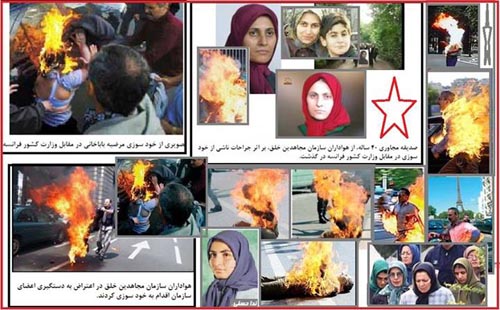
The level of devotion expected of members was [on] stark display in 2003 when the French police arrested Maryam Rajavi in Paris. In protest, ten MKO members and sympathizers set themselves on fire in various European cities; two of them subsequently died.”
The rights group also reported “mass divorces” as a result of leadership’s “ideological revolution.” MEK told members it would enhance their “capacity for struggle.” Celibacy is likewise mandatory.

Human rights abuses carried out by [MEK] leaders against dissident members ranged from prolonged incommunicado and solitary confinement to beatings, verbal and psychological abuse, coerced confessions, threats of execution, and torture.”

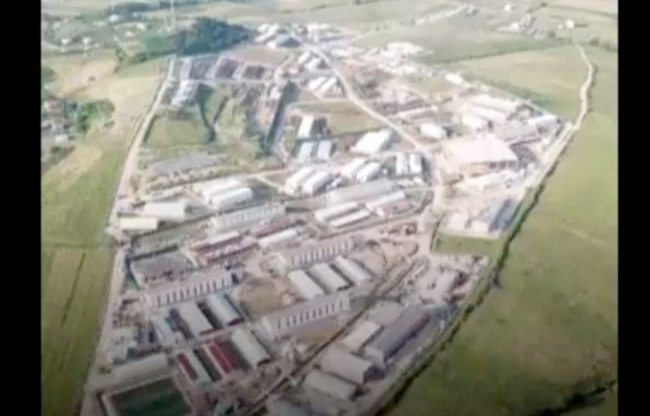
Today, the MEK is constructing a massive compound in Tirana, Albania. A former head of Albanian military intelligence told Channel 4 he thought they were trying to build “a state within a state.”

The outlet reported that Albania agreed to allow the camp to be set up in order to earn itself additional support from the United States. The report contains the story of one couple from Canada who say their daughter was kidnapped 20 years ago by the group and who traveled to Albania to find her. The MEK social-media troll said there was “forced public confession about any thoughts about sex,” every night. Another said he was tortured for 45 days. The journalist behind the report was repeatedly harassed by MEK and its Albanian private security on camera.
A separate report, in LobeLog, states:

“One journalist confessed to me he felt afraid in his own country when the MEK, accompanied by hired armed Albanian security personnel, followed him. In a public space, they photographed him and made verbal threats, demanding that he hand over his phone on which he had earlier filmed activity outside the MEK camp gate.”

These horrifying anecdotes are apparently of little concern to former Sen. Torricelli, who lobbied to have the group removed from the U.S. terrorist list. “To those of you in Tirana, thank you for being who you are: the point of the spear in the effort for Iranian freedom,” he told the MEK crowd in D.C. on Friday.

Media downplay the MEK
It appears that the horror stories from MEK compounds from Europe to the Middle East are also of little concern to the D.C. press corps. Multiple journalists tweeted about the events in manners clearly designed to manufacture a pro-war consensus. Reuters’ White House reporter Steve Holland and Eamon Javers, Washington correspondent for CNBC, offered no context on the group, thereby presenting the pro-regime change cultists as ordinary, concerned, Iranian-Americans.
NBC News White House Correspondent Kelly O’Donnell called the group “pro-democracy protesters seeking Iran regime change.” She eventually deleted the tweet without offering an explanation.
But despite the correspondent’s likely realization of the complete failure in her characterization, the report from NBC News that aired on its local affiliate made no mention of the MEK, yet somehow managed to regurgitate MEK’s inflated claim that it had “thousands” of protesters who attended, when it was clearly far less. The report even concluded with an unsourced claim:
I am told this march and rally was seen in Iran because of live coverage streamed over the internet. Reporting from the White House, Chris Gordon, News 4.”
The report was also tilted “US-Iran Tensions Trigger Protests in DC.” The headline gives the impression that the MEK was protesting in response to recent escalations, when its protest had in fact been long planned to mark the anniversary of a major protest held by the group in Tehran decades ago.

But when CodePink decided to have its own rally out in front of the White House — a feat organized in just three days — calling for an end to sanctions on Sunday, the media virtually ignored it save for a handful of independent reporters.

The MEK’s influence operation in the United States is monied and arguably successful. The cult has the backing of a number of Trump administration officials and allies, current and former members of Congress, and the establishment media. As they say, politics makes strange bedfellows. When it comes to the overthrow of a sovereign foreign government, it seems they are made even with those who are not allowed to keep bedfellows.

by Alexander Rubinstein , MintPress News
Alexander Rubinstein is a staff writer for MintPress News based in Washington, DC. He reports on police, prisons and protests in the United States and the United States’ policing of the world.

June 25, 2019 0 comments
FacebookTwitterPinterestWhatsappTelegramSkypeEmail
US Warmonger Hawks
Mujahedin Khalq; A proxy force

RT Analyst was right on the Gulf of Oman tankers incident

Gulf of Oman tankers incident: Attempt to start a war or invitation to resume US-Iran talks?

Thursday’s Gulf of Oman tanker explosions may be exploited to trigger the war between US and Iran, an analyst told RT, adding that the links of Japan and Oman to the incident were no coincidence.
Two oil tankers were rocked by powerful blasts not far from Oman’s shores on Thursday. Little is known about the incident so far, but some reports insist that one of vessels was hit by a torpedo.
“A torpedo does make sense,” Alessandro Bruno of Gulf State Analytics said. “Some torpedoes can be launched by airplanes at a distance, as well as by submarines. Besides, if the tankers had been attacked from above the sea level –by boats– there would’ve been witnesses,” he suggested, but apparently there aren’t any.
Washington accused Iran of the attack, although it didn’t provide any proof. Bruno believes “a number of people could be interested in it, and for a number of reasons.”

The obvious answer is Saudi Arabia and the US or the Iranian opposition group, Mojahedin-e Khalq, which sabotages Iranian government interests and facilities for the past few years.

The tanker explosions “look like a technique that Trump’s national security adviser John Bolton would exploit to cause trouble in Iran and trigger a conflict,” the analyst said, but Donald Trump “might not be prepared to take a dangerous line” as his hawks are pushing for.
After withdrawing the US from the Iranian nuclear deal last year, Donald Trump has been insisting that a new accord –which would also incorporate Tehran’s ballistic missile developments– must be signed. But Iran bluntly refuses to get involved in any negotiations, despite the Americans pressuring it, by sending warships to the Persian Gulf and by tightening sanctions.
Another significant fact that shouldn’t be downplayed is that the provocation occurred on the same day that Japanese Prime Minister Shinzo Abe was visiting Iran, on a first such high-level trip since 1979.
“Japan is one of the countries that has suffered the most from Trump’s sanctions against Iran because it was one of the biggest buyers of Iranian oil,” therefore improved relations between Washington and Tehran are among Tokyo’s core interests. Besides “the two tankers were, apparently, connected to Japan,” he added.
The tankers’ blasts occurring off Oman’s shores may not be a coincidence either. “This country is independent of the crisis [in the Persian Gulf]. Oman has maintained very good relations with Qatar and also has good relations with Iran,” which were both made pariahs by Saudi Arabia and other Arab states. Bruno suggested that both Oman and Japan are interested in US and Iran making a deal and were ready to mediate it.

June 24, 2019 0 comments
FacebookTwitterPinterestWhatsappTelegramSkypeEmail
blank
Mujahedin Khalq; A proxy force

Saudi Intel Chief Pleads With UK to Attack Iran

Tape Shows MKO-Saudi Plot to Attack Tankers

A Saudi intelligence chief pleaded with British authorities to carry out limited strikes against Iranian military targets, just hours after Donald Trump allegedly aborted planned U.S. attacks against the Islamic Republic, a senior UK official has told Middle East Eye.
The intelligence chief was accompanied by Saudi diplomat Adel al-Jubeir on his trip to London, the source said.
Still, the Saudi lobbying efforts fell on deaf ears, according to the source, who spoke on condition of anonymity because of the sensitivity of the subject.
“Our people were skeptical,”the source said, adding that the Saudi official was told a plain”no”in response to the request.
The Saudi official also provided additional intelligence allegedly linking Iran to a recent attack on two oil tankers in the Gulf of Oman, but his British counterparts were”not impressed”with the new evidence.
The British government has already publicly backed the Saudi and American accusation that Tehran is behind the Gulf of Oman attacks.
“I condemn yesterday’s attacks on vessels in the Gulf of Oman. UK’s assessment concludes that responsibility for the attacks almost certainly lies with Iran,”UK Foreign Secretary Jeremy Hunt wrote on Twitter on 14 June.
“These latest attacks build on a pattern of destabilizing Iranian behavior and pose a serious danger to the region.”
According to the British source, the Saudi intelligence chief will head to Jerusalem Al-Quds at the weekend, where he will engage in similar lobbying efforts with Zionist officials and U.S. National Security Adviser John Bolton, an anti-Iran hawk, who will be visiting Occupied Palestine.
On Thursday, Zionist PM Benjamin Netanyahu reiterated his support for Washington against Iran.
Tensions started to rise sharply early in May, as Washington deployed military assets to the Persian Gulf.
Since then, the U.S. has blamed Tehran for a series of strikes in the region, including attacks on four ships off the coast of the United Arab Emirates on 12 May.
Riyadh has also pointed the finger at Iran for an increase in attacks by Yemeni fighters against Saudi Arabia. The kingdom has been locked in a four-year destructive war, which has caused an enormous humanitarian crisis in Yemen.
Saudi Arabia’s Jubeir has denied that Riyadh is trying to draw the U.S. into war with Iran.”That’s ridiculous,”he said in an interview with Sky News on Thursday, when asked about the claim.
“Saudi Arabia has made it very clear that we want to avoid war at all costs, so has the United States, so has the United Arab Emirates.”
But last month, a government-aligned Saudi newspaper called for”surgical strikes”against Iran.
“Our point of view is that they must be hit hard,”an Arab News editorial published on 16 May reads.
“They need to be shown that the circumstances are now different. We call for a decisive, punitive reaction to what happened so that Iran knows that every single move they make will have consequences.”

Collusion With MKO

An unverified audio tape leaked from the Mujahedin-e-Khalq Organization (MKO), a terrorist outfit banned in Iran, purportedly shows that the group colluded with Saudi Arabia in handling the aftermaths of explosions earlier this month on oil tankers near the Persian Gulf waters as the two sides sought to blame Iran for the sabotage activity.

The audio tape published on Iran Front Page on Saturday is a record of a short conversation between a senior MKO member and a sympathizer who are heard coordinating their positions on the June 13 explosions on two tankers in the Sea of Oman, which heightened already simmering tensions between Iran and the United States.

The English translation of the conversation, as provided by an online footage containing the tape, shows head of MKO’s cyber operations Shahram Fakhteh telling the sympathizer, identified as Daei-ul-Eslam, that Saudi Arabia was seeking a follow-up on the case from MKO ringleader Maryam Rajavi.
“In the past week we did our best to blame the (Iranian) regime for the blasts. Saudis have called Sister Maryam (Rajavi)’s office to follow up on the results, (to get) a conclusion of what has been done, and the possible consequences,” Fakhteh is heard saying in the tape.
Daei-ul-Eslam then replies by saying that blaming Iran for the explosions can have various types of consequences for Iran and can even lead to a military operation against the country.
Iran has vehemently denied any role in the attacks on the tankers while major international powers have dismissed a video provided by US alleging that Tehran was behind the explosions.
The MKO has been banned in Iran and around the world for its role in numerous terrorist activities targeting Iranian and foreign nationals.
Removing its decade-long ban on the MKO, the United States has used the group as a tool to pressure Iran over the past years.
Reports have also shown that the Saudi intelligence agency has provided the MKO with vast funding, especially since main elements of the group were purged from their old bastion in Iraq more than a decade ago.
The group launched a demonstration outside U.S. States Department in Washington on Friday calling for a military operation against Iran.
kayhan.ir

June 24, 2019 0 comments
FacebookTwitterPinterestWhatsappTelegramSkypeEmail
blank
Mujahedin Khalq; A proxy force

Leaked Audio Shows Saudi-MKO Collusion over Tanker Attacks

A leaked audio of a phone conversation between two members of the anti-Iran terrorist group, the Mujahedin-e-Khalq Organization, reveals Saudi Arabia has colluded with the MKO elements to frame Iran for the recent tanker attacks in the Persian Gulf.


In the audio, which is being released by the Iran Front Page for the first time, Shahram Fakhteh, an official member and the person in charge of MKO’s cyber operations, is heard talking with a US-based MKO sympathizer named Daei-ul-Eslam in Persian.
In this conversation, the two elements discuss the MKO’s efforts to introduce Iran as the culprit behind the recent tanker attacks in the Persian Gulf, and how the Saudis contacted them to pursue the issue.

“In the past week we did our best to blame the [Iranian] regime for the [oil tanker] blasts. Saudis have called Sister Maryam [Rajavi]’s office to follow up on the results, [to get] a conclusion of what has been done, and the possible consequences,”

Fakhteh is heard saying.

“I guess this can have different consequences. It can send the case to the UN Security Council or even result in military intervention. It can have any consequence,”

Daei-ul-Eslam says.
Attacks on two commercial oil tankers in the Gulf of Oman on June 13, and an earlier attack on four oil tankers off the UAE’s Fujairah port on May 12, have escalated tensions in the Middle East and raised the prospect of a military confrontation between Iran and the United States.
The US, Saudi Arabia, and the UAE have rushed to blame Iran for the incidents, with the US military releasing a grainy video it claimed shows Iranian forces in a patrol boat removing an unexploded mine from the side of a Japanese-owned tanker which caught fire earlier this month.
It later released some images of the purported Iranian operation after the video was seriously challenged by experts and Washington’s own allies.
The MKO which has assassinated over 17,000 Iranians receives support from the US and its allies in the region, including Saudi Arabia.
The MKO which is said to be a cult which turns humans into obedient robots, turned against Iran after the 1979 Revolution and has carried out several terrorist attacks killing senior officials in Iran; yet the West which says cultism is wrong and claims to be against terrorism, supports this terrorist group officially.
After the Islamic Revolution in 1979, the MKO began its enmity against Iran by killings and terrorist activities.
By IFP Editorial Staff

June 23, 2019 0 comments
FacebookTwitterPinterestWhatsappTelegramSkypeEmail
Medea Benjamin at the State Department
Mujahedin Khalq Organization's Propaganda System

Take a stroll with Codepink through the MEK Washington Rally

No war with Iran

Medea Benjamin and the Code Pink group members presented outside the State Department to counter the MEK warmongers rally.
They stated the American people’s unwillingness towards the sanctions and a regime change wars with Iran:

DC June 21: State Department Petition Delivery and Protest
Event Description

Join CODEPINK as we head to the State Department to tell Secretary of State Mike Pompeo, if he wants genuine good faith talks with Iran, he must lift economic sanctions and end the threat of war.

After we hand in our petition, we will be outside of the State Department calling for no sanctions and no war with Iran to counter the Mujahideen-e-khalq’s (MEK) rally. The MEK are an exiled Iranian cult group, who have little to no support inside of Iran because of the alliance it had with Iraqi leader Saddam Hussein during the Iraq-Iran war, which killed thousands of Iranians. The group supports brutal sanctions and regime change in Iran. Despite having been previously listed as a terrorist organization in the U.S., the MEK has cultivated close ties with members of the Trump administration having paid $140,000 in speaking fees to National Security Advisor John Bolton

We will be outside the MEK rally at the U.S. State Department to show our presence that the American people are against sanctions and a regime change wars with Iran.
Codepink.org

June 23, 2019 0 comments
FacebookTwitterPinterestWhatsappTelegramSkypeEmail
blank
Mujahedin Khalq Organization's Propaganda System

The American Journalist on the MEK Washington DC rally

The American author, journalist, and blogger “Max Blumenthal” working as the editor at the Grayzone Project and Co-host of Moderate Rebels published a wide range of tweets to denounce the “rent – a crowd” MEK rally at Washington DC:

Shout out to my personal MEK media minder from the cult’s rally today at the State Department.
This guy was part of the team tasked with preventing me from interviewing any of the Iranian emigres bussed in to cheer for regime change:

June 22, 2019 0 comments
FacebookTwitterPinterestWhatsappTelegramSkypeEmail
blank
Mujahedin Khalq as an Opposition Group

MEK misusing media to push for war

Filings reveal Iranian dissident group’s foreign influence operation to push for regime change

Tensions between the United States and Iran are rising to a fever pitch following the downing of an American drone Wednesday by Iran’s Revolutionary Guard over the Strait of Hormuz. It comes less than a week after an attack on two tankers purportedly conducted by Iran.

Iran has declared that although it does not want conflict, it is “ready for war.” Hawkish voices in the U.S. have called for aggressive action as top military leaders review plans for a possible confrontation.

As both nations move closer to the brink of war, the National Council of Resistance of Iran, a little-known advocacy group determined to install itself as the new government of Iran, continues to build a powerful influence network in Washington and beyond.

Recent documents in accordance with the Foreign Agents Registration Act reveal that the council, the political arm of opposition group Mujahedeen Khalq or MEK, has been hosting opulent events at the National Press Club and elsewhere, publicizing itself through national and international media, and meeting with dozens of current and former government officials, all with the end goal of toppling the current Iranian government and rising to power in its place.

OpenSecrets previously reported on the MEK’s deep ties to National Security Advisor John Bolton and other voices currently agitating for war against Iran. The new documents reveal the extent to which the dissident group is using media and its vast array of prominent supporters to push the national discourse toward confrontation.

The council of resistance either submitted or was quoted in 51 media pieces between December 2018 and May 2019, according to FARA filings. These pieces were concentrated in right-leaning media outlets such as Fox News, The Washington Times, The Washington Examiner and NewsMax.

Throughout their appearances, the organization stood firm behind dubious claims that Iran is currently carrying out assassinations in Europe and the U.S., an assertion widely rejected by experts. The rhetoric, based on Dutch intelligence reports that two Iranian dissidents were murdered by Tehran in 2015 and 2017, portrays the threat as dire and immediate, including calling for all Iranian embassies in Europe to be shut down in May.

The group also continued to meet with a number of major former government officials, including James Jones, who served as Barack Obama’s national security advisor from 2009 to 2010, and Tom Ridge, the first Secretary of Homeland Security.

The council has been building a war chest of prominent advocates to justify its mission to the public and to national and international political communities, including Bolton, former New York City Mayor Rudy Giulliani, former Speaker of the House Newt Gingrich, former Attorney General Michael Mukasey and former U.N. Ambassador Bill Richardson.

Some of these individuals were investigated by the Treasury Department in 2012 for accepting significant speaking fees from the MEK, which was, at the time, still designated by the federal government as a terrorist organization. The investigation ultimately dissipated after the group was de-listed as a terrorist organization later that same year following a multi-million dollar lobbying blitz.

The group continues to organize public protests, rallies and speeches claiming to represent the Iranian people, even though the group is reportedly “widely despised” within Iran and has been exiled from the country for decades. The group spoke with several U.S. senators on Nowruz (Persian New Year) in March and received the backing of two sitting senators, John Boozman (R-Ark.) and Jeanne Shaheen (D-N.H.).

Standing between two Iranian flags emblazoned with the MEK’s golden lion insignia, Boozman told the group, “We are committed to helping you in any way that we can.”

Boozman and Shaheen aren’t the only members of Congress to have publicly backed the MEK Sen. Tom Cotton (R-Ark.), who has repeatedly called for launching a first strike on Iran, spoke at a 2015 meeting of the Organization of Iranian American Communities, an advocacy group closely aligned with the MEK.

Two other senators, Thom Tillis (R-N.C.) and Roy Blunt (R-Mo.), flew to Albania in 2017 to meet with the MEK’s leader Maryam Rajavi and wish her group “success in their struggle for democracy and human rights in Iran.”

Supporters of the MEK claim that Rajavi will usher in a secular democratic state in the place of the current theocratic regime. They champion her stated commitment to free-market capitalism and promises to modernize the nation.

The council was founded in the early 1980s as the political front of the MEK, which itself was started by self-described Marxist Iranian students in 1965. Initially fighting with other opposition groups to take down the Shah in the 1979 Iranian Revolution, the group soon came into conflict with the new Ayatollah Khomeini’s government, with members of the MEK eventually killing the Iranian president and prime minister in 1981.

They later fought alongside Saddam Hussein’s Iraq in the 1980 Iran-Iraq war and into the 1990s and early 2000s against Iraqi Shiites, Kurds and Americans. They have been blamed for the deaths of thousands of Iraqi soldiers and at least six American citizens.

The group plans to demonstrate in front of State Department headquarters in D.C. on Friday in a protest dubbed “March 4 Regime Change by Iranians” by social media supporters and closely-aligned groups, including OIAC. OIAC has been spending to amplify the march with more than $300 going to Facebook ads in the days leading up to the event and multiple tweets promoting the demonstration on Twitter, but the amount of that spending is unknown since OIAC is not on the list of issue advertisers tracked by Twitter’s Ads Transparency Center.

By Reid Champlin , OpenSecrets News 

June 22, 2019 0 comments
FacebookTwitterPinterestWhatsappTelegramSkypeEmail
Newer Posts
Older Posts

Recent Posts

  • The black box of the torture camps of the MEK

    December 24, 2025
  • Pregnancy was taboo in the MEK

    December 22, 2025
  • MEPs who lack awareness about the MEK’s nature

    December 20, 2025
  • Why did Massoud Rajavi enforce divorces in the MEK?

    December 15, 2025
  • Massoud Rajavi and widespread sexual abuse of female members

    December 10, 2025
  • Facebook
  • Twitter
  • Instagram
  • Youtube

© 2003 - 2025 NEJAT Society . All Rights Reserved. NejatNGO.org


Back To Top
Nejat Society
  • Home
  • Articles
  • Media
    • Cartoons
    • NewsPics
    • Photo Gallery
    • Videos
  • Publications
    • Books
    • Nejat NewsLetter
    • Pars Brief
  • About Us
  • Contact us
  • Editions
    • عربي
    • فارسی
    • Shqip